
Hot Rolled Coil Steel Market Size and Share
Market Overview
| Study Period | 2021 - 2031 |
|---|---|
| Market Size (2026) | USD 223.51 Billion |
| Market Size (2031) | USD 290.59 Billion |
| Growth Rate (2026 - 2031) | 5.39 % |
| Fastest Growing Market | Asia-Pacific |
| Largest Market | Asia-Pacific |
| Market Concentration | Low |
Major Players *Disclaimer: Major Players sorted in no particular order Image © Mordor Intelligence. Reuse requires attribution under CC BY 4.0. | |
Hot Rolled Coil Steel Market Analysis by Mordor Intelligence
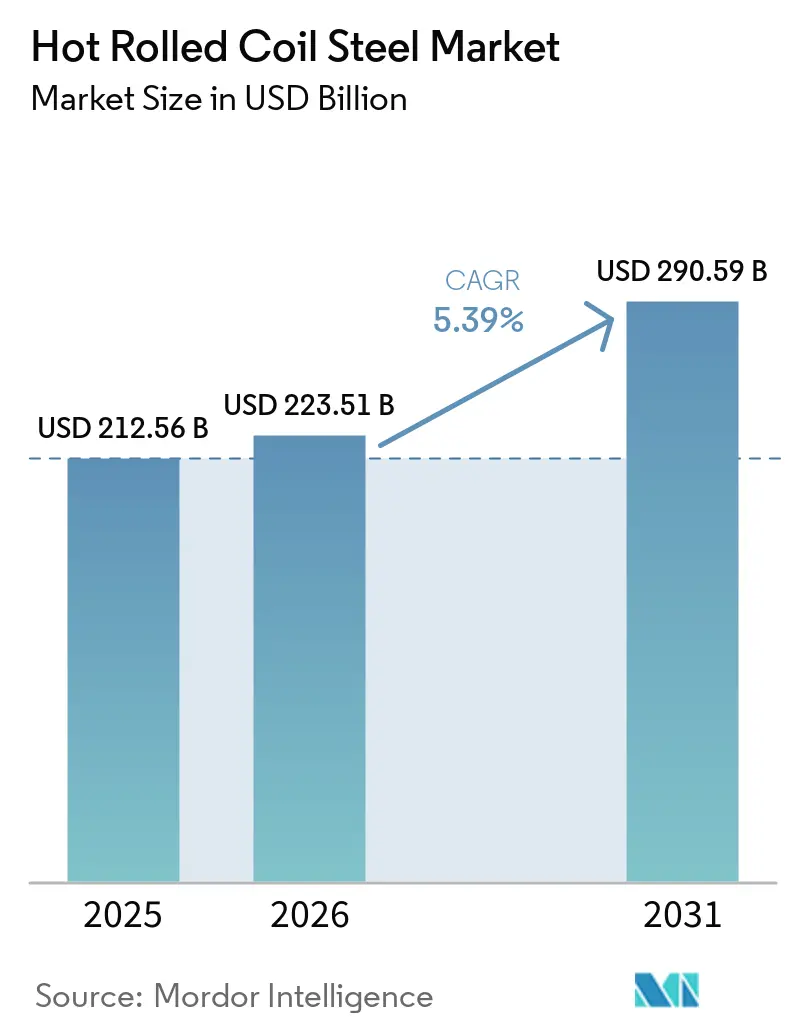
The hot rolled coil steel market size was valued at USD 212.56 billion in 2025 and is estimated to grow from USD 223.51 billion in 2026 to reach USD 290.59 billion by 2031, at a CAGR of 5.39% during the forecast period (2026-2031). Infrastructure renewal, utility modernization, and industrial construction are simultaneously driving demand across multiple regions. Renewable energy projects and power grid investment are also increasing demand for certified heavy-gauge coil. Automotive producers are adopting more advanced grades in electric vehicle structures and battery protection components. Competition is shifting toward traceability, carbon intensity, and specialized grades, although low-priced Chinese exports continue to pressure margins in many import markets.
Key Report Takeaways
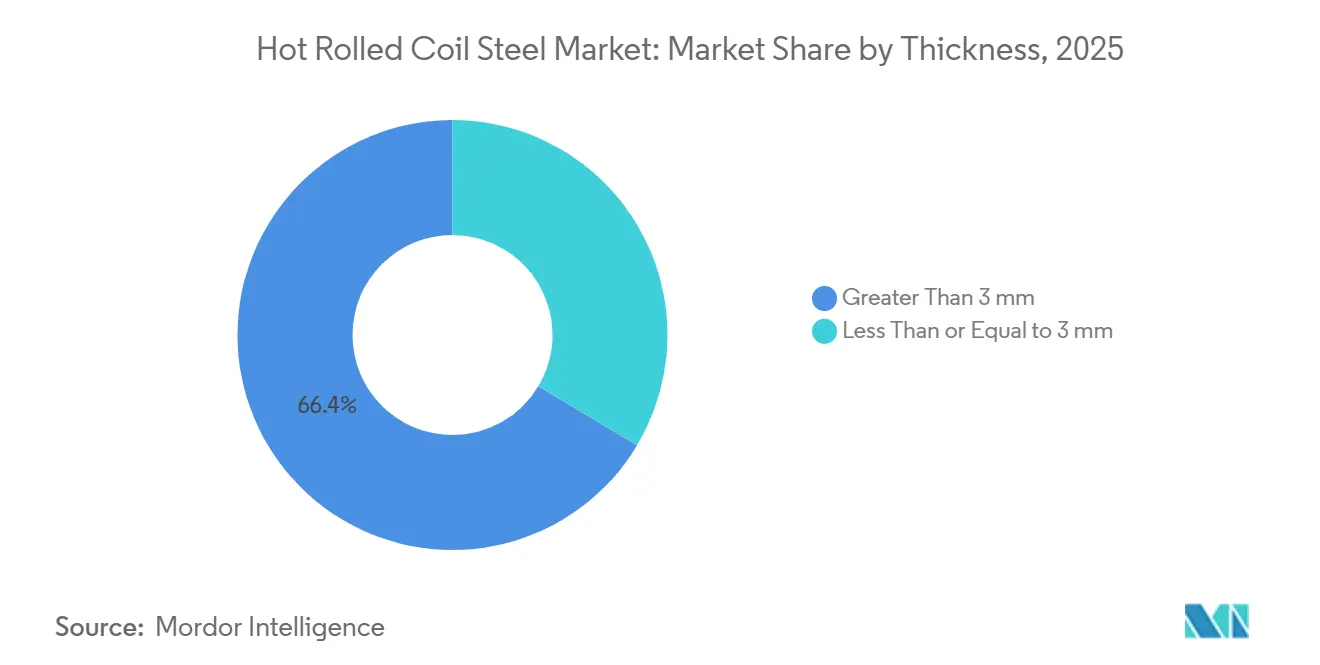
- By thickness, grades greater than 3 mm accounted for 66.43% of the hot rolled coil steel market share in 2025, and this category is projected to grow at a 5.67% CAGR through 2031.
- By steel grade, low-carbon steel accounted for 55.06% of the hot rolled coil steel market share in 2025, while high-carbon steel is forecast to record a 5.88% CAGR through 2031.
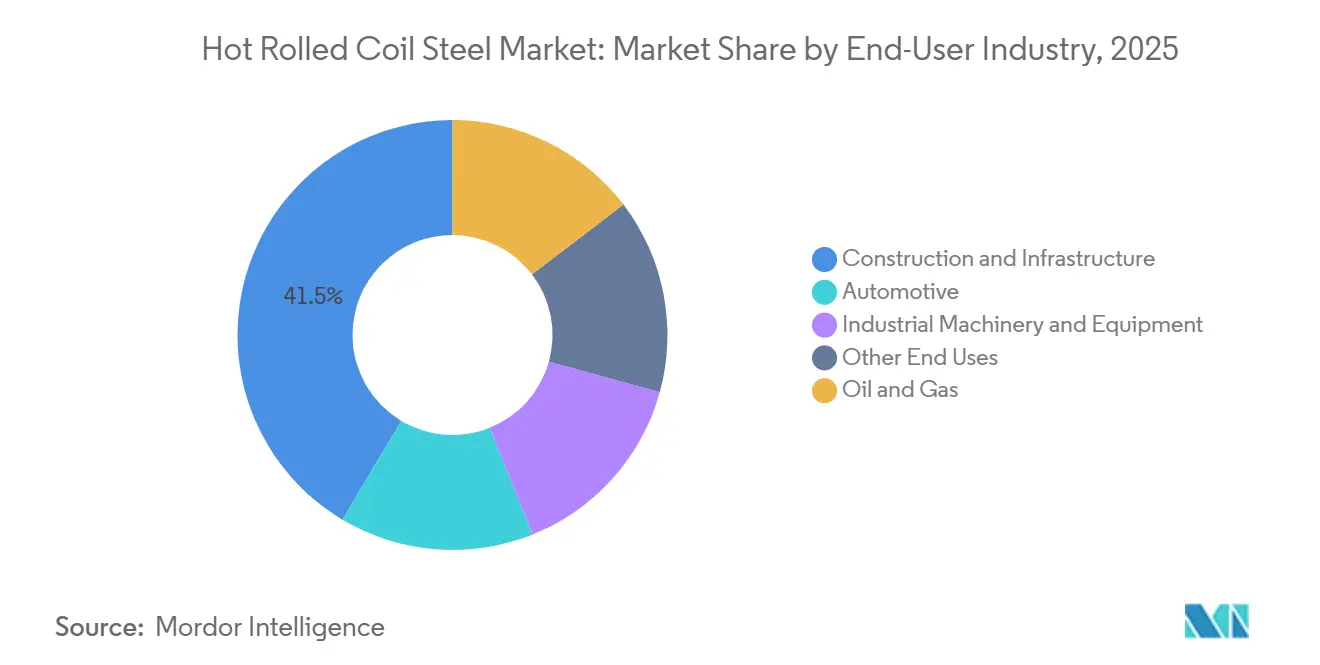
- By end-user industry, construction and infrastructure accounted for 41.45% of the hot rolled coil steel market share in 2025, while automotive is forecast to grow at a 6.35% CAGR through 2031.
- By geography, Asia-Pacific accounted for 52.17% of the hot rolled coil steel market share in 2025 and is forecast to expand at a 6.14% CAGR through 2031.
Note: Market size and forecast figures in this report are generated using Mordor Intelligence’s proprietary estimation framework, updated with the latest available data and insights as of January 2026.
Global Hot Rolled Coil Steel Market Trends and Insights
Drivers Impact Analysis*
| Drivers | (~) % Impact on CAGR Forecast | Geographic Relevance | Impact Timeline |
|---|---|---|---|
| Infrastructure Renewal and Public-Utility Modernization | +1.4% | Global, with core gains in South Asia, ASEAN, North America, and Africa | Medium term (2-4 years) |
| Automotive Lightweighting and Electric Vehicle Production | +0.9% | North America, Europe, East Asia, including Japan, South Korea, China, and India | Long term (≥ 4 years) |
| Manufacturing Expansion and Industrial Equipment Demand | +0.8% | Global, with the highest concentration in India, ASEAN, and North America | Medium term (2-4 years) |
| Energy-Transition Infrastructure and Grid Investment | +1.2% | Global, concentrated in China, the European Union, India, and Australia | Long term (≥ 4 years) |
| Application-Specific Certification and Traceability Requirements | +0.5% | European Union and North America, with spillover to export-oriented Asia-Pacific mills | Short term (≤ 2 years) |
| Source: Mordor Intelligence | |||
Infrastructure Renewal and Public-Utility Modernization
Public infrastructure spending is supporting demand in economies that account for a large share of global hot rolled coil consumption. India's crude steelmaking capacity reached 222 million tons per annum (MTPA) by June 2026, while the National Steel Policy targets 300 MTPA by 2030. Finished steel consumption in India grew by 8.3% in the April to June 2026 quarter, driven by progress in roads, ports, railways, and housing programs. Data centers and related digital infrastructure are adding steel requirements beyond conventional construction. Saudi Arabia's Vision 2030-linked steel demand grew 11.5% in 2025, supported by advances in transport, urban, and energy projects.
Automotive Lightweighting and Electric Vehicle Production
The automotive transition is increasing demand for specialty hot rolled coil grades rather than reducing steel's role in vehicle production. Electric vehicles accounted for 15% of U.S. light-vehicle output in 2025, driving demand for battery enclosures, motor housings, and underbody parts. Aluminum megacasting remains selective due to high capital requirements, manufacturing risk, and a demanding learning curve. Advanced high-strength steel retains a cost-and-performance advantage in crash-critical chassis and underbody components. Hyundai Steel completed the development of third-generation advanced high-strength steel in February 2026 and is conducting customer trials. Thirteen of 18 major automakers had low-carbon steel procurement policies in place in 2026, supporting demand for traceable and certified coil.
Manufacturing Expansion and Industrial Equipment Demand
Manufacturing investment in India, Southeast Asia, and North America is generating additional demand outside normal construction cycles. The World Steel Association projected Indian steel demand growth of 7.4% in 2026, reflecting activity in capital goods, vehicles, and consumer durables. Vietnam's crude steel production rose 27.2% year over year in May 2026, as the country expanded its role as a regional manufacturing hub[1]World Steel Association, “May 2026 Crude Steel Production,” worldsteel.org.. The hot rolled coil steel market benefits when factories require machinery, structural parts, and processing equipment. Nucor struck the first arc at its West Virginia sheet mill in August 2026, with commercial shipments expected in early 2027. Industrial zone development in the Middle East and Africa is also raising demand for hydraulic equipment, farm machinery, and process plant fabrication.
Energy-Transition Infrastructure and Grid Investment
Renewable power installations are a significant source of demand for hot rolled flat steel. China added more than 100 GW of wind capacity in 2025, bringing its cumulative installed base to 640 GW. Wind towers and foundations require 200 to 300 tons of steel per MW of new capacity. The European Union's Clean Industrial Deal targets 100 GW of annual renewable capacity additions through 2030. Australia committed USD 500 million through the Future Made in Australia Innovation Fund and a further USD 3 billion through the National Reconstruction Fund for relevant fabrication capacity. Solar structures use thinner standard coil, while wind towers and transmission assets require certified heavy-gauge material that fewer mills can produce consistently.
Restraints Impact Analysis*
| Restraints | (~) % Impact on CAGR Forecast | Geographic Relevance | Impact Timeline |
|---|---|---|---|
| Iron Ore, Coking Coal, Scrap, and Energy Price Volatility | -0.7% | Global, particularly acute for mills in India, Europe, and the Middle East | Short term (≤ 2 years) |
| Substitution by Aluminum, Composites, and Engineered Wood | -0.4% | North America and Europe, especially the premium and battery electric vehicle segments | Long term (≥ 4 years) |
| Mill Outages, Allocation Risk, and Extended Lead Times | -0.2% | North America and Europe | Short term (≤ 2 years) |
| Source: Mordor Intelligence | |||
Iron Ore, Coking Coal, Scrap, and Energy Price Volatility
Raw material costs are compressing producer margins across the hot rolled coil steel market. Premium hard coking coal averaged USD 236 per metric ton FOB Australia in the first seven months of 2026, up 25% year over year. A fatal mine accident in Shanxi idled 50 metric tons per annum (MTPA) of domestic Chinese supply, while labor negotiations at Port Hedland tightened seaborne supply conditions. Fitch raised its 2026 coking coal forecast to USD 220 per metric ton and projected iron ore to average USD 100 per dry metric ton. Chinese integrated producers can absorb shocks more readily than independent mills due to scale, policy support, and access to domestic ore. Mill outages, allocation risk, and extended lead times add further short-term pressure in North America and Europe.
Substitution by Aluminum, Composites, and Engineered Wood
Material substitution remains a constraint in certain automotive and construction applications, although aggregate displacement is currently limited. BYD introduced the Yangwang U8L with an aerospace-grade aluminum alloy frame produced through low-pressure casting. Aluminum automotive sheet costs five times as much as steel automotive sheet on a conversion-cost basis. A late-2025 fire at Novelis' Oswego mill exposed supply risk for automotive aluminum and disrupted Ford production. Platform design choices made now can determine material use for six to eight years. Press-hardened steel and third-generation advanced high-strength steel remain important options where crash performance is required.
*Our forecasts treat driver/restraint impacts as directional, not additive. The impact forecasts reflect baseline growth, mix effects, and variable interactions.
Segment Analysis
By Thickness: Heavy-Gauge Grades Anchor Structural Demand
Grades greater than 3 mm held 66.43% of the hot rolled coil steel market in 2025. Their application in structural beams, heavy plate, wind-tower sections, and industrial machinery supports this position. Construction and infrastructure projects in India, ASEAN, Saudi Arabia, and North America provide consistent demand for this category. Heavy-gauge grades also meet the material requirements of utility and renewable energy infrastructure. Their broad base of applications gives producers a relatively stable source of output.
Grades of 3 mm or less are used in automotive stamping, light fabrication, and appliance manufacturing. These products allow material savings and precision forming where heavier coil is less suitable. The European Commission's Implementing Regulation 2026/1963 takes effect on October 1, 2026, requiring country-of-melt-and-pour evidence for imported steel. From October 1, 2027, this evidence requirement becomes mandatory in all cases. Grades greater than 3 mm are forecast to grow at a 5.67% CAGR through 2031. Documentation requirements are likely to favor mills with established EN 10204-compliant quality systems.



By Steel Grade: Low-Carbon Steel Leads by Output, High-Carbon Grades Record Faster Growth
Low-carbon steel accounted for 55.06% of the hot rolled coil steel market in 2025. Its affordability and formability make it the common specification for structural uses in price-sensitive emerging markets. The grade remains important for broad construction demand and basic fabrication. India's green steel taxonomy introduced a star-rating system for certified low-carbon hot rolled coil. ArcelorMittal Nippon Steel India received a 4-star rating for hot rolled coil, becoming the first integrated producer to achieve this. Certification is adding a quality distinction to a category that has traditionally competed mainly on price.
High-carbon steel is projected to see the fastest growth, at a 5.88% CAGR through 2031. Demand comes from press-hardened, wear-resistant, and spring steel products used in vehicles and mining. Third-generation advanced high-strength steel uses a high-carbon matrix to achieve higher strength-to-weight performance. Hyundai Steel's customer trials indicate that vehicle specifications are shifting toward grades that require qualified production routes. Medium-carbon steel is used in industrial machinery, farm equipment, and infrastructure hardware where machinability and moderate strength are required. Other steel grades, including special alloy and micro-alloyed material, support energy applications such as X-grade pipeline and tower steel.
By End-User Industry: Construction Dominates but Automotive’s Ascent Reshapes the Mix
Construction and infrastructure held 41.45% of the hot rolled coil steel market in 2025. Large projects across multiple regions have sustained demand for structural coil and related products. Demand is shifting away from greenfield residential construction in China toward utilities, infrastructure renewal, and data center construction, which require different coil grades and thicknesses. Oil and gas pipe grades remain a stable contributor to Middle East pipeline projects and U.S. energy facility expansion. Industrial machinery demand follows capital-goods investment in India and ASEAN.
Automotive is forecast to grow at a 6.35% CAGR through 2031, the highest rate among end-user industries. Electric vehicle production requires battery enclosures, body-in-white components, and structural underbody parts. Electric vehicle designs may require higher structural and battery-protection grades than comparable internal combustion engine vehicles, shifting the composition of steel demand rather than necessarily reducing steel content per vehicle. Other end uses include shipbuilding and agricultural machinery. South Korea's shipbuilding program and the U.S. maritime action plan support steel-intensive vessel fabrication.
Geography Analysis
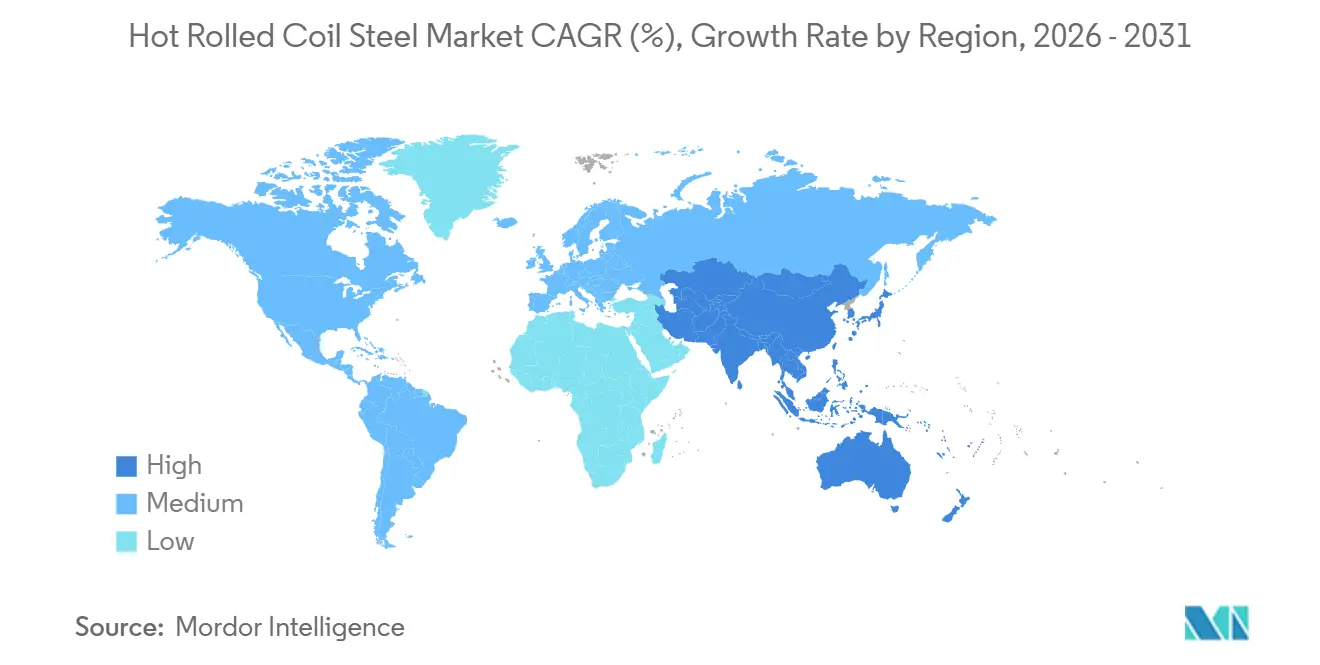
Asia-Pacific accounted for 52.17% of the hot rolled coil steel market share in 2025 and is projected to grow at a 6.14% CAGR through 2031. India's finished steel consumption grew 8.3% in the April to June 2026 quarter, while capacity reached 222 million tons per annum (MTPA). China's hot rolled coil capacity reached 410 million tons by the end of 2025, up from 300 million tons in 2020. China exported 119 million tons of steel in 2025, an increase of 7.5%, and early-2026 free-on-board (FOB) hot-rolled coil prices were USD 460 per ton. Vietnam's crude steel output grew 27.2% in May 2026, reflecting its expanding manufacturing role.
North America and Europe are undergoing a structural transition. Infrastructure spending, a recovery in residential construction, and additions to electric arc furnaces are reshaping the U.S. supply position. In January 2026, U.S. hot rolled coil prices were more than twice Chinese prices, while European Union prices were 50% higher[2]OECD, “Steel Market and Industry Prospects: OECD Steel Outlook 2026,” OECD Publishing, oecd.org.. The European Union Carbon Border Adjustment Mechanism became fully operational in January 2026, raising the effective cost of carbon-intensive imported coil and favoring domestic or low-carbon supply.
Brazil's infrastructure activity and Argentina's resource projects support regional demand, although imports continue to pressure local mills. Africa recorded 16.1% growth in steel demand in 2025, while the Middle East recorded 6.4% growth. Egypt's flat steel consumption is forecast to grow 1.8% in 2026, supported by the 900 MW Ras Shokeir offshore wind project. XinFeng Steel is pursuing a USD 10 billion integrated complex in Egypt's Suez Canal Economic Zone with a capacity of 10 MTPA. These developments indicate the region's shift from import dependence toward greater domestic production.

Competitive Landscape
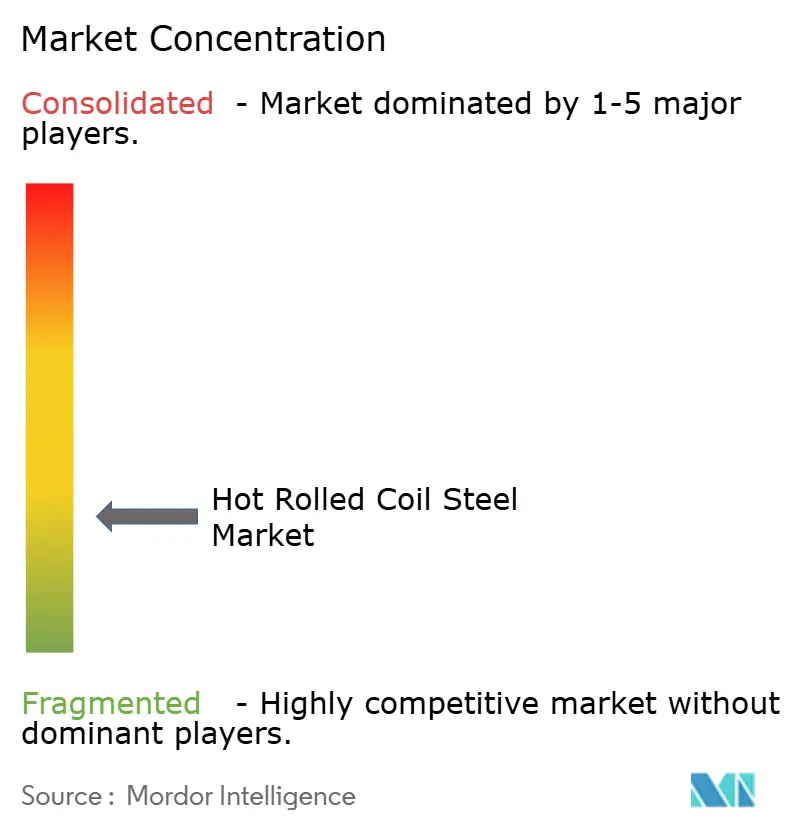
The hot rolled coil steel market is fragmented. China Baowu Steel Group, ArcelorMittal, POSCO, Nippon Steel, and HBIS Group control a significant share of global output. Greenfield projects in India and electric arc furnace sheet-mill additions in North America are expanding the competitive base. JSW Steel's FY26 crude steel output rose 8% to 30.14 million tons. Its joint venture with POSCO involves a 6 MTPA greenfield facility in Odisha with an investment of USD 7.29 billion. Its partnership with JFE Steel supports a 6 MTPA expansion in Sambalpur.
Certification, carbon intensity, and supply chain traceability are becoming increasingly important competitive factors. The European Union's melt-and-pour documentation rules create a commercial requirement for documented flat-steel supply. The forthcoming Digital Product Passport framework is expected to require information on recycled content, embodied carbon, and production route. Electric arc furnace producers, including Nucor and Steel Dynamics, hold an advantage where buyers factor in embodied emissions. ArcelorMittal confirmed a EUR 1.3 billion (USD 1.4 billion) electric arc furnace project at Dunkirk in February 2026. The facility is expected to produce flat steel with 0.6 tons of carbon dioxide per ton of steel, approximately one-third of the emissions from a conventional blast-furnace route.
High-specification wear-resistant and spring steel grades remain an area where few producers meet demanding certified quality standards. JFE Steel and Nippon Steel have established capabilities in precision rolling and heat treatment. Chinese hot rolled coil exports priced at USD 460 per ton FOB in early 2026 continued to pressure margins for mid-tier mills. Producers with access to capital, captive raw materials, or premium product niches are better positioned to withstand this pressure. Capacity investment is therefore concentrated among mills with clear product or cost advantages. The competitive environment remains open to new capacity, but scale and certification are increasingly necessary for profitable participation.
Hot Rolled Coil Steel Industry Leaders
BAOWU Metal
ARCELORMITTAL
NIPPON STEEL CORPORATION
POSCO
HBIS GROUP
- *Disclaimer: Major Players sorted in no particular order

Recent Industry Developments
- August 2026: Nucor Corporation struck the first arc in the electric arc furnace at its USD 4 billion, 3 MTPA sheet mill in Apple Grove, West Virginia, marking the beginning of commissioning for the largest new hot rolled coil (HRC) capacity addition in North America in a decade; commercial shipments are expected to begin ramping in early 2027.
- July 2026: JSW Steel commenced construction of a 2 MTPA integrated steel plant in Kadapa, Andhra Pradesh, through subsidiary JSW Rayalaseema Steel Ltd, with a total planned investment of INR 16,350 crore (USD 1.94 billion) at 2026 average exchange rates, and Phase 1 targeting low-carbon flat steel products.


Global Hot Rolled Coil Steel Market Report Scope
A hot rolled metal product formed by heating steel slabs above 1,700°F (900°C) and passing them through heavy rollers before winding them into large rolls. The process involves reducing the thickness of the steel slab while increasing its length and width, resulting in a coiled product that is widely used across industries such as automotive, construction, and manufacturing.
The hot rolled coil steel market is segmented by thickness, steel grade, end-user industry, and geography. By thickness, the market is segmented into less than or equal to 3 mm and greater than 3 mm. By steel grade, the market is segmented into low-carbon steel, medium-carbon steel, high-carbon steel, and others. By end-user industry, the market is segmented into construction and infrastructure, oil and gas, automotive, industrial machinery and equipment, and other end uses. The report also covers market size and forecasts for hot rolled coil steel across 16 countries in major regions. The market sizes and forecasts are provided in terms of value (USD).
| Less Than or Equal to 3 mm |
| Greater Than 3 mm |
| Low-Carbon Steel |
| Medium-Carbon Steel |
| High-Carbon Steel |
| Others |
| Construction and Infrastructure |
| Oil and Gas |
| Automotive |
| Industrial Machinery and Equipment |
| Other End Uses |
| Asia-Pacific | China |
| India | |
| Japan | |
| South Korea | |
| ASEAN Countries | |
| Rest of Asia-Pacific | |
| North America | United States |
| Canada | |
| Mexico | |
| Europe | Germany |
| United Kingdom | |
| France | |
| Italy | |
| NORDIC Countries | |
| Russia | |
| Rest of Europe | |
| South America | Brazil |
| Argentina | |
| Rest of South America | |
| Middle East and Africa | Saudi Arabia |
| South Africa | |
| Rest of Middle East and Africa |
| By Thickness | Less Than or Equal to 3 mm | |
| Greater Than 3 mm | ||
| By Steel Grade | Low-Carbon Steel | |
| Medium-Carbon Steel | ||
| High-Carbon Steel | ||
| Others | ||
| By End-User Industry | Construction and Infrastructure | |
| Oil and Gas | ||
| Automotive | ||
| Industrial Machinery and Equipment | ||
| Other End Uses | ||
| By Geography | Asia-Pacific | China |
| India | ||
| Japan | ||
| South Korea | ||
| ASEAN Countries | ||
| Rest of Asia-Pacific | ||
| North America | United States | |
| Canada | ||
| Mexico | ||
| Europe | Germany | |
| United Kingdom | ||
| France | ||
| Italy | ||
| NORDIC Countries | ||
| Russia | ||
| Rest of Europe | ||
| South America | Brazil | |
| Argentina | ||
| Rest of South America | ||
| Middle East and Africa | Saudi Arabia | |
| South Africa | ||
| Rest of Middle East and Africa | ||


Key Questions Answered in the Report
What is current market size of Hot Rolled Coil Steel Market?
The hot rolled coil steel market size was valued at USD 212.56 billion in 2025 and is estimated to grow from USD 223.51 billion in 2026 to reach USD 290.59 billion by 2031, at a CAGR of 5.39% during the forecast period (2026-2031).
Which thickness category leads hot rolled coil steel demand?
Greater than 3 mm grades held a 66.43% share in 2025 and are forecast to grow at a 5.67% CAGR through 2031.
Why is automotive demand rising for hot rolled coil steel?
Electric vehicles require specialized battery enclosures, body structures, and underbody components, helping the automotive industry grow at a 6.35% CAGR through 2031.
Which region has the largest demand base for hot rolled coil steel?
Asia-Pacific held a 52.17% share in 2025 and is forecast to grow at a 6.14% CAGR through 2031.
Page last updated on:





