
High-temperature Thermoplastic Market Size and Share
Market Overview
| Study Period | 2020 - 2031 |
|---|---|
| Market Size (2026) | USD 28.27 Billion |
| Market Size (2031) | USD 41.47 Billion |
| Growth Rate (2026 - 2031) | 7.98 % |
| Fastest Growing Market | Asia Pacific |
| Largest Market | Asia Pacific |
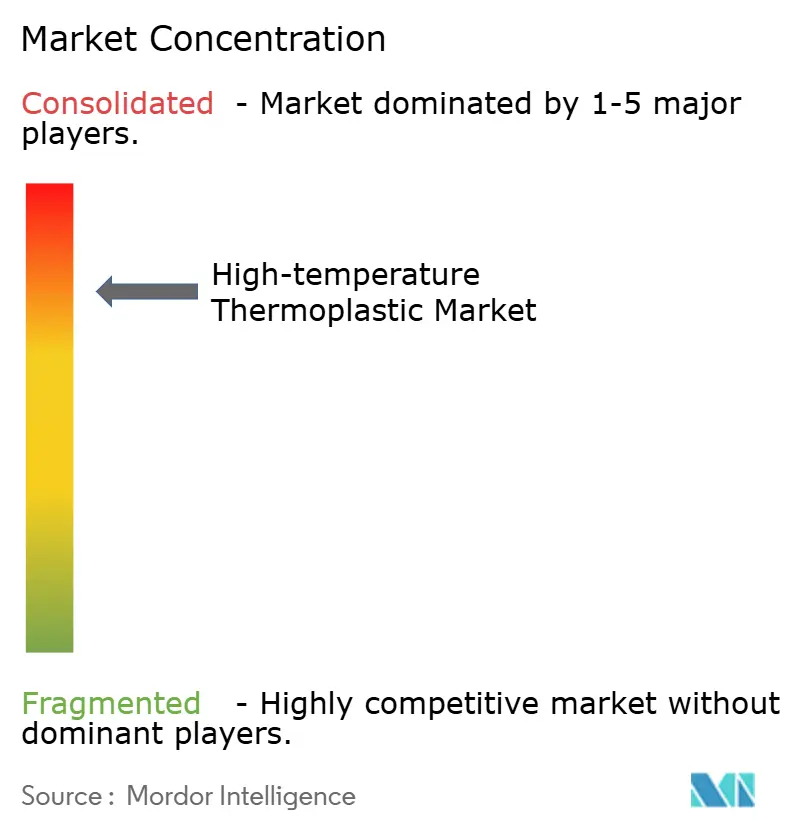
| Market Concentration | High |
Major Players *Disclaimer: Major Players sorted in no particular order Image © Mordor Intelligence. Reuse requires attribution under CC BY 4.0. | |
High-temperature Thermoplastic Market Analysis by Mordor Intelligence
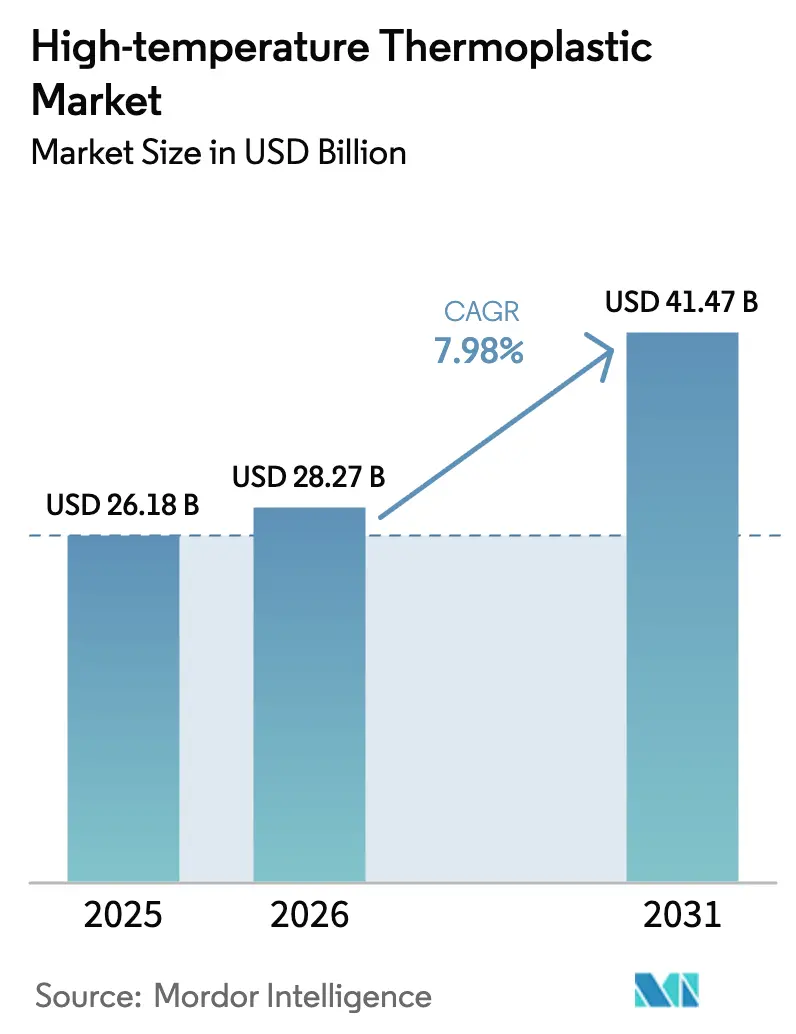
High-temperature Thermoplastic market size in 2026 is estimated at USD 28.27 billion, growing from 2025 value of USD 26.18 billion with 2031 projections showing USD 41.47 billion, growing at 7.98% CAGR over 2026-2031. Demand accelerates because these polymers tolerate continuous temperatures above 200 °C while retaining strength, an essential property for electric vehicle batteries, miniaturized electronics, and lightweight aerospace structures. Electrification, 5G roll-outs, and record aircraft build rates combine to pull larger production volumes through the supply chain. Supply-side readiness also improves as key resin producers open additional capacity in Asia-Pacific, shortening lead times for regional converters and original equipment manufacturers. Even so, cost volatility in specialty monomers and energy continues to challenge smaller participants that lack the scale to hedge input swings. The result is a balanced but vibrant industry that rewards technology leadership, regionalized manufacturing, and closed-loop product development.
Key Report Takeaways
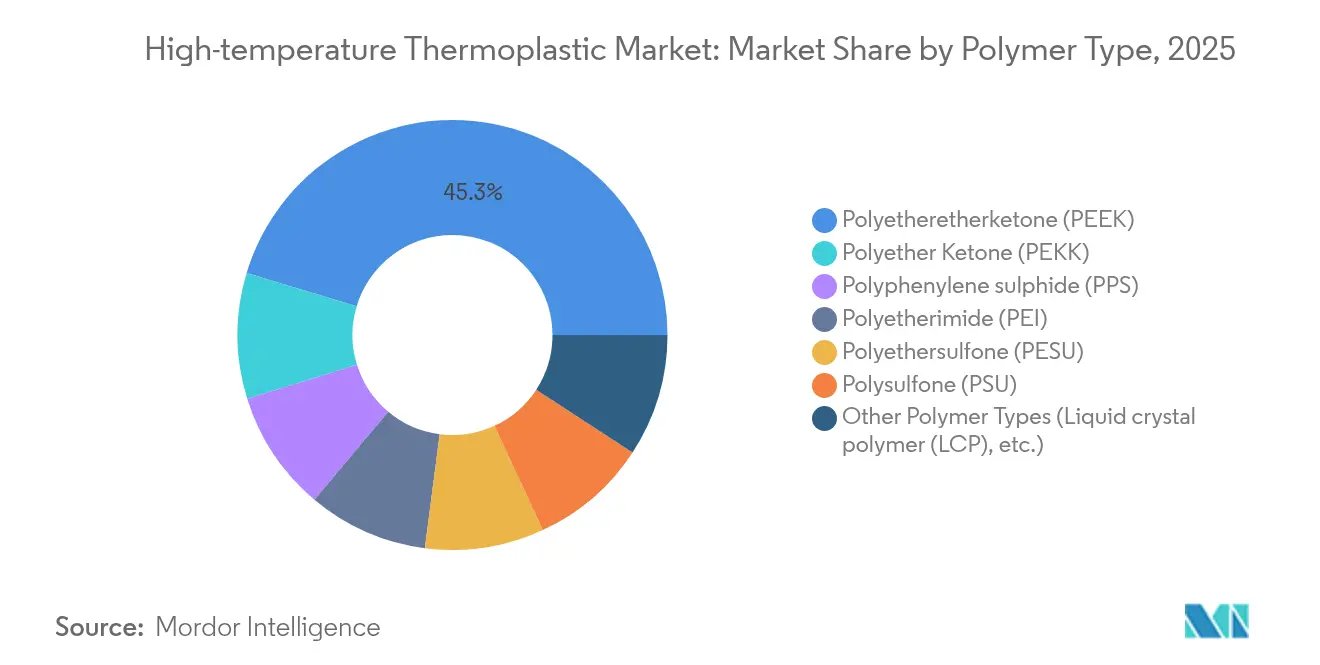
- By polymer type, PEEK captured 45.35% of high-temperature thermoplastic market share in 2025, while PEKK is projected to advance at an 10.78% CAGR through 2031.
- By molecular structure, semi-crystalline grades held 71.10% share of the high-temperature thermoplastic market size in 2025; amorphous grades post the fastest 7.67% CAGR to 2031.
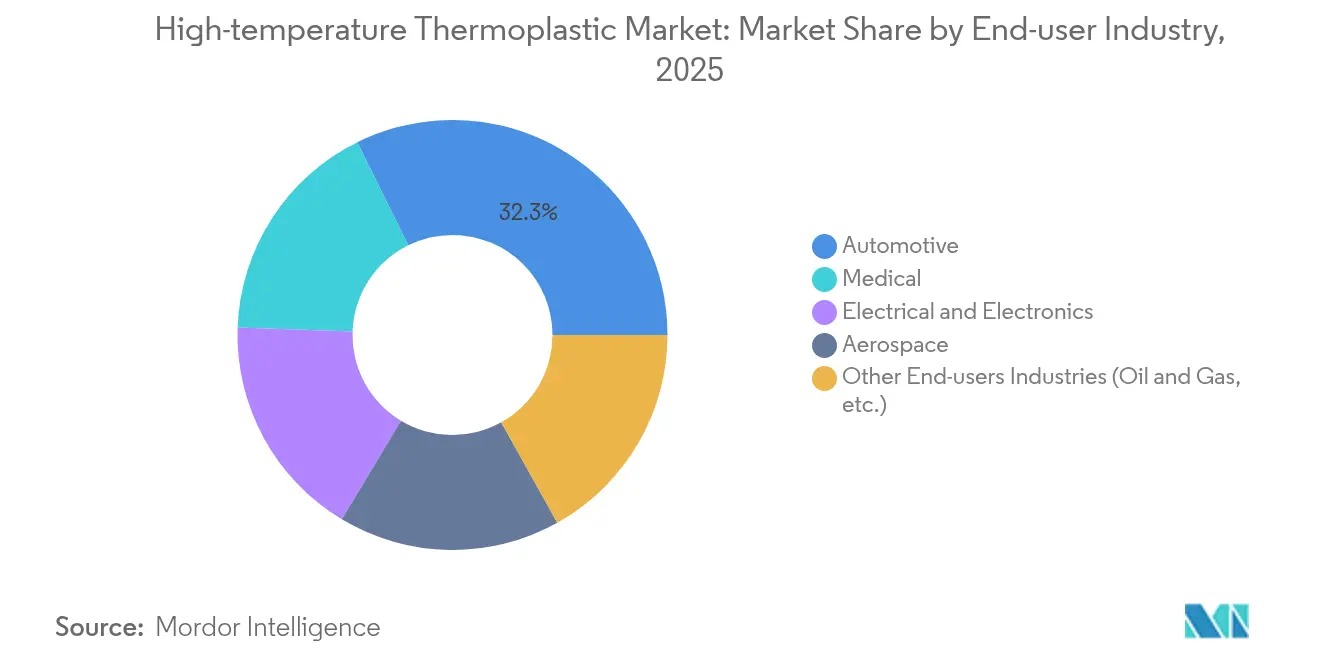
- By end-user industry, the automotive segment led with 32.30% revenue share in 2025; medical and healthcare is forecast to grow at a 9.72% CAGR through 2031.
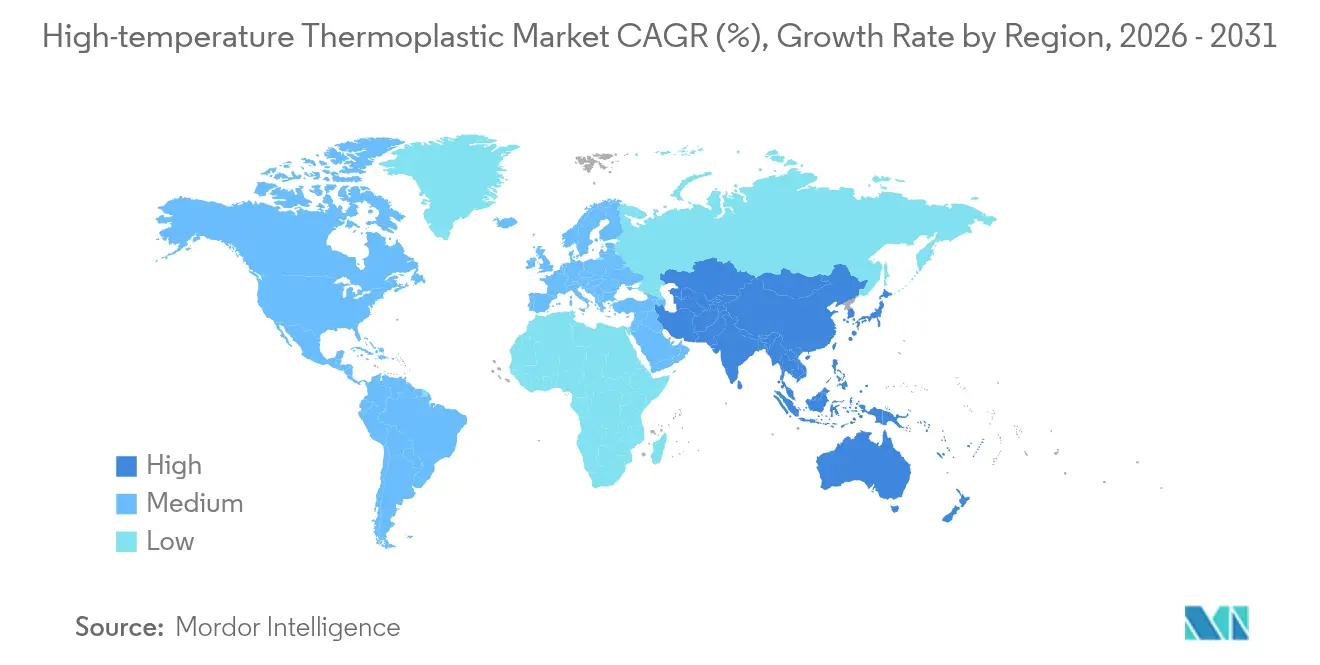
- By region, Asia-Pacific commanded 39.05% of the high-temperature thermoplastic market in 2025 and is poised to rise at an 8.45% CAGR to 2031.
Note: Market size and forecast figures in this report are generated using Mordor Intelligence’s proprietary estimation framework, updated with the latest available data and insights as of 2026.
Market Trends and Insights
Drivers Impact Analysis of High-temperature Thermoplastic Market*
| Drivers | (~) % Impact on CAGR Forecast | Geographic Relevance | Impact Timeline |
|---|---|---|---|
| Rising demand for lightweight automotive components | +2.1% | Global, with concentration in Asia-Pacific and Europe | Medium term (2-4 years) |
| Growth electronics miniaturisation and high-heat PCB applications | +1.8% | Asia-Pacific core, spill-over to North America | Short term (≤ 2 years) |
| Growing demand from the aerospace and defense industry | +1.5% | North America and Europe, emerging in Asia-Pacific | Long term (≥ 4 years) |
| High usage in 3D printing and additive manufacturing | +1.2% | Global, with early adoption in North America and Europe | Medium term (2-4 years) |
| Rising demand from healthcare industry | +0.9% | Global, with premium markets leading | Long term (≥ 4 years) |
| Source: Mordor Intelligence | |||
Rising Demand for Lightweight Automotive Components
Electric vehicles require resin grades that endure battery pack temperatures, flame exposure, and constant vibration. SABIC’s NORYL NHP8000VT3 delivers a CTI PLC0 rating that helps protect 800-volt power-train architectures against tracking failure. The 2024 Bluebus e-bus integrated a thermoplastic battery housing, trimming mass versus an aluminum shell while exceeding fire-safety limits. Tesla specified roughly 9 kg of PEEK per Optimus-Gen2 humanoid robot and removed 10 kg of total weight, proving the polymer’s versatility beyond vehicles. Automakers pursuing longer range and faster charging combine those examples to confirm a structural shift toward advanced thermoplastics.
Growth in Electronics Miniaturization and High-Heat PCB Applications
Shrinking form factors raise component heat flux, pushing board temperatures above 300 °C during assembly reflow. Polyimide film maintains dimensional stability and matches copper’s coefficient of thermal expansion, reducing delamination in high-density circuits. The IEEE Heterogeneous Integration Roadmap flags high-temperature thermoplastics as critical die-attach and under-fill materials for chiplet packaging, enabling further transistor scaling[1]IEEE Publications, “Heterogeneous Integration Roadmap 2025,” ieee.org. As data-center operators chase higher rack power and 5G radios proliferate, board makers specify polymers that survive rapid thermal cycling without embrittlement. Asia-Pacific foundries already line up additional laminator lines, indicating a near-term pull that benefits regional resin suppliers.
Growing Demand from the Aerospace and Defense Industry
Commercial and defense airframers move toward thermoplastic composite ribs, clips, and skins to support rate ramp-ups targeting 100 single-aisle jets per month. Arkema and Hexcel produced the first qualified PEKK-based primary structure in 2024, proving industrial readiness for flight parts. Boeing’s 155,000 ft² Advanced Composite Fabrication Center in Arizona will reach steady-state output in late 2025, reinforcing North American leadership. PEEK and PEI already meet FAR 25.853 without added flame retardants, eliminating secondary treatments and speeding assembly. Certification hurdles deter new entrants, yet once cleared they lock in multi-decade revenue streams, enhancing the driver’s long-term potency.
High Usage in 3D Printing and Additive Manufacturing
EOS lasers sinter PEKK powders into aircraft brackets with repeatable porosity control, while Markforged feeds continuous-fiber thermoplastics for robotic end-effectors at small lot sizes. Hot-isostatic pressing improves 3D-printed PEEK composites by 46% in flexural strength and 30% in inter-laminar shear, narrowing the gap with injected parts. Custom implants tailored to patient anatomy, plus flight-ready ducting with integral stiffeners, make additive a strong mid-term accelerator.
Rising Demand from Healthcare Industry
Orthopedic and cranial implants rely on PEEK for biocompatibility and radiolucency. Evonik’s VESTAKEEP Fusion, which embeds biphasic calcium phosphate, raised osteoblast attachment by more than 30% versus standard PEEK. Single-use surgical tools favor amorphous PSU and PESU for steam-sterilization cycles and clear sight-lines. Global aging populations and minimally invasive procedures lock in steady growth, positioning healthcare as a durable long-term volume contributor.
Restraints Impact Analysis of High-temperature Thermoplastic Market*
| Restraints | (~) % Impact on CAGR Forecast | Geographic Relevance | Impact Timeline |
|---|---|---|---|
| High raw-material and compounding cost | -1.4% | Global, with acute impact in cost-sensitive markets | Short term (≤ 2 years) |
| Recycling and circular-economy challenges | -0.8% | Europe and North America leading, expanding globally | Long term (≥ 4 years) |
| Capital-intensive high-temperature processing equipment | -0.6% | Global, with higher barriers in emerging markets | Medium term (2-4 years) |
| Source: Mordor Intelligence | |||
High Raw-Material and Compounding Cost
Specialty monomers face tight balances and geopolitical disruptions. Composite resin producer AOC raised prices by EUR 200 per ton for vinyl ester blends in 2024, passing energy hikes through the chain. Medical device firms coping with PTFE shortages were forced to verticalize fluoropolymer extrusion to secure supply. High-temperature twin-screw extruders and mold-temperature control units rated above 400 °C require capital that smaller firms cannot easily deploy. Until unit costs go down, price-sensitive segments will continue to substitute with engineering plastics or aluminum.
Recycling and Circular-Economy Challenges
Closed-loop recovery of PEEK, PEKK, and PPS remains complex because residual glass or carbon fibers degrade molecular weight. Researchers achieved depolymerization of PEEK with sulfur nucleophiles to clean monomer streams, but scale-up is unproven[2]Nature Communications Chemistry, “Selective Depolymerization of PEEK,” nature.com. Röchling allocated EUR 10 million to its Sustainability Centre to mechanically reprocess 10,000 tons of waste a year, yet still must blend recycled flake with virgin resin for critical properties. Regulatory pushes for minimum recycled content intensify in Europe and North America, creating compliance costs and, in some applications, performance compromises.
*Our forecasts treat driver/restraint impacts as directional, not additive. The impact forecasts reflect baseline growth, mix effects, and variable interactions.
High-temperature Thermoplastic Market Segment Analysis
By Polymer Type:
PEEK Dominance Faces PEKK InnovationPEEK held 45.35% of the high-temperature thermoplastic market share in 2025. Tensile strength near 115 MPa and continuous-use temperature around 260 °C keep the polymer on most qualified parts lists. Aerospace seat frames, spinal cages, and semiconductor wafer-handling components rely on that track record. PEKK’s lower crystallization speed supports layer-by-layer fusion in additive manufacturing, a trait that underpins its 10.78% CAGR. Arkema’s licensing deal with SEQENS enables back-integration of anode-grade raw materials, thereby reducing exposure to supply shocks.
Second-tier materials advance as well. Liquid-crystal polymer grades with a glass transition temperature above 280 °C meet the next-generation connector pin density requirements in 5G base stations. Ultra-high-molecular-weight polybenzimidazole is used in downhole seals at 350 °C, but it is sold in kilograms rather than tonnes. Collectively, these specialty niches limit commoditization, sustaining premium margins across the high-temperature thermoplastic market.



By Molecular Structure:
Semi-Crystalline Strength Versus Amorphous VersatilitySemi-crystalline grades accounted for 71.10% of the overall high-temperature thermoplastic market in 2025, as their ordered domains confer high modulus, excellent barrier properties, and long-term creep resistance. Carbon–fiber–reinforced PEKK panels with a 60% fiber volume fraction maintain an eighty-plus gigapascal flexural modulus at 150 °C. Such traits are essential for aerospace wing access doors and electric-vehicle skid plates that are subjected to rock strikes. Amorphous cousins grow 7.67% CAGR on the back of optical and processing advantages.
PESU powder dissolves in dimethylacetamide, enabling the application of spray-coated anti-corrosion layers on steel vessels. Lower melt viscosity lets molders fill thin-wall connectors without voids, cutting cycle time. Advances in plasma surface activation now improve adhesion across both structures, widening part-design freedom. Dual-matrix hybrids, which combine amorphous PEI skins with semi-crystalline PEEK cores, are expected to arrive in 2025 prototypes, aiming to optimize both clarity and stiffness in a single component.
By End-User Industry:
Automotive Leadership Challenged by Medical InnovationAutomotive applications consumed 32.30% of the total volume in 2025. Battery enclosures made from continuous-fiber PEEK/CF laminates meet the UL 94 V0 standard with a margin and weigh 30% less than aluminum boxes. Syensqo’s Ajedium PEEK dielectric film squares the circle on high dielectric strength and low dissipation factor for 800-V inverter busbars. The medical and healthcare sector’s 9.72% CAGR stems from growth in image-compatible implants and sterilizable single-use tools. PEEK spinal cages machined to patient scans reduce operating time, while PSU trocar cannulas withstand more than 1,000 steam cycles.
Aerospace demand rides Boeing and Airbus build-rate targets. Military rotorcraft retrofit programs specify PEKK clamps because the polymer does not galvanically corrode adjacent carbon fiber. Oil and gas operators still purchase PPS valve seats for sour-gas service, yet new field investments lag behind the pace of electric-mobility spending. Diverse requirements across end-users keep the supply base balanced, smoothing revenue against cyclical swings in any one sector.
Geography Analysis
APAC High-temperature Thermoplastic Market
Asia-Pacific’s 39.05% 2025 share stems from vertically integrated supply chains that connect monomer synthesis, compounding, and part fabrication within a day’s trucking distance. The region is expected to post the fastest 8.45% CAGR to 2031. Government incentives for new-energy vehicles in China, India, and Thailand boost demand for PEEK battery frames and PPS coolant fittings. Japanese OEMs are pioneering PEI-based connector blocks for ultrafast chargers, thereby expanding the domestic converter base.
North America High-temperature Thermoplastic Market
North America maintains a resilient position. The aerospace backbone of Washington state and Alabama anchors steady polymer off-take, while the Texas chemical corridor supplies key monomers. Post-pandemic reshoring policies are encouraging battery manufacturers to invest in Michigan and Georgia, where processors are installing new 450-ton presses.

Value Chain Analysis
The value chain for high-temperature thermoplastics starts upstream with specialty monomers and polymerization into base resins (notably PEEK, PEKK, PPS, PEI, and PSU/PESU), then moves into compounding (glass or carbon fiber reinforcement, flame-smoke-toxicity packages, tribology modifiers, and dielectric tuning). From there, the supply chain converts resins into semi-finished forms (films, sheets, and powders) and finished parts via injection molding, extrusion, compression molding, and additive manufacturing. Distribution and localization are typically supported through specialty channels and regional networks, while resin producers and integrators such as Toray use multi-region resin and materials businesses to shorten lead times for converters serving electronics, automotive electrification, aerospace, and medical OEMs.
Value creation and bottlenecks tend to center on qualification, processability, and application engineering rather than commodity logistics. In regulated or safety-critical uses, switching material sources can trigger requalification and revalidation, increasing switching costs and reinforcing long-term supplier positions. Standardization and test methods governed through bodies such as ISO/TC 61/SC 9 shape how grades are specified and compared across the chain, while industry groups such as the Plastics Industry Association (PLASTICS) influence machinery safety and related standards that affect converter investment and operating practices. Capability-building at the conversion layer, including MPMA implementing an advanced injection molding train-the-trainers program in November 2025 in Penang, also supports the adoption of higher-temperature polymers by tightening operator and quality-system readiness.
Competitive Landscape
The high-temperature thermoplastic market exhibits a high degree of concentration. Victrex, Syensqo, SABIC, and Arkema defend their shares through extensive patent estates and multi-regional plants that offer local service, as well as redundancy. Competition is increasingly shifting to processing innovation rather than basic chemistry. Supply-chain disruptions push producers to regionalize compounding and stock safety inventories. SABIC expanded Ultem resin output in Singapore by 50%, securing Asian supply for autos and electronics.
High-temperature Thermoplastic Industry Leaders
Arkema
Solvay
SABIC
Victrex plc
Evonik Industries AG
- *Disclaimer: Major Players sorted in no particular order
High-temperature Thermoplastic Market Companies Covered in this Report
- AKRO-PLASTIC GmbH
- Arkema
- BASF
- Celanese Corporation
- Drake Plastics
- DuPont
- Ensinger
- Evonik Industries AG
- GSF Plastics
- Hexcel Corporation
- Polyplastics Co., Ltd.
- RTP Company
- SABIC
- Solvay
- Sumitomo Chemical Co., Ltd.
- TORAY INDUSTRIES, INC.
- Victrex plc

Market Opportunities and Future Outlook
Near-term whitespace centers on shortening qualification-to-production cycles and expanding regionally available, application-ready formats (powders, films, and compounded grades) for electrification, miniaturized electronics, and high-rate aerospace programs. Evidence of ongoing capability and supply expansion includes Ensinger expanding production capacities for thermoplastic composites in June 2024 and Borealis investing over EUR 100 million to expand polymer compounding capabilities in Schwechat, Austria in September 2025, which increases the range of compounded and semi-finished options for processors that lack in-house formulation depth. Toray Advanced Composites also announced expanded capacity and capabilities in continuous-fiber reinforced thermoplastic products in November 2024, reinforcing the pathway to more thermoplastic composite content in structures where throughput and out-of-autoclave processing matter.
Material innovation and localization programs add opportunity in specialty grades that reduce system cost, improve manufacturability, or enable new component designs. Evonik introduced VESTAKEEP Easy Slide 2 in April 2026 for high-temperature, high-pressure sliding applications, where wear and friction performance can replace metal parts and reduce lubrication complexity. On the supply side, new Asian capacity projects, including Ningbo Huaxiang initiating trial production on an integrated PEEK line (12,000 tons per year nameplate referenced, with staged ramp) and Toray Industries (India) announcing a new 3,000-ton-per-year PPS composite line at Sri City (announced June 2026), point to more localized access to high-performance resins and composite intermediates. Together, new grades, additional compounding capacity, and regionally closer supply create room for converters and OEMs to expand multi-sourcing, increase thermoplastic composite content, and standardize high-temperature polymer use across EV power electronics, chip packaging materials, and sterilizable medical devices.
Recent Industry Developments in High-temperature Thermoplastic Market
- June 2026: Arkema successfully started up a 15% PVDF capacity expansion at its Calvert City, Kentucky facility, backed by an investment of about USD 20 million. The additional output supports battery, energy storage, and semiconductor supply chains where tight material specifications and continuity of supply influence qualification and production planning.
- June 2026: SABIC launched LNP THERMOCOMP OFM compounds based on PPS resin for high-power and high-voltage EV drive and power module applications. The release broadens compound options for 800V-class architectures that require thermal stability, dielectric performance, and dimensional control in compact housings and insulators.
- June 2025: Hexcel unveiled a PEKK/carbon thermoplastic over-wing emergency-exit component under the HELUES aerospace project, highlighting rate-capable out-of-autoclave forming. The demonstration supports the shift toward thermoplastic composite parts that can be formed faster than traditional thermosets while meeting aerospace performance requirements.


High-temperature Thermoplastic Market Report Scope and Research Methodology
Market Definition and Coverage
This market tracks the value of high-temperature thermoplastic materials sold for use in applications that require performance at elevated operating temperatures. It includes resin sales and engineered grades that are processed into parts by end users.
Scope exclusions: thermoset polymers, commodity thermoplastics that are not positioned for high-temperature performance, and downstream fabricated component value added are not counted.
Segments Covered in This Report
- By Polymer Type
- Polyetheretherketone (PEEK)
- Polyether Ketone (PEKK)
- Polyphenylene sulphide (PPS)
- Polyetherimide (PEI)
- Polyethersulfone (PESU)
- Polysulfone (PSU)
- Other Polymer Types (Liquid crystal polymer (LCP), etc.)
- By Molecular Structure
- Amorphous
- Semi-crystalline
- By End-user Industry
- Automotive
- Electrical and Electronics
- Aerospace
- Medical
- Other End-users Industries (Oil and Gas, etc.)
- By Geography
- Asia-Pacific
- China
- India
- Japan
- South Korea
- Rest of Asia-Pacific
- North America
- United States
- Canada
- Mexico
- Europe
- Germany
- United Kingdom
- France
- Italy
- Rest of Europe
- South America
- Brazil
- Argentina
- Rest of South America
- Middle-East and Africa
- Saudi Arabia
- South Africa
- Rest of Middle-East and Africa
- Asia-Pacific
Data Sources, Market Sizing, and Validation
Desk Research
Desk research was used to set the industry context and keep model inputs within realistic ranges. We referenced public materials such as national statistical agencies for industrial output series, USGS-style chemical and minerals notes where relevant to feedstocks, and trade portals that publish HS-based import and export statistics for polymers and engineered plastics. We also reviewed standards and safety documents from bodies such as ASTM and ISO to understand qualification requirements that influence adoption timelines.
To convert that foundation into sizing inputs, we triangulated sources including company annual reports, investor presentations, and audited filings, and cross-checked association websites plus reputable press coverage of capacity additions and new grades. Patent databases were selectively reviewed to see where innovation is focused and which applications appear to be moving from trials into wider use. A subscription database for company financials and news was used to improve coverage of private players and to validate timing and sequencing. These desk sources are illustrative only, and many other public and paid references were reviewed for data collection, validation, and clarification.
Primary Interviews and Surveys
Primary conversations were conducted with resin producers, compounders, distributors, and downstream users in sectors such as transportation, electrical and electronics, and industrial processing. The goal was to confirm demand signals and pricing behavior. Input from procurement, product, and plant-level roles helped pressure-test assumptions on qualification cycles, substitution decisions, and how quickly new capacity converts into sellable volume across major regions.
Distribution of primary research fieldwork respondents
| Company type | Respondent position | Region |
|---|---|---|
| Top tier: 30% | CXOs: 13% | APAC: 47% |
| Mid tier: 56% | Functional/Unit leaders: 36% | EMEA: 30% |
| Smaller Players: 14% | Managers: 51% | Americas: 23% |
Market-Sizing & Forecasting
Sizing begins with a top-down build where end-use demand pools are reconstructed from production indicators and trade flows for industries that consume high-temperature polymers. That output is then adjusted using penetration rates of high-temperature grades within each application. After the totals are formed, we corroborate them with selective bottom-up approximations, such as sampled price per kg by resin family multiplied by estimated consumption volumes, and then we use supplier and channel checks to correct obvious gaps.
Key inputs include regional output trends in aerospace and automotive manufacturing, electronics production and assembly activity, installed processing capacity and utilization signals for specialty polymers, typical qualification and replacement cycles, and the observed price spread between neat resin and compounded grades. Because the market moves with both end-use cycles and price movements, we run scenario analysis supported by expert views on resin price direction, capacity additions, and adoption speed in high-heat applications. When company disclosures are incomplete, missing volume is handled by proxying from capacity, export orientation, and application mix, and then normalized back to realistic regional totals.
Data Validation & Update Cycle
Validation is completed by comparing the model outputs against independent signals such as resin capacity announcements, trade balances for relevant polymer categories, and end-use production trends that should move in the same direction. If a variance looks unusual, we revisit assumptions on penetration, pricing, and regional mix, and we re-engage primary contacts to confirm what changed and why. Before sign-off, the full model is reviewed in multiple steps by another analyst to check calculation logic, unit conversions, and currency handling.
The report is refreshed annually, and interim updates are triggered when material events occur, such as major capacity starts, supply disruptions, or large demand shocks in key end uses. Right before delivery, a final pass is completed so clients receive the most current inputs and an updated market view.
Mordor Intelligence's High Temperature Thermoplastic Market Sizing Compared With Other Published Estimates
Published market sizes for high-temperature thermoplastics can differ substantially even when the label appears similar, because scope and counting rules often do not match. The main drivers are what is treated as high-temperature material, which pricing level is used (resin only versus compounded), and how quickly adoption is assumed to rise across aerospace, automotive, electronics, and industrial use cases.
The key gap is how some estimates include adjacent heat-resistant plastics and broader engineering polymer baskets, while Mordor Intelligence keeps the count tied to high-temperature thermoplastic grades and applies qualification-led adoption timing instead of assuming immediate full penetration based on end-use output. Differences also show up when one study uses a conservative ramp and another uses an aggressive ramp, and when currency conversion timing and inflation treatment are not aligned to the same year.
Benchmark comparison
| Source | Market Size | Gaps in Research Methodology |
|---|---|---|
| Mordor Intelligence | USD 28.27 B (2026) | |
| Regional Consultancy A | USD 18.60 B (2024) | Uses an earlier base year and appears to apply a narrower reported value that may emphasize selected end uses and temperature ranges, which can undercount compounded grades and later-stage adoption in aerospace and electronics. |
| Global Consultancy B | USD 30.21 B (2025) | Likely includes a broader basket of high-performance polymers or counts more of the downstream compounded value at higher average selling prices, and it may assume faster penetration without fully gating demand through qualification and replacement cycles. |
The spread across sources becomes easier to explain once scope and adoption logic are reviewed side by side. By keeping inputs traceable to end-use output, penetration, and realistic pricing levels, the final number stays repeatable and easier to reconcile when new capacity, pricing, or demand signals shift.


Key Questions Answered in the Report
What is the current high-temperature thermoplastic market size?
The high-temperature thermoplastic market size reached USD 28.27 billion in 2026 and is forecast to reach USD 41.47 billion by 2031.
Which region leads the high-temperature thermoplastic market?
Asia-Pacific leads with 39.05% revenue share in 2025 and is projected to grow at an 8.45% CAGR through 2031.
Which polymer dominates the high-temperature thermoplastic market?
PEEK held 45.35% market share in 2025, driven by its track record in aerospace, medical, and industrial parts.
Why are high-temperature thermoplastics important for electric vehicles?
They enable lighter battery housings and withstand continuous exposure above 200 °C, improving range and safety.
What is the fastest-growing end-use segment?
Medical and healthcare applications are set to expand at a 9.72% CAGR to 2031 due to stricter biocompatibility and minimally invasive surgery trends.
Page last updated on:


 Your data is secure and never sold or shared.


