
Thermoplastic Starch (TPS) Market Size and Share
Market Overview
| Study Period | 2021 - 2031 |
|---|---|
| Market Volume (2026) | 197.29 kilotons |
| Market Volume (2031) | 282.05 kilotons |
| Growth Rate (2026 - 2031) | 7.41 % |
| Fastest Growing Market | Asia Pacific |
| Largest Market | Europe |
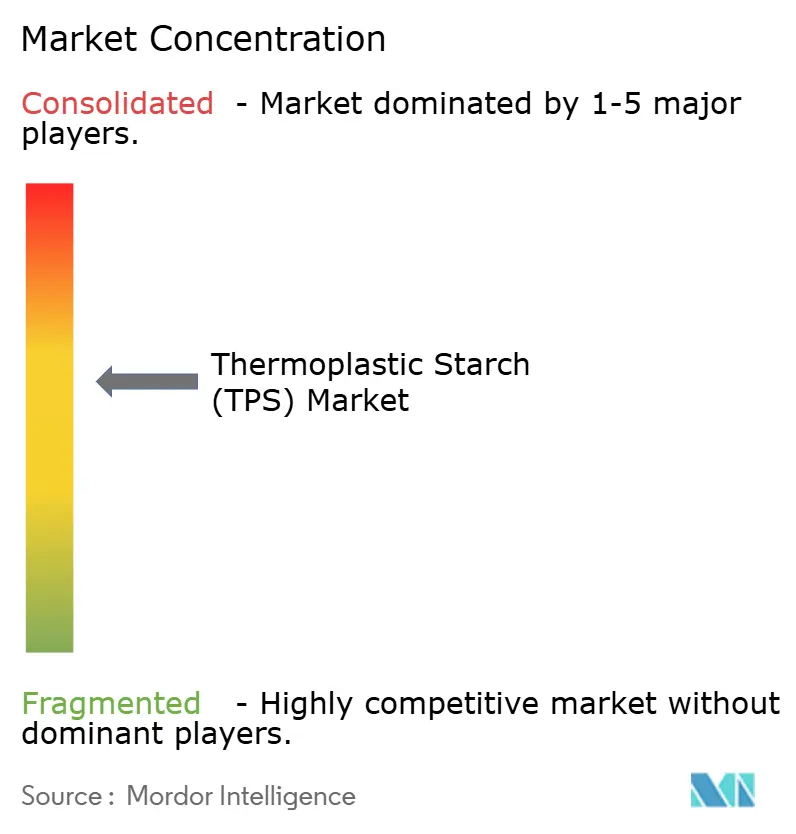
| Market Concentration | Medium |
Major Players *Disclaimer: Major Players sorted in no particular order Image © Mordor Intelligence. Reuse requires attribution under CC BY 4.0. | |
Thermoplastic Starch (TPS) Market Analysis by Mordor Intelligence
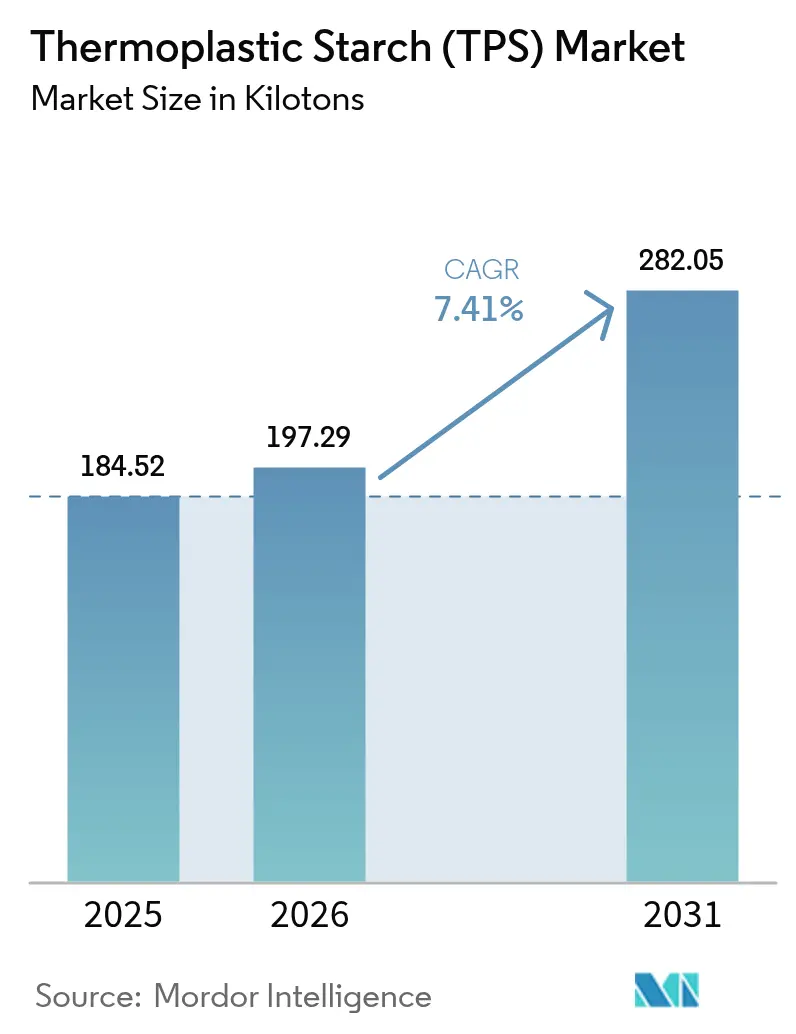
The Thermoplastic Starch Market size is expected to increase from 184.52 kilotons in 2025 to 197.29 kilotons in 2026 and reach 282.05 kilotons by 2031, growing at a CAGR of 7.41% over 2026-2031. Brand-owner sustainability targets, escalating bans on single-use plastics, and advances in moisture-barrier chemistry are steering converters toward starch-based resins that can run on existing polyethylene lines. Europe leads because the Packaging and Packaging Waste Regulation (PPWR 2025/40) accelerates the switch to certified-compostable formats, while Asia-Pacific gains momentum as China, India, and ASEAN tighten import and disposal rules for conventional plastics. Extrusion remains the dominant processing route for high-volume film and bag grades, yet medical trials are boosting demand for injection-moldable TPS composites with tighter dimensional tolerances. Supply security hinges on diversified, low-grade starch feedstocks that decouple resin costs from food-grade corn and cassava price spikes.
Key Report Takeaways
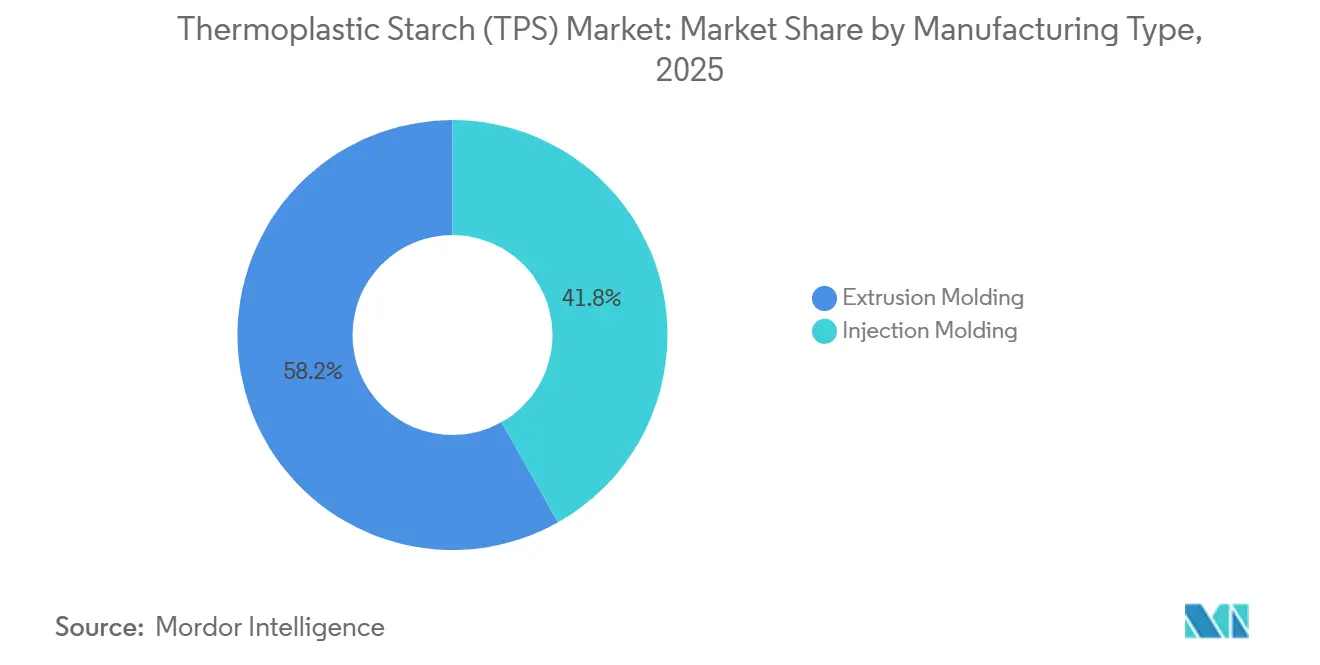
- By manufacturing type, extrusion molding held 58.17% of the thermoplastic starch market share in 2025, while injection molding is projected to post the highest 7.89% CAGR to 2031.
- By application, films commanded 47.80% of the thermoplastic starch market size in 2025; bags are set to grow the fastest at an 8.38% CAGR through 2031.
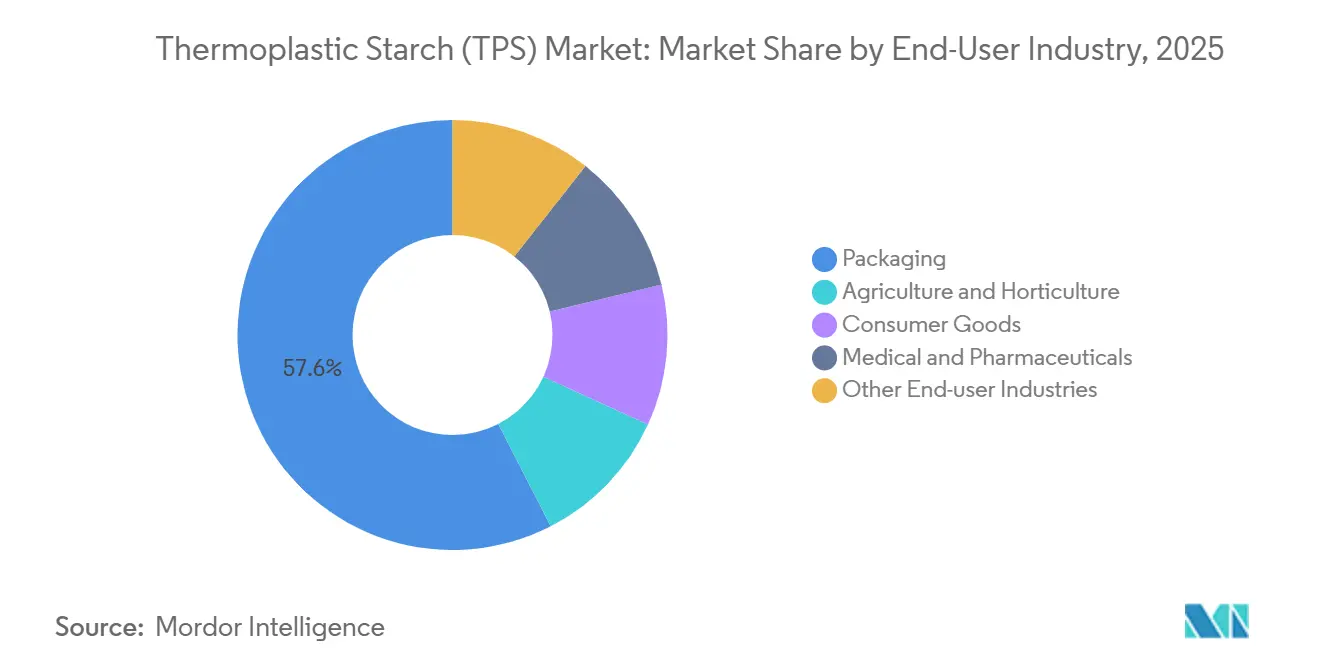
- By end-user industry, packaging dominated with 57.55% of the thermoplastic starch market share in 2025, whereas medical and pharmaceuticals will expand at an 8.90% CAGR during 2026-2031.
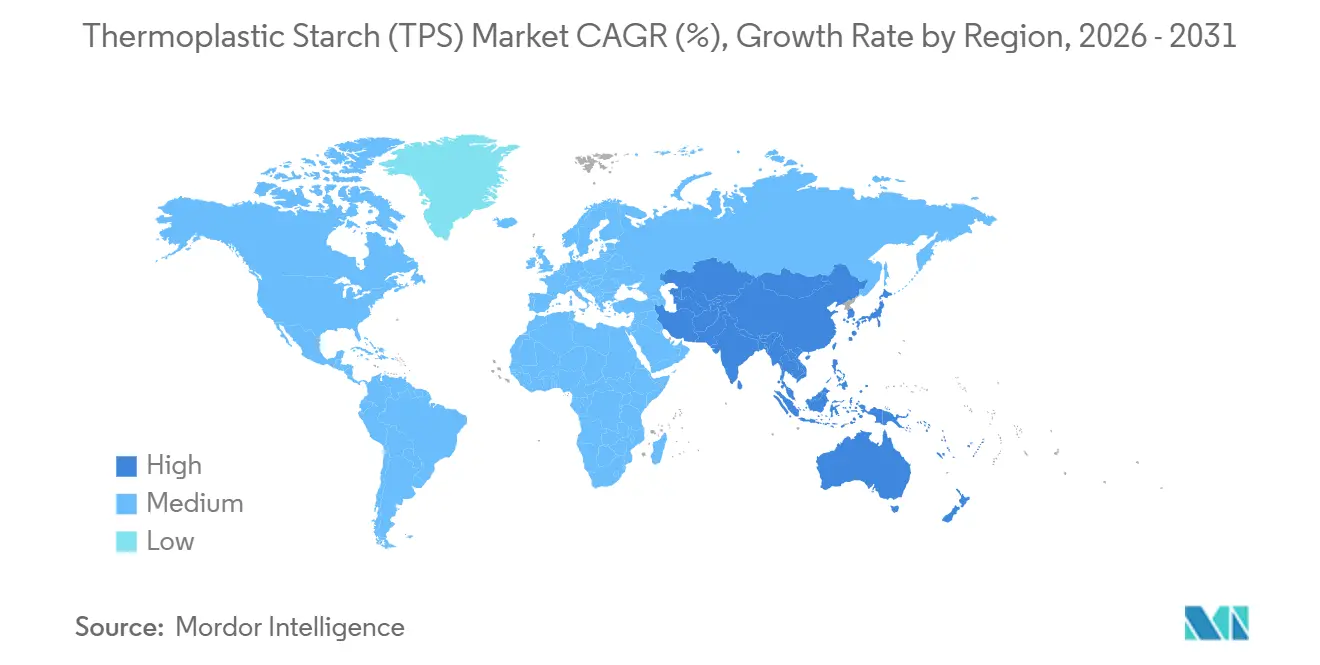
- By geography, Europe led with a 39.82% thermoplastic starch market share in 2025, and Asia-Pacific is expected to record the quickest 8.54% CAGR to 2031.
Note: Market size and forecast figures in this report are generated using Mordor Intelligence’s proprietary estimation framework, updated with the latest available data and insights as of 2026.
Market Trends and Insights
Drivers Impact Analysis of Thermoplastic Starch (TPS) Market*
| Drivers | (~) % Impact on CAGR Forecast | Geographic Relevance | Impact Timeline |
|---|---|---|---|
| Rising demand for biodegradable packaging | +2.1% | Global, with EU and North America leading | Medium term (2-4 years) |
| Ban on single-use plastics in major economies | +1.8% | EU, UK, Canada, China, India, select U.S. states | Short term (≤ 2 years) |
| Brand-owner sustainability pledges beyond regulatory mandates | +1.3% | Global, concentrated in North America and EU | Medium term (2-4 years) |
| Shift toward home-compostable e-commerce mailers | +0.9% | North America, EU, Australia | Short term (≤ 2 years) |
| Pharma blister-pack replacement trials with TPS composites | +0.6% | North America, EU, Japan | Long term (≥ 4 years) |
| Source: Mordor Intelligence | |||
Rising Demand for Biodegradable Packaging
Under the PPWR 2025/40 regulation, converters are racing against the clock to meet the 2030 deadlines for recyclability or compostability. This urgency is compressing research and development cycles and accelerating material substitutions. By blending TPS with PLA or PBAT, manufacturers can meet EN 13432 and ASTM D6400 standards, allowing brand owners to upgrade their materials without overhauling major equipment. In Germany, France, and the Netherlands, municipal organics-collection initiatives have begun accepting certified TPS films, smoothing the path for wider adoption. Major FMCG companies are on track to eliminate non-recyclable plastics by 2028, shifting their procurement focus to pouches and sachets with higher renewable content. Collectively, these developments are driving up the baseline demand for TPS packaging grades across both consumer and industrial sectors[1].
Ban on Single-Use Plastics in Major Economies
National prohibitions on polyethylene checkout bags, straws, and food-service items compel rapid TPS substitutions. Canada’s regulations entered full enforcement in December 2024, sweeping food-service operators into compliance overnight. India tightened penalties in 2025, prompting domestic converters to switch to starch blends that meet local compostability norms. China’s revised Solid Waste Law levies fees on non-degradable packaging, pushing leading e-commerce firms toward TPS mailers for urban deliveries. Because starch resins can be certified under multiple regional standards, suppliers capture demand across jurisdictions that previously required separate formulations[2].
Brand-Owner Sustainability Pledges Beyond Regulatory Mandates
PepsiCo and Mars Wrigley have each committed to TPS-based film development, aiming to achieve science-driven carbon targets ahead of mandated deadlines. These voluntary pledges not only surpass the EU's recycled-content benchmarks but also bolster the demand for suppliers who can ensure traceability from farm to resin. In 2025, long-term offtake agreements were inked, integrating TPS volumes into packaging strategies. This move enhances the financial viability of starch expansion initiatives and reduces borrowing costs for local processors.
Shift Toward Home-Compostable E-Commerce Mailers
California's organic-waste diversion rules now embrace backyard-compostable mailers. This niche is particularly suited for TPS grades, which are coated with thin wax layers. These layers retain moisture during transit but decompose within 26 weeks after use. In 2025, both Australian and U.S. startups witnessed a surge, boasting significant sales growth. This uptick was largely driven by small merchants adopting these eco-friendly mailers to cater to environmentally-conscious consumers. Furthermore, certification logos have emerged as key marketing differentiators, establishing a formidable entry barrier against untested imports.
Restraints Impact Analysis of Thermoplastic Starch (TPS) Market*
| Restraints | (~) % Impact on CAGR Forecast | Geographic Relevance | Impact Timeline |
|---|---|---|---|
| Moisture sensitivity limiting shelf-life | -1.2% | Global, acute in tropical Asia-Pacific and Latin America | Short term (≤ 2 years) |
| Inferior mechanical strength vs. petro-plastics | -0.9% | Global, particularly in heavy-duty packaging | Medium term (2-4 years) |
| Food-versus-materials debate around starch feedstock | -0.7% | Global, concentrated in regions with food-security concerns | Long term (≥ 4 years) |
| Source: Mordor Intelligence | |||
Moisture Sensitivity Limiting Shelf-Life
Unmodified TPS can absorb significant water within two days at high relative humidity, causing swelling and early tearing in tropical logistics chains. PBAT-rich blends lower water uptake but dilute renewable-content claims and raise cost. Surface coatings, while helpful, must remain under a small percentage of total weight to keep EN 13432 certification, adding process complexity. Consequently, TPS remains preferred for short-lived produce bags and mulch films rather than multi-month shelf-stable goods.
Inferior Mechanical Strength vs. Petro-Plastics
While TPS's tensile strength is lower than polypropylene, this disparity restricts TPS's application in stretch-wrap and shipping sacks. Although nanofiller reinforcement and specialized compatibilizer chemistry help bridge this gap, they also elevate formulation costs. Consequently, converters are compelled to thicken the film gauge, undermining the lightweighting benefits brands seek from their packaging overhauls.
*Our forecasts treat driver/restraint impacts as directional, not additive. The impact forecasts reflect baseline growth, mix effects, and variable interactions.
Thermoplastic Starch (TPS) Market Segment Analysis
By Manufacturing Type:
Extrusion Dominates, Injection Gains in HealthcareExtrusion molding held 58.17% volume in 2025, reflecting its compatibility with existing polyethylene blown-film lines and the high-throughput economics prized by converters. This route lets regional processors retrofit rather than retool, speeding market entry and anchoring standard-grade volumes that reinforce the thermoplastic starch market. Injection molding captured a smaller base but is projected to outpace at 7.89% CAGR as medical-device makers adopt TPS composites for blister packs, trays, and diagnostic housings. The willingness of hospitals to pay a quality premium insulates injection grades from the cost pressures felt in commodity film markets.
Extrusion’s cost leadership spurs capacity additions in China and India that may temper average selling prices worldwide. Yet medical-grade injection compounds demand ISO 13485 certification and tight tolerances that shield margins. Suppliers that master both processing routes can tier their portfolios, positioning standard grades for retail bags while reserving high-amylose or nanoclay-reinforced grades for healthcare. This dual strategy allows producers to defend their share as petrochemical incumbents leverage compounding assets to challenge the thermoplastic starch market.
By Application:
Films Lead, Bags Accelerate on Retail MandatesFilms controlled 47.80% application volume in 2025 and remain the anchor segment because agricultural mulch, e-commerce mailers, and fresh-produce wraps all require thin-gauge, high-surface-area formats well suited to blown extrusion. Mulch adoption surged after Spain and Italy linked farm subsidies to biodegradable film use, cementing Europe’s leadership. Bags, however, are on track for the fastest growth at 8.38% CAGR, lifted by checkout-bag bans that exclude all but ASTM D6400-compliant materials. Together, these two uses safeguard baseline demand and account for more than half of the overall thermoplastic starch market size through 2031.
Technical diversification is also underway. PLA-TPS filaments for 3D printing are winning prototype packaging work for luxury brands that want novel shapes without injection tooling. Smaller but lucrative niches such as loose-fill, plant pots, and coated paper cups extend the addressable space, giving converters multiple on-ramps into the thermoplastic starch industry. Suppliers that secure certifications across these end-uses deepen customer lock-in and can command a price premium over untested imports.
By End-User Industry:
Packaging Commands, Medical SurgesPackaging consumed 57.55% of TPS volume in 2025, driven by grocery bags, courier mailers, and flexible food wraps. The segment’s regulatory exposure means volumes will climb as additional states and provinces copy California’s compostable-bag rules. Medical and pharmaceuticals, although smaller, are forecast to grow at 8.90% CAGR, the highest among end-users, because hospitals target single-use plastic reductions and generic drug makers seek packaging differentiation. This shift positions specialty grades to capture premium margins and elevates the thermoplastic starch market share of medical applications by the decade’s close.
Agriculture and horticulture benefit from in-soil degradability, eliminating costly mulch retrieval. Consumer goods, ranging from cutlery to clamshells, fill compliance gaps for quick-service restaurants facing extended producer responsibility fees. Collectively, these outlets diversify revenue streams and buffer suppliers against price swings in any single sector.

Geography Analysis
Europe Thermoplastic Starch (TPS) Market
Europe kept 39.82% global volume leadership in 2025 as PPWR 2025/40 and country-level levies made non-compostable packaging economically unattractive. Germany, France, and Italy pooled more than half of continental demand, underpinned by mature composting infrastructure that validates the thermoplastic starch market size leadership. The United Kingdom’s 2024 plastic packaging tax, although outside the EU, further expanded certified-compostable demand. Nordic pilots that accept TPS films in municipal organics bins remove a historic barrier and promise steady incremental growth across Scandinavia.
APAC Thermoplastic Starch (TPS) Market
Asia-Pacific is the fastest-growing region at an 8.54% CAGR to 2031. China's extended producer responsibility fees target non-degradable cartons, while India's regulations on bag thickness are steering major retail chains towards starch blends. Japan's Plastic Resource Circulation Act sets a reduction target for single-use plastics by 2030, urging retailers to adopt compostable display and produce bags. In ASEAN, harmonized standards introduced in 2024 are slashing certification costs for exporters, facilitating smoother cross-border trade in TPS packaging.
The Americas and MEA Thermoplastic Starch (TPS) Market
North America's adoption of these trends is uneven. States like California, Washington, and Oregon have mandated compostable food serviceware, but many interior states have yet to catch up. In Canada, a nationwide ban on polyethylene checkout bags set for 2024 has spurred TPS demand among fast-food chains. Meanwhile, Mexican states initiated their own rolling bans in 2025. A notable surge in certification volume at BPI in 2025 underscores a growing acknowledgment of starch-based compliance. However, South America and the Middle-East and Africa lag, hindered by a lack of composting infrastructure and a policy emphasis on mechanical recycling rather than organic diversion.
Regulatory Landscape
Thermoplastic starch (TPS) demand is closely tied to packaging and compostability rules, as well as the test standards used to substantiate claims. In the EU, the Packaging and Packaging Waste Regulation (EU) 2025/40 (PPWR) enters full application on 12 August 2026, tightening sustainability, labeling, and compostability-related requirements for packaging placed on the market. This increases the compliance bar for TPS-based packaging formats and their labeling.
EU food-contact requirements also continue to influence resin selection and additive packages. Transitional provisions under Regulation 2025/351 (amending Regulation (EU) No 10/2011) allow certain non-compliant plastic materials and articles first placed on the market before 16 September 2026 to be sold until stocks are exhausted. Outside Europe, TPS compliance is shaped by national standards and by the need to meet widely referenced compostability specifications demanded by global brand owners and converters. In China, GB/T 33796-2025 replaced the 2017 version and updated technical requirements for TPS, including a shift toward performance-oriented controls and making biodegradability an optional requirement, which affects how domestic grades are specified and qualified for downstream conversion. For suppliers selling into multiple jurisdictions, dual alignment to EN 13432 and ASTM D6400 remains a practical pathway to support transatlantic packaging programs and reduce certification and reformulation friction across markets.
Value Chain Analysis
The TPS value chain starts with starch feedstock sourcing, followed by plasticizer supply, compounding, and downstream conversion into films, bags, and molded parts. Corn starch remains the most common global feedstock, while tapioca is important in Southeast Asia and wheat and potato starch play larger roles in Europe, creating region-specific exposure to agricultural availability and pricing. Native starch is destructured under heat and shear with plasticizers such as glycerol, sorbitol, and water, typically via extrusion, to produce TPS pellets. These are then compounded and frequently blended with biodegradable polyesters (PLA, PBAT, PCL) to improve moisture resistance and mechanical properties for packaging and other applications.
Midstream compounders and specialty producers provide tailored grades and certifications that gate access to end markets. Companies such as Rodenburg Biopolymers (Netherlands) supply starch-based compounds and services for extrusion-oriented converters, while Sunar NP (Turkiye) markets W-Natural TPS blends positioned around EN 13432 and ASTM D6400 compostability compliance. In Thailand, RosEco leverages tapioca-based feedstock to supply TPS compounds used in flexible packaging and thermoforming. Downstream, film extruders, bag makers, and injection molders convert these compounds for brand owners and institutional buyers, and qualification is increasingly tied to compostability labeling, food-contact requirements, and application-specific performance testing. Feedstock diversification, including the use of agro-industrial side streams (such as potato rejections), is an emerging lever to reduce raw-material risk and address food-versus-materials concerns while improving circularity narratives.
Competitive Landscape
The thermoplastic starch market remains moderately consolidated. Emerging challengers pursue three white-space themes. First, waste-derived feedstocks such as potato peels cut raw-material costs and sidestep the food-versus-materials debate. Second, medical-grade formulations that pass ISO 11607 and EMA stability tests address an underserved, high-margin niche. Third, hybrid barrier technologies—thin PVOH or chitosan layers below the 5% weight threshold—expand TPS use cases to humid-climate snack and pharma wraps. Certification under multiple compostability regimes erects a compliance moat that favors producers with in-house labs or partnerships with accredited testing centers. Competitive intensity is rising as petrochemical incumbents retrofit compounding assets for bioplastics, compressing spot margins for pure-play TPS suppliers. Yet vertically integrated starch processors enjoy cost advantages in feedstock sourcing and can customize plasticizer chemistries for regional climate needs. Strategic collaborations with FMCG brand owners and medical-device OEMs provide volume visibility that de-risks capacity expansions, illustrating how demand-side partnerships now influence capital allocation across the thermoplastic starch industry.
Thermoplastic Starch (TPS) Industry Leaders
-
Novamont S.p.A (Versalis S.p.A.)
-
BASF
-
Danimer Scientific
-
Rodenburg Biopolymers
-
BIOTEC Biologische Naturverpackungen GmbH & Co. KG.
- *Disclaimer: Major Players sorted in no particular order
Thermoplastic Starch (TPS) Market Companies Covered in this Report
- AGRANA
- BASF
- BioLogiQ Inc.
- Biome Bioplastics
- BIOTEC Biologische Naturverpackungen GmbH & Co. KG.
- Danimer Scientific
- Great Wrap
- Grupa Azoty
- Kuraray Co., Ltd
- Novamont S.p.A (Versalis S.p.A.)
- Rodenburg Biopolymers
Market Opportunities and Future Outlook
Opportunities concentrate where regulation and infrastructure make certified compostability a procurement requirement rather than a marketing claim. Europe is the primary commercialization arena because PPWR (EU) 2025/40 moves into full application on 12 August 2026, which raises the importance of compliant labeling and verified end-of-life pathways for packaging. This regulatory anchor supports TPS blends that meet recognized compostability specifications, commonly EN 13432 in Europe and ASTM D6400 for suppliers supporting cross-border programs. It also reinforces demand for accredited testing, in-house lab capability, and multi-standard certification portfolios among TPS compounders.
Material performance and function are also widening white space beyond commodity films. Published 2026 academic work on antimicrobial TPS/polyester nanocomposites (including zinc oxide and copper oxide additives) points to an innovation track for applications where hygiene and shelf-life are critical, including medical and certain food-contact packaging formats, as long as compostability and food-contact constraints are maintained. On the supply side, Asia-Pacific offers scale and localization headroom linked to regional conversion clusters and starch availability; China has concentrated TPS activity near corn-producing provinces, supporting high-throughput compounding ecosystems that can feed film and bag capacity additions. Brand-owner programs aimed at sustainable procurement shape material selection as well. Under its PASSION 2026 management plan, Kuraray has communicated actions around increasing sustainable procurement and expanding capacity for bio-based films used in detergent and pharmaceutical packaging, highlighting how established materials companies are upgrading bio-based film supply chains that can incorporate TPS-based structures where performance and certification align.
Recent Industry Developments in Thermoplastic Starch (TPS) Market
- May 2026: BASF published patent application US20260125554A1 describing a thermoplastic polymer blend combining aliphatic polyesters with thermoplastic starch. The disclosure indicates continued formulation work to improve TPS blend performance, which aligns with converter needs for better processability and a more balanced property set in packaging-grade compounds.
- July 2025: Teknor Apex completed the acquisition of Danimer Scientific, adding biopolymer capabilities to its sustainable materials portfolio. The transaction increases the relevance of larger compounders in bio-based materials commercialization and can influence supplier choices for converters that source certified compostable materials at scale.
- September 2024: Danimer Scientific and Ningbo Homelink Eco-iTech announced the commercial launch of home-compostable PHA-based extrusion coating for drink cups. The announcement broadened the set of compostable barrier and coating options available to packaging producers and increased competitive pressure on TPS blend developers targeting coated paper and flexible packaging applications.
Thermoplastic Starch (TPS) Market Report Scope and Research Methodology
Market Definition and Coverage
This market covers thermoplastic starch (TPS) materials produced and sold for processing into finished goods, tracked on a global basis. The sizing is built around physical consumption volumes in tons, then mapped to where TPS is actually used across the main end-use demand pools.
Scope exclusions: This sizing excludes conventional petro-based plastics and non-TPS biodegradable polymers that are not formulated with thermoplastic starch.
Segments Covered in This Report
- By Manufacturing Type
- Extrusion Molding
- Injection Molding
- By Application
- Bags
- Films
- 3-D Printing
- Other Applications
- By End-User Industry
- Packaging
- Agriculture and Horticulture
- Consumer Goods
- Medical and Pharmaceuticals
- Other End-user Industries
- By Geography
- Asia-Pacific
- China
- India
- Japan
- South Korea
- ASEAN Countries
- Rest of Asia-Pacific
- North America
- United States
- Canada
- Mexico
- Europe
- Germany
- United Kingdom
- Italy
- France
- Nordic Countries
- Rest of Europe
- South America
- Brazil
- Argentina
- Rest of South America
- Middle-East and Africa
- Saudi Arabia
- South Africa
- Rest of Middle-East and Africa
- Asia-Pacific
Data Sources, Market Sizing, and Validation
Desk Research
Desk research was used to set the guardrails for the model so volumes could be tied back to real-world packaging and bio-based material activity. We typically use public sources such as UN Comtrade trade statistics, the World Bank and IMF macro series, Eurostat data, and environment and industry publications from US government bodies, along with standards or guidance from ISO and ASTM on compostability related definitions.
Along with these, company filings, sustainability reports, investor presentations, and reputable press releases were reviewed to understand where TPS is still in trial versus where it is scaling, and how resin availability is changing by region. Patent databases were also checked for formulation and processing directions that can influence adoption in films and bags. The desk source list is not exhaustive, and additional public references were reviewed to collect inputs, validate assumptions, and narrow remaining data gaps.
Primary Interviews and Surveys
Primary work focused on interviews and structured surveys with TPS value-chain participants, including resin producers, compounders, converters, distributors, and procurement or sustainability roles at end users. Because this is a global market, coverage included APAC, EMEA, and the Americas so regional packaging policy shifts and local feedstock economics could be reflected, then responses were used to confirm realistic penetration ranges and processing yields.
Distribution of primary research fieldwork respondents
| Company type | Respondent position | Region |
|---|---|---|
| Top tier: 30% | CXOs: 19% | APAC: 51% |
| Mid tier: 51% | Functional/Unit leaders: 23% | EMEA: 30% |
| Smaller Players: 19% | Managers: 58% | Americas: 19% |
Market-Sizing & Forecasting
Sizing is built using a top-down approach where packaging and select durable-use demand pools are reconstructed from public production and trade signals, then filtered through TPS adoption rates by application. To keep totals realistic, the outputs are corroborated with selective bottom-up checks, including sampled converter throughput, supplier capacity and utilization discussions, and a sanity check of typical resin use per unit output for films and bags.
Key model inputs include packaging film and bag production indicators, compostable and biodegradable material policy signals, relative feedstock availability (corn, cassava, potato) and price direction, converter line compatibility and yield loss assumptions, and shifts in application mix toward films versus molded items. Forecasts are guided through scenario analysis, where adoption paths are adjusted based on how quickly regulations translate into purchasing specifications and how reliably supply can meet quality needs. Where bottom-up inputs are incomplete in smaller regions, conservative penetration ranges are applied, then re-checked against import and export patterns and expert feedback before finalizing.
Data Validation & Update Cycle
Outputs are validated through multiple checks so major variances are caught early, including cross-checking implied per-capita consumption, regional splits, and year-over-year growth against independent packaging and materials indicators. If a country or application shows an unusual jump, the drivers are revisited, the input series are re-checked, and a small set of respondents is used to confirm whether the change is demand-related or whether a modeling assumption needs adjustment.
Before sign-off, the work is reviewed in steps, starting with logic and unit consistency checks, followed by peer review on assumptions and final totals. Reports are refreshed annually, and interim updates are added when material events occur, such as major regulation changes or supply expansions. Right before delivery, a final pass is completed so clients receive the latest updated view.
Mordor Intelligence's Global Thermoplastic Starch Market Size Versus Other Published Estimates
Published market sizes for thermoplastic starch do not always align, mainly because the market can be measured in either volume or revenue, and because some sources blend TPS with adjacent biodegradable polymers. Differences also come from how quickly adoption is assumed to rise in packaging, and whether estimates are updated after regulation timing or feedstock price moves.
The biggest gap is the unit of measurement. Mordor Intelligence sizes thermoplastic starch in kilotons (197.29 kilotons in 2026) so converter demand and application yields drive the total, rather than relying on blended revenue assumptions that can fold in non-TPS materials or different price points.
Benchmark comparison
| Source | Market Size | Gaps in Research Methodology |
|---|---|---|
| Mordor Intelligence | USD 0.20 M (2026) | |
| Global Consultancy A | USD 1.40 B (2024) | Uses a revenue-based view and appears to apply broad segment mixes and price assumptions, which can increase totals if TPS blends and adjacent biodegradable polymers are counted together or if ASP progression is not tied back to converter-level demand. |
| Industry Publisher B | USD 0.90 B (2024) | States a global revenue figure but provides limited detail on how volumes and application splits are built, so differences can come from higher assumed penetration in packaging and a less explicit treatment of regional policy timing and currency conversion years. |
The spread in the table is mainly explained by volume-versus-value choices and by how tightly each estimate defines TPS versus nearby bio-based plastics. By keeping the model anchored to application demand pools, yield assumptions, and region-level adoption checks, the final total stays easier to trace and repeat when inputs change.
Key Questions Answered in the Report
Key growth driver through 2031?
Enforced bans on single-use polyethylene bags and films in the EU, Canada, China, and India are the strongest uplift factors for certified-compostable TPS grades.
Leading application segment by 2025 volume?
Films, including agricultural mulch and courier mailers, represented 47.80% of global tonnage in 2025.
Fastest-growing region?
Asia-Pacific is projected to expand at an 8.54% CAGR during 2026-2031 due to synchronized regulatory measures across China, India, and ASEAN.
What is the current global demand for the thermoplastic starch market and its expected growth by 2031?
Global consumption is 197.29 kilotons in 2026 and is projected to reach 282.05 kilotons by 2031, reflecting a 7.41% CAGR.