
High-Performance Additives Market Size and Share
Market Overview
| Study Period | 2021 - 2031 |
|---|---|
| Market Size (2026) | USD 15.86 Billion |
| Market Size (2031) | USD 22.61 Billion |
| Growth Rate (2026 - 2031) | 7.34 % |
| Fastest Growing Market | Asia-Pacific |
| Largest Market | Asia-Pacific |
| Market Concentration | Low |
Major Players *Disclaimer: Major Players sorted in no particular order Image © Mordor Intelligence. Reuse requires attribution under CC BY 4.0. | |
High-Performance Additives Market Analysis by Mordor Intelligence
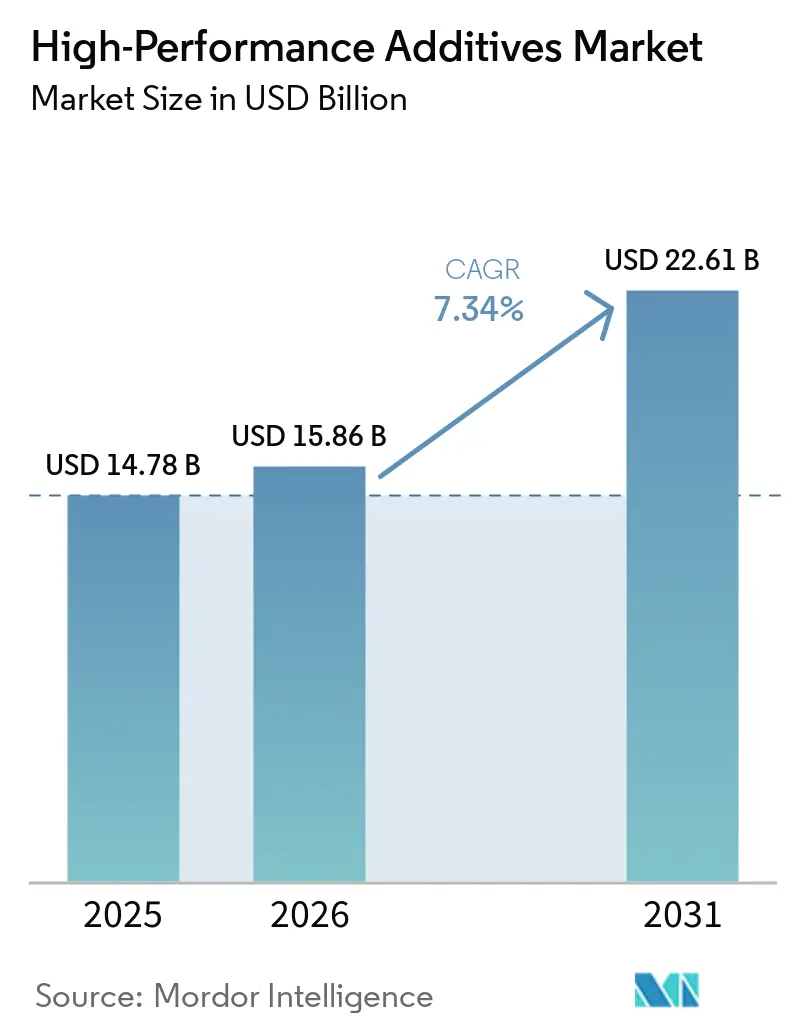
The High-Performance Additives Market size was valued at USD 14.78 billion in 2025 and is estimated to grow from USD 15.86 billion in 2026 to reach USD 22.61 billion by 2031, at a CAGR of 7.34% during the forecast period (2026-2031). Electric vehicle production is raising requirements for tire compounds, battery housing materials, high-voltage connector plastics, and electrical components that operate under sustained thermal and mechanical stress. Manufacturers are also seeking materials that retain performance through heat, ultraviolet exposure, oxidation, repeated processing, and long service periods in demanding end uses. Chemical safety rules are shortening replacement cycles for established additive chemistries, especially in coatings, adhesives, and plastics that must meet low-emission and substance-management requirements. Suppliers are responding through specialty capacity investments, local production near major processing centers, and closer work with polymer processors on customized additive packages. The high-performance additives market therefore favors products that combine compliance, durability, processing reliability, and properties that customers can validate for specific applications.
Key Report Takeaways
- By product type, stabilizers held 24.67% of the high-performance additives market share in 2025 and are projected to advance at a 7.95% CAGR through 2031.
- By function, performance additives held 68.32% of the high-performance additives market share in 2025 and are projected to advance at an 8.26% CAGR through 2031.
- By application, rubber and tires held 35.09% of the high-performance additives market share in 2025, while composites are projected to advance at an 8.48% CAGR through 2031.
- By end-use industry, automotive held 31.58% of the high-performance additives market share in 2025 and is projected to advance at an 8.72% CAGR through 2031.
- By geography, Asia-Pacific held 46.66% of the high-performance additives market share in 2025 and is projected to advance at an 8.07% CAGR through 2031.
Note: Market size and forecast figures in this report are generated using Mordor Intelligence’s proprietary estimation framework, updated with the latest available data and insights as of January 2026.
Global High-Performance Additives Market Trends and Insights
Drivers Impact Analysis*
| Driver | (~) % Impact on CAGR Forecast | Geographic Relevance | Impact Timeline |
|---|---|---|---|
| Growth in Electric Vehicles and High-Performance Tires | +2.1% | Global, with concentration in China, Europe, and North America | Short term (≤ 2 years) |
| Lightweighting and Material Efficiency in Automotive and Aerospace | +1.7% | North America, Europe, APAC core | Medium term (2–4 years) |
| Tightening Emissions, Fuel-Economy, and Low-VOC Standards | +1.3% | EU, China, North America | Short to medium term (≤ 4 years) |
| Expansion of Electronics, Medical, and High-Performance Plastics | +1.0% | Asia-Pacific, North America, Europe | Medium term (2–4 years) |
| Recycled-Polymer Processing Complexity | +0.6% | Europe, North America; spillover to APAC core | Medium term (2–4 years) |
| Source: Mordor Intelligence | |||
Growth in Electric Vehicles and High-Performance Tires
Global electric vehicle sales reached 20.7 million units in 2025, representing one in four new cars sold worldwide[1]International Energy Agency, “Global EV Outlook 2026,” International Energy Agency, iea.org. This vehicle mix changes the requirements placed on rubber compounds and tire additives because electric powertrains deliver torque immediately. Regenerative braking also subjects tires to repeated thermomechanical loads during normal vehicle operation. Tire producers therefore need antioxidant and anti-aging systems that help rubber retain durability under demanding conditions. The high-performance additives market is benefiting as tire makers review materials that protect rubber while meeting evolving environmental expectations. LANXESS launched Vulkanox 4060, also called CCPD, in September 2026 as an alternative anti-aging agent to 6PPD after completing European Union Registration, Evaluation, Authorisation and Restriction of Chemicals (REACH) Annex VII registration. The company reported no observed acute effects in coho salmon testing and plans initial commercial production in Q4 2026. This development places substitution products directly within tire makers’ material evaluation programs.
Lightweighting and Material Efficiency in Automotive and Aerospace
Automotive and aerospace producers are increasing their use of materials that reduce component weight while meeting safety requirements. Lower vehicle mass remains important for electric vehicles because battery systems add material weight to each platform. Composite structures require additives that support toughness, thermal stability, resin adhesion, and fire performance. These functions determine whether lightweight materials can meet the required certification and service conditions. Composite applications include primary and secondary aircraft structures as well as interior and under-hood vehicle parts. SABIC introduced ULTEM SU3102P reactive polyetherimide oligomer for thermoset composite applications in 2026. The product illustrates the need for additives that improve toughness without undermining stiffness in structural applications. The high-performance additives market has a clear role in helping processors balance weight reduction with service-life requirements.
Tightening Emissions, Fuel-Economy, and Low-VOC Standards
Low-volatile organic compound requirements are encouraging replacement of older chemistries in coatings, adhesives, and polymer systems. These rules increase the value of products that meet emissions limits without changing material performance. Buyers increasingly assess whether an additive can meet regulatory and product requirements together. This shifts purchasing decisions away from basic unit cost alone and toward validated compliant formulations. Evonik Industries AG expanded specialty amine production in Nanjing in April 2026 to support polyurethane and epoxy applications. The investment supports reactive specialty amines that can be used as curing agents and foam additives. These materials can support lower-emission formulations without removing performance properties required by end users. This compliance-led demand creates a defined opportunity within the high-performance additives market.
Expansion of Electronics, Medical, and High-Performance Plastics
Electronics and medical applications require polymer materials with controlled electrical, thermal, and sterilization performance. These conditions raise the value of flame retardants, thermal stabilizers, and other functional materials. Electronic systems in electric vehicles add to demand for parts that retain dielectric properties under high-voltage operating conditions. Medical polymer systems also require materials that can withstand sterilization while maintaining intended physical properties. CLARIANT completed a CHF 100 million (approximately USD 127 million) investment in Daya Bay, China, in June 2026 to expand halogen-free Exolit OP production for e-mobility applications. The facility supports grades designed for polybutylene terephthalate parts used in 800 V and higher systems. Its product range also includes materials for composite parts and intumescent coatings. These uses extend the high-performance additives market beyond conventional industrial polymer demand.
Restraints Impact Analysis*
| Restraint | (~) % Impact on CAGR Forecast | Geographic Relevance | Impact Timeline |
|---|---|---|---|
| Volatile Crude-Derived Feedstock Costs | -1.9% | Global, concentrated in Europe, Middle East supply chains | Short term (≤ 2 years) |
| Stringent Chemical Registration and Product Safety Requirements | -1.3% | EU, North America, with growing extension to APAC | Long term (≥ 4 years) |
| Compatibility and Batch-Consistency Risk in Recycled Matrices | -0.8% | Europe, North America; spillover to APAC core | Medium term (2–4 years) |
| Source: Mordor Intelligence | |||
Volatile Crude-Derived Feedstock Costs
Specialty chemical production depends on benzene, propylene, and other inputs linked to crude oil and naphtha markets. Input price changes can reduce margins before producers can revise contract pricing. The effect is greater where supply agreements have fixed prices and long renewal cycles. Producers must continue to supply technically demanding products even when input costs rise sharply. This makes planning more difficult for suppliers of specialized formulations and for customers that need predictable material pricing. Customers may respond by seeking more performance from each unit of additive rather than moving to low-cost alternatives. Lower-cost substitutions can create performance problems when materials are used in advanced tire, electrical, medical, and aerospace applications. The high-performance additives market must therefore manage cost volatility while preserving the performance features that customers require.
Stringent Chemical Registration and Product Safety Requirements
New product launches require detailed technical and regulatory work before commercial use. This process can be costly for companies with small product portfolios or limited compliance staff. REACH obligations also influence reformulation when existing ingredients become subject to added review. Documentation requirements can affect both manufacturers and importers that supply substances and mixtures into regulated markets. LANXESS completed REACH Annex VII registration for Vulkanox 4060 before its planned European commercialization. The example shows that even a replacement material needs regulatory clearance before it can enter a major market. Larger specialty chemical groups can spread these requirements across established regulatory and technical teams. These requirements can slow expansion within the high-performance additives market, particularly for smaller formulators.
*Our forecasts treat driver/restraint impacts as directional, not additive. The impact forecasts reflect baseline growth, mix effects, and variable interactions.
Segment Analysis
By Product Type: Stabilizers Anchor Both Scale and Growth
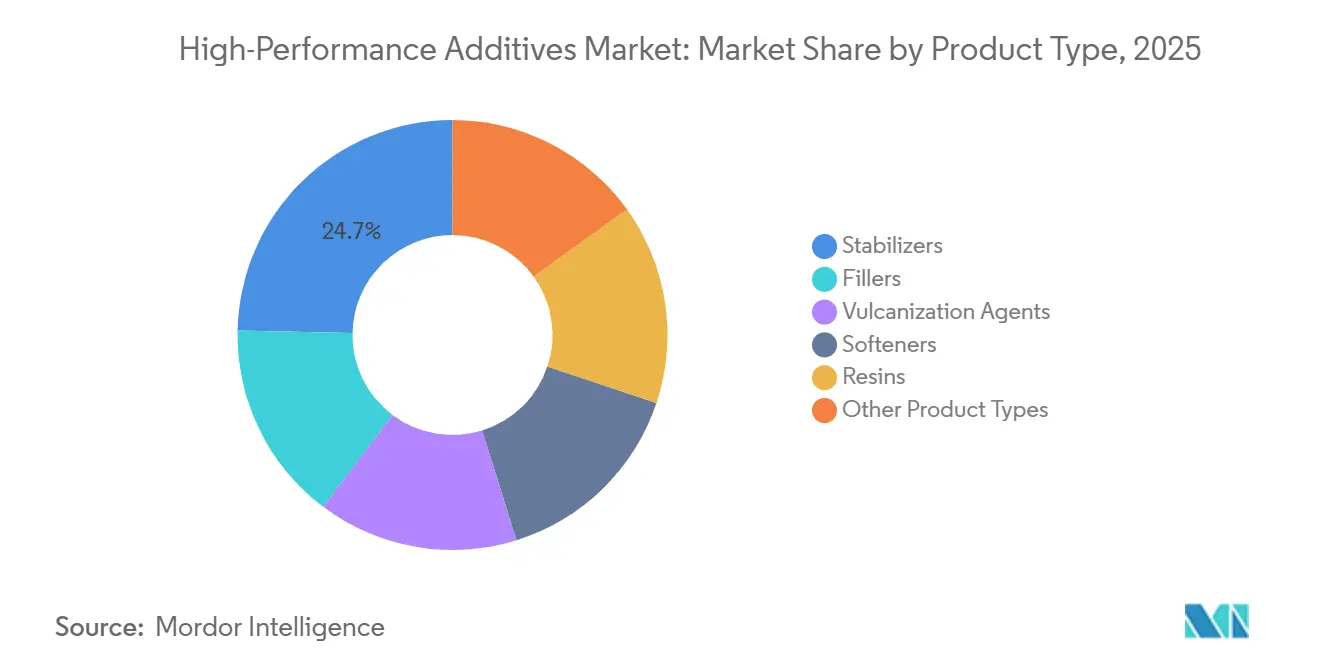
Stabilizers held 24.67% of the high-performance additives market share in 2025 and are projected to advance at a 7.95% CAGR through 2031. Their scale reflects use in automotive exterior parts, agricultural films, rubber compounds, and high-performance plastics. These applications need protection against ultraviolet radiation, heat, and oxidation over extended service periods. Hindered amine light stabilizers and non-migrating hindered amine light stabilizers are widely relevant where surface appearance and mechanical strength must be retained. Research on automotive polymer matrices found that combined stabilizer systems can preserve material properties during accelerated weathering. The result supports demand for packages that address more than one degradation pathway.
BASF announced significant investment to expand capacity for standard hindered amine light stabilizers and non-migrating hindered amine light stabilizers in April 2026. The expansion was linked to demand from electric vehicles, agricultural films, and automotive exterior applications. Fillers remain relevant for rubber reinforcement and for managing costs in plastic compounds. Vulcanization agents continue to track tire production and the shift toward upgraded tire compounds. Softeners and resins serve rubber and coating systems with more established specifications. Product development in the high-performance additives industry is also shaped by the need to meet safety requirements without sacrificing long-term durability.



By Function: Performance Additives Lead Premium Formulations
Performance additives held 68.32% of the high-performance additives market share in 2025 and are projected to advance at an 8.26% CAGR through 2031. The category includes antioxidants, flame retardants, ultraviolet stabilizers, antidegradants, and coupling agents. These materials allow polymers and rubbers to meet demanding specifications in automotive, aerospace, electronics, and medical uses. Their value rests on material performance rather than process efficiency alone. Customers use them when basic polymer grades cannot achieve the required thermal, electrical, mechanical, or safety properties. This supports their leading role in the high-performance additives market.
Processing additives remain important because they help compounders maintain flow, mixing, and throughput. Their role becomes more important when recycled feedstock introduces variation into the production process. Evonik Industries AG opened expanded specialty amine capacity in Nanjing in April 2026 for polyurethane and epoxy applications. The investment illustrates the focus on chemicals that improve end-use performance in demanding formulations. Automotive electrification and electronics production are important demand bases for this function. The high-performance additives market is moving toward solutions that combine process control with measurable material performance.
By Application: Composites Present the Fastest Expansion
Rubber and tires held 35.09% of the high-performance additives market share in 2025, while composites are projected to advance at an 8.48% CAGR through 2031. Rubber compounds consume antioxidants, antiozonants, and vulcanization agents that support tire life and safety. Electric vehicle tire requirements make this application especially important because tires operate under high torque and repeated braking loads. Composites offer a faster path because aircraft and vehicle components need lighter structures that still meet stringent certification requirements. Toughening agents, flame retardants, and coupling agents support the required balance of weight and durability. The high-performance additives market size for these applications is supported by materials that improve the reliability of composite systems.
SABIC introduced ULTEM SU3102P in 2026 for thermoset composites used in aerospace structures. The product was designed to improve the balance of toughness and stiffness in these systems. Plastics demand is supported by packaging and electronics demand. Paints and coatings are being influenced by the replacement of chemistries that do not meet current emission and safety requirements. Additive suppliers therefore need to support both formulation performance and compliance documentation. The high-performance additives market has opportunities where application requirements make generic products unsuitable.
By End-Use Industry: Automotive Supports Scale and Growth
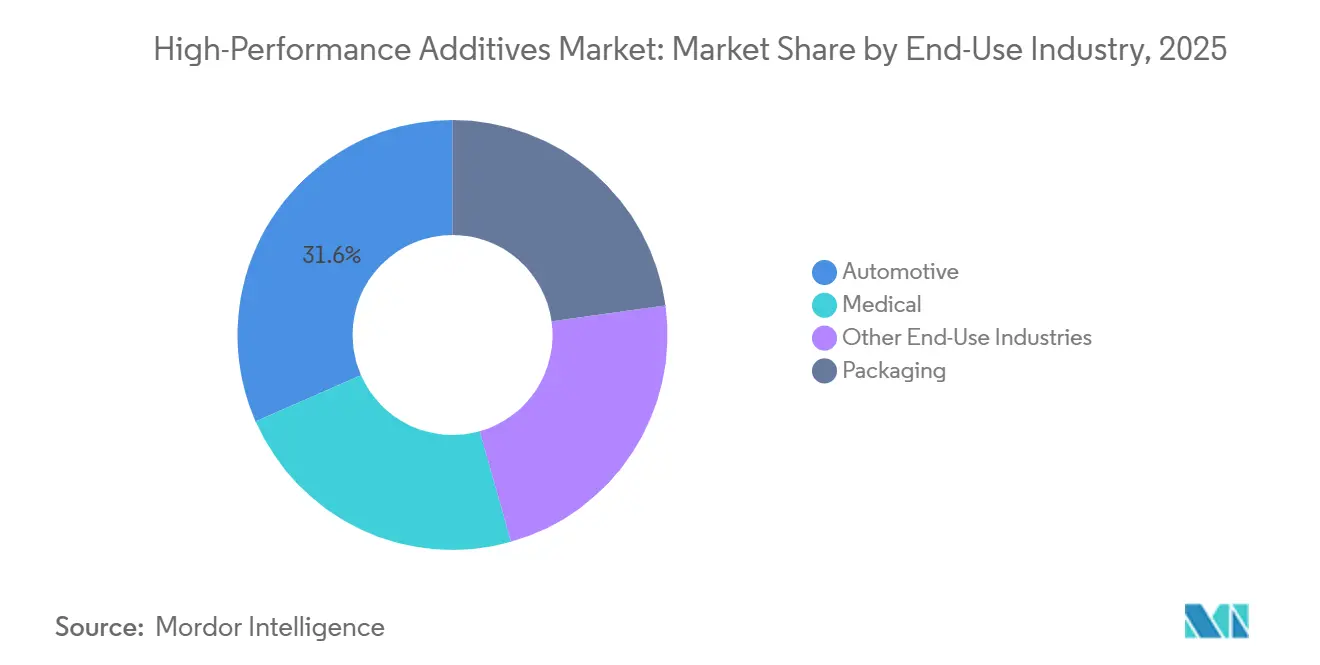
Automotive held 31.58% of the high-performance additives market share in 2025 and is projected to advance at an 8.72% CAGR through 2031. Vehicle manufacturers use additives in tires, interior and exterior plastics, coatings, adhesives, electrical systems, and lightweight components. Electric vehicle growth increases the need for materials that tolerate heat, voltage, mechanical stress, and long service lives. This provides a large demand base for specialized rubber and polymer formulations. Automotive remains a central end-use for the high-performance additives market.
Medical uses require materials that can meet biocompatibility and sterilization stability requirements. Packaging demand is supported by interest in recycled-content systems that retain workable processing and material properties. Construction, agriculture, and consumer goods create a broader base of demand across regions. These applications help reduce exposure to short-term changes in vehicle and industrial production. They also require product designs tailored to the polymer, process, and required service life. The high-performance additives industry benefits when suppliers can apply technical knowledge across several end-use settings.
Geography Analysis
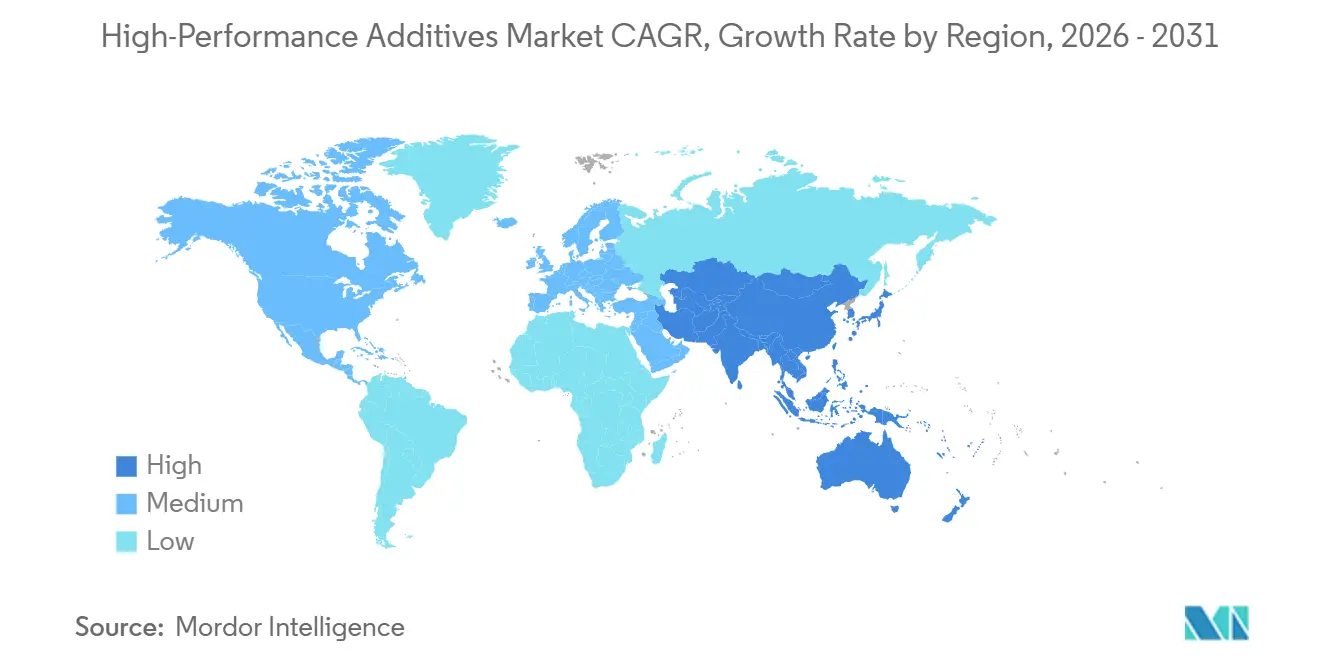
Asia-Pacific held 46.66% of the high-performance additives market share in 2025 and is projected to advance at an 8.07% CAGR through 2031. China is the regional anchor because it combines large electric vehicle production with extensive polymer processing. India is expanding its automotive and pharmaceutical manufacturing base. LANXESS opened a lubricant additive blending plant in Jhagadia, Gujarat, in April 2026. Japan and South Korea support high-value consumption in electronics, semiconductor packaging films, and automotive applications.
Thailand, Vietnam, and Indonesia are developing as automotive assembly locations in Southeast Asia. This creates upstream demand for additives as original equipment manufacturers diversify production networks. CLARIANT completed its Daya Bay expansion in China in June 2026, focusing on halogen-free flame retardants for e-mobility. Evonik Industries AG also expanded specialty amine capacity in Nanjing in April 2026. These investments reflect demand for local supply of higher-value formulations. Asia-Pacific, therefore, remains the principal production and consumption base for the high-performance additives market size.
North America and Europe form important demand centers with different end-market conditions. North America is supported by aerospace composites, pharmaceutical plastics, and electric vehicle supply chains. Europe is strongly shaped by chemical safety and emissions requirements that drive product reformulation. Germany remains important through its automotive supplier base and specialty chemical production. South America benefits from rubber, tire, and packaging activity in Brazil and Argentina. The Middle East and Africa are developing through automotive assembly, health care investment, and regional polymer operations, though infrastructure constraints limit specialty penetration in some locations.

Competitive Landscape
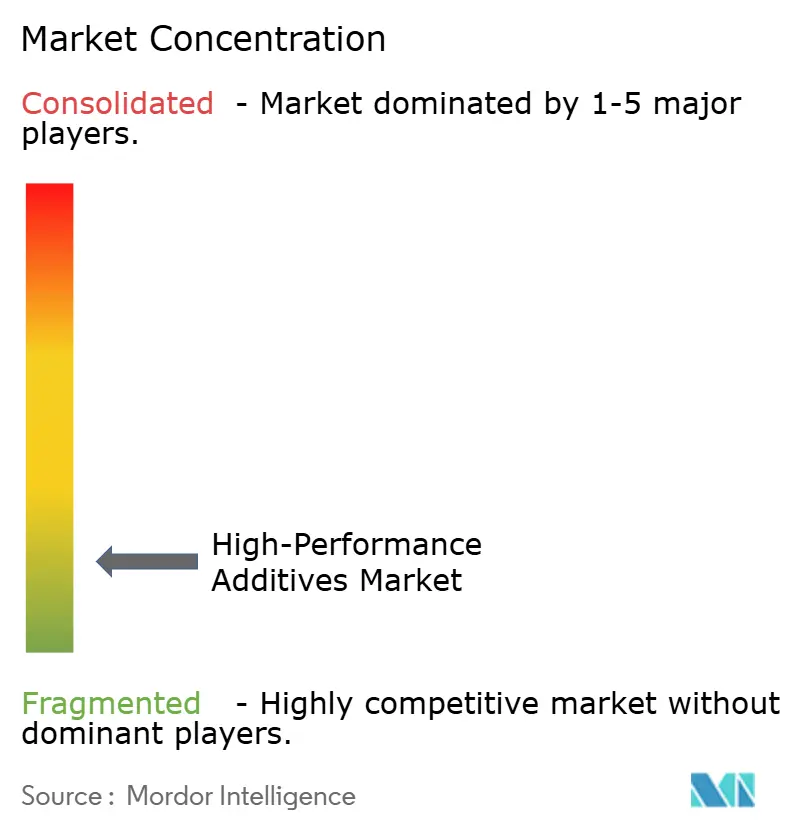
The high-performance additives market is highly fragmented, with the top five players including BASF, Evonik Industries AG, CLARIANT, LANXESS, and Solvay. Regional suppliers compete more actively in standardized grades, where price has greater weight in customer decisions. Larger producers use proprietary chemistry and application support to deepen relationships with polymer processors. Technical teams often work with customers on packages designed for specific polymer matrices and production conditions. This approach can make switching suppliers more difficult when the formulation is validated for a demanding application. Competitive success, therefore, depends on service, compliance capability, and dependable supply as well as chemistry.
CLARIANT completed a CHF 100 million (approximately USD 127 million) investment at Daya Bay in June 2026 to expand flame-retardant capacity for e-mobility systems. Evonik Industries AG started operations at its expanded Nanjing specialty amine facility in April 2026[2]Evonik Industries AG, “Evonik Expands Global Production of Hydroxyl-Terminated Polybutadienes,” Evonik Industries AG, evonik.com. BASF announced capacity additions for standard and non-migrating hindered amine light stabilizers in April 2026. These moves show that capacity is being placed near growing Asian demand and in applications that need specialized performance. LANXESS also introduced Vulkanox 4060 for tire applications in September 2026. The high-performance additives market is increasingly shaped by products that address regulatory and application requirements together.
Bio-based and lower-impact chemistries are becoming part of product positioning in selected categories. LANXESS launched Disflamoll Advance in August 2026 with less than 0.1% triphenyl phosphate content. The company positioned the platform for flexible polyvinyl chloride, thermoplastic polyurethane, synthetic rubber, and cellulose ester uses. Research has also described modeling tools that may help predict additive dispersion and interactions in complex polymer matrices. Such approaches may shorten development work for customized recycled-material formulations. Competition in the high-performance additives market is likely to remain strongest where product performance must be validated against demanding technical requirements.
High-Performance Additives Industry Leaders
BASF
Evonik Industries AG
CLARIANT
LANXESS
Solvay
- *Disclaimer: Major Players sorted in no particular order

Recent Industry Developments
- April 2026: Evonik Industries AG inaugurated an expanded specialty amine production facility in Nanjing, China, following a double-digit-million-euro investment to increase supply of advanced amine-based additives. The additional capacity supports growing demand for high-performance, low-Volatile Organic Compound (VOC) additives used in polyurethane and epoxy applications.
- April 2026: BASF announced capacity expansions for standard Hindered Amine Light Stabilizers (HALS) and NOR HALS, strengthening its supply of high-performance plastic additives for applications requiring enhanced ultraviolet (UV) resistance, durability, and longer service life. The investment supports demand for advanced additives in agricultural films, molded plastics, and other applications exposed to harsh environmental conditions.


Global High-Performance Additives Market Report Scope
High-performance additives are specialized materials incorporated into formulations to enhance specific properties and processing characteristics. They help improve durability, stability, functionality, and manufacturing efficiency in finished products.
The High-Performance Additives Market is segmented by product type, function, application, end-use industry, and geography. By product type, the market is segmented into stabilizers, fillers, vulcanization agents, softeners, resins, and other product types. By function, the market is segmented into performance additives and processing additives. By application, the market is segmented into rubber and tires, plastics, paints and coatings, composites, and other applications. By end-use industry, the market is segmented into automotive, medical, packaging, and other end-use industries. The report also covers the market size and forecasts for high-performance additives in 15 countries across major regions. For each segment, the market sizing and forecasts have been done on the basis of value (USD).
| Stabilizers |
| Fillers |
| Vulcanization Agents |
| Softeners |
| Resins |
| Other Product Types |
| Performance Additives |
| Processing Additives |
| Rubber and Tires |
| Plastics |
| Paints and Coatings |
| Composites |
| Other Applications |
| Automotive |
| Medical |
| Packaging |
| Other End-Use Industries |
| Asia-Pacific | China |
| India | |
| Japan | |
| South Korea | |
| ASEAN Countries | |
| Rest of Asia-Pacific | |
| North America | United States |
| Canada | |
| Mexico | |
| Europe | Germany |
| United Kingdom | |
| France | |
| Italy | |
| NORDIC Countries | |
| Rest of Europe | |
| South America | Brazil |
| Argentina | |
| Rest of South America | |
| Middle East and Africa | Saudi Arabia |
| South Africa | |
| Rest of Middle East and Africa |
| By Product Type | Stabilizers | |
| Fillers | ||
| Vulcanization Agents | ||
| Softeners | ||
| Resins | ||
| Other Product Types | ||
| By Function | Performance Additives | |
| Processing Additives | ||
| By Application | Rubber and Tires | |
| Plastics | ||
| Paints and Coatings | ||
| Composites | ||
| Other Applications | ||
| By End-Use Industry | Automotive | |
| Medical | ||
| Packaging | ||
| Other End-Use Industries | ||
| By Geography | Asia-Pacific | China |
| India | ||
| Japan | ||
| South Korea | ||
| ASEAN Countries | ||
| Rest of Asia-Pacific | ||
| North America | United States | |
| Canada | ||
| Mexico | ||
| Europe | Germany | |
| United Kingdom | ||
| France | ||
| Italy | ||
| NORDIC Countries | ||
| Rest of Europe | ||
| South America | Brazil | |
| Argentina | ||
| Rest of South America | ||
| Middle East and Africa | Saudi Arabia | |
| South Africa | ||
| Rest of Middle East and Africa | ||


Key Questions Answered in the Report
What is the size of the high-performance additives market?
The high-performance additives market stands at USD 15.86 billion in 2026 and is projected to reach USD 22.61 billion by 2031.
What is driving demand for high-performance additives?
Electric vehicle production, lightweight materials, low-emission formulation requirements, electronics, medical plastics, and recycled-polymer processing needs are supporting demand.
Which product type led the market demand in 2025?
Stabilizers held a 24.67% share in 2025.
Which application is expected to grow fastest through 2031?
Composites are projected to advance at an 8.48% CAGR through 2031, supported by aerospace and automotive lightweighting needs.
Page last updated on:





