
Heart Closure Devices Market Size and Share
Market Overview
| Study Period | 2020 - 2031 |
|---|---|
| Market Size (2026) | USD 3.19 Billion |
| Market Size (2031) | USD 6.56 Billion |
| Growth Rate (2026 - 2031) | 15.52 % |
| Fastest Growing Market | Asia-Pacific |
| Largest Market | North America |
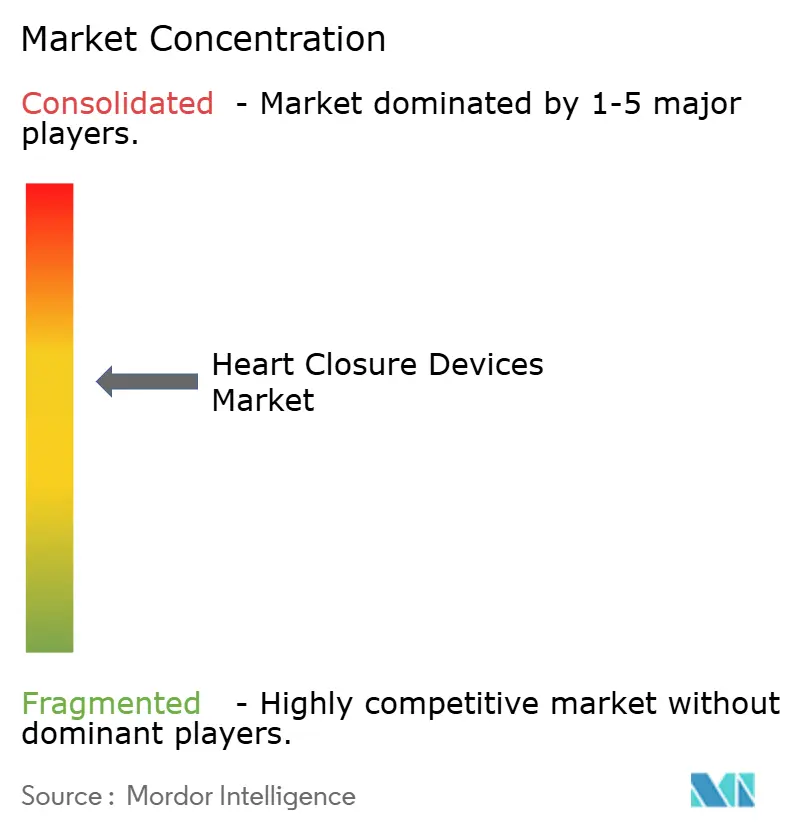
| Market Concentration | Medium |
Major Players *Disclaimer: Major Players sorted in no particular order Image © Mordor Intelligence. Reuse requires attribution under CC BY 4.0. | |
Heart Closure Devices Market Analysis by Mordor Intelligence
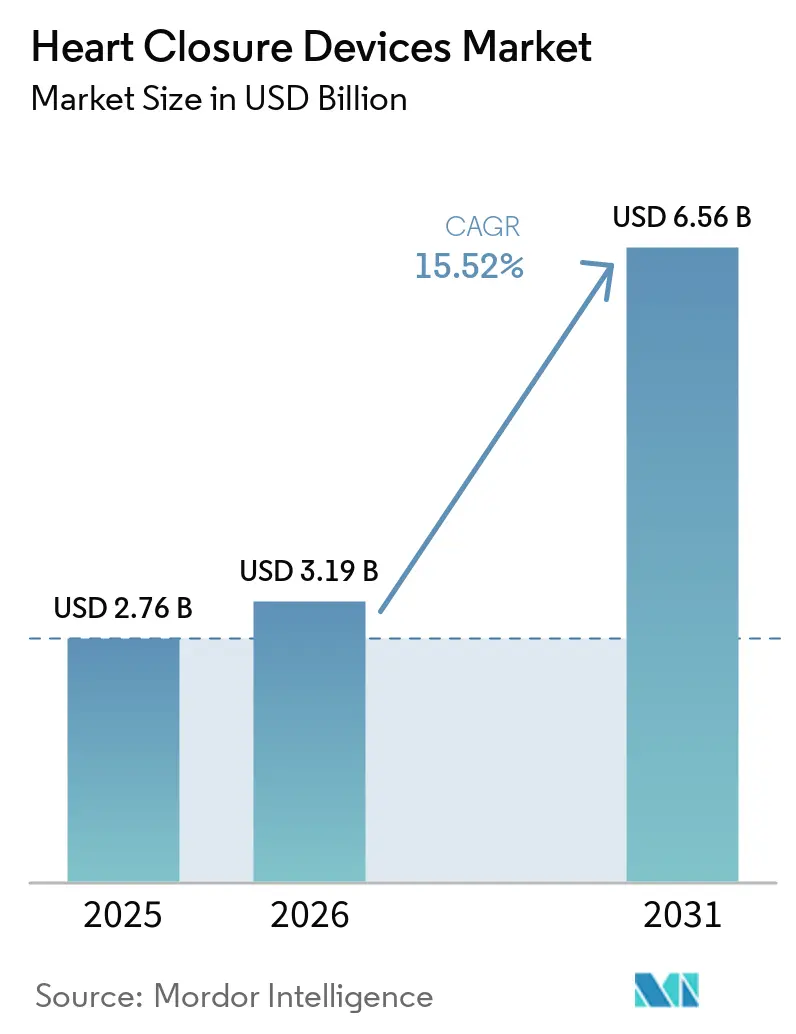
The Heart Closure Devices Market size is expected to grow from USD 2.76 billion in 2025 to USD 3.19 billion in 2026 and is forecast to reach USD 6.56 billion by 2031 at 15.52% CAGR over 2026-2031.
Demand is supported by atrial fibrillation and congenital heart disease, which create separate patient pools for left atrial appendage and septal closure procedures and make demand less dependent on one treatment pathway. Atrial fibrillation and atrial flutter affected 52.55 million people globally in 2021, and prevalence is expected to rise as populations age in higher-income regions. Congenital heart disease affected 2.3 million to 2.5 million newborns each year, while 16 million people lived with the condition globally in 2023, reflecting a broader population surviving after diagnosis. The heart closure device market is also moving toward catheter-based care, supported by clinical evidence, reimbursement changes, and a wider outpatient care base that can improve procedural capacity. Companies are therefore competing through evidence generation, imaging support, material design, and access to trained procedure centers, while supply planning and local clinical training remain important for extending adoption beyond established hospitals and reaching patients who are currently treated only at major referral centers, particularly as healthcare systems move suitable procedures into more specialized outpatient settings and seek to manage capacity without weakening safety controls or limiting access for clinically appropriate patient groups in diverse care settings.
Key Report Takeaways
- By closure type, congenital heart defect closure held 46.65% of the heart closure device market share in 2025, while left atrial appendage closure is forecast to grow at a 17.43% CAGR through 2031.
- By material, nitinol-based devices held 51.87% share in 2025 and are forecast to expand at a 17.54% CAGR through 2031.
- By mode of delivery, transcatheter delivery held 57.43% share in 2025 and is forecast to expand at a 17.85% CAGR through 2031.
- By end user, tertiary care hospitals held 51.65% share in 2025, while specialty heart clinics are forecast to grow at an 18.43% CAGR through 2031.
- By geography, North America held 44.28% share in 2025, while the Asia-Pacific is projected to grow at a CAGR of 16.54%.
Note: Market size and forecast figures in this report are generated using Mordor Intelligence’s proprietary estimation framework, updated with the latest available data and insights as of January 2026.
Global Heart Closure Devices Market Trends and Insights
Drivers Impact Analysis*
| Driver | (~) % Impact on CAGR Forecast | Geographic Relevance | Impact Timeline |
|---|---|---|---|
| Rising Structural Heart Disease And Atrial Fibrillation Burden | +4.50% | Global, highest in North America and high-SDI Europe | Long term (≥ 4 years) |
| Shift Toward Minimally Invasive Transcatheter Treatment | +3.80% | Global, especially North America, Western Europe, and urban Asia-Pacific centers | Medium term (2-4 years) |
| Stronger Clinical Evidence And Reimbursement Expansion | +3.20% | North America and the European Union, with effects in Asia-Pacific and the Middle East and Africa | Medium term (2-4 years) |
| Aging And Pediatric Congenital Heart Disease Populations | +2.20% | Global, with pediatric demand in South and East Asia and aging demand in Western Europe and Japan | Long term (≥ 4 years) |
| Procedure Planning With Intracardiac Echocardiography And Computational Imaging | +1.80% | Global, with earlier adoption in high-volume structural heart centers in North America, Europe, and Asia-Pacific | Medium term (2-4 years) |
| Biodegradable Occluders For Pediatric And Repeat-Intervention Use | +1.50% | Global, with stronger relevance in pediatric congenital heart disease centers in Asia-Pacific, Europe, and North America | Long term (≥ 4 years) |
| Source: Mordor Intelligence | |||
Rising Structural Heart Disease and Atrial Fibrillation Burden
Atrial fibrillation remains the main clinical driver for left atrial appendage closure in the heart closure device market. The U.S. Centers for Disease Control and Prevention projects that 12.1 million people in the United States will have atrial fibrillation by 2050. Mortality associated with atrial fibrillation and ischemic heart disease rose at an annual percentage change of 1.6% from 2010 to 2023. Boston Scientific reported in March 2026 that 40% of patients prescribed blood thinners for stroke prevention do not take them consistently. On the congenital side, ventricular septal defects represent 30% to 40% of congenital heart disease cases, and atrial septal defects account for 7% to 10%. This combination gives the heart closure device market a demand base that is not tied to one clinical indication.
Shift Toward Minimally Invasive Transcatheter Treatment
Transcatheter procedures have become central to congenital heart defects, patent foramen ovale, and left atrial appendage closure. Multiple atrial septal defect devices have received U.S. Food and Drug Administration approval, and CPT code 93580 provides a standard reimbursement route for closure of congenital interatrial communications. Studies involving more than 5,000 patients reported closure success approaching 100% within 6 months for leading nitinol occluders. Japan had performed more than 10,000 left atrial appendage closure procedures by 2025 after introducing the procedure in 2019. The heart closure device market benefits when standardized procedures can be offered in a wider range of settings. This shift can reduce the hospital capacity limits that restrict procedure volumes.
Stronger Clinical Evidence and Reimbursement Expansion
Clinical evidence is widening the potential use of left atrial appendage closure. The CHAMPION-AF trial enrolled 3,000 patients at 141 sites in 16 countries and found Watchman FLX non-inferior to NOACs for a composite endpoint at 3 years, with event rates of 5.7% and 4.8%, respectively. The trial also reported lower non-procedural bleeding and a better net clinical benefit result for the device group. Boston Scientific stated that a successful label expansion could increase the addressable population from 5 million to 20 million atrial fibrillation patients globally. The CMS FY2026 rule raised payment for MS-DRG 317 by 10% to USD 48,656 and increased payments for MS-DRGs 273 and 274 by 8%. These changes improve the procedure economics supporting the heart closure device market.
Aging and Pediatric Congenital Heart Disease Populations
Longer survival after a congenital heart disease diagnosis is increasing the number of patients who may need care across their lifetime. Global congenital heart disease prevalence reached 16 million people in 2023, compared with 11.8 million in 1990. The U.S. annual economic burden of congenital heart disease exceeds USD 74 billion, and the average lifetime cost per patient is USD 2.1 million. Abbott received FDA clearance and CE Mark in December 2025 for the Amplatzer Piccolo Delivery System for premature infants weighing as little as 2 pounds. The system shows how product design is extending treatment to smaller and clinically fragile patients. The heart closure device market also has room for biodegradable devices, where long-term metal retention can be a concern for pediatric patients.
Restraints Impact Analysis*
| Restraint | (~) % Impact on CAGR Forecast | Geographic Relevance | Impact Timeline |
|---|---|---|---|
| High Upfront Device And Procedure Cost | -1.20% | Global, with the greatest constraint in the Middle East and Africa, South America, and Tier 2 and Tier 3 Asia-Pacific markets | Long term (≥ 4 years) |
| Device-Related Thrombus, Embolization, Effusion, And Atrial Fibrillation Risk | -0.90% | Global, particularly early-experience centers and settings with limited intensive care support | Medium term (2-4 years) |
| Operator Learning Curve And Imaging-Dependent Workflow | -1.10% | Global, especially lower-volume hospitals and emerging structural heart procedure centers | Medium term (2-4 years) |
| Nitinol And Specialized Component Supply Volatility | -0.80% | Global, with highest relevance across major medical device manufacturing and supply hubs | Medium term (2-4 years) |
| Source: Mordor Intelligence | |||
High Upfront Device and Procedure Cost
The cost of a closure procedure can limit adoption outside North America and Western Europe. Device cost, catheterization laboratory time, imaging, specialist services, and inpatient care can take the cost of a left atrial appendage closure procedure above USD 25,000 in high-income settings. This level can strain reimbursement systems in middle-income countries where payment may be much lower. China’s volume-based procurement program places pricing pressure on structural heart devices even as procedure volumes increase. Boston Scientific stated in its first-quarter 2026 update that standalone Watchman volumes softened because of hospital capacity constraints, procedure prioritization, and reimbursement dynamics[1]Centers for Medicare & Medicaid Services, “FY2026 IPPS Final Rule Advisory Reimbursement Summary,” Boston Scientific Reimbursement Resources, bostonscientific.com.. These factors can slow heart closure device market adoption in lower-income systems without preventing long-term demand.
Device-Related Thrombus, Embolization, Effusion, and Atrial Fibrillation Risk
Safety outcomes remain important for physicians and patients, especially at lower-volume centers. In CHAMPION-AF, ischemic stroke occurred in 3.2% of the left atrial appendage closure group and 2% of the NOAC group at 3 years. Device-related thrombus requires careful post-procedure antiplatelet monitoring. The WATCHMAN FLX Pro NOAC Alone Post-Approval Study filed its 6-month report on schedule in January 2026 and evaluates a NOAC-alone post-implant regimen[2]U.S. Food and Drug Administration, “WATCHMAN FLX Pro NOAC Alone PAS Reporting Schedule,” FDA CDRH, accessdata.fda.gov.. Cardiac effusion and device embolization need experienced teams and adequate imaging capacity when they occur. The 2025 SCAI statement found higher pericardial effusion and residual shunt rates with ICE-guided left atrial appendage occlusion than with TEE guidance.
*Our forecasts treat driver/restraint impacts as directional, not additive. The impact forecasts reflect baseline growth, mix effects, and variable interactions.
Segment Analysis
By Closure Type: Congenital Closure Leads, While LAA Closure Expands
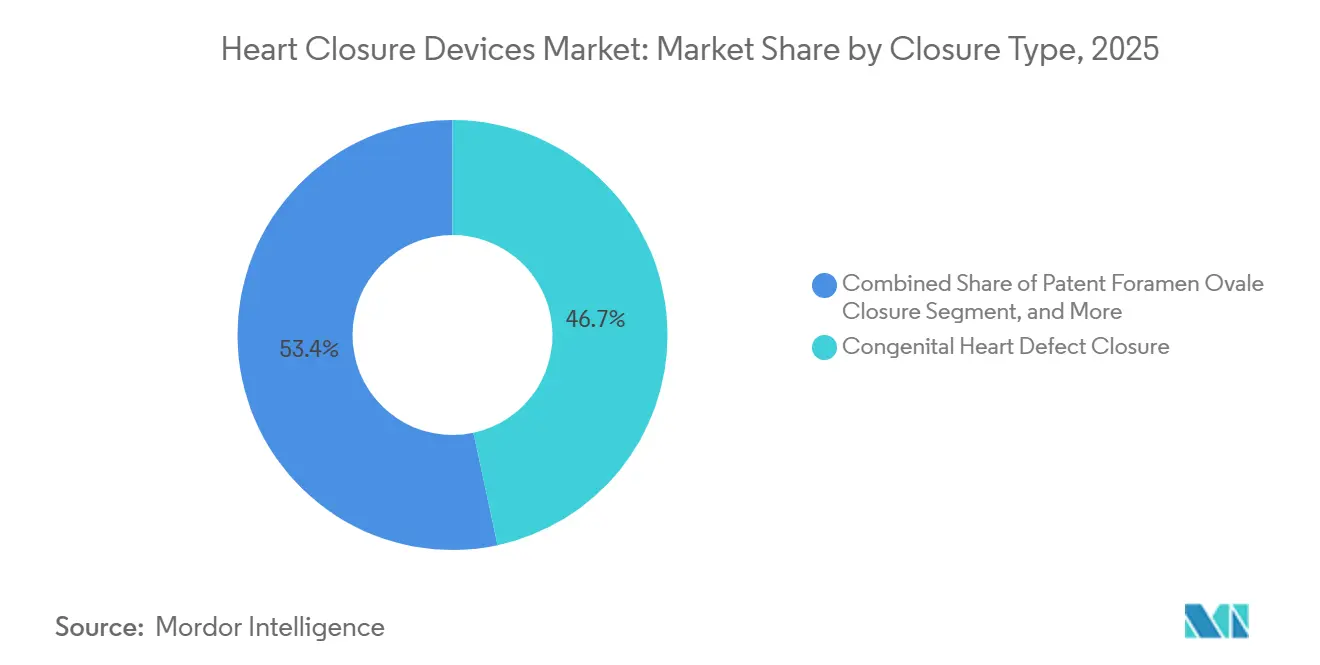
Congenital heart defect closure accounted for 46.65% of the closure device category in 2025. Its position reflects the frequency of ventricular and atrial septal defects and the maturity of transcatheter repair pathways. Ventricular septal defects and atrial septal defects together account for 37% to 50% of congenital heart disease cases. The Amplatzer Septal Occluder and GORE CARDIOFORM devices are established options in this field. Occlutech’s ASD Occluder also received FDA approval for the U.S. market. Published data from more than 5,000 patients support high closure success rates for leading devices.
Left atrial appendage closure is projected to expand at a 17.43% CAGR through 2031. This rate makes it the fastest-growing closure type in the heart closure device market. CHAMPION-AF supports a potential move from use in selected anticoagulation patients to a larger stroke prevention population. Abbott received CE Mark for Amulet 360 in August 2026 after the VERITAS study reported 99.8% implant success and 93.9% complete closure at 45 days. Patent foramen ovale closure remains a meaningful secondary category, supported by its established role in cryptogenic stroke prevention. The PerFOrm and PROTEA-PFO studies are assessing additional PFO device applications and device designs.



By Material: Nitinol Leads While Bioresorbable Devices Develop
Nitinol-based devices held 51.87% share in 2025. Their position comes from shape-memory and superelastic properties that support self-expanding occluder designs. These devices can be compressed in a catheter and expand to match defect geometry at implantation. Nitinol occluders accounted for 79.8% of the worldwide atrial septal occluder category in 2025. Stainless steel devices remain in a narrower role as newer platforms offer stronger biocompatibility and MRI compatibility. Polymer composite and bioresorbable products have smaller current positions in the heart closure device industry.
Bioresorbable devices are a developing material option for patients who may benefit from avoiding a permanent metal implant. Lepu Medical’s MemoSorb uses a PDO stent and PLA membrane that fully degrade within 12 to 24 months. A 2025 study reported 90.63% closure success for MemoSorb at 6 months, compared with 91.30% for metal occluders, and 99.8% material degradation at 2 years. The BioMetal trial is comparing a biodegradable occluder with a nitinol alloy device in 400 PFO patients with medication-refractory migraine. Nitinol supply concentration remains a risk because lead times had risen from 10 to 12 weeks to nearly 1 year. Confluent Medical Technologies committed more than USD 50 million to expand capacity 3 times by 2027 through an ATI partnership.
By Mode of Delivery: Transcatheter Delivery Gains from Outpatient Care
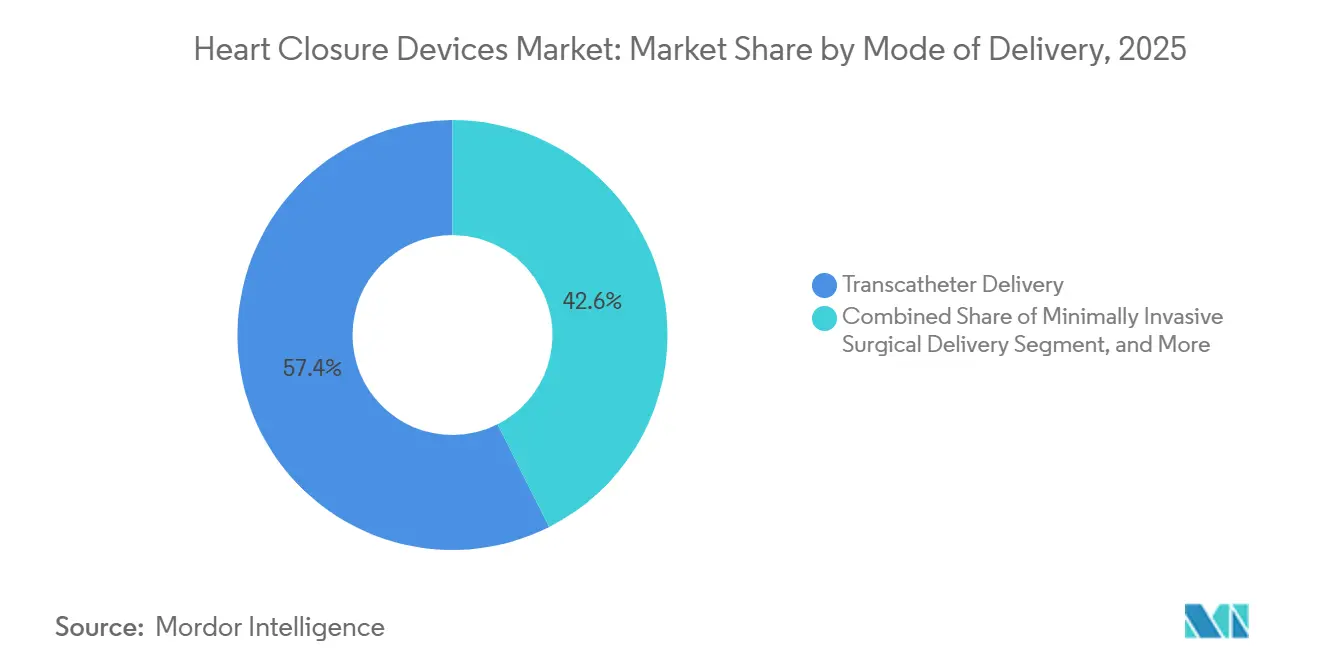
Transcatheter delivery held 57.43% of the heart closure device market size in 2025 and is forecast to grow at a 17.85% CAGR through 2031. It leads because it can shorten hospital stays and lower anesthesia exposure compared with open surgery. Its role covers closure procedures for congenital heart disease, patent foramen ovale, and the left atrial appendage. A multicenter study reported 98.7% technical success and 94.8% clinical success with the VeriSight Pro ICE catheter. ICE can allow procedures without general anesthesia in suitable patients. The 2025 SCAI statement also standardized ICE protocols for left atrial appendage, atrial septal defect, and PFO closure.
Minimally invasive surgical delivery remains relevant when transcatheter access is not suitable or when procedures are combined with cardiac ablation. CMS increased reimbursement for concomitant left atrial appendage closure and ablation by 10% to USD 48,656 under MS-DRG 317. Open surgical delivery is used mainly for complex congenital presentations that require operative access. Outpatient cardiovascular procedures are projected to grow 25% by 2035, compared with 8% for inpatient procedures. This setting change favors the heart closure device market segment served through catheters. Surgical approaches remain important where anatomy, risk, or combined procedures require them.
By End User: Tertiary Hospitals Lead While Specialty Clinics Grow
Tertiary care hospitals held 51.65% of the heart closure device market size in 2025. They have catheterization laboratories, advanced imaging, and multidisciplinary teams for high-risk procedures. These hospitals treat many pediatric congenital cases and adults with multiple conditions. They also host device studies that can shape later adoption. Ascension Saint Thomas Rutherford opened a Structural Heart and Valve Center in Tennessee in September 2025. The continued expansion of these programs supports complex care within the heart closure device industry.
Specialty heart clinics are expected to grow at an 18.43% CAGR through 2031. Their growth follows the transfer of standardized procedures from large academic hospitals to focused outpatient cardiovascular sites. These sites can reduce overhead and increase patient throughput. Amavita Heart and Vascular Health opened a dedicated cardiovascular ambulatory surgery center in Miami in June 2025 with 2 hybrid operating suites. Cardiac catheterization laboratories remain the main procedural setting for left atrial appendage closure. Ambulatory surgical centers are becoming more relevant as payment and regulatory conditions support outpatient cardiac care.
Geography Analysis
North America held 44.28% of the heart closure device market share in 2025. The region benefits from established reimbursement, device approval systems, and a high density of structural heart centers. The United States accounts for most regional revenue through Watchman and Amplatzer procedures. CHAMPION-AF data reported in March 2026 can support future label expansion efforts in the region. CMS payment changes are also favorable for procedure economics.
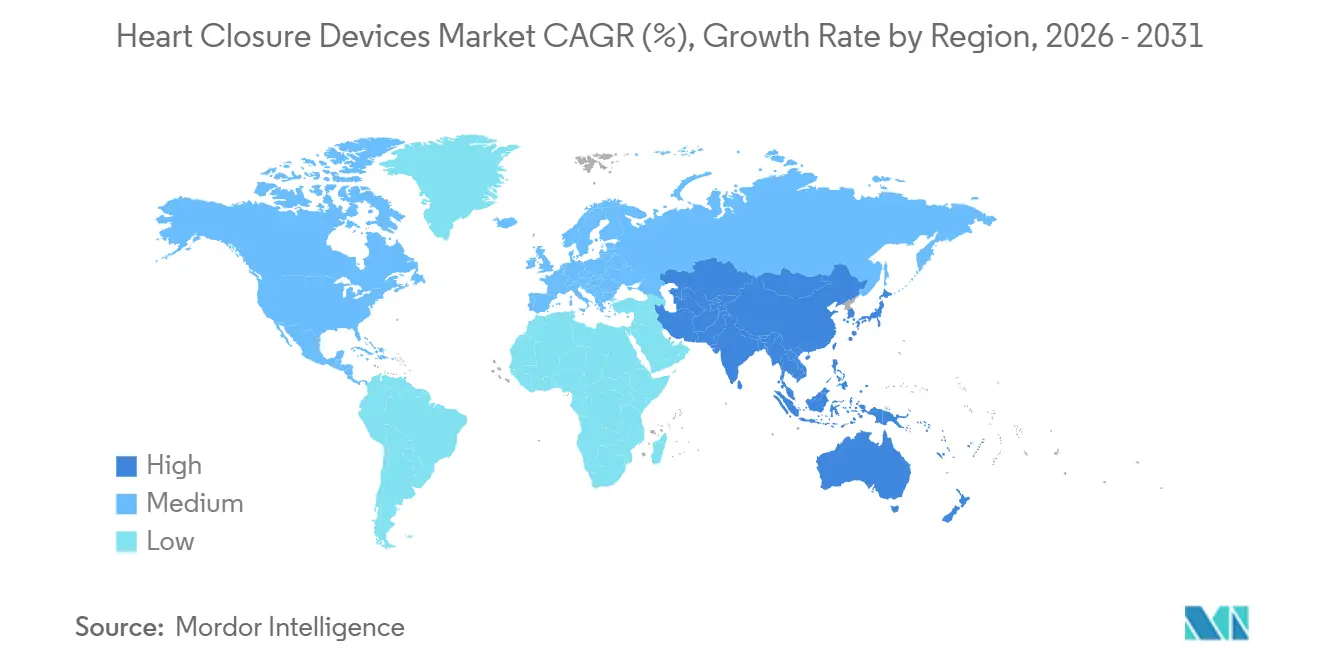
Asia-Pacific is expected to grow at a 16.54% CAGR through 2031, the fastest regional rate in the heart closure device market. China has a large congenital heart disease patient population and a domestic manufacturing base for closure devices. Its volume-based procurement approach can lower average selling prices while volumes rise. India’s National Health Mission identified more than 1.2 million new cardiovascular cases in FY2023-24 through district-level screening. Production-linked incentives also support domestic medical device manufacturing. Japan has performed more than 10,000 left atrial appendage closure procedures since 2019.
Europe holds the second-largest regional position, led by Germany, the United Kingdom, France, and Italy. The 2025 ESC and EACTS guidelines added 28 recommendations and emphasized specialized Heart Valve Centers with high procedural volumes. This infrastructure can support the heart closure device market through shared imaging and multidisciplinary capabilities. The CLOSURE-AF trial included 912 high-risk atrial fibrillation patients and found non-inferiority for left atrial appendage closure across composite outcomes. The Middle East, Africa, and South America have lower adoption because of budget limits, reimbursement gaps, and training needs. Investment in catheterization laboratories in Gulf Cooperation Council nations and Brazil can support later volume growth.

Competitive Landscape
The heart closure device market is moderately concentrated in left atrial appendage closure. Abbott and Boston Scientific are the key companies in this category through the Amplatzer Amulet and Watchman FLX platforms. The congenital heart defect closure category is more fragmented. Important participants include Occlutech Holding AG, W. L. Gore & Associates, Lepu Medical Technology, Lifetech Scientific, Meril Life Sciences, and pfm medical ag. China-based and India-based manufacturers also serve local demand. Competition in the heart closure device market is increasingly based on clinical evidence, material design, and regulatory access.
Abbott presented 5-year Amulet IDE data in November 2024 from more than 1,800 patients. In August 2026, Abbott obtained CE Mark for Amulet 360, which uses a redesigned lobe and dual-seal design. Boston Scientific used the CHAMPION-AF trial to support a planned submission for first-line indication expansion. Lepu Medical expanded MemoSorb use through a first implantation in Russia in June 2026. These actions show that leading companies are working on evidence, next-generation design, and geographic access.
Bioresorbable occluders offer a possible opening in pediatric congenital care because no major incumbent has reached large-scale approval outside China. Lepu Medical has positioned MemoSorb as an early entrant in this field. Recross Cardio’s P3 Occluder and Shanghai Lingsi Medical Technology’s biodegradable PFO occluder are in clinical studies. New devices must meet applicable implant, biocompatibility, and national regulatory requirements. FDA approval routes apply in the United States, while CE Mark requirements apply in Europe and NMPA registration applies in China. The heart closure device market remains concentrated in LAA closure but dispersed across congenital closure suppliers.
Heart Closure Devices Industry Leaders
Abbott
Boston Scientific Corporation
W. L. Gore & Associates, Inc.
Lifetech Scientific Corporation
Occlutech Holding AG
- *Disclaimer: Major Players sorted in no particular order

Recent Industry Developments
- August 2026: Abbott received CE Mark for the Amulet 360™ Left Atrial Appendage Occluder, a next-generation device featuring a redesigned softer, more conformable lobe and dual-seal design. The VERITAS study across more than 30 hospitals in the US, Canada, and Europe reported 99.8% implant success and 93.9% complete LAA closure with zero peri-device leaks greater than 3 mm at 45 days. The first European cases were completed in Frankfurt, Lübeck, and Aarhus. The device remains investigational in the United States.
- June 2026: Lepu Medical completed the first-in-Russia implantation of MemoSorb biodegradable occluders for ASD and PFO at the Bakoulev National Medical Research Center for Cardiovascular Surgery in Moscow, marking a geographic expansion for biodegradable occluder adoption.
- March 2026: Boston Scientific’s CHAMPION-AF trial at the American College of Cardiology demonstrated that Watchman FLX is non-inferior to NOACs for composite stroke, cardiovascular death, and systemic embolism at 3 years. The study included 3,000 patients at 141 sites in 16 countries and showed lower non-procedural bleeding events.
- December 2025: Abbott received FDA clearance and CE Mark for the Amplatzer Piccolo Delivery System, a single-catheter system for closing patent ductus arteriosus in premature infants weighing as little as 2 pounds.


Global Heart Closure Devices Market Report Scope
The heart closure devices market is segmented into closure type, material, mode of delivery, end user, and geography. By closure type, the market is segmented into congenital heart defect closure, patent foramen ovale closure, and left atrial appendage closure. By material, the market is segmented into nitinol-based devices, stainless steel devices, polymer composite devices, and bioresorbable and fully degradable materials. By mode of delivery, the market is segmented into transcatheter delivery, minimally invasive surgical delivery, and open surgical delivery. By end user, the market is segmented into tertiary care hospitals, cardiac catheterization laboratories, ambulatory surgical centers, and specialty heart clinics. By geography, the market is segmented into North America, Europe, Asia-Pacific, the Middle East and Africa, and South America. The report also covers the estimated market sizes and trends for 17 countries across major regions globally. The report offers values (USD) for all the above segments.
| Congenital Heart Defect Closure |
| Patent Foramen Ovale Closure |
| Left Atrial Appendage Closure |
| Nitinol-Based Devices |
| Stainless Steel Devices |
| Polymer Composite Devices |
| Bioresorbable and Fully Degradable Materials |
| Transcatheter Delivery |
| Minimally Invasive Surgical Delivery |
| Open Surgical Delivery |
| Tertiary Care Hospitals |
| Cardiac Catheterization Laboratories |
| Ambulatory Surgical Centers |
| Specialty Heart Clinics |
| North America | United States |
| Canada | |
| Mexico | |
| Europe | Germany |
| United Kingdom | |
| France | |
| Italy | |
| Spain | |
| Rest of Europe | |
| Asia-Pacific | China |
| Japan | |
| India | |
| Australia | |
| South Korea | |
| Rest of Asia-Pacific | |
| Middle East and Africa | GCC |
| South Africa | |
| Rest of Middle East and Africa | |
| South America | Brazil |
| Argentina | |
| Rest of South America |
| By Closure Type | Congenital Heart Defect Closure | |
| Patent Foramen Ovale Closure | ||
| Left Atrial Appendage Closure | ||
| By Material | Nitinol-Based Devices | |
| Stainless Steel Devices | ||
| Polymer Composite Devices | ||
| Bioresorbable and Fully Degradable Materials | ||
| By Mode of Delivery | Transcatheter Delivery | |
| Minimally Invasive Surgical Delivery | ||
| Open Surgical Delivery | ||
| By End User | Tertiary Care Hospitals | |
| Cardiac Catheterization Laboratories | ||
| Ambulatory Surgical Centers | ||
| Specialty Heart Clinics | ||
| Geography | North America | United States |
| Canada | ||
| Mexico | ||
| Europe | Germany | |
| United Kingdom | ||
| France | ||
| Italy | ||
| Spain | ||
| Rest of Europe | ||
| Asia-Pacific | China | |
| Japan | ||
| India | ||
| Australia | ||
| South Korea | ||
| Rest of Asia-Pacific | ||
| Middle East and Africa | GCC | |
| South Africa | ||
| Rest of Middle East and Africa | ||
| South America | Brazil | |
| Argentina | ||
| Rest of South America | ||


Key Questions Answered in the Report
What is the forecast value for heart closure devices market in 2031?
The heart closure devices market size is expected to grow from USD 2.76 billion in 2025 to USD 3.19 billion in 2026 and is forecast to reach USD 6.56 billion by 2031 at 15.52% CAGR over 2026-2031.
Which heart closure procedure is growing fastest?
Left atrial appendage closure is the fastest-growing closure type, with a projected 17.43% CAGR through 2031.
Why are transcatheter heart closure procedures expanding?
Transcatheter delivery held 57.43% share in 2025 and is forecast to grow at a 17.85% CAGR because it can reduce hospital stays and avoid open surgery in suitable cases.
Which settings are important for closure procedures?
Tertiary care hospitals led end-user demand with 51.65% share in 2025, while specialty heart clinics are forecast to grow at an 18.43% CAGR.
Which region is growing fastest for heart closure devices?
Asia-Pacific is projected to grow at a 16.54% CAGR through 2031, supported by procedure capacity, screening activity, and congenital heart disease demand.
What risks can limit adoption of closure devices?
High procedure costs, device-related thrombus, effusion, embolization, and uneven access to experienced clinical teams can limit adoption.
Page last updated on:





