
Glycine Market Size and Share
Market Overview
| Study Period | 2021 - 2031 |
|---|---|
| Market Size (2026) | USD 1.60 Billion |
| Market Size (2031) | USD 1.98 Billion |
| Growth Rate (2026 - 2031) | 4.34 % |
| Fastest Growing Market | Asia-Pacific |
| Largest Market | Asia-Pacific |
| Market Concentration | Low |
Major Players *Disclaimer: Major Players sorted in no particular order Image © Mordor Intelligence. Reuse requires attribution under CC BY 4.0. | |
Glycine Market Analysis by Mordor Intelligence
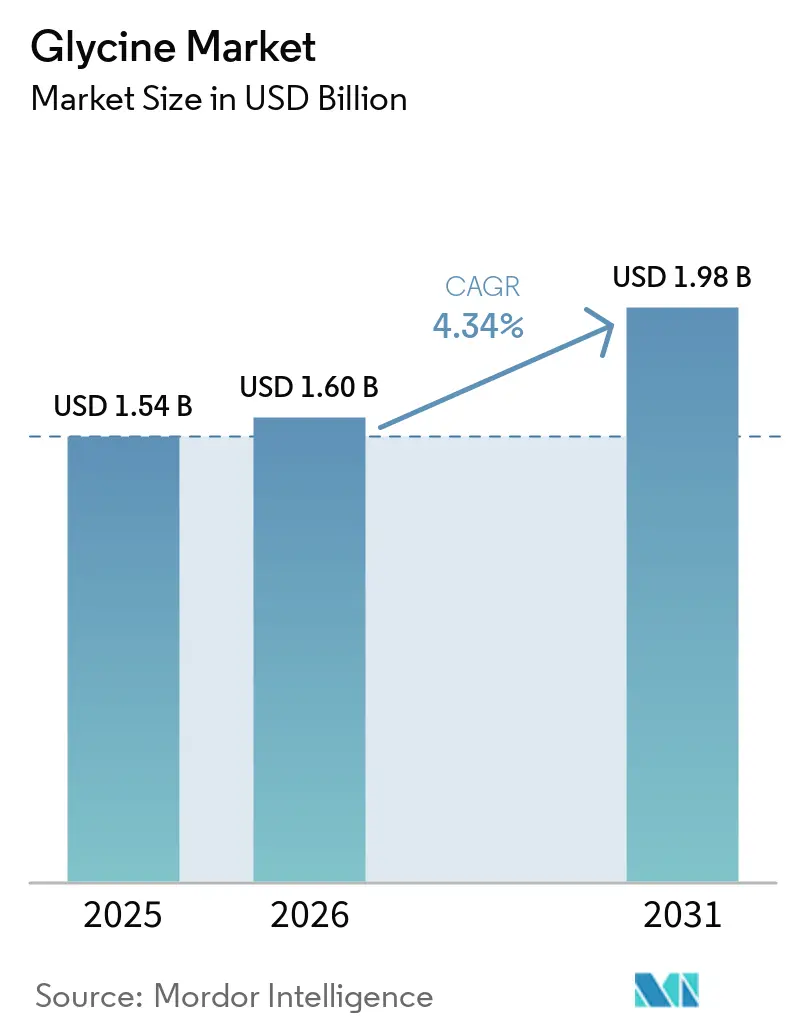
The Glycine market size was valued at USD 1.54 billion in 2025 and is estimated to grow from USD 1.60 billion in 2026 to USD 1.98 billion by 2031, at a CAGR of 4.34% during the forecast period (2026-2031). The glycine market serves pharmaceutical, food, feed, agrochemical, and industrial applications, reducing dependence on any single demand channel. Pharmaceutical and nutraceutical uses are shifting the value mix, as certified material commands higher prices than commodity supply. Chinese production capacity continues to put pressure on food-grade and technical-grade pricing, even as demand for premium materials rises. Producers with fermentation capabilities and pharmacopeia certifications are better positioned to serve higher-value applications. The market also faces input-cost exposure and a potential decline in demand for technical-grade glyphosate if glyphosate producers increase adoption of the iminodiacetic acid (IDA) route.
Key Report Takeaways
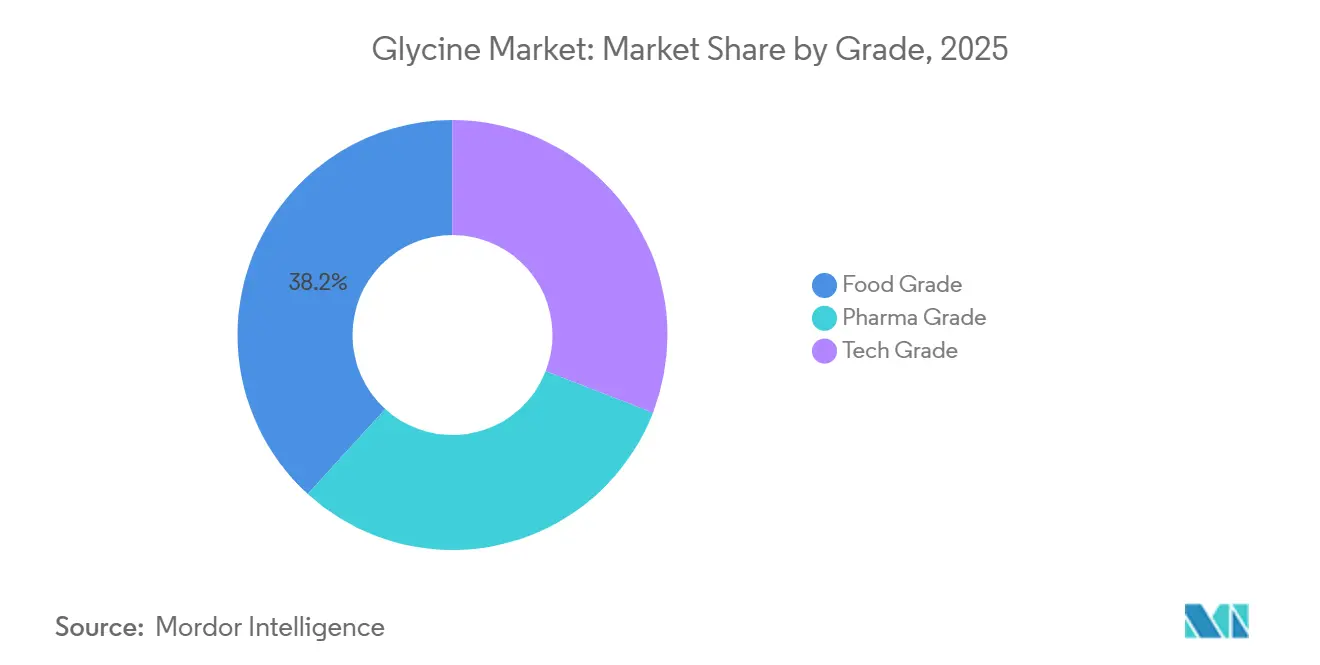
- By grade, Food Grade held 38.24% of the glycine market share in 2025, while Pharma Grade is forecast to expand at a 4.87% CAGR through 2031.
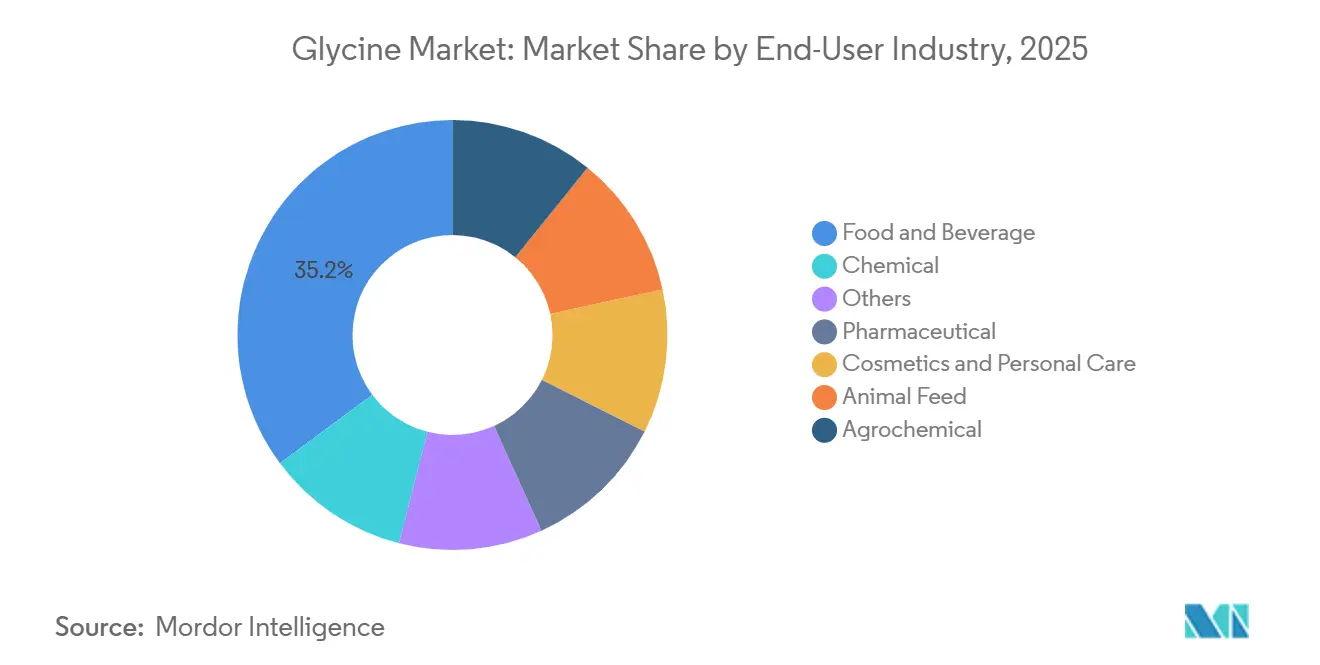
- By end-user industry, Food and Beverage held 35.18% of the glycine market share in 2025, while Pharmaceutical is forecast to expand at a CAGR of 5.14% through 2031.
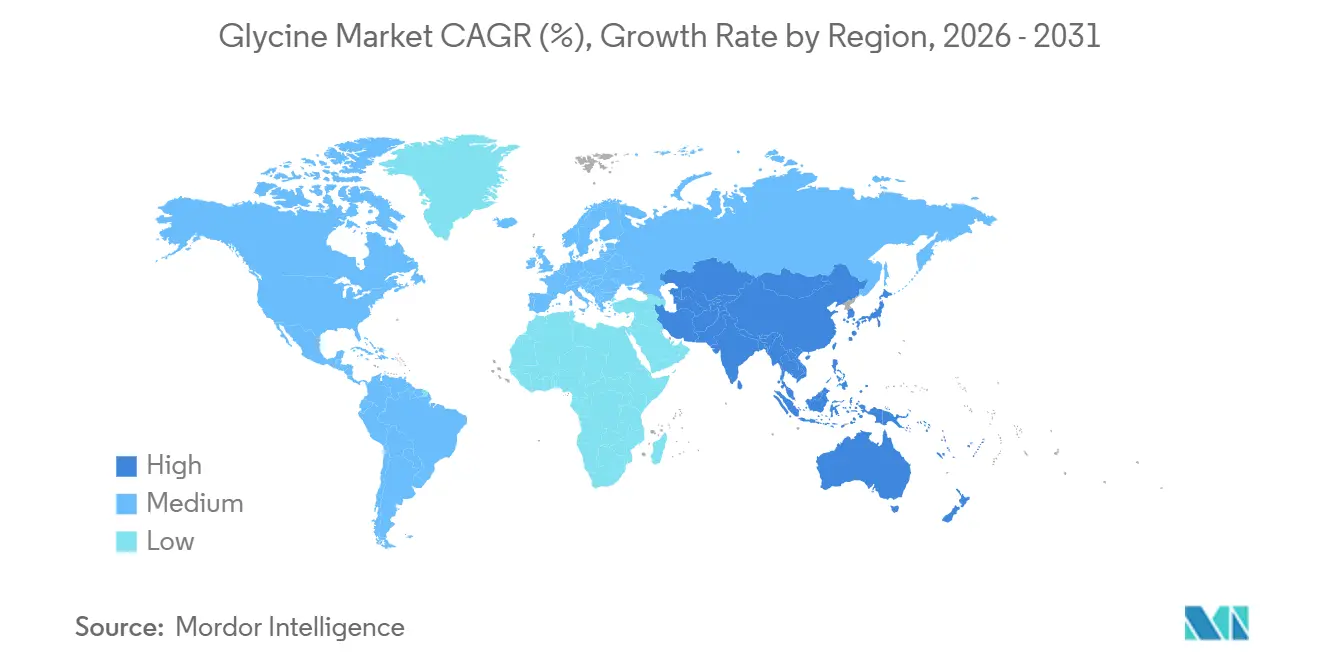
- By geography, Asia-Pacific accounted for 44.67% of the glycine market share in 2025 and is forecast to grow at a 5.05% CAGR through 2031.
Note: Market size and forecast figures in this report are generated using Mordor Intelligence’s proprietary estimation framework, updated with the latest available data and insights as of January 2026.
Global Glycine Market Trends and Insights
Drivers Impact Analysis*
| Drivers | (~) % Impact on CAGR Forecast | Geographic Relevance | Impact Timeline |
|---|---|---|---|
| Pharmaceutical and Nutraceutical Formulation Demand | +1.1% | Global, concentrated in North America, the EU, and Japan | Medium term (2-4 years) |
| Animal Feed Efficiency and Rising Meat Consumption | +0.9% | APAC core, spillover to South America and MEA | Short term (≤ 2 years) |
| Agrochemical and Glyphosate Intermediate Demand | +0.8% | APAC, China, South America, and North America | Short term (≤ 2 years) |
| Functional Food and Dietary Supplement Adoption | +0.7% | North America and the EU, expanding into APAC | Medium term (2-4 years) |
| Fermentation-Based and Bio-Based Glycine Premiumization | +0.5% | EU, Japan, with early gains in North America | Long term (≥ 4 years) |
| Source: Mordor Intelligence | |||
Pharmaceutical, Nutraceutical, and Functional Food Formulation Demand
The glycine market is seeing higher-value demand driven by its use as a functional excipient in biologics and complex drug formulations. Glycine supports protein stabilization in lyophilized products, limits aggregation in monoclonal antibody solutions, and acts as a tonicity agent in ophthalmic and parenteral preparations. These applications place it in drug formats with demanding performance and quality requirements, where formulators evaluate whether an excipient can consistently support protein stability, preserve the intended characteristics of the finished medicine, and meet quality expectations across development, scale-up, commercial manufacturing, and supply to regulated healthcare settings. Ajinomoto identified glycine-Gamma-Aminobutyric Acid (GABA) sleep-wellness products as a consumer-health growth category in Asian markets in its FY2025 investor presentation. Clinical use in sleep and metabolic health formulations supports demand for targeted supplements, while collagen products provide another delivery format for food-grade and United States Pharmacopeia (USP)-grade materials. This mix creates demand pockets that are less exposed to economic cycles than commodity-grade sales, making grade mix more important to revenue growth than quantity alone, as pharmaceutical and targeted wellness customers assess purity, formulation performance, and supply assurance in addition to basic ingredient cost.
Animal Feed Efficiency and Rising Meat Consumption
Glycine supports feed conversion, gut integrity, and animal nutrition in poultry, aquaculture, and other intensive livestock systems. Large commercial producers incorporate amino acids into precision nutrition programs to reduce feed waste, support immune function, and reduce nitrogen excretion per unit of animal growth. Restrictions on in-feed antibiotics in several ASEAN markets have increased interest in amino acid supplementation as an alternative to support animal growth and gut health. Zinc glycine and copper glycine chelates create a higher-value stream because mineral binding can improve mineral bioavailability. Biochem's planned acquisition of BASF's global glycinate business broadened its organic trace mineral portfolio and distribution reach in animal nutrition[1]Biochem GmbH, “Biochem and BASF Announce Agreement for Biochem’s Acquisition of BASF’s Global Glycinate Business,” Biochem Press Release, biochem.net.. Growing aquaculture use in Southeast Asian shrimp and tilapia feed adds another route for near-term consumption in the glycine market, where producers and formulators seek predictable feed performance, nutrient efficiency, and ingredients that fit established compound-feed production practices, including formulations designed for commercial operations that must manage feed cost, animal health, water conditions, and production outcomes across large quantities of fish and shrimp.
Agrochemical and Glyphosate Intermediate Demand
Technical-grade glycine remains an important feedstock for glyphosate produced through the glycine route. This route forms a substantial base for demand, particularly in China and in crop-intensive markets in North and South America. Corn and soybean planting cycles drive glyphosate consumption, while Brazilian and Argentine crop systems continue to require large quantities of herbicide. The glycine market, therefore, retains a demand foundation in agrochemicals despite lower margins in technical-grade supply. The main countervailing factor is the migration of some Chinese glyphosate production to the iminodiacetic acid (IDA) route, which does not use glycine as a direct feedstock. Wider IDA adoption could gradually reduce the technical-grade quantity link to herbicide demand beyond the forecast period, meaning technical suppliers must monitor not only crop demand but also the process choices made by glyphosate producers and their effects on raw material requirements.
Fermentation-Based and Bio-Based Glycine Premiumization
Fermentation-based production offers a route to high-purity glycine and can alter the cost and quality profile of supply outside China. Research published in 2025 reported a two-stage biosynthetic process with a 65.4 g/L glycine titer, 99.8% purity, and an 87.2% molar conversion yield at 50-liter scale. These results support the technical viability of production pathways capable of meeting pharmaceutical-compendial purity requirements. Fermentation-derived supply can also support bio-based and non-genetically modified organism (GMO) positioning in European and North American food and supplement channels. These characteristics can create a differentiated tier within food-grade supply, where buyers place greater value on traceability and product positioning, and where producers can present the material as part of a broader ingredient decision that considers manufacturing method, purity, consistency, formulation suitability, and the claims or sourcing preferences relevant to the finished food, supplement, or wellness product. Investment in fermentation capability can therefore help producers address both premium food applications and pharmaceutical demand within the glycine market, connecting process innovation with buyers that value high purity, consistent specification, bio-based positioning, and differentiated ingredient sources.
Restraints Impact Analysis*
| Restraints | (~) % Impact on CAGR Forecast | Geographic Relevance | Impact Timeline |
|---|---|---|---|
| Ammonia and Chloroacetic Acid Price Volatility | -0.8% | Global, most acute in China and European import-dependent markets | Short term (≤ 2 years) |
| Good Manufacturing Practice (GMP), Purity, and Regulatory Compliance Costs | -0.7% | North America and the EU, with secondary effects on export-oriented Asian plants | Medium term (2-4 years) |
| Capacity Surplus and Price Compression in Asia | -0.6% | APAC core, with spillover pricing pressure to export markets | Short term (≤ 2 years) |
| Source: Mordor Intelligence | |||
Ammonia and Chloroacetic Acid Price Volatility
The dominant chloroacetic acid ammonolysis process exposes glycine producers to the costs of ammonia and chloroacetic acid. Both inputs are energy-intensive, and their cost movements affect the economics of producing commodity-grade material, influencing producers' ability to offer stable quotations, protect operating margins, commit capacity to individual customers, and consider upgrades that might shift part of their output toward higher-value grades with more demanding quality requirements. Chinese export pricing remained volatile through 2025 and into 2026, with chloroacetic acid identified as a key near-term cost variable in producer commentary. Commodity suppliers cannot always pass higher input costs to customers because capacity is abundant and price competition is strong. This pressure constrains margins and can disrupt supply commitments to downstream buyers, especially when producers must balance immediate orders against uncertain input prices, treatment requirements, and the need to remain competitive in a segment where many purchasers have access to multiple Asian sources of conventional food-grade and technical-grade glycine. Waste-treatment expenses from ammonolysis add a further cost burden and can limit capital available for current Good Manufacturing Practice (cGMP) upgrades in the glycine market, reinforcing the gap between producers that can fund cleaner, qualified lines and those that remain focused on lower-margin output.
Good Manufacturing Practice (GMP), Purity, and Regulatory Compliance Costs
Pharmaceutical-grade glycine requires sustained investment in production infrastructure, quality systems, and regulatory documentation. United States Pharmacopeia (USP), European Pharmacopeia (EP), and Japanese Pharmacopeia (JP) requirements raise the cost of entering pharmaceutical supply chains, especially for smaller producers. Drug manufacturers also expect validated production processes, traceability, dedicated facilities, and controls that limit cross-contamination. Certificates of Suitability and Drug Master Files serve as baseline qualification requirements for pharmaceutical suppliers. These requirements favor companies with established certification and documentation capabilities while limiting the number of new qualified suppliers, as producers must demonstrate ongoing control over material quality and manufacturing practices rather than simply achieving a qualifying result at a single point in time or relying on cost advantages available in commodity production. The resulting barrier supports premium pricing for certified products but restricts market entry for producers without established regulatory standing in the glycine market, because qualification requires continuing investment in facilities, documentation, process validation, and customer-specific supplier approval.
*Our forecasts treat driver/restraint impacts as directional, not additive. The impact forecasts reflect baseline growth, mix effects, and variable interactions.
Segment Analysis
By Grade: Food Grade Leads While Pharma Grade Gains Value
Food-grade held 38.24% of the glycine market share in 2025, while pharma-grade is projected to grow at a 4.87% CAGR through 2031. Food-grade glycine is widely used as a flavor enhancer, mild sweetener, and nutritional additive in processed foods, beverages, and seasonings. In Japan, South Korea, and China, glycine also functions as an E640 flavor modifier and as a preservative in fermented and pickled foods. These uses provide a steady baseline demand across large food categories. Food applications remain important because they combine everyday consumption with broad formulation flexibility, allowing manufacturers to use the same ingredient across seasoning blends, beverages, dairy products, preserved foods, and nutrition-focused formulations without altering glycine's fundamental role in taste, sweetness, and nutritional positioning. Food applications also benefit from demand distributed across many product formats rather than concentrated in a single category. This distribution gives suppliers a stable base of orders from processors using glycine in established recipes and from brands seeking nutrition-oriented or taste-focused reformulation. It also supports recurring purchasing relationships across conventional and premium packaged-food channels in major consuming countries and across multiple annual product cycles. The range of uses makes food demand a counterweight when industrial purchasing conditions are less favorable. Premium food and supplement products add a quality threshold that is not always required in conventional commodity food applications.
Technical grade remains tied to agrochemical synthesis, particularly glyphosate production, and continues to account for a significant share of output. Its margins remain constrained by a Chinese capacity surplus and a possible shift toward the iminodiacetic acid (IDA) route for glyphosate. Pharma benefits from biologics development and tighter quality requirements set by drug manufacturers globally. Evonik Industries AG expanded pharmaceutical-grade glycine capacity at its Nanning facility by 50% through process efficiency gains and particle-size engineering capability. Fermentation offers another path to pharmaceutical-compendial purity and can simultaneously serve premium food applications. Producers that invest in this capability can address grade premiumization more directly than chemical synthesis-only suppliers, as the same production platform can support discussions with pharmaceutical customers focused on purity and with food and supplement customers focused on ingredient origin, quality consistency, and differentiated formulation claims. That flexibility is relevant where quality specifications are becoming a larger part of customer selection and where premium applications offer a route away from direct commodity price competition.



By End-User Industry: Food and Beverage Leads as Pharmaceutical Use Expands
Food and beverage accounted for 35.18% of the glycine market share in 2025, while pharmaceuticals are forecast to grow at a 5.14% CAGR through 2031. Food and beverage manufacturers use glycine as a flavor enhancer, sweetener, and antimicrobial ingredient in seasoning systems, dairy products, beverages, and other processed foods. This broad use keeps food and beverage as the largest end-user segment. Pharmaceutical demand is supported by parenteral nutrition, the development of biologics and biosimilars, and the production of generic injectables in India and China. These applications require pharmaceutical-compendial buffering and stabilization materials. Their growth gives the glycine market a more favorable mix of high-value demand, as suppliers can participate in formulations where product performance, batch consistency, and regulatory documentation matter alongside price, rather than competing solely on output and cost. This does not displace the large food-and-beverage base. Still, it shifts the relative importance of applications that require closer supplier engagement and increases the value of reliable quality processes.
Animal feed represents another significant demand pool, particularly in poultry, swine, and aquaculture formulations across the Asia-Pacific and South America. Cosmetics and personal care uses include skin conditioning, moisture binding, and pH buffering in amino acid skincare and scalp-health formulations. Clean-label and amino acid-active positioning support interest in these applications in Asia-Pacific and Europe. Agrochemical use remains centered on glyphosate synthesis, while broader chemical applications include chelating, buffering, and industrial intermediates. The other category includes electronics uses, where glycine can support chelating and etching processes in semiconductor chemicals. Biochem's acquisition of BASF's global glycinate business shows how glycine-linked ingredients are becoming strategic assets across adjacent nutrition and pharmaceutical supply chains, connecting mineral nutrition expertise, product portfolios, customer relationships, and distribution capability across several end-user groups. The deal also indicates why suppliers may place greater importance on related specialty ingredients rather than treating glycine solely as a standalone commodity, as portfolio breadth can help companies serve customers who purchase mineral nutrition, feed additives, and other formulated inputs through connected buying channels.
Geography Analysis
Asia-Pacific accounted for 44.67% of the glycine market share in 2025 and recorded the fastest regional CAGR of 5.05% through 2031. China anchors regional production through large-scale capacity and exports food-grade and industrial-grade material, while continuing to import high-purity pharmaceutical-grade supplies from Japan and Germany. This pattern reflects a quality gap at the premium end of the domestic supply base, where broad production scale does not automatically translate into supply that meets the certification, purity, documentation, and customer-qualification requirements associated with pharmaceutical use. This gap leaves room for imports despite China's central role in global output. India adds to demand through its expanding pharmaceutical formulation sector, which relies heavily on imported pharmaceutical-grade materials. Japan remains a producer of note, with Resonac holding a long-standing position in glycine production. Resonac, Nippon Steel, Nippon Steel Engineering, and the University of Toyama are participating in a New Energy and Industrial Technology Development Organization (NEDO)-selected project to develop glycine production from methanol derived from CO2. This approach connects research on industrial carbon use to the need to maintain production quality in the amino acid supply[2]Resonac Corporation, “Joint Research and Development on Glycine Production via Methanol Derived from CO₂ Selected by NEDO,” Resonac News, resonac.com.. The project shows interest in process pathways that meet environmental expectations and the technical requirements for higher-grade material. It's planned work through FY2027 falls within the period when producers are evaluating longer-term production options for the region.
North America and Europe are major demand regions for premium pharmaceutical-grade glycine. North American supply changed after GEO Specialty Chemicals exited domestic glycine production in mid-2024, increasing reliance on fewer facilities and imports. U.S. biologics manufacturing supports demand for Certificate of Suitability to the Monographs of the European Pharmacopeia (CEP)-certified materials from U.S. and European sources, as pharmaceutical customers manage supply chain risk. In Europe, Germany, France, and the United Kingdom account for much of the demand for pharmaceutical-grade supplies. Evonik's Nanning expansion, supported by current Good Manufacturing Practice (cGMP) and European Pharmacopeia (CEP) validation, along with new milling and sieving capacity, serves European pharmaceutical supply chains by combining Asian manufacturing efficiency with the product specifications and qualification documentation required by regulated customers. This structure demonstrates how companies can serve European customers without locating all production in the destination region. It also highlights the importance of process capability and documentation in the glycine market, where geographic location alone does not determine whether a supplier can serve pharmaceutical accounts.
South America, the Middle East, and Africa remain smaller markets within the global glycine market. Brazil and Argentina rely mainly on agrochemical demand, as intensive soy and corn cultivation drives glyphosate use. Brazil also has an expanding pharmaceutical manufacturing sector, which adds demand for pharmaceutical-grade products. Argentina's technical-grade consumption moves with agricultural procurement cycles. Saudi Arabia's investments linked to Vision 2030 support emerging demand in food processing and personal care, while South Africa remains the main sub-Saharan African market. These regions are expected to remain net importers through 2031, leaving buyers exposed to freight and currency movements that affect landed cost competitiveness, procurement timing, supplier selection, and the relative cost of premium imported material compared with locally available commodity supply. Import dependence can make availability and delivered cost more variable for food, feed, and pharmaceutical users in these regions. Buyers must therefore consider the reliability of their supply channels as well as the stated price of the material, particularly when their requirement is for premium grades.

Competitive Landscape
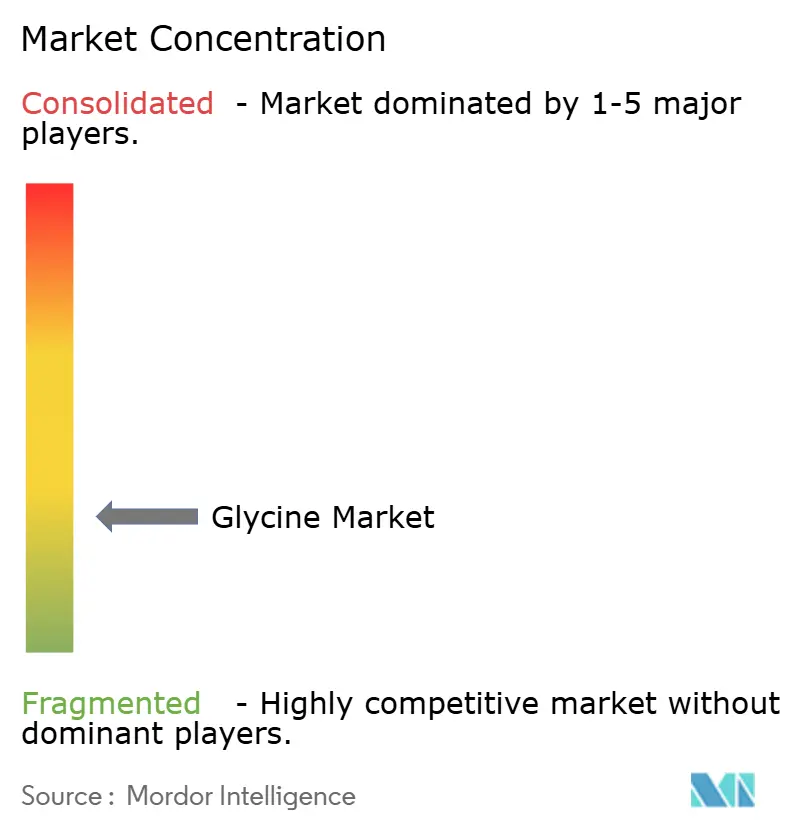
The glycine market is fragmented. Ajinomoto Co. Inc., Evonik Industries AG, Resonac Holdings Corporation, and YUKI GOSEI KOGYO CO. LTD. compete in the high-value pharmaceutical-grade tier. Chinese suppliers, including Shijiazhuang Donghua Jinlong Chemical Co. Ltd., Hebei Donghua Jiheng Chemical Co. Ltd., Hubei Xingfa Chemicals Group Co. Ltd., and Baoding Mantong Fine Chemistry Co. Ltd., are more active in food-grade and technical-grade materials. Premium suppliers differentiate through USP, EP, and JP certifications, fermentation technology, supply reliability, and regulatory documentation. Commodity suppliers rely on feedstock integration and production scale but face tighter margins due to surplus capacity. The glycine market presents an opportunity for certified local supply in India, South Korea, and Southeast Asia, where drug manufacturing is expanding faster than qualified local production and customers require dependable access to material supported by documentation aligned with international pharmacopeia and quality standards. This gap is not simply a capacity issue, as qualification standards determine whether local output can meet the requirements of regulated drug manufacturers. A supplier that combines production with the necessary quality records can be more relevant to these customers than a larger supplier focused primarily on bulk material.
Evonik's 50% capacity expansion in Nanning reflects a strategy centered on pharmaceutical-grade supply, cGMP and CEP certification, and particle-size engineering. Biochem entered a binding agreement to acquire BASF's global glycinate business in November 2025, with the transaction closing in the first quarter of 2026. The acquisition expanded Biochem's trace mineral portfolio and global distribution position in animal nutrition. Resonac's CO2-derived methanol project represents another strategic move, with the potential to develop a lower-carbon production route for glycine. Chattem Chemicals Inc. and Paras Intermediates Private Ltd. provide regional supply support in North America and South Asia, respectively. These positions illustrate that supply strategies differ between premium certified material and large-scale commodity production. The former depends on customer qualification, process control, particle characteristics, and regulatory support, whereas the latter remains more closely tied to plant scale, feedstock access, and delivered cost. This distinction requires companies to make different choices regarding investment, customers, and product development. It also explains why a supplier can hold a strong position in high-output technical materials while remaining less competitive in pharmaceutical supply, or vice versa.
Changes to Western portfolios and the exit of a major U.S. producer from domestic glycine production have concentrated non-Asian pharmaceutical-grade supply in fewer facilities. This can improve pricing leverage for qualified suppliers while increasing procurement risk for buyers that require non-Chinese sourcing. Fermentation-based producers could challenge established middle-tier supply as process technology improves. The key competitive question is not only total production capacity but also the ability to meet demanding quality and documentation requirements. High-value supply depends on certifications, consistency, and reliable customer support, all of which take time to establish. The glycine market, therefore, remains more concentrated in pharmaceutical-grade product than in technical and food-grade material, since certification breadth, reliable batch quality, and a long record of serving regulated customers cannot be replicated quickly by suppliers that have historically focused on commodity output. Commodity categories remain more exposed to a larger producer base and to pricing pressure from Asian capacity. The contrast between these tiers is central to how companies assess growth, margins, and investment priorities across the glycine market.
Glycine Industry Leaders
Ajinomoto Co., Inc.
GEO
Evonik Industries AG
Resonac Holdings Corporation
Shijiazhuang Donghua Jinlong Chemical Co., Ltd.
- *Disclaimer: Major Players sorted in no particular order

Recent Industry Developments
- November 2025: Biochem GmbH and BASF SE entered a binding agreement for Biochem's acquisition of BASF's global glycinate business. The acquisition broadened Biochem's organic trace mineral portfolio, expanded its global distribution network, and strengthened its position in high-bioavailability mineral nutrition for animal feed, increasing the glycine derivatives available to the market.
- June 2025: Resonac Corporation, Nippon Steel Corporation, Nippon Steel Engineering Co. Ltd., and the University of Toyama announced that their joint project, "Research and Development on Glycine Production via Methanol Derived from CO₂," was selected by the New Energy and Industrial Technology Development Organization (NEDO) in May 2025.


Global Glycine Market Report Scope
Glycine is the simplest and smallest naturally occurring amino acid. It plays a fundamental role in several biological processes, including protein synthesis, the production of essential molecules such as creatine, glutathione, and heme, and neurotransmission in the central nervous system. Glycine is a non-essential amino acid that the human body produces naturally, though it is also obtained from dietary sources such as meat, fish, dairy, and legumes.
The glycine market is segmented by grade, end-user industry, and geography. By grade, the market is segmented into food grade, pharma grade, and tech grade. By end-user industry, the market is segmented into food and beverage, pharmaceutical, cosmetics and personal care, animal feed, agrochemical, chemical, and others. The report also covers market size and forecasts for glycine across 15 countries in major regions. The market sizes and forecasts are provided in terms of value (USD).
| Food Grade |
| Pharma Grade |
| Tech Grade |
| Food and Beverage |
| Pharmaceutical |
| Cosmetics and Personal Care |
| Animal Feed |
| Agrochemical |
| Chemical |
| Others |
| Asia-Pacific | China |
| India | |
| Japan | |
| South Korea | |
| ASEAN Countries | |
| Rest of Asia-Pacific | |
| North America | United States |
| Canada | |
| Mexico | |
| Europe | Germany |
| United Kingdom | |
| France | |
| Italy | |
| NORDIC Countries | |
| Rest of Europe | |
| South America | Brazil |
| Argentina | |
| Rest of South America | |
| Middle East and Africa | Saudi Arabia |
| South Africa | |
| Rest of Middle East and Africa |
| By Grade | Food Grade | |
| Pharma Grade | ||
| Tech Grade | ||
| By End-User Industry | Food and Beverage | |
| Pharmaceutical | ||
| Cosmetics and Personal Care | ||
| Animal Feed | ||
| Agrochemical | ||
| Chemical | ||
| Others | ||
| By Geography | Asia-Pacific | China |
| India | ||
| Japan | ||
| South Korea | ||
| ASEAN Countries | ||
| Rest of Asia-Pacific | ||
| North America | United States | |
| Canada | ||
| Mexico | ||
| Europe | Germany | |
| United Kingdom | ||
| France | ||
| Italy | ||
| NORDIC Countries | ||
| Rest of Europe | ||
| South America | Brazil | |
| Argentina | ||
| Rest of South America | ||
| Middle East and Africa | Saudi Arabia | |
| South Africa | ||
| Rest of Middle East and Africa | ||


Key Questions Answered in the Report
What is current market size of Glycine Market?
The Glycine market size was valued at USD 1.54 billion in 2025 and is estimated to grow from USD 1.60 billion in 2026 to USD 1.98 billion by 2031, at a CAGR of 4.34% during the forecast period (2026-2031).
Which glycine grade is growing fastest?
Pharma Grade is forecast to grow at a 4.87% CAGR through 2031, supported by biologics and pharmaceutical quality requirements.
Which end-user application is expanding fastest?
Pharmaceutical use records the highest forecast CAGR at 5.14% through 2031.
Which region leads global glycine demand?
Asia-Pacific held 44.67% of global value in 2025 and is projected to grow at a 5.05% CAGR through 2031.
Page last updated on:


 Your data is secure and never sold or shared.


