
Market Overview
| Study Period | 2021 - 2031 |
|---|---|
| Market Volume (2026) | 0.68 gigawatt |
| Market Volume (2031) | 2.97 gigawatt |
| Growth Rate (2026 - 2031) | 34.10 % |
| Fastest Growing Market | North America |
| Largest Market | Asia Pacific |
| Market Concentration | Medium |
Major Players
*Disclaimer: Major Players sorted in no particular order Image © Mordor Intelligence. Reuse requires attribution under CC BY 4.0. |
|
Tidal Power Market Analysis by Mordor Intelligence
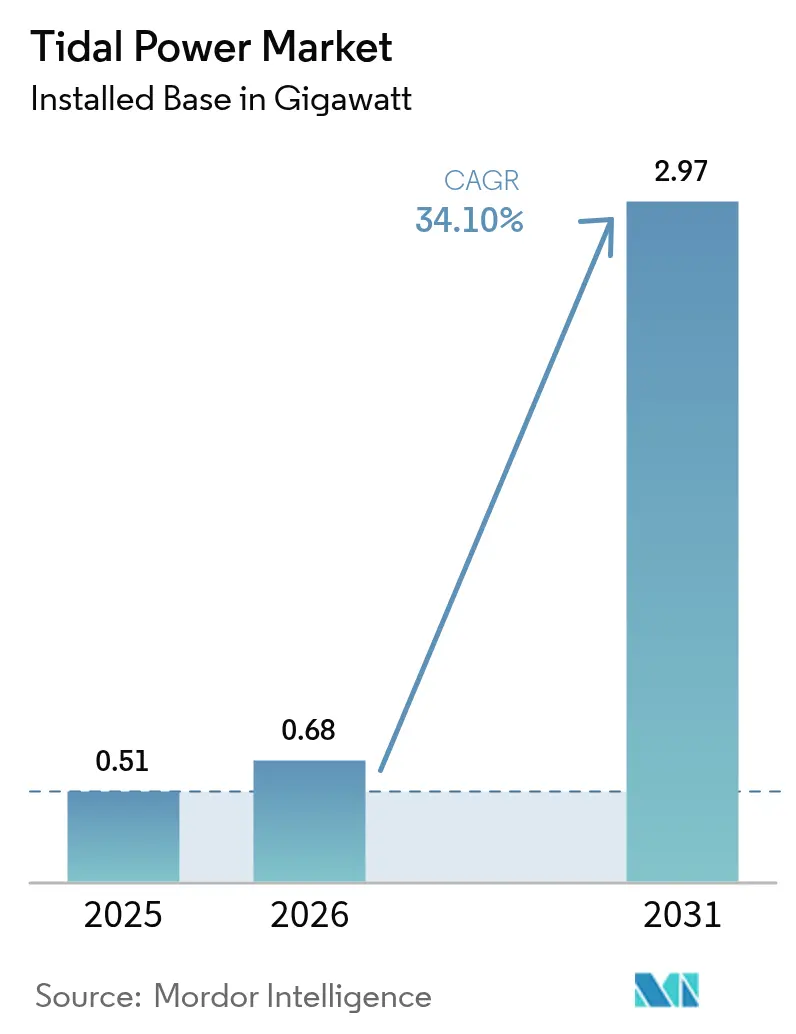
Tidal Power market size in 2026 is estimated at 0.68 gigawatt, growing from 2025 value of 0.51 gigawatt with 2031 projections showing 2.97 gigawatt, growing at 34.10% CAGR over 2026-2031.
This surge from a 511.15 MW base in 2024 underscores the sector’s move from demonstration arrays to bankable commercial plants. Unlike wind and solar, tidal projects deliver power on a timetable set by the moon, giving grid operators a degree of certainty they rarely enjoy with weather-driven assets.[1]Lancaster University, “Integrating Predictable Renewables into the Grid,” lancaster.ac.uk Asia-Pacific anchored 50.9% of global installations in 2024 and remains the volume leader, while North America is projected to post the fastest regional climb through 2030, thanks to Alaska’s Cook Inlet resource and new U.S. federal incentives. Power-only schemes still dominate, claiming 78.2% of deployments, yet desalination plants tied to tidal flows are expanding at the highest rate as coastal communities pursue water security. Tidal-barrage assets hold a 44.7% share of the tidal power market, but floating platforms are accelerating at a 36.5% clip as deeper-water anchoring systems mature.
Key Report Takeaways
- By the generation method, tidal-barrage plants accounted for 44.12% of the tidal power market share in 2025; floating platforms are forecasted to expand at a 35.30% CAGR through 2031.
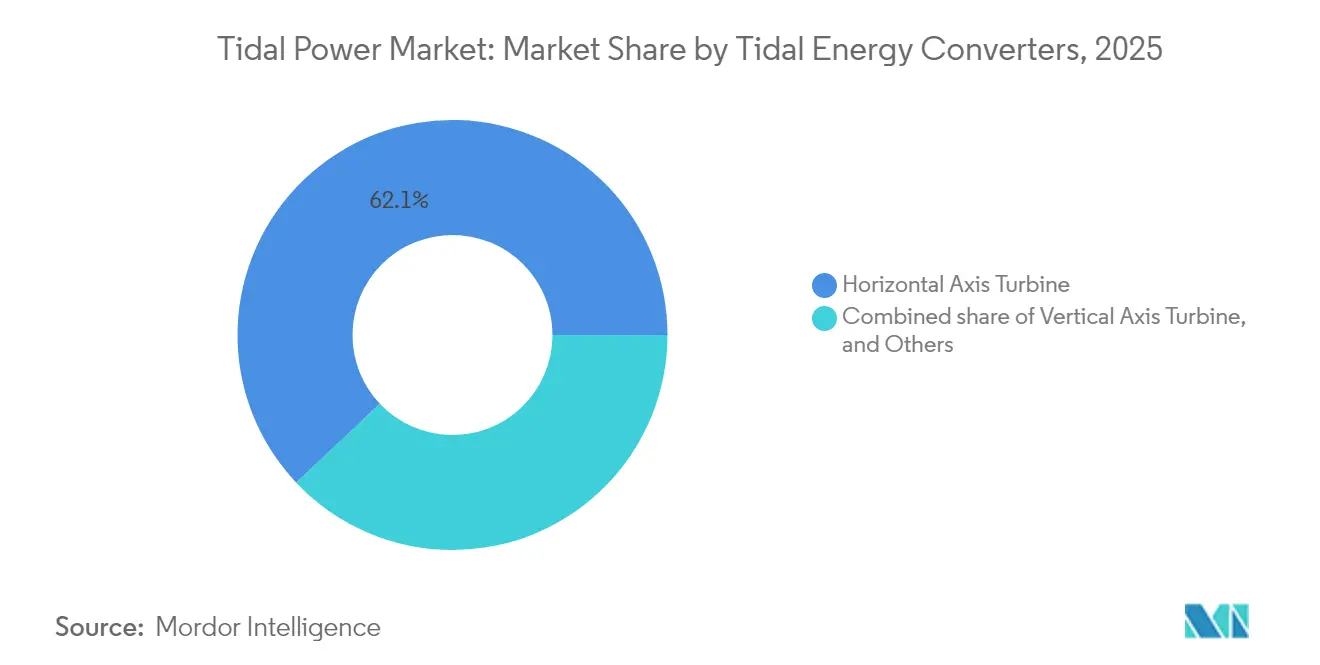
- By converter type, horizontal-axis turbines captured 62.05% of the tidal power market share in 2025 and are set to grow at a 34.90% CAGR through 2031.
- By application, power-only projects represented 77.65% of the tidal power market size in 2025, while desalination systems are projected to grow at a 39.25% CAGR between 2026-2031.
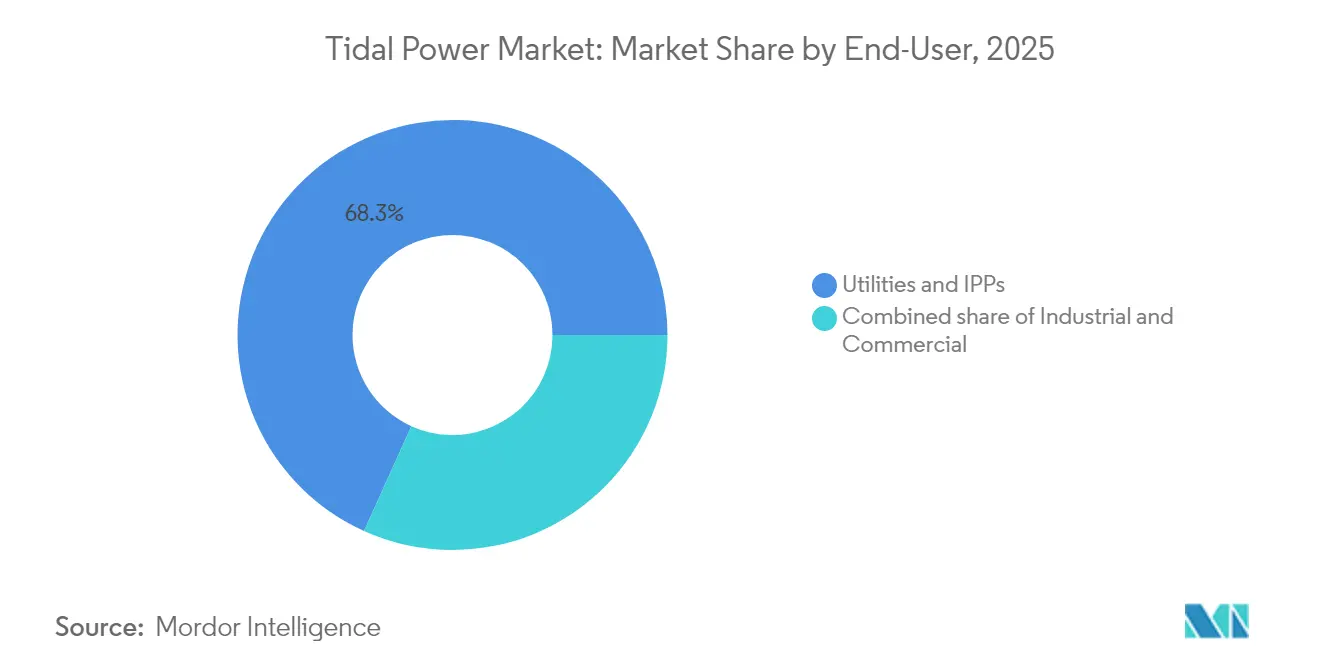
- By end-user, utilities and IPPs held 68.25% of demand in 2025; industrial buyers are expected to show the quickest upside with a 40.10% CAGR to 2031.
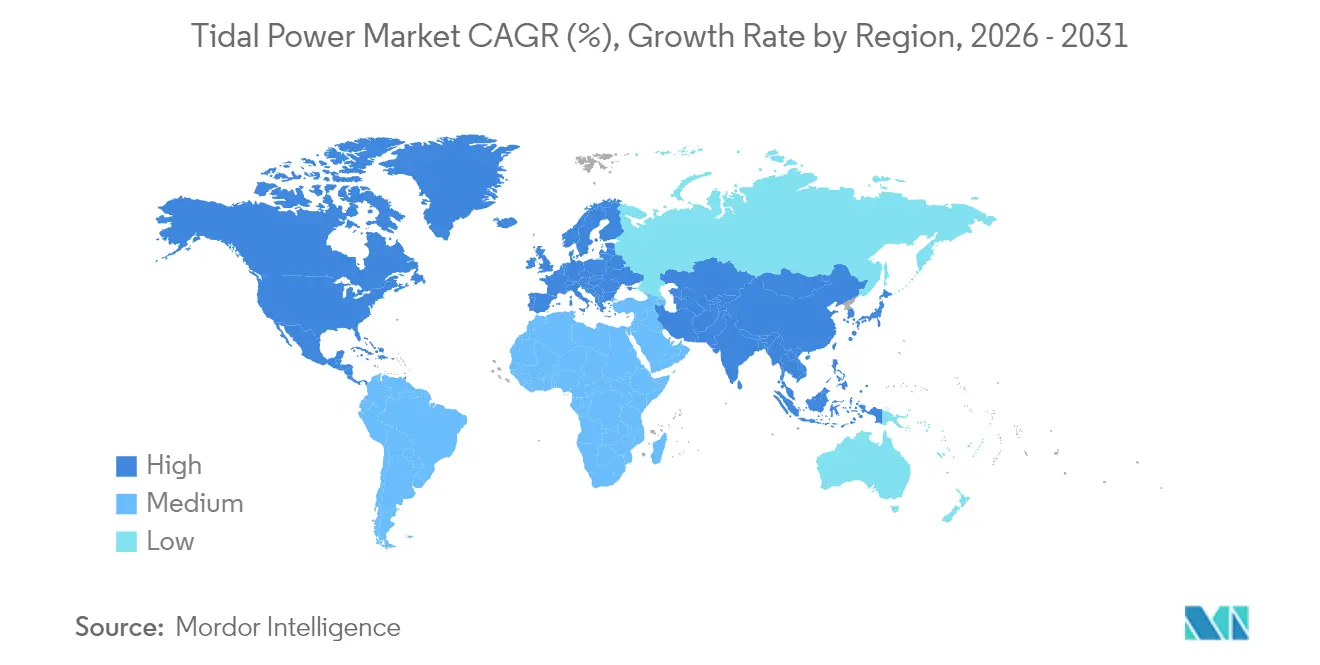
- By geography, Asia-Pacific held 50.35% of capacity in 2025, whereas North America is on course for the steepest rise, advancing at a 49.80% CAGR.
Note: Market size and forecast figures in this report are generated using Mordor Intelligence’s proprietary estimation framework, updated with the latest available data and insights as of 2026.
Global Tidal Power Market Trends and Insights
Drivers Impact Analysis*
| Driver | (~) % Impact on CAGR Forecast | Geographic Relevance | Impact Timeline |
|---|---|---|---|
| Global decarbonization and net-zero targets | +9.1% | Global, early gains in Asia-Pacific and North America | Medium term (2-4 years) |
| Predictable generation from high-range sites | +7.2% | North America and Asia-Pacific, spill-over to Europe | Long term (≥4 years) |
| Government subsidies and feed-in tariffs | +6.8% | Asia-Pacific, North America, emerging Europe | Short term (≤2 years) |
| Advances in turbine and floating-platform tech | +5.4% | Global | Medium term (2-4 years) |
| Co-location with coastal hydrogen hubs | +3.9% | Asia-Pacific, North America, emerging Europe | Long term (≥4 years) |
| Coastal-protection and climate-resilience use | +2.8% | Global, concentration in vulnerable coasts | Medium term (2-4 years) |
| Source: Mordor Intelligence | |||
Global Decarbonization and Net-Zero Targets
Governments and corporations are chasing more predictable clean-power sources to backfill intermittent wind and solar. China’s flagship array in the Zhoushan archipelago signals national intent, while U.S. planners see Cook Inlet covering up to 20% of regional demand by 2035. G-20 data show roughly 10% of renewable-finance packages are now directed to ocean-energy technology.[2]International Institute for Sustainable Development, “G-20 Public Finance for Ocean Energy,” iisd.org Consistently high capacity factors strengthen the tidal power market value proposition for coastal factories that cannot afford production lapses.
Predictable Generation from High-Tidal-Range Sites
Because tidal cycles can be forecast centuries ahead, operators avoid the forecasting errors that plague wind and solar. Cook Inlet’s theoretical 80 TWh resource illustrates the scale; China’s eight-gigawatt coastal potential offers similar promise. Such precision slashes reserve-margin requirements, easing grid integration costs and supporting power-plus-desalination projects.[3]U.S. Department of Energy, "Tidal Energy Could Help Decarbonize Alaska's Biggest Grid by 2035," energy.gov
Government Subsidies and Feed-in Tariffs
Asia-Pacific governments now dominate incentive roll-outs: China has deployed more than USD 2.7 billion in ocean-energy support since 2020, and Japan is evaluating a tidal FIT of roughly USD 0.19/kWh. In Europe, the U.K. awarded 41 MW of tidal capacity under its latest Contracts for Difference auction, while Wales topped up project grants with GBP 2 million in 2025. Guaranteed revenues compress financing spreads and attract institutional lenders to the tidal power market.
Advancements in Turbine and Floating-Platform Technology
Sustainable Marine Energy’s PLAT-I 6.40 prototype delivers 50% more output than its predecessor while meeting strict environmental limits. Orbital Marine Power’s 2 MW O2 machine uses four 10 m composite blades supplied by AC Marine & Composites, proving that offshore-wind supply chains can pivot to tidal needs. Minesto’s Dragon 12 kite attained stable 1.2 MW operation in 2025, widening the workable resource base for the tidal power market.
Restraints Impact Analysis*
| Restraint | (~) % Impact on CAGR Forecast | Geographic Relevance | Impact Timeline |
|---|---|---|---|
| High CAPEX versus other renewables | -5.2% | Global | Short term (≤ 2 years) |
| Marine-ecosystem impact concerns | -3.1% | Asia-Pacific, North America, emerging in Europe | Medium term (2-4 years) |
| Supply-chain bottlenecks for composite blades | -2.9% | Global, with concentration in manufacturing regions | Short term (≤ 2 years) |
| Limited grid capacity in remote coastlines | -2.4% | Remote coastal regions globally | Medium term (2-4 years) |
| Source: Mordor Intelligence | |||
High CAPEX versus Other Renewables
Capital requirements range between USD 6,244/kW and USD 18,700/kW, compared to sub-USD 1,000/kW for utility solar, which restricts financing options despite superior capacity factors. Limited fleets of heavy-lift vessels inflate mobilization expenses, while composite-blade fabrication still depends on bespoke facilities, elongating lead times. Current levelized energy costs sit at USD 0.12-0.40/kWh—well above prevailing market rates. Nonetheless, learning-curve projections show potential cost declines of 29% through modular designs and standardized installation sequences endorsed by the European Commission.
Marine-Ecosystem Impact Concerns
Comprehensive assessments prolong permitting cycles, yet field evidence continues to ease apprehensions. Pacific Northwest National Laboratory’s 2024 review of 40 tidal facilities catalogued minimal wildlife disruption, though it underscored the need for multi-turbine studies to capture array-scale effects.[4]Pacific Northwest National Laboratory, “Environmental Effects of Marine Energy 2024,” pnnl.gov Morlais developers deployed acoustic and visual monitoring buoys to gather marine mammal data throughout the 240 MW build-out. Regulators increasingly favor risk-tiered frameworks that discontinue redundant studies once operational evidence demonstrates limited hazard, which should streamline approvals and underpin medium-term expansion of the tidal power market.
*Our forecasts treat driver/restraint impacts as directional, not additive. The impact forecasts reflect baseline growth, mix effects, and variable interactions.
Segment Analysis
By Power Generation Method: Barrage strength; platform acceleration
Tidal-barrage plants held 44.12% of capacity in 2025 thanks to proven dams like La Rance and South Korea’s 254 MW Sihwa Lake, which together produce 550 GWh a year. Floating platforms, free of depth limits, are on track for a 35.30% CAGR to 2031. Stream devices such as Scotland’s MeyGen array add new megawatts yearly, while dynamic-tidal concepts remain in R&D. Convergence is likely: modular floats equipped with sluice-gate technology could merge barrage efficiency with deep-water flexibility, enriching the tidal power market size even where shorelines lack estuaries.
In parallel, platform OEMs are switching to barge-mounted pre-assembly to cut offshore time by 40%. Such tweaks trim vessel rental costs-one of the steepest expense lines-and should keep the tidal power market competitive as capital costs slide.
By Tidal Energy Converters: Horizontal-axis supremacy with niche challengers
Horizontal-axis turbines controlled 62.05% of installations in 2025, largely because they borrow gearboxes, bearings, and SCADA logic from the wind sector. Upgrades now push rotor diameters past 20 m while shaving nacelle weight. Vertical-axis units serve bi-directional channels, minimizing yaw complexity, and underwater kites harvest slower currents to unlock low-head sites. As serial production ramps up, cross-item standardization-cables, connectors, control software-should shrink procurement lead times, helping the tidal power market broaden its converter mix without escalating costs.



By Application: Power generation rules; desalination sprints
Power-only contracts still accounted for 77.65% of 2025 capacity, a reflection of well-trodden tariff structures. Yet tidal-powered desalination plants are scaling fast at 39.25% CAGR. Canary Island utilities already co-locate reverse-osmosis units with pilot turbines, cutting delivered-water costs by 25%. Port operators test mini-arrays to charge harbor ferries at night, while offshore data buoys rely on micro-turbines to feed sensors and communications kits. The diversified use-case portfolio cushions revenue risk and magnifies the total addressable tidal power market.
By End-User: Utility dominance; industrial rise
Utilities and IPPs purchased 68.25% of tidal output in 2025. Nevertheless, industrial buyers-steel, chemicals, fertilizer, even green ammonia-show the strongest appetite, with a 40.10% CAGR ahead. Direct onsite supply avoids grid congestion and delivers high-availability power that factories crave. Resort operators and port authorities round out the commercial slice, adopting smaller turbines to trim diesel bills.
Geography Analysis
Asia-Pacific held 50.35% of capacity in 2025, led by China’s industrial drive and Southeast Asia’s first grid-connected plant in South Korea. Japanese and Indonesian programs next focus on upscaling pilot devices, while Australia partners with Minesto to electrify isolated mining hubs.
North America is projected to be the growth champion at 49.80% CAGR. Alaska’s Cook Inlet resource could feed 80 TWh a year, and tax-credit parity with offshore wind is drawing project financiers back to the region. Nova Scotia’s revised leasing act speeds permitting in the Bay of Fundy, and West Coast grids study subsea cables for future Pacific builds.
Europe remains the policy trend-setter. The U.K.’s latest CfD round reserved a tidal budget, and the 240 MW Morlais zone entered early works in 2025. France’s decades-old La Rance barrage still runs at more than 40% capacity factor, anchoring O&M best-practice data. Nordic yards now retrofit anchor-handling tugs into installation craft, adding local content jobs to the tidal power market narrative.

Regulatory Landscape
Policy support for tidal power is increasingly framed around revenue stabilization and adaptive environmental permitting. In the United Kingdom, the Department for Energy Security and Net Zero (DESNZ) published Contracts for Difference (CfD) Allocation Round 7 results on 14 January 2026, and February 2026 procurement included 20.9 MW of tidal stream capacity, which keeps CfD as the main route to bankable offtake for tidal stream projects.
In Canada, Nova Scotia enacted the Powering the Offshore Act (2025), amending the Marine Renewable-energy Act to streamline licensing and enable licence mergers, while Bay of Fundy oversight continues to rely on Fisheries Act authorizations and staged, evidence-led monitoring coordinated through the Task Force on Sustainable Tidal Energy Development and federal agencies (NRCan and DFO). In France, tidal and broader marine renewables are governed through Decree 2018-1204 and later 2023 modifications, with developers typically needing a maritime domain concession and environmental permitting under regional Prefects, which keeps multi-agency approvals central to project timelines.
Competitive Landscape
Five front-runners—SIMEC Atlantis Energy, Orbital Marine Power, Minesto, Nova Innovation, and HydroWing—together control an estimated 65% of installed megawatts, giving the tidal power market a concentration score of 6. SIMEC Atlantis is raising debt for an 80 MW MeyGen expansion, armed with EUR 1 million of upgrade grants. Orbital Marine signed a preferred-supplier deal with Global Energy Group that trims assembly cycles to ten months. Minesto exported its first power from its Dragon 12 kite in early 2024, then secured a Queensland seabed option.
Second-tier firms are differentiating through logistics. HydroWing unveiled a purpose-built installation barge that cuts offshore person-hours by 25%. Nova Innovation leads a Horizon-Europe consortium to deploy 16 turbines in Orkney, bundling storage and grid services.[5]Ocean Energy Europe, "SEASTAR project to deploy largest number of turbines in Scottish tidal farm with Horizon Europe and UKRI support," oceanenergy-europe.eu Such specialization pushes down balance-of-plant costs, vital for the tidal power market as it competes for capital against mature renewables.
Tidal Power Industry Leaders
-
Andritz AG
-
Orbital Marine Power Ltd
-
Sustainable Marine Energy Ltd
-
Nova Innovation Ltd
-
SIMEC Atlantis Energy Ltd
- *Disclaimer: Major Players sorted in no particular order


Market Opportunities and Future Outlook
A near-term opportunity is in projects that can move from single-device deployments to arrays under adaptive permitting, with North America and the U.K. as key focus areas. Canada provided an example in November 2025, when Fisheries and Oceans Canada authorized up to three floating O2-X turbines at the Fundy Ocean Research Centre for Energy (FORCE), which helps developers progress beyond one-off demonstrations while keeping environmental conditions embedded in the authorization framework.
Equipment standardization and design optionality at consented zones is another workable lever, since it can broaden the supplier base and reduce redesign cycles. In April 2026, Natural Resources Wales approved a marine licence variation for the Morlais tidal energy scheme off Anglesey, allowing a wider range of turbine designs, which supports competitive procurement across device OEMs and supply-chain partners. On the offtake side, the U.K. CfD mechanism continues to support commercialization, with tidal stream CfD support reaching 140 MW in total capacity, while sites such as MeyGen in Scotland (6 MW installed) provide operational benchmarks that developers and lenders use to de-risk O&M, availability, and installation approaches.
Recent Industry Developments
- February 2026: Orbital Marine Power secured a Contract for Difference (CfD) in the UKs Allocation Round 7, expanding its CfD-backed tidal portfolio to 17 MW. The award adds long-dated revenue visibility that supports manufacturing scheduling and supplier commitments for multi-turbine delivery.
- December 2025: Orbital Marine Power announced a multi-million pound investment to advance international commercial projects. The funding strengthens balance-sheet capacity for engineering, procurement, and early works across a cross-border pipeline, helping the company move from prototype operation to repeatable project delivery.
- November 2025: Fisheries and Oceans Canada issued a Fisheries Act Authorisation to Eauclaire Tidal Ltd for deployment of up to three Orbital Marine Power O2-X devices at the Fundy Ocean Research Centre for Energy (FORCE). The authorization formalized an adaptive, staged approach to environmental oversight that enables array progression while preserving monitoring requirements.


Research Methodology Framework and Report Scope
Market Definition and Coverage
For this study, the tidal power market covers grid connected and near grid tidal energy projects where electricity is generated from predictable tidal movement and is recorded as installed capacity additions and the active base.
Scope exclusions: We exclude wave energy, ocean thermal, salinity gradient power, and non commercial lab prototypes that are not deployed as operating assets.
Segmentation Overview
-
By Power Generation Method
- Tidal Barrage
- Floating Tidal Power Platform
- Tidal Stream Generation
- Dynamic Tidal Power
-
By Tidal Energy Converters
- Horizontal Axis Turbine
- Vertical Axis Turbine
- Other Tidal Energy Converters
-
By Application
- Power Generation
- Desalination
- Marine Propulsion
- Data and Telecom Platforms
-
By End-User
- Utilities and IPPs
- Industrial
- Commercial
-
By Geography
-
North America
- United States
- Canada
- Mexico
-
Europe
- United Kingdom
- France
- Spain
- Netherlands
- Denmark
- Russia
- Rest of Europe
-
Asia Pacific
- China
- India
- Japan
- South Korea
- ASEAN Countries
- Australia and New Zealand
- Rest of Asia Pacific
-
South America
- Brazil
- Argentina
- Colombia
- Rest of South America
-
Middle East and Africa
- Saudi Arabia
- United Arab Emirates
- South Africa
- Egypt
- Rest of Middle East and Africa
-
North America
Data Sources, Market Sizing, and Validation
Desk Research
Desk work starts with building a project and capacity picture for the tidal power base, since the market is commonly tracked in MW and GW. We review public sources such as the International Energy Agency, IRENA statistics, the World Bank energy indicators, national energy departments and regulators, and marine energy focused industry association publications, and then we align definitions across them.
To turn those references into a usable model, we also screen developer and utility announcements, environmental permitting disclosures, grid connection updates, and company filings and investor presentations where project timelines and nameplate ratings are described. A paid subscription used for company financials and intelligence helps us cross check ownership changes and commissioning status, and a patent database is used selectively to understand where converter designs are moving. These sources are illustrative, and other public documents were used to collect, validate, and clarify inputs.
Primary Interviews and Surveys
Primary inputs are gathered through expert interviews and structured surveys with developers, component suppliers, EPC and marine contractors, utilities, and policy or permitting stakeholders, since project timing is a key swing factor in tidal power. For global coverage, we balance views across APAC, EMEA, and the Americas so assumptions on commissioning schedules, typical capacity factors, and project level cost and pricing signals can be checked and adjusted.
Distribution of primary research fieldwork respondents
| Company type | Respondent position | Region |
|---|---|---|
| Top tier: 33% | CXOs: 15% | APAC: 41% |
| Mid tier: 51% | Functional/Unit leaders: 28% | EMEA: 33% |
| Smaller Players: 16% | Managers: 57% | Americas: 26% |
Market-Sizing & Forecasting
Sizing is built using a top-down approach where installed tidal capacity is reconstructed from project commissioning schedules, announced and permitted nameplate ratings, and country level renewable additions and grid connection signals, and then it is cleaned for delays and cancellations. Once the demand pool is shaped, we corroborate totals using selective bottom-up checks such as sampled project roll ups by region, channel checks on turbine shipments, and typical MW per site assumptions, which are then used to correct outliers.
A few practical inputs keep the model grounded, including annual commissioned MW, project pipeline by stage (planned, permitted, under construction), average capacity factor ranges by technology type, typical refurbishment or repowering cycles for installed devices, and the pace of coastal grid upgrades that enable new connections. Forecasts are formed using scenario analysis supported by expert consensus, since policy decisions, permitting outcomes, and marine construction windows can shift timing even when long term demand remains steady. Where project data is incomplete, gaps are handled by applying conservative timing factors and using regional averages for unit ratings until better evidence is received.
Data Validation & Update Cycle
Validation is done by comparing model outputs with independent signals, such as national renewable capacity trackers, publicly reported commissioning notices, and observed changes in the active project pipeline. When a variance looks unusual, the assumptions are reopened and experts are re contacted to confirm whether the change is caused by a slip in commissioning, a scope mismatch, or a one off project moving ahead faster than expected.
Before sign off, the file is reviewed in more than one step, where calculations are re checked and key drivers are tested for sensitivity so the totals do not hinge on a single assumption. Reports are refreshed annually, and interim updates are made when material events occur such as policy changes, major project cancellations, or a large site reaching commissioning. Right before delivery, a final pass is completed so clients receive the latest updated view.
Mordor Intelligence's Global Tidal Power Market Market Estimate Compared With Other Published Estimates
Published tidal power market sizes often differ because some authors report installed capacity and others report revenue, and the conversion between the two depends on pricing choices and timing. Differences also come from whether the count is based on commissioned assets only or whether late stage pipeline is treated as if it is already in the market.
In a market where projects can slip by seasons and currencies move meaningfully year to year, refresh cadence and currency timing can shift the converted USD value even if the MW base is the same. Mordor Intelligence therefore keeps the main series in GW and applies a dated, interview checked ASP logic only where a value view is needed. Gaps also show up when adjacent ocean energy categories are blended in, or when aggressive scenarios assume faster permitting and grid connections than recent project evidence supports.
Benchmark comparison
| Source | Market Size | Gaps in Research Methodology |
|---|---|---|
| Mordor Intelligence | USD 0.68 B (2026) | |
| Industry Publisher A | USD 2.08 B (2024) | Reported in USD with a broad segment set that blends capacity and revenue views, which can pull in pipeline value assumptions and price progression choices that are not tied back to commissioned MW. |
| Regional Publisher B | USD 1.52 B (2025) | Uses a revenue base year and a long forecast window, and the published note set suggests a component and installation lens that can count more of the supply chain rather than focusing strictly on operating tidal generation capacity. |
The spread in the table mainly comes from the unit of measure and what is counted as in-market, and those choices matter more here than they do in mature renewables. By keeping the steps traceable to commissioning evidence, pipeline stage gates, and a clear timing convention for any USD conversion, we get a balanced view that can be repeated and audited as new projects move through development.


Key Questions Answered in the Report
How large is the tidal power market today?
Installed capacity hit 683.91 MW in 2026 and is on track for 2,966.99 MW by 2031.
What CAGR is forecast for global tidal capacity?
The tidal power market is projected to grow at a 34.10% CAGR from 2026-2031.
Which region is expanding fastest?
North America leads with a 49.80% CAGR thanks to Alaska’s Cook Inlet and Canadian projects.
Why is tidal energy valued by grid operators?
Lunar-driven cycles allow output to be forecast years in advance, easing balancing costs.
What is the biggest obstacle to tidal roll-out?
High upfront capital costs-USD 6,000-18,700 per kW-compared with other renewables.
Can tidal plants support other uses besides power?
Yes; co-located desalination, hydrogen production, and coastal-defense functions are gaining traction.
Page last updated on:


 Your data is secure and never sold or shared.


