
Stationery And Supplies Market Size and Share
Stationery And Supplies Market Analysis by Mordor Intelligence
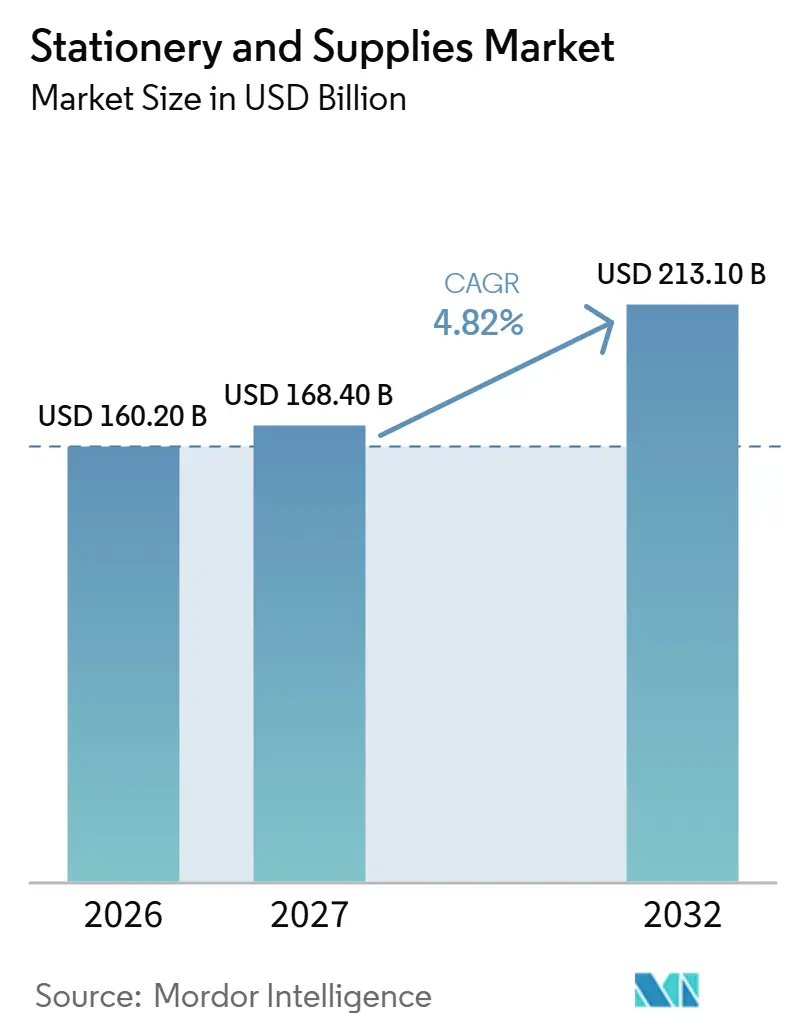
The stationery and supplies market size was valued at USD 160.2 billion in 2026 and estimated to grow from USD 168.4 billion in 2027 to reach USD 213.1 billion by 2032, at a CAGR of 4.82% during the forecast period (2027-2032).
Education participation and premium writing products support physical-product demand, while digital workflows displace routine paper tasks. In Japan, the premium mechanical-pencil opportunity connects differentiation to everyday education use, while digital retail services give suppliers additional routes to buyers. Middle East shipping disruptions affecting Strait of Hormuz chemical-feedstock routes added pressure to European printing-ink inputs in March 2026. For producers, premium writing formats and app-linked notebooks offer ways to preserve a physical sale when routine paper tasks migrate online and material costs press on basic supplies.
Key Report Takeaways
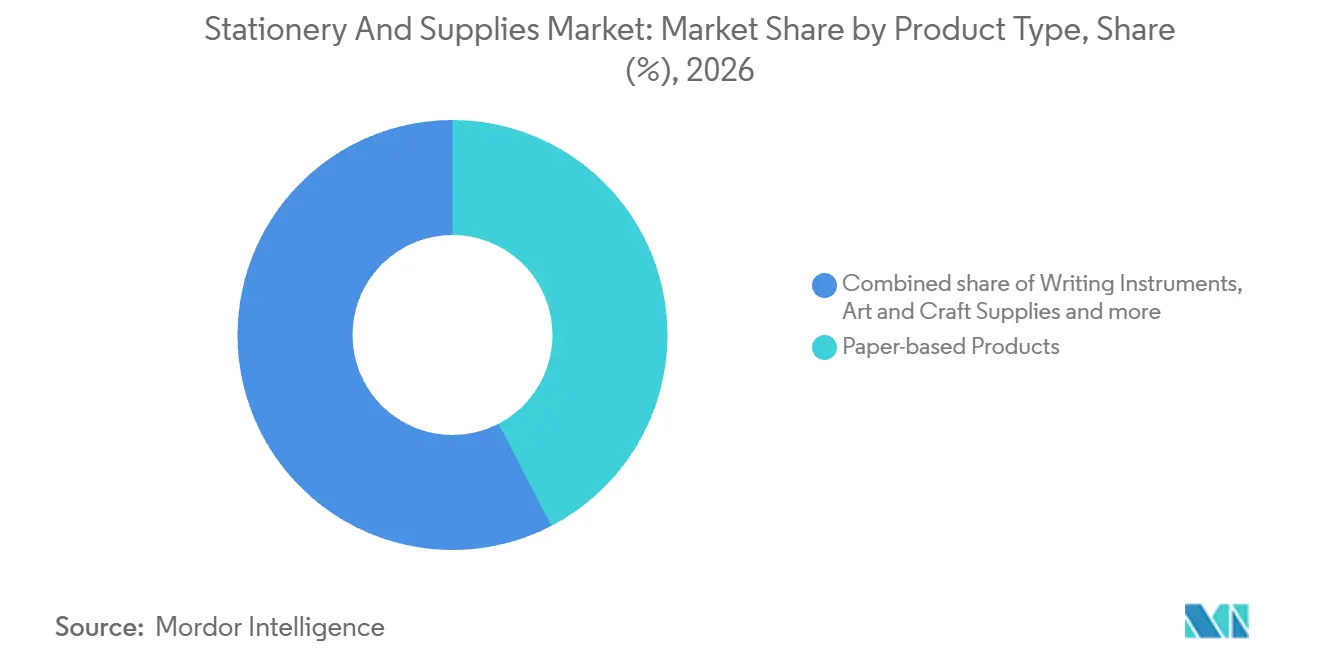
- By product type, paper-based products led with a 42.39% stationery and supplies market share in 2026, while non-paper office essentials are forecast to be the fastest-growing segment at a CAGR of 6% during 2027-2032.
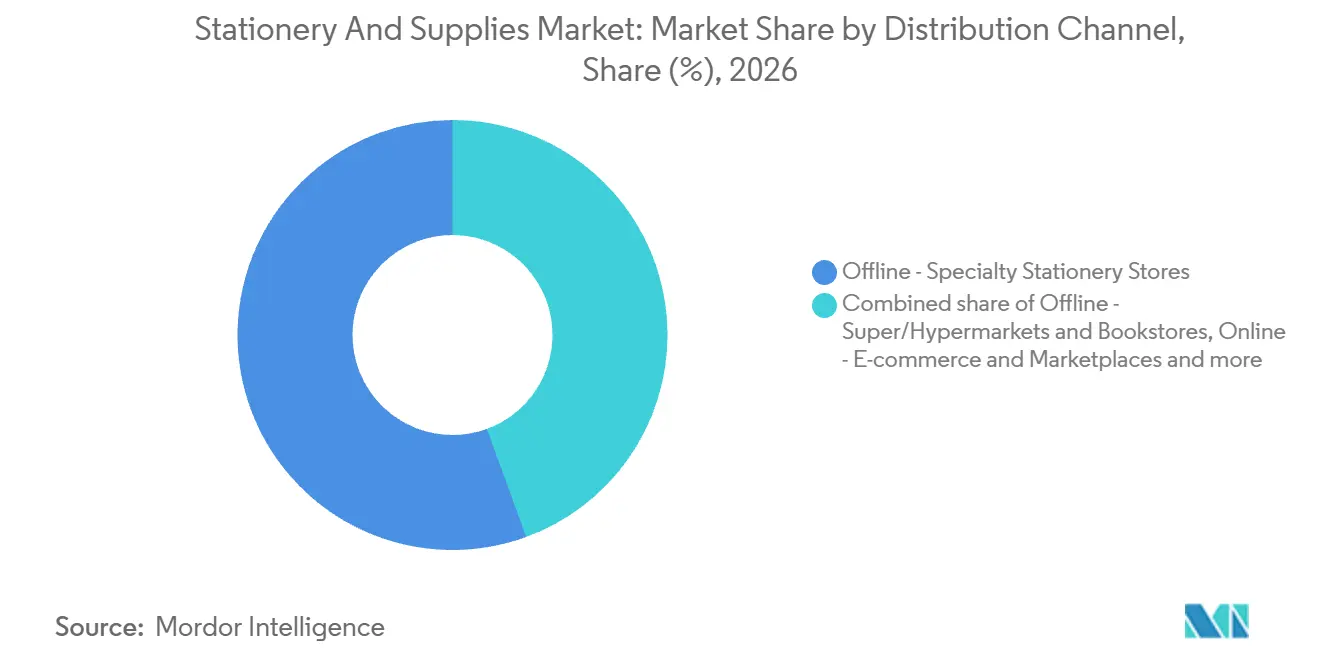
- Among distribution channels, offline specialty stationery stores accounted for a 55.57% share of the stationery and supplies market size in 2026, while online e-commerce and marketplaces are forecast to grow fastest at a CAGR of 6.4% during 2027-2032.
- Educational institutions led end-user demand with 45.58% of the market in 2026, and individual consumers are expected to grow fastest at a CAGR of 5.5% during 2027-2032.
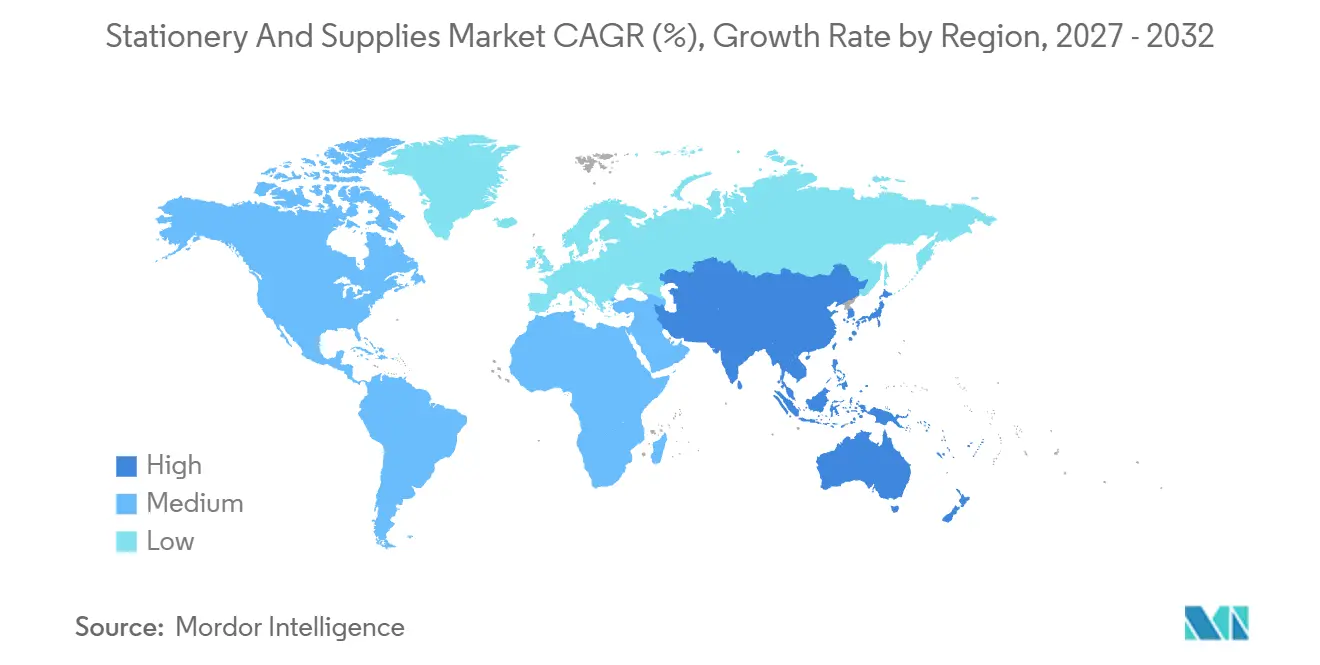
- Geographically, Asia-Pacific held 35.63% of the market in 2026 and is projected to be the fastest-growing region at a CAGR of 5.78% during 2027-2032.
Note: Market numbers in this report are based on Mordor Intelligence's proprietary estimation framework, which combines nine months of actuals with Q4 projections for base year 2026.
Market Trends and Insights
Drivers Impact Analysis of Stationery And Supplies Market*
| Driver | (~) % Impact on CAGR Forecast | Geographic Relevance | Impact Timeline |
|---|---|---|---|
| Rising e-commerce penetration for stationery and office supplies | +2.1% | Australia, North America, Europe | Short term (≤ 2 years) |
| Expanding enrollment in K-12 and tertiary education worldwide | +2.2% | United States and Asia-Pacific | Medium term (2-4 years) |
| Premium and customized writing instruments gaining traction | +1.3% | Japan, Europe, North America | Medium term (2-4 years) |
| Smart reusable notebooks integrated with cloud services | +0.8% | North America and Europe | Long term (≥ 4 years) |
| Corporate ESG mandates driving demand for recycled stationery | +0.6% | Europe, North America, Asia-Pacific | Medium term (2-4 years) |
| Revival of journaling/art-therapy trends among Gen-Z | +0.4% | Australia and North America | Short term (≤ 2 years) |
| Source: Mordor Intelligence | |||
Rising e-commerce penetration for stationery and office supplies
Online assistance creates a demand lever by improving how customers interact with a retailer before they complete an order. In FY2025, Officeworks' expanded next-day, same-day and 2-hour delivery and 2-hour Click & Collect supported online sales growth across its broader retail offer. In FY2026, Wesfarmers launched retail shopping assistants, including Officeworks' Ollie, adding customer functionality and supporting higher online sales collectively across the group's retail divisions. Officeworks sells technology, stationery, furniture, art supplies and learning resources, placing physical supplies within that broader retail environment. For stationery producers, this places part of the growth opportunity with the channel partner that controls the customer interaction.
Expanding enrollment in K-12 and tertiary education worldwide
A larger enrolled student population expands the potential user base for physical learning supplies, even when spending per student is unchanged. As a U.S. postsecondary example, enrollment was estimated at over 19.4 million in fall 2025, up 1% from fall 2024. Undergraduate enrollment was estimated at 16.2 million, up 1.2% over that period, while graduate enrollment was broadly stable at 3.2 million, down 0.3%. Australian school enrollment rose 0.7% in 2025 from 2024, although primary enrollment fell 0.3%. The school-level difference makes an undifferentiated education assortment a weaker response than matching supplies to the cohorts adding learners.
Premium and customized writing instruments gaining traction
Premium writing instruments can increase spending on a familiar task without requiring buyers to write more often. Pilot Corporation reported that its global fountain-pen category grew 14.6% year over year in 2025.[1] It attributed that growth to overseas fan-focused events involving sales and technician-led fountain-pen adjustments. In January 2025, Tenjin Loft reported growing popularity for higher-priced mechanical pencils among students in Fukuoka, Japan. The premium offer needs 2 distinct propositions, specialist servicing for fountain-pen enthusiasts and everyday utility for students choosing mechanical pencils.
Smart reusable notebooks integrated with cloud services
Smart reusable notebooks can preserve a role for handwriting when a buyer also needs organized digital notes. In February 2025, Rocketbook updated its reusable Core and Flip notebooks with page features that let its app automatically name and sort scanned files. Global Printing & Packaging says it acquired Rocketbook and that its products and app remain fully supported. For buyers choosing this combination, continued app support matters because the notebook's digital usefulness depends on the accompanying service. Title bars and tags make the physical page the organizing interface for scanned notes, giving buyers who need both formats a reason to choose an app-linked notebook.
Restraints Impact Analysis of Stationery And Supplies Market*
| Restraint | (~) % Impact on CAGR Forecast | Geographic Relevance | Impact Timeline |
|---|---|---|---|
| Accelerating digitalization reducing paper consumption | -1.3% | North America, Europe, Asia-Pacific | Long term (≥ 4 years) |
| Volatility in pulp & petro-chemical input prices | -0.8% | Japan, Europe, North America | Short term (≤ 2 years) |
| Counterfeiting and gray-import channels eroding branded share | -0.3% | Eastern Europe, Middle East, Africa, North America, South America | Medium term (2-4 years) |
| Pigment/ink supply shocks from geo-political conflicts | -0.2% | Europe and Middle East | Short term (≤ 2 years) |
| Source: Mordor Intelligence | |||
Accelerating digitalization reducing paper consumption
Digital substitution reduces demand by removing paper-consuming tasks, which limits how much suppliers can recover through better distribution alone. ACCO Brands Corporation reported in its 2025 Form 10-K that rising worldwide technology use and changing hybrid work and education had reduced demand for many of its traditional paper-based and related products. ACCO also stated that the demand decline had materially adversely affected its business and results of operations and that it expected demand for those products to decline further. For exposed suppliers, a disappearing use occasion creates a different problem from losing an order to another brand, because lower prices cannot recreate the task.
Volatility in pulp & petro-chemical input prices
Input inflation constrains stationery demand when suppliers must choose between absorbing higher costs and passing them into selling prices. In April 2026, PLUS Stationery reported that rising paper-based raw-material costs made prices difficult to maintain for selected files, printing paper and office supplies. It implemented a price revision in June 2026, citing raw-material, logistics and labor costs. Its August 2026 notice, issued after that revision, said rising crude-derived material and logistics costs, alongside resin and packaging pressures, made prices difficult to maintain for 2,017 listed stationery products.[2] Pressure spanning paper, resins and packaging leaves limited room to shelter an assortment by adjusting a single material.
*Our forecasts treat driver/restraint impacts as directional, not additive. The impact forecasts reflect baseline growth, mix effects, and variable interactions.
Stationery And Supplies Market Segment Analysis
By Product Type:
Paper Scale and Durable Office ToolsPaper-based products represented a 42.39% stationery and supplies market share in 2026. ITC Ltd. said Classmate consolidated its leadership in India's notebook segment during FY2025-26. Its Education and Stationery Products business reported significant second-half improvement after focused interventions and calibrated pricing actions. The business faced subdued realizations amid low-priced paper imports and competition from local and regional players.
Non-paper office essentials are forecast to be the fastest-growing segment, at a CAGR of 6% during 2027-2032. Within MAX Co., Ltd.'s overseas office-equipment business, sales of labeling and signage products, including BEPOP sign and label printing machines, increased in FY2025, ended March 2026. MAX partly attributed that increase to more European exhibition participation attracting prospective customers. Its broader Office Equipment segment, which includes staplers and label printers among other products, nevertheless reported 2% lower sales over the same fiscal year. The commercial opening lies in reaching new buyers for a defined labeling task, even where a supplier's wider equipment assortment is under pressure.

By Distribution Channel:
Specialist Access and Digital ReachOffline specialty stationery stores were the largest segment, accounting for 55.57% of market sales in 2026. Shanghai M&G Stationery reported nearly 900 Jiumu stores across China at the end of June 2026, selling stationery alongside creative products, educational toys and entertainment, and practical household goods. In 2025, Jiumu tested multiple offline formats and adjusted assortments and in-store settings to fit customer groups in different commercial districts. Revenue at the multi-category Jiumu format grew 15.9% year over year in the first half of 2026. That local assortment flexibility gives stationery-focused retail a way to serve distinct customer groups beyond simply providing a physical sales counter.
Online e-commerce and marketplaces are forecast to be the fastest-growing segment, at a CAGR of 6.4% during 2027-2032. In Australia, the combined books, stationery and multimedia category was the strongest-growing category for online spending in 2025. Online sales accounted for 45% of that combined category's Australian spending in the same year. Mass merchants were the top shopping destination in Deloitte's May 2026 U.S. K-12 parent survey, with 80% planning back-to-school purchases there. For sellers into the combined books, stationery and multimedia category, the online spending base supports a digital presence alongside physical retail.
By End-User:
Institutional Scale and Consumer ChoiceEducational institutions accounted for a 45.58% share of the stationery and supplies market size in 2026. In 2024-25, the United States had 51,463 regular operating public elementary schools, excluding exclusively virtual schools and those with zero or missing membership or an unreported level. Average student membership was 438 at those schools. That school count and average enrollment imply demand spread across many small sites, making broad distribution reach commercially relevant to serving this institutional base.
Individual consumers are forecast to be the fastest-growing segment, at a CAGR of 5.5% during 2027-2032. In 2025, Gen Z online spending on the combined books, stationery and multimedia category grew 50.9% in Australia. Eligible government and public-sector buyers can use Ireland's Office of Government Procurement framework for office paper made from 100% recycled fibers from May 7, 2025, to May 7, 2029. For suppliers serving the measured consumer category, digital retail provides a route alongside organized institutional purchases.
Geography Analysis
Asia-Pacific Stationery And Supplies Market
Asia-Pacific was the largest geography, with a 35.63% share of the stationery and supplies market size in 2026, and is forecast to be the fastest-growing geography at a CAGR of 5.78% during 2027-2032. In 2025, Shanghai M&G Stationery Inc. reported China principal-business revenue of CNY 23.9 billion (USD 3.35 billion), up 3.34% year over year. That business included stationery and office-supplies manufacturing and sales, non-M&G retail sales through Colipu Group and M&G Life, and franchise-management fees. India's Department of School Education and Literacy received a 6.35% higher FY2026-27 allocation than its FY2025-26 budget estimate. M&G's China revenue shows one supplier operating manufacturing, retail and franchise channels at scale, while India's larger school-education allocation creates potential institutional purchasing capacity.
In North America, 41% of U.S. students and families in the National Retail Federation's 2026 back-to-college survey planned to shop online for the broader basket of clothing, supplies and other goods. In Europe, the Government of Flanders in Belgium included EU Ecolabel-aligned paper criteria in a stationery-supplies framework, while Poland's Poczta Polska reported an online office-supplies channel with postal-branch, parcel-locker and partner-point delivery in June 2026. Within Asia-Pacific's other markets, under New Zealand's 2025-2028 Community Education Collective Agreement, covered adult and community education and out-of-hours music and arts personnel must be reimbursed for approved course stationery against receipts, with school printing or photocopying permitted instead when required for work. For suppliers, Flanders' framework puts paper specifications in the institutional sales route, while New Zealand's agreement connects reimbursement to approved course expenses and receipts.
In South America, São Paulo's credit program for municipal-school students recorded more than 1.3 million school-material and uniform sales through accredited stores from January through March 19, 2026, with families choosing the goods. In Colombia, EPM's school-kit donation program delivered 14,200 kits to children in Antioquia municipalities for the start of the 2026 school year. Within the Middle East and Africa, South Africa's Eastern Cape 2026/27 budget described stationery funding through Norms and Standards transfers for most Quintile 4 and 5 schools, with centralized procurement for Quintiles 1 to 3. Ghana's Nursing and Midwifery Training College Koforidua approved a stationery contract award including an office-supplies lot on March 22, 2026. Municipal credits can spread supply across accredited shops, while school transfers and college contract awards create institutional points of entry.
Regulatory Framework and Outlook
The comparison assesses selected jurisdictions from the perspective of a supplier placing covered physical stationery, student supplies, art materials and writing paper on the market. Product-specific assessment and certification shape access, while packaging obligations create additional compliance work. Under U.S. art-material rules, the Consumer Product Safety Commission (CPSC) enforcement policy treats labeling failures by ordinary-use pencils and single-color pens or markers as insufficient enforcement grounds unless packaging, promotion or marketing indicates art-material use. China's student-supply standard covers products for users age 14 and younger, and covered notebooks also face GB 40070-2021 requirements.
Regulatory Table of Stationery And Supplies Market
| Decision factor | United States | Germany | China | Brazil | Saudi Arabia |
|---|---|---|---|---|---|
| Primary authority | Consumer Product Safety Commission (CPSC) | State market-surveillance authorities for product safety; European Commission for packaging implementation | Ministry of Industry and Information Technology for GB 21027-2020 | INMETRO for school-article regulatory assessment | Saudi Standards, Metrology and Quality Organization (SASO) |
| Key instruments or direction | 16 CFR 1500.14(b)(8) for covered art materials | Product Safety Act; Regulation (EU) 2025/40 on packaging | GB 21027-2020 for covered student articles | Portaria 423/2021, school-article conformity assessment | Technical Regulation for Paper and Cardboard, including writing paper |
| Commercial effect | Producers or repackagers submit assessment criteria and required lists; conformance statement; hazard warnings when required | Exposure to product-safety sanctions; phased packaging requirements from August 12, 2026 | Chemical, physical and labeling compliance for covered student supplies | Conformity-assessment planning for school articles | Type 1a certificate from a SASO-accepted body for covered writing paper; exclude toxic, environmentally hazardous or carcinogenic substances; account for reuse or recycling in design |
| Current policy attractiveness | Medium | Low | Medium | Medium | Medium |
| Future direction of policy attractiveness | No change | Hardening | No change | No change | No change |
| Source: Mordor Intelligence | |||||
U.S. continuity reflects operative art-material duties and no art-material action in the 2026 CPSC agenda, while China's current student-supply standard provides the baseline during draft revision work. Germany's lower attractiveness reflects market-surveillance exposure and phased packaging requirements from August 12, 2026, with label and recycled-content measures in preparation. Brazil's school-article assessment framework and its review scheduled for 2026 to consider safety adjustments for children younger than 14 support an unchanged supplier-planning baseline. Saudi Arabia's conformity certificate and requirements to account for reuse or recycling in design support a continuing compliance path for covered writing-paper products.
Value Chain Stages
The comparison follows paper supply, finished stationery manufacturing and distribution, separating material conversion from the final sales channel. Mondi supplies paper for notebooks, sticky notes, agendas, index cards and folders. Kokuyo Co., Ltd. converts purchased semi-finished paper, mainly through printing, into finished products such as notebooks. These roles place supplier earnings in paper sales, finished-product sales and distribution sales, with different costs governing each stage.
Value Chain Analysis Table of Stationery And Supplies Market
| Primary activity | Key participants | Value capture | Bottleneck | Resilience response |
|---|---|---|---|---|
| Paper supply | Paper producers such as Suzano and Mondi | Paper sales to converters | Qualifying grades for different stationery applications | Test alternative grades against application requirements |
| Finished stationery manufacturing | Stationery manufacturers such as Kokuyo Co., Ltd. and Société BIC S.A. | Finished-product sales | Coordinating purchased paper with notebook conversion | Align paper orders with conversion schedules |
| Online and enterprise distribution | Supply-channel operators such as MonotaRO Co., Ltd. | Distribution sales | Handling costs absorb sales value | Improve sales value per box and distribution-center productivity |
| Source: Mordor Intelligence | ||||
MonotaRO's distribution-related costs were 6.2% of sales in 2025, down 0.5 percentage points from 2024 in its broader non-consolidated business. Its report tied a 0.1 percentage point lower labor and outsourcing expense ratio to higher sales per box, fewer boxes handled and improved distribution-center productivity. The figures connect a distributor's value capture to the relationship between order value and handling workload, so product sales alone give an incomplete picture of this stage's economics.
Competitive Landscape
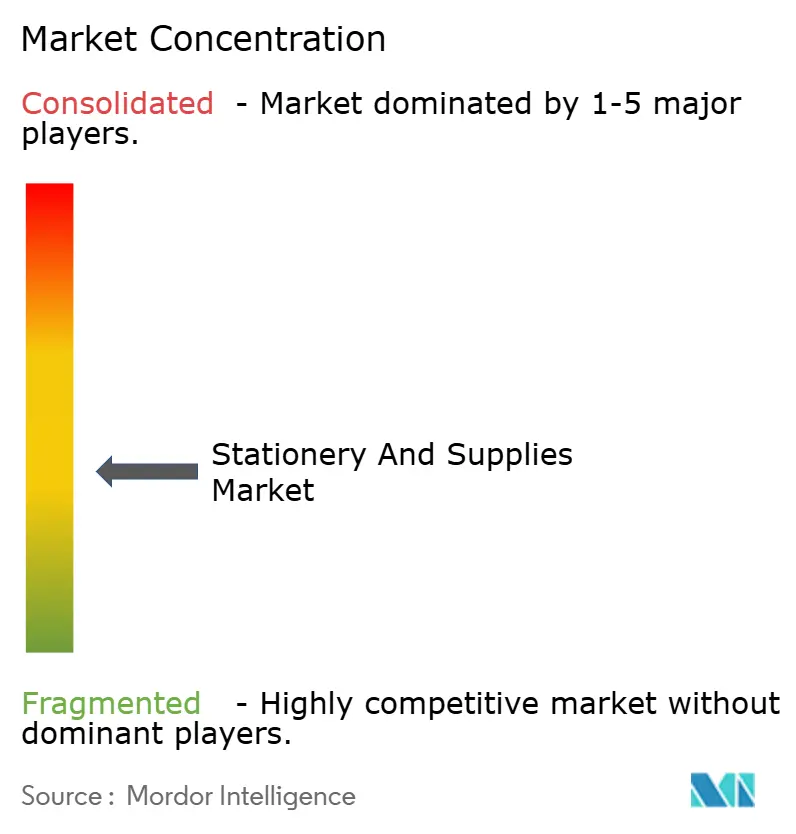
Competition combines diversified suppliers and specialist stationery businesses, led by 3M Company, ACCO Brands Corporation, Société BIC S.A., Kokuyo Co., Ltd., and Faber-Castell AG. 3M's Consumer segment supplies stationery and office products, while ACCO's Americas and International segments design, market, source, manufacture and sell products including notebooks, stapling, punching and planners. About 75% of ACCO Brands' 2025 net sales came from brands ranked first or second in their respective product categories. Challengers to ACCO face first- or second-ranked brands in much of its business, so entry is contested category by category.
On October 10, 2025, Faber-Castell announced plans to close its Textliner highlighter plant in Engelhartszell, Austria, in summer 2026 and relocate the production facilities to Lima, Peru. It cited sharply declining Textliner demand and its Global Production Footprint project, stating that delivery capability would remain guaranteed throughout the transfer. In December 2025, Kokuyo approved plans to buy Thien Long An Thinh Investment Corporation shares and tender for Vietnamese stationery manufacturer and distributor Thien Long Group, subject to Vietnamese approval. On September 30, 2026, Kokuyo approved JPY 28 billion (approximately USD 177 million) in capital for its wholly owned Singapore acquisition vehicle to fund those purchases, conditional on Vietnamese approval, leaving the Singapore-dollar amount and injection date undecided. Faber-Castell's plan would consolidate Textliner production at its Lima site, while Kokuyo's proposed ownership would extend its Vietnamese manufacturing and distribution base.
Société BIC's Human Expression division recorded 0.5% organic net sales growth in the first half of 2026 at constant currency and perimeter. BIC attributed the gain to North America and the Middle East and Africa, which more than offset declines in Europe and Latin America. Reported division net sales fell 7.2% in the same period, while second-quarter organic net sales declined 1.0%. Across its broader portfolio, BIC said genuine products smuggled from intended markets into other countries could violate regulations and create recall risks, especially in the United States. North America's contribution to division growth makes compliant U.S. sales routes a competitive consideration for retailers, since even genuine goods can carry the disclosed recall exposure.
Stationery And Supplies Industry Leaders
-
3M Company
-
ACCO Brands Corporation
-
Société BIC S.A.
-
Kokuyo Co., Ltd.
-
Faber-Castell AG
- *Disclaimer: Major Players sorted in no particular order
Stationery And Supplies Market Companies Covered in this Report
- 3M Company
- ACCO Brands Corporation
- Société BIC S.A.
- Kokuyo Co., Ltd.
- Faber-Castell AG
- Newell Brands Inc. (Paper Mate, Sharpie, Parker)
- Pilot Corporation
- Pentel Co., Ltd.
- STAEDTLER SE
- Deli Group Co., Ltd.
- DOMS Industries Ltd.
- Linc Limited
- ITC Ltd. (Classmate)
- Schneider Schreibgeräte GmbH
- Crayola LLC
- Fellowes Brands
- Staples Inc.
- Office Depot, LLC
- Montblanc International GmbH
- Mitsubishi Pencil Co. (Uni-Ball)
Key Opportunities for Market Participants
The opportunities compare potential product supply and delivery roles within Brazil's school-kit procurement planning. On September 21, 2026, Brazil's Fundo Nacional de Desenvolvimento da Educação (FNDE) announced a public hearing to gather input for planning the acquisition of school-material kits by states, the Federal District and municipalities.[3] The hearing, scheduled for September 29, 2026, was set to bring manufacturers, suppliers and public-school network managers into planning for a national price-registration procurement. Proposed kit components included notebooks, pens, pencils, crayons, paint and geometry tools.
Market Opportunities Table of Stationery And Supplies Market
| Opportunity | Why now | Buyer / lead segment | Recommended play | Main barrier | Likely beneficiaries |
|---|---|---|---|---|---|
| Complete school-supply kits | National kit procurement in planning | State and Federal District public-school networks | Coordinate complete-kit offers against final specifications | Conformity across every supplied component | Manufacturers and kit suppliers |
| Stationery and art-supply components | Proposed stationery and art components identified | Suppliers assembling kits for public-school networks | Develop component offers with kit partners | Maintaining quality across the component package | Stationery and art-supply producers |
| Municipal kit fulfillment | Municipal networks included in the planned arrangement | Municipal public-school networks | Prepare aggregation and delivery partnerships | Delivering complete kits across participating school networks | Kit suppliers and distribution partners |
| Source: Mordor Intelligence | |||||
That mix creates a component-supply opening for single-category producers working with kit assemblers. The scheduled hearing was intended to allow review of the kits' technical specifications, making product qualification a practical preparation step. Commercial commitments depend on the eventual procurement terms.
Recent Industry Developments in Stationery And Supplies Market
- Sep 2026: On September 30, Kokuyo approved a JPY 28 billion (approximately USD 177 million) capital increase for its wholly owned Singapore acquisition vehicle to fund Thien Long share purchases, with execution conditioned on Vietnamese approval and the Singapore-dollar amount and injection date undecided.
- Sep 2026: Brazil's FNDE announced a public hearing, scheduled for September 29, to gather input from manufacturers, suppliers and public-school network managers on planning a future national price-registration procurement of school-material kits for states, the Federal District and municipalities.
- Aug 2026: PLUS Stationery said rising crude-derived material and logistics costs, alongside resin and packaging pressures, made prices difficult to maintain for 2,017 listed stationery products in Japan.
Stationery And Supplies Market Report Scope and Research Methodology
Market Definition and Coverage
Stationery and supplies market measures annual value of physical stationery and supplies sold across Global. The measure is annual point-of-sale spending by retail and institutional buyers.
Scope exclusions: Printing equipment, large office furniture, IT hardware, and pure digital products such as note-taking apps and subscriptions are excluded.
Segments Covered in This Report
- By Product Type
- Paper-based Products
- Writing Instruments
- Art and Craft Supplies
- Office Essentials (Non-paper)
- By Distribution Channel
- Offline - Specialty Stationery Stores
- Offline - Super/Hypermarkets & Bookstores
- Online - E-commerce & Marketplaces
- By End-User
- Educational Institutions
- Corporate and Home-office Users
- Individual Consumers
- Government and Public Sector
- By Geography
- North America
- United States
- Canada
- Mexico
- South America
- Brazil
- Peru
- Chile
- Argentina
- Rest of South America
- Europe
- United Kingdom
- Germany
- France
- Spain
- Italy
- BENELUX (Belgium, Netherlands, Luxembourg)
- NORDICS (Denmark, Finland, Iceland, Norway, Sweden)
- Rest of Europe
- Asia-Pacific
- India
- China
- Japan
- South Korea
- Australia
- South-East Asia (Singapore, Malaysia, Thailand, Indonesia, Vietnam, Philippines)
- Rest of Asia-Pacific
- Middle East and Africa
- United Arab Emirates
- Saudi Arabia
- South Africa
- Nigeria
- Rest of Middle East and Africa
- North America
Data Sources, Market Sizing, and Validation
Desk Research
Illustrative sources include the Food and Agriculture Organization's Forest Products Statistics for paper production and trade context, the World Bank's World Development Indicators for enrollment and population indicators, and the UNESCO Institute for Statistics' Repository of Education Expenditure Reports for public education spending. World Bank WITS trade statistics, which draw on UN Comtrade product codes, help identify cross-border patterns in paper and related supplies. Together, these indicators frame education-linked demand, material availability, and trade exposure.
Company annual reports and regulatory filings can supplement these indicators with product portfolios, financial performance, and channel disclosures, while investor materials and reputable press can help cross-check dated company or market developments. For example, an issuer's 10-K can clarify which stationery categories sit inside a diversified company's reported segments and support company-level product and financial cross-checks. The named sources are not exhaustive, and further sources inform collection, validation, and clarification.
Primary Interviews and Surveys
Interviews and structured surveys can include stationery manufacturers, distributors and retail category leaders, education procurement staff, corporate and public buyers, and e-commerce merchandising managers across APAC, EMEA, and the Americas. Analysts can use respondents to check secondary-source interpretations of product coverage, channel and buyer shares, pricing, input costs, and forecast drivers, then reconcile disagreements against company disclosures and official indicators. When evidence is missing or inconsistent, the model can retain a documented range, seek clarification from relevant respondent types, and triangulate against independent supply, trade, and demand signals.
Distribution of primary research fieldwork respondents
| Company type | Respondent position | Region |
|---|---|---|
| Top tier: 30% | CXOs: 20% | APAC: 40% |
| Mid tier: 45% | Functional/Unit leaders: 35% | EMEA: 30% |
| Smaller Players: 25% | Managers: 45% | Americas: 30% |
Market-Sizing & Forecasting
The model starts with a top-down estimate of global final sales of physical stationery, then checks selected product, channel, buyer, and regional values against supplier disclosures and sampled average selling price times volume or channel roll-ups where evidence permits. Enrollment and education spending indicate institutional demand. Paper and paperboard production and trade, pulp and packaging input prices, and supplier sales help test supply and value trends. E-commerce reach and digital substitution inform channel movement and paper demand. Where direct segment observations are missing, analysts infer shares from the closest supported category evidence for paper-based products, writing instruments, art and craft supplies, non-paper office essentials, the named sales channels and buyer groups, and the five report regions, then reconcile them to the market total. Multivariate regression can relate historical market value to these demand and supply indicators, while scenario adjustments address material-cost and channel changes when historical relationships are unstable. Analysts can use the resulting forecasts as variable-level hypotheses for interviews with manufacturers, retailers, and institutional buyers. Selective bottom-up checks use supplier revenue or channel coverage and sampled price times volume, with gaps recorded as ranges and checked against the top-down total rather than treated as a complete bottom-up market build.
Data Validation & Update Cycle
Analysts triangulate independent company, trade, education, and material indicators against the market estimate and its segment shares, investigate outliers and unexplained variance, and document the evidence supporting each resolution. A second analyst reviews the boundary, units, calculations, source dates, and forecast drivers before sign-off, and the lead analyst re-contacts relevant respondents when a material contradiction, changed definition, or new disclosure could alter an estimate. The model is refreshed annually, reviewed between cycles after material events such as major price or trade disruptions, and given a fresh pre-delivery source and calculation pass.
Mordor Intelligence's Global Stationery and Supplies Market Size Compared With Other Published Estimates
Published estimates can differ in the transactions and products they count and the inputs used to model demand. Stationery and supplies market measures annual value of physical stationery and supplies sold across Global.
Key Gap Drivers include the study's defined coverage and market-specific modeling choices. Multivariate regression can relate historical market value to these demand and supply indicators, while scenario adjustments address material-cost and channel changes when historical relationships are unstable.
Benchmark comparison
| Source | Market Size | Gaps in Research Methodology |
|---|---|---|
| Mordor Intelligence | USD 168.4 B (2027) | |
| Global Research Firm A | USD 154.6 B (2025) | At its 2025 base, this estimate is 8.2% below this report's 2027 value of USD 168.4 B, 2 years later. Its older base precedes this report's current-year estimate, while its published forward outlook projects continued market growth. |
| Global Research Firm B | USD 152.6 B (2025) | At its 2025 base, this estimate is 9.4% below this report's 2027 value of USD 168.4 B, 2 years later. Its older base precedes this report's current-year estimate, while its published forecast describes continued market expansion. |
Mordor Intelligence's analysts triangulate independent company, trade, education, and material indicators against the market estimate and its segment shares, investigate outliers and unexplained variance, and document the evidence supporting each resolution.
Key Questions Answered in the Report
What is the stationery and supplies market size and growth outlook?
The industry was valued at USD 160.2 billion in 2026 and is estimated at USD 168.4 billion in 2027. It is projected to reach USD 213.1 billion by 2032, at a CAGR of 4.82% during 2027-2032.
What is driving demand for physical stationery?
Education use, premium writing products and digital retail capabilities support demand. Wesfarmers reported that shopping assistants, including Officeworks' Ollie, supported higher online sales collectively across its retail divisions in FY2026.
Which product category leads stationery sales?
Paper-based products were the largest segment at 42.39% of the market in 2026. Non-paper office essentials are forecast to grow fastest at a CAGR of 6% during 2027-2032.
Who are the leading stationery suppliers?
Leading suppliers include 3M Company, ACCO Brands Corporation, Société BIC S.A., Kokuyo Co., Ltd., and Faber-Castell AG.
What is the main challenge for paper-based stationery?
ACCO Brands Corporation reported that technology use and changing hybrid work and education reduced demand for many of its traditional paper-based and related products.
Which region has the strongest stationery outlook?
Asia-Pacific was the largest region with 35.63% of the market in 2026 and is forecast to grow fastest at a CAGR of 5.78% during 2027-2032.