
Secondary Battery Market Size and Share
Market Overview
| Study Period | 2021 - 2031 |
|---|---|
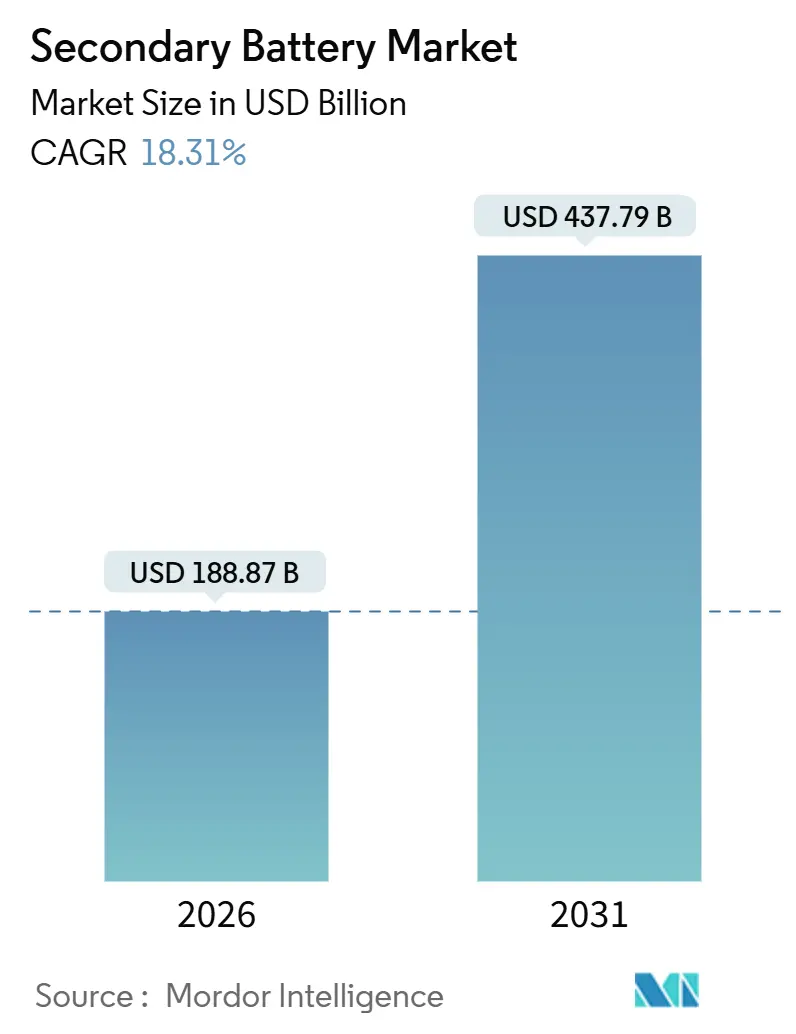
| Market Size (2026) | USD 188.87 Billion |
| Market Size (2031) | USD 437.79 Billion |
| Growth Rate (2026 - 2031) | 18.31 % |
| Fastest Growing Market | Asia Pacific |
| Largest Market | Asia Pacific |
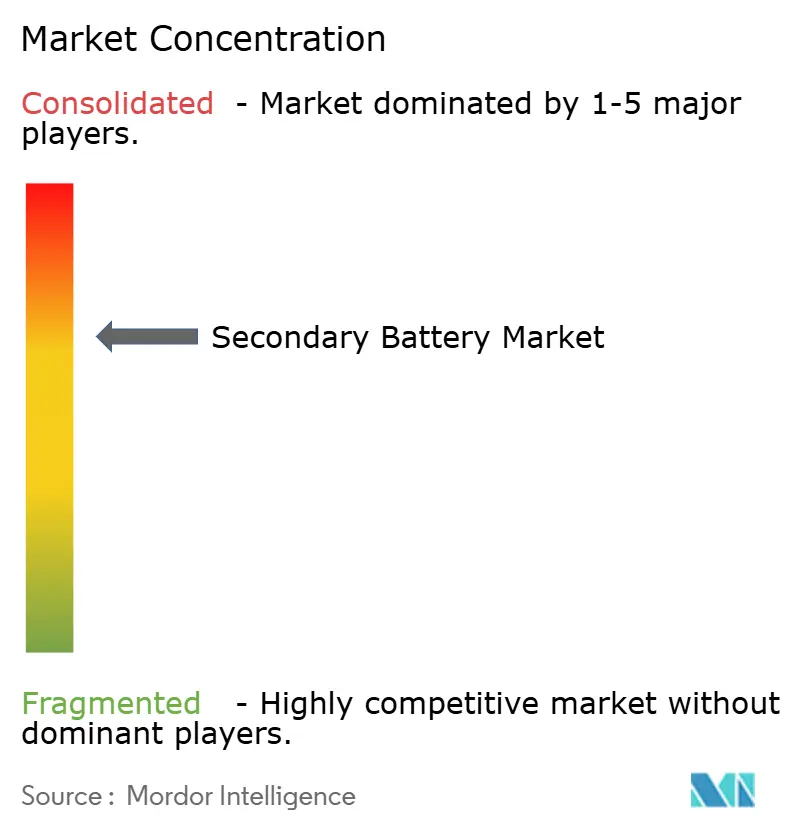
| Market Concentration | Medium |
Major Players
*Disclaimer: Major Players sorted in no particular order Image © Mordor Intelligence. Reuse requires attribution under CC BY 4.0. |
|
Secondary Battery Market Analysis by Mordor Intelligence
The Secondary Battery Market size is estimated at USD 188.87 billion in 2026, and is expected to reach USD 437.79 billion by 2031, at a CAGR of 18.31% during the forecast period (2026-2031).
Cost declines below USD 85 per kWh, the rise of sodium-ion alternatives for entry-level segments, and policy incentives that reward local cell assembly are reshaping competitive boundaries. Solid-state pilots have moved from laboratory scale to limited pre-commercial runs, prompting incumbent lithium-ion suppliers to hedge with ceramic and polymer electrolyte programs. Meanwhile, utilities are treating four-hour lithium-ion systems as dispatchable capacity, a change that is closing the demand gap with passenger EVs. Finally, integrated Asian champions continue to defend share by pairing low-cost lithium iron phosphate (LFP) chemistry with aggressive pricing, even as Western automakers pursue regionalized supply chains.
Key Report Takeaways
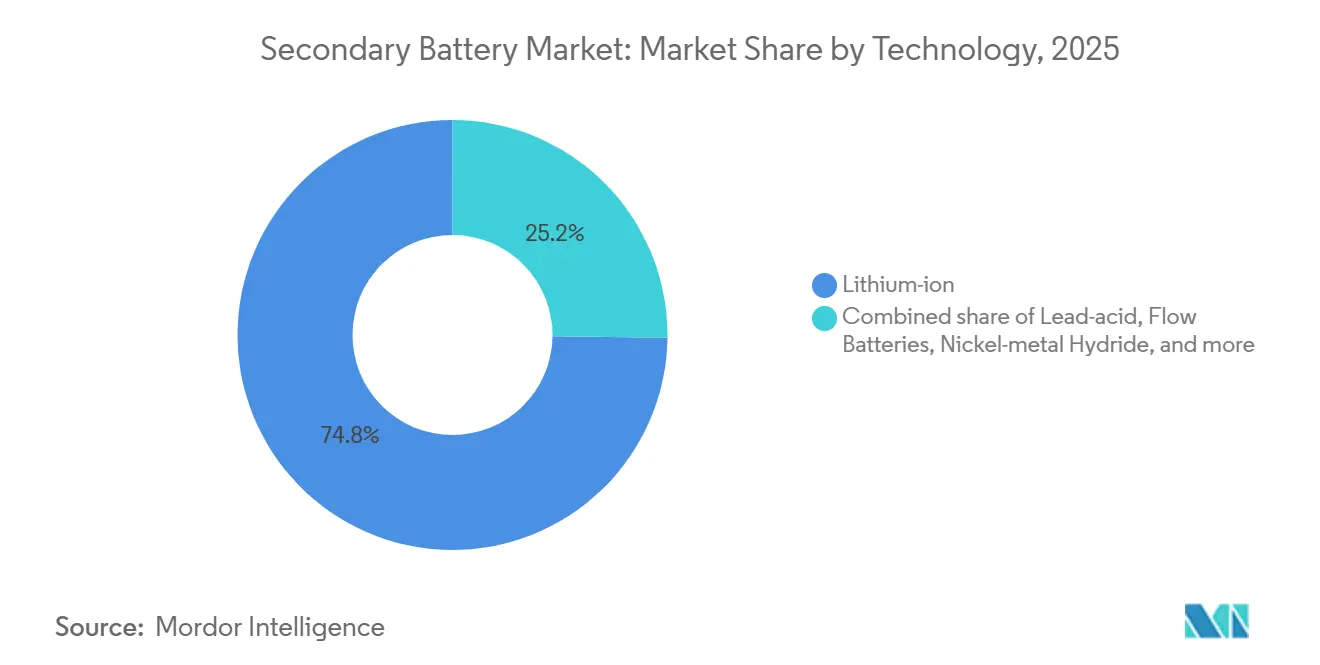
- By technology, lithium-ion captured 74.8% of the secondary battery market share in 2025, while solid-state options are projected to expand at a 24.9% CAGR through 2031.
- By form factor, cylindrical cells led with 53.5% revenue share in 2025; pouch formats are forecast to grow at a 22.2% CAGR to 2031.
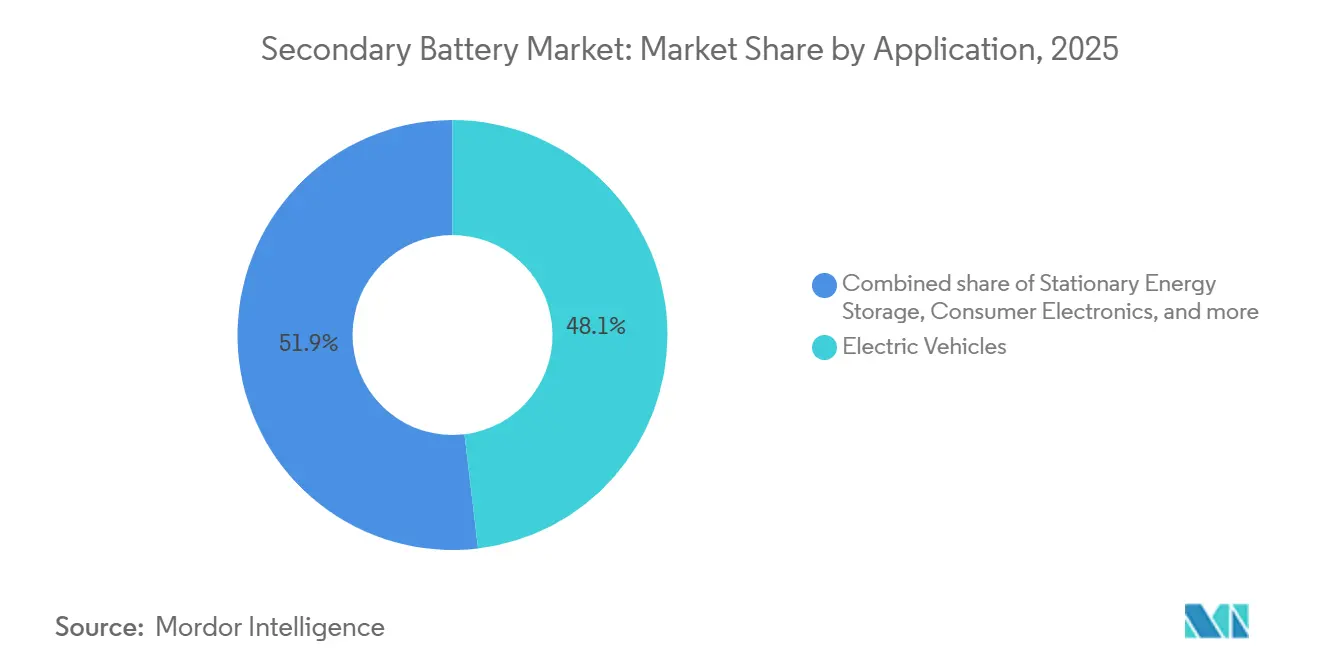
- By application, electric vehicles held 48.1% of the secondary battery market size in 2025, whereas stationary storage is advancing at a 23.5% CAGR through 2031.
- By end-user industry, automotive accounted for 50.6% revenue in 2025, yet utilities are the fastest riser at 22.8% CAGR to 2031.
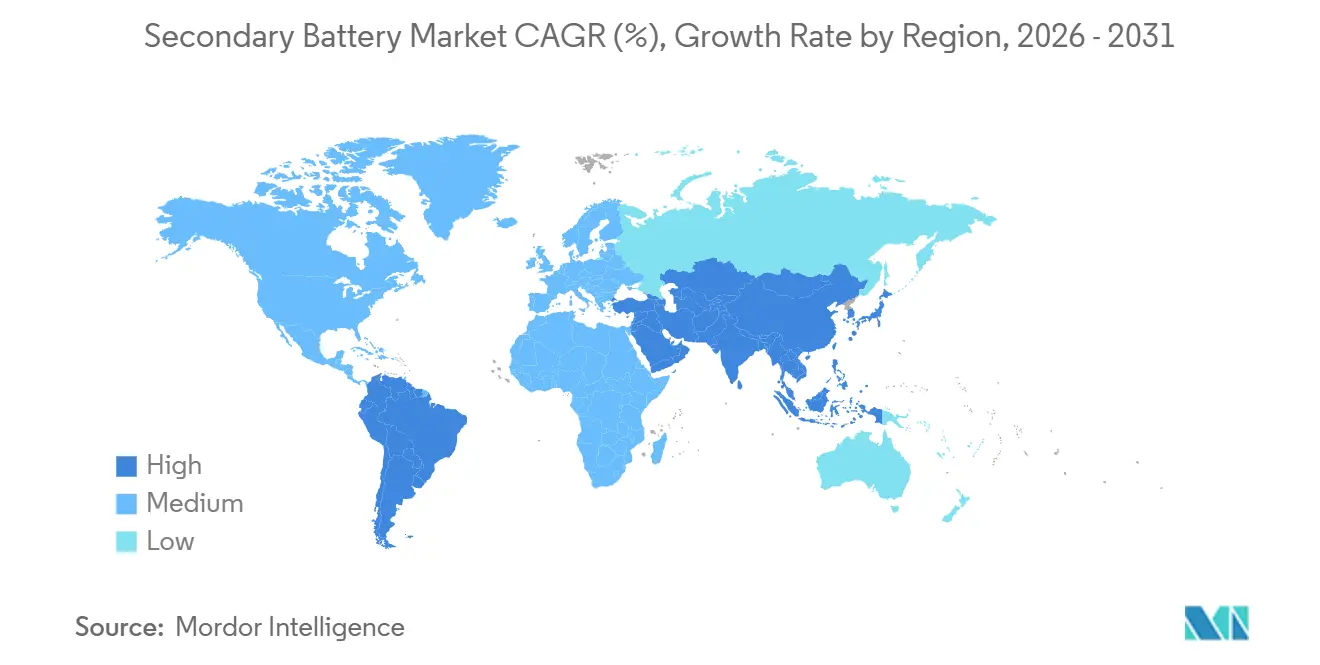
- By geography, Asia-Pacific commanded 49.7% of the secondary battery market in 2025 and is poised for a 20.1% CAGR over the forecast period.
Note: Market size and forecast figures in this report are generated using Mordor Intelligence’s proprietary estimation framework, updated with the latest available data and insights as of January 2026.
Market Trends and Insights
Drivers Impact Analysis of Secondary Battery Market*
| Driver | (~) % Impact on CAGR Forecast | Geographic Relevance | Impact Timeline |
|---|---|---|---|
| Surging EV adoption boosts Li-ion demand | 5.2% | Global, with APAC and Europe leading passenger EV penetration | Medium term (2-4 years) |
| Growth of renewable-integrated storage projects | 4.1% | Global, concentrated in APAC, North America, and Europe | Medium term (2-4 years) |
|
Declining Li-ion cost curve (pack |
3.8% | Global, with fastest cost reductions in China and Southeast Asia | Short term (≤ 2 years) |
| Second-life battery repurposing ecosystems | 1.9% | Europe and North America, early pilots in Japan | Long term (≥ 4 years) |
| Policy-driven localization of gigafactories | 2.7% | North America and Europe, spillover to India and Southeast Asia | Medium term (2-4 years) |
| Rapid LFP uptake for cost & safety advantages | 3.4% | APAC core, expanding to North America and Europe | Short term (≤ 2 years) |
| Source: Mordor Intelligence | |||
Surging EV Adoption Boosts Li-ion Demand
EV sales reached 13.9 million units in 2024, equal to 16% of global passenger car sales, and industry trackers expect the share to exceed 25% by 2026 [1]. Automakers already have offtake contracts that lock in roughly two-thirds of 2027 cell capacity, tightening supply. China crossed 38% domestic EV penetration in 2024, reinforcing a cost-driven shift toward LFP chemistries for mass-market cars. Platforms adopting 800-volt architectures, such as Hyundai E-GMP, need higher energy density, which is pushing suppliers toward silicon-rich anodes and high-nickel cathodes. Those chemistry changes force cell makers to retool lines mid-cycle, squeezing margins even as volume rises.
Growth of Renewable-Integrated Storage Projects
Utility-scale battery storage installations climbed to 45 GW worldwide in 2024, with forecasts pointing to 120 GW by 2026. California mandates 11.5 GW of storage by 2026, while Texas has a 10 GW pipeline, making four-hour lithium-ion systems a cost-effective alternative to gas peakers. Ancillary service markets pay USD 15-25 per MW-hour for frequency regulation, supporting project returns near 20%. Europe’s REPowerEU funding has accelerated tender volumes, though permitting delays shifted 40% of 2024 bids into later years. Developers with ready-to-build sites are therefore well positioned to capture the backlog.
Declining Li-ion Cost Curve (Pack < USD 85/kWh)
Average lithium-ion pack prices fell to USD 139 per kWh in 2024 and are on track for USD 113 by 2026.[2] Chinese LFP suppliers already breached USD 95 per kWh by vertically integrating lithium refining and cathode synthesis. The USD 85 threshold is considered decisive for parity between electric and internal-combustion vehicles in the compact class. Tesla’s tabless 4680 cell aims for USD 70 per kWh by 2028, but current yields remain below 80%, limiting near-term supply. As module housings disappear through cell-to-pack designs, pack-level material intensity drops another 7-9%, reinforcing the downtrend.
Rapid LFP Uptake for Cost and Safety Gains
LFP batteries served 40% of global EV demand in 2024, up ten percentage points in two years. BYD’s Blade Battery provides 140 Wh/kg at pack level while eliminating cobalt, an ESG flashpoint for NMC chemistries. Ford adopted LFP in its Mustang Mach-E standard-range models, cutting battery costs by roughly one-quarter. CATL’s M3P variant reached 210 Wh/kg in 2024 pilot cells, narrowing the density gap with NMC-811 cells to 15%. As insurance premiums rise for NMC stationary projects, the inherent thermal stability of LFP earns preference among utility buyers.
Restraints Impact Analysis of Secondary Battery Market*
| Restraint | (~) % Impact on CAGR Forecast | Geographic Relevance | Impact Timeline |
|---|---|---|---|
| Critical-mineral supply constraints | -2.8% | Global, with acute pressure on lithium, cobalt, and nickel supply chains | Medium term (2-4 years) |
| Safety / thermal-runaway incidents | -1.6% | Global, with heightened scrutiny in North America and Europe | Short term (≤ 2 years) |
| End-of-life compliance cost escalation | -1.3% | Europe and North America, emerging in APAC | Long term (≥ 4 years) |
| Capital diversion to alternative storage tech | -0.9% | North America and Europe, niche deployments in APAC | Long term (≥ 4 years) |
| Source: Mordor Intelligence | |||
Critical-Mineral Supply Constraints
Battery-grade lithium demand hit 620,000 tons LCE in 2024 and could double by 2030, yet new mine approvals lag by almost two years. Cobalt remains concentrated in the Democratic Republic of Congo, where artisanal output adds ESG risk that forces automakers to audit sub-tier suppliers. Nickel sulfate prices spiked to USD 22,000 per ton in early 2024 on Indonesian supply questions and carbon-intensity scrutiny, complicating long-term contract pricing. Recycling may cover just 10-12% of cathode metal demand by 2030 because hydrometallurgical recovery still loses around 10% of lithium.
Safety and Thermal-Runaway Incidents
There were 38 recorded lithium-ion fires in stationary storage sites in 2024, prompting revisions to NFPA 855 that mandate gas detection and aerosol suppression in enclosures larger than 50 kWh.[3] Insurance underwriters now require UL 9540A test data, adding up to USD 100,000 to project certification. Thermal runaway typically initiates near 150 °C in NMC cells, but the reaction cascades quickly in tightly packed modules. LFP’s higher onset temperature of 270 °C is driving its adoption for stationary use. Compliance costs and reputational risk together slow deployments until improved battery management systems become standard.
*Our forecasts treat driver/restraint impacts as directional, not additive. The impact forecasts reflect baseline growth, mix effects, and variable interactions.
Secondary Battery Market Segment Analysis
By Technology:
Solid-State Pilots Challenge Li-ion HegemonyLithium-ion held 74.8% of the secondary battery market share in 2025. However, solid-state variants are forecast to post a 24.9% CAGR to 2031 as Toyota, Samsung SDI, and QuantumScape scale pilot lines. The solid-state architecture replaces liquid electrolytes with ceramic separators, enabling lithium-metal anodes that double energy density to 400-500 Wh/kg. Toyota reported 1,200 cycles at 80% retention for its sulfide-based cell and plans 10,000 units annually by 2027. QuantumScape's oxide separator passed 800 cycles with less than 10% fade, securing Volkswagen's supply for 2028 platforms.
Commercial viability hinges on manufacturing yield and raw-material availability, especially for sulfide powders. Incumbent suppliers hedge risk by licensing solid-state IP while continuing to expand conventional lines. Lead-acid batteries still serve forklifts and telecom sites because of low upfront cost, yet their share slips each year. Flow batteries grow at a 19% CAGR for multi-hour grid storage, though their contribution to the secondary battery market size remains under 1% due to high capital cost.

By Form Factor:
Pouch Cells Gain Ground in Premium EVsCylindrical formats led the secondary battery market in 2025 with 53.5% share, underpinned by Tesla’s 4680 and ubiquitous 2170 cells. Yet pouch cells are forecast to expand at 22.2% CAGR through 2031 as automakers seek thinner packs that maximize cabin space. General Motors uses LG-made pouch cells in its Ultium platform, stacking layers vertically to deliver 200 kWh per pack. Hyundai’s E-GMP also favors pouch designs, which dissipate heat more evenly under 350 kW fast charging.
Manufacturing dynamics differ by region. Chinese producers lean toward prismatic cells for automation gains, European startups trial large-format pouches for premium EVs, and U.S. players balance cylindrical and pouch output to meet IRA domestic-content thresholds. The form-factor battle, therefore, reflects strategic positioning rather than one-size-fits-all design.
By Application:
Stationary Storage Narrows Gap with EVsElectric vehicles controlled 48.1% of demand in 2025 thanks to strong adoption in China, Europe, and California. Stationary storage, however, is projected to grow at 23.5% CAGR, closing in on mobility volumes by decade-end. California’s 11.5 GW mandate and Texas’s 10 GW pipeline have validated four-hour lithium-ion systems as peaker plant substitutes. The U.S. Energy Information Administration calculates that batteries undercut gas turbines on a cost-per-start basis for projects below 100 MW.
Residential storage adoption climbs at 28% CAGR in markets with high retail electricity prices and time-of-use tariffs, although it still represents under 10% of stationary value. Industrial motive power transitions from lead-acid to lithium-ion because fast charging eliminates downtime. Consumer electronics demand matures at single-digit growth, but power tools and e-mobility devices keep niche volumes steady.
By End-User Industry:
Utilities Emerge as Growth EngineAutomotive buyers accounted for 50.6% of the secondary battery market size in 2025, including cars, light trucks, and buses. Most leading OEMs are building or co-owning cell plants to secure supply and capture value from battery management software. Utilities and power producers, though smaller in absolute revenue, will deliver a 22.8% CAGR through 2031. Revised market rules in PJM and ERCOT now pay four-hour batteries the same capacity credits as gas turbines, encouraging multi-gigawatt procurement.
Electronics and IT companies maintain about one-fifth of demand, tied to two-year upgrade cycles. Logistics operators electrify forklifts to improve uptime, illustrated by Amazon’s 15,000 lithium-ion units in North American warehouses. Aerospace, defense, and healthcare remain specialized niches that require extreme temperature tolerance or stringent regulatory compliance.
Geography Analysis
APAC Secondary Battery Market
Asia-Pacific dominated the secondary battery market with a 49.7% share in 2025 and is forecast to expand at a 20.1% CAGR. China’s 1,200 GWh of cell capacity delivers up to 20% cost advantages through full vertical integration. South Korean suppliers focus on high-nickel chemistries that command price premiums in premium EV segments. Japan’s Panasonic has seen its share slide to 18% as Chinese rivals undercut on price, yet it retains a strong foothold with Tesla.
North America Secondary Battery Market
North America is undergoing rapid supply-chain reshoring under the Inflation Reduction Act. Manufacturing tax credits of USD 35 per kWh have triggered USD 73 billion in announced investments, lifting planned capacity to 550 GWh by 2030. General Motors, Ford, and Stellantis all co-locate cell plants with vehicle assembly lines to minimize logistics costs. Canada is positioning itself as a raw-material hub, and Mexico is securing cost-sensitive assembly contracts, though labor shortages and permitting delays remain constraints.
EMEA and South America Secondary Battery Market
Europe held just under one-quarter of global demand in 2025, driven by its 2035 internal-combustion ban and strict carbon-footprint rules. Northvolt’s Swedish facility satisfies premium OEM needs with cells below 60 kg CO2 per kWh. Germany operates a complete ecosystem, from BASF cathode materials to Volkswagen’s PowerCo cell lines.[4] Southern and Eastern Europe attract new gigafactories because of lower labor costs and EU structural funds. South America’s lithium triangle offers long-term resource security, but water scarcity and political risk slow expansion. The Middle East and Africa remain nascent, accounting for only a low single-digit share.
Regulatory Landscape
In the United States, eligibility for major clean energy and manufacturing credits is increasingly tied to battery supply-chain sourcing. IRS Notice 2026-15 (issued February 12, 2026) provides interim guidance for applying the material assistance cost ratio for Sections 45Y, 48E, and 45X, including thresholds linked to prohibited foreign entity (PFE) considerations for projects that began construction after December 31, 2025. This approach heightens the need for documentation and traceability across electrodes, cells, and packs for both EV and stationary storage deployments that rely on incentive-backed economics.
In Europe, the Batteries Regulation (EU) 2023/1542 is tightening sustainability, due diligence, and information obligations for batteries placed on the EU market. The due diligence obligations application date is postponed to July 26, 2026, while the digital battery passport becomes mandatory from February 18, 2027 for EV batteries, industrial batteries above 2 kWh, and LMT batteries, with the European Commission responsible for establishing the digital battery passport registry by July 2026. These requirements raise compliance readiness expectations for manufacturers and importers by making lifecycle data and responsible sourcing a procurement prerequisite.
Competitive Landscape
The five largest suppliers, CATL, LG Energy Solution, BYD, Panasonic, and Samsung SDI, controlled 68% of global cell capacity in 2024, giving the secondary battery market a moderately concentrated structure. CATL differentiates through chemistry diversity, offering LFP, NMC, and sodium-ion products. Its Qilin pack integrates cooling plates into cell walls, improving density by 13%. BYD captures value from mine to pack, sustaining gross margins near 20%. LG Energy Solution and Samsung SDI face tighter margins as automakers push for cost reductions, leading both to co-invest in regional plants that qualify for local incentives.
Emerging players target chemistry and format niches. SVOLT’s cobalt-free NMX cathodes cut material cost by as much as USD 20 per kWh while maintaining 240 Wh/kg density. Form Energy is advancing iron-air batteries for 100-hour discharge durations that could undercut gas peakers in high-renewable grids. Patent activity is shifting to solid-state electrolytes, with Toyota holding 28% of sulfide-based filings and Samsung SDI leading in oxide ceramics. Compliance with IEC 62619 and UL 1973 standards now influences procurement decisions, as insurers and grid operators require certified products for systems above 1 MWh.
Gigafactory localization introduces new regional competitors. Reliance Industries and Ola Electric are building 50 GWh of capacity in India under production-linked incentives. Indonesia is integrating nickel refining with cell assembly to leverage its resource base. In the United States, unionized labor negotiations and energy-price volatility influence plant siting, while Europe ties financing to strict carbon-footprint audits that favor renewable-powered facilities.
Secondary Battery Industry Leaders
-
CATL
-
BYD Co. Ltd
-
LG Energy Solution
-
Panasonic Holdings
-
Samsung SDI
- *Disclaimer: Major Players sorted in no particular order
Secondary Battery Market Companies Covered in this Report
- CATL
- LG Energy Solution
- Panasonic Holdings
- BYD Co. Ltd
- Samsung SDI
- SK On
- Envision AESC
- Northvolt AB
- Tesla Inc. (Gigafactory)
- GS Yuasa
- Clarios
- EnerSys
- Saft Groupe
- Duracell
- Showa Denko Materials
- Toshiba SCiB
- SVOLT Energy
- CALB
- Farasis Energy
- A123 Systems
- Tianjin Lishen
- VARTA AG
- Hitachi Astemo Battery
- EVE Energy
- Amara Raja
Market Opportunities and Future Outlook
Localization-driven procurement is creating whitespace for cell makers and integrators that can qualify under incentive and traceability requirements, particularly for stationary storage and mass-market EV segments. In North America, compliance hurdles tied to tax credit eligibility, including the February 2026 IRS Notice 2026-15 framework for material assistance, increase the value of regionally assembled cells, modules, and packs with auditable content. This favors suppliers building local LFP and alternative-chemistry lines that meet cost targets and safety needs for grid-scale deployments.
Chemistry diversification is also expanding addressable applications beyond conventional lithium-ion, especially where buyers weigh cost, safety, and mineral exposure. CATL has advanced sodium-ion commercialization through large-scale energy storage commitments, while LFP continues to move beyond EVs into utility and commercial ESS, where thermal stability and certification requirements shape purchasing decisions. In parallel, the EU digital battery passport program, with a registry targeted by July 2026 and mandatory passports from February 2027, is creating opportunities for software, testing, and certification ecosystems that can operationalize data capture from cell manufacturing through end-of-life pathways. This can support OEM and utility compliance at scale.
Recent Industry Developments in Secondary Battery Market
- July 2026: LG Energy Solution began mass production of lithium iron phosphate (LFP) batteries for energy storage systems at the Ultium Cells plant in Tennessee, United States. The ramp expands localized ESS cell supply in North America and brings product availability closer to the region's tightening sourcing and qualification requirements for incentive-linked deployments.
- May 2026: CATL announced a 5 billion yuan investment to expand sodium-ion battery capacity by 40 GWh at its Fuding base in Ningde, Fujian. The buildout is aimed at raising delivery scale for sodium-ion and strengthening CATL's position in cost-focused storage applications where lithium and nickel exposure is a concern.
- April 2026: CATL and HyperStrong signed a strategic cooperation agreement to supply 60 GWh of sodium-ion batteries for energy storage over three years. The contract size supports sodium-ion bankability in stationary systems and increases competitive pressure on LFP and entry-level lithium-ion offerings for grid and commercial storage.
Secondary Battery Market Report Scope and Research Methodology
Market Definition and Coverage
For this study, the secondary battery market is measured as revenue generated from rechargeable batteries sold for use in transport, consumer devices, industrial equipment, and stationary energy storage across all major regions.
Scope exclusions: primary (non-rechargeable) batteries and unrelated power components such as chargers, battery management electronics, and connectors are not counted as market revenue.
Segments Covered in This Report
-
By Technology
- Lead-acid
- Lithium-ion
- Nickel-metal Hydride
- Nickel-cadmium
- Flow Batteries
- Solid-state (pre-commercial)
-
By Form Factor
- Cylindrical
- Prismatic
- Pouch
-
By Application
- Electric Vehicles
- Stationary Energy Storage
- Industrial Motive Power
- Consumer Electronics
- Power Tools and Others
-
By End-user Industry
- Automotive
- Utilities and Power
- Electronics and IT
- Logistics and Warehousing
- Aerospace and Defense
- Healthcare and Others
-
By Geography
-
North America
- United States
- Canada
- Mexico
-
Europe
- United Kingdom
- Germany
- France
- Spain
- NORDIC Countries
- Russia
- Rest of Europe
-
Asia-Pacific
- China
- India
- Japan
- South Korea
- ASEAN Countries
- Australia and New Zealand
- Rest of Asia-Pacific
-
South America
- Brazil
- Argentina
- Colombia
- Rest of South America
-
Middle East and Africa
- Saudi Arabia
- United Arab Emirates
- South Africa
- Egypt
- Rest of Middle East and Africa
-
North America
Data Sources, Market Sizing, and Validation
Desk Research
Desk research was used to set the market boundaries and to anchor the model to realistic demand signals before forecasts were built. We reviewed public sources such as the International Energy Agency (IEA) for EV and storage deployment, the U.S. Energy Information Administration (EIA) for power and storage context, and the U.S. Geological Survey (USGS) for battery raw-material direction indicators.
To make regional splits and timing more consistent, we also checked sources such as UN Comtrade for battery-related trade flows and the World Bank for macro indicators linked to industrial activity. Patent databases were reviewed to understand technology momentum and commercialization timing. Company annual reports, investor decks, and credible industry association publications were used to validate capacity additions and to support pricing narratives, and then a paid subscription for company financials and news was used to cross-check revenue baselines where disclosures were limited. These desk research sources are illustrative, and many other public references were also used for data collection, validation, and research clarification.
Primary Interviews and Surveys
Primary work was carried out through expert interviews and structured surveys with battery manufacturers, material and component suppliers, system integrators, distributors, and large end users that procure batteries for mobility and stationary storage. We gathered supply and demand views across APAC, EMEA, and the Americas so pricing, utilization, and adoption assumptions could be tested. We also used the respondent input to close gaps from secondary sources with practical inputs on how shipments and revenue are reported in the field.
Distribution of primary research fieldwork respondents
| Company type | Respondent position | Region |
|---|---|---|
| Top tier: 26% | CXOs: 16% | APAC: 41% |
| Mid tier: 56% | Functional/Unit leaders: 33% | EMEA: 36% |
| Smaller Players: 18% | Managers: 51% | Americas: 23% |
Market-Sizing & Forecasting
Sizing was built using a top-down and bottom-up approach, where regional demand pools were first reconstructed from adoption indicators and then corroborated with selective supplier and channel checks. On the top-down side, we linked batteries consumed to EV production and sales, stationary storage additions, industrial motive-power equipment demand, and replacement cycles. We then applied realistic pack and cell value per unit to translate volumes into revenue.
To keep the model grounded, a few market fingerprints were tracked closely, such as battery chemistry mix shifts (especially lithium-ion versus lead-acid), pack prices per kWh and how they move over time, average pack sizes by use case, manufacturing capacity expansions, and utilization levels that influence near-term shipment timing. Where bottom-up visibility was incomplete, gaps were handled by using disclosed revenue ranges, import and export signals, and interview-based share estimates, and then normalizing so regional totals stayed consistent with the demand pool.
Forecasts were produced using scenario analysis supported by trend-based smoothing. Key variables such as EV penetration, grid storage policy momentum, pricing decline rates, and raw material cost pass-through were adjusted into base, conservative, and faster-adoption paths. Expert feedback was used to sanity-check turning points, especially when rapid capacity builds or pricing drops could temporarily inflate or suppress revenue even when unit demand remains strong.
Data Validation & Update Cycle
Model outputs were validated through triangulation across independent signals, including installation and production statistics, trade movements, and company commentary on volumes and pricing. Variance checks were run at region and application levels, and when large mismatches appeared, we triggered follow-up calls so assumptions could be corrected instead of averaged across sources.
Before sign-off, the model and narrative are reviewed in multiple steps, and key assumptions are re-tested against the latest macro and industry developments. Reports are refreshed annually, with interim updates when major events materially change capacity, pricing, or demand outlook. A final pre-delivery check is completed so clients receive the most current view.
Mordor Intelligence's Global Secondary Battery Market Market Estimate Compared With Other Published Estimates
Published market values for secondary batteries can look far apart because the year chosen, the product boundary, and how price erosion is treated are not consistent across studies. Differences also show up when some estimates lean heavily on shipment volume narratives without rechecking the implied revenue against real pricing and deployment signals.
A refresh-led gap is common in this market because pack prices and chemistry mix can change quickly, and even the same physical volume can map to different revenue depending on the exchange-rate month and the ASP curve used. By rechecking quarterly price movements and reconciling them with deployment indicators, then locking the year conversion consistently, Mordor Intelligence reduces timing noise that can distort the headline number.
Benchmark comparison
| Source | Market Size | Gaps in Research Methodology |
|---|---|---|
| Mordor Intelligence | USD 188.87 B (2026) | |
| Industry Research Publisher A | USD 121.70 B (2024) | Uses a different base year and a shorter forecast window, and the revenue line tends to reflect a slower ASP decline curve that can understate fast lithium-ion mix shifts in recent years. |
| Market Research Publisher B | USD 96.70 B (2022) | Anchors the market two years earlier, and the estimate appears more application-weighted to traditional categories, which can miss the step-change effect from EV and stationary storage ramp-up in later years. |
The spread in the table is mostly explained by timing and how price and mix are updated, rather than a single disagreement on battery demand direction. With clear year selection, repeatable input variables, and practical validation checks, the model provides a traceable number that users can reconcile back to adoption and pricing signals.
Key Questions Answered in the Report
What is the projected value of the secondary battery market by 2031?
It is forecast to reach USD 437.79 billion, expanding at an 18.31% CAGR based on 2026-2031 projections.
Which technology is expected to grow fastest within secondary batteries?
Solid-state batteries are projected to post a 24.9% CAGR between 2026 and 2031 as pilot lines scale toward commercial output.
Why are pouch cells gaining popularity in electric vehicles?
Pouch formats allow thinner pack designs and superior heat dissipation, helping automakers fit higher capacities within the same chassis volume.
How are policy incentives reshaping battery production in North America?
The Inflation Reduction Act offers USD 35 per kWh manufacturing credits and domestic-content rules, triggering USD 73 billion in announced cell-plant investments.
Which end-user segment shows the fastest growth through 2031?
Utilities and power producers lead with a 22.8% CAGR as grid operators procure four-hour battery systems for capacity and ancillary services.
What chemistry is gaining traction for cost-sensitive EV segments?
Lithium iron phosphate (LFP) is expanding quickly due to its lower cost, robust safety profile, and reduced reliance on cobalt and nickel.