
Retail Loyalty Program Market Size and Share
Market Overview
| Study Period | 2022 - 2031 |
|---|---|
| Market Size (2026) | USD 18.94 Billion |
| Market Size (2031) | USD 25.77 Billion |
| Growth Rate (2026 - 2031) | 6.36 % |
| Fastest Growing Market | Asia-Pacific |
| Largest Market | North America |
| Market Concentration | Low |
Major Players *Disclaimer: Major Players sorted in no particular order Image © Mordor Intelligence. Reuse requires attribution under CC BY 4.0. | |
Retail Loyalty Program Market Analysis by Mordor Intelligence
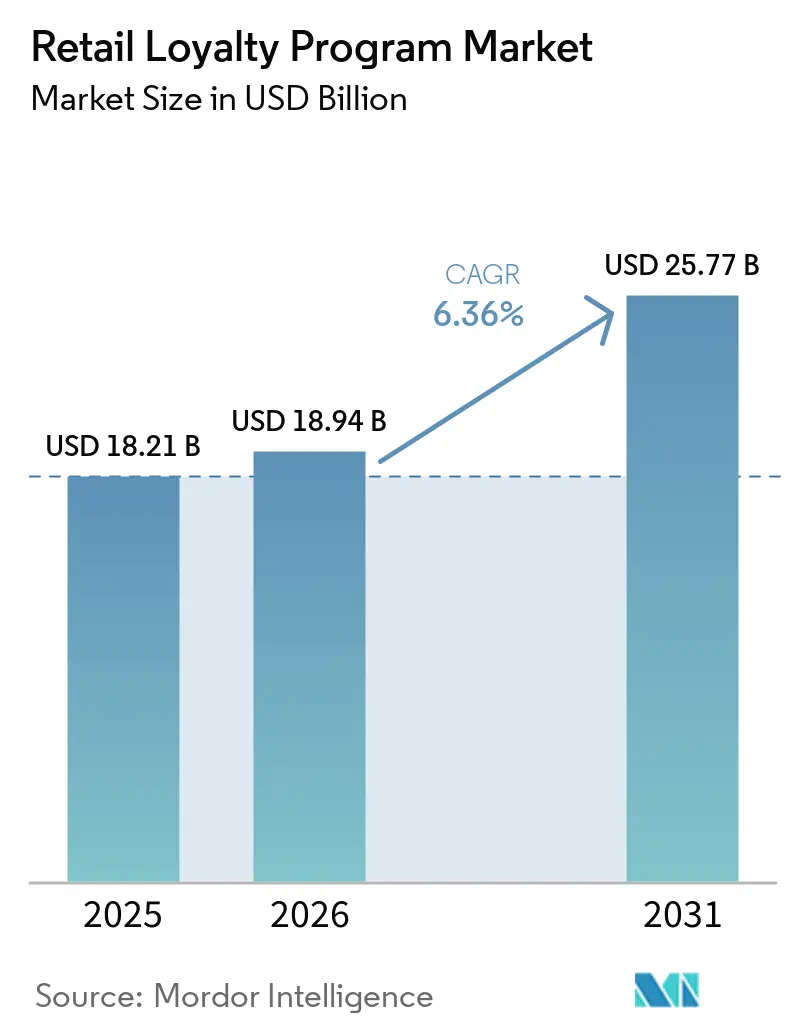
The Retail-loyalty-program-market size was valued at USD 18.21 billion in 2025 and is estimated to grow from USD 18.94 billion in 2026 to reach USD 25.77 billion by 2031, at a CAGR of 6.36% during the forecast period (2026-2031).
The retail loyalty program market is moving closer to core retail operations because retailers now need stronger retention, cleaner customer data, and tighter control over promotion spending. The phase-out of third-party cookies has increased the value of permission-based loyalty data, giving retailers a direct way to understand buying behavior and improve targeting across digital and in-store channels. Artificial intelligence is also moving from pilot use to daily operations, pushing the retail loyalty program market toward real-time offers, better segmentation, and more relevant member communication. This shift matters in India because mobile-led payments and fast reward recognition fit well with UPI-linked retail transactions and shorten the gap between purchase, reward accrual, and redemption at scale. The near-term outlook still reflects some pressure from unredeemed points and heavier compliance demands. Still, the retail loyalty program market continues to benefit from better data ownership, stronger personalization, and rising interest in loyalty-linked retail media monetization.[1]
Key Report Takeaways
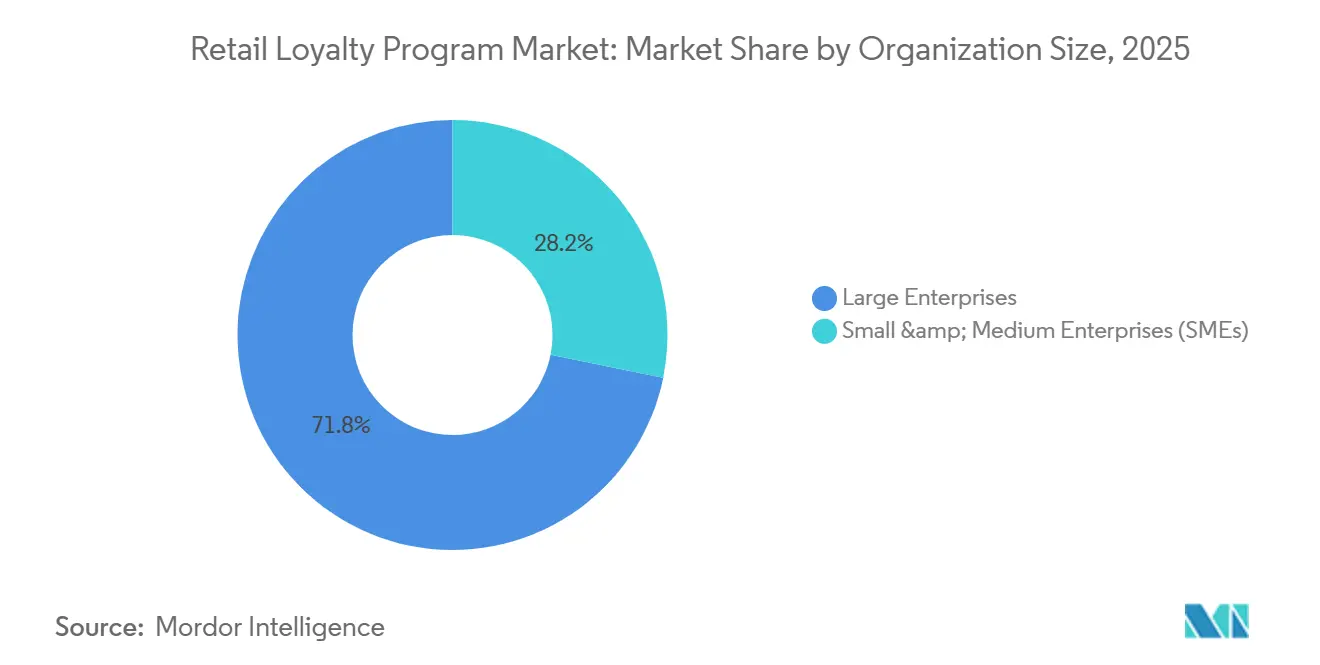
- By organization size, Large Enterprises accounted for 71.82% of revenue in 2025, while SMEs are projected to record the fastest CAGR of 7.74% through 2031.
- By retail vertical, Grocery & Supermarkets led with 26.23% revenue share in 2025, while Health & Beauty Retail is projected to expand at 7.96% CAGR through 2031.
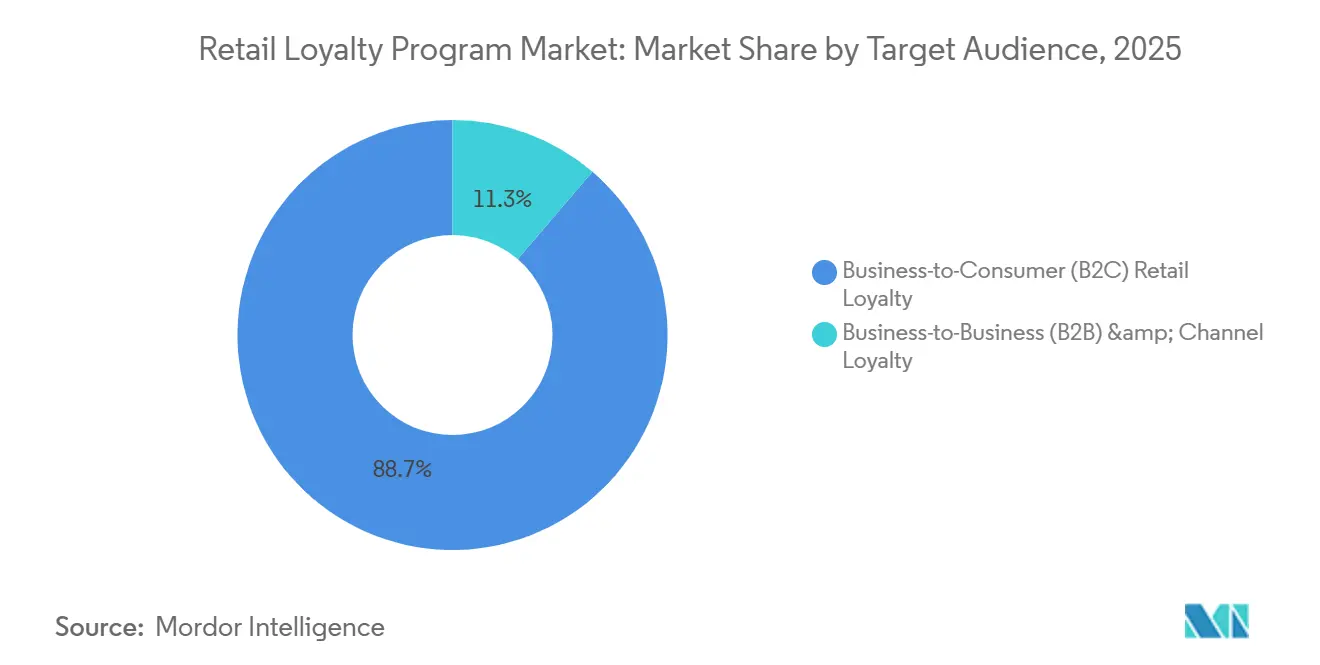
- By target audience, B2C held 88.71% share in 2025, while B2B and Channel Loyalty is expected to grow fastest at 7.34% through 2031.
- By program type, Points-Based Loyalty Programs accounted for 41.32% share in 2025, while Tiered Loyalty Programs are forecast to advance at 7.85% CAGR through 2031.
- By geography, North America led with 35.92% share in 2025, while Asia-Pacific is projected to record the highest CAGR at 8.93% through 2031.
Note: Market size and forecast figures in this report are generated using Mordor Intelligence’s proprietary estimation framework, updated with the latest available data and insights as of January 2026.
Global Retail Loyalty Program Market Trends and Insights
Drivers Impact Analysis*
| Drivers | (~) % Impact on CAGR Forecast | Geographic Relevance | Impact Timeline |
|---|---|---|---|
| Rising Customer Acquisition Costs and Margin Pressure | +1.3% | Global, most acute in North America and Western Europe | Short term (≤ 2 years) |
| First-Party Data Imperative | +1.0% | Global, the highest regulatory urgency in Europe and North America | Medium term (2-4 years) |
| AI-Driven Hyper-Personalization | +1.5% | Global, leading adoption in North America and Asia-Pacific | Medium term (2-4 years) |
| Demand for Gamification and Emotional Engagement | +0.5% | Global, concentrated in younger consumer markets across Asia-Pacific and North America | Medium term (2-4 years) |
| App-Free and Wallet-Based Integration | +0.4% | North America, Western Europe, Australia | Short term (≤ 2 years) |
| Retail Media Network Monetization | +0.8% | Global, most advanced in North America and the United Kingdom | Long term (≥ 4 years) |
| Source: Mordor Intelligence | |||
Rising Customer Acquisition Costs and Margin Pressure
Retail economics are placing greater pressure on repeat purchase value, making retention a more practical lever than constant customer acquisition. In this setting, the retail loyalty program market is gaining budget support as retailers seek tools that can protect margins without relying solely on discount-led traffic. Programs that can identify frequent shoppers, encourage repeat visits, and improve redemption efficiency are becoming easier to justify at both marketing and finance levels. This also changes vendor expectations because buyers increasingly want clearer return metrics, shorter payback periods, and direct links between loyalty activity and commercial outcomes. For Indian retailers with expanding omnichannel operations, this logic is especially relevant, as growth depends on retaining existing shoppers while keeping customer-acquisition spending under control.
The First-Party Data Imperative
The retail loyalty program market is benefiting from a wider shift toward owned customer data, especially as retailers lose some of the targeting support they once received from third-party cookies. Loyalty programs give retailers a direct, consent-based path to capture transaction history, shopping frequency, response to offers, and cross-channel behavior in a single member record. That data becomes more valuable when retailers want to personalize promotions, build audience segments, and support closed-loop measurement inside retail media and partner ecosystems. The same dynamic is relevant in India, where organized retail is becoming more digital, and merchants increasingly need customer records that connect payments, promotions, and repeat visits within a single operating framework. As a result, the retail loyalty program market is being shaped not only by member rewards but also by the commercial value of clean first-party data inside retail decision-making.
AI-Driven Hyper-Personalization
Artificial intelligence is transforming the retail loyalty program market from a rules-based to a more predictive environment. Instead of sending the same offer to every member, retailers are moving toward reward structures that respond to actual shopping habits, product affinity, and timing. Eagle Eye reported that its AI-driven Personalized Challenges delivered a 7-to-1 return on investment for major grocery retailers, underscoring why personalization has become a stronger commercial argument rather than a branding feature. This change also raises the standard for program performance because basic points accumulation is less effective when competitors can deliver relevant and better-timed rewards. In the retail loyalty program market, AI now influences not only campaign quality, but also customer retention, media monetization, and the value retailers can extract from every transaction.
Demand for Gamification and Emotional Engagement
The retail loyalty program market is also gaining from a move toward more engaging reward mechanics that keep members active between purchases. Progress bars, missions, tier milestones, member-only challenges, and non-purchase tasks all create more frequent points of contact and reduce the dependence on discount-only participation. These tools matter because shoppers now compare programs not only on value but also on how easy they are to understand and how rewarding they feel during everyday shopping. Gamified formats are particularly useful when retailers want to increase basket-building behavior, category trial, or visit frequency without cutting prices on every transaction. For India, where app usage is already embedded in everyday retail behavior, emotional engagement and simple progress-based rewards can help retailers make loyalty participation feel immediate and habitual.
Restraints Impact Analysis*
| Restraints | (~) % Impact on CAGR Forecast | Geographic Relevance | Impact Timeline |
|---|---|---|---|
| Data Privacy and Consent Compliance | -0.7% | Europe, United States, Asia-Pacific | Short term (≤ 2 years) |
| Legacy POS and IT Integration Burden | -0.9% | Global, most acute in mid-market and SME retail | Medium term (2-4 years) |
| Loyalty Fatigue and Expectation Inflation | -0.4% | Global, most pronounced in mature markets | Short term (≤ 2 years) |
| Reward Liability and Financial Volatility | -0.3% | Global, material for large programs with high point balances | Long term (≥ 4 years) |
| Source: Mordor Intelligence | |||
Data Privacy and Consent Compliance
The retail loyalty program market faces structural costs due to privacy governance, as any program that collects behavior, identity, and purchase history must carefully manage consent across channels and partners. This burden becomes heavier when retailers operate across multiple legal jurisdictions or share member data with coalition partners, media buyers, or external technology providers. Compliance work does not create visible customer value on its own, yet it consumes legal, technical, and process budgets that could otherwise be allocated to personalization or reward enrichment. The effect is sharper for mid-market retailers, who often need enterprise-grade governance without the same engineering depth or compliance teams. In the retail loyalty program market, privacy readiness is no longer optional because weak controls can limit data collection, slow partnership activity, and reduce the commercial yield of loyalty programs.[2]
Legacy POS and IT Integration Burden
The retail loyalty program market still runs into practical limits when older store systems cannot support real-time reward logic. Open Loyalty noted that weak integration across the technology stack can undermine program performance. At the same time, Paytronix pointed to implementation burdens that grow when retailers need custom workflows across payments, promotions, and loyalty settlement. If transaction data moves too slowly, retailers cannot confirm rewards quickly enough, which reduces trust at the exact moment the customer expects to see value. Older systems also limit personalization because live offers, trigger-based messaging, and instant redemption require real-time transaction data rather than batch files. For Indian retailers that are modernizing across stores, marketplaces, and franchise networks, integration quality will remain a key factor in how effectively the retail loyalty program market converts investment into daily customer use.
*Our forecasts treat driver/restraint impacts as directional, not additive. The impact forecasts reflect baseline growth, mix effects, and variable interactions.
Segment Analysis
By Organization Size: Large Enterprises Anchor Revenue, SMEs Extend the Growth Frontier
Large Enterprises held 71.82% of the retail loyalty program market share in 2025, underscoring how strongly scale continues to influence adoption, data monetization, and platform depth. Their lead is supported by multi-brand deployments, broader technology budgets, and the ability to spread compliance and integration costs across large member bases. These retailers are also in a stronger position to connect loyalty with proprietary media assets, supplier funding, and cross-banner offers, which improves the business case for reinvestment. In the retail loyalty program market, large operators can test new mechanics faster because they have richer transaction volumes and more room to optimize offers across categories and regions. This keeps the segment anchored in revenue terms even as the broader demand base becomes more diverse.
SMEs are projected to grow at a 7.74% CAGR from 2026 to 2031, making them the fastest-growing demand cohort in the retail loyalty program market. The key reason is that software delivery has become lighter, faster, and more affordable for retailers without large internal technology teams. SaaS-led deployments now allow smaller operators to launch tiered rewards, campaign triggers, and wallet-friendly formats without replacing every legacy system at once. This matters in India because many retail businesses still operate across regional store clusters, franchise structures, or specialty chains where low-complexity deployment is critical for adoption. As SME access improves, the retail loyalty program market is widening from an enterprise-led category into a broader operating tool for customer retention and repeat spend.

By Retail Vertical: Grocery Commands Share, Health & Beauty Outpaces
Grocery & Supermarkets accounted for 26.23% of the retail loyalty program market in 2025, reflecting the value of frequent shopping cycles and high transaction density. Grocery programs benefit from weekly or multiple weekly visits, which create a steady stream of member-level purchase data and give retailers more opportunities to influence basket composition. The segment also supports faster learning because offer response, category switching, and repeat behavior can be measured quickly across large customer bases. In the retail loyalty program market, grocery remains the most operationally useful vertical because loyalty is tied directly to daily essentials and checkout behavior rather than occasional discretionary purchases. This makes grocery a strong foundation for both retention and retail media activity.
Health & Beauty Retail is projected to grow at a 7.96% CAGR through 2031, making it the fastest-growing vertical in the retail loyalty program market. This segment aligns well with loyalty because members often respond not only to price benefits but also to early access, curated recommendations, refill logic, and content-led engagement. Product discovery, repeat replenishment, and brand affinity all favor programs that can personalize communication beyond the transaction itself. That pattern also aligns with India’s rising beauty and wellness retail opportunity, where digital-first engagement and member data can help retailers manage repeat purchase cycles more effectively. As a result, the retail loyalty program market is seeing health and beauty shift from a promotional use case toward a longer-term customer value engine.
By Target Audience: B2C Drives Volume, B2B Channels Emerge as a Value Multiplier
B2C accounted for 88.71% of demand in 2025, keeping consumer-facing programs at the center of the retail loyalty program market. This lead reflects the long build-out of grocery, fashion, and beauty loyalty ecosystems, where large member bases already exist and where transaction capture is deeply tied to store and digital checkout processes. Consumer programs also benefit from a broad mix of reward types, including points, coupons, cashback, tiers, and partner-linked benefits, which gives retailers several ways to influence behavior. In the retail loyalty program market, B2C scale matters because higher member volume deepens data and enhances the usefulness of segmentation and media monetization. That is why consumer loyalty remains the main revenue base even as adjacent models expand.
B2B and Channel Loyalty is projected to expand at a 7.34% CAGR through 2031, making it the fastest-growing segment of the retail loyalty program market. This segment matters because many retail value chains still depend on distributors, dealers, franchise partners, and channel intermediaries that influence sell-through and category presence. A structured digital loyalty platform can align partner behavior more consistently than one-off incentive schemes because it ties rewards to measurable activity and repeat outcomes. The point is highly relevant in India, where channel relationships remain important across consumer goods distribution and the expansion of organized retail. That makes B2B loyalty a meaningful growth layer for the retail loyalty program market, even though it currently generates less revenue than B2C.
By Loyalty Program Type: Points Retain Scale, Tiers Drive the Next Engagement Cycle
Points-Based Loyalty Programs held a 41.32% share in 2025, keeping them the largest format in the retail loyalty program market. Their lead comes from familiarity, operational simplicity, and broad use across high-frequency retail categories where every transaction can feed the same earning framework. Points are also useful because they provide a consistent way to capture behavior data while giving retailers flexibility in how they structure redemptions, expiry, and promotional multipliers. In the retail loyalty program market, this format remains the default architecture for large consumer programs because it is easy to explain and easy to scale. That is why points continue to anchor current volume even as newer engagement models gain ground.
Tiered Loyalty Programs are forecast to grow at a 7.85% CAGR through 2031, which makes them the fastest-growing program type in the retail loyalty program market. Tier structures work because they give members visible progress and a stronger sense of status, which can motivate behavior between purchases and reduce dependence on discount-only logic. They also give retailers more room to combine transactional value with experiential rewards such as access, priority treatment, or member recognition. This approach fits well with categories where lifestyle relevance and identity matter, and it also supports more deliberate customer segmentation. In the retail loyalty program market, tier growth signals a broader shift from pure accumulation toward engagement models that reward relationship depth.
Geography Analysis
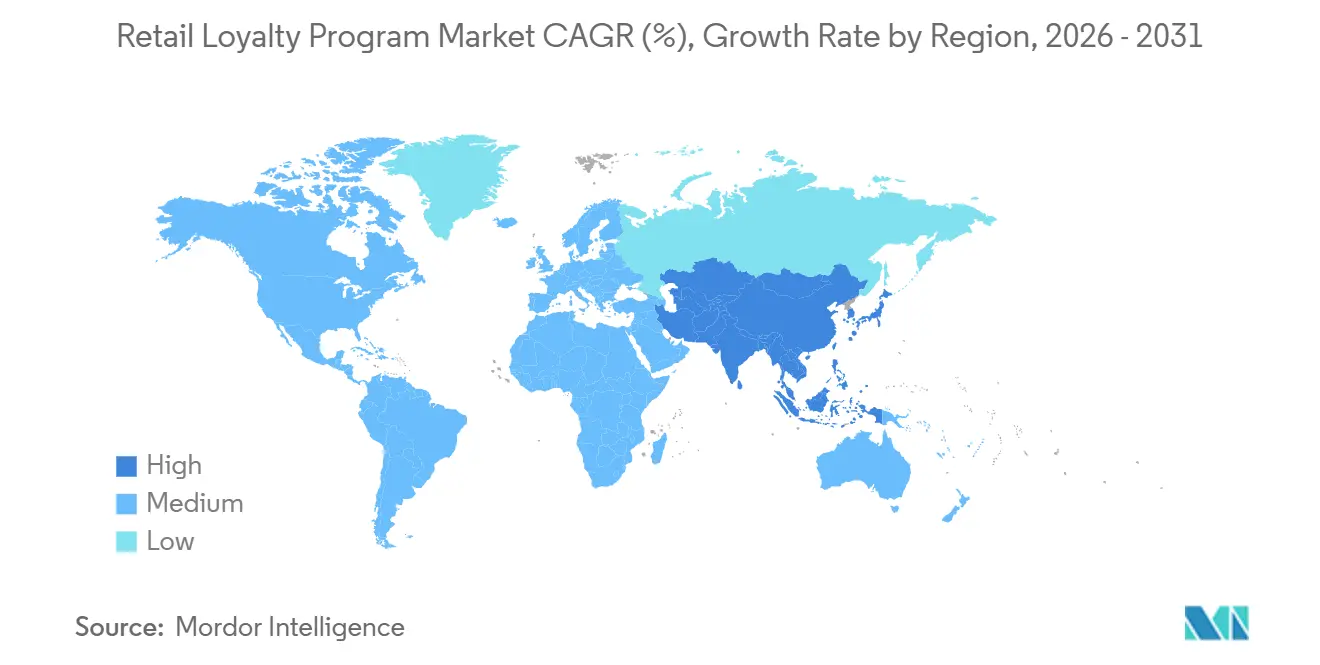
North America accounted for 35.92% of revenue in 2025, maintaining its position as the largest region in the retail loyalty program market. The region’s lead reflects high digital payment adoption, mature grocery and general merchandise programs, and a long history of member-led promotional models. It also shows how, over time, large retailers have linked loyalty to audience monetization, cross-brand partnerships, and broader customer data operations. Canada offers a clear example through the January 2026 RBC partnership and the March 2026 WestJet partnership, both of which expanded Triangle Rewards into a wider multi-category earning system. In the retail loyalty program market, North America remains the benchmark for scale, but continued growth depends on keeping loyalty convenient, personalized, and commercially measurable.
Europe remains a major region in the retail loyalty program market because retailers there are investing in omnichannel consistency and more unified customer propositions. Program design in the region is shaped by a mix of grocery scale, health and beauty sophistication, and a stronger focus on data governance than in many other markets. That combination encourages loyalty models that can connect store, online, and partner activity while still supporting compliance discipline. Europe also shows why basic point mechanics are no longer enough, as retailers are shifting toward more personalized, behavior-led engagement structures to sustain participation. This keeps the region important not only for revenue, but also for program design trends that often influence other mature retail markets.
Asia-Pacific is projected to grow at an 8.93% CAGR from 2026 to 2031, making it the fastest-growing geography in the retail loyalty program market. India and China together account for more than 57% of Asia-Pacific loyalty management revenue in 2025, which reflects scale, digital payments maturity, and a rapidly expanding organized retail base. India’s role is especially important because UPI handled more than 12 billion monthly transactions in 2025, providing retailers with a large real-time payment rail that can support faster earn-and-redeem journeys. Southeast Asia is also expanding through mobile-first loyalty and coalition structures, while Australia continues to use predictive personalization in grocery-led ecosystems. South America and the Middle East & Africa remain smaller in the retail loyalty program market. Still, both offer long-term potential as mobile-led commerce, premium tiers, and digital payments continue to improve program reach and usability.[3]
Competitive Landscape
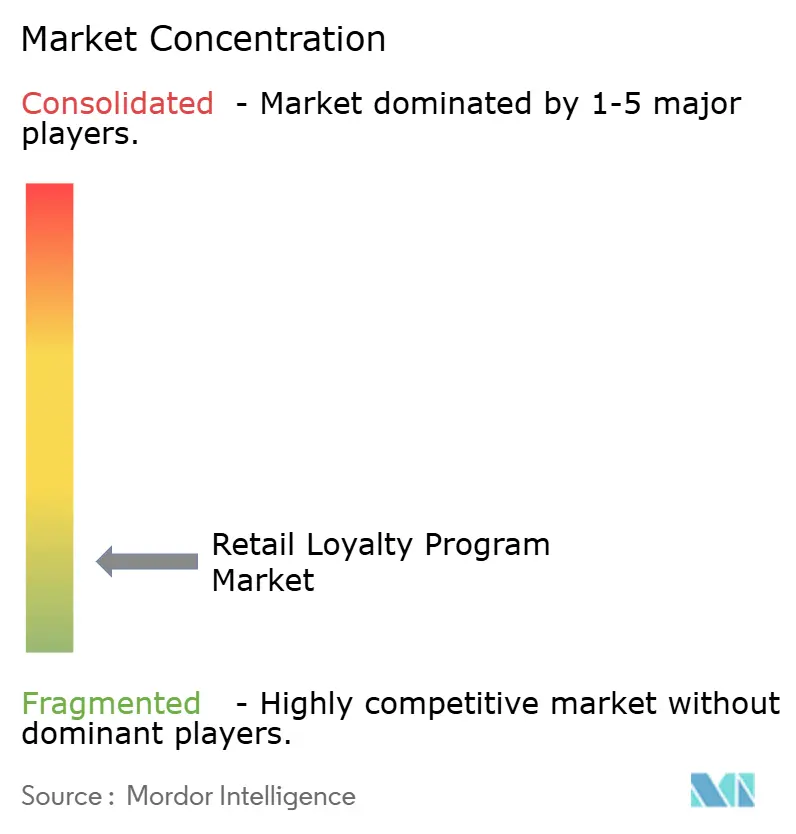
The retail loyalty program market remains highly fragmented, with no single vendor controlling a dominant share of global demand. Large enterprise providers such as Oracle, Salesforce, and SAP compete with specialists such as Capillary Technologies, Eagle Eye, Antavo, and Talon.One across personalization, integration depth, and deployment flexibility. This fragmentation means that buying decisions often depend on use-case fit rather than brand scale alone, especially when retailers want composable architectures or faster rollout cycles. One of the clearest strategic signals came in April 2026 when Adyen agreed to acquire Talon.One for EUR 750 million (USD 879 million), combining payment infrastructure with loyalty and promotion decisioning in a single stack. That move matters because it suggests the retail loyalty program market is converging with transaction systems rather than remaining separate from them.
A second important shift came in May 2026 when Capillary Technologies completed the acquisition of SessionM from Mastercard for USD 20 million in cash. Capillary said the deal added more than USD 35 million in annual recurring revenue and around 40 enterprise customers, including Fortune 500 retailers, airlines, and consumer brands. That transaction strengthens Capillary’s enterprise position and also matters from an India-linked perspective because it shows how a company with roots in the region is scaling into a broader global loyalty platform play. The retail loyalty program market is therefore seeing more competition around platform breadth, global delivery capability, and the ability to unify loyalty with customer data and commerce infrastructure. As consolidation continues, specialist vendors with proven depth in integration and personalization are likely to remain attractive targets.
Strategy across the retail loyalty program market is increasingly centered on three themes: AI-led differentiation, ecosystem integration, and faster merchant deployment. Eagle Eye has positioned its AIR platform and personalization engine around measurable retailer outcomes, while Yotpo is expanding easier loyalty activation for merchants through features such as Loyalty Spotlight on Shopify. SAP’s move to general availability for SAP Customer Loyalty Management in October 2025 shows how enterprise suite vendors are also embedding loyalty more deeply into core business processes and financial visibility. For Indian retailers, vendors that can connect payments, enable omnichannel retailing, and expand partnerships without long integration cycles are likely to have a stronger edge. The retail loyalty program market will remain competitive because retailers do not just want software; they want proof that loyalty can improve retention, reduce promotional waste, and create monetizable customer data assets.
Retail Loyalty Program Industry Leaders
-
Oracle Corporation
-
Salesforce, Inc.
-
SAP SE
-
Epsilon Data Management, LLC
-
Comarch SA
- *Disclaimer: Major Players sorted in no particular order
Recent Industry Developments
- May 2026: Capillary Technologies completed the acquisition of SessionM Inc. and Session M Czech Republic s.r.o. from Mastercard for USD 20 million in cash on May 1, 2026. The deal added over USD 35 million in ARR and approximately 40 enterprise customers, including Fortune 500 retailers, airlines, and CPG brands, increasing Capillary's total ARR by approximately 40% .
- April 2026: Adyen entered a definitive agreement to acquire Talon.One GmbH for EUR 750 million (USD 879 million). Talon.One serves more than 300 global merchants, including Nordstrom and H&M, and is projected to generate approximately EUR 60 million in annual recurring revenue by end-2026. The transaction is expected to close in H2 2026, subject to regulatory approval
- April 2026: Bed Bath & Beyond, Inc. and Bilt announced a strategic partnership deploying Bilt's customer identity and loyalty platform across Bed Bath & Beyond's retail portfolio, including The Container Store, Kirkland's, Overstock, and buybuy BABY, creating a unified cross-brand loyalty foundation under an "Everything Home" positioning.
- March 2026: Canadian Tire Corporation and WestJet launched a cross-loyalty partnership enabling members to earn both Triangle Rewards and WestJet points simultaneously on eligible purchases, linking Triangle Rewards' approximately 12 million members with WestJet's national route network.
Global Retail Loyalty Program Market Report Scope
| Large Enterprises |
| Small & Medium Enterprises (SMEs) |
| Grocery & Supermarkets |
| Apparel & Fashion Retail |
| Health & Beauty Retail |
| Consumer Electronics Retail |
| Department Stores & General Merchandise |
| Other Retail Formats |
| Business-to-Consumer (B2C) Retail Loyalty |
| Business-to-Business (B2B) & Channel Loyalty |
| Points-Based Loyalty Programs |
| Tiered Loyalty Programs |
| Cashback & Rebate Programs |
| Others (Paid Membership, Coalition & Partner Loyalty Programs) |
| North America | United States |
| Canada | |
| Mexico | |
| South America | Brazil |
| Peru | |
| Chile | |
| Argentina | |
| Rest of South America | |
| Europe | United Kingdom |
| Germany | |
| France | |
| Spain | |
| Italy | |
| BENELUX (Belgium, Netherlands, and Luxembourg) | |
| NORDICS (Denmark, Finland, Iceland, Norway, and Sweden) | |
| Russia | |
| Rest of Europe | |
| Asia-Pacific | India |
| China | |
| Japan | |
| Australia | |
| South Korea | |
| South East Asia (Singapore, Malaysia, Thailand, Indonesia, Vietnam, and Philippines) | |
| Rest of Asia-Pacific | |
| Middle East and Africa | United Arab Emirates |
| Saudi Arabia | |
| South Africa | |
| Nigeria | |
| Rest of Middle East and Africa |
| By Organization Size | Large Enterprises | |
| Small & Medium Enterprises (SMEs) | ||
| By Retail Vertical | Grocery & Supermarkets | |
| Apparel & Fashion Retail | ||
| Health & Beauty Retail | ||
| Consumer Electronics Retail | ||
| Department Stores & General Merchandise | ||
| Other Retail Formats | ||
| By Target Audience | Business-to-Consumer (B2C) Retail Loyalty | |
| Business-to-Business (B2B) & Channel Loyalty | ||
| By Loyalty Program Type | Points-Based Loyalty Programs | |
| Tiered Loyalty Programs | ||
| Cashback & Rebate Programs | ||
| Others (Paid Membership, Coalition & Partner Loyalty Programs) | ||
| By Geography | North America | United States |
| Canada | ||
| Mexico | ||
| South America | Brazil | |
| Peru | ||
| Chile | ||
| Argentina | ||
| Rest of South America | ||
| Europe | United Kingdom | |
| Germany | ||
| France | ||
| Spain | ||
| Italy | ||
| BENELUX (Belgium, Netherlands, and Luxembourg) | ||
| NORDICS (Denmark, Finland, Iceland, Norway, and Sweden) | ||
| Russia | ||
| Rest of Europe | ||
| Asia-Pacific | India | |
| China | ||
| Japan | ||
| Australia | ||
| South Korea | ||
| South East Asia (Singapore, Malaysia, Thailand, Indonesia, Vietnam, and Philippines) | ||
| Rest of Asia-Pacific | ||
| Middle East and Africa | United Arab Emirates | |
| Saudi Arabia | ||
| South Africa | ||
| Nigeria | ||
| Rest of Middle East and Africa | ||
Key Questions Answered in the Report
What is the current size and outlook for the retail loyalty program space?
The Retail loyalty program market was valued at USD 18.21 billion in 2025, stood at USD 18.94 billion in 2026, and is forecast to reach USD 25.77 billion by 2031 at a 6.4% CAGR.
Which retail vertical leads demand for loyalty platforms?
Grocery & Supermarkets led with a 26.23% share in 2025 because of high shopping frequency, which creates repeat engagement and richer transaction data.
Which loyalty format is growing the fastest?
Tiered Loyalty Programs are the fastest-growing format and are projected to expand at a 7.85% CAGR through 2031 because they encourage behavior beyond simple point collection.
Why is India becoming important in loyalty platform adoption?
India is important because the Asia-Pacific region is the fastest-growing, and India’s UPI-linked payment ecosystem enables faster reward accrual and redemption at scale.
What is the biggest challenge facing loyalty operators today?
Key challenges include privacy compliance, legacy POS integration, loyalty fatigue, and the financial burden created by large unredeemed reward balances.
Which company moves are shaping competition most in 2025 and 2026?
The most important moves include Adyen’s planned Talon.One acquisition, Capillary Technologies’ SessionM acquisition, SAP’s product availability, and Yotpo’s new merchant-facing loyalty feature rollout.