
Primary Education Market Size and Share
Market Overview
| Study Period | 2021 - 2031 |
|---|---|
| Market Size (2026) | USD 1.81 Trillion |
| Market Size (2031) | USD 2.02 Trillion |
| Growth Rate (2026 - 2031) | 2.22 % |
| Fastest Growing Market | Asia-Pacific |
| Largest Market | Asia-Pacific |
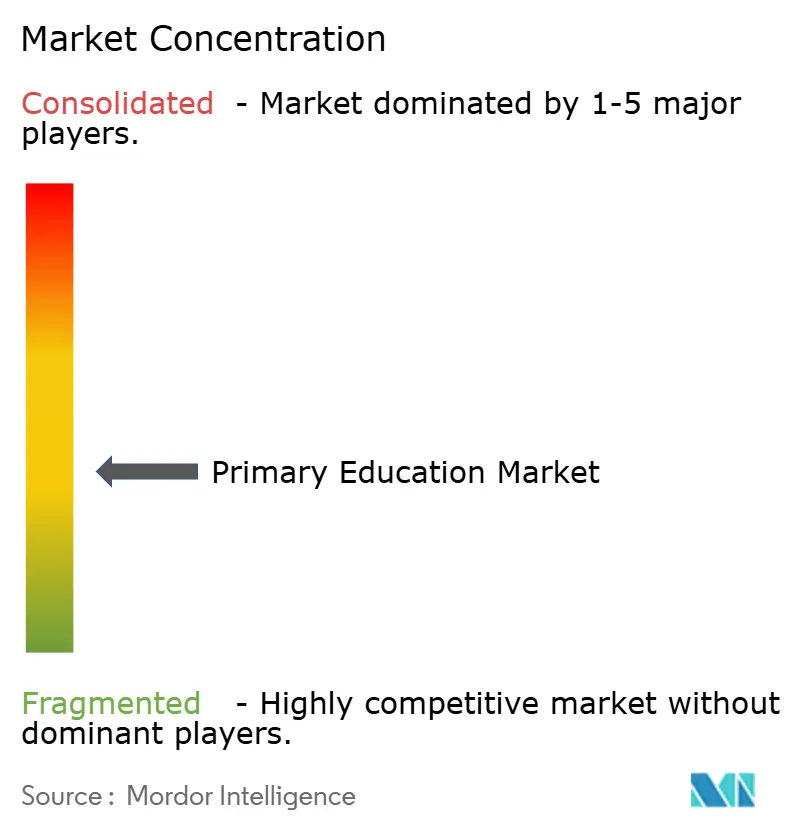
| Market Concentration | Medium |
Major Players *Disclaimer: Major Players sorted in no particular order Image © Mordor Intelligence. Reuse requires attribution under CC BY 4.0. | |
Primary Education Market Analysis by Mordor Intelligence
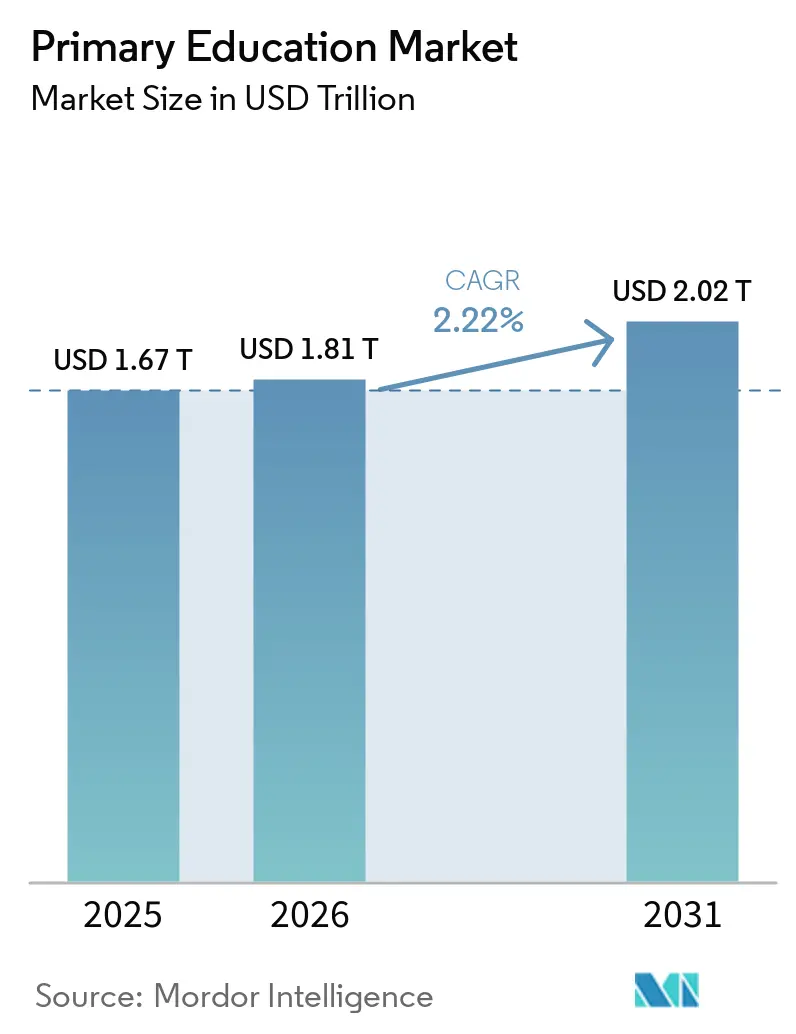
The Primary Education Market size is projected to expand from USD 1.67 trillion in 2025 and USD 1.81 trillion in 2026 to USD 2.02 trillion by 2031, registering a CAGR of 2.22% between 2026 to 2031.
The primary education market continues to be supported by steady demand for structured K-6 schooling across public and private channels, even though the quality of expansion differs sharply by country income level. A key pressure point is the changing mix of education spending, because total public spending has increased in many systems. At the same time, per-student allocation has remained weak in several low-income markets, which affects delivery quality and procurement depth. Enrollment remains the core volume driver, with UNESCO reporting 1.4 billion students in school globally in 2024 and a 30% rise in primary and secondary enrollment since 2000, which shows the broad and durable base of demand behind the primary education market. At the same time, 79 million primary-age children remained out of school in 2024. That unmet need continues to shape expansion opportunities for low-cost provision models and supplementary delivery systems in the primary education market. Competitive activity in the primary education market remains split among large school operators, curriculum publishers, and education technology providers. At the same time, funding pressures and teacher shortages continue to influence how buyers prioritize bundled, scalable, and lower-risk solutions.[1]
Key Report Takeaways
- By curriculum, national and state curricula led with 79.11% share in 2025, while international curricula recorded the highest projected CAGR at 5.76% through 2031.
- By school type, government and publicly funded schools held 80.46% share in 2025, while private and independent schools are forecast to expand at a 4.44% CAGR through 2031.
- By learning mode, offline and traditional classroom learning accounted for 88.76% share in 2025, while online and virtual learning is advancing at an 18.24% CAGR through 2031.
- By end user, institutional buyers captured 70.65% share in 2025, while consumer buyers are projected to grow at an 8.56% CAGR through 2031.
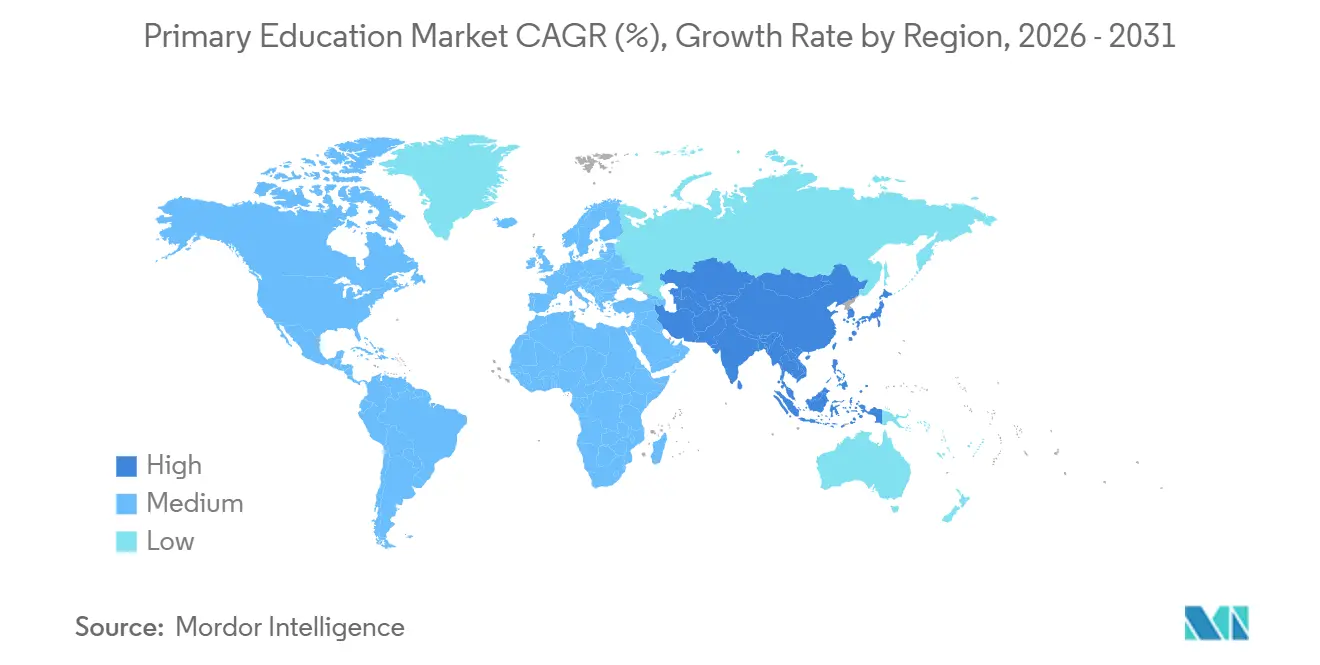
- By geography, Asia-Pacific held 40.20% share in 2025 and also recorded the highest projected regional CAGR at 3.50% through 2031.
Note: Market size and forecast figures in this report are generated using Mordor Intelligence’s proprietary estimation framework, updated with the latest available data and insights as of January 2026.
Global Primary Education Market Trends and Insights
Drivers Impact Analysis*
| Drivers | (~) % Impact on CAGR Forecast | Geographic Relevance | Impact Timeline |
|---|---|---|---|
| Government Funding and Universal Access Mandates | +0.5% | Global, particularly Sub-Saharan Africa, South Asia, and Latin America | Long term (≥ 4 years) |
| Rising Enrollment in Structured Primary Schooling | +0.4% | Asia-Pacific, Sub-Saharan Africa, South & Southeast Asia | Medium term (2-4 years) |
| Expansion of Low-Cost Private School Networks | +0.3% | Sub-Saharan Africa, South Asia, Southeast Asia | Medium term (2-4 years) |
| Digital Classroom Adoption in Foundational Learning | +0.4% | Asia-Pacific core, spill-over to Middle East and Africa and Latin America | Short term (≤ 2 years) |
| Micro-credentialing and Teacher Upskilling Demand | +0.2% | North America, Europe, Australia | Medium term (2-4 years) |
| Child Safety, Attendance, and Learning Outcome Analytics | +0.2% | Global, early gains in North America and Western Europe | Short term (≤ 2 years) |
| Source: Mordor Intelligence | |||
Government Funding and Universal Access Mandates
Public systems remain the volume anchor for the primary education market, so government spending continues to set the baseline for demand across most countries. OECD data for 2025 showed that average government expenditure per primary student across OECD countries was USD 12,051, with a very wide gap between Luxembourg at USD 25,482 per student and Mexico and Peru at below USD 3,000, highlighting how uneven fiscal capacity remains across education systems. The spending gap matters because countries with public schools as the main delivery channel create the largest and most stable procurement base for digital content, hardware, school management systems, and classroom support tools in the primary education market. Mexico’s commitment of MXN 350 billion (USD 20 billion) through 2030 to school infrastructure under the La Escuela es Nuestra program also underscores how public capital programs can serve as long-duration demand signals for vendors serving education systems. Multi-year obligations linked to universal access and SDG 4 keep education funding on policy agendas even when budgets tighten, which is why public funding remains one of the strongest structural supports for the primary education mark.[2]
Rising Enrollment in Structured Primary Schooling
Enrollment growth continues to shape the primary education market, especially in regions where school-age populations are still rising faster than system capacity. UNESCO confirmed in 2026 that 79 million primary-age children were still out of school in 2024, even after global student enrollment reached 1.4 billion, which shows that demand growth is not yet fully absorbed by existing systems. The commercial effect is not limited to higher student numbers, because families in capacity-constrained systems often move toward more structured private alternatives when public access or quality weakens. Nigeria illustrates this pattern, with private schools growing by 39% between 2017 and 2022, while public schools expanded by only 3.5%, indicating that incremental enrollment is moving into more monetizable channels within the primary education market. This shift supports demand for curriculum services, school administration platforms, parent communication tools, and student tracking systems, particularly in fast-growing urban education clusters. As a result, headline enrollment growth in the primary education market still understates the commercial expansion occurring within private and semi-formal delivery models.
Expansion of Low-Cost Private School Networks
Low-cost private schools have become a practical access channel in several African and South Asian urban markets, making them an important growth layer within the primary education market. The financing side of this segment remains underdeveloped. Yet the operating need is clear: founder-led and community-embedded schools continue to serve large demand pools that public systems have not fully absorbed. Acumen’s EdPartners case study showed that loans had been disbursed to more than 420 private schools in Kenya, serving 123,801 students, highlighting how even small-scale financial support can expand capacity across fragmented school networks. In January 2025, Enko Education raised USD 24 million from Africa Capitalworks and Adiwale Partners to acquire and consolidate fragmented African international school assets, with a target of reaching 20,000 students by 2029, which shows that formal capital is entering school network expansion where fragmentation is high. The primary education market, therefore, gains not only from new school openings but also from financing models that help small operators improve compliance, scale operations, and become more attractive to institutional capital.
Digital Classroom Adoption in Foundational Learning
Digital classroom adoption is shifting the primary education market toward a more mixed delivery model, but the pace remains uneven across regions and income levels. India’s NITI Aayog, based on UDISE+ data reported in May 2026, found that only 30.6% of schools had functional digital classrooms in 2024-25, up from 14.9% in 2021-22, which means most schools still operate without usable digital infrastructure. Kenya’s Ministry of Education announced in May 2026 that 25,000 laptops and interactive smartboards would be deployed to public primary schools, which shows that digital adoption is also advancing in systems that are still building basic classroom access. China has taken a broader, policy-led approach, with the Ministry of Education’s April 2025 digitalization directive and the State Council’s June 2026 education plan pushing smart platforms, AI-enabled learning, and technology-supported teacher development nationwide. These uneven starting points mean the primary education market is not moving toward a single digital model, but toward a layered system in which advanced markets adopt AI-enhanced tools while emerging markets still prioritize device access, connectivity, and classroom hardware.
Restraints Impact Analysis*
| Restraints | (~) % Impact on CAGR Forecast | Geographic Relevance | Impact Timeline |
|---|---|---|---|
| Budget Pressure on Public School Systems | -0.4% | Global, acute in Sub-Saharan Africa, LatAm, and parts of Europe | Long term (≥ 4 years) |
| Teacher Shortages and Attrition in Early Grades | -0.3% | OECD economies, Asia-Pacific, Sub-Saharan Africa | Long term (≥ 4 years) |
| Uneven Device and Connectivity Access in Rural Districts | -0.2% | Sub-Saharan Africa, South Asia, rural Asia-Pacific, and Latin America | Medium term (2-4 years) |
| Fragmented Procurement and Compliance Burden | -0.1% | Global, most acute in decentralized school systems (United States, India, Brazil) | Medium term (2-4 years) |
| Source: Mordor Intelligence | |||
Budget Pressure on Public School Systems
Budget pressure remains a major restraint on the primary education market, as public systems still account for the largest share of student enrollment in most countries. The Organization of Ibero-American States reported in April 2026 that education investment across Latin America had fallen from an average of 5.2% of GDP before the pandemic to below 4% in 2025, indicating that fiscal compression is still affecting school systems serving very large child populations. UNESCO financing data also showed that international aid to education fell by 14% in 2025, as major bilateral donors reduced support, adding pressure on markets that depend on external funding to sustain expansion and quality upgrades. In practical terms, tighter budgets slow procurement, delay infrastructure upgrades, and push buyers toward bundled platforms instead of specialized point solutions. This means the primary education market faces not only slower public spending growth but also a more concentrated vendor environment, with buyers choosing larger providers that can meet multiple needs at lower perceived risk.
Teacher Shortages and Attrition in Early Grades
Teacher supply constraints continue to limit the quality of expansion in the primary education market, especially in systems already dealing with enrollment growth, aging workforces, or weak retention. OECD-linked analysis estimated that 44 million additional teachers will be needed by 2030 to meet SDG 4 goals for primary and secondary education, with Sub-Saharan Africa alone requiring 15 million of them, underscoring the scale of the supply challenge still ahead. TALIS 2025 also showed that 23% of teachers globally work in schools where principals report qualified staff shortages, while the average OECD teacher age has risen to 45 years, with some countries reporting averages above 50. Higher salary costs and lower-class sizes in many systems have also pushed institutions to think more carefully about productivity and classroom support models. The effect on the primary education market is double-edged: staffing gaps limit physical expansion and quality delivery. Still, they also raise demand for assessment tools, adaptive learning systems, and teacher support platforms that reduce the workload per instructor.
*Our forecasts treat driver/restraint impacts as directional, not additive. The impact forecasts reflect baseline growth, mix effects, and variable interactions.
Segment Analysis
By Curriculum: State Frameworks Anchor Demand; International Programs Gain Momentum
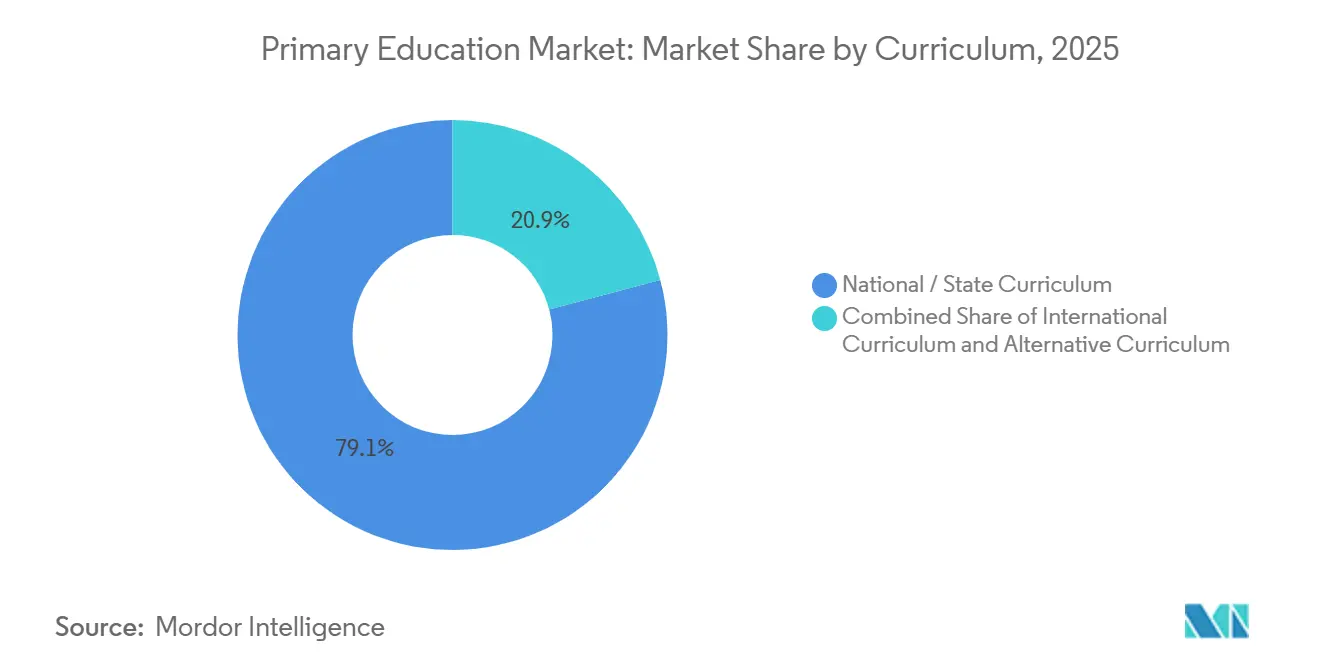
National and state curricula held 79.11% of the primary education market share in 2025, reflecting the central role of government-defined syllabi in organizing school delivery worldwide. This position remains strong because even many private schools operate within national content frameworks to meet licensing and approval requirements. The segment therefore benefits from the sheer scale of public enrollment and from the regulatory weight attached to domestic curriculum structures across Asia, Latin America, and the Middle East. The primary education market continues to rely on these frameworks as the base layer for textbook demand, classroom planning, teacher preparation, and standardized assessment. That makes national and state curricula the most stable demand pool in the current primary education market structure.
International curricula remain smaller in value, but they are forecast to grow at a 5.76% CAGR through 2031, making them the fastest-expanding curriculum category in the primary education market. Growth in this segment is supported by demand for globally recognized pathways, premium fee structures, and operator interest in brand-based school models. As of August 2025, there were 6,039 IB-accredited schools worldwide, including 175 new schools added in a single year, and 544 new IB programs were authorized in 2024, with the Primary Years Program identified as the fastest-growing IB program globally. India also remains relevant to this trend, with the user draft noting that the IB school network expanded by 44% between 2020 and 2025, rising from 192 to 276 schools and extending beyond top metros into Tier 2 and Tier 3 cities. Alternative models such as Montessori and related pedagogies remain less valued, but they continue to attract operators because they support differentiated positioning and stronger revenue per student.

By School Type: Public Systems Hold the Volume; Private Operators Chase the Value
Government and publicly funded schools accounted for 80.46% of the primary education market share in 2025, and that lead still reflects the overwhelming enrollment weight of public systems worldwide. Public schools dominate in volume, but their revenue density per student is usually lower than in private systems because spending levels and fee structures are more constrained. This means the primary education market still depends on public provision for scale, even when value creation is growing faster in private channels. In most countries, public systems remain the first point of access, the main procurement customer, and the base market for core curriculum, student information systems, and classroom infrastructure. Their size also means that any shift in public budgets has an outsized effect on the direction of the primary education market.
Private and independent schools are forecast to grow at a 4.44% CAGR through 2031, above the broader market rate and reflecting higher fee income, international demand, and stronger capital deployment in selected urban centers. The user draft noted that GEMS Education committed DH 2 billion, equivalent to USD 545 million, to add 20,000 student seats in Dubai over three years, while also launching a USD 30 million India market entry program tied to 21 school projects, with the first 5 campuses set to open in 2026. The regulatory side is also evolving, and Nigeria’s 2025 policy on non-state schools showed how a more formal licensing framework can reduce risk for affordable private operators and investors. That matters because capital often enters fragmented school markets only after legal status, compliance expectations, and operating rights become clearer. The private side of the primary education market, therefore, remains smaller than public provision in terms of volume. Still, it remains the segment where revenue growth and investor attention move faster.
By Learning Mode: Offline Dominates, but Online Growth Signals a Structural Shift in Delivery
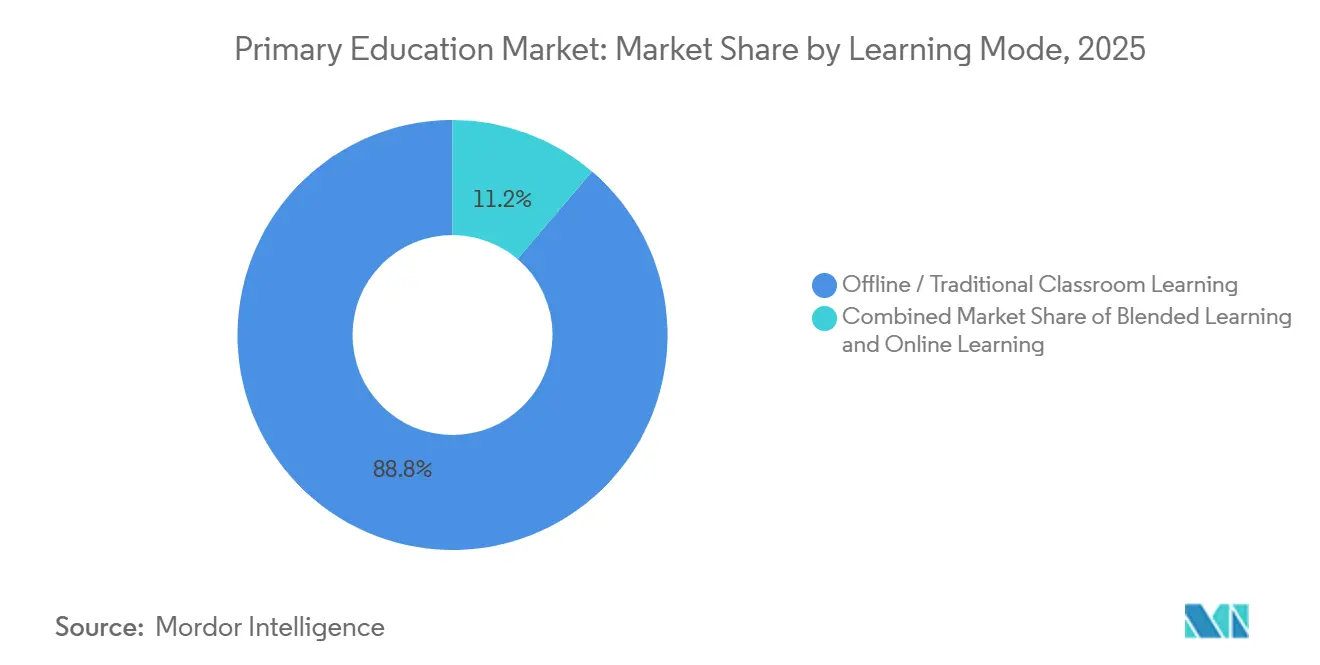
Offline and traditional classroom learning retained an 88.76% share in 2025, confirming that physical schooling still sits at the center of the primary education market. This large position reflects system inertia, infrastructure realities, parent preference for in-person instruction, and the continuing importance of supervised classroom learning in early grades. It also shows that digital adoption in the primary education market is still more additive than fully substitutive in most regions. Schools continue to treat classroom-based delivery as the core model, even as digital tools become part of routine teaching. That is why offline learning remains the dominant base for revenue generation, staffing, infrastructure planning, and procurement in the primary education market.
Online and virtual learning is projected to grow at a 18.24% CAGR through 2031, giving it the fastest expansion rate among learning modes in the primary education market. Stride Inc. reported average full-year enrollment of 234,000 students in fiscal 2025, up 20.4% from fiscal 2024, and its first-quarter fiscal 2026 results also showed 11.3% year-over-year enrollment growth, supporting the view that demand for fully virtual learning has persisted beyond temporary disruptions. Blended and hybrid delivery sits between the two models and is gaining relevance in middle-income systems that need flexibility without removing face-to-face teaching. This model is especially useful where teacher shortages, timetable pressure, or infrastructure gaps require a practical mix of physical and digital instruction. The long-term direction of the primary education market still depends on whether learning outcomes in virtual and blended formats remain acceptable to policymakers, institutions, and families.
By End User: Institutional Procurement Drives Scale; Consumer Buyers Are the Margin Story
Institutional buyers accounted for 70.65% of end-user demand in 2025, which shows that ministries, districts, and school systems remain the largest spending channel in the primary education market. This segment dominates because most large contracts for curriculum, student information systems, classroom platforms, and communication infrastructure are placed at the school system or district level. Institutional procurement also shapes vendor strategy, because large buyers value compliance, integration, and continuity more than point innovation alone. In the primary education industry, this gives established providers an advantage when purchasing committees want fewer vendors and broader service coverage. The institutional side, therefore, remains the scale engine for the primary education market even as other buyer groups expand more quickly.
Consumer buyers are forecast to grow at a 8.56% CAGR through 2031, making them the fastest-growing end-user segment in the primary education market. This demand is supported by family spending on tutoring supplements, learning apps, direct-purchase curriculum materials, and communication tools that extend beyond the school gate. ClassDojo is a useful example because the platform expanded into an all-in-one district communication platform in January 2026 and launched a website management product in June 2026 after already serving 90% of US schools and more than 45 million families and teachers globally. Teacher-facing adoption is also becoming a route into larger contracts, and Amplify’s platform launch for the 2025-26 school year with 300,000 educator users shows how free or low-friction teacher tools can influence later institutional buying decisions. The user draft also pointed to strong parental uptake of India-linked online schooling, which supports the broader view that household spending is becoming a meaningful growth driver in the primary education market.
Geography Analysis
Asia-Pacific accounted for 40.20% of the primary education market in 2025 and is also projected to record the fastest regional CAGR of 3.50% through 2031. China and India anchor this position because they combine very large school-age populations with extensive public-school systems and expanding digital education agendas. China’s April 2025 multi-ministry directive on education digitalization and the June 2026 State Council education plan both support long-term demand for adaptive learning systems, smart campus infrastructure, and AI-enabled teacher development. India is also a major demand center in the primary education market. However, it is still scaling from a low digital base, with only 30.6% of schools reported to have functional digital classrooms in 2024-25. Southeast Asia remains an active corridor for international school expansion, and Nord Anglia’s 2026 addition of Mont’Kiara International School in Kuala Lumpur shows that premium operators still see room for growth across the region.
North America and Europe remain among the most commercially developed parts of the primary education market because institutional software spend, private school fees, and compliance requirements are all relatively high. The United States remains important for platform adoption, curriculum integration, and school communication tools, but data governance has become a more visible buying factor since the 2025 PowerSchool cybersecurity breach. In the United Kingdom, the Department for Education’s 2026 market review noted that one-fifth of primary schools still lacked a digital strategy, which shows that adoption readiness remains uneven even in a relatively advanced education technology environment. Germany and France continue to lean more heavily on public system delivery, which supports scale but slows private market penetration in some categories. South America presents a mixed picture in the primary education market, with infrastructure commitments, such as Mexico’s school investment program, pointing to potential demand. In contrast, tighter fiscal conditions in markets such as Brazil and Argentina continue to limit the pace of expansion.
The Middle East and Africa offer the longest runway for expansion in the primary education market, but near-term execution still depends heavily on funding capacity and infrastructure readiness. UNESCO-linked financing data showed that international aid to education fell by 14% in 2025, a trend that matters more in regions where public systems and donor-backed programs still carry heavy delivery burdens. Within the region, the UAE and Saudi Arabia form a distinct premium school sub-market where international demand, high-fee models, and operator expansion remain strong. Nord Anglia and Dubai Holding announced a new development partnership in February 2026 for multiple K-12 campuses across Dubai communities, which reflects continued confidence in premium school demand. At the broader continental level, the African Union’s CESA 2026-2035 framework provides a policy anchor for enrollment and quality targets, which should support medium-term budget commitments and keep the primary education market on national policy agendas.[3]
Competitive Landscape
The primary education market is fragmented at the school-operator level, but it shows more visible consolidation in curriculum publishing and education technology platforms. Large operators such as Nord Anglia Education, GEMS Education, and Cognita Schools compete in the premium or mid-market private education segments, often with distinct geographic focuses and limited direct overlap. Their strategies are centered on expansion, portfolio diversification, and stronger integration of digital services into school delivery. At the same time, publishers and platform providers compete for institutional relationships that span entire school systems, making retention, integration depth, and compliance more important than content breadth alone. This split structure means the primary education market is broad and dispersed in school ownership, but more concentrated in the enabling tools that support teaching, assessment, and administration.
Strategic moves in 2025 and 2026 show that major companies are using acquisitions, product expansion, and partnerships to deepen their position in the primary education market. Pearson'sPearson's acquisition of eDynamic Learning for GBP 168 million (USD 225 million) expanded its K-12 and career-readiness footprint and demonstrated how established education companies are widening their reach across the learner lifecycle. Nord Anglia's February 2026 partnership with Dubai Holding and its August 2026 addition of Mont'Kiara International School also illustrate the continued use of geographic expansion and premium school network building as core growth tools. ClassDojo's district platform expansion and website launch in 2026 point to a different strategy, where the company is moving from a communication utility to a broader school system workflow infrastructure. These moves show that companies in the primary education market are no longer competing only on classroom content, but on ecosystem control, administrative relevance, and buyer stickiness.
Technology and analytics capabilities are becoming increasingly central to competition in the primary education market as schools seek better instructional support, clearer reporting, and easier implementation. Amplify's AI-powered speech recognition launch for the 2025-26 school year is one example of how curriculum-linked technology is being built directly into literacy assessment and early learning workflows. Large technology companies such as Alphabet, Microsoft, and Apple also remain relevant through their device, cloud, and productivity ecosystems, which influence school-level adoption decisions. Yet the most open commercial space in the primary education market still appears to be in outcome analytics, attendance monitoring, and system-level visibility, especially in low- and middle-income markets where student-level data remains limited. That is why the competitive landscape continues to favor companies that can connect instruction, assessment, communication, and compliance within a single deployable platform.
Primary Education Industry Leaders
-
Pearson plc
-
McGraw Hill LLC
-
Scholastic Corporation
-
Houghton Mifflin Harcourt
-
Microsoft Corporation
- *Disclaimer: Major Players sorted in no particular order
Global Primary Education Market Report Scope
| National / State Curriculum |
| International Curriculum |
| Alternative Curriculum (Montessori, IB Primary Years, Waldorf, etc.) |
| Government & Publicly Funded Schools |
| Private & Independent Schools |
| Offline / Traditional Classroom Learning |
| Blended / Hybrid Learning |
| Online / Virtual Learning |
| Institutional Buyers |
| Classroom Educators |
| Consumer Buyers |
| North America | United States |
| Canada | |
| Mexico | |
| South America | Brazil |
| Peru | |
| Chile | |
| Argentina | |
| Rest of South America | |
| Europe | United Kingdom |
| Germany | |
| France | |
| Spain | |
| Italy | |
| BENELUX (Belgium, Netherlands, and Luxembourg) | |
| NORDICS (Denmark, Finland, Iceland, Norway, and Sweden) | |
| Russia | |
| Rest of Europe | |
| Asia-Pacific | India |
| China | |
| Japan | |
| Australia | |
| South Korea | |
| South East Asia (Singapore, Malaysia, Thailand, Indonesia, Vietnam, and Philippines) | |
| Rest of Asia-Pacific | |
| Middle East and Africa | United Arab Emirates |
| Saudi Arabia | |
| South Africa | |
| Nigeria | |
| Rest of Middle East and Africa |
| By Curriculum | National / State Curriculum | |
| International Curriculum | ||
| Alternative Curriculum (Montessori, IB Primary Years, Waldorf, etc.) | ||
| By School Type | Government & Publicly Funded Schools | |
| Private & Independent Schools | ||
| By Learning Mode | Offline / Traditional Classroom Learning | |
| Blended / Hybrid Learning | ||
| Online / Virtual Learning | ||
| By End User | Institutional Buyers | |
| Classroom Educators | ||
| Consumer Buyers | ||
| By Geography | North America | United States |
| Canada | ||
| Mexico | ||
| South America | Brazil | |
| Peru | ||
| Chile | ||
| Argentina | ||
| Rest of South America | ||
| Europe | United Kingdom | |
| Germany | ||
| France | ||
| Spain | ||
| Italy | ||
| BENELUX (Belgium, Netherlands, and Luxembourg) | ||
| NORDICS (Denmark, Finland, Iceland, Norway, and Sweden) | ||
| Russia | ||
| Rest of Europe | ||
| Asia-Pacific | India | |
| China | ||
| Japan | ||
| Australia | ||
| South Korea | ||
| South East Asia (Singapore, Malaysia, Thailand, Indonesia, Vietnam, and Philippines) | ||
| Rest of Asia-Pacific | ||
| Middle East and Africa | United Arab Emirates | |
| Saudi Arabia | ||
| South Africa | ||
| Nigeria | ||
| Rest of Middle East and Africa | ||
Key Questions Answered in the Report
What is the projected value of primary education by 2031?
The primary education market is projected to reach USD 2.02 trillion by 2031, up from USD 1.81 trillion in 2026, at a 2.22% CAGR over 2026 to 2031.
Which region leads global demand for primary schooling services?
Asia-Pacific led with 40.20% share in 2025 and is also the fastest-growing region with a 3.50% CAGR through 2031.
Why are digital tools becoming more important in early-grade schooling?
Schools are using digital tools to manage teacher shortages, improve communication, support assessment, and widen access. India’s low digital classroom base and China’s policy push both show why this remains a major growth area.
Which learning mode is growing the fastest through 2031?
Online and virtual learning is forecast to expand at an 18.24% CAGR, although offline classroom learning still held 88.76% share in 2025.
What is driving private school growth in this space?
Private and independent schools are projected to grow at a 4.44% CAGR due to premium fee models, demand for international curricula, and capital deployment in high-growth urban markets.
Who are the main buyer groups in this sector?
Institutional buyers remain the largest group with 70.65% share in 2025, while consumer buyers are the fastest-growing group with an 8.56% CAGR through 2031.