
Optical Switches Market Size and Share
Market Overview
| Study Period | 2020 - 2031 |
|---|---|
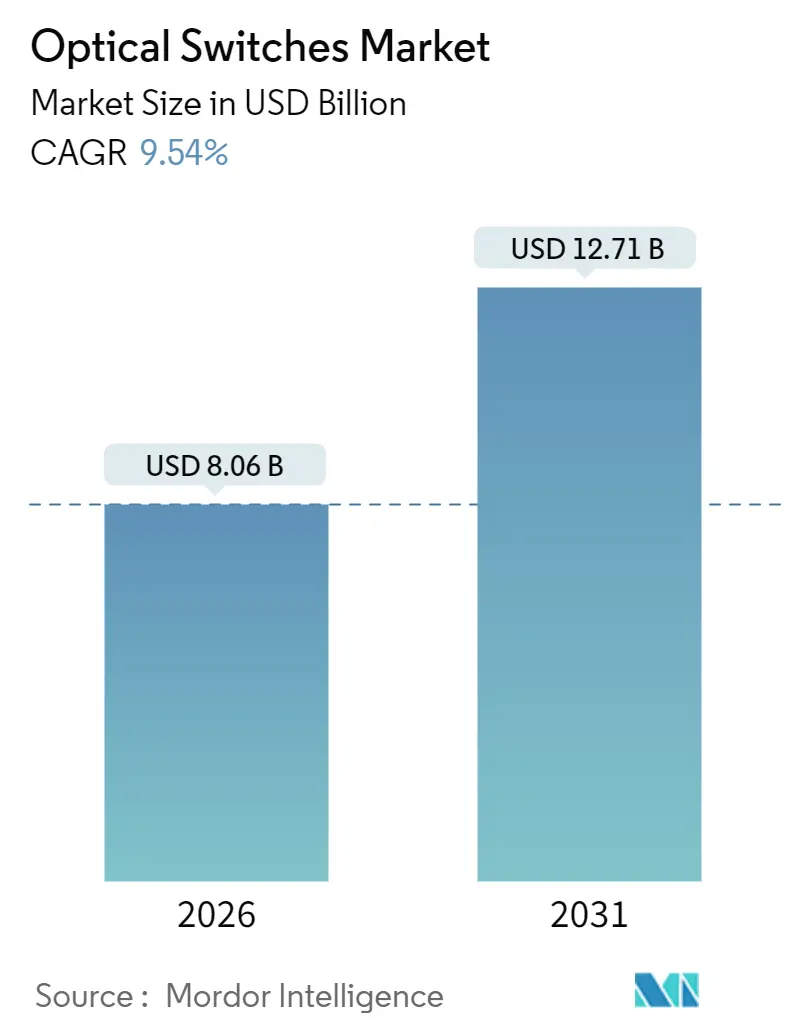
| Market Size (2026) | USD 8.06 Billion |
| Market Size (2031) | USD 12.71 Billion |
| Growth Rate (2026 - 2031) | 9.54 % |
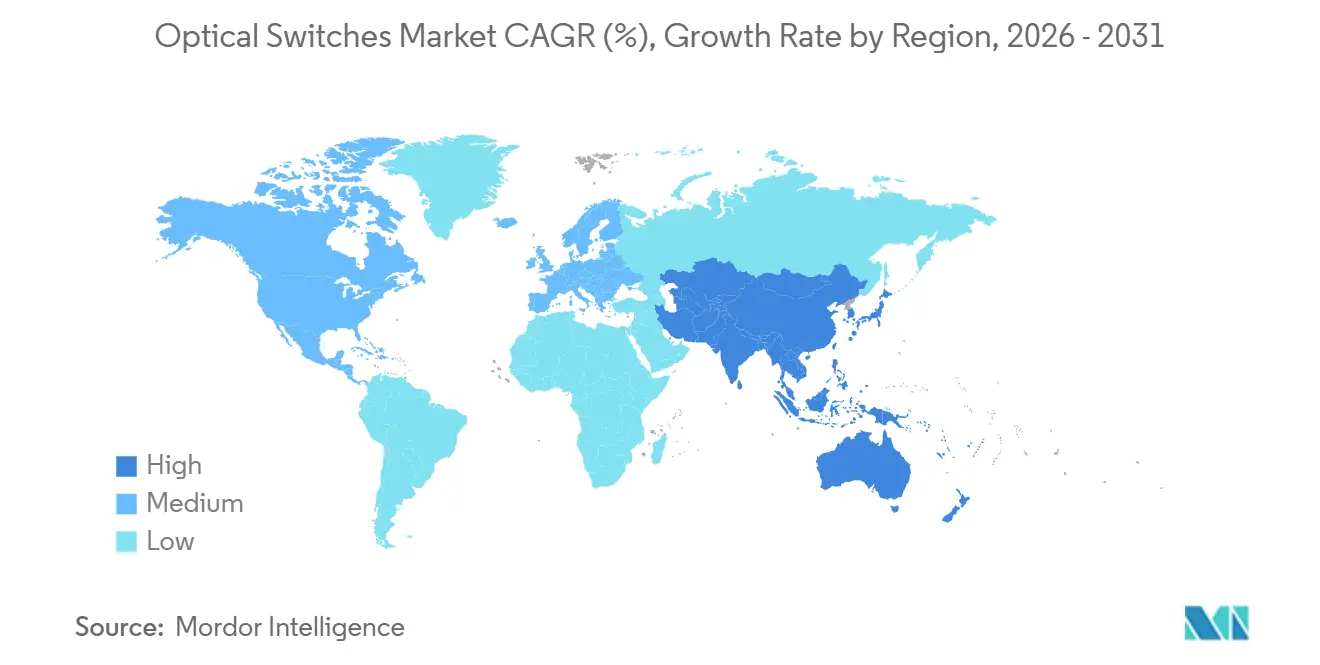
| Fastest Growing Market | Middle East |
| Largest Market | Asia Pacific |
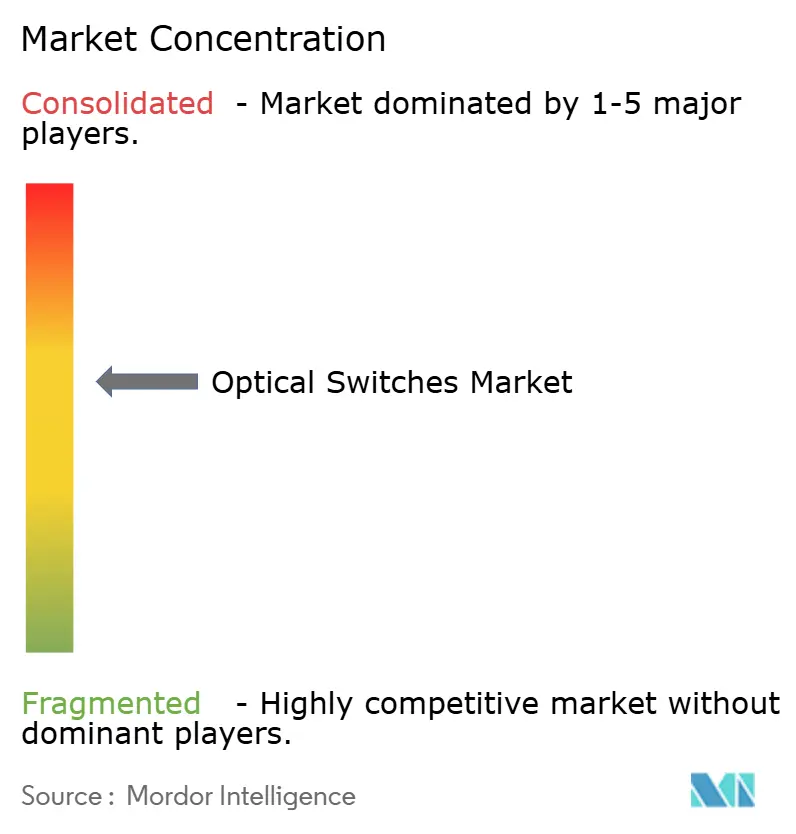
| Market Concentration | Medium |
Major Players *Disclaimer: Major Players sorted in no particular order Image © Mordor Intelligence. Reuse requires attribution under CC BY 4.0. | |
Optical Switches Market Analysis by Mordor Intelligence
The optical switches market size reached USD 8.06 billion in 2026 and is projected to climb to USD 12.71 billion by 2031, advancing at a 9.54% CAGR. The growing deployment of all-optical fabrics in hyperscale data centers, 800 Gbps port migration, and falling silicon photonics costs are the chief growth catalysts. Sovereign AI compute clusters, 5G and soon-to-arrive 6G backhaul densification, and energy-efficiency mandates are pushing operators to abandon electronic leaf-spine topologies in favor of deterministic optical paths. Competitive pressure from vertically integrated hyperscalers is forcing traditional equipment vendors to accelerate MEMS and co-packaged optics roadmaps. Supply-chain diversification into III-V wafers and domestic photonics packaging is also reshaping vendor strategies, while AI-driven network automation is lowering operating expenses and shortening fault-recovery windows.
Key Report Takeaways
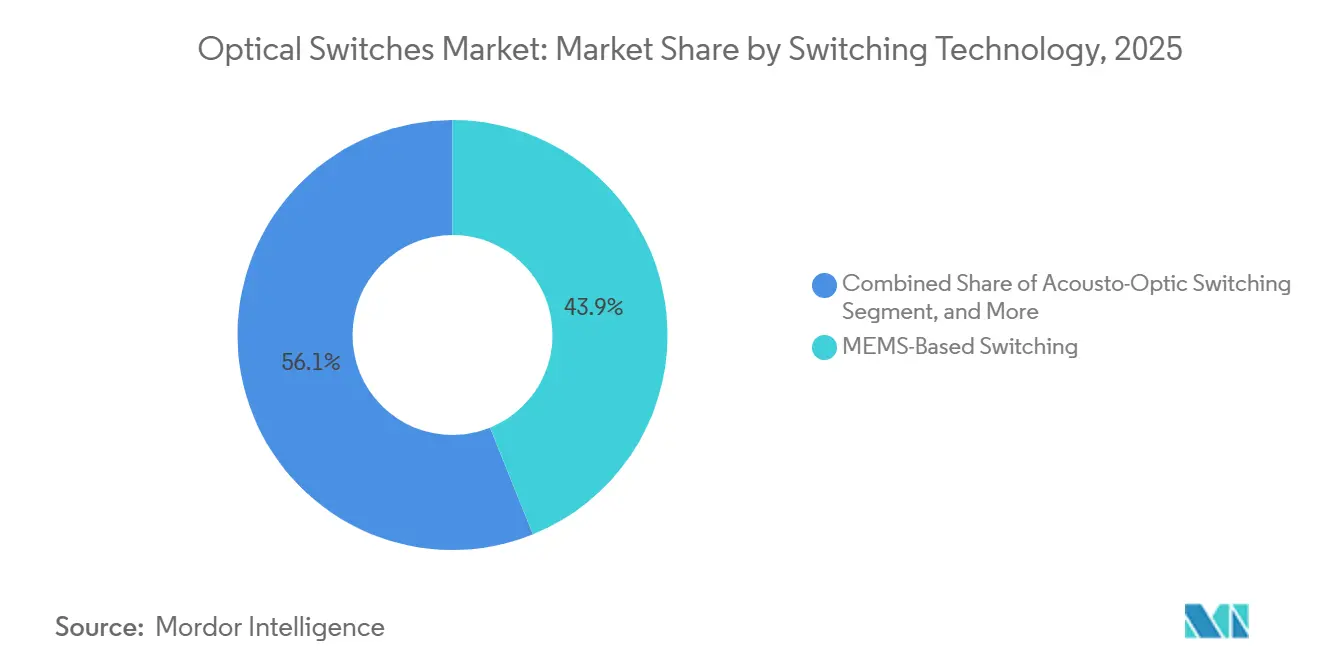
- By switching technology, MEMS commanded 43.89% of the optical switches market share in 2025 and is expanding at a 10.62% CAGR through 2031.
- By port count, 1×8 accounted for 36.71% of revenue share in 2025, whereas 1×16 and above is projected to post a 10.41% CAGR through 2031.
- By data rate, 100-400 Gbps ports captured 39.67% of the optical switches market size in 2025, but ports above 400 Gbps are advancing at a 10.47% CAGR.
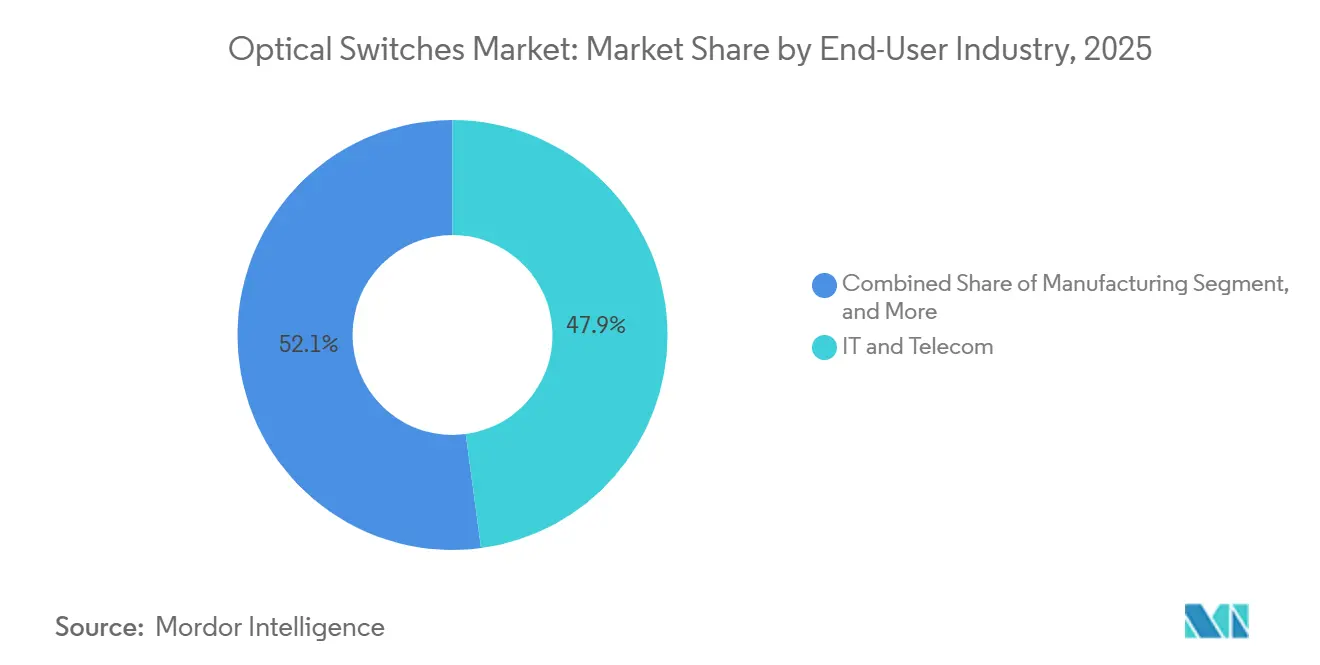
- By end-user industry, IT and telecom accounted for 47.88% of demand in 2025, while BFSI is the fastest-growing segment with a 10.59% CAGR.
- By application, circuit switching led with 41.24% revenue share in 2025, yet testing and monitoring is on track for a 10.56% CAGR.
- By geography, Asia Pacific accounted for 35.79% of 2025 revenue, whereas the Middle East is forecast to register the fastest regional growth at 10.51% through 2031.
Note: Market size and forecast figures in this report are generated using Mordor Intelligence’s proprietary estimation framework, updated with the latest available data and insights as of January 2026.
Global Optical Switches Market Trends and Insights
Drivers Impact Analysis*
| Driver | (~) % Impact on CAGR Forecast | Geographic Relevance | Impact Timeline |
|---|---|---|---|
| Surge in hyperscale data-center buildouts | +2.1% | Global, with concentration in North America, Asia Pacific, and Middle East | Medium term (2-4 years) |
| Rapid 5G and forthcoming 6G backhaul densification | +1.8% | Asia Pacific, Middle East, Europe | Medium term (2-4 years) |
| Silicon-photonics cost curve crossing for ≥400 Gbps ports | +1.6% | Global, led by North America and Asia Pacific | Short term (≤ 2 years) |
| Energy-efficiency mandates favouring all-optical switching | +1.3% | Europe, North America, with spillover to Asia Pacific | Long term (≥ 4 years) |
| Government quantum-network pilot deployments | +0.9% | United States, European Union, China | Long term (≥ 4 years) |
| AI-driven optical network automation and self-healing | +1.2% | Global, early adoption in North America and Europe | Medium term (2-4 years) |
| Source: Mordor Intelligence | |||
Surge in Hyperscale Data-Center Buildouts
Hyperscalers are shifting to optical fabrics to shave power budgets and curb latency spikes. Microsoft rolled out optical circuit switches across 12 Azure zones in 2025 and cut rack-level power draw by 18%.[1]Microsoft Corporation, “Annual Report 2025,” microsoft.com AWS is committed to silicon-photonics co-packaged optics for its next Graviton platforms, eliminating top-of-rack hops. Similar moves by Google and Meta confirmed a structural transition toward deterministic east-west bandwidth. These upgrades concentrate in Virginia, Oregon, Singapore, and the United Arab Emirates, where electricity costs and tax policies are favorable.
Rapid 5G and Forthcoming 6G Backhaul Densification
Mobile operators are inserting optical switches into central offices and edge sites to aggregate traffic from thousands of small cells. China Mobile equipped 47 provincial hubs with MEMS switches, trimming leased-fiber pairs by 29%. Bharti Airtel followed in 18 Indian metro areas, while Vodafone’s Open RAN plan embeds optical cross-connects for real-time fronthaul redistribution. The GSM Association has already positioned optical circuit switching as a baseline for 6G backhaul, underscoring future traffic requirements.
Silicon-Photonics Cost Curve Crossing for ≥400 Gbps Ports
In 2025, co-packaged optics reached price parity with electrical SerDes at 400 Gbps, clearing adoption hurdles. Intel shipped 1.2 million modules after a 31% price drop. Broadcom’s 51.2 Tbps Tomahawk-5 matched the economics of 12.8 Tbps electrical ASICs, catalyzing hyperscale interest.[2]Broadcom Inc., “Investor Presentation 2025,” investors.broadcom.com Standardized 800 Gbps and 1.6 Tbps form factors from the Optical Internetworking Forum should push the curve further down.
Energy-Efficiency Mandates Favoring All-Optical Switching
Regulations under the European Green Deal and California Title 24 incentivize data center operators to reduce thermal overhead by removing electronic packet inspection stages. Operators in Germany, the United Kingdom, and France accelerated optical retrofits during 2025 to align with 2027 compliance deadlines. Similar policies are emerging across the Asia Pacific, creating a long-tail pull for energy-efficient optical fabrics.
Restraints Impact Analysis*
| Restraint | (~) % Impact on CAGR Forecast | Geographic Relevance | Impact Timeline |
|---|---|---|---|
| Persistent premium over electronic leaf-spine fabrics | -1.4% | Global, particularly in cost-sensitive enterprise and SMB segments | Short term (≤ 2 years) |
| Limited field expertise for multi-terabit optical fabrics | -1.1% | Global, acute in emerging markets and smaller service providers | Medium term (2-4 years) |
| Supply-chain exposure to III-V wafer shortages | -0.8% | Global, with highest impact in Asia Pacific and Europe | Short term (≤ 2 years) |
| Cyber-resilience certification lag for mission-critical users | -0.6% | North America, Europe, with spillover to government and BFSI sectors globally | Long term (≥ 4 years) |
| Source: Mordor Intelligence | |||
Persistent Premium Over Electronic Leaf-Spine Fabrics
At 100- and 200 Gbps port tiers, optical switches remain 35-50% more expensive than their electronic peers. Dell’Oro pegged a 32-port optical chassis at USD 47,000 versus USD 31,000 for an electronic equivalent in Q2 2025. Many mid-tier enterprises cannot absorb the three-year payback threshold cited by Arista Networks, slowing penetration outside hyperscale footprints.
Limited Field Expertise for Multi-Terabit Optical Fabrics
Few engineers possess hands-on experience with wavelength management or dispersion budgeting. Cisco reported that professional-services engagements for optical projects averaged 18 months, twice the duration of electronic upgrades.[3]Cisco Systems Inc., “Services Revenue Disclosure 2025,” investor.cisco.com Workforce surveys suggest that only 12% of North American network engineers can troubleshoot reconfigurable optical add-drop multiplexers, resulting in deployment delays.
*Our forecasts treat driver/restraint impacts as directional, not additive. The impact forecasts reflect baseline growth, mix effects, and variable interactions.
Segment Analysis
By Switching Technology: MEMS Pace Sets the Benchmark
MEMS technology accounted for 43.89% of the market in 2025 and is tracking a 10.62% CAGR through 2031. The optical switches market size for MEMS platforms is climbing as hyperscalers specify sub-millisecond reconfiguration for AI workload balancing. Calient’s 1,024×1,024 array, with insertion loss below 2.5 dB, illustrates how high-port-count MEMS is replacing spine routers in pods. Electro-optic lithium niobate variants target nanosecond-switching niches, mainly finance and defense, but their higher power draw curbs mainstream adoption. Thermo-optic devices are winning cost-sensitive metro contracts, while magneto-optic switches stay limited to quantum pilots. Patent filings grew 47% year over year, reflecting brisk R&D in actuation physics.
Second-order effects center on supply-chain shifts. Specialized MEMS fabs in Taiwan and South Korea offer design-to-production services, lowering entry barriers for startups and widening vendor choice for buyers. Compliance with IEC 61753 reliability protocols is now non-negotiable in Europe, spurring vendors to harden products for millions of daily cycles. Collectively, these dynamics entrench MEMS as the benchmark for future competitive benchmarking in the optical switches market.



By Port Count: Density Demands Propel 1×16+ adoption
The 1×8 cohort held a 36.71% revenue share in 2025, owing to broad adoption in access aggregation and test-and-measurement racks. Yet demand is rapidly tilting toward 1×16 and larger matrices, expanding at a 10.41% CAGR as hyperscale operators pursue spine-level mesh fabrics. Lumentum’s newly qualified 1×32 MEMS switch for Meta’s data-center refresh is emblematic. Lower tiers, such as 1×2 latching models, remain vital for protection schemes but generate less revenue, while growing demand for compact switching components creates opportunities in the micro switch market.
High-density products enable optical circuit-switched overlays that offload elephant flows without engaging packet silicon, driving step-function latency gains. European research networks, for example, documented a 68% reduction in latency after inserting 1×64 arrays. Given these measurable advantages, large-port switches are expected to eclipse legacy counts before the end of the decade, reinforcing their strategic importance in the optical switches market.
By Data Rate: Above-400 Gbps Configurations Accelerate
Ports in the 100-400 Gbps band still delivered 39.67% of 2025 revenue, but momentum clearly favors the above-400 Gbps tier, posting a 10.47% CAGR. Next-wave ASICs from Broadcom and Coherent integrate 800 Gbps optical engines, removing the fiber-count penalty that hampered early adoption. The optical switches market share for ultra-high-speed ports will rise sharply as hyperscalers standardize on single-wavelength 800 Gbps links to fit AI cluster topologies.
Meanwhile, sub-40 Gbps ports persist mainly in legacy environments where incremental capex is preferable, and the 40-100 Gbps slice remains serviceable for metro backbones. Yet vendor roadmaps, IEEE 802.3ck compliance activity, and skyrocketing 1.6 Tbps test-gear orders indicate the center of gravity is moving inexorably upward in bandwidth.
By End-User Industry: BFSI’s Low-Latency Push
IT and telecom retained 47.88% of spending in 2025, but BFSI’s forecast 10.59% CAGR signals a strategic realignment. Major banks deployed optical circuit switches to shave microseconds from order routing and fraud analytics. JPMorgan Chase trimmed derivatives-execution latency by 23% after deploying optical fabrics in New York and London data centers. Manufacturing, healthcare, and government are also leaning on deterministic optics for robotics, genomics, and secure satellite links, respectively. These vertical-specific performance imperatives underscore why end-user diversification will continue to broaden the optical switches market.
Second-tier verticals such as media and retail are increasingly buying optical capacity for high-resolution streaming and campus-area networks. Though smaller individually, their aggregate demand supports a healthier long-tail vendor ecosystem, preventing over-reliance on hyperscale capex cycles.
By Application: Testing and Monitoring’s Fastest Track
Circuit switching contributed 41.24% of 2025 revenue and remains foundational for data-center and transport fabrics. Nevertheless, testing and monitoring lead growth at a 10.56% CAGR as operators instrument multi-terabit networks for closed-loop automation. Keysight’s 48% sales jump in optical-switch test systems during 2025 affirms the pivot toward instrumentation. Optical performance monitoring baked into switching silicon, such as Ciena’s WaveLogic 6, is blurring lines between active switching and telemetry.
Multiplexing and cross-connect use cases remain steady in metro and cable-landing stations, while niche requirements, such as quantum-safe protection switching, are emerging. Collectively, application diversity spreads risk and sustains continuous innovation within the optical switches market.
Geography Analysis
Asia Pacific generated 35.79% of global revenue in 2025, fueled by China’s quantum backbones, India’s 5G standalone buildouts, and Japan’s post-Olympic data-center boom. China Mobile connected 12 provincial quantum links with optical switches, aiming for 50-city coverage by 2028. Bharti Airtel’s optical fiber rollout across 18 metros reduced backhaul fiber requirements by 31%. South Korea’s 6G roadmap names optical switching as a terahertz fronthaul enabler, while Australia’s National Broadband Network committed AUD 1.2 billion (USD 804 million) to optical upgrades.
The Middle East is projected to grow at 10.51% through 2031 as Saudi Arabia and the United Arab Emirates localize cloud capacity. Saudi Telecom installed MEMS switches to underpin the NEOM smart-city backbone and real-time grid automation. Etisalat integrated optical fabrics into its 5G core, aiming for sub-5 ms latency for industrial IoT.
North America held roughly 30% of 2025 demand, anchored by USD 15 billion in hyperscale retrofits from Microsoft, Amazon, and Google. Europe accounted for nearly 22%, with German and French operators accelerating upgrades to meet energy-efficiency regulations. South America and Africa together contributed under 8%, but they received tailwinds from new spectrum allocations in Brazil and fiber corridor funding in Kenya. Regulatory frameworks, such as the EU’s Network and Information Security Directive 2 and a proposed U.S. FCC interoperability mandate, will shape regional adoption curves by standardizing security and compatibility baselines.

Regulatory Landscape
Optical-switch deployments operate within telecom and data-center regulatory frameworks that increasingly emphasize faster fiber buildouts, interoperability, and cyber resilience. In the United States, the Federal Communications Commission (FCC) adopted FCC-26-19 in March 2026 to reduce barriers and costs for the transition to IP-based infrastructure. In June 2026, it advanced a Draft NPRM proposing a nationwide framework for wireline access to rights-of-way, including a rebuttable presumption of 120 days for processing infrastructure requests, which affects the timing of optical-network upgrades and the related switching equipment.
Standards and security compliance requirements are also tightening in parallel with deployment streamlining. The ITU-T approved Recommendation G.798.4 in February 2026, covering optical transport network hierarchy functional blocks (including FlexO), reinforcing interoperability baselines used across carrier transport systems that integrate optical switching. In the EU, the European Commission published the Digital Networks Act (DNA) proposal in January 2026 to harmonize the electronic communications framework. Meanwhile, NIS2 implementation (classified operators as essential entities) increases requirements around incident reporting and supply-chain risk controls, which in turn influence network equipment selection and vendor qualification.
Value Chain Analysis
The optical switches value chain begins with specialty raw materials and wafers, notably III-V substrates such as InP for laser-related components. It then moves into photonic chip fabrication and switch-engine builds, including MEMS mirrors, silicon photonics, and the associated control electronics. Packaging, assembly, and system integration follow, linking the switch engines to data-center optical fabrics and carrier transport platforms.
On the downstream side, networking systems OEMs and module suppliers pair optical switching with transceivers, coherent optics, and control software before selling into hyperscalers and telecom operators. In practice, qualification cycles and multi-year procurement plans at these buyers largely determine shipment timing and design wins. Bottlenecks are concentrated around advanced-node DSP availability and high-speed optics supply for 1.6T-era builds, including constraints around 3 nm DSPs and InP-based components, which can extend lead times for optical-fabric rollouts. The shift toward co-packaged and on-board optics also moves value toward photonics packaging, test, and automation capabilities alongside the switch element itself. This balance is reflected in research-to-product translation at large port counts, including OFC 2026 demonstrations of a 4,096 x 4,096 non-blocking optical circuit switch architecture delivering 819.2 Tb/s.
Competitive Landscape
The optical switches market is moderately concentrated: the top five vendors, Broadcom, Cisco, Huawei, Nokia, and Ciena, held roughly 52% combined 2025 revenue. Yet fragmentation is increasing as hyperscalers roll out proprietary fabrics and startups introduce niche photonics. Broadcom bought a stake in a Taiwan MEMS foundry to secure supply, while Cisco and Intel are codeveloping 1.6 Tbps co-packaged optics. Patent filings jumped 34% year over year, especially in China and South Korea, reflecting a land-grab for acousto-optic and thermo-optic IP.
Technical differentiation now hinges on switching speed, port density, and power per bit. Lumentum and II-VI battle on sub-10-ms MEMS actuation, whereas Ciena and Infinera promote coherent-optics integration to remove external transponders. New entrants such as Ayar Labs (chip-to-chip photonics) and Lightmatter (photonic AI processors) target white-space territories that challenge incumbent roadmaps. Standards work inside IEEE 802.3 for 3.2 Tbps and 6.4 Tbps Ethernet could reshuffle rankings by 2028, depending on which vendors execute volume silicon first.
Vendor go-to-market models are also evolving. Smaller companies like DiCon Fiberoptics and Sercalo leverage customization speed to win protection-switch and quantum-network contracts. Meanwhile, larger players double down on services, automation software, and vertical solutions to defend share. This interplay of scale, specialization, and integration will define competitive dynamics for the remainder of the decade.
Optical Switches Industry Leaders
Broadcom Inc.
Cisco Systems Inc.
Huawei Technologies Co. Ltd.
Fujitsu Ltd.
Juniper Networks Inc.
- *Disclaimer: Major Players sorted in no particular order

Market Opportunities and Future Outlook
AI data-center fabrics are opening opportunities for higher-port-count optical circuit switching and silicon-photonic switching, particularly where operators want to reduce O-E-O conversions and manage extremely large fiber counts. In March 2026, multiple suppliers announced new OCS products aimed at AI networking, including Salience Labs (32-port all-optical silicon photonic switch), DiCon Fiberoptics (300 x 300 and 64 x 64 MEMS OCS, with a stated plan to manufacture 3,000 units in 2026), and Eoptolink (NX200 and NX300 OCS systems with 140-port and 320-port configurations). These launches expand vendor choice beyond traditional transport OEMs and add near-term procurement pathways for operators standardizing on optical fabrics for GPU clusters.
Manufacturing and packaging scale-up is another near-term opportunity as buyers look for predictable supply and faster qualification. iPronics announced a SiPh packaging and assembly manufacturing line at Fabrinet that it described as fully operational in Q2 2026, indicating additional downstream capacity to move switch engines into deployable systems. On the carrier side, backbone modernization continues to support optical switching in transport and cross-connect use cases, including the January 2026 Ciena 6500 deployment with WaveLogic 5 Extreme on an 800 Gb/s cross-border link for Telekom Srbija and Mtel.
Recent Industry Developments
- March 2026: Broadcom announced that its Tomahawk 6 switch family is shipping in production volume, bringing 102.4 Tbps-class capacity into mainstream AI and cloud network designs. Higher-capacity switching platforms accelerate the move to ultra-high-speed optical interfaces and increase pull-through for optical switching and co-packaged optics architectures used in scale-out fabrics.
- December 2025: Broadcom completed a USD 320 million silicon-photonics expansion in Colorado to scale optical-engine output to 2 million units per year by Q4 2026. This capacity build targets supply assurance for high-speed optical components that sit upstream of optical switching systems and influences lead times for above-400 Gbps deployments.
- March 2024: Broadcom introduced its 51.2 Tbps co-packaged optics Ethernet switch platform for scalable AI systems. By advancing co-packaged optics integration earlier in the design cycle, the announcement strengthened the technology pathway for lowering power per bit and reducing electrical bottlenecks that drive adoption of all-optical fabrics.


Research Methodology Framework and Report Scope
Market Definition and Coverage
For this study, the optical switches market covers revenues earned from devices that switch optical signals across fiber networks, including switches used in telecom networks, data centers, and enterprise optical connectivity, across all major regions.
Scope exclusions: We exclude fiber-optic cable, optical transceivers, and pure electronic Ethernet switching equipment when the switching function is not performed in the optical domain.
Segmentation Overview
- By Switching Technology
- Electro-Optic Switching
- Acousto-Optic Switching
- MEMS-Based Switching
- Magneto-Optic Switching
- Thermo-Optic Switching
- Other Switching Technologies
- By Port Count
- 1×2
- 1×4
- 1×8
- 1×16 and Above
- By Data Rate
- Up to 40 Gbps
- 40–100 Gbps
- 100–400 Gbps
- Above 400 Gbps
- By End-User Industry
- IT and Telecom
- Government and Defense
- Banking, Financial Services, and Insurance (BFSI)
- Manufacturing
- Healthcare and Life Sciences
- Other End-User Industries
- By Application
- Circuit Switching
- Testing and Monitoring
- Multiplexing
- Cross-Connects
- Signal Monitoring
- Other Applications
- By Geography
- North America
- United States
- Canada
- Mexico
- Europe
- Germany
- United Kingdom
- France
- Russia
- Rest of Europe
- Asia-Pacific
- China
- Japan
- India
- South Korea
- Australia
- Rest of Asia-Pacific
- Middle East and Africa
- Middle East
- Saudi Arabia
- United Arab Emirates
- Rest of Middle East
- Africa
- South Africa
- Egypt
- Rest of Africa
- Middle East
- South America
- Brazil
- Argentina
- Rest of South America
- North America
Data Sources, Market Sizing, and Validation
Desk Research
We started by building a fact base on fiber broadband rollouts, telecom capex direction, and data center networking expansion, since these are the demand pools where optical switching is typically specified. Public sources such as the International Telecommunication Union (ITU) indicators, World Bank connectivity datasets, OECD broadband statistics, and regulator publications helped us keep country-level rollout assumptions realistic. For technology and standards context, we also referenced sources such as IEEE standards documents and peer-reviewed optics and photonics journals.
On the supply and pricing side, we reviewed public company filings, investor presentations, and technical datasheets to understand product positioning, typical port configurations, and pricing bands across use cases. Trade data and shipment-level signals were supported through an import/export shipment-level database, which helped sanity check where manufacturing and cross-border movement appeared concentrated. A paid database for company financials and intelligence was also used selectively to confirm reported business lines and to avoid misallocating adjacent optical networking revenues into switches. The desk sources listed above are illustrative, and many other public documents and datasets were also referenced for data collection, validation, and clarification.
Primary Interviews and Surveys
Primary work focused on cross-checking adoption timing and average selling price movement, since product mixes can shift quickly with data rate upgrades and network refresh cycles. We spoke with a mix of component ecosystem participants, system suppliers, network operators, and channel partners across key regions, so desk research assumptions could be adjusted where procurement realities differed. These discussions also helped us confirm whether demand was more tied to telecom backbone upgrades or data center interconnect builds, and how project-based buying introduced lumpiness in order flow.
Distribution of primary research fieldwork respondents
| Company type | Respondent position | Region |
|---|---|---|
| Top tier: 37% | CXOs: 22% | APAC: 39% |
| Mid tier: 41% | Functional/Unit leaders: 24% | EMEA: 35% |
| Smaller Players: 22% | Managers: 54% | Americas: 26% |
Market-Sizing & Forecasting
Our model uses a top-down build that reconstructs demand from optical network spending and deployment activity, then filters down to the portion where optical switching is required by architecture and use case. In practice, we mapped spending and rollout indicators to switching needs across telecom networks, data centers, and enterprise optical connectivity, and then applied adoption rates that were validated through expert checks. To keep totals realistic, we also used selective bottom-up approximations, such as sampled product ASPs multiplied by likely shipment volumes for common port counts and data rates, followed by channel checks to correct for over-counting.
Inputs that mattered most included fiber broadband and 5G transport rollout pace, data center capacity additions and interconnect builds, typical port count mixes, and data rate transitions (such as 100G to 400G class links), along with regional price differences shaped by procurement patterns and certification requirements. Where product or regional splits were not fully visible, gaps were handled using conservative ranges from interviews, and then narrowed based on public pricing references and consistency with total optical networking spend.
For forecasting, scenario analysis was used to reflect how telecom capex cycles, cloud build timing, and technology refresh schedules can shift year to year. The final outlook was aligned to consensus direction from primary respondents, and then stress-tested by varying a small set of drivers (adoption rate, ASP drift, and deployment pace) to see whether results stayed within plausible bounds.
Data Validation & Update Cycle
Totals were triangulated by checking model outputs against independent signals such as network infrastructure spending direction, shipment and trade movement patterns, and the pace of new build activity in major regions. Variance checks were performed at region and application levels, so outliers could be traced back to a specific assumption, and then corrected or defended with supporting evidence. Before sign-off, the work goes through multi-step analyst reviews, and re-contact is triggered when interview feedback meaningfully disagrees with the desk-based assumption set.
The report is refreshed annually, and interim updates are made when material events change demand or pricing, such as major standards shifts, large capex revisions, or supply constraints. Before delivery, an analyst performs a fresh pass on key inputs so clients receive the latest updated view available at that time.
Mordor Intelligence's Global Optical Switches Market Estimate Compared With Other Published Estimates
Published market sizes for optical switches often vary because the scope boundary is not consistent, and because conversion and pricing choices can change the total even when growth direction looks similar. We also see differences when some estimates mix in adjacent optical networking hardware that sits near switching in the bill of materials.
By tracking demand drivers like fiber rollout activity and data center interconnect builds, and then refreshing ASP and product-mix assumptions through interviews, Mordor Intelligence keeps the total tied to optical switching revenues rather than broad optical transport spending. Gaps usually come from whether all-optical switches are blended with optoelectronic or packet switching platforms, and whether the estimate assumes aggressive upgrades to higher data rates early in the forecast. Currency timing and refresh cadence matter too, since fast-moving component pricing can shift reported totals if assumptions are not updated close to the base year.
Benchmark comparison
| Source | Market Size | Gaps in Research Methodology |
|---|---|---|
| Mordor Intelligence | USD 8.06 B (2026) | |
| Trade Journal A | USD 4.80 B (2024) | This estimate appears to reflect a narrower definition focused on optical switch units sold into selected telecom and DCI use cases, and it may not fully include higher port-count systems used in broader network architectures. |
| Industry Report B | USD 4.20 B (2025) | The sizing approach looks closer to a device-only view with limited coverage of system-level optical switching configurations, and it likely applies different ASP progression assumptions that compress revenue totals in the base year. |
Taken together, the spread is mainly explained by what is counted as an optical switch, and how fast the model assumes product mix shifts toward higher value configurations. Our approach stays repeatable because the steps are tied to observable deployment indicators, interview-checked adoption rates, and transparent pricing logic that can be re-tested as conditions change.


Key Questions Answered in the Report
What is the current value of the optical switches market?
The optical switches market is valued at USD 8.06 billion in 2026.
How fast is the market expected to grow?
It is forecast to register a 9.54% CAGR, reaching USD 12.71 billion by 2031.
Which switching technology leads revenue?
MEMS platforms led with 43.89% revenue share in 2025 and continue to expand fastest.
Which vertical is set to grow quickest?
BFSI is projected to post the highest growth, advancing at a 10.59% CAGR through 2031.
Which region will record the fastest expansion?
The Middle East is expected to grow at a 10.51% CAGR as sovereign data-center buildouts accelerate.
What are the main challenges facing adoption?
Upfront cost premiums and shortages of skilled optical-fabric engineers remain key hurdles.
Page last updated on:


 Your data is secure and never sold or shared.


