
Market Overview
| Study Period | 2020 - 2031 |
|---|---|
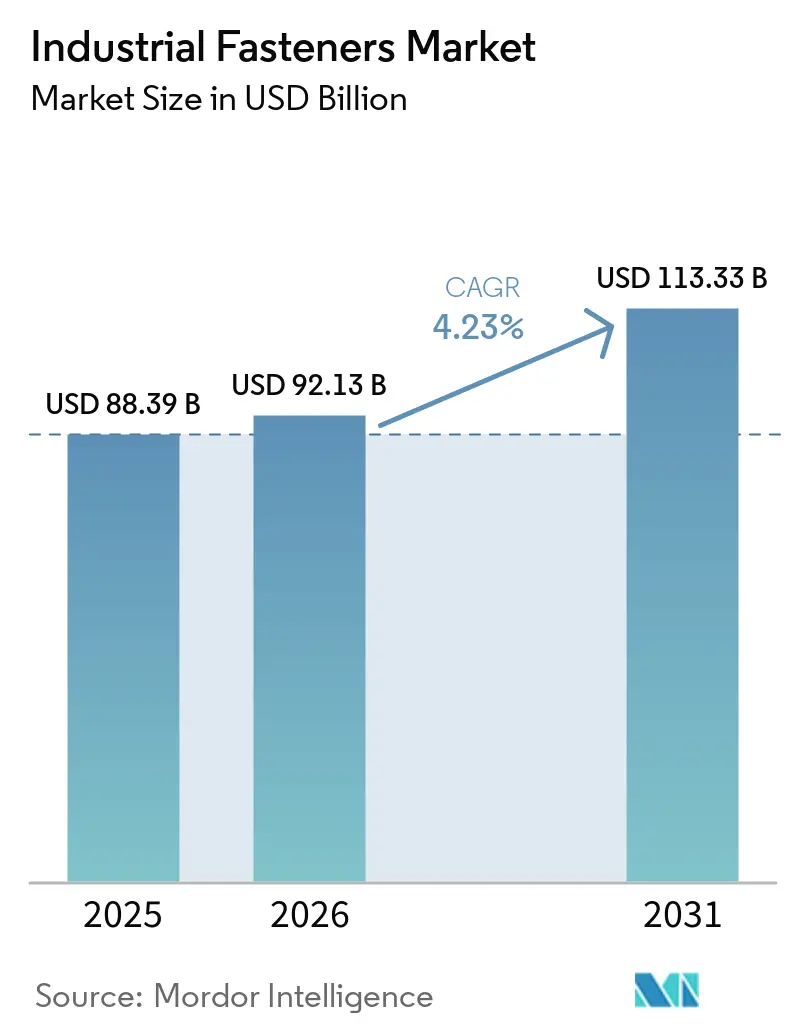
| Market Size (2026) | USD 92.13 Billion |
| Market Size (2031) | USD 113.33 Billion |
| Growth Rate (2026 - 2031) | 4.23 % |
| Fastest Growing Market | Middle East |
| Largest Market | Asia Pacific |
| Market Concentration | Medium |
Major Players *Disclaimer: Major Players sorted in no particular order Image © Mordor Intelligence. Reuse requires attribution under CC BY 4.0. | |
Industrial Fasteners Market Analysis by Mordor Intelligence
The industrial fasteners market size is projected to expand from USD 88.39 billion in 2025 and USD 92.13 billion in 2026 to USD 113.33 billion by 2031, registering a CAGR of 4.23% between 2026 and 2031. Pent-up infrastructure spending, electrification of transportation, and offshore wind buildouts are shifting demand away from commodity bolts toward engineered, certified solutions. Automotive battery-pack designs now specify torque-to-yield screws that hold clamping force across −40 °C to +85 °C cycles, lifting unit prices even as vehicle fastener counts fall. High-rise seismic codes in North America and Japan mandate pretensioned bolts with ultimate strengths up to 200 ksi, widening the gap between entry-level carbon-steel hardware and premium alloy products. At the same time, nickel and molybdenum volatility squeezes stainless-steel margins, forcing producers to hedge raw materials or pass on costs to customers.
Key Report Takeaways
- By raw material, metal fasteners accounted for 49.23% of 2025 revenue and are projected to post the fastest expansion among tracked materials at a 4.61% CAGR through 2031.
- By product, externally threaded fasteners held 47.34% of the industrial fasteners market share in 2025, while aerospace-grade fasteners are forecast to advance at a 5.07% CAGR to 2031.
- By application, automotive accounted for 33.47% of 2025 industrial fasteners market sales, whereas industrial machinery and robotics represent the fastest-growing use case for industrial fasteners, with a 5.66% CAGR through 2031.
- By sales channel, OEM purchases accounted for 69.23% of the 2025 value; aftermarket and maintenance-repair-operations revenues are expected to rise at a 4.69% CAGR by 2031.
- By geography, Asia Pacific generated 38.64% of global revenue in 2025, while the Middle East is poised for a 5.26% CAGR through 2031.
Note: Market size and forecast figures in this report are generated using Mordor Intelligence’s proprietary estimation framework, updated with the latest available data and insights as of 2026.
Market Trends and Insights
Drivers Impact Analysis of Industrial Fasteners Market*
| Driver | (~) % Impact on CAGR Forecast | Geographic Relevance | Impact Timeline |
|---|---|---|---|
| Automotive Electrification Boosting Demand for Battery-Ready Fasteners | +0.8% | Global, with concentration in China, Europe, and North America | Medium term (2-4 years) |
| Seismic-Resistant Building Codes Driving High-Strength Structural Bolts | +0.6% | North America, Japan, Chile, Turkey, and seismically active zones in Asia Pacific | Long term (≥ 4 years) |
| Offshore Wind Installations Requiring Large-Diameter Corrosion-Resistant Bolts | +0.5% | Europe (North Sea), Asia Pacific (China, Taiwan), and emerging U.S. Atlantic Coast | Long term (≥ 4 years) |
| Localization of Aerospace Fastener Supply Chains | +0.4% | North America, Europe, with spillover to India and Southeast Asia | Medium term (2-4 years) |
| Precision Micro-Fasteners for Industrial Automation Equipment | +0.5% | Global, led by Germany, Japan, South Korea, and China | Medium term (2-4 years) |
| Infrastructure Stimulus Programs in Emerging Economies | +0.7% | India, Middle East (Saudi Arabia, UAE), Southeast Asia, and Latin America | Short term (≤ 2 years) |
| Source: Mordor Intelligence | |||
Automotive Electrification Boosting Demand for Battery-Ready Fasteners
Electric-vehicle battery packs demand torque-to-yield bolts that hold clamp force across −40 °C to +85 °C, a range that exceeds the capability of standard carbon-steel screws. Automakers also shift to aluminum-rich bodies to offset battery mass, which forces industrial fasteners suppliers to provide galvanic-corrosion-resistant fasteners with pull-out strengths above 15 kN. Although an electric car uses about 12% fewer parts than an internal-combustion model, the remaining components cost 30-40% more due to tighter tolerances and premium coatings. Coating lines that apply zinc-nickel or geom finish are therefore expanding, while ISO 16047 testing for hydrogen-embrittlement resistance is becoming routine. These specifications raise average revenue per vehicle and position qualified suppliers to capture long-term platform awards.[1]
Seismic-Resistant Building Codes Driving High-Strength Structural Bolts
North American and Japanese regulators now require pretensioned bolts with ultimate strengths up to 200 ksi, a 25% jump over legacy ASTM A490 limits. AISC 358-22 prequalifies moment-frame connections that use such hardware, and the forthcoming AISC 341-27 draft extends similar demands to concentric and buckling-restrained braced frames. Japan’s April 2025 amendments mandate JIS B1186 friction-grip bolts for towers taller than 60 m, while Turkey’s updated code aligns with Eurocode 8 to prefer bolted over welded joints in hospitals and emergency centers. Contractors must document batch traceability and verify pretension with direct-tension indicators, creating a premium tier separate from commodity carbon-steel bolts. Producers that offer in-house heat treatment and metallurgical labs gain an edge under the stricter inspection regime.[2]
Offshore Wind Installations Requiring Large-Diameter Corrosion-Resistant Bolts
Global offshore wind capacity is forecast to rise from 83.2 GW in 2025 to 441 GW by 2034, and every turbine foundation relies on M36-M72 studs exceeding 1 m in length and weighing up to 50 kg. DNV and ABS certificates mandate 100% ultrasonic or magnetic-particle inspection plus full material traceability, driving capital investment in robotic NDT cells. Splash-zone corrosion allowances of up to 3 mm are pushing the market toward super-duplex stainless steel or nickel-aluminum-bronze alloys that resist pitting for a 25-year service life. Europe’s North Sea yards and new U.S. Atlantic fabrication hubs are prompting OEMs to localize bolt production to trim 18-month lead times down to roughly a year. Industrial fasteners manufacturers that master large-diameter forging and heat treatment secure a durable share of this high-growth niche.[3]
Localization of Aerospace Fastener Supply Chains
Boeing’s August 2025 titanium billet pact with ATI followed an 84% price surge for aerospace hardware since 2019 and lead times that stretched to 52 weeks. U.S. and European airframers now dual-source regional tier-two suppliers to hedge geopolitical risks and shorten logistics legs, while India’s 2024 policy offers 30% capital subsidies for AS9100-certified plants. Localization lowers freight costs and tariff exposure but forces newcomers to replicate decades-old Western metallurgical controls and digital traceability systems. Inventory pooling and long-term agreements stabilize schedules for 737 MAX, 787, and Airbus A320neo family ramps. Suppliers that lock in domestic alloy feeds gain pricing power as OEMs prioritize schedule certainty over lowest cost.
Restraints Impact Analysis of Industrial Fasteners Market*
| Restraint | (~) % Impact on CAGR Forecast | Geographic Relevance | Impact Timeline |
|---|---|---|---|
| Adhesives and Tapes Substituting Metal Fasteners in Interior Modules | -0.4% | Global, concentrated in automotive hubs of Europe, North America, and China | Medium term (2-4 years) |
| Volatile Nickel and Molybdenum Prices Inflating Stainless-Steel Costs | -0.3% | Global, with acute impact in Europe and North America | Short term (≤ 2 years) |
| Certification Burden, AS9100 and IATF 16949, for Small Manufacturers | -0.2% | Global, disproportionately affecting tier-two and tier-three suppliers | Long term (≥ 4 years) |
| Titanium Alloy Shortages Limiting Aerospace Fastener Capacity | -0.3% | North America, Europe, with spillover to Asia Pacific aerospace clusters | Medium term (2-4 years) |
| Source: Mordor Intelligence | |||
Adhesives and Tapes Substituting Metal Fasteners in Interior Modules
Structural adhesives such as Henkel TEROSON EP 5150 and 3M acrylic foam tapes bond dissimilar materials without galvanic corrosion risk, reducing 0.9 kg per vehicle and cutting assembly time by up to 20%. SAE J2914 standardized lap-shear and peel tests in 2024, giving engineers confidence to specify bonded joints for HVAC ducts and trim panels. Hybrid body-in-white designs now combine continuous adhesive beads with fewer spot welds and bolts, especially on electric-vehicle platforms, where each kilogram saved is roughly equivalent to 20 Wh of battery capacity. The resulting decline in low-load interior screws erodes volume for commodity steel fasteners, even as exterior and structural bolts remain indispensable. Fastener makers that cannot pivot to coated, high-value products risk margin compression in automotive programs.
Volatile Nickel and Molybdenum Prices Inflating Stainless-Steel Costs
The IMF metals index rose 7.7% in 1H 2024, and molybdenum averaged USD 21 per lb, lifting raw-material costs for duplex and super-austenitic grades used in marine, chemical, and food equipment. Nickel prices swung sharply with Indonesian export shifts, compelling suppliers to insert quarterly surcharges into contracts, which in turn complicates OEM budgeting. Some buyers down-specify to lower-nickel 200-series stainless or adopt coated carbon steel for non-critical tasks, shrinking demand for premium 300-series bolts. Margin volatility also deters long-term fixed-price agreements, pushing distributors to hold leaner inventories. These pressures incentivize vertical integration and hedging but leave smaller producers exposed to raw-material shocks.
*Our forecasts treat driver/restraint impacts as directional, not additive. The impact forecasts reflect baseline growth, mix effects, and variable interactions.
Industrial Fasteners Market Segment Analysis
By Raw Material:
Metal Continues To Anchor Structural DemandMetal accounted for 49.23% of the industrial fasteners market share in 2025, a lead it is expected to defend as it grows at a 4.61% CAGR through 2031. Carbon-steel grades standardized under ASTM F3125 remain the default choice for bridges, towers, and general machinery because they balance strength and price. Alloy-steel bolts heat-treated to ISO 898-1 grades 8.8 through 12.9 handle drivetrain and suspension loads where cyclic fatigue life must exceed 10 million cycles. Stainless fasteners solve corrosion challenges in food plants and marine projects, yet nickel price swings have prompted buyers to evaluate duplex or 200-series substitutes. Brass and aluminum stay niche, valued for conductivity or weight savings but limited by higher raw-metal costs and lower tensile properties.
Plastic fasteners are growing from a small base on the back of interior trim, appliance housings, and electronics. Glass-fiber-reinforced nylon 6/6 now achieves tensile strengths of around 120 MPa and a service temperature of 150 °C, opening under-hood cable and duct clips to polymer options. Polycarbonate snap-fits help appliance OEMs meet EU WEEE disassembly rules, while PVC ties win where cost outranks performance. Even so, polymers rarely enter high-load joints because their tensile strengths lag steel by 70-80%. As long as seismic and offshore codes continue to require pretensioned or large-diameter bolts, metal will remain the default substrate across the industrial fasteners market.

By Product:
Externally Threaded Dominates, Aerospace-Grade Leads GrowthExternally threaded bolts, screws, and studs held 47.34% of the industrial fasteners market share in 2025, reflecting their ubiquity in structural steel, automotive chassis, and machine frames. Bolts standardized under ASTM F3125 bind girders and turbine towers, while self-tapping screws shorten electronics assembly times by double-digit percentages. Studs meet ASME B16.5 flange requirements in process piping where temperatures or pressures are high. Internally threaded parts, such as prevailing-torque nuts, safeguard joints that face constant vibration, and blind rivets enable aircraft fuselage work where access is available only from one side.
Aerospace-grade industrial fasteners are forecast to expand at a 5.07% CAGR through 2031, representing the fastest-growing product category in the industrial fasteners market. Titanium screws that cost twenty times more than carbon steel anchor engine pylons and landing-gear beams exposed to 300 °C operating zones. Super-alloy components made from Inconel 718 or Waspaloy withstand turbine exhaust temperatures of roughly 700 °C without creep. Certification under AS9100 and 100% nondestructive testing tighten supplier rosters, granting incumbents pricing power. Outside aerospace, growth pockets include thread-forming screws for electric-vehicle battery modules and large-diameter studs for offshore wind monopiles, both requiring tight tolerances and traceable metallurgy.
By Application:
Automation Fuels Industrial Machinery UpswingAutomotive led spending with 33.47% of 2025 revenue, but industrial machinery and robotics are set to post the fastest 5.66% CAGR through 2031. Collaborative robots need micro-fasteners under 2 mm in diameter placed to ±10 µm, a precision beyond conventional cold heading. Stainless and titanium parts certified to ISO 13485 enter medical device production lines, where traceability is compulsory. Battery-cell plants fit torque-controlled screws that maintain preload through thousands of thermal cycles, elevating unit values even as piece counts fall.
Automotive demand is shifting toward torque-to-yield bolts coated in zinc-nickel or toward geometries that survive −40 °C to +85 °C battery-pack cycles. Construction fasteners are subject to seismic and wind-load code updates that now specify 200 ksi ultimate strengths. Aerospace orders, though smaller in volume, offer the highest margins under AS9100 audits and 52-week lead times. Appliance makers increasingly adopt plastic snaps and thread-forming screws for tool-free, WEEE-compliant disassembly, whereas plumbing and HVAC stay loyal to dezincification-resistant brass. Mining, rail, and agriculture round out the long tail of end users that still depend on high-strength alloy-steel bolts treated with heavy-duty anti-corrosion coatings.


By Sales Channel:
OEMs Dominant, Aftermarket Rising with the Infrastructure AgeOEM accounts accounted for 69.23% of the industrial fasteners market in 2025, as automakers, airframers, and machinery builders locked in multi-year contracts that bundle kitting and consignment inventory services. Stanley Engineered Fastening, Bossard Smart Factory Logistics, and Fastenal's onsite programs all aim to reduce line-side touches and working capital needs. Digital scheduling, bar-coded totes, and predictive replenishment help OEMs avoid costly assembly stoppages.
Aftermarket and maintenance-repair-operations revenues are forecast to climb at a 4.69% CAGR to 2031 on the back of aging bridges, wind turbines, and chemical plants. AISC 360-22 demands bolt pretension checks every 24 months in seismic zones, feeding recurring sales for structural hardware. Wind-turbine operators schedule flange-bolt replacements every 5 years, and retrofits for older bridges now specify high-strength bolts instead of rivets. Distributors are responding with vending machines and next-day e-commerce fulfillment, while platforms like MISUMI’s meviy supply custom runs inside 48 hours. As infrastructure assets mature, the aftermarket share should widen even though OEM orders still set the volume baseline across the industrial fasteners market.
Geography Analysis
APAC Industrial Fasteners Market
Asia Pacific generated 38.64% of the industrial fasteners market revenue in 2025, supported by China’s EV production and electronics exports. India’s 2025-26 budget earmarked INR 11.11 trillion (USD 132 billion) for capital projects, fueling demand for high-strength bridge and rail bolts. Japan now enforces JIS B1186 friction-grip bolts for towers above 60 m, while South Korea’s LNG carriers revive marine-grade stainless steel consumption.
North America and Europe Industrial Fasteners Market
North America and Europe, though mature, see a boost from offshore wind and aerospace ramp-ups. Offshore wind capacity is heading for 441 GW by 2034, with each monopile foundation needing M36-M72 studs over 1 m long. The United States Inflation Reduction Act keeps renewable-energy buildouts on pace, and AISC 358-22 specifications drive retrofits in seismic zones. Germany’s auto plants localize high-grade bolts to avoid post-Brexit UKCA paperwork on imports.
MEA and South America Industrial Fasteners Market
The Middle East leads growth with a 5.26% CAGR through 2031. Saudi Arabia’s USD 1.3 trillion Vision 2030 and the United Arab Emirates’ Expo legacy projects demand corrosion-resistant hardware for coast-adjacent megaprojects. Africa and South America follow infrastructure stimulus, with Brazil closing USD 12.7 billion in concessions and Egypt’s New Administrative Capital requiring galvanized anchor bolts. Political and currency volatility tempers supply-chain commitments but leaves aftermarket potential for retrofits.

Competitive Landscape
Market concentration is moderate: the top 10 players control roughly 35-40% of global turnover. Stanley Black and Decker integrates cold heading with installation tooling to lock in automotive contracts, while Illinois Tool Works crosses construction and auto programs on shared coatings and quality systems. Howmet Aerospace’s USD 1.8 billion CAM acquisition adds machining capacity that complements titanium and super-alloy forgings.
Digital service models differentiate distributors. Fastenal’s predictive replenishment grew FMI Technology revenue 11.1% year over year, and Bossard’s Smart Factory Logistics installs pick-to-light bins on customer lines. Niche innovators such as Layana capture micro-fastener share in sensors and medical implants. Certification overhead under AS9100 and IATF 16949, costing USD 15,000-50,000 annually, discourages small entrants and encourages consolidation.
Producers are increasingly locking in raw material supplies or shifting to duplex grades as volatile nickel prices continue to pressure stainless steel margins. This trend highlights the importance of raw-material hedging in maintaining profitability. Simultaneously, titanium shortages are compelling OEMs to adopt dual-sourcing strategies by partnering with multiple regional mills, which is creating growth opportunities for established players like ATI and emerging Indian manufacturers. Suppliers that offer a combination of metallurgical laboratories, non-destructive testing (NDT), and advanced digital inventory management services are well-positioned to secure a competitive advantage in premium market segments.
Industrial Fasteners Industry Leaders
-
Acument Global Technologies
-
Arconic Corporation
-
LISI Group
-
Nifco Inc.
-
Hilti Corporation
- *Disclaimer: Major Players sorted in no particular order

Industrial Fasteners Market Companies Covered in this Report
- Acument Global Technologies
- Arconic Corporation
- LISI Group
- Nifco Inc.
- Hilti Corporation
- Stanley Black and Decker Inc.
- MacLean-Fogg Company
- MISUMI Group Inc.
- Precision Castparts Corp.
- SFS Group
- Illinois Tool Works Inc.
- Fastenal Company
- Wurth Group
- Bossard Group
- Penn Engineering & Manufacturing Corp.
- Bulten AB
- KAMAX Holding GmbH
- Sundram Fasteners Ltd.
- Shanghai Prime Machinery Co. Ltd.
- TriMas Corporation
- Nitto Seiko Co. Ltd.
Recent Industry Developments in Industrial Fasteners Market
- December 2025: Howmet Aerospace completed the USD 1.8 billion purchase of Consolidated Aerospace Manufacturing, adding USD 485-495 million in 2026 revenue potential.
- December 2025: Clarendon Specialty Fasteners bought Swift Aerospace, deepening its North American aerospace inventory.
- October 2025: Linamar acquired GF Casting Solutions’ Leipzig plant for EUR 45 million (USD 50.9 million).
- August 2025: Boeing inked a long-term titanium billet deal with ATI to mitigate 52-week lead times.
Global Industrial Fasteners Market Report Scope
The Industrial Fasteners Market Report is Segmented by Raw Material (Metal, and Plastic), Product (Externally Threaded Fasteners, Internally Threaded Fasteners, Non-Threaded Fasteners, Aerospace-Grade Fasteners), Application (Automotive, Aerospace and Defense, Building and Construction, Industrial Machinery and Robotics, Home Appliances and Electronics, Plumbing and HVAC Products, Other Applications), Sales Channel (OEM, and Aftermarket/MRO), and Geography (North America, Europe, Asia Pacific, Middle East, Africa, South America). The Market Forecasts are Provided in Terms of Value (USD).
Segmentation Overview
By Raw Material
| Metal | Carbon Steel |
| Alloy Steel | |
| Stainless Steel | |
| Non-Ferrous | |
| Plastic | Nylon |
| Polycarbonate | |
| PVC and Other Plastics |
By Product
| Externally Threaded Fasteners | Bolts |
| Screws | |
| Studs | |
| Internally Threaded Fasteners | Nuts |
| Inserts | |
| Non-Threaded Fasteners | Rivets |
| Washers | |
| Pins and Clips | |
| Aerospace-Grade Fasteners | Titanium Fasteners |
| Super-Alloy Fasteners |
By Application
| Automotive |
| Aerospace and Defense |
| Building and Construction |
| Industrial Machinery and Robotics |
| Home Appliances and Electronics |
| Plumbing and HVAC Products |
| Other Applications |
By Sales Channel
| OEM |
| Aftermarket / MRO |
By Geography
| North America | United States | |
| Canada | ||
| Mexico | ||
| Europe | United Kingdom | |
| Germany | ||
| France | ||
| Italy | ||
| Rest of Europe | ||
| Asia-Pacific | China | |
| Japan | ||
| India | ||
| South Korea | ||
| Rest of Asia-Pacific | ||
| Middle East and Africa | Middle East | United Arab Emirates |
| Saudi Arabia | ||
| Turkey | ||
| Rest of Middle East | ||
| Africa | South Africa | |
| Egypt | ||
| Rest of Africa | ||
| South America | Brazil | |
| Argentina | ||
| Rest of South America | ||
| By Raw Material | Metal | Carbon Steel | |
| Alloy Steel | |||
| Stainless Steel | |||
| Non-Ferrous | |||
| Plastic | Nylon | ||
| Polycarbonate | |||
| PVC and Other Plastics | |||
| By Product | Externally Threaded Fasteners | Bolts | |
| Screws | |||
| Studs | |||
| Internally Threaded Fasteners | Nuts | ||
| Inserts | |||
| Non-Threaded Fasteners | Rivets | ||
| Washers | |||
| Pins and Clips | |||
| Aerospace-Grade Fasteners | Titanium Fasteners | ||
| Super-Alloy Fasteners | |||
| By Application | Automotive | ||
| Aerospace and Defense | |||
| Building and Construction | |||
| Industrial Machinery and Robotics | |||
| Home Appliances and Electronics | |||
| Plumbing and HVAC Products | |||
| Other Applications | |||
| By Sales Channel | OEM | ||
| Aftermarket / MRO | |||
| By Geography | North America | United States | |
| Canada | |||
| Mexico | |||
| Europe | United Kingdom | ||
| Germany | |||
| France | |||
| Italy | |||
| Rest of Europe | |||
| Asia-Pacific | China | ||
| Japan | |||
| India | |||
| South Korea | |||
| Rest of Asia-Pacific | |||
| Middle East and Africa | Middle East | United Arab Emirates | |
| Saudi Arabia | |||
| Turkey | |||
| Rest of Middle East | |||
| Africa | South Africa | ||
| Egypt | |||
| Rest of Africa | |||
| South America | Brazil | ||
| Argentina | |||
| Rest of South America | |||
Key Questions Answered in the Report
What is the projected value of the industrial fasteners market by 2031?
The sector is forecast to reach USD 113.33 billion by 2031, growing at a 4.23% CAGR from 2026.
Which application will grow fastest through 2031?
Industrial machinery and robotics is set to expand at 5.66% annually, propelled by precision micro-fasteners for automation equipment.
Why are aerospace-grade fasteners outpacing commodity bolts?
Aircraft production ramps and defense supply-chain localization drive demand for titanium and super-alloy fasteners that command premium pricing.
How are seismic codes affecting fastener demand in construction?
Updated AISC and Japanese standards require pretensioned bolts up to 200 ksi, boosting demand for certified high-strength structural hardware.
What challenges do small fastener makers face in aerospace supply chains?
AS9100 certification costs of up to USD 50,000 and 3-15-month audits create barriers, favoring larger, vertically integrated producers.