
Grocery Retail Market Size and Share
Market Overview
| Study Period | 2021 - 2031 |
|---|---|
| Market Size (2026) | USD 12.31 Trillion |
| Market Size (2031) | USD 15.13 Trillion |
| Growth Rate (2026 - 2031) | 4.21 % |
| Fastest Growing Market | Asia-Pacific |
| Largest Market | Asia-Pacific |
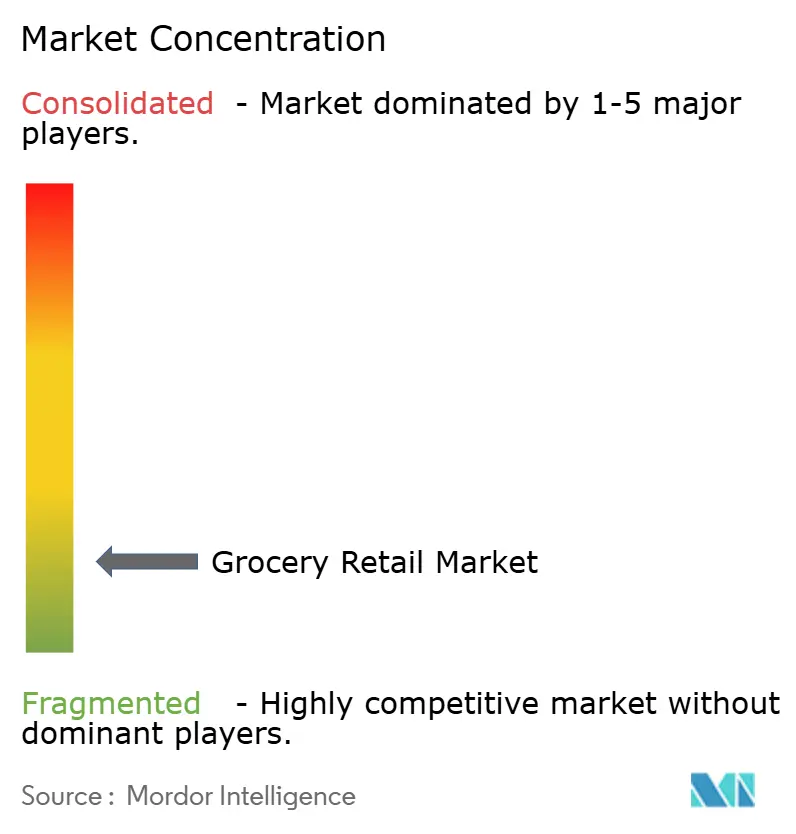
| Market Concentration | Low |
Major Players *Disclaimer: Major Players sorted in no particular order Image © Mordor Intelligence. Reuse requires attribution under CC BY 4.0. | |
Grocery Retail Market Analysis by Mordor Intelligence
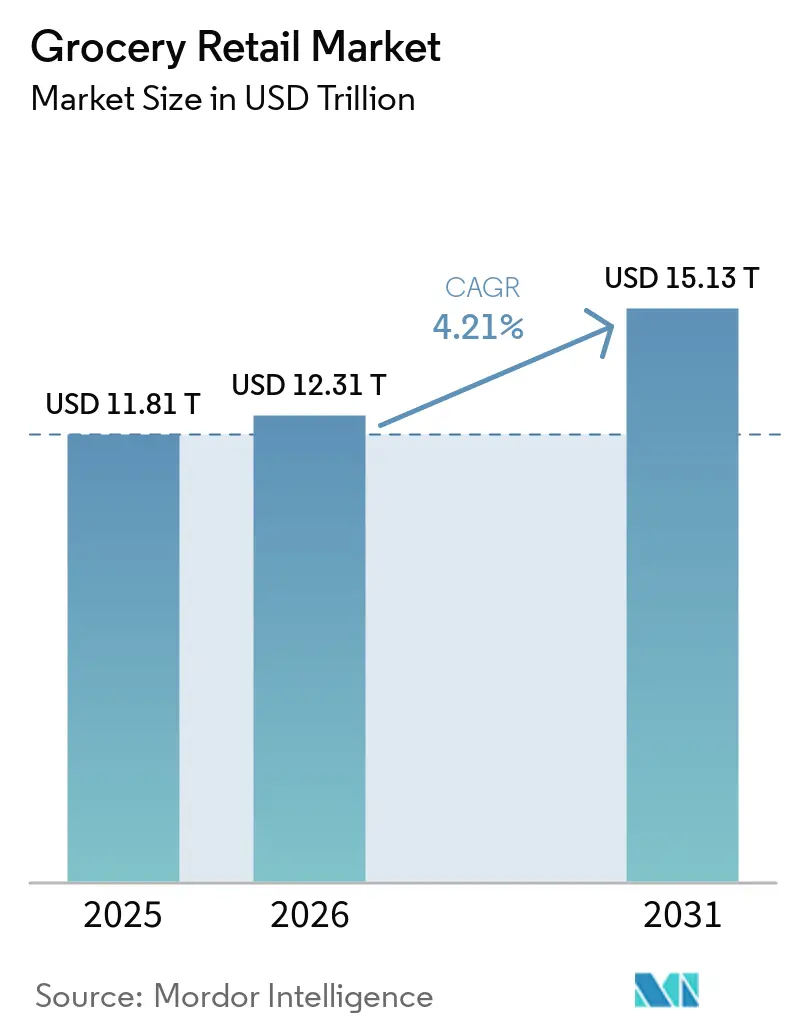
The Global Grocery Retail Market was valued at USD 11.81 trillion in 2025 and is estimated to grow from USD 12.31 trillion in 2026 to reach USD 15.13 trillion by 2031, at a CAGR of 4.21% during the forecast period (2026–2031). The market continues to grow as food remains a non-discretionary part of household spending, keeping demand stable even when consumer budgets are under pressure. In February 2026, consumer spending on groceries averaged USD 169 per household per week in the United States, reflecting the category's daily importance and the resilience of recurring demand[1]Food Industry Association, “Food Industry Facts,” FMI, fmi.org. Retailers are reshaping their operations with digital ordering, same-day fulfillment, private-label growth, and store modernization becoming core priorities. Companies that manage data, fulfillment, and pricing with greater discipline are protecting margins more effectively, while those with weaker digital and supply chain capabilities face greater competitive pressure. The market presents clear growth opportunities through fresh food, business buyers, and faster fulfillment models, while cost inflation, shrink, and labor intensity remain the primary constraints on performance.
Key Report Takeaways
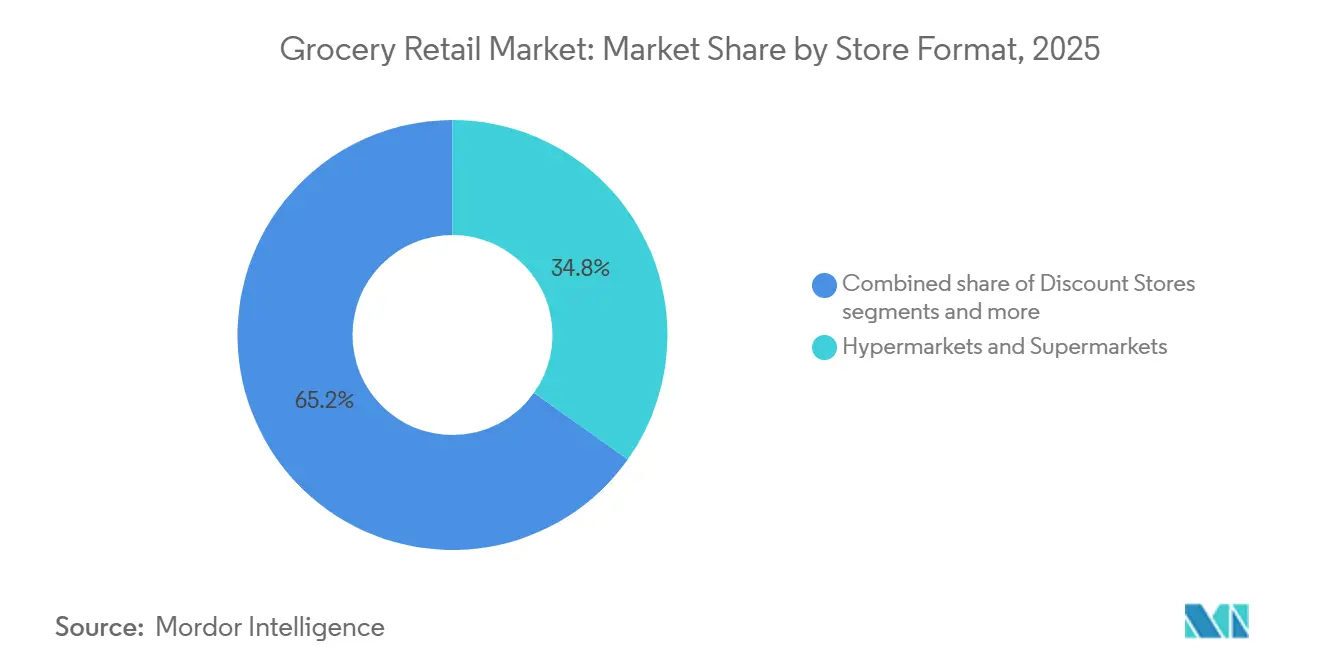
- By store format, Hypermarkets and Supermarkets commanded a 34.82% share of the Global Grocery Retail Market in 2025, while Online Grocery is projected to grow at the highest CAGR of 5.43% by 2031.
- By product type, Packaged Food accounted for a 30.31% share of the Global Grocery Retail Market in 2025, while Fresh Food is projected to grow at the highest CAGR of 6.21% by 2031.
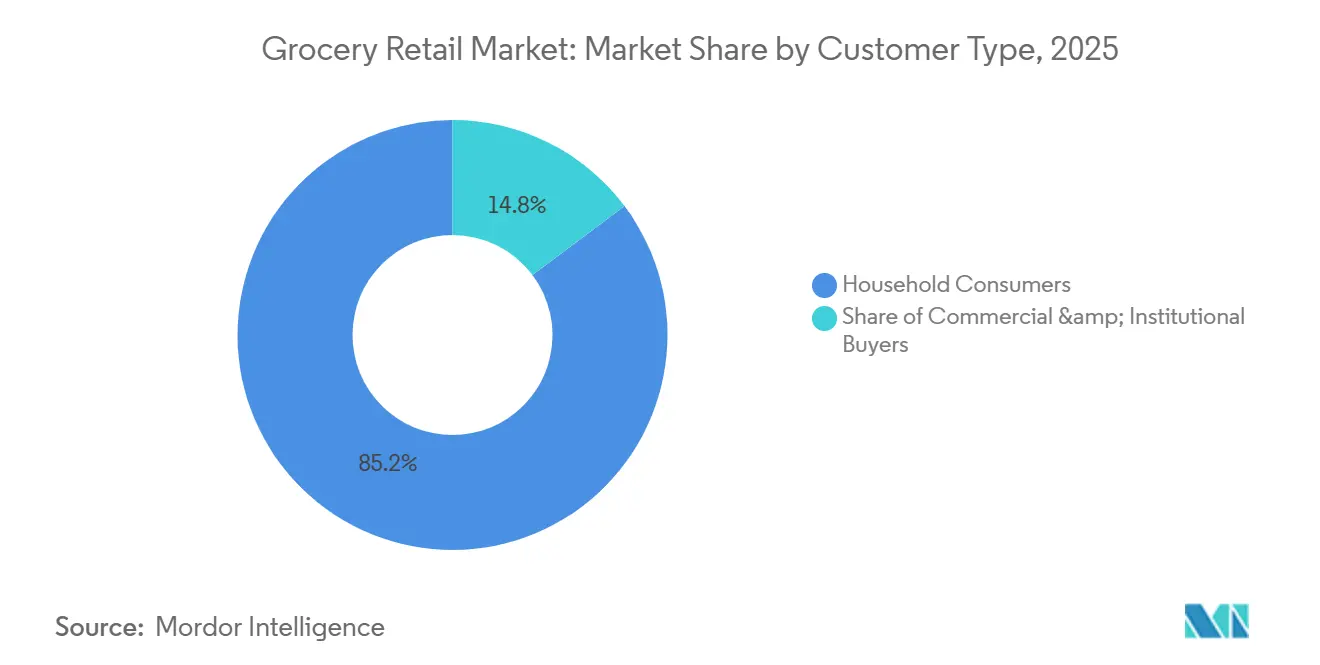
- By customer type, Household Consumers accounted for an 85.24% share of the Global Grocery Retail Market in 2025, while Commercial and Institutional Buyers are projected to grow at the highest CAGR of 5.12% by 2031.
- By geography, Asia-Pacific commanded a 40.14% share of the Global Grocery Retail Market in 2025 and is also projected to grow at the highest CAGR of 5.97% by 2031.
Note: Market size and forecast figures in this report are generated using Mordor Intelligence’s proprietary estimation framework, updated with the latest available data and insights as of January 2026.
Global Grocery Retail Market Trends and Insights
Drivers Impact Analysis*
| Driver | (~) % Impact on CAGR Forecast | Geographic Relevance | Impact Timeline |
|---|---|---|---|
| Omnichannel Grocery Adoption and Rapid Delivery Expansion | +1.0% | Global, strongest in North America, Western Europe, and the Asia-Pacific | Medium term (2-4 years) |
| Private Label Penetration and Margin Expansion | +0.7% | Global, led by North America and Europe | Medium term (2-4 years) |
| Data-Driven Assortment and Pricing Optimization | +0.4% | Global, early-mover advantage in North America and Europe | Short term (≤ 2 years) |
| Emerging Market Formalization and Modern Trade Penetration | +0.8% | Asia-Pacific core, with spillover to South America, the Middle East, and Africa | Long term (≥ 4 years) |
| Shrink Reduction Through Automated Inventory and Loss Prevention | +0.3% | Global, stronger adoption in North America and Europe | Short term (≤ 2 years) |
| Health, Wellness, and Premium Fresh Food Demand | +0.5% | Global, led by North America, Asia-Pacific, and Europe | Medium term (2-4 years) |
| Source: Mordor Intelligence | |||
Omnichannel Grocery Adoption and Rapid Delivery Expansion
The global grocery retail market is shifting toward an operating model in which customers expect stores, apps, pickup, and delivery to function as a single connected service. Walmart's United States e-commerce business reached a significant share of total domestic sales in 2025 and turned profitable for the first time, indicating that scale is beginning to improve digital economics in the market. Tesco's Whoosh rapid-delivery service recorded strong growth in FY2025/26 and expanded coverage to most households in the United Kingdom, demonstrating that rapid fulfillment is becoming a standard part of grocery shopping rather than a niche service[2]Tesco PLC, “Preliminary Results 2025/26,” Tesco PLC, tescoplc.com. Ahold Delhaize reported a notable rise in United States online sales at constant exchange rates in Q1 2026, with a large share of those orders fulfilled via same-day delivery, reflecting growing customer acceptance of faster fulfillment models. Retailers that own or tightly manage fulfillment, inventory visibility, and customer data are building stronger repeat demand and a more defensible cost base.
Private Label Penetration and Margin Expansion
Private label remains one of the clearest margin and value levers in the global grocery retail market. Store brand dollar sales in the United States reached USD 282.8 billion in 2025, and PLMA reported that store brands accounted for nearly half of all dollar sales gains in the United States retailing that year[3]Private Label Manufacturers Association, “Store Brands, A Bright Beacon,” PLMA, plma.com. This indicates that private label supports both customer value perception and retailer growth. Private label gives retailers greater control over pricing, assortment, and gross margin simultaneously. It also enables operators to respond more quickly when branded input costs rise, or shoppers become more price-conscious. In the global grocery retail market, strong private label programs are no longer purely defensive tools; they are becoming central to loyalty, basket building, and category management.
Data-Driven Assortment and Pricing Optimization
The global grocery retail market is increasingly relying on data-driven decisions in assortment, replenishment, and customer targeting. Tesco delivered nearly 100 million personalized Clubcard offers to 1.5 million customers since March 2026, demonstrating how retailers are using loyalty data to improve offer relevance rather than relying solely on broad discounts. Albertsons completed the rollout of Afresh's AI-powered fresh replenishment solution across all fresh departments in more than 2,200 stores in October 2025, reflecting a broader push toward more accurate ordering and lower inventory waste. Ahold Delhaize's continued double-digit online growth in the United States further highlights the value of improved order orchestration, availability management, and same-day delivery execution. Better pricing and assortment decisions not only lift sales but also reduce markdowns, improve inventory turns, and help retailers protect margins in a price-transparent environment.
Emerging Market Formalization and Modern Trade Penetration
The global grocery retail market retains significant potential for formalization across emerging economies, particularly where traditional food purchasing remains dominant and organized retail penetration is still developing. Asia is expected to record the largest absolute grocery volume growth globally through 2030, projected to reach USD 4.6 trillion at a 5% CAGR, indicating that scale growth will continue to originate from this part of the market. Traditional trade is still expected to account for 72% of incremental sales in Asia, meaning modern retail expansion is occurring alongside legacy channels rather than replacing them. As a result, store networks, digital ordering, payments, and supply chains will need to function across both formal and informal structures for several years. The extended growth runway in emerging economies supports sustained market expansion, but operators will need locally relevant formats, affordable fulfillment, and reliable cold-chain execution to convert that opportunity into durable market share.
Restraints Impact Analysis*
| Restraint | (~) % Impact on CAGR Forecast | Geographic Relevance | Impact Timeline |
|---|---|---|---|
| Thin Operating Margins and High Labor Intensity | -0.7% | Global, acute in North America and Europe | Short term (≤ 2 years) |
| Perishability, Waste, and Cold Chain Cost Pressure | -0.4% | Global, severe in the Asia-Pacific, the Middle East, and Africa | Medium term (2-4 years) |
| Rent, Energy, and Distribution Cost Inflation | -0.5% | North America, Europe, and the Asia-Pacific | Short term (≤ 2 years) |
| Pricing Transparency and Low Switching Costs Intensify Competition | -0.3% | Global, acutest in mature markets | Short term (≤ 2 years) to medium term (2-4 years) |
| Source: Mordor Intelligence | |||
Thin Operating Margins and High Labor Intensity
The grocery retail market remains one of the most margin-constrained segments of consumer commerce. FMI reported that average food retail net profit was 1.7% in 2024, leaving little room for operators to absorb labor inflation, transport increases, or food cost volatility without adjusting store operations. Kroger's Q1 2026 results showed gross margin declining from 23.0% to 22.7% year over year, driven by higher transportation costs, egg deflation, and planned labor investment, illustrating how quickly margins can tighten in this market. FMI also noted that self-checkout accounted for 35% of all transactions in United States supermarkets in 2024, indicating that automation has become a necessity for many operators seeking to manage labor costs. Larger retailers can invest in automation and scheduling tools, while smaller chains face the same cost pressures with less capacity to make equivalent investments.
Perishability, Waste, and Cold Chain Cost Pressure
Perishability remains a structural constraint on margin expansion in the global grocery retail market. The University of Portsmouth and ECR Retail Loss estimated that the hidden cost of unsold and surplus food reaches EUR 90 billion (USD 98.1 billion) annually, with related costs absorbing up to 1.8% of sales revenue. Avery Dennison reported in 2026 that reducing food waste across the global retail supply chain represents a USD 540 billion annual value opportunity, indicating the extent of financial leakage within everyday operations[4]University of Portsmouth, “New Research Reveals the Hidden Cost of Managing Unsold and Surplus Food,” University of Portsmouth, port.ac.uk. A 2025 Sustainability study on fresh food markdowns further showed that discounting alone does not resolve the problem, as poor timing and weak forecasting continue to erode profits. Cold-chain control, replenishment accuracy, and expiry tracking remain unevenly deployed across the global grocery retail market, keeping waste-related cost pressure elevated.
*Our forecasts treat driver/restraint impacts as directional, not additive. The impact forecasts reflect baseline growth, mix effects, and variable interactions.
Segment Analysis
By Store Format: Discounters and Digital Channels Are Reshaping the Mix
Hypermarkets and supermarkets retained their position as the largest format in the global grocery retail market, accounting for 34.82% of global revenue in 2025. This reflects their store density, broad product assortment, and the continued role of weekly stock-up shopping in many countries. Online grocery is the fastest-growing format, with a projected CAGR of 5.43% through 2031, indicating that digital convenience is capturing a growing share of the global grocery retail market. Physical formats are not losing relevance, as major operators continue to invest in stores, remodels, and local fulfillment. Walmart's plans for more than 650 store remodels, and approximately 20 new stores through 2026 and early 2027, demonstrate that physical capacity remains central to how major players compete in this market.
Online grocery is projected to expand at a CAGR of 5.43% through 2031 as shoppers shift more routine and urgent purchases to digital channels. Tesco's Whoosh service crossed GBP 400 million (USD 508 million) in sales in FY2025/26, reflecting the growing role of rapid delivery in meeting fill-in and convenience-driven demand. Ahold Delhaize's same-day fulfillment model accounted for more than 90% of its United States online sales in Q1 2026, underscoring the importance of delivery speed as a competitive requirement. Traditional and convenience formats continue to serve an important role by addressing proximity needs and smaller basket sizes, particularly in markets where local shopping remains entrenched. The grocery retail market is moving toward a blended format, where store networks, click-and-collect, and same-day delivery complement rather than compete with one another.



By Product Type: Fresh Food Gains Momentum While Packaged Food Holds Scale
Packaged Food accounted for 30.31% of the Global Grocery Retail Market in 2025, making it the largest product segment. Its dominant position is supported by a longer shelf life, broad brand coverage, easier logistics, and strong private-label participation across everyday categories. Fresh Food is projected to grow at the fastest CAGR of 6.21% by 2031, driven by increasing consumer demand for healthier, minimally processed, and locally sourced products. This growth is driven by rising interest in minimally processed food, greater health awareness, and increased retailer focus on the fresh perimeter. The Organic Trade Association reported that organic fresh produce reached USD 22.7 billion in 2025, reflecting strong demand that fresh categories can generate when quality, nutrition, and trust are clearly communicated to shoppers.
Fresh food is also becoming more operationally manageable as retailers improve forecasting and replenishment. The OTA's 2026 report showed stronger organic growth in categories such as baby food and formula, dried beans and vegetables, and organic beef, indicating that demand is spreading across multiple nutrition-linked subcategories. PLMA reported that refrigerated private-label products grew 6.1% in dollar sales in 2025, suggesting shoppers are increasingly accepting retailer-owned offerings in fresh-adjacent categories. Albertsons' full rollout of Afresh across bakery, deli, meat, seafood, and produce demonstrates that fresh food growth is increasingly tied to better inventory management and reduced waste. Packaged food will remain the largest segment in terms of scale, but fresh food is becoming a stronger driver of store traffic, differentiation, and long-term category mix improvement.
By Customer Type: Household Demand Dominates While Institutional Buying Builds
Household consumers accounted for the largest share of value in 2025, at 85.24%, making them the dominant customer segment in the global grocery retail market. This position remains stable because food purchasing is routine and frequent, and is distributed across all income groups. FMI reported that United States households spent an average of USD 169 per week on groceries in February 2026. FMI also reported that the average online grocery basket was USD 108 in 2024, compared with an in-store basket of USD 45.70, indicating that digital household purchases tend to involve larger, planned transactions. Household demand continues to drive volume, but the way households distribute spending across store visits, pickup, and delivery is changing store economics and fulfillment priorities.
Commercial and institutional buyers are projected to grow at a 5.12% CAGR by 2031, making them the fastest-growing customer segment in the global grocery retail market. This segment includes foodservice operators, workplace cafeterias, healthcare facilities, and hospitality buyers, all of which are increasingly adopting digital procurement and replenishment processes. Sysco's announced USD 29.1 billion acquisition of Jetro Restaurant Depot in March 2026 highlights the growing importance of the cash-and-carry and B2B channel for large food distribution companies. As business buyers prioritize reliable availability and streamlined ordering, the distinction between foodservice supply and the broader grocery retail market is becoming less defined, positioning institutional demand as an important growth driver.
Geography Analysis
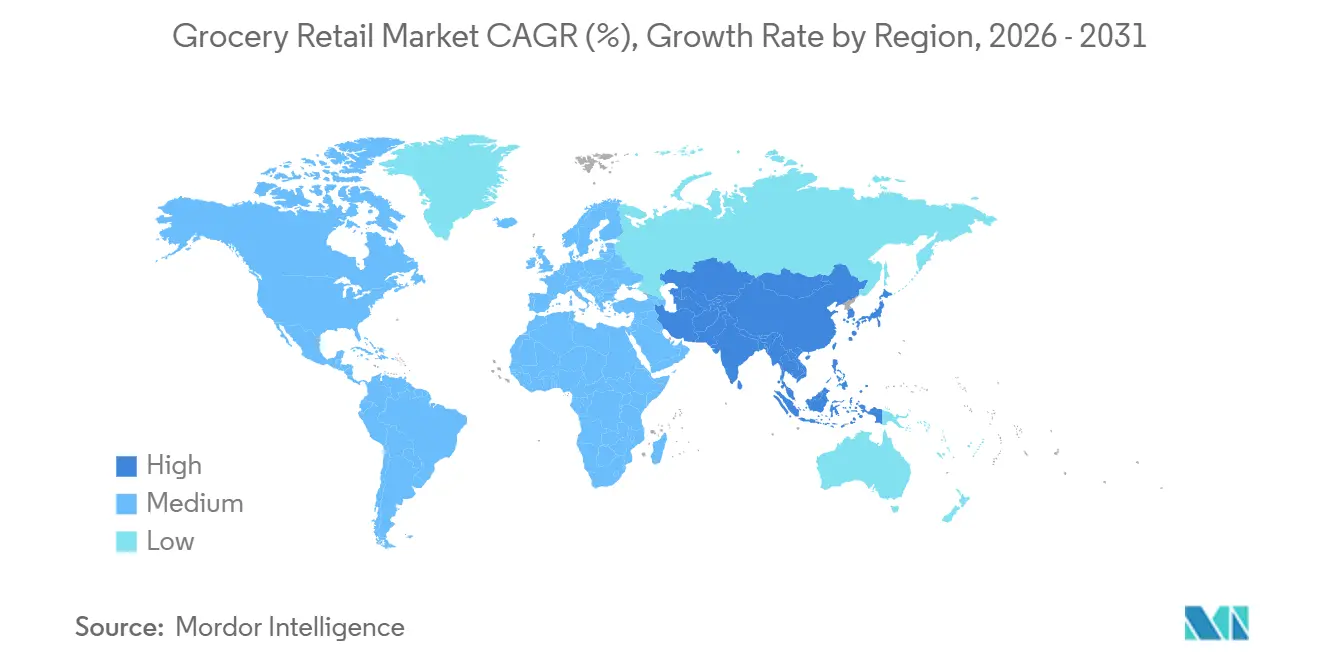
Asia-Pacific accounted for 40.14% of the Global Grocery Retail Market in 2025 and is also projected to grow at the highest CAGR of 5.97% by 2031. IGD expects the region to reach USD 4.6 trillion by 2030 at a 5% CAGR, with traditional trade accounting for 72% of incremental sales. Growth is driven not only by scale but also by gradual channel formalization, improved distribution, and more consistent digital access.
North America is experiencing more channel change than pure consumption expansion. Supermarkets held a 34.2% channel share, while online grocery is projected to grow at a 10.6% CAGR and reach 11.4% of channel share by 2030. Store remodel programs expanded physical networks, and a 3.2% food-at-home inflation forecast for 2026 reflects the growing importance of price architecture, private label, and omnichannel fulfillment.
Europe's grocery retail market is growing in a disciplined, cost-sensitive environment. Germany's food retail revenue grew 3.4% in 2025, and major operators have announced significant investment and store expansion plans. In South America, Carrefour's plan targets 70 additional Atacadão stores in Brazil by 2030, taking the network to 455 stores. Across both regions, the market is shaped by format efficiency, price pressure, and selective expansion in scalable formats.

Competitive Landscape
The global grocery retail market is highly fragmented, with competition spread across multinational retailers, regional supermarket chains, discount grocers, warehouse clubs, and digital-first grocery platforms. No single player dominates the market globally. Competition is centered on omnichannel retailing, private-label expansion, supply chain efficiency, and the use of customer data to improve loyalty and purchasing behavior. Retailers are integrating physical stores with digital platforms to improve convenience, optimize fulfillment, and deliver personalized shopping experiences. Investments in store modernization, automation, and data-driven promotions are strengthening customer engagement while improving operational efficiency.
The competitive landscape is evolving through acquisitions, partnerships, and selective geographic expansion, enabling companies to broaden market presence, diversify retail formats, and strengthen distribution capabilities. Discount retailing, warehouse formats, and value-focused grocery models continue to gain traction as consumers prioritize affordability and convenience. Retailers are also investing in same-day delivery, click-and-collect services, and advanced inventory management to improve service quality and operational resilience. Competitive success in the global grocery retail market will increasingly depend on balancing cost efficiency, digital innovation, supply chain resilience, and personalized customer experiences, while maintaining strong product availability and value-driven offerings.
Grocery Retail Industry Leaders
Walmart Inc.
Costco Wholesale Corporation
Schwarz Group
Aldi Einkauf SE and Co. oHG
Carrefour S.A.
- *Disclaimer: Major Players sorted in no particular order

Recent Industry Developments
- April 2026: Lidl GB announced a major investment to open over 50 new stores within 12 months, creating nearly 2,000 jobs. This expansion follows the retailer's 33-month streak as the United Kingdom's fastest-growing supermarket, with initial store openings planned for Abbots Langley, Warrington, and Thornbury.
- April 2026: Empire Company Limited (parent company of Sobeys) announced an agreement to acquire Mayrand Food Group Inc., a Quebec-based cash-and-carry/warehouse retailer operating multiple large-format locations in Greater Montreal, entering the Quebec discount and warehouse food segment.
- April 2026: Walmart announced plans to remodel hundreds of Supercenters and Neighborhood Market stores and open approximately 20 new stores through 2026 and early 2027. This builds on its commitment to open or convert new locations over a five-year period.
- March 2026: Sysco Corporation announced a definitive agreement to acquire Jetro Restaurant Depot in a transaction valued at approximately USD 29.1 billion, marking Sysco's entry into the cash-and-carry foodservice channel.


Global Grocery Retail Market Report Scope
| Hypermarkets and Supermarkets |
| Convenience Stores |
| Discount Stores |
| Online Grocery Retail |
| Traditional Grocery Stores |
| Other Store Formats (Cash-and-Carry, Warehouse Clubs, etc.) |
| Packaged Food |
| Fresh Food |
| Beverages |
| Dairy and Frozen Products |
| Personal Care and Household Products |
| Other Product Types |
| Household Consumers |
| Commercial & Institutional Buyers |
| North America | United States |
| Canada | |
| Mexico | |
| South America | Brazil |
| Peru | |
| Chile | |
| Argentina | |
| Rest of South America | |
| Europe | United Kingdom |
| Germany | |
| France | |
| Spain | |
| Italy | |
| BENELUX (Belgium, Netherlands, and Luxembourg) | |
| NORDICS (Denmark, Finland, Iceland, Norway, and Sweden) | |
| Rest of Europe | |
| Asia-Pacific | India |
| China | |
| Japan | |
| Australia | |
| South Korea | |
| South East Asia (Singapore, Malaysia, Thailand, Indonesia, Vietnam, and Philippines) | |
| Rest of Asia-Pacific | |
| Middle East and Africa | United Arab Emirates |
| Saudi Arabia | |
| South Africa | |
| Nigeria | |
| Rest of Middle East and Africa |
| By Store Format | Hypermarkets and Supermarkets | |
| Convenience Stores | ||
| Discount Stores | ||
| Online Grocery Retail | ||
| Traditional Grocery Stores | ||
| Other Store Formats (Cash-and-Carry, Warehouse Clubs, etc.) | ||
| By Product Type | Packaged Food | |
| Fresh Food | ||
| Beverages | ||
| Dairy and Frozen Products | ||
| Personal Care and Household Products | ||
| Other Product Types | ||
| By Customer Type | Household Consumers | |
| Commercial & Institutional Buyers | ||
| By Geography | North America | United States |
| Canada | ||
| Mexico | ||
| South America | Brazil | |
| Peru | ||
| Chile | ||
| Argentina | ||
| Rest of South America | ||
| Europe | United Kingdom | |
| Germany | ||
| France | ||
| Spain | ||
| Italy | ||
| BENELUX (Belgium, Netherlands, and Luxembourg) | ||
| NORDICS (Denmark, Finland, Iceland, Norway, and Sweden) | ||
| Rest of Europe | ||
| Asia-Pacific | India | |
| China | ||
| Japan | ||
| Australia | ||
| South Korea | ||
| South East Asia (Singapore, Malaysia, Thailand, Indonesia, Vietnam, and Philippines) | ||
| Rest of Asia-Pacific | ||
| Middle East and Africa | United Arab Emirates | |
| Saudi Arabia | ||
| South Africa | ||
| Nigeria | ||
| Rest of Middle East and Africa | ||


Key Questions Answered in the Report
What is the current size of the Global Grocery Retail Market?
The Global Grocery Retail Market size is USD 12.31 trillion in 2026 and is projected to reach USD 15.13 trillion by 2031, at a 4.21% CAGR.
Which region leads the Global Grocery Retail Market?
Asia-Pacific leads with a 40.14% share in 2025 and is also the fastest-growing region, with a projected 5.97% CAGR through 2031.
Which store format is growing the fastest in grocery retail?
Online grocery is the fastest-growing store format, with a projected 5.43% CAGR through 2031, supported by delivery, pickup, and faster fulfillment models.
Which product category is expanding the fastest?
Fresh food is the fastest-growing product segment, with a 6.21% CAGR through 2031, supported by stronger demand for fresh, organic, and nutrition-focused items.
Why are private labels becoming more important for retailers?
Private label supports both value and margin. United States store brand sales reached USD 282.8 billion in 2025, and PLMA said store brands accounted for 47% of all dollar sales gains in the United States retailing that year.
What is the biggest challenge for grocery retailers today?
Thin margins remain the main issue. FMI reported average food retail net profit at only 1.7% in 2024, while labor, transport, waste, and inflation continue to pressure earnings.
Page last updated on:


 Your data is secure and never sold or shared.


