
Emotion Analytics Market Size and Share
Market Overview
| Study Period | 2020 - 2031 |
|---|---|
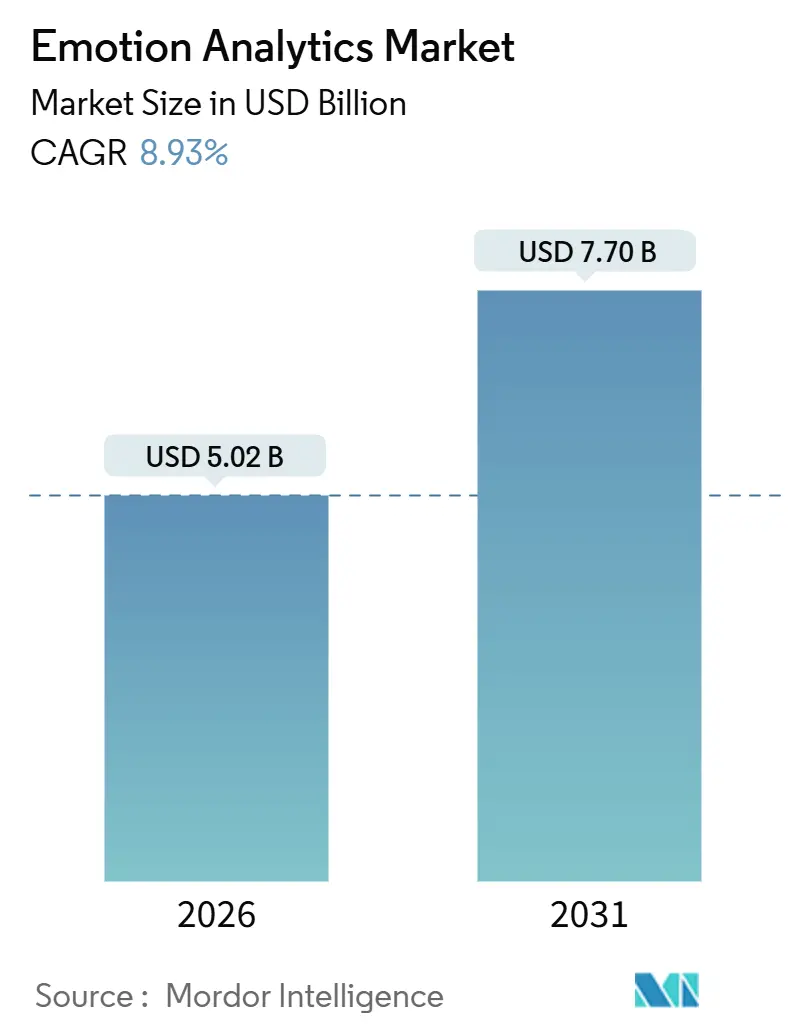
| Market Size (2026) | USD 5.02 Billion |
| Market Size (2031) | USD 7.70 Billion |
| Growth Rate (2026 - 2031) | 8.93 % |
| Fastest Growing Market | Asia Pacific |
| Largest Market | North America |
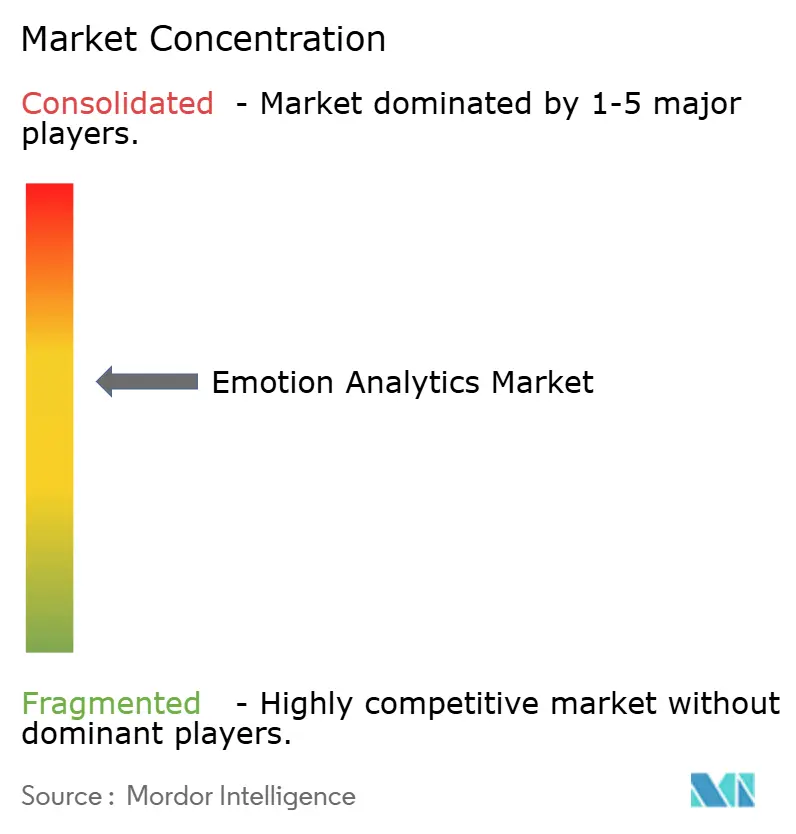
| Market Concentration | Medium |
Major Players *Disclaimer: Major Players sorted in no particular order Image © Mordor Intelligence. Reuse requires attribution under CC BY 4.0. | |
Emotion Analytics Market Analysis by Mordor Intelligence
The Emotion Analytics Market size is estimated at USD 5.02 billion in 2026, and is expected to reach USD 7.70 billion by 2031, at a CAGR of 8.93% during the forecast period (2026-2031).
Momentum reflects enterprises moving from one-dimensional sentiment tagging toward real-time, multimodal inference that fuses facial micro-expressions, voice prosody, bio-signals, and text sentiment. Mandatory driver-monitoring regulations in automotive cabins, coupled with measurable gains in contact-center time-to-resolution, have accelerated purchase decisions. Cloud deployment still dominates but sovereignty, latency, and bandwidth economics are steering the shift toward edge and on-device processing, especially where millisecond safety alerts are critical. Vendors able to embed privacy-preserving learning or homomorphic encryption are positioned to capture European demand amid stringent biometric rules.
Key Report Takeaways
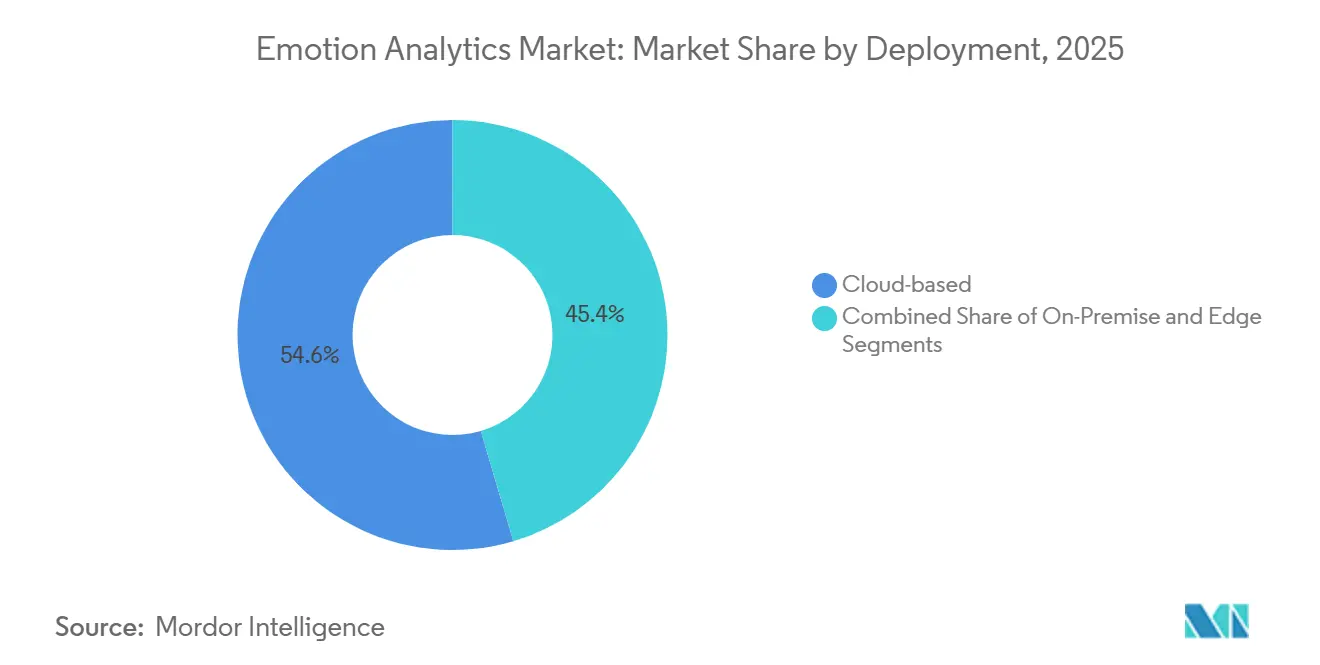
- By deployment, cloud-based solutions accounted for 54.57% of the emotion analytics market share in 2025, while edge and on-device inference is projected to advance at a 10.11% CAGR to 2031.
- By component, software platforms held 45.72% of the emotion analytics market size in 2025, whereas hardware modules will post the fastest 9.43% CAGR through 2031.
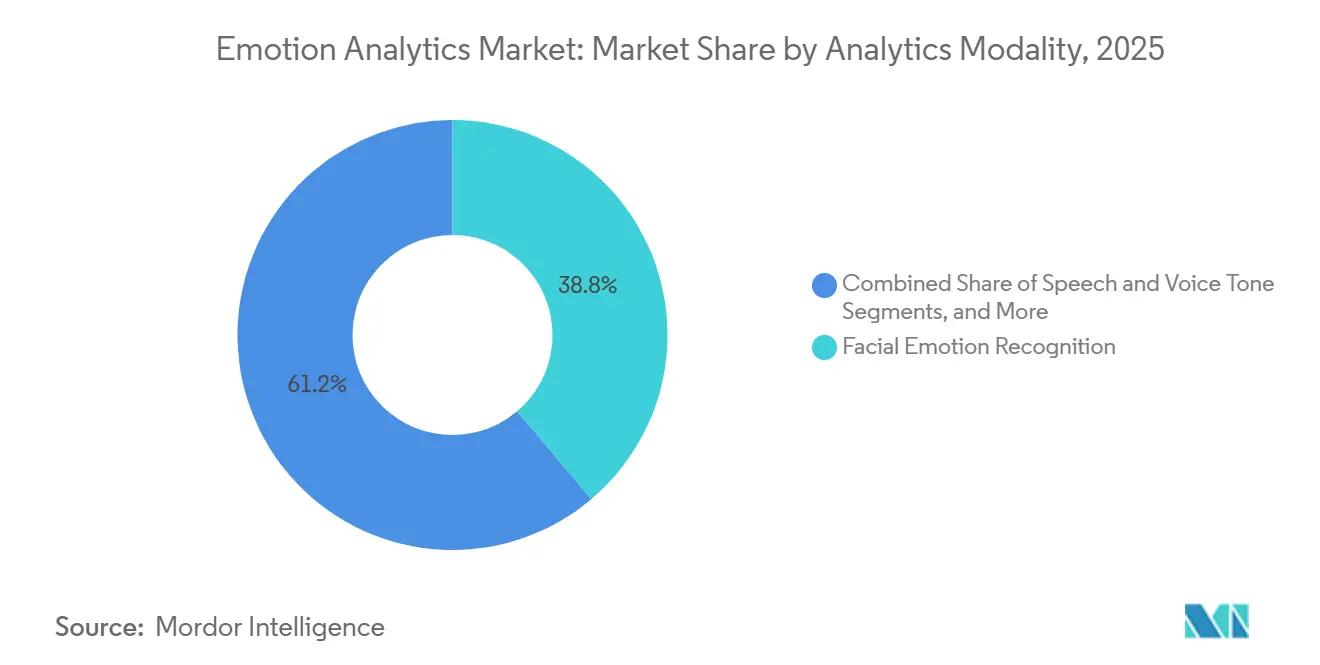
- By modality, facial emotion recognition commanded 38.82% of revenue in 2025; biosignal-driven multimodal systems will expand at a 10.96% CAGR.
- By application, customer service and contact centers captured 55.47% share in 2025, yet healthcare and well-being use cases are forecast to grow at 9.08% CAGR to 2031.
- By geography, North America led with 36.64% share in 2025, while Asia-Pacific is expected to log an 11.61% CAGR through 2031.
Note: Market size and forecast figures in this report are generated using Mordor Intelligence’s proprietary estimation framework, updated with the latest available data and insights as of January 2026.
Market Trends and Insights
Drivers Impact Analysis of Emotion Analytics Market*
| Driver | (~) % Impact on CAGR Forecast | Geographic Relevance | Impact Timeline |
|---|---|---|---|
| Proliferation of IoT wearables and smart devices | +2.8% | Global | Medium term (2-4 years) |
| Advances in deep-learning-based computer vision and natural language processing | +3.2% | Global | Medium term (2-4 years) |
| Demand for hyper-personalised customer engagement tools | +2.5% | North America and Europe | Short term (≤ 2 years) |
| Regulatory mandate for driver-monitoring systems (EU GSR 2024) | +1.8% | Europe | Short term (≤ 2 years) |
| Emergence of empathetic AI in tele-mental-health platforms | +1.5% | Global | Medium term (2-4 years) |
| Edge-compute frameworks for privacy-preserving analytics | +2.0% | Global | Long term (≥ 4 years) |
| Source: Mordor Intelligence | |||
Proliferation of IoT Wearables and Smart Devices
Wearable emotion-sensing hardware has scaled from laboratory prototypes to enterprise rollouts, exemplified by the Emotiv EPOC X, a 14-channel electroencephalography headset priced at USD 999 that now ships for workplace stress audits and user experience trials.[1]Emotiv Inc., “Emotiv Epoc X,” emotiv.com The BIOPAC Research Ring combines galvanic skin response, photoplethysmography, electrocardiogram, temperature, and accelerometer streams into a single form factor, delivering continuous affect tracking without chest straps or facial cameras. A December 2025 Nature Scientific Data paper introduced the LLaMAC dataset that fuses Epoc-X and Empatica E4 signals with synchronized video and audio to train multimodal emotion models. Physiological signals, such as heart rate variability and skin conductance, exhibit greater cross-population consistency than facial cues, thereby reducing demographic bias. On-device inference further limits latency and data-leak risk by removing the need to stream raw biosignals to cloud servers.
Advances in Deep-Learning-Based Computer Vision and Natural Language Processing
Transformer architectures and self-supervised pre-training have reduced the need for labeled data, allowing vendors to fine-tune foundation models on call-center audio, clinical interviews, or in-cabin driver videos with far fewer annotations than their convolutional predecessors.[2]Google LLC, “Contact Center AI Insights,” cloud.google.com Google Cloud’s Conversational Insights surfaces sentiment, intent, and escalation cues from live audio, while Microsoft Azure AI offers pre-built sentiment APIs that parse text, speech, and video, reducing barriers for firms lacking machine-learning staff. Real-time emotion routing lowers handle time and boosts throughput in contact centers, turning potential churn into loyalty gains. Text analysis also tracks brand perception across social media, product reviews, and surveys within minutes. Together, these advances extend affective computing from isolated pilots to routine business workflows.
Demand for Hyper-Personalized Customer Engagement Tools
Companies recognize that generic journeys miss revenue, so emotion signals now trigger dynamic content, offers, and service escalation inside customer-relationship-management and marketing-automation suites. Retail banks use sentiment-aware chatbots that transfer distressed users to human agents before abandonment, while e-commerce sites adjust recommendations as engagement fluctuates during browsing. By layering affect data on click streams and purchase history, marketers gain causal insight into cart abandonment and feature-trial outcomes. User-experience teams pair eye-tracking, facial coding, and galvanic skin response to locate friction points, shortening iteration cycles. These practices lift conversion, retention, and lifetime value across digital channels.
Regulatory Mandate for Driver-Monitoring Systems (EU GSR 2024)
European Union Regulation 2019/2144 requires driver drowsiness and distraction warnings for all new vehicle types from July 2024 and for every newly registered vehicle from July 2026. United Nations Regulations 158 and 159 set performance criteria and are transposed into Commission Delegated Regulations 2023/1231 and 2023/1230. These rules require automakers to embed in-cabin cameras and infrared sensors that monitor gaze, blink rate, head pose, and facial microexpressions, issuing alerts when thresholds are breached. The mandate creates a captive installed base of tens of millions of sensor units each year, spurring tier-one suppliers to rapidly certify compliant systems. Similar harmonization discussions in Asia-Pacific and North America signal the formation of a global driver-monitoring ecosystem around hardware and inference software.
Restraints Impact Analysis of Emotion Analytics Market*
| Restraint | (~)% Impact on CAGR Forecast | Geographic Relevance | Impact Timeline |
|---|---|---|---|
| Stringent data-privacy regulations (GDPR, CPRA, etc.) | -1.5% | Global, with acute impact in Europe and North America | Short term (≤ 2 years) |
| Bias and accuracy issues in facial-emotion data sets | -1.2% | Global | Medium term (2-4 years) |
| High latency and bandwidth cost in real-time video analytics | -0.8% | Emerging markets in Asia-Pacific, Middle East, and Africa | Short term (≤ 2 years) |
| Ethical backlash against emotion surveillance in schools and workplaces | -0.6% | North America and Europe | Short term (≤ 2 years) |
| Source: Mordor Intelligence | |||
Stringent Data-Privacy Regulations (GDPR, CPRA, etc.)
General Data Protection Regulation Article 9 treats biometric inference as sensitive data, demanding explicit consent, purpose limitation, and strict retention windows. The California Privacy Rights Act imposes similar rules on biometric identifiers, adding deletion rights and algorithmic-decision explanations. The forthcoming European Union Artificial Intelligence Act will categorize school and workplace emotion analytics as high risk, requiring conformity assessments and post-market monitoring.[3]European Commission, “Regulation (EU) 2019/2144,” europa.eu Compliance overhead raises deployment costs and delays procurement for small firms. Privacy-preserving tools such as federated learning and homomorphic encryption mitigate exposure but add latency and compute expense, slowing global rollouts.
Bias and Accuracy Issues in Facial-Emotion Data Sets
Audits show higher error rates for darker-skinned individuals and women, exposing demographic bias in commercial classifiers. A 2024 study found misclassifications in non-Western cultural contexts where emotional norms differ from Western-centric training data. Researchers also report low agreement on subtle states, such as polite versus genuine smiles, questioning the benchmark reliability. Such gaps pose legal and reputational risks in hiring, education, and mental-health use cases. Demand is rising for independent fairness tests and explainable artificial-intelligence dashboards that reveal confidence intervals and demographic performance splits.
*Our forecasts treat driver/restraint impacts as directional, not additive. The impact forecasts reflect baseline growth, mix effects, and variable interactions.
Emotion Analytics Market Segment Analysis
By Deployment:
Edge Inference Gains MomentumEdge and on-device deployment is projected to advance at a 10.11% CAGR between 2026 and 2031 as enterprises push inference closer to sensors to satisfy data-sovereignty mandates and millisecond-level latency targets. Cloud architectures still held 54.57% of the emotion analytics market share in 2025 thanks to elastic compute and centralized model updates. However, round-trip delays make cloud impractical for safety-critical driver monitoring or tele-mental-health sessions that require sub-second feedback. On-premise stacks appeal to banks and hospitals that ban biometric data egress, yet they demand capital outlays for local accelerators and skilled machine-learning staff.
Technical progress is lowering the hurdles to run models at the edge. The open-source BioGAP-Ultra platform, published in 2025, processes electroencephalography, electromyography, electrocardiogram, and photoplethysmography streams on low-power microcontrollers, proving that accurate emotion inference can run without cloud connectivity. Federated-learning toolkits let thousands of devices co-train a shared model while keeping raw data local, cutting bandwidth cost and helping firms comply with General Data Protection Regulation Article 9. As chip makers add neural-processing units to standard system-on-chip designs and model-compression methods shrink footprints, the economic gap between edge and cloud continues to close.



By Component:
Hardware Sensors AccelerateHardware sensors, including cameras, electroencephalography headsets, galvanic skin response rings, and electrocardiogram modules, are forecast to grow at a 9.43% CAGR through 2031, the fastest rate among all component groups. Software layers (software development kits, application programming interfaces, and managed dashboards) captured 45.72% of the emotion analytics market size in 2025, reflecting the early ease of spinning up cloud APIs. Service offerings that bundle integration and custom model training expand in parallel as buyers seek turnkey rollouts.
Regulation and wearable adoption explain hardware momentum. EU driver-monitoring rules push automakers to install infrared cameras in every new cabin. In healthcare and corporate wellness, the Emotiv Epoc X 14-channel electroencephalography headset ships with pre-trained stress and engagement metrics, lowering the entry bar for non-specialist teams.[4]Emotiv Inc., “Epoc X 14-Channel EEG Headset,” emotiv.com The BIOPAC Research Ring fuses galvanic skin response, photoplethysmography, electrocardiogram, temperature, and accelerometer streams in a finger-worn form factor, giving researchers a multimodal option when privacy policies restrict video capture. Ongoing sensor miniaturization and rising production volume are set to bring hardware from labs to consumer wearables and ambient-intelligence ceilings.
By Analytics Modality:
Bio-Signal Multimodal Systems SurgeFacial emotion recognition accounted for 38.82% of revenue in 2025, driven by mature computer vision pipelines and widespread camera infrastructure. Bio-signal multimodal systems that blend electroencephalography, electrocardiography, and galvanic skin response are projected to grow at a 10.96% CAGR, the fastest among modalities. Video-based multimodal engines add body language and scene context, while speech analysis captures pitch contour and energy patterns linked to arousal. Text sentiment models mine polarity and intent from written feedback across social channels and support tickets.
The outperformance of physiological fusion stems from bias mitigation and continuous coverage. Signals from the autonomic nervous system vary less across demographic groups than facial landmarks, trimming fairness gaps documented in many vision-only classifiers. Wearable biosensors also work in low-light or occluded settings such as vehicle cabins at night. The December 2025 LLaMAC corpus pairs Epoc X electroencephalography and Empatica E4 wrist data with synchronized video and audio, giving developers a large open dataset to train and benchmark multimodal fusion architectures. Because physiological data do not identify a person in the same way a face does, European privacy law treats them with fewer restrictions, easing consent workflows for longitudinal studies.
By Application:
Healthcare Leads GrowthCustomer service and contact centers accounted for 55.47% of revenue in 2025, after firms reported faster call resolution and higher customer satisfaction scores. Healthcare and well-being use cases are expected to rise at a 9.08% CAGR through 2031, making them the fastest-growing segment. Insurers, hospitals, and digital therapeutics providers deploy empathetic chatbots and remote-patient-monitoring dashboards that flag distress or therapy non-adherence in real time. Automotive and transportation applications benefit from mandated driver-state monitoring, while education pilots continue at a measured pace due to surveillance concerns.
Clinical validation is paving the way for reimbursement. A 2025 meta-analysis in JMIR Mental Health found conversational agents produced effect sizes of 0.62 for anxiety and 0.74 for depression, numbers that payers and regulators now cite when reviewing coverage requests. Platforms such as Woebot and Replika fine-tune large language models on psychotherapy transcripts to deliver round-the-clock coaching. The United States Food and Drug Administration convened expert panels in 2025 to draft guidance on software-as-a-medical-device for generative artificial intelligence, signaling that clear approval pathways are imminent. As reimbursement codes emerge, healthcare buyers gain the budget certainty needed to scale deployments.
Geography Analysis
North America and APAC Emotion Analytics Market
North America accounted for 36.64% of revenue in 2025, driven by early pilots, venture funding, and cloud credits from hyperscale providers. Asia-Pacific is projected to log an 11.61% CAGR through 2031, the steepest regional trajectory. China promotes emotion analytics within intelligent-vehicle programs and smart-city cameras, while Japan invests in eldercare robots that track affect to improve engagement. India’s business-process-outsourcing hubs embed sentiment dashboards into quality-assurance workflows, and South Korean electronics firms integrate mood-sensing capabilities into smartphones and televisions.
Europe Emotion Analytics Market
Europe is growing more slowly because vendors must demonstrate compliance with both the General Data Protection Regulation (Article 9) and the forthcoming Artificial Intelligence Act. Suppliers that package federated-learning pipelines and homomorphic encryption gain procurement preference.
The Americas, APAC and MEA Emotion Analytics Market
South America, the Middle East, and Africa report early pilots in retail, hospitality, and public safety, yet bandwidth and infrastructure gaps temper near-term contributions. Overall, the regional revenue mix is poised to diversify as the Asia-Pacific narrows the gap with North America over the forecast window.


Regulatory Landscape
Regulation is tightening around biometric and emotion inference, particularly in Europe. Regulation (EU) 2024/1689 (the EU Artificial Intelligence Act) entered into force on 1 August 2024, and its Article 5 prohibitions became applicable on 2 February 2025. These include restrictions on AI systems intended to infer emotions in workplace and educational settings (with exceptions for strictly medical or safety reasons). Alongside this, GDPR Article 9 governs special-category biometric processing, raising the bar for consent, purpose limitation, and retention across many emotion-analytics deployments.
Governance standards and compliance tooling are becoming procurement requirements. ISO/IEC 42005:2025, published in May 2025, provides an AI system impact assessment framework that vendors and enterprise buyers can use to document risk controls and accountability. Under the EU AI Act, non-compliance can trigger penalties up to EUR 35 million or 7% of global annual turnover, reinforcing the need for privacy-preserving architectures (such as on-device processing and federated learning) and clear product scoping that avoids prohibited use cases.
Value Chain Analysis
The value chain begins with data capture and signal generation, spanning cameras (including in-cabin infrared), microphones, and physiological sensors such as EEG, ECG, and GSR wearables. Outputs then move through preprocessing, labeling, and model training across cloud or edge compute stacks. Hyperscale infrastructure from providers such as AWS, Google, IBM, and Microsoft supports large-scale training and managed analytics, while specialist firms contribute domain models and multimodal fusion layers tailored to vertical needs like automotive driver monitoring, contact centers, and healthcare and well-being.
In downstream delivery, vendors provide SDKs/APIs, embedded on-device libraries, dashboards, and integration services that connect outputs to CRM, telehealth, or vehicle safety systems. Consolidation and platform bundling are shaping distribution. Smart Eye Group integrated Affectiva media analytics into iMotions to form a consolidated behavioral research unit, tightening the link between research-grade multimodal capture and production analytics. Hardware-software co-design partnerships and joint ventures, including emotion3D with DXC Technology for in-cabin stacks and NeuroSky with ZKTeco for a chip-plus-emotion-cloud BCI architecture, also point to end-to-end offerings aimed at controlling latency, privacy exposure, and certification readiness.
Competitive Landscape
Fragmentation defines the 2025 baseline, with no vendor holding double-digit global share as hyperscale cloud providers (Microsoft Azure AI, Google Cloud, Amazon Web Services, and IBM Watson) jostle with specialist pure plays such as Smart Eye Affectiva, Realeyes, Entropik Technologies, iMotions, and Cogito. Incumbents monetize distribution reach by bundling sentiment-analysis application programming interfaces into broader cloud suites, whereas pure plays lean on vertical datasets, proprietary biosensors, and domain expertise to win automotive, healthcare, or market-research contracts. Procurement teams increasingly weigh privacy engineering credentials and third-party bias audits alongside raw accuracy scores, a shift that favors suppliers willing to open model cards and demographic test results.
Platform expansion and partnership deals accelerated through 2025-2026. In January 2025, Affectiva and iMotions linked their facial-coding and physiological-signal toolkits, enabling user-experience researchers to use a synchronized multimodal workflow. Realeyes followed in October 2025 by optimizing its lightweight transformer library for Intel Movidius vision processors, cutting laptop power draw by 37% and opening a new consumer electronics channel. These moves illustrate three broader strategies: adding new modalities to create full-stack inference suites, vertical integration that marries hardware with algorithms, and silicon-level co-design to meet latency and thermal budgets in cars and wearables.
Open-source disruptors also exert competitive pressure. The BioGAP-Ultra modular edge artificial-intelligence platform, released as a 2025 preprint, lets startups spin up multimodal biosignal inference on low-power microcontrollers at negligible licensing cost. Buyers facing General Data Protection Regulation and California Privacy Rights Act obligations reward vendors that ship models capable of federated learning and homomorphic encryption, tilting demand toward privacy-preserving architectures. Because the five largest providers together controlled roughly 32% of 2025 revenue, analysts expect selective mergers and data-sharing alliances rather than winner-take-all dynamics, especially as regional regulations continue to fragment deployment requirements.
Emotion Analytics Industry Leaders
IBM Corporation
Affectiva Inc.
Clarifai Inc.
Sensum Co.
Realeyes OÜ
- *Disclaimer: Major Players sorted in no particular order
Emotion Analytics Market Companies Covered in this Report
- Affectiva Inc.
- Realeyes OU
- IBM Corporation
- Clarifai Inc.
- Sensum Ltd.
- Beyond Verbal Communication Ltd.
- Noldus Information Technology BV
- Sentiance NV
- Lexalytics Inc.
- Deloitte Touche Tohmatsu Ltd.
- Gorilla Technology Group Inc.
- Microsoft Corporation
- Google LLC
- Amazon Web Services Inc.
- Apple Inc.
- NEC Corporation
- Intel Corporation
- NVISO SA
- Sightcorp BV
- Kairos Inc.
- Entropik Technologies Pvt Ltd.
- iMotions A/S
- CrowdEmotion Ltd.
- Cogito Corporation

Market Opportunities and Future Outlook
Regulatory boundaries are creating whitespace for vendors that can clearly distinguish prohibited settings from permitted ones, and for those that package compliance as a product capability. With the EU AI Act prohibitions applicable from 2 February 2025 and full application scheduled for 2 August 2026, opportunities concentrate in medical and safety exceptions (for example, driver monitoring and certain clinical or well-being workflows). There is also demand for enterprise deployments built around explicit consent, short retention windows, and impact-assessment documentation. ISO/IEC 42005:2025 offers a structured pathway for vendors to standardize AI impact assessments, which helps buyers operationalize governance across multimodal emotion models.
Buying criteria are shifting toward privacy-first and low-latency architectures, which increases the scope for edge and on-device inference, model compression, and federated learning toolchains that keep raw biometrics local. Evidence of this shift includes iMotions releasing an Affectiva Emotion SDK for Android to enable on-device facial expression and emotion analysis for mobile applications. In parallel, open multimodal resources such as the December 2025 LLaMAC corpus (EEG and wrist-worn physiology synchronized with video and audio) lower development friction for biosignal-driven multimodal systems, supporting healthcare and well-being use cases and improving robustness relative to vision-only pipelines.
Recent Industry Developments in Emotion Analytics Market
- May 2026: iMotions released the Affectiva Emotion SDK for Android, enabling on-device facial expression and emotion analysis for mobile applications. The release supports privacy-first deployments by reducing dependence on streaming video to the cloud, aligning product delivery with stricter biometric processing expectations in regulated environments. It also broadens the addressable base to smartphone-led workflows in research, customer experience, and lightweight field studies.
- May 2026: Nihilent secured a patent from the South African Patent Office for its Emoscape emotion detection framework, which analyzes upper-body micro-movements using standard web cameras. The patent milestone strengthens IP positioning around non-invasive approaches that can complement or substitute facial-only analytics in settings where face capture is constrained. It also indicates continued commercialization activity outside North America and Europe, where regulatory and buyer preferences vary by geography.
- October 2024: DAIVID announced an AI-powered solution that predicts attention, emotions, memory, and brand impact for advertising measurement, positioning the platform as a cross-media, multimodal analytics tool for campaign optimization. The announcement points to growing demand for multimodal performance claims and transparent metrics in media measurement.


Emotion Analytics Market Report Scope and Research Methodology
Market Definition and Coverage
This market covers tools and services that capture, interpret, and score human emotions from signals such as facial expressions, voice, text, video, and bio-signals, and then convert those outputs into decisions and insights used by organizations.
Scope exclusions: We exclude general-purpose BI and generic customer analytics that do not include an emotion-detection layer or emotion scoring output.
Segments Covered in This Report
- By Deployment
- On-Premise
- Cloud-based
- Edge/On-Device
- By Component
- Software (SDK/API)
- Hardware (Sensors/Camera)
- Services (Integration and Managed)
- By Analytics Modality
- Facial Emotion Recognition
- Video-based Multimodal
- Speech and Voice Tone
- Text and Sentiment
- Bio-signal (EEG/ECG/GSR) Multimodal
- By Application
- Customer Service and Contact Centers
- Product and Market Research
- Healthcare and Well-being
- Automotive and Transportation
- Education and E-Learning
- Gaming and Entertainment
- Security and Public Safety
- By Geography
- North America
- United States
- Canada
- Mexico
- South America
- Brazil
- Argentina
- Rest of South America
- Europe
- Germany
- United Kingdom
- France
- Italy
- Spain
- Rest of Europe
- Asia-Pacific
- China
- Japan
- India
- South Korea
- ASEAN
- Rest of Asia-Pacific
- Middle East
- Saudi Arabia
- United Arab Emirates
- Rest of Middle East
- Africa
- South Africa
- Nigeria
- Rest of Africa
- North America
Data Sources, Market Sizing, and Validation
Desk Research
Desk research was used to set the basic structure of the value chain and to anchor the model in real-world adoption signals. We reviewed public sources such as US Census Bureau service indicators, Eurostat digital economy statistics, OECD ICT indicators, ITU connectivity series, and national data protection regulators for guidance on data use and consent (including EU-level guidance).
We also reviewed company filings and investor materials, product documentation, credible press coverage, peer-reviewed papers on affective computing, and open patent databases to track where capabilities are moving (for example, multimodal emotion inference and edge processing). In addition, we used paid subscriptions limited to company financials and intelligence, news and financials, and patent databases to cross-check revenue context and product positioning. These sources are illustrative only, and many other public and internal references were consulted to collect data, validate assumptions, and identify gaps.
Primary Interviews and Surveys
Primary work focused on validating what is actually being sold and bought, which is often unclear in public disclosures for emotion analytics. We spoke with solution-side roles and user-side decision makers across customer service, marketing insights, healthcare-related use cases, and security, and we kept coverage balanced across APAC, EMEA, and the Americas so regional adoption patterns and pricing differences could be reflected.
Distribution of primary research fieldwork respondents
| Company type | Respondent position | Region |
|---|---|---|
| Top tier: 28% | CXOs: 14% | APAC: 46% |
| Mid tier: 54% | Functional/Unit leaders: 37% | EMEA: 35% |
| Smaller Players: 18% | Managers: 49% | Americas: 19% |
Market-Sizing & Forecasting
The core model uses a top-down approach where the demand pool is reconstructed from digital customer interaction volumes and enterprise analytics spend, and then narrowed using penetration rates for emotion-capable workflows across key use cases. To keep the totals realistic, we run targeted bottom-up approximations, such as sampled average selling prices for software subscriptions and services multiplied by estimated active deployments in contact centers, market research programs, and healthcare pilots.
A few inputs that mattered in this market include the share of contact center seats using speech and text analytics, the number of customer experience programs adopting video and facial analysis, the shift from on-premise to cloud and edge deployments, typical contract lengths for SaaS platforms, and the weighting of multimodal analytics versus single-modality tools. When bottom-up checks did not close against the top-down totals, we used conservative proxying, such as comparable buyer cohorts and regional price normalization before rolling results into the total.
Forecasts were built using scenario analysis, since adoption is sensitive to privacy and consent rules as well as budget cycles. The forward view was guided by consensus ranges shared by interviewees on adoption speed, modality mix changes, and pricing progression, and the final curve was kept consistent with observed enterprise software purchase behavior.
Data Validation & Update Cycle
Each model output is reviewed against independent signals, including public adoption indicators, pricing checks, and whether segment totals still add up after regional currency normalization. Outliers are flagged, reviewed by a second analyst, and then traced back to the exact assumption that created the variance so it can be corrected or documented.
Reports are refreshed annually, and interim updates are made when there is a material event such as a major regulatory change, a step-change in deployment patterns, or a visible pricing reset in the market. Before delivery, a fresh validation pass is completed so the numbers reflect the latest available evidence and the final dataset remains internally consistent.
Mordor Intelligence's Emotion Analytics Market Size Compared Against Other Published Estimates
Published values for emotion analytics rarely match because firms define the boundary differently, especially around what qualifies as emotion analytics versus adjacent speech analytics or sentiment tools. Differences also come from the year selected as the anchor, the way pricing is projected for cloud subscriptions, and how quickly regional uptake is assumed to move.
Contact center adoption signals and cross-checked price ranges from buyer interviews are two of the evidence points that tie Mordor Intelligence's estimate to a defined set of emotion-scoring deployments rather than broader experience analytics bundles. When these checks are not used, it becomes easier for other estimates to count overlapping software categories, apply aggressive penetration assumptions, or use uniform global pricing that does not reflect real regional mixes.
Benchmark comparison
| Source | Market Size | Gaps in Research Methodology |
|---|---|---|
| Mordor Intelligence | USD 5.02 B (2026) | |
| Industry Publisher A | USD 4.00 B (2025) | Uses an earlier base year and a broader application grouping that can blend emotion analytics with general customer experience and workforce analytics, which lowers comparability even when the label is similar. |
| Industry Publisher B | USD 4.68 B (2025) | Anchors the estimate to 2025 and applies a wider modality and deployment interpretation, which can pull in surrounding affective-computing elements and create overlap with adjacent recognition and sensing spend. |
The table shows that the spread is largely explained by base-year choice and what is counted as in-scope emotion analytics revenue. With clear inclusion rules, practical demand indicators, and repeatable pricing logic, the estimate remains easier to reconcile across regions and over time.


Key Questions Answered in the Report
What is the forecast value for the emotion analytics market in 2031?
The emotion analytics market is projected to reach USD 7.70 billion by 2031, expanding at a 8.93% CAGR.
Which deployment model is growing fastest within emotion analytics?
Edge and on-device inference is forecast to grow at 10.11% CAGR through 2031 due to latency and data-sovereignty advantages.
Which component category is expected to outpace overall market growth?
Hardware modules such as specialized cameras and biosignal sensors will expand at a 9.43% CAGR through 2031.
Which region shows the highest future growth rate?
Asia-Pacific is anticipated to register an 11.61% CAGR from 2026 to 2031, propelled by automotive and manufacturing deployments.
What is the main regulatory hurdle for emotion analytics in Europe?
General Data Protection Regulation Article 9 treats biometric inference as special-category data, necessitating explicit consent and privacy-preserving architectures.
Why are biosignal multimodal systems gaining traction?
Integrating electroencephalography, electrocardiogram, and galvanic skin response data provides physiological ground truth that mitigates demographic bias inherent in vision-only models.
Page last updated on:


 Your data is secure and never sold or shared.


