
Direct-to-Consumer (D2C) Subscription Market Size and Share
Market Overview
| Study Period | 2022 - 2031 |
|---|---|
| Market Size (2026) | USD 164.32 Billion |
| Market Size (2031) | USD 286.77 Billion |
| Growth Rate (2026 - 2031) | 11.78 % |
| Fastest Growing Market | Asia-Pacific |
| Largest Market | North America |
| Market Concentration | Medium |
Major Players *Disclaimer: Major Players sorted in no particular order Image © Mordor Intelligence. Reuse requires attribution under CC BY 4.0. | |
Direct-to-Consumer (D2C) Subscription Market Analysis by Mordor Intelligence
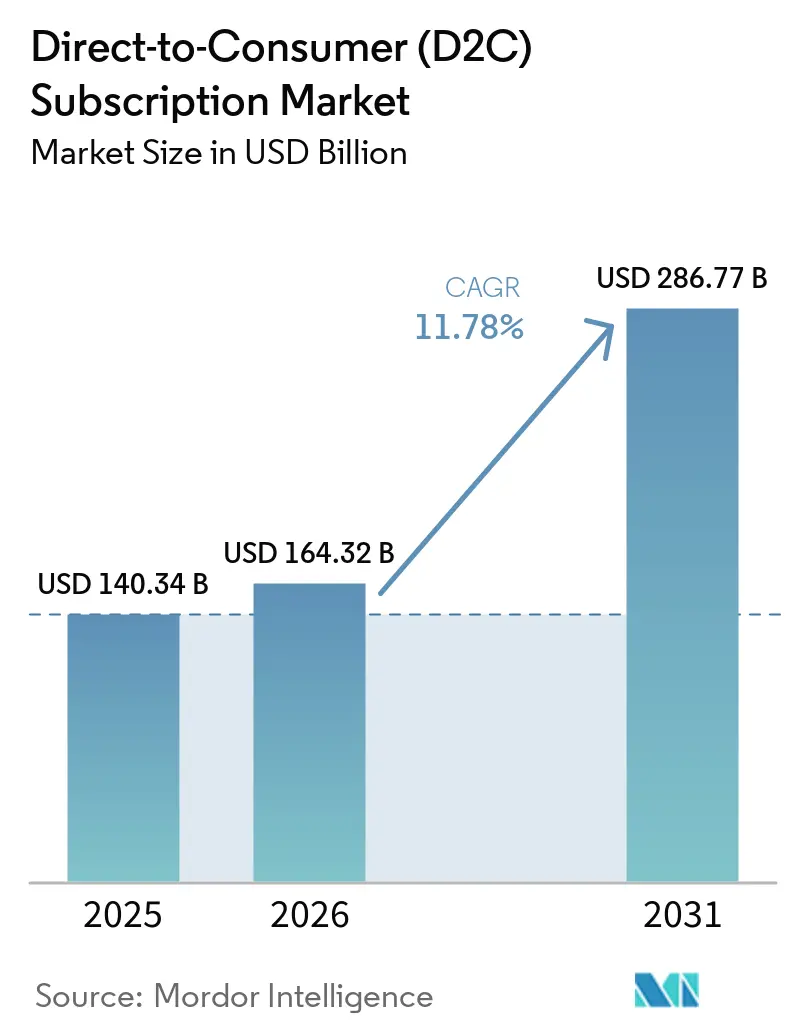
The Direct-to-Consumer Subscription Market size is expected to increase from USD 140.34 billion in 2025 to USD 164.32 billion in 2026 and reach USD 286.77 billion by 2031, growing at a CAGR of 11.78% over 2026-2031.
The D2C subscription market is expanding as consumers shift from one-time purchases to recurring access across both digital and physical categories. Operators in the D2C subscription market are also investing more heavily in personalization, data-led retention, and ecosystem design, making subscriber relationships more durable and valuable over time, as shown by Peloton's 2026 rollout of Peloton IQ and its broader product platform strategy. Payment flexibility is also supporting the D2C subscription market, with the pay-in-4 BNPL segment reaching USD 70 billion in purchase volume in 2025 across the 6 largest participants, lowering the entry barrier for higher-ticket recurring purchases. Cross-border billing is becoming easier to manage in Europe following the EU's adoption of Council Directive 2025/516 in March 2025, which provides the D2C subscription market with a clearer compliance path for multi-country billing models. Sustainability is also becoming increasingly relevant to the D2C subscription market, with refill and reuse models gaining practical support from circular-economy research and large-scale brand programs, especially in beauty and personal care.[1]
Key Report Takeaways
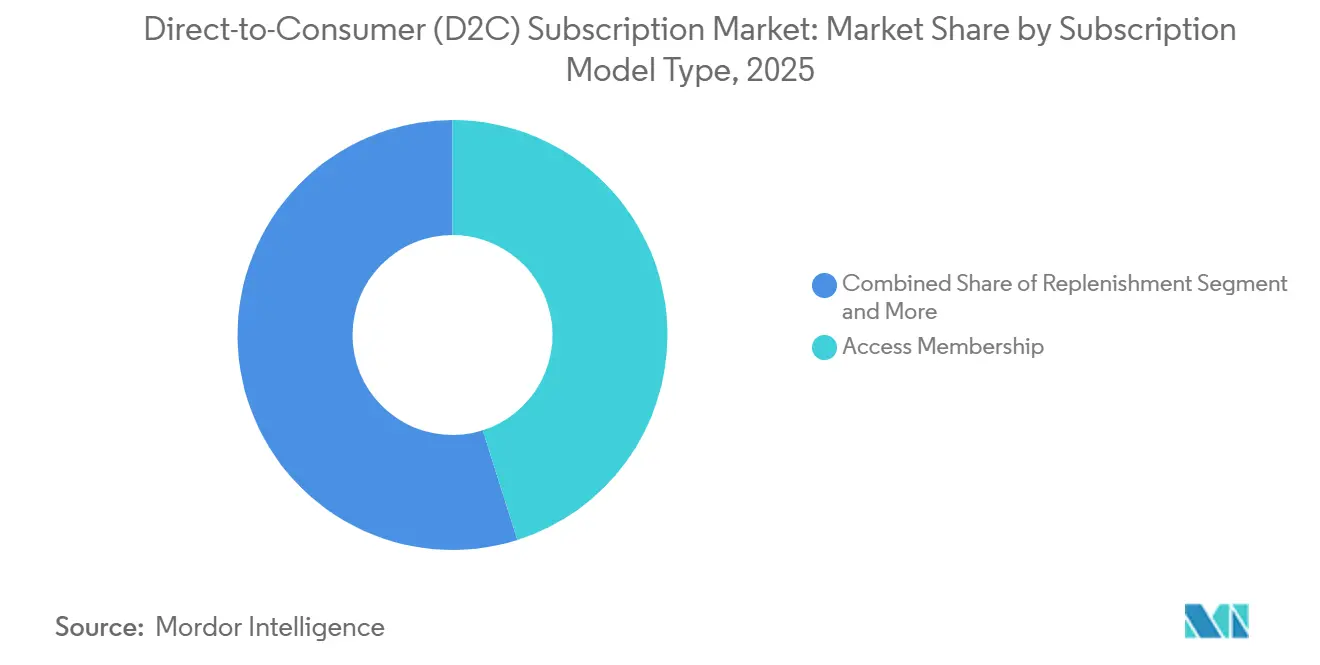
- By subscription model type, Access Membership held 45.12% of revenue in 2025, while Curation Discovery Boxes is forecast to expand at a 16.12% CAGR through 2031.
- By product category, Entertainment & Digital Media accounted for 40.04% of revenue in 2025, while Beauty & Personal Care is projected to grow at a 17.76% CAGR through 2031.
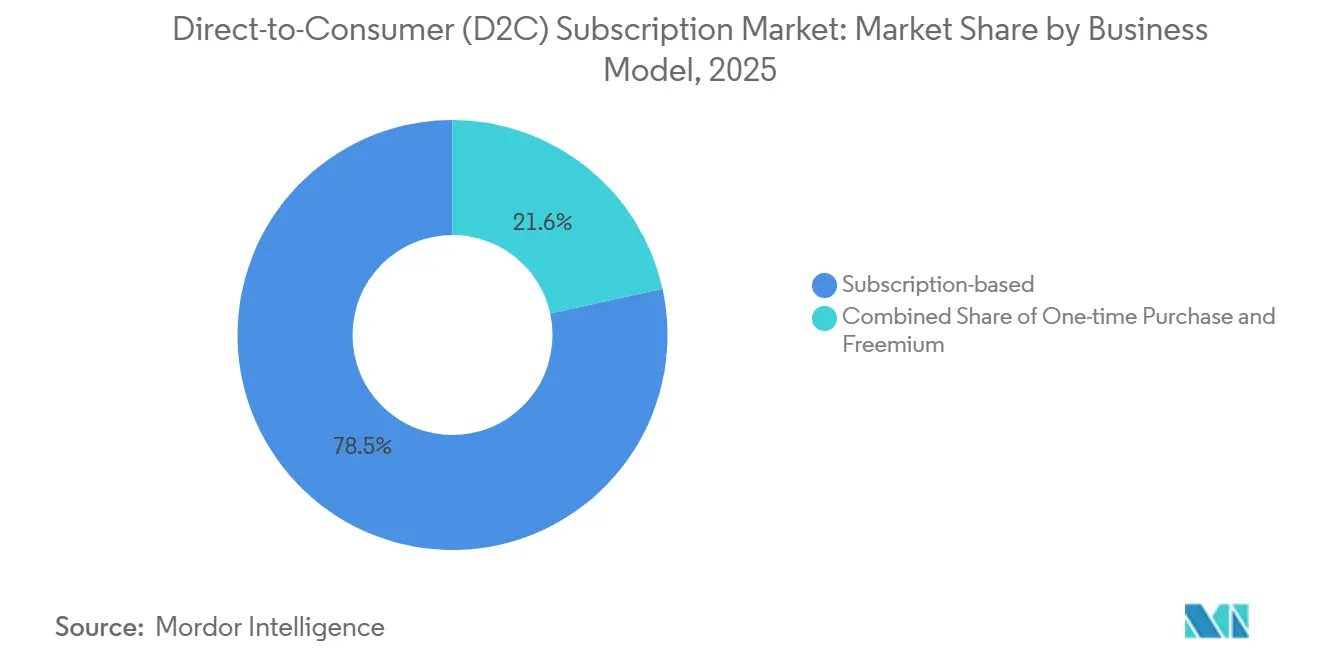
- By business model, Subscription-based accounted for 78.45% of revenue in 2025, while Freemium is forecast to grow at a 15.45% CAGR through 2031.
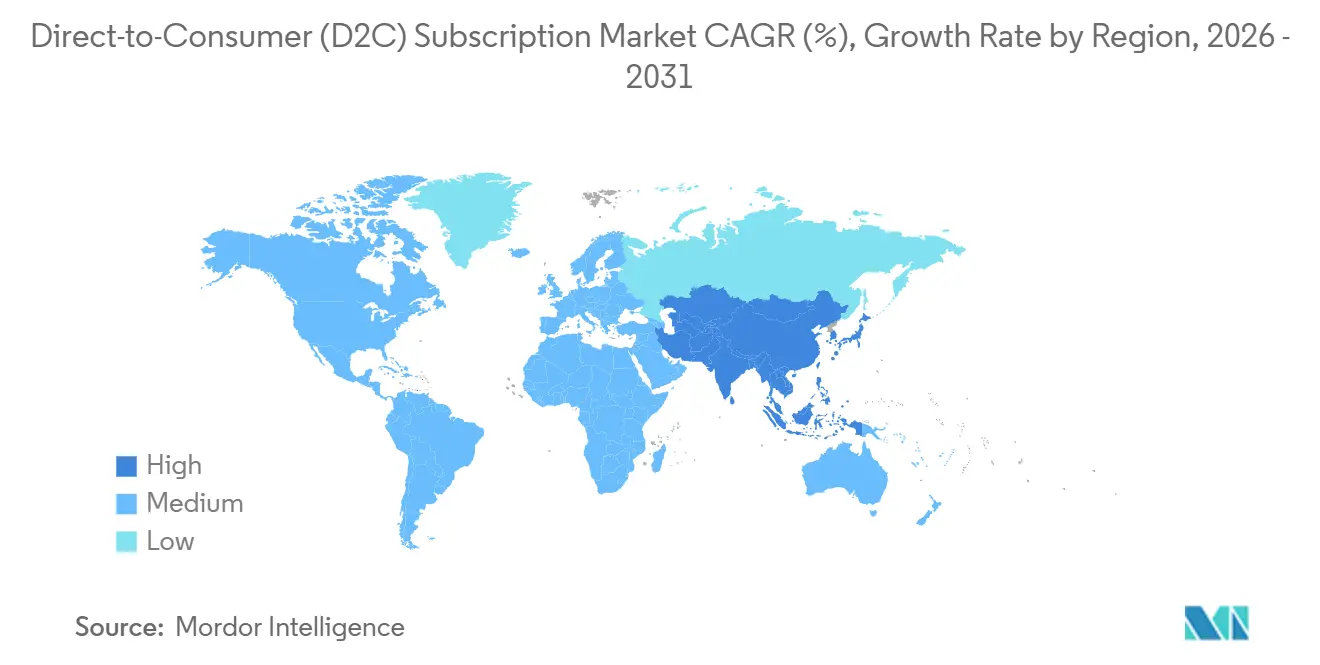
- By geography, North America held 38.17% of revenue in 2025, while Asia-Pacific is projected to grow at a 17.36% CAGR through 2031.
Note: Market size and forecast figures in this report are generated using Mordor Intelligence’s proprietary estimation framework, updated with the latest available data and insights as of January 2026.
Global Direct-to-Consumer (D2C) Subscription Market Trends and Insights
Drivers Impact Analysis*
| Drivers | (~) % Impact on CAGR Forecast | Geographic Relevance | Impact Timeline |
|---|---|---|---|
| AI-Powered Hyper-Personalization in Subscriber Journeys | +2.8% | Global, highest intensity in North America and APAC | Short term (≤ 2 years) |
| Shift Toward Access Over Ownership | +2.1% | North America and Europe, emerging pull in Southeast Asia | Medium term (2-4 years) |
| Subscription-Friendly Payment Rails, Including BNPL and Pay-By-Bank | +1.9% | Global, most acute in North America, the UK, and Australia | Short term (≤ 2 years) |
| Post-Purchase Analytics to Reduce Churn Before Renewal Failure | +1.5% | North America, Europe, APAC | Short term (≤ 2 years) |
| Corporate Sustainability Targets Favoring Refill and Reuse Models | +1.2% | Europe-led, spill-over to North America and APAC | Medium term (2-4 years) |
| Digital VAT and Cross-Border Billing Modernization | +0.9% | EU core, secondary benefit to the UK and associated trade partners | Long term (≥ 4 years) |
| Source: Mordor Intelligence | |||
AI-Powered Hyper-Personalization In Subscriber Journeys
AI-led personalization has become a core operating layer in the D2C subscription market rather than a premium add-on. It matters because recurring models improve when the offer adapts to subscriber behavior, product usage, and timing, rather than remaining static across every billing cycle. Peloton’s 2026 launch of Peloton IQ shows how leading companies are using AI to shape training guidance, engagement, and retention inside a subscription relationship rather than treating personalization as a one-time onboarding feature. Peloton’s FY2025 filing also reported net monthly churn for connected fitness subscriptions of 1.6%, highlighting the value of data-rich ecosystems that can keep members engaged over time. In the D2C subscription market, this makes personalization a direct competitive advantage, as brands that learn faster from subscriber behavior can retain subscribers better, cross-sell more effectively, and launch new offers with less risk.
Shift Toward Access Over Ownership
The shift from ownership to access is widening the addressable scope of the D2C subscription market beyond media and software. This matters most in categories where repeat use, personalization, and convenience outweigh the value of permanent possession. The European Commission Joint Research Center stated in December 2025 that product-as-a-service models can outperform ownership models in circular economy outcomes when consumer participation in reuse is limited, which supports the case for recurring access models in practical consumer categories. L’Oréal’s 2025 refill campaign across 4 divisions, 18 brands, and 28 products shows how large beauty companies are already building around this logic, with the group’s refillable product range up 3.7x between 2019 and 2025. In the D2C subscription market, access works best when the recurring relationship improves convenience and continuity, not just payment timing.
Subscription-Friendly Payment Rails, Including BNPL And Pay-By-Bank
Payment infrastructure is now acting as a growth enabler for the D2C subscription market. The Federal Reserve Bank of Richmond estimated that pay-in-4 BNPL purchase volume reached USD 70 billion in 2025 across the 6 largest participants, and it has grown at a real annual rate of 20% since 2021. The Federal Reserve Board estimated that 6 major providers originated close to USD 160 billion across all consumer credit products in 2025, with pay-in-4 plans growing strongly since the CFPB's prior 2023 measurement. In the D2C subscription market, this reduces the upfront friction associated with wellness kits, fitness programs, and other higher-ticket recurring offers. It also gives operators more room to test price points, bundles, and category expansion without depending only on standard card rails.[2]
Post-Purchase Analytics to Reduce Churn Before Renewal Failure
Post-purchase analytics is becoming a central operating requirement in the D2C subscription market because the real test of a subscription begins after the first payment clears. The strongest operators now monitor usage patterns, engagement depth, payment behavior, and product interaction well before renewal dates. Peloton’s FY2025 net monthly paid connected fitness subscription churn of 1.6% is one of the clearest public benchmarks showing the retention power of a well-managed recurring model with strong data visibility. Peloton’s 2026 product rollout also shows that the next phase of retention depends on using subscriber data to continuously adapt the experience rather than only reacting when cancellation intent emerges. In the D2C subscription market, this makes post-purchase analytics more valuable than simple campaign optimization because it improves lifetime value and lowers the cost of future acquisition.
Restraints Impact Analysis*
| Restraints | (~) % Impact on CAGR Forecast | Geographic Relevance | Impact Timeline |
|---|---|---|---|
| Subscription Fatigue and Wallet-Share Saturation | -2.1% | North America, Europe, APAC emerging markets | Short term (≤ 2 years) |
| Rising Customer Acquisition Costs on Paid Social Channels | -1.8% | Global, most acute in North America and Europe | Short term (≤ 2 years) |
| Fragmented Recurring Billing Tax Compliance | -1.2% | Global, the highest friction in the EU, Southeast Asia, and Latin America | Medium term (2-4 years) |
| High Last-Mile Delivery Costs in Emerging Subscription Markets | -1.0% | APAC, MEA, and Latin America | Medium term (2-4 years) |
| Source: Mordor Intelligence | |||
Subscription Fatigue and Wallet-Share Saturation
Subscription fatigue is a real brake on the D2C subscription market because every recurring charge competes with every other recurring charge for consumer budget share. This pressure becomes more apparent when brands raise prices or add paid features during a period when households are already managing multiple memberships. Peloton raised its All-Access Membership price to USD 49.99 per month in 2026, while also launching new features and hardware, indicating that operators are trying to defend perceived value while also seeking greater wallet share. Netflix’s push to consolidate content assets through the Warner Bros. Discovery transaction shows the same pressure from another angle, with deeper content libraries being used to justify retention and reduce churn risk. In the D2C subscription market, brands that cannot demonstrate clear, compounding value in the first few billing cycles are most exposed when consumers start cutting nonessential recurring spend.
Rising Customer Acquisition Costs on Paid Social Channels
Higher acquisition costs are limiting how quickly some operators can scale in the D2C subscription market. The issue is not only the cost of traffic, but also the lower certainty of payback when a brand depends too heavily on rented channels for the first purchase. This is pushing more companies to deepen owned ecosystems, improve conversion from existing audiences, and build more reasons for repeat engagement after sign-up. Stitch Fix’s 2025 launch of Stylist Connect and Family Accounts is a useful example because it strengthens direct household-level engagement without relying only on fresh paid traffic. In the D2C subscription market, brands with weaker first-party data and weaker retention loops will find it harder to absorb rising acquisition costs than operators that can grow through deeper existing relationships.
*Our forecasts treat driver/restraint impacts as directional, not additive. The impact forecasts reflect baseline growth, mix effects, and variable interactions.
Segment Analysis
By Subscription Model Type: Access Memberships anchor market, while Discovery boxes accelerate
Access Membership held 45.12% of the D2C subscription market in 2025, making it the largest model type by revenue. Its lead comes from the structural advantages of digital access, including low marginal delivery costs, habitual usage patterns, and the ability to deepen value within the same subscriber relationship over time. This part of the D2C subscription market is also easier to bundle, as content, services, and account privileges can be added without creating the same physical fulfillment burden as box or refill models. Peloton’s platform strategy in 2026 supports this point because it combined AI-led personalization, new hardware, and broader ecosystem engagement within a single membership relationship. The segment remains the clearest expression of recurring access economics, where the product is the ongoing experience rather than a fixed unit of physical delivery.
Curation Discovery Boxes have a lower revenue share but are projected to grow at a 16.12% CAGR through 2031, making them the fastest-growing model type in the D2C subscription market. Their appeal lies in novelty, curation, and repeat engagement rather than simple replenishment. Hybrid models are also expanding because they combine access, service, and product flow inside the same subscription architecture, which raises switching costs and creates more touchpoints across the billing cycle. Hims & Hers reached 2.51 million subscribers by the end of FY2025. They guided 2026 revenue to USD 2.8-3.0 billion, showing how a hybrid subscription structure can scale when access and recurring product needs are combined in a single consumer proposition. The EU’s 2025 VAT framework change also favors operators in the D2C subscription market that can present recurring charges clearly and manage cross-border billing with fewer operational breaks.

By Product Category: Entertainment leads, but Beauty and Health rewrite the growth calculus
Entertainment & Digital Media held 40.04% of the D2C subscription market by product category in 2025, giving it the largest revenue share across verticals. This lead reflects the maturity of subscription-native digital categories, where recurring billing was normalized earlier, and scale was built before most physical-goods models reached the same level of consumer familiarity. The category still benefits from strong habitual engagement and a wide installed base, but competition is increasingly dependent on ecosystem strength and content depth rather than on simple subscriber count. Netflix’s Warner Bros. Discovery transaction is a clear example of this direction because it points to content consolidation as a retention and platform strategy rather than a short-term volume play. In the D2C subscription market, this keeps entertainment large even as faster growth begins shifting toward physical and hybrid categories.
Beauty & Personal Care is the fastest-growing product category, with a 17.76% CAGR through 2031, and that growth is supported by personalization, refill adoption, and repeat usage patterns that naturally align with subscription logic. L’Oreal’s 2025 refill campaign, covering 4 divisions, 18 brands, and 28 products, shows how beauty is moving toward subscription-compatible consumption models at scale. Health & Wellness is also strengthening its position in the D2C subscription market, with Hims & Hers guiding 2026 revenue to USD 2.8-3.0 billion, following a USD 2.35 billion FY2025 base. Food & Beverages remains attractive where cadence and household routine support repeat ordering, and HelloFresh’s Q1 2026 average order value reached EUR 70.9, or USD 78, as the company continued shifting toward a higher-value customer base. The product mix in the D2C subscription market is therefore moving from pure digital scale toward a broader set of recurring use cases where convenience, refill, and personalization carry more weight.
By Business Model: Subscription dominance deepens, Freemium reshapes acquisition
The Subscription-based model accounted for 78.45% of revenue in 2025, confirming that the core of the D2C subscription market still sits in direct recurring billing rather than in supporting or transitional models. The reason is straightforward: subscriptions convert customer activity into visible, repeatable revenue and give operators more control over forecasting, retention work, and customer lifetime value. This model also gives brands a stronger room to bundle products, content, access, and services without having to reacquire the same customer every cycle. Peloton’s membership ecosystem, Hims & Hers’ subscriber base, and Stitch Fix’s household-level account expansion all show how recurring billing supports deeper ongoing relationships once the initial conversion has happened. In practice, the D2C subscription market still relies on the subscription model because it remains the cleanest way to convert product fit into long-term revenue.
The Freemium model grows faster, with a 15.45% CAGR through 2031, as brands seek lower-friction entry points in a tighter acquisition environment. In the D2C subscription market, freemium serves as a funnel architecture that lets users engage before committing to paid recurring subscriptions. One-time Purchase remains relevant too, but mostly as a feeder path for gifting, trial, reactivation, or category sampling rather than as the central value engine. This means the D2C subscription market is not moving away from subscription but instead building more flexible routes into subscription. Over time, the strongest brands are likely to be those that connect free engagement, paid entry, and retained usage into a single coherent lifecycle rather than managing them as separate commercial tracks.
Geography Analysis
North America accounted for 38.17% of the D2C subscription market in 2025, making it the largest regional contributor by revenue. The region benefits from mature digital payments, deep subscription familiarity, and a large installed base across streaming, fitness, beauty, and wellness categories. The North America D2C subscription market share remains high, but the region is shifting from raw subscriber growth toward better revenue density and stronger retention economics. Stitch Fix reported Q3 FY2026 revenue of USD 340.3 million, active clients of 2.3 million, and a record revenue per active client of USD 578, which shows how operators are focusing on higher-value customer relationships rather than scale at any cost. In the D2C subscription market, North America therefore remains the revenue anchor even as its growth profile becomes more selective and retention-led.
Europe presents a more mixed pattern for the D2C subscription market, with stronger readiness in digitally mature economies and more gradual adoption in the rest of the region. The biggest structural factor in Europe is compliance modernization, as the EU’s 2025 VAT in the Digital Age directive provides operators with a clearer path for managing recurring cross-border charges. Europe is also important for refill and circular subscription models, supported by policy direction and corporate execution. The European Commission Joint Research Center’s 2025 work on product-as-a-service and L’Oréal’s refill program both support the idea that repeat-use consumer models can align retention economics with sustainability goals. For the D2C subscription market, Europe is likely to reward companies that combine regulatory discipline with refill-compatible product design and clean billing infrastructure.
Asia-Pacific is the fastest-growing region in the D2C subscription market, with a 17.36% CAGR projected for 2026-2031. This growth rate indicates more room for category formation, especially in digitally enabled consumer segments where recurring commerce is still gaining share. The Asia-Pacific D2C subscription market size is expanding faster than mature regions because penetration is lower and the format mix is still broadening across digital access, wellness, and curated consumer products. At the same time, South America and MEA remain promising but more operationally demanding parts of the D2C subscription market because physical formats must absorb higher delivery complexity and weaker route density. MIT Sloan’s work on last-mile delivery cost pressure is highly relevant here, since fulfillment economics can decide whether subscriber growth creates value or only volume.[3]
Competitive Landscape
The D2C subscription market has a two-layer competitive structure, with a concentrated upper tier and a fragmented mid-market. The top 5 D2C subscription platform vendors accounted for 41.3% of global subscription platform revenues in 2025, indicating leadership but not absolute control. Large operators have clear advantages in first-party data, product breadth, fulfillment systems, and the ability to bundle multiple consumer needs into a single recurring relationship. The D2C subscription market, therefore, rewards companies that can build depth around the subscriber, not just scale around the product. This is why competitive advantage now comes from retention design, ecosystem reach, and operating discipline more than from simple brand visibility.
A good example is Peloton, which in 2026 combined a Spotify partnership, the AI-powered Peloton IQ platform, and the new Cross Training Series hardware inside a broader wellness positioning. Another example is Netflix, which amended its Warner Bros. Discovery acquisition agreement to an all-cash transaction in January 2026, showing that content control remains a major retention weapon in subscription entertainment. L’Oréal also showed how legacy consumer brands are adapting to the D2C subscription market by building refill-compatible behavior into mainstream beauty at scale rather than treating it as a niche sustainability concept. Stitch Fix’s launch of Stylist Connect and Family Accounts added another competitive template, centered on deeper household engagement and more direct relationship management. These moves show that the D2C subscription market is increasingly being shaped by feature depth, account expansion, and ecosystem integration.
Mid-market and niche operators still have room in the D2C subscription market, but their path is narrower. They tend to compete through sharper category focus, stronger curation, better fulfillment execution, or more credible community positioning rather than through broad platform scale. Hims & Hers remains a strong example of how focused category expansion can still scale, with 2.51 million subscribers by the end of FY2025 and 2026 revenue guidance of USD 2.8-3.0 billion. Even so, the D2C subscription market is not concentrated enough for a few companies to dictate the field without challenge. The competitive balance still leaves substantial revenue outside the top tier, which is why execution quality continues to matter as much as scale.
Recent Industry Developments
- June 2026: Hims & Hers entered a definitive agreement to acquire Eucalyptus for up to USD 1.15 billion to expand its personalized, AI-driven healthcare platform internationally. This strategic move leverages Eucalyptus's global infrastructure to transform Hims & Hers from a U.S.-focused business into a multinational health ecosystem.
- May 2026: Honasa Consumer, the parent company of the prominent D2C brand Mamaearth, successfully acquired a 58% majority stake in Fluence Pharma.
- May 2026: Peloton launched a global Spotify partnership and the AI-powered Peloton IQ platform, acquired breathwork app Breathwrk, and announced the new Cross Training Series hardware, widening its subscription ecosystem beyond connected fitness alone.
- December 2025: Stitch Fix launched Stylist Connect and Family Accounts, giving subscribers a two-way communication channel with stylists and a household shopping feature that supports multi-profile management from a single account.
Global Direct-to-Consumer (D2C) Subscription Market Report Scope
| Access Membership |
| Replenishment |
| Curation Discovery Boxes |
| Hybrid Mixed |
| Beauty and Personal Care |
| Food and Beverages |
| Entertainment and Digital Media |
| Fashion and Apparel |
| Health and Wellness |
| Other Product Categories |
| Subscription-based |
| One-time Purchase |
| Freemium |
| North America | United States |
| Canada | |
| Mexico | |
| South America | Brazil |
| Peru | |
| Chile | |
| Argentina | |
| Rest of South America | |
| Europe | United Kingdom |
| Germany | |
| France | |
| Spain | |
| Italy | |
| BENELUX (Belgium, Netherlands, and Luxembourg) | |
| NORDICS (Denmark, Finland, Iceland, Norway, and Sweden) | |
| Russia | |
| Rest of Europe | |
| Asia-Pacific | India |
| China | |
| Japan | |
| Australia | |
| South Korea | |
| South East Asia (Singapore, Malaysia, Thailand, Indonesia, Vietnam, and Philippines) | |
| Rest of Asia-Pacific | |
| Middle East and Africa | United Arab Emirates |
| Saudi Arabia | |
| South Africa | |
| Nigeria | |
| Rest of Middle East and Africa |
| By Subscription Model Type | Access Membership | |
| Replenishment | ||
| Curation Discovery Boxes | ||
| Hybrid Mixed | ||
| By Product Category | Beauty and Personal Care | |
| Food and Beverages | ||
| Entertainment and Digital Media | ||
| Fashion and Apparel | ||
| Health and Wellness | ||
| Other Product Categories | ||
| By Business Model | Subscription-based | |
| One-time Purchase | ||
| Freemium | ||
| By Geography | North America | United States |
| Canada | ||
| Mexico | ||
| South America | Brazil | |
| Peru | ||
| Chile | ||
| Argentina | ||
| Rest of South America | ||
| Europe | United Kingdom | |
| Germany | ||
| France | ||
| Spain | ||
| Italy | ||
| BENELUX (Belgium, Netherlands, and Luxembourg) | ||
| NORDICS (Denmark, Finland, Iceland, Norway, and Sweden) | ||
| Russia | ||
| Rest of Europe | ||
| Asia-Pacific | India | |
| China | ||
| Japan | ||
| Australia | ||
| South Korea | ||
| South East Asia (Singapore, Malaysia, Thailand, Indonesia, Vietnam, and Philippines) | ||
| Rest of Asia-Pacific | ||
| Middle East and Africa | United Arab Emirates | |
| Saudi Arabia | ||
| South Africa | ||
| Nigeria | ||
| Rest of Middle East and Africa | ||
Key Questions Answered in the Report
How large is the D2C subscription space in 2026?
The D2C subscription market size is USD 164.32 billion in 2026 and is projected to reach USD 286.77 billion by 2031, with a 11.8% CAGR.
Which product category leads revenue generation?
Entertainment & Digital Media leads with 40.04% of revenue in 2025, supported by mature digital access behavior and large subscriber bases.
Which category is growing the fastest through 2031?
Beauty & Personal Care is the fastest-growing product category with a 17.76% CAGR, supported by refill models and personalization.
Which subscription model is currently the largest?
Access Membership is the largest model type, accounting for 45.12% of revenue in 2025, because digital access models scale efficiently and foster habitual usage.
Which region offers the strongest growth outlook?
Asia-Pacific is projected to grow the fastest at a 17.36% CAGR through 2031, indicating broader room for penetration and category buildout.
What is the main competitive challenge for brands?
The biggest challenge is balancing retention, acquisition efficiency, and fulfillment discipline, especially when the top 5 vendors still control only 41.3% of revenue, and mid-market competition remains active.