
GigE Vision Network Components Market Size and Share
Market Overview
| Study Period | 2020 - 2031 |
|---|---|
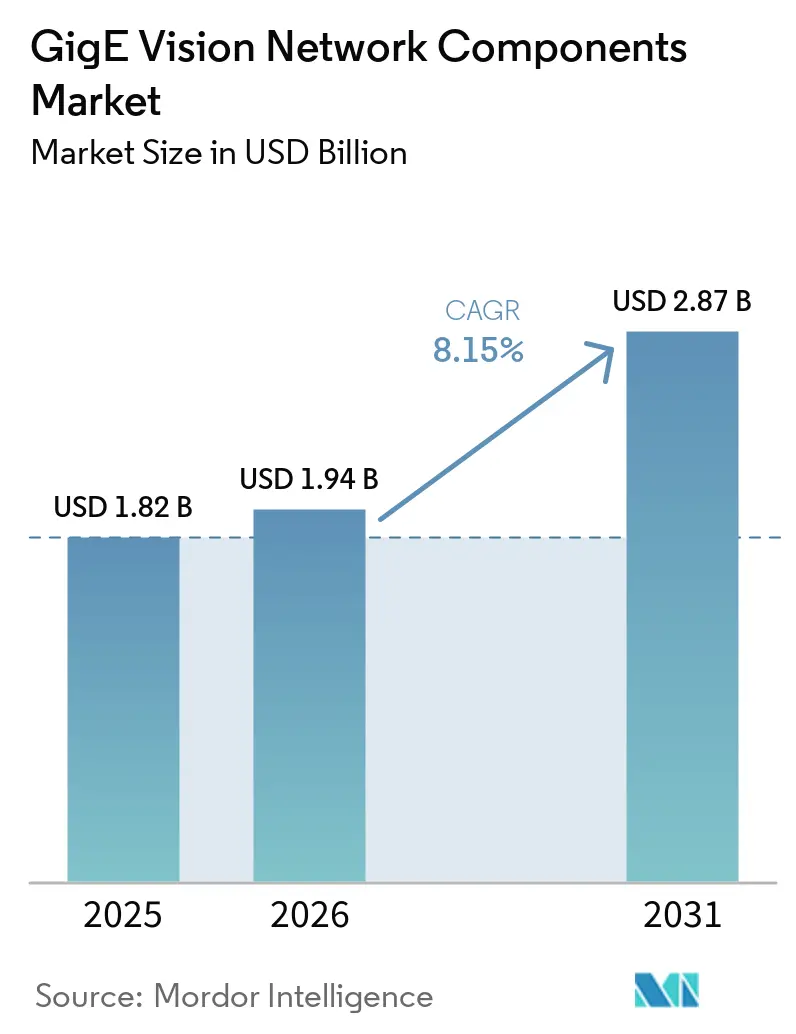
| Market Size (2026) | USD 1.94 Billion |
| Market Size (2031) | USD 2.87 Billion |
| Growth Rate (2026 - 2031) | 8.15 % |
| Fastest Growing Market | Asia-Pacific |
| Largest Market | Asia-Pacific |
| Market Concentration | Low |
Major Players *Disclaimer: Major Players sorted in no particular order Image © Mordor Intelligence. Reuse requires attribution under CC BY 4.0. | |
GigE Vision Network Components Market Analysis by Mordor Intelligence
The GigE Vision Network Components Market size was valued at USD 1.82 billion in 2025 and is estimated to expand from USD 1.94 billion in 2026 to reach USD 2.87 billion by 2031, at an CAGR of 8.15% during the forecast period (2026-2031). Industrial automation spending, edge-based image processing, and higher-speed Ethernet are supporting demand across the GigE Vision Network Components Market. The May 2026 release of GigE Vision 3.0 provides suppliers with a clearer path to support lower-latency image transfer and higher network speeds. Power over Ethernet is also changing deployment decisions because a single cable can carry both data and power to cameras. This favors system designs with more cameras, synchronized devices, and centralized network management. Competition is shifting toward suppliers that can combine cameras, software, network components, and integration support.
Key Report Takeaways
- By component type, cameras held 57.83% of GigE Vision Network Components Market share in 2025, while software, SDKs, and drivers are projected to expand at a 10.47% CAGR through 2031.
- By camera type, area-scan cameras accounted for 48.67% revenue share in 2025, while 3D and stereo vision cameras are expected to expand at an 11.38% CAGR through 2031.
- By network interface speed, 1 GigE held 46.27% revenue share in 2025, while 10 GigE and 25 GigE are projected to expand at an 11.16% CAGR through 2031.
- By end-user industry, manufacturing held 27.43% revenue share in 2025, while electronics and semiconductor is projected to expand at a 10.76% CAGR through 2031.
- By geography, Asia-Pacific held 38.71% of GigE Vision Network Components Market share in 2025 and is expected to expand at an 11.28% CAGR through 2031.
Note: Market size and forecast figures in this report are generated using Mordor Intelligence’s proprietary estimation framework, updated with the latest available data and insights as of January 2026.
Global GigE Vision Network Components Market Trends and Insights
Drivers Impact Analysis*
| Driver | (~) % Impact on CAGR Forecast | Geographic Relevance | Impact Timeline |
|---|---|---|---|
| Industrial Automation and Smart Manufacturing Investment | +2.8% | Global, North America and Asia-Pacific are core markets, with spillover to Europe and South America | Medium term (2-4 years) |
| High-Bandwidth Edge AI and Real-Time Image Processing | +1.7% | Global, with early adoption in North America, China, and South Korea | Medium term (2-4 years) |
| GigE Vision 3.0 and RoCEv2 Adoption | +1.3% | Global, with early adoption in North America, Germany, and Japan | Short term (≤ 2 years) |
| PoE-Enabled Single-Cable Vision Systems | +0.9% | Global, especially European and North American manufacturing corridors | Short term (≤ 2 years) |
| High-Speed, Long-Distance Image Transmission | +0.6% | Asia-Pacific and North America, with spillover to Middle East and Africa infrastructure projects | Medium term (2-4 years) |
| Multi-Camera Synchronization Through PTP and ToE | +0.4% | Global, especially automotive and semiconductor inspection in Germany, Japan, and China | Medium term (2-4 years) |
| Source: Mordor Intelligence | |||
Industrial Automation and Smart Manufacturing Investments
Factory automation is sustaining demand for cameras, network interfaces, and supporting infrastructure in the GigE Vision Network Components Market. Inspection systems are being installed with robotic cells, assembly equipment, and automated material handling. These applications often need cameras, switches, and network interface cards to operate as an integrated system. Higher camera density can increase component demand even when a facility does not add a new production line. Multi-robot cells can use separate camera views for motion guidance, quality checks, and safety monitoring. This makes automation investment relevant to both new projects and upgrades to existing production systems.
High-Bandwidth Edge AI and Real-Time Image Processing
Edge AI is raising the value of image data that can be processed near the production line. NVIDIA said its Jetson Orin Nano 2 delivers twice the inference performance of its predecessor at 40% lower power in 15-watt mode, supporting lower-power robotics and vision deployments.[1] Qualcomm introduced the Dragonwing IQ-2390 for industrial machine vision, deterministic networking, and real-time processing in September 2026. Cognex reported USD 994 million in 2025 revenue, an increase of 9%, and linked its performance to AI-enabled industrial machine vision. Larger image files and faster frame rates can make 10 GigE and 25 GigE connections more relevant for real-time analysis. The GigE Vision Network Components Market benefits when processing performance enables vision functions that were previously impractical at the edge.[2]
GigE Vision 3.0 and RoCEv2 Adoption
A3 officially released GigE Vision 3.0 in May 2026, following its approval at the April International Vision Standards Meeting in Prague. The release introduced the GigE Vision RDMA Streaming Protocol, which uses RoCEv2 for direct transfers between devices and host memory. The approach reduces memory copy operations and can free host processing capacity for image analysis. The specification supports 10 G, 25 G, 50 G, 100 G, and higher Ethernet speeds. Pleora and Imavix announced a partnership in April 2026 for a standards-compliant transmit-to-receive pipeline using FPGA intellectual property and the eBUS SDK. This gives the GigE Vision Network Components Market a transition path from legacy systems to higher-speed, lower-latency architectures.
PoE-Enabled Single-Cable Vision System Deployment
Power over Ethernet simplifies camera installation by combining power and network traffic over a single cable. Cisco identifies PoE, PoE+, and 4PPoE as options for industrial machine vision deployments, with PoE+ supporting up to 30 W per port and 4PPoE supporting up to 90 W per port. This can reduce the need for separate power runs and injectors in dense camera installations.[3] Neousys launched its 4-port PCIe-PoE464at in May 2026, providing 5GBASE-T PoE+ connectivity and software-controlled power management. Single-cable layouts can also make maintenance and expansion easier in large facilities. The GigE Vision Network Components Market benefits from this preference for integrated power-and-data hardware.[4]
Restraints Impact Analysis*
| Restraint | (~) % Impact on CAGR Forecast | Geographic Relevance | Impact Timeline |
|---|---|---|---|
| Network Configuration and Interoperability Complexity | -1.2% | Global, most acute in emerging Asia-Pacific markets and distributed multi-vendor deployments | Long term (≥ 4 years) |
| Host CPU and Bandwidth Constraints in Multi-Camera Systems | -0.8% | Global, especially North America, Japan, and Germany in high-camera-count lines | Medium term (2-4 years) |
| Thermal and Power Management in High-Speed Components | -0.5% | Global, especially Asia-Pacific manufacturing environments with high ambient temperatures | Medium term (2-4 years) |
| Qualification Risks From Proprietary SDKs and Driver Dependencies | -0.3% | Global, especially healthcare, aerospace, and defense applications with long validation cycles | Long term (≥ 4 years) |
| Source: Mordor Intelligence | |||
Network Configuration and Interoperability Complexity
Multi-vendor installations need careful configuration of packet settings, multicast policies, and switch quality-of-service rules. Poor configuration can lead to dropped frames, jitter, and lost synchronization that may appear to be camera faults. GenICam package 2025.10 continued work on common feature access across devices, but device-level compliance does not make every network configuration portable across switches and network interface cards. Brownfield facilities can face extra work when legacy 1 GigE equipment operates with 10 GigE or 25 GigE segments. GigE Vision 3.0 supports coexistence between legacy GVSP and GVRSP, but its full efficiency requires compatible cameras, firmware, and host hardware. These GigE Vision Network Components Market requirements can lengthen project planning and increase the need for specialist integration skills.
Host CPU and Bandwidth Constraints in Multi-Camera Systems
Within the GigE Vision Network Components Market, host CPUs can become a limiting factor as inspection systems move from a single camera to multiple cameras. Conventional GVSP systems create interrupt and memory-copy workloads that increase with camera count. RoCEv2 can reduce this load, but the benefit depends on compatible firmware and RDMA-capable network interface cards. Teledyne reported single-digit growth in industrial and scientific vision for 2026, citing a recovery in machine vision cameras and sensors in late 2025. Many older systems will continue to use legacy pipelines until the camera and host equipment are replaced. Integrators may distribute processing across multiple nodes, thereby raising system design and latency management requirements.
*Our forecasts treat driver/restraint impacts as directional, not additive. The impact forecasts reflect baseline growth, mix effects, and variable interactions.
Segment Analysis
By Component Type: Software and SDK Demand Changes Hardware Economics
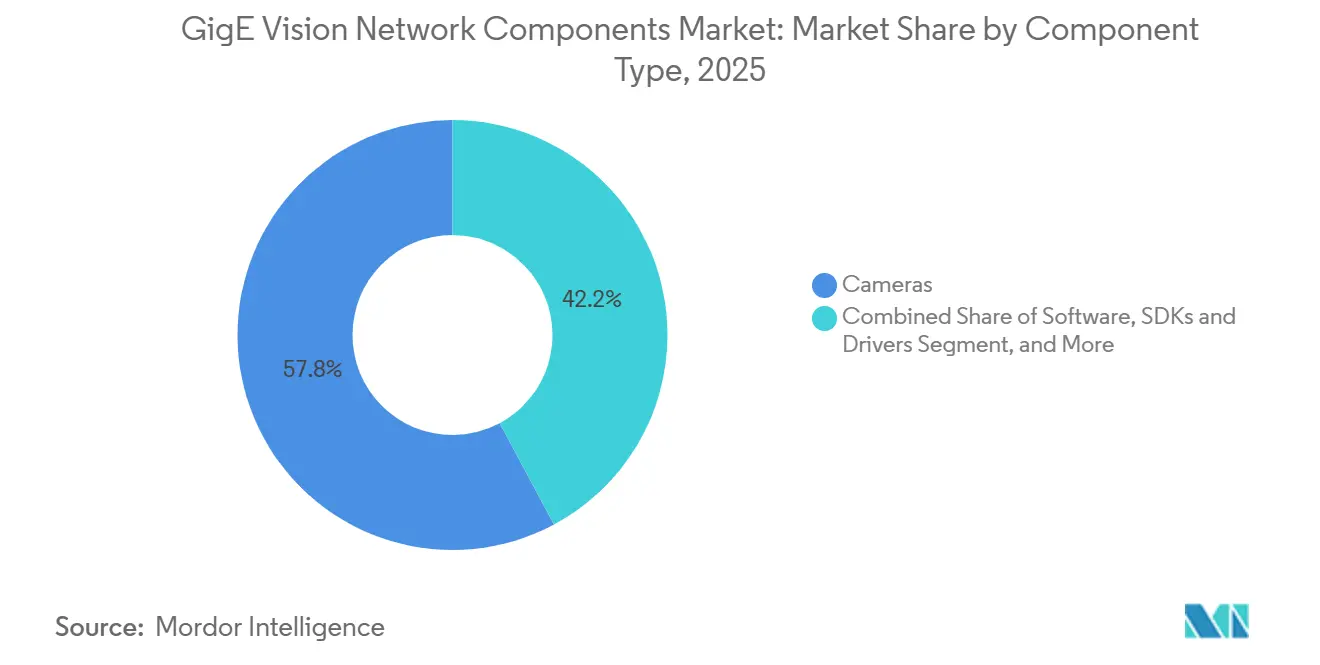
Cameras accounted for 57.83% of overall market revenue in 2025, reflecting their role as the first hardware purchase in a vision installation. Software, SDKs, and drivers are projected to expand at a 10.47% CAGR from 2026 to 2031. This GigE Vision Network Components Market segment benefits from subscriptions, cloud-connected tools, and managed image-processing services. Cognex introduced its OneVision cloud-based AI platform in 2025, combining camera control, inference, and analytics in a managed environment. The model extends the supplier relationship beyond the initial equipment purchase and makes recurring support and software updates more important to lifetime customer value.
Network interface cards and frame grabbers are moving beyond basic input and output functions. Gidel FPGA-based network products and Euresys frame grabbers with onboard preprocessing show the move toward processing closer to image capture. Ethernet switches, cables, transceivers, power accessories, and synchronization accessories expand with camera installations because they form the network layer and support PoE+ and IEEE 1588 PTP requirements. The GigE Vision Network Components Industry is therefore balancing a large camera base with a software layer that can produce recurring revenue. Suppliers that support both legacy and new network standards can reduce migration concerns for customers.

By Camera Type: Depth Imaging Expands Robotics Use Cases
Area-scan cameras held 48.67% of revenue in 2025, supported by their broad use in discrete manufacturing and packaging inspection. 3D and stereo vision cameras are expected to expand at an 11.38% CAGR from 2026 to 2031. Depth information is needed for robotics guidance, bin picking, body assembly verification, and semiconductor metrology. LUCID launched the Helios2 Wide Chroma in January 2026, featuring integrated depth and RGB sensors within a factory-calibrated enclosure. The product direction reduces the effort of aligning separate RGB and depth cameras and enables calibrated point cloud use in logistics and collaborative robotics.
Within the GigE Vision Network Components Market, Basler and Orbbec announced a technology partnership for the Basler Stereo mini 3D camera for factory and logistics automation. This shows established camera suppliers targeting autonomous mobile robots and automated guided vehicles. Line-scan cameras remain important for continuous-web, printing, film-coating, and cylindrical inspection tasks because their line-by-line imaging method is well-suited to high linear speeds. Embedded and board-level cameras are also being used in smart end effectors and quality-at-source modules. These form factors suit applications where standard industrial camera housings cannot fit.
By Network Interface Speed: Higher-Speed Connections Serve Data-Intensive Inspection
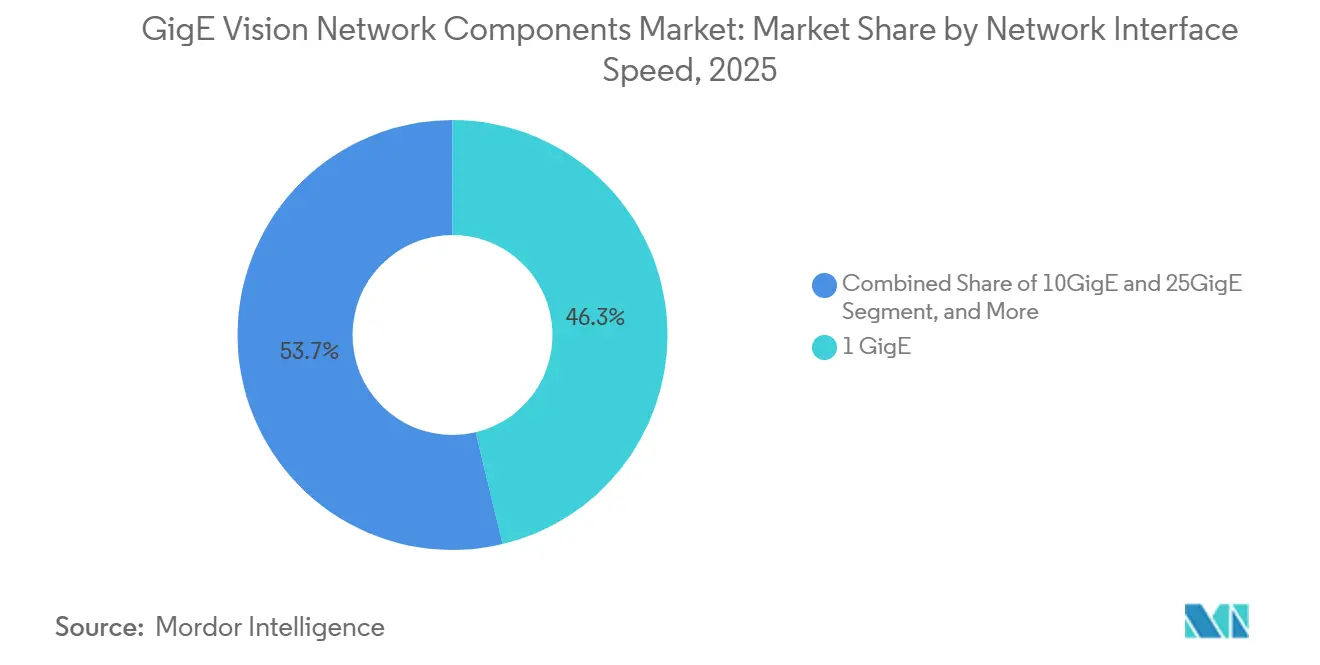
The 1 GigE tier accounted for 46.27% of the GigE Vision Network Components Market size in 2025, supported by a large installed base of standardized equipment. It remains appropriate for many food, beverage, pharmaceutical, and general assembly applications. The 10 GigE and 25 GigE tier is projected to expand at an 11.16% CAGR from 2026 to 2031. Semiconductor wafer inspection, multi-camera data capture, and fast line-scan systems need more throughput than 1 GigE can provide. GigE Vision 3.0 adds RoCEv2 support and higher Ethernet speed options, helping reduce the host processing burden associated with high camera counts. This makes higher-speed designs more practical for production environments.
Within the GigE Vision Network Components Market, Allied Vision offers FXO camera variants with 10 GigE, 25 GigE, and 100 GigE options, as well as integrated RDMA support. Emergent Vision said its EROS 10 GigE models with Sony Pregius S sensors began shipping in December 2024. The 2.5 GigE and 5 GigE tiers offer a middle path for facilities seeking more bandwidth over existing CAT6 cabling without the full cost of a 10 GigE switch and network interface replacement. Other Ethernet speeds, including 40 GigE and 100 GigE, remain at an earlier commercial stage and are most relevant to research and high-speed scientific imaging.
By End-User Industry: Electronics and Semiconductor Add Inspection Density
Manufacturing held 27.43% of revenue in 2025, supported by automotive, metal fabrication, food, and packaging installations. The electronics and semiconductor sector is projected to expand at a 10.76% CAGR from 2026 to 2031. Advanced chip fabrication, printed circuit board assembly, and EV battery production require dense, precise inspection. Teledyne identified semiconductor mask and wafer inspection and electronic component inspection as drivers of industrial machine vision recovery. These use cases require cameras, interfaces, and software capable of handling high-resolution image streams. New fabs and upgraded inspection processes support demand in this vertical.
Within the GigE Vision Network Components Market, automotive demand includes battery tray inspection, cable harness verification, and thermal cell imaging for EV platforms, which can offset slower spending in traditional paint-and-body-shop systems. Pharmaceutical and life sciences installations support tablet, vial, and serialization inspection. Logistics, transportation, security, and public safety applications are adding multi-camera deployments in sortation and traffic-related systems. Together, these end users broaden the revenue base beyond general manufacturing.
Geography Analysis
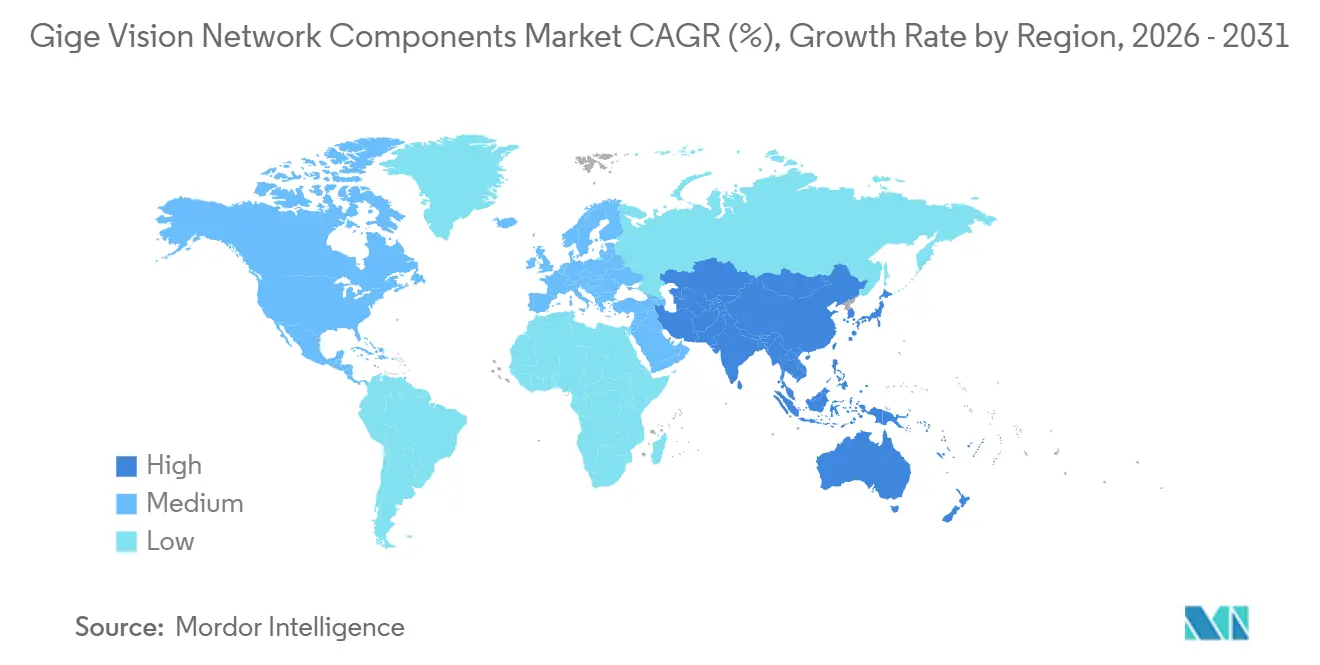
Asia-Pacific accounted for 38.71% of regional market revenue in 2025 and is projected to grow at an 11.28% CAGR from 2026 to 2031. The region combines electronics production, semiconductor capacity, public automation programs, and rising labor costs. Basler reported 37.8% revenue growth in China during 2025 and identified China and Asia-Pacific as highly competitive regions in its 2026 interim reporting. China has a price-focused base for standard cameras and a higher-end requirement for AI-supported and semiconductor inspection systems, while South Korea announced KRW 1.4131 trillion (USD 1.01 billion) in physical AI programs in September 2026 for manufacturing and factory platforms. Japan remains connected to domestic robotics and semiconductor production cycles.
In the GigE Vision Network Components Market, North America is the second-largest regional market, supported by semiconductor fab construction and precision manufacturing. The CHIPS and Science Act provides USD 52.7 billion for domestic semiconductor production, while private-sector commitments had exceeded USD 500 billion by July 2025. These investments support the purchase of inspection equipment across the semiconductor, automotive, and food manufacturing sectors. The United States installed 47,000 industrial robots in 2025, while Canada is a production and research node because Pleora Technologies is based in Ottawa and LUCID Vision Labs is based in Burnaby. This supplier presence gives Canada a larger role in standards and camera development than its demand size alone suggests.
In the GigE Vision Network Components Market, Europe is the third-largest regional market, with Germany serving as a key design and engineering center where Basler, IDS, Allied Vision, and Baumer maintain significant operations. The European Machine Vision Association co-hosted the April 2026 standards meeting in Prague. ISO-24942, previously EMVA 1288, became an international ISO standard in October 2024 and supports camera-quality measurement in procurement specifications. South America has lower demand, with Brazil supporting automotive and agri-food processing applications, while demand in the Middle East and Africa is emerging through industrial diversification and smart-city projects in Saudi Arabia and the UAE.
Competitive Landscape
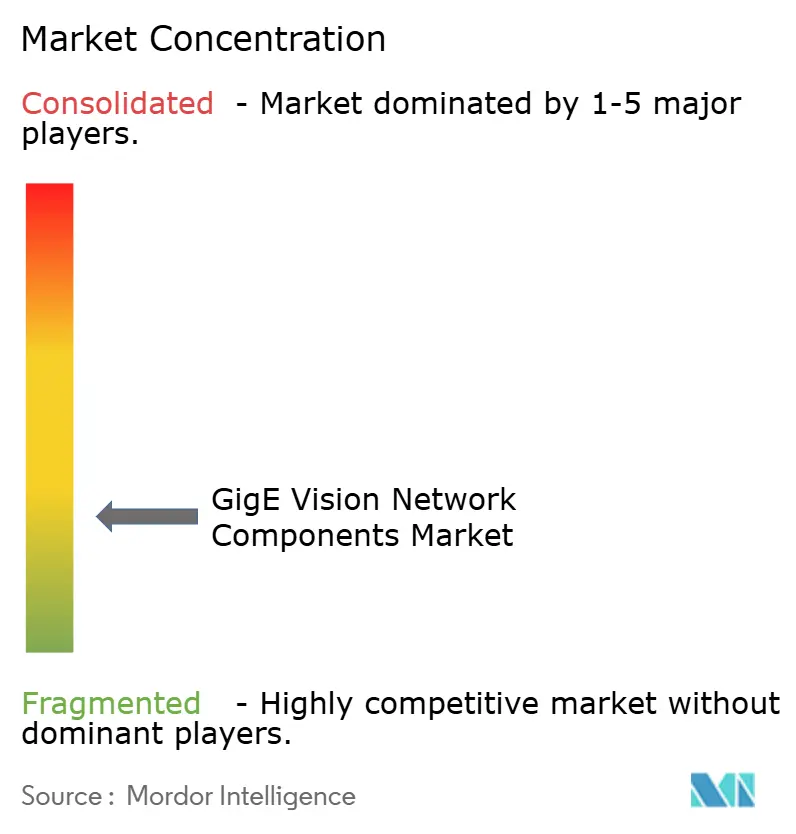
The GigE Vision Network Components Market is fragmented across camera manufacturers, network interface card suppliers, frame grabber specialists, software providers, and cable suppliers. Basler, Teledyne, Allied Vision, and Cognex are prominent camera suppliers that compete through sensor selection, camera formats, SDK capability, and standard compliance. No supplier has a commanding share across the full global component stack, while Basler reported EUR 237.1 million (USD 256.5 million) in incoming orders and a 47.4% gross margin for 2025. Its results show that premium positioning and cost control can coexist with entry-level price competition.
Basler and Advantech announced a partnership in April 2026 that combines Basler ace 2 GMSL cameras with Advantech robotics controllers for physical AI and mobile robotics applications. The move links cameras to a broader robotics control environment and can extend SDK and accessory sales. Allied Vision unified Allied Vision, Chromasens, Mikrotron, NET, and SVS-Vistek under one brand in 2025 within TKH Vision, creating a broader camera and imaging portfolio, while Euresys added frame-grabber capability. These moves reflect a preference for fewer suppliers and more complete imaging stacks.
In the GigE Vision Network Components Market, open areas include lower-cost GigE Vision 3.0-native network interface cards, software that bridges GVRSP and GVSP, and 3D platforms that output calibrated point clouds without proprietary software layers. LUCID’s Atlas25 family demonstrates the value of early alignment with the new standard, while Emergent Vision designs network interface cards for 10 GigE, 25 GigE, and 100 GigE systems, enabling closer coordination between cameras and interfaces. Full GVRSP compliance can help smaller suppliers compete on performance rather than proprietary high-speed systems alone. Sensor availability remains a risk for camera manufacturers without diversified sourcing. Basler flagged a disruption affecting the Kumamoto sensor fabrication cluster and potential constraints on CMOS sensors in the second half of 2026.
GigE Vision Network Components Industry Leaders
-
Basler AG
-
Teledyne Technologies Incorporated
-
Allied Vision Technologies GmbH
-
JAI A/S
-
IDS Imaging Development Systems GmbH
- *Disclaimer: Major Players sorted in no particular order
Recent Industry Developments
- September 2026: Qualcomm launched the Dragonwing IQ-2390 processor, the first in a new IQ2 Series of industrial edge AI processors specifically designed for machine vision, deterministic networking, and real-time industrial automation, with integration of AI, vision, and real-time processing in a compact, cost-optimized platform, directly expanding the addressable edge inference market for GigE Vision camera pipelines.
- August 2026: LUCID Vision Labs announced its lineup for VISION 2026 (Stuttgart, October 6-8, 2026), including new 8K line-scan, near-infrared, STARVIS, and RGB-D GigE Vision cameras alongside additions to the GigE Vision 3.0-capable Atlas25 25 GigE family, reinforcing LUCID's positioning as an early adopter of the new standard.
- June 2026: Pleora Technologies launched the iPORT GEV-TB External Frame Grabber, enabling high-bandwidth GigE Vision 2.x camera connectivity to compact computing platforms via Thunderbolt 3/4 and USB4 ports at up to 22.5 Gbps, eliminating the need for a PCIe slot and enabling deployment on laptops, embedded PCs, and single-board computers.
- May 2026: The Association for Advancing Automation (A3) officially released GigE Vision 3.0, incorporating RoCEv2 and the GigE Vision RDMA Streaming Protocol (GVRSP), extending supported bandwidths to 400 Gbps and beyond with zero-copy image transfer and hardware-delegated error handling, the most significant standard revision since the specification's 2006 origin.
Global GigE Vision Network Components Market Report Scope
GigE Vision Network Components refer to the specialized hardware and software infrastructure required to implement the GigE Vision standard, enabling high-speed, reliable transmission of video data from industrial cameras to processing units over standard Ethernet networks for real-time machine vision applications.
The GigE Vision Network Components Market Report is Segmented by Component Type (Cameras, Network Interface Cards and Frame Grabbers, Ethernet Switches, Cables and Transceivers, Power and Synchronization Accessories, and Software, SDKs and Drivers), Camera Type (Area-Scan Cameras, Line-Scan Cameras, 3D and Stereo Vision Cameras, and Embedded and Board-Level Cameras), Network Interface Speed (1 GigE, 2.5GigE and 5GigE, 10GigE and 25GigE, and Other GigE Vision-Compatible Ethernet Speeds), End-User Industry (Manufacturing, Electronics and Semiconductor, Automotive, Food and Beverage, Pharmaceutical and Life Sciences, Logistics and Transportation, Security and Public Safety, Aerospace and Defense, Research and Academia, and Other End-User Industries), and Geography (North America, South America, Europe, Asia-Pacific, Middle East and Africa). The Market Forecasts are Provided in Terms of Value (USD).
| Cameras |
| Network Interface Cards and Frame Grabbers |
| Ethernet Switches |
| Cables and Transceivers |
| Power and Synchronization Accessories |
| Software, SDKs and Drivers |
| Area-Scan Cameras |
| Line-Scan Cameras |
| 3D and Stereo Vision Cameras |
| Embedded and Board-Level Cameras |
| 1 GigE |
| 2.5GigE and 5GigE |
| 10GigE and 25GigE |
| Other GigE Vision-Compatible Ethernet Speeds |
| Manufacturing |
| Electronics and Semiconductor |
| Automotive |
| Food and Beverage |
| Pharmaceutical and Life Sciences |
| Logistics and Transportation |
| Security and Public Safety |
| Aerospace and Defense |
| Research and Academia |
| Other End-User Industries |
| North America | United States | |
| Canada | ||
| Mexico | ||
| South America | Brazil | |
| Argentina | ||
| Rest of South America | ||
| Europe | Germany | |
| United Kingdom | ||
| France | ||
| Italy | ||
| Spain | ||
| Rest of Europe | ||
| Asia-Pacific | China | |
| Japan | ||
| India | ||
| South Korea | ||
| Rest of Asia-Pacific | ||
| Middle East and Africa | Middle East | Saudi Arabia |
| United Arab Emirates | ||
| Turkey | ||
| Rest of the Middle East | ||
| Africa | South Africa | |
| Nigeria | ||
| Rest of Africa | ||
| By Component Type | Cameras | ||
| Network Interface Cards and Frame Grabbers | |||
| Ethernet Switches | |||
| Cables and Transceivers | |||
| Power and Synchronization Accessories | |||
| Software, SDKs and Drivers | |||
| By Camera Type | Area-Scan Cameras | ||
| Line-Scan Cameras | |||
| 3D and Stereo Vision Cameras | |||
| Embedded and Board-Level Cameras | |||
| By Network Interface Speed | 1 GigE | ||
| 2.5GigE and 5GigE | |||
| 10GigE and 25GigE | |||
| Other GigE Vision-Compatible Ethernet Speeds | |||
| By End-User Industry | Manufacturing | ||
| Electronics and Semiconductor | |||
| Automotive | |||
| Food and Beverage | |||
| Pharmaceutical and Life Sciences | |||
| Logistics and Transportation | |||
| Security and Public Safety | |||
| Aerospace and Defense | |||
| Research and Academia | |||
| Other End-User Industries | |||
| By Geography | North America | United States | |
| Canada | |||
| Mexico | |||
| South America | Brazil | ||
| Argentina | |||
| Rest of South America | |||
| Europe | Germany | ||
| United Kingdom | |||
| France | |||
| Italy | |||
| Spain | |||
| Rest of Europe | |||
| Asia-Pacific | China | ||
| Japan | |||
| India | |||
| South Korea | |||
| Rest of Asia-Pacific | |||
| Middle East and Africa | Middle East | Saudi Arabia | |
| United Arab Emirates | |||
| Turkey | |||
| Rest of the Middle East | |||
| Africa | South Africa | ||
| Nigeria | |||
| Rest of Africa | |||
Key Questions Answered in the Report
What is the size of the GigE Vision Network Components Market?
The GigE Vision Network Components Market is estimated at USD 1.94 billion in 2026 and is forecast to reach USD 2.87 billion by 2031, at an 8.15% CAGR.
What is driving demand for GigE Vision components?
Industrial automation, edge AI, high-speed Ethernet, and single-cable PoE deployments are increasing demand for cameras, interfaces, software, and related infrastructure.
Which component leads revenue in this sector?
Cameras led with 57.83% revenue share in 2025. Software, SDKs, and drivers are projected to expand fastest, at a 10.47% CAGR through 2031.
Why are 10 GigE and 25 GigE connections becoming more important?
They provide the throughput required for high-resolution, multi-camera, and real-time inspection systems, particularly in semiconductor and electronics applications.
Which region has the strongest outlook for GigE Vision components?
Asia-Pacific held 38.71% revenue share in 2025 and is projected to expand at an 11.28% CAGR through 2031.
How does GigE Vision 3.0 affect system design?
GigE Vision 3.0 adds GVRSP and RoCEv2 support, which can lower host processing loads and support higher-speed Ethernet deployments.