
Machine Vision Cable Assemblies Market Size and Share
Market Overview
| Study Period | 2020 - 2031 |
|---|---|
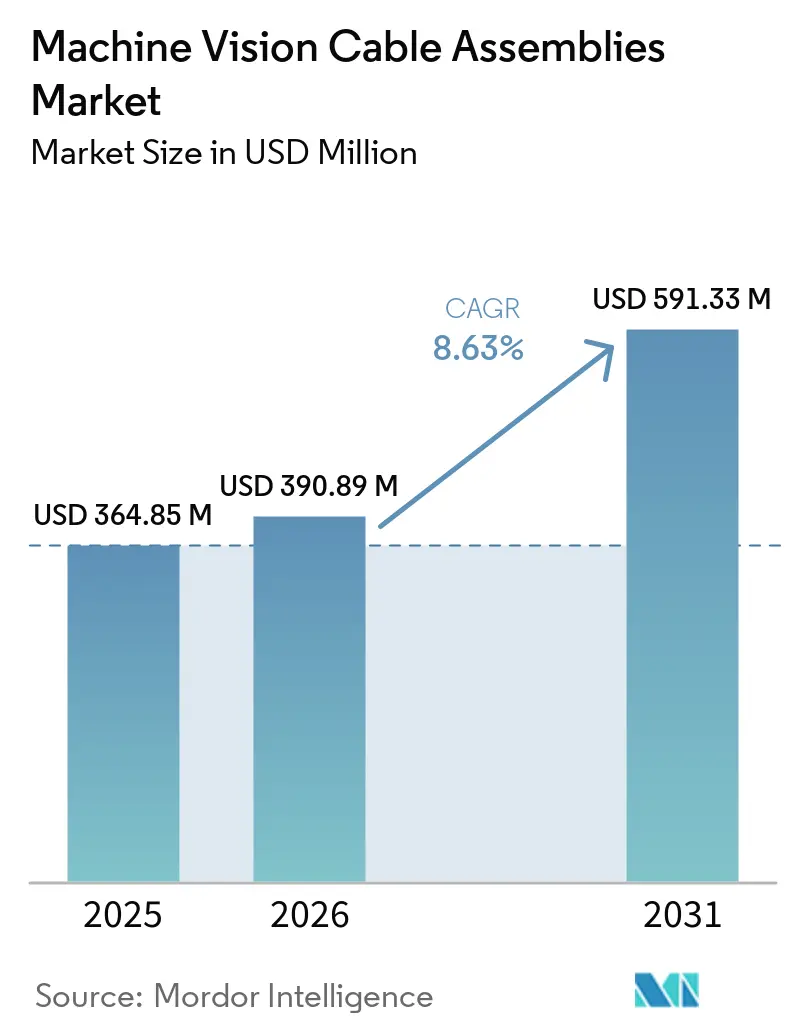
| Market Size (2026) | USD 390.89 Million |
| Market Size (2031) | USD 591.33 Million |
| Growth Rate (2026 - 2031) | 8.63 % |
| Fastest Growing Market | Asia-Pacific |
| Largest Market | Asia-Pacific |
| Market Concentration | Low |
Major Players *Disclaimer: Major Players sorted in no particular order Image © Mordor Intelligence. Reuse requires attribution under CC BY 4.0. | |
Machine Vision Cable Assemblies Market Analysis by Mordor Intelligence
The Machine Vision Cable Assemblies Market size is projected to expand from USD 364.85 million in 2025 to USD 390.89 million in 2026, and to USD 591.33 million by 2031, registering a CAGR of 8.63% between 2026 and 2031. Faster imaging interfaces, broader use of robotics, and factory automation projects in semiconductor, logistics, and automotive facilities are shaping the Machine Vision Cable Assemblies Market. CoaXPress v3.0 is expected to be finalized in 2026, with 25 Gbps links over coaxial copper and optical fiber, which raises the performance requirements for new cable purchases. This change can prompt replacement decisions because many installed assemblies were not designed to meet the new attenuation requirements. Suppliers with interface certifications, custom-design capability, and reliable access to shielding and high-flex conductors are better positioned to serve these projects. Legacy installations may delay upgrades because frame grabber replacement, software validation, and process qualification can cost more than the camera hardware itself, even though the work remains a future source of demand.
Key Report Takeaways
- By interface type, GigE Vision and 10 GigE Vision held 34.81% of the Machine Vision Cable Assemblies Market share in 2025, while CoaXPress is projected to expand at an 11.27% CAGR through 2031.
- By cable media, copper cable assemblies held 38.57% share in 2025, while fiber-optic cable assemblies are projected to expand at an 11.73% CAGR through 2031.
- By cable construction, high-flex cable assemblies held 31.46% Machine Vision Cable Assemblies Market share in 2025, while torsion-resistant robotic assemblies are projected to expand at an 10.83% CAGR through 2031.
- By end-user industry, semiconductor and electronics held 23.68% share in 2025, while logistics, packaging, and transportation are projected to expand at an 10.97% CAGR through 2031.
- By geography, Asia-Pacific held a 38.93% share of the the Machine Vision Cable Assemblies Market in 2025 and is projected to expand at an 11.47% CAGR through 2031.
Note: Market size and forecast figures in this report are generated using Mordor Intelligence’s proprietary estimation framework, updated with the latest available data and insights as of January 2026.
Global Machine Vision Cable Assemblies Market Trends and Insights
Drivers Impact Analysis*
| Driver | (~) % Impact on CAGR Forecast | Geographic Relevance | Impact Timeline |
|---|---|---|---|
| High-Speed Machine Vision Interface Expansion | +2.8% | Global, concentrated in Asia-Pacific and Europe | Short term (≤ 2 years) |
| Automated Inspection and Smart Factory Adoption | +2.0% | Global, strongest in China, Germany, and the United States | Medium term (2-4 years) |
| Multi-Camera and High-Resolution Imaging Deployments | +1.5% | Global, led by semiconductor fabs and large logistics facilities | Medium term (2-4 years) |
| High-Flex Robotic Cabling Demand | +1.0% | Global, concentrated in automotive and electronics manufacturing | Short term (≤ 2 years) |
| Interface-Dense Retrofit Demand in Legacy Lines | +0.7% | North America and Europe | Medium term (2-4 years) |
| Long-Reach Optical and Hybrid Vision Links | +0.5% | Global, particularly large-footprint facilities | Long term (≥ 4 years) |
| Source: Mordor Intelligence | |||
Expansion of High-Speed Machine Vision Interfaces
The CoaXPress Committee stated in July 2026 that v3.0 is expected to support 25 Gbps over coaxial copper and fiber, include CoaXPress over Fiber, and add forward error correction for optical paths.[1]CoaXPress Committee, “CoaXPress Roadmap - Status at July 2026,” CoaXPress Committee, coaxpress.com A 4-cable CXP-12 configuration can sustain 50 Gbps of aggregate bandwidth for demanding high-resolution inspection. That requirement can disqualify installed assemblies that do not meet 25 Gbps attenuation profiles. JIIA CXP-001 certification is a key requirement for assemblies specified in the new CoaXPress environment. The Machine Vision Cable Assemblies Market, therefore, has a tighter replacement window than a typical product upgrade because certification and performance requirements change together. Assemblers that already work within the JIIA standards framework can have an advantage while other suppliers complete their qualification.[2] Japan Industrial Imaging Association, “CoaXPress Over Fiber v1.1 - CXPR-008-2023,” Japan Industrial Imaging Association, jiia.org
Growth of Automated Inspection and Smart Factories
Cognex stated in May 2026 that more than 100 manufacturers moved from single-line artificial intelligence vision pilots to multi-site rollouts during the OneVision beta period. A rollout across multiple lines raises the number of camera connections, trigger cables, and interface assemblies compared with a single installation. The Machine Vision Cable Assemblies Market benefits when inspection programs move from pilot systems to standard equipment across facilities. Connected factory systems also increase the importance of cable specifications and documented performance. These requirements can favor specialty assemblers over suppliers of general industrial cable. The effect is not limited to the initial order; replacement, line expansion, and maintenance can continue after the first deployment.
Rising Multi-Camera and High-Resolution Imaging Deployments
High-resolution inspection systems require consistent signal integrity when multiple cameras operate simultaneously. A 4-camera CoaXPress CXP-12 array can sustain 50 Gbps of aggregate downstream bandwidth, choosing interconnect a core engineering decision. Intel RealSense demonstrated a GMSL depth-camera portfolio at Hannover Messe 2026 that supports up to 8 synchronized cameras over a single cable infrastructure with FAKRA connectors. Such architectures are extending from automotive applications into industrial robotics and warehouse automation. Each synchronized camera group requires assemblies capable of supporting timing-sensitive triggering. This increases cable content per installed vision system even when the camera count does not rise at the same rate.
Increasing Demand for High-Flex Robotic Cabling
Robot-mounted cameras need assemblies that can withstand repeated bending and torsion at tight radii. Nortech Systems states that machine-vision cable designs must meet the mechanical demands of moving applications.[3]Nortech Systems Incorporated, “Machine Vision and Optical Technologies,” Nortech Systems, nortechsys.com High-flex and torsion-resistant assemblies can command a higher value than static cables because they use specialized conductors and shielding. A 2025 WIPO filing described collaborative robotic systems for assembling flexible cables and connectors. The filing reflects the growing connection between collaborative robots and flexible interconnect production. The Machine Vision Cable Assemblies Market gains from camera-on-wrist installations in automotive, electronics, aerospace, and general manufacturing. These uses require a more demanding cable design than fixed-camera inspection cells.[4]World Intellectual Property Organization, “WO/2025/127806 - Assembly System for Assembling Flexible Cables and Connectors by Using Collaborative Robots,” World Intellectual Property Organization, wipo.int
Restraints Impact Analysis*
| Restraint | (~) % Impact on CAGR Forecast | Geographic Relevance | Impact Timeline |
|---|---|---|---|
| High Migration Cost From Legacy Cabling | -1.8% | Global, with the highest burden in North America and Europe | Medium term (2-4 years) |
| Bandwidth, Distance, EMI, and Flex-Life Tradeoffs | -1.2% | Global | Long term (≥ 4 years) |
| Cable Qualification and Compliance Burden | -0.8% | North America and Europe | Medium term (2-4 years) |
| Limited Ecosystem Standardization | -0.5% | Global | Long term (≥ 4 years) |
| Source: Mordor Intelligence | |||
High Migration Cost From Legacy Cabling
A production line moving from Camera Link to CoaXPress may need new frame grabbers, cable assemblies, and software validation. PCIe frame grabbers can cost USD 3,000-8,000 per slot, making the conversion difficult for smaller manufacturers. Automotive and medical device users can also need process requalification under IATF 16949 or FDA 21 CFR Part 820. Existing cells may reveal conduit constraints, controller firmware issues, or inadequate cable management after the project begins. These conditions are more common in North America and Europe, where the installed base of Camera Link is significant. The result is usually delayed demand rather than permanent cancellation, with upgrades shifting to a later purchase period.
Bandwidth, Distance, EMI, and Flex-Life Tradeoffs
No cable medium meets bandwidth, reach, electromagnetic interference, and flex-life requirements simultaneously. Copper CoaXPress is limited to 40 m at CXP-12 speeds, while fiber can extend much farther and avoids electromagnetic interference. Fiber also requires active optical components and separate power conductors in many camera installations. High-flex designs support movement but rely on specialized shielding and fine-strand conductors, which increase costs and constrain supply. End users often need parallel approved supplier lists for different cable types. This repeated qualification work can delay project decisions and increase ownership costs beyond the cable's unit price.
*Our forecasts treat driver/restraint impacts as directional, not additive. The impact forecasts reflect baseline growth, mix effects, and variable interactions.
Segment Analysis
By Interface Type: GigE Vision Leads Installed Demand, While CoaXPress Advances
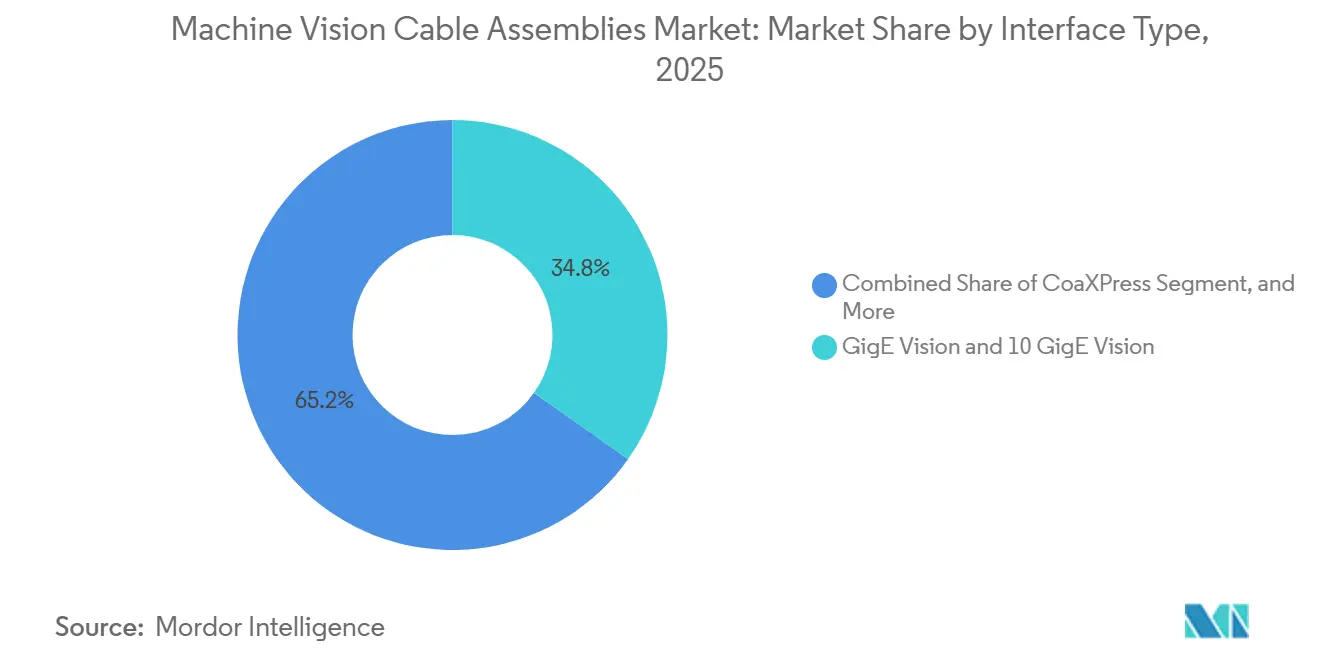
GigE Vision and 10 GigE Vision accounted for the largest interface-type share at 34.81% in 2025. The installed Ethernet infrastructure supports additional inspection points without a full network replacement. Camera Link and Camera Link HS remain relevant for wafer metrology and continuous web inspection. USB3 Vision serves compact and cost-sensitive deployments. Legacy interfaces still create replacement demand where a full system change lacks a clear cost benefit.
CoaXPress is projected to expand at an 11.27% CAGR from 2026 to 2031 in the Machine Vision Cable Assemblies Industry. It supports high-megapixel tasks that are moving away from multi-cable Camera Link configurations. Basler identifies CoaXPress as an industrial camera interface with high transfer rates and stable connections. CoaXPress over Fiber can support long-reach and multi-camera applications under the v3.0 framework. JIIA compliance directs demand toward certified suppliers in the Machine Vision Cable Assemblies Market.



By Cable Media: Fiber-Optic Demand Reflects Copper Limits
Copper cable assemblies led cable media with 38.57% share in 2025. Their position reflects power delivery capability and compatibility with GigE Vision and Camera Link installations. Coaxial assemblies serve CoaXPress systems requiring high-speed image transfer. Hybrid products pair fiber data transmission with copper power delivery. The use of copper, coaxial, hybrid, and fiber options reflects a gradual transition in technology.
Fiber-optic assemblies are projected to expand at an 11.73% CAGR from 2026 to 2031. The JIIA CoaXPress over Fiber v1.1 standard supports 40 Gbps over a single QSFP+ transceiver for up to 120 km, compared with 40 m over copper. Fiber avoids electromagnetic interference from motors and variable-frequency drives. Nortech Systems launched its Power over Fiber platform in April 2026 for camera, actuator, and sensor applications. The Machine Vision Cable Assemblies Market can therefore see demand for optical and hybrid cable assemblies rise in high-performance installations.
By Cable Construction: High-Flex Assemblies Serve Robotic Systems
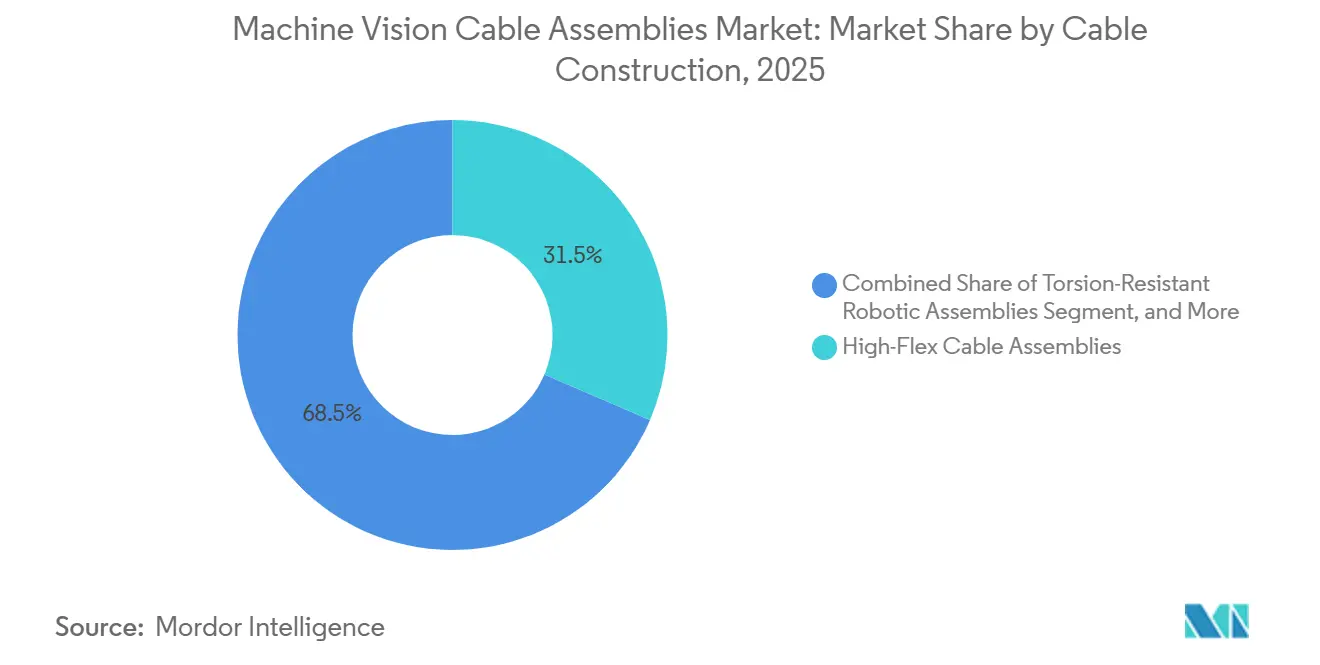
High-flex cable assemblies commanded 31.46% of the overall share in 2025. Collaborative robots and articulated arms need cables that withstand repeated bending at tight radii. Static assemblies suit fixed camera cells, overhead arrays, and quality gates. Continuous-flex products are used with conveyor-tracked cameras and gantry systems. Armored designs support washdown, chemical exposure, and outdoor applications.
Torsion-resistant robotic assemblies are projected to expand at an 10.83% CAGR from 2026 to 2031. Their use is linked to 6-axis robots and collaborative robot installations in automotive and electronics plants. Camera-on-wrist systems impose simultaneous bending and torsional stress. A 2025 WIPO filing described collaborative robot systems for assembling flexible cables and connectors. The Machine Vision Cable Assemblies Market rewards designs that remain reliable during continuous movement.
By End-User Industry: Semiconductor and Electronics Lead, While Logistics Expands
Semiconductor and electronics held the largest end-user share at 23.68% in 2025. Advanced logic, 3D NAND, and HBM fabrication use machine-vision inspection at several stages of production. Onto Innovation launched the Dragonfly G5 inspection system in March 2026, with defect detection down to 150 nm. Automotive demand includes ADAS printed circuit board inspection and EV battery verification. Medical device applications use armored and cleanroom-rated cable designs.
Logistics, packaging, and transportation are projected to expand at an 10.97% CAGR from 2026 to 2031. Kargo deployed automated receiving at Lineage’s Decatur warehouse in August 2026 and processed more than 64,000 receipts in 6 months. Multi-camera networks scan packages at conveyor speeds above 2 m/s. These systems need shielding and vibration resistance in motor-dense locations. The Machine Vision Cable Assemblies Market can benefit from broader warehouse automation.
Geography Analysis
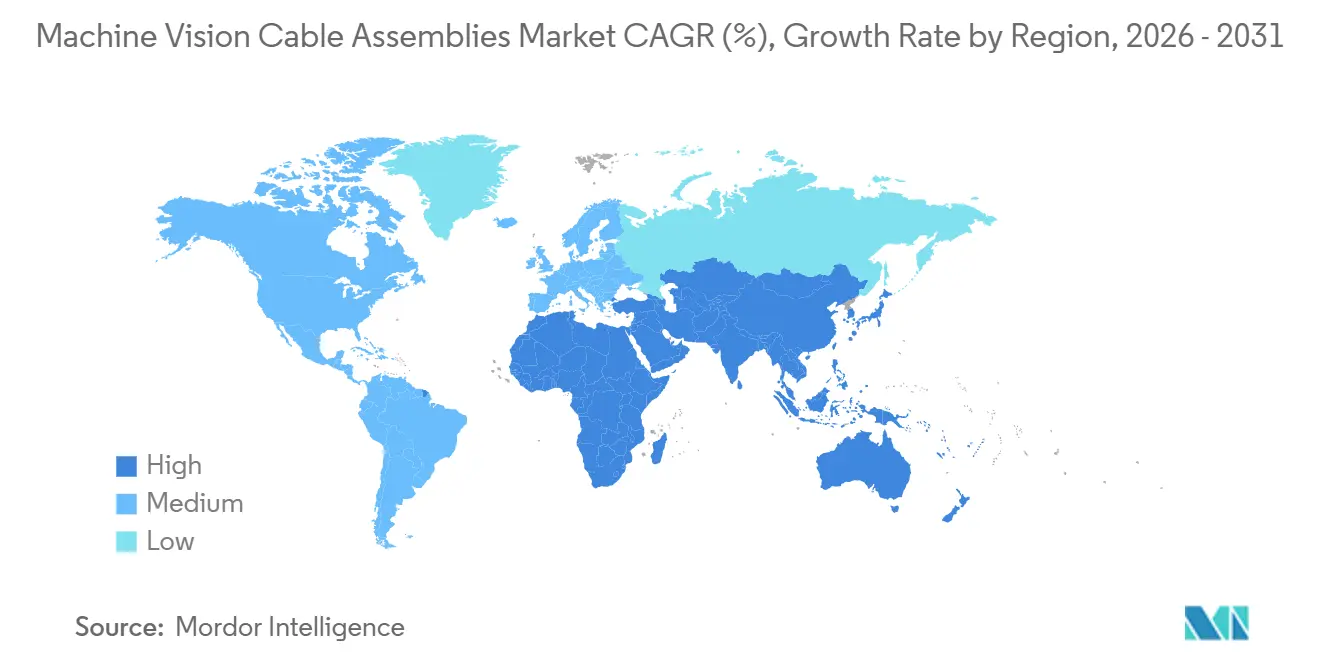
Asia-Pacific accounted for 38.93% of the Machine Vision Cable Assemblies Market share in 2025 and is projected to expand at an 11.47% CAGR through 2031. China’s Yangtze River Delta supports EV battery assembly and semiconductor backend packaging. South Korea and Taiwan use high-bandwidth CoaXPress and multi-camera GigE products in front-end semiconductor inspection. Japan’s incentives and China’s smart-manufacturing standards can shorten adoption timelines. India adds demand through smartphone display inspection and EV module assembly.
Europe is the second-largest regional market, supported by German automotive and machine-tool production. Digitalization programs, labor constraints, and scrap-reduction needs are driving the adoption of inspection automation. Germany’s supplier network drives demand for CoaXPress and high-flex cable assemblies in EV battery and ADAS printed circuit board inspection. VDMA stated that German automation revenue is expected to decline 5% to EUR 14.1 billion (USD 15.8 billion) in 2026. Italy, France, the United Kingdom, and Spain add demand from pharmaceutical machinery, food processing, and logistics sorting.
North America has a mature base where interface upgrades outweigh greenfield installations. The United States hosts OEMs whose procurement specifications influence cable requirements throughout the supply chain. Canada and Mexico support automotive production with IATF 16949-aligned inspection practices. South America centers on Brazilian automotive and agricultural machinery inspection, while the Middle East and Africa are early-stage opportunities in food-processing and construction-materials inspection.

Competitive Landscape
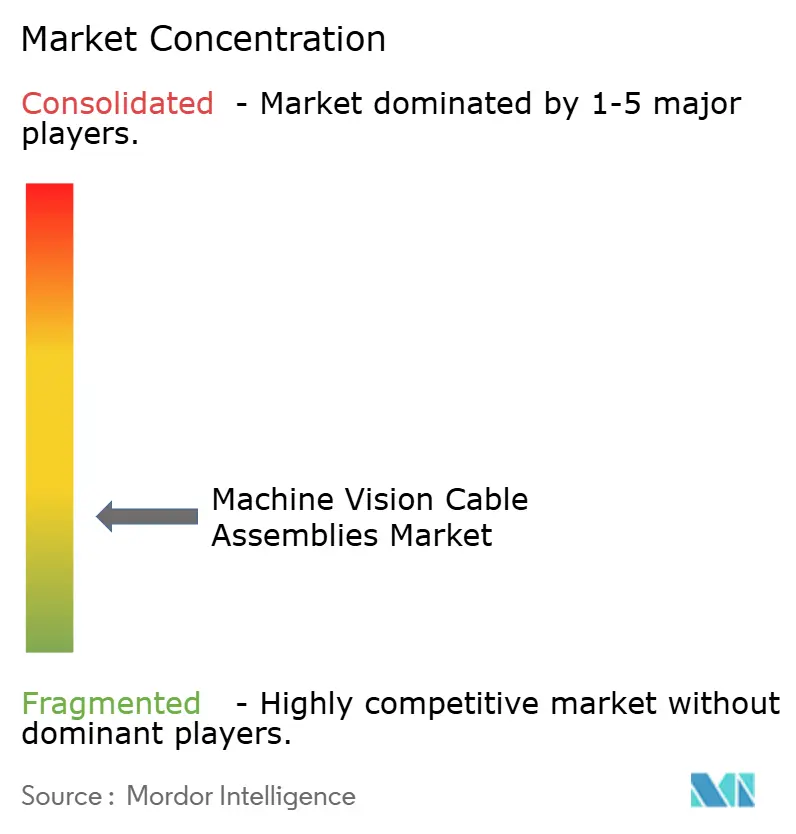
The Machine Vision Cable Assemblies Market is fragmented, with no dominant supplier. Competition includes machine vision specialists, active optical component suppliers, and broad industrial cable manufacturers. Nortech Systems, through Intercon 1, and Alysium-Tech compete through certifications, application engineering, and custom constructions. 3M and Oki Electric Cable compete through scale, global stock availability, and OEM purchasing relationships. Engineering approval, price, and availability all affect supplier selection.
Nortech Systems received a U.S. patent in April 2025 for non-magnetic GRIN-lens expanded-beam fiber-optic cable technology. It launched Power over Fiber in April 2026 for EMI-sensitive machine vision and motor-control applications. These actions extend its offering from passive cable to active optical and hybrid interconnects. EverProX Technologies Munich launched the Silicon Line MSDL 20G chipset in September 2026 for 20 Gbps MIPI D-PHY connectivity over tens of meters. The chipset may enable active optical camera cables beyond the 3-5 m reach of USB3 Vision.
CoaXPress v3.0 creates a new qualification cycle for high-speed vision suppliers. Assemblers with established JIIA test relationships may receive an early preference period. The Machine Vision Cable Assemblies Market remains open to specialists and large-scale manufacturers because users require diverse cable media and construction types. No combined share data is available for the leading suppliers.
Machine Vision Cable Assemblies Industry Leaders
Nortech Systems, Incorporated
Components Express, Inc.
Northwire, Inc.
Hirakawa Hewtech Corp.
Comoss Electronics Co., Ltd.
- *Disclaimer: Major Players sorted in no particular order

Recent Industry Developments
- September 2026: EverProX Technologies Munich GmbH launched the Silicon Line MSDL 20G SerDes chipset, extending 20 Gbps MIPI D-PHY camera connectivity over tens of meters of optical or copper cable at under 100 mW per link. The dual-port chipset delivers 2 simultaneous 10 Gbps serialized links, targeting industrial robotics and machine vision applications where copper MIPI D-PHY limits reach and EMI vulnerability.
- April 2026: Nortech Systems Incorporated launched its Power over Fiber technology platform, delivering power and high-speed data through optical fiber for machine vision cameras, actuators, and sensors. The platform eliminates copper power delivery and the EMI exposure it introduces in high-sensitivity imaging environments, targeting machine vision and motor-control installations where electromagnetic noise causes false rejects.
- November 2025: The CoaXPress standards committee presented the full v3.0 draft at the Fall International Vision Standards Meeting in Haikou, China. Chinese manufacturer participation in the PlugFest reached its highest level to date, reflecting broadening Asia-Pacific supply-chain readiness for the new standard.
- April 2025: Nortech Systems received a U.S. patent for non-magnetic expanded-beam fiber-optic cable technology using GRIN-lens optics and non-magnetic materials including aluminum, titanium, and silver, enabling machine vision cable assemblies for MRI suites and magnetically sensitive manufacturing environments where standard steel-armored cables generate interference.


Global Machine Vision Cable Assemblies Market Report Scope
Machine Vision Cable Assemblies are specialized interconnect solutions designed to transmit high-speed video data, power, and control signals between industrial cameras and processing units, engineered to withstand the mechanical stress, electromagnetic interference, and environmental challenges of automated manufacturing and inspection environments.
The Machine Vision Cable Assemblies Market Report is Segmented by Interface Type (Camera Link and Camera Link HS, CoaXPress, USB3 Vision, GigE Vision and 10 GigE Vision, and Legacy Interfaces), Cable Media (Copper Cable Assemblies, Coaxial Cable Assemblies, Fiber-Optic Cable Assemblies, and Hybrid Copper-Fiber Cable Assemblies), Cable Construction (Static and Fixed-Installation Cable Assemblies, High-Flex Cable Assemblies, Continuous-Flex and Drag-Chain Cable Assemblies, Torsion-Resistant Robotic Cable Assemblies, and Armored and Harsh-Environment Cable Assemblies), End-User Industry (Automotive, Semiconductor and Electronics, Pharmaceutical and Medical Device, Food and Beverage, General Manufacturing and Industrial Machinery, Logistics, Packaging and Transportation, and Other End-User Industries), and Geography (North America, South America, Europe, Asia-Pacific, Middle East and Africa). The Market Forecasts are Provided in Terms of Value (USD).
| Camera Link and Camera Link HS |
| CoaXPress |
| USB3 Vision |
| GigE Vision and 10 GigE Vision |
| Legacy Interfaces |
| Copper Cable Assemblies |
| Coaxial Cable Assemblies |
| Fiber-Optic Cable Assemblies |
| Hybrid Copper-Fiber Cable Assemblies |
| Static and Fixed-Installation Cable Assemblies |
| High-Flex Cable Assemblies |
| Continuous-Flex and Drag-Chain Cable Assemblies |
| Torsion-Resistant Robotic Cable Assemblies |
| Armored and Harsh-Environment Cable Assemblies |
| Automotive |
| Semiconductor and Electronics |
| Pharmaceutical and Medical Device |
| Food and Beverage |
| General Manufacturing and Industrial Machinery |
| Logistics, Packaging and Transportation |
| Other End-User Industries |
| North America | United States | |
| Canada | ||
| Mexico | ||
| South America | Brazil | |
| Argentina | ||
| Rest of South America | ||
| Europe | Germany | |
| United Kingdom | ||
| France | ||
| Italy | ||
| Spain | ||
| Rest of Europe | ||
| Asia-Pacific | China | |
| Japan | ||
| India | ||
| South Korea | ||
| Rest of Asia-Pacific | ||
| Middle East and Africa | Middle East | Saudi Arabia |
| United Arab Emirates | ||
| Turkey | ||
| Rest of the Middle East | ||
| Africa | South Africa | |
| Nigeria | ||
| Rest of Africa | ||
| By Interface Type | Camera Link and Camera Link HS | ||
| CoaXPress | |||
| USB3 Vision | |||
| GigE Vision and 10 GigE Vision | |||
| Legacy Interfaces | |||
| By Cable Media | Copper Cable Assemblies | ||
| Coaxial Cable Assemblies | |||
| Fiber-Optic Cable Assemblies | |||
| Hybrid Copper-Fiber Cable Assemblies | |||
| By Cable Construction | Static and Fixed-Installation Cable Assemblies | ||
| High-Flex Cable Assemblies | |||
| Continuous-Flex and Drag-Chain Cable Assemblies | |||
| Torsion-Resistant Robotic Cable Assemblies | |||
| Armored and Harsh-Environment Cable Assemblies | |||
| By End-User Industry | Automotive | ||
| Semiconductor and Electronics | |||
| Pharmaceutical and Medical Device | |||
| Food and Beverage | |||
| General Manufacturing and Industrial Machinery | |||
| Logistics, Packaging and Transportation | |||
| Other End-User Industries | |||
| By Geography | North America | United States | |
| Canada | |||
| Mexico | |||
| South America | Brazil | ||
| Argentina | |||
| Rest of South America | |||
| Europe | Germany | ||
| United Kingdom | |||
| France | |||
| Italy | |||
| Spain | |||
| Rest of Europe | |||
| Asia-Pacific | China | ||
| Japan | |||
| India | |||
| South Korea | |||
| Rest of Asia-Pacific | |||
| Middle East and Africa | Middle East | Saudi Arabia | |
| United Arab Emirates | |||
| Turkey | |||
| Rest of the Middle East | |||
| Africa | South Africa | ||
| Nigeria | |||
| Rest of Africa | |||


Key Questions Answered in the Report
What is the size of the Machine Vision Cable Assemblies Market?
The Machine Vision Cable Assemblies Market was USD 390.89 million in 2026. It is projected to reach USD 591.33 million by 2031, registering an 8.63% CAGR between 2026 to 2031. Demand is linked to interface upgrades, robotics, and inspection automation in semiconductor, logistics, and automotive facilities. The transition to faster imaging links can also bring forward purchasing decisions for qualified replacement assemblies.
Which interface type leads demand for machine vision cable assemblies?
GigE Vision and 10 GigE Vision led with 34.81% share in 2025. The installed Ethernet base helps the Machine Vision Cable Assemblies Market support incremental inspection network additions without a complete factory network replacement. CoaXPress is expected to serve more demanding high-frame-rate and high-resolution applications. Its certification requirements may concentrate early demand among established suppliers.
Why are fiber-optic cable assemblies gaining use in vision systems?
Fiber-optic assemblies are projected to expand at an 11.73% CAGR. They provide long-distance transmission and immunity to electromagnetic interference, which is relevant to the Machine Vision Cable Assemblies Market in heavy industrial settings. Fiber also supports large-footprint facilities and multi-camera systems that exceed the practical reach of high-speed copper. Hybrid products retain a role where the installation also needs copper power delivery.
Which end-user application is expanding the fastest?
Logistics, packaging and transportation is projected to expand at an 10.97% CAGR through 2031. Warehouse automation is increasing the Machine Vision Cable Assemblies Market requirement for shielded, vibration-resistant assemblies. Multi-camera networks support automated receiving, package scanning, sorting, and other inspection tasks around motor-dense conveyor systems. This application is moving from isolated pilots toward broader facility deployment.
Which region has the strongest outlook for machine vision cable assemblies?
Asia-Pacific led with 38.93% share in 2025 and is projected to expand at an 11.47% CAGR through 2031. Its electronics, semiconductor, and EV production base supports the Machine Vision Cable Assemblies Market. China, South Korea, Taiwan, Japan, and India each contribute different sources of manufacturing and automation demand. The region also combines installed manufacturing capacity with new smart-factory investment.
What limits upgrades from legacy Camera Link systems?
Frame grabbers, cable assemblies, software validation, and process requalification can delay upgrades. These costs can defer projects within the Machine Vision Cable Assemblies Market, especially for smaller operators. Existing cells can also require changes to conduits, controller firmware, and cable management before a newer interface can be used. Delays usually shift demand into later purchasing periods rather than remove the requirement permanently.
Page last updated on:


 Your data is secure and never sold or shared.


