
Ghana Fruits And Vegetables Market Analysis by Mordor Intelligence
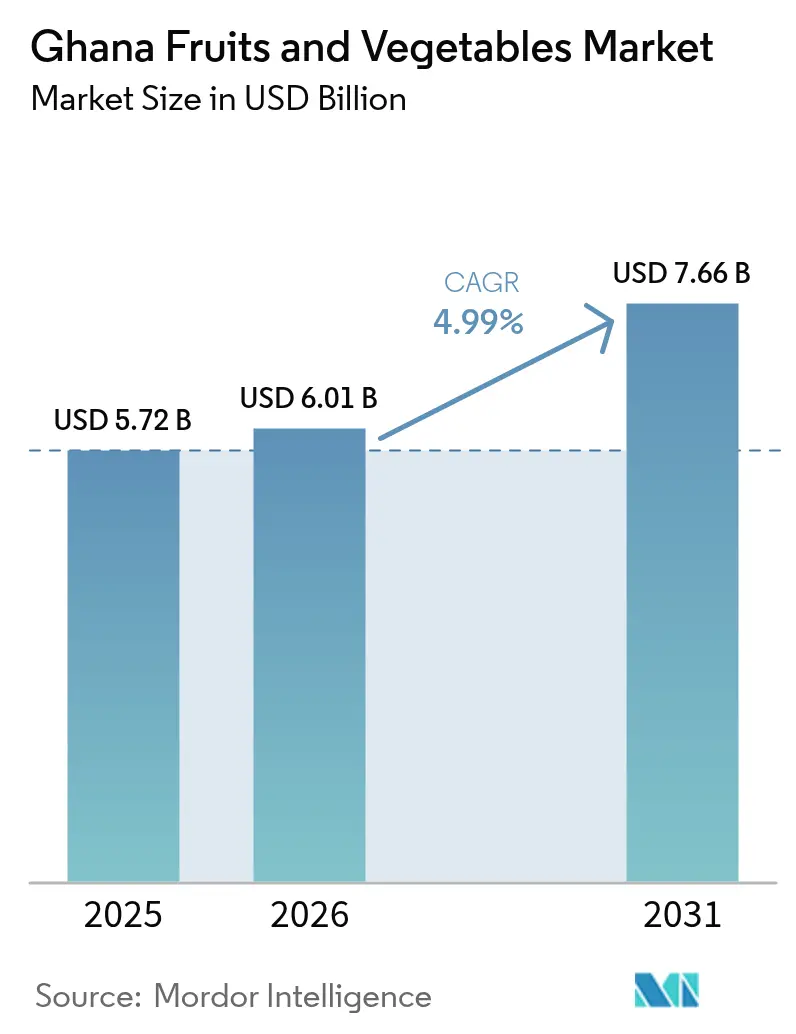
Ghana fruits and vegetables market size in 2026 is estimated at USD 6.01 billion, growing from 2025 value of USD 5.72 billion with 2031 projections showing USD 7.66 billion, growing at 4.99% CAGR over 2026-2031. The country's urbanization rate of 58% is influencing consumer dietary preferences toward fresh produce. Government investments in irrigation systems, cold chain facilities, and export infrastructure are expanding production capacity[1]. The Economic Partnership Agreement with the European Union provides preferential market access, establishing Ghana's position as a regional produce hub. The implementation of technologies, such as solar-powered cold rooms, is reducing post-harvest losses and improving farmer profitability. Hybrid seed programs have increased yields by 40% to 60%, while blockchain traceability initiatives are generating price premiums in European retail markets. Despite challenges from financing constraints and pest outbreaks, targeted credit programs and integrated pest management strategies are helping to minimize growth risks.
Key Report Takeaways
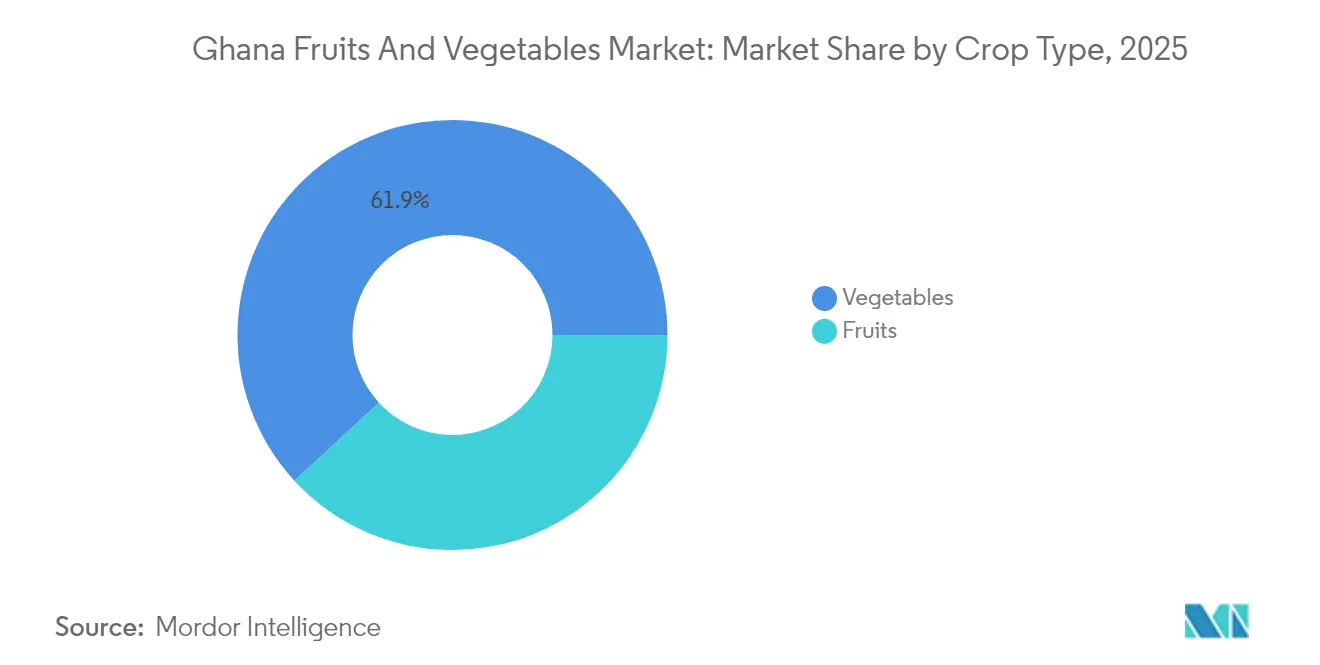
- By crop type, vegetables held a 61.85% of the Ghana fruits and vegetables market share in 2025, while fruits are projected to expand at a 5.00% CAGR through 2031, the fastest pace among all crop categories.
Note: Market size and forecast figures in this report are generated using Mordor Intelligence’s proprietary estimation framework, updated with the latest available data and insights as of 2026.
Ghana Fruits And Vegetables Market Trends and Insights
Drivers Impact Analysis*
| Driver | (~) % Impact on CAGR Forecast | Geographic Relevance | Impact Timeline |
|---|---|---|---|
| Urbanization led rise in per capita produce intake | +1.0% | Greater Accra, Ashanti, and Western | Medium term (2-4 years) |
| Expansion of irrigation under nation lead programs | +0.7% | Upper East, Upper West, and Northern | Long term (≥ 4 years) |
| Hybrid seed adoption improving yields | +0.5% | Central and Eastern | Medium term (2-4 years) |
| Cold chain and pack-house investments | +0.4% | Tema, Takoradi, and Kotoka International Airport | Short term (≤ 2 years) |
| Agro-processing clusters in free zones | +0.3% | Tema and Ashanti | Long term (≥ 4 years) |
| Blockchain traceability premiums | +0.2% | Volta, Eastern, and Central | Medium term (2-4 years) |
| Source: Mordor Intelligence | |||
Urbanization Led Rise in Per-Capita Produce Intake
Urban households allocate 23% of their food budgets to fresh produce, compared to 15% in rural areas, creating stable domestic demand and reducing dependence on volatile export markets. The expansion of middle-income households, with 12% more families earning above USD 2,000 in 2024, has increased the consumer base for premium produce. Retail chains in Accra and Kumasi focus on high-grade fruits and vegetables, allowing farmers to achieve export-level margins without freight costs. Urban demand encourages year-round greenhouse production to meet supermarket quality requirements. These market changes contribute to a 1.2-percentage-point increase in forecast CAGR while reducing revenue volatility.
Expansion of Irrigation Under Nation Lead Programs
The Ghana Commercial Agriculture Project expanded irrigated land by 15,000 hectares in 2024, with plans to reach 50,000 hectares by 2027. The project supports small farms through subsidized solar pumps, reducing fuel costs by 40% compared to diesel systems. Irrigated plots yield 3.2 metric tons of tomatoes per hectare, while rain-fed fields produce 1.8 metric tons per hectare. This increased production enables off-season supply at premium prices and helps stabilize food security by reducing seasonal price fluctuations. The World Bank provides financing while the German development agency offers technical support, with both organizations monitoring water management practices. The project adheres to Ghana Water Resources Commission standards for sustainable water usage, while solar pumping systems help participating smallholder farmers reduce operational costs by 40% compared to diesel irrigation.
Hybrid Seed Adoption Improving Yields
The Planting for Food and Jobs program reduced hybrid seed costs by 50% for registered growers, leading to a 35% adoption rate among vegetable farmers in 2024[2]. Hybrid tomato varieties produce 25 metric tons per hectare compared to 15 metric tons for local seeds, representing a 67% increase in yield. This higher productivity enables farmers to maintain consistent export volumes that meet international quality standards. According to the Ghana Seed Producers Association, domestic hybrid seed production capacity grew by 80% in 2024, reducing import reliance while supporting local agricultural research institutions in developing climate-resilient varieties adapted to Ghana's agro-ecological zones.
Cold-Chain and Pack-House Investments
The 200-kilowatt-peak solar photovoltaic array at Fruit Terminal Company generates 285 megawatt hours annually and reduces post-harvest losses from 30% to below 10% for participating suppliers in 2024. Pay-as-you-go financing enables farmer groups to access cooling technology through affordable installment payments. Wegdam Food Link operates a network of modern, solar-powered cold storage facilities across Ghana through partnerships with local entities, enhancing food safety standards and maintaining product quality throughout the supply chain. These cold storage solutions help exporters meet international quality requirements while minimizing post-harvest losses for participating farmers.
Restraints Impact Analysis*
| Restraint | (~) % Impact on CAGR Forecast | Geographic Relevance | Impact Timeline |
|---|---|---|---|
| Limited access to affordable agri-finance | -0.7% | Nationwide, most acute in Northern corridor | Medium term (2-4 years) |
| Pest outbreaks in fruits and vegetables farming | -0.5% | Forest and transitional zones | Short term (≤ 2 years) |
| Rising jet fuel driven freight costs | -0.4% | Export nodes in Greater Accra, Central, and Eastern | Short term (≤ 2 years) |
| Land tenure disputes limiting scale-up | -0.3% | Rural customary lands, and Northern regions | Long term (≥ 4 years) |
| Source: Mordor Intelligence | |||
Limited Access to Affordable Agri-finance
Commercial banks allocate 8% of their loan portfolios to agriculture, with collateral requirements excluding smallholders who lack formal land titles, forcing them to pay informal interest rates between 25% and 35%[3]. The USD 2.8 billion funding gap prevents investments in cold rooms, irrigation systems, and hybrid seeds, which limits yield improvements and quality enhancements. While government risk-sharing schemes are expanding, their coverage remains limited. Fintech lenders have increased their loan portfolios by 25%, but they constitute a minor portion of total agricultural credit. The Ghana Agricultural Development Bank's urban-focused branch network leaves rural producers reliant on expensive informal financing, restricting their investments in cold storage, irrigation, and quality inputs needed for export market access.
Pest Outbreaks in Fruits and Vegetables Farming
In Ghana, fall armyworm damaged 1.2 million hectares in 2024, causing 20% to 40% yield losses in severely affected vegetable areas[4]. The spread of the banana bunchy top virus and citrus greening disease threatens major export crops. The adoption rate of integrated pest management remains below 30% due to the limited availability of biological controls and insufficient extension services. Climate changes, including rising temperatures and irregular rainfall patterns, expand pest habitats, increase pesticide expenses, and result in higher pesticide residue levels exceeding European maximum limits. These factors lead to market rejections, affecting exporters' cash flow and diminishing buyer confidence.
*Our forecasts treat driver/restraint impacts as directional, not additive. The impact forecasts reflect baseline growth, mix effects, and variable interactions.
Segment Analysis
By Crop Type: Vegetables Anchored Domestic Demand While Fruits Accelerate Momentum
Vegetables hold 61.85% of the Ghana fruits and vegetables market share in 2025. The Vea and Tono irrigation projects support 6,000 growers across 3,340 hectares. Urban household demand for fresh produce maintains steady domestic sales despite international market fluctuations. The segment includes plantain as both a domestic staple and export crop, dry-season tomatoes that command premium prices through irrigation, and traditional crops like cassava and okra that combine cultural significance with modern farming methods. Consistent year-round production enhances food security and farmer income stability.
The fruit segment projects a 5.00% CAGR through 2031. Recent developments include Elefante Farms' February 2025 agreement with Melissa's Produce for pineapple exports to the United States. Golden Exotics Limited exports 100,000 metric tons of bananas annually, generating Euro 60 million (USD 65 million) in foreign exchange. Mango, avocado, and papaya exports to Europe increase through organic and Fairtrade certification. Smallholder cooperatives access premium markets through blockchain traceability and certification programs, supporting the segment's growth.

Geography Analysis
Northern Ghana, comprising Upper East, Upper West, and Northern regions, dominates the country's fruits and vegetables market through irrigated dry-season vegetable production. While the region has abundant land and labor resources, only a few households have reliable electricity access, which limits cold storage facilities and export capabilities. Government initiatives aim to install 22 megawatts of mini-grid capacity by 2027 to support small pack houses and address the current post-harvest losses. In April 2025, government authorities unveiled a USD 1 million support package aimed at bolstering fruit and vegetable growers. Complementing this initiative, broader strategies have been set in motion, such as advocating for climate-smart agriculture and establishing a specialized Tree Crops Development Authority to further uplift the sector. These endeavors, backed by global entities like the Solidaridad Network and the United Nations Industrial Development Organization, emphasize boosting production, ensuring better access to produce, and sharpening trade competitiveness for exports.
The forest and transitional zones, including Ashanti, Eastern, Central, and parts of Western regions, generate USD 2.23 billion in 2025 revenue and constitute the primary fruit export regions. The areas benefit from fertile soils and annual rainfall exceeding 1,400 millimeters, supporting large-scale operations like Golden Exotics Limited, which manages 2,000 hectares with 4,000 employees. The regions face increasing challenges from fall armyworm and banana bunchy top virus, necessitating enhanced integrated pest management programs to control rising production costs.
Coastal Greater Accra and neighboring Central and Western districts function as the primary trade hub, containing the majority of certified cold rooms and export pack houses. Kotoka International Airport handles 60% of Ghana's high-value fruit exports, though airfreight costs increased by 28% in 2024 due to jet fuel price increases. Infrastructure developments include Thai Union's USD 14 million cold storage facility in Tema in 2024, with 8,000 metric tons capacity and integrated solar panels planned under their SeaChange 2030 sustainability initiative. While these investments reduce transportation requirements and environmental impact, capacity limitations during peak harvest periods have prompted investigations into sea freight refrigeration alternatives.
Regulatory Landscape
Ghana's fruits and vegetables sector is overseen by multiple authorities covering plant health, food safety, standards, and export administration. The Ministry of Food and Agriculture (MoFA) Plant Protection and Regulatory Services Directorate (PPRSD) manages plant quarantine, export inspection, and issuance of phytosanitary certificates for fresh produce, anchored in the Plants and Fertilizer Act, 2010 (Act 803). The Food and Drugs Authority (FDA), under the Public Health Act, 2012 (Act 851), regulates food safety and product registration for processed and prepackaged foods, while the Ghana Standards Authority (GSA) develops national standards used for market access and buyer compliance.
For tree-crop-linked fruit value chains, the Tree Crops Development Authority (TCDA), established under the Tree Crops Development Authority Act, 2019 (Act 1010), regulates six crops (including mango and coconut), covering production, processing, and trading. Export documentation and clearance processes have been tightened through procedural guidance, including the FDA's June 2025 guideline that operationalizes export permit processing for prepackaged foods via the FDA's electronic eMDA system. This raises the importance of timely digital compliance to avoid delays at ports of exit.
Value Chain Analysis
Ghana's fruits and vegetables value chain starts with input supply (seeds, crop protection, fertilizer, and irrigation equipment) and smallholder-dominated production, with commercial plantations supporting export-oriented fruits. National programs bundle extension, inputs, and on-farm infrastructure, while pest surveillance and phytosanitary controls sit with MoFA (PPRSD). Aggregation is carried out by traders, cooperatives, and outgrower schemes that consolidate volumes for wholesale markets and exporters, with quality sorting and grading increasingly linked to packhouses and structured collection points.
Post-harvest handling, cold storage, and logistics are the main value-chain friction points, given commonly cited loss rates of 20% to 50% for fruits and vegetables, electricity constraints outside major nodes, and variable rural road access. Export routes concentrate around certified packhouses and cold rooms connected to Kotoka International Airport and ports such as Tema, while processed and value-added routes include dried fruit and prepackaged foods that require FDA registration and export permits. Upgrading efforts include packhouse-led professionalization such as the Yeredua vegetable development project under Feed Ghana, which adds grading and cold-chain functions for tomatoes, onions, and peppers, alongside export-promotion coordination through bodies such as GEPA and the Federation of Associations of Ghanaian Exporters (FAGE).
Market Opportunities and Future Outlook
The near-term opportunity is centered on reducing post-harvest losses and tightening compliance for premium domestic retail and export channels, where cold-chain coverage, packhouses, and standardized handling still lag production growth. Feed Ghana (2025-2028) provides a clear demand signal through prioritizing private sector participation in agribusiness, logistics, and digital agriculture for vegetables among other priority commodities. The Yeredua vegetable development project launched in Kukuom (Ahafo Region) adds solar-powered irrigation and packhouse capabilities targeted at tomatoes, onions, and peppers.
On the export side, opportunities track the government's non-traditional export agenda and compliance-driven market access. The Accelerated Export Development Programme, launched in May 2025 through the presidency's advisory framework, emphasizes value addition for agro-commodities, aligning with investment themes for fresh and processed fruits and vegetables under the National Export Development Strategy. For compliance, exporters of prepackaged fruit and vegetable products must obtain FDA export permits through the eMDA workflow set out in the June 2025 guideline, which supports demand for formalization, traceability, testing, and standards certification aligned with GSA systems. Sector activity at international trade fairs, led by GEPA and industry stakeholders, also reinforces export-ready production models, including chili, mango, and pineapple, that combine aggregation, SPS compliance, and reliable cold chain.
Recent Industry Developments
- April 2026: Ghana's Ministry of Food and Agriculture (MoFA) signed a public-private partnership agreement with FarmMate Limited to scale tomato production nationwide and link output to processing. The program scope cited up to 40,000 acres for cultivation and includes targets for both fresh tomatoes and tomato puree, aligning farm expansion with downstream offtake. The agreement addresses import substitution pressures and signals new demand for irrigation, aggregation, and processing-linked supply contracts.
- August 2025: Elefante Farms expanded its export offering by introducing premium MD2 pineapples from Ghana to international markets, building on its prior Sugarloaf pineapple positioning. Adding MD2 broadens addressable buyer requirements across wholesale, retail, and processing channels where varietal specifications are strict. The portfolio step-up supports stronger exporter leverage with buyers that demand consistent grade and volume.
- May 2024: Dutch and Company completed the installation of a 200-kWp rooftop solar system at The Fruit Terminal Company (FTC) cold-room facility at Tema Harbour. The grid-tied system supports cold-chain operations with lower energy costs and improved emissions performance, strengthening reliability for temperature-sensitive produce handling. This type of infrastructure upgrade underpins loss reduction and service levels for exporters moving through Tema.
Research Methodology Framework and Report Scope
Market Definition and Coverage
This market is defined as the value of fruits and vegetables in Ghana, tracked through what is produced, consumed, imported, and exported, along with the price movements that shape value over time.
Scope exclusions: We exclude processed fruit and vegetable products and any value added after primary handling, such as packaged meals, beverages, and wider food retail margins.
Segmentation Overview
- By Crop Type (Production Analysis (Volume), Consumption Analysis (Volume and Value), Import Analysis (Volume and Value), Export Analysis (Volume and Value), and Price Trend Analysis)
- Fruits
- Vegetables
Data Sources, Market Sizing, and Validation
Desk Research
Desk work starts by grounding the supply and demand picture in public statistics, and then mapping those data points into a clean set of assumptions we can test. We mainly refer to sources such as FAOSTAT for production series, UN Comtrade for trade flows, and Ghana Statistical Service releases for agriculture context and macro indicators that influence spending.
To avoid over relying on one dataset, we also review materials such as Ministry of Food and Agriculture (Ghana) updates, Bank of Ghana macro publications, and peer reviewed agriculture and horticulture journals that discuss yield trends and post harvest losses. Company filings, investor presentations, and reputable press coverage are used to understand cold chain rollouts and commercialization signals. In a few cases, paid subscriptions are used to speed up company financials checks, patent scans, and shipment level import export validation. These examples are not exhaustive, and other sources were consulted for data collection, validation, and clarification.
Primary Interviews and Surveys
Interviews and surveys with Ghana-based growers, produce traders, processors, retailers, food-service buyers, logistics providers, and agricultural officials are used to check local prices, crop availability, post-harvest losses, channel margins, import reliance, and demand changes. Respondents also help clarify gaps in public records, such as how produce moves through local channels. Findings are compared with the desk model before assumptions and final results are adjusted.
Distribution of primary research fieldwork respondents
| Company type | Respondent position |
|---|---|
| Top tier: 29% | CXOs: 18% |
| Mid tier: 46% | Functional/Unit leaders: 31% |
| Smaller Players: 25% | Managers: 51% |
Market-Sizing & Forecasting
The model is built using a top-down approach where production and trade data reconstruct the available supply pool for key produce categories, which is then aligned with domestic consumption and export pull to arrive at an annual value total. Once the demand pool is set, we corroborate results through selective bottom-up checks, such as sampled wholesale and farmgate price points multiplied by indicative traded volumes, followed by channel checks with buyers to adjust the totals.
A few of the practical inputs we use include harvested area and yield trends, import and export volumes by produce group, seasonal price spreads between peak and lean months, post harvest loss ranges, and the share of output that moves through commercial channels versus informal trade. Forecasts lean on scenario analysis supported by expert views on irrigation expansion, cold chain penetration, export compliance, and expected inflation and currency movements. When bottom-up signals are missing for a crop or route, we bridge gaps with proxy pricing bands and trade mirrors, and then recheck reasonableness against total food spending direction.
Data Validation & Update Cycle
Validation is done by cross checking the final market value against independent signals, such as whether implied average prices align with observed farmgate to wholesale ranges, and whether trade totals reconcile with mirrored partner data. If a variance looks unusual, the assumptions are reopened and the analyst recontacts sources to confirm whether the shift is real or data timing related.
Before sign off, the numbers go through multi step internal reviews, including consistency checks across volumes, prices, and macro inputs, followed by a final logic pass on the forecast drivers. Reports are refreshed annually, and interim updates are added when major events occur, such as policy changes on imports, large weather shocks, or sharp currency moves. Right before delivery, a final update sweep is done so clients receive the most current view available.
Mordor Intelligence's Ghanaian Fruit Vegetable Market Size Measured Against Other Published Estimates
Published numbers for Ghana fruits and vegetables can differ quite a lot, and that spread is usually not random. It often comes from what each study counts as the market, what price basis is used, and whether trade and domestic consumption are both treated as value drivers.
Some studies lean toward production value only, while others blend in processed items, retail margins, or even adjacent root crops, which can quickly inflate the final total. Currency handling also matters because a single year average FX rate versus a spot rate can swing USD values, and refresh timing matters when inflation and seasonal prices move fast.
Benchmark comparison
| Source | Market Size | Gaps in Research Methodology |
|---|---|---|
| Mordor Intelligence | USD 5.72 B (2025) | |
| Industry Dataset A | USD 3.01 B (2024) | Reported as PPP based gross production value for primary fruits and vegetables, so it does not capture trade value movements or consumption side pricing that can lift market value in nominal USD terms. |
| Advisory Publisher B | USD 100.00 B (2023) | Uses a much wider product and value chain scope that includes processed products and additional categories, and the stated value level suggests the total may include downstream channels and end uses beyond primary fruits and vegetables. |
The table shows a wide range, and in Mordor Intelligence's model the market is kept to fruits and vegetables tracked through production, consumption, and trade flows in Ghana, rather than adding processed food value or broad retail markups. When the scope is held to that demand and supply loop, the inputs can be traced back to measurable volumes and observable prices, which makes the final estimate easier to reproduce and explain during updates.
Key Questions Answered in the Report
What is the current value of the Ghana fruits and vegetables market?
The Ghana fruits and vegetables market size reached USD 6.01 billion in 2026.
How fast is the sector projected to grow through 2031?
Market revenue is projected to rise at a 4.99% compound annual growth rate, reaching USD 7.66 billion by 2031.
Which crop category generates the largest portion of sales?
Vegetables dominate with 61.85% market share due to year-round irrigated production.
Which segment shows the strongest growth momentum?
Fruits are forecast to expand at a 5.00% CAGR driven by expanding export partnerships for pineapples, mangoes, and bananas.
What infrastructure investments are reducing post-harvest losses?
Solar powered cold rooms and pack houses in Tema Harbour and farmgate locations have cut losses from 30% to below 10% for participating growers.
How are technology solutions improving export competitiveness?
Blockchain traceability and artificial intelligence enabled farm management systems secure premium pricing and automate compliance with European import rules.