
Market Overview
| Study Period | 2021 - 2031 |
|---|---|
| Forecast Data Period | 2026 - 2031 |
| Historical Data Period | 2021 - 2024 |
| Growth Rate | 3.41 % |
| Market Concentration | Medium |
Major Players *Disclaimer: Major Players sorted in no particular order Image © Mordor Intelligence. Reuse requires attribution under CC BY 4.0. | |
Germany Nuclear Power Reactor Decommissioning Market Analysis by Mordor Intelligence
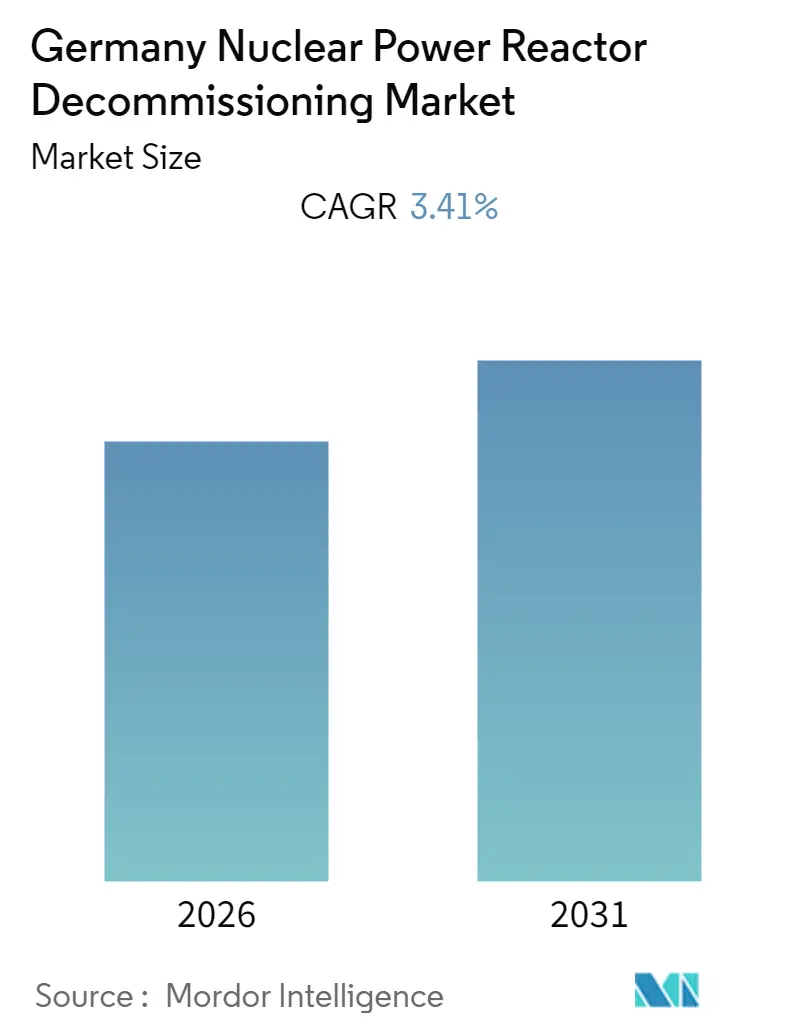
The Germany Nuclear Power Reactor Decommissioning Market size is expected to register a CAGR of greater than 3.41% during the forecast period.
- The Commercial Power Reactor segment is expected to witness decommissioning at the fastest rate due to the upcoming decommissioning projects in the country of the type.
- The new German government's strong support for the nuclear power phase-out by 2022 is the biggest opportunity for the market. The country has decommissioned around half of its nuclear power generation fleet by 2021 with fast-tracked government support, and three commercial power plants are going to be dysfunctional by 2022.
- The high growth of renewables in the power generation sector is expected to catalyze the nuclear power decommissioning market in the near future.
Note: Market size and forecast figures in this report are generated using Mordor Intelligence’s proprietary estimation framework, updated with the latest available data and insights as of 2026.
Germany Nuclear Power Reactor Decommissioning Market Trends and Insights
Commercial Power Reactor Expected to Witness Significant Growth
- A decade ago, Germany had a considerable nuclear power generation installed capacity with all types of nuclear power reactors, commercial, prototype, and research reactors. With the occurrence of the Fukushima nuclear disaster in Japan, many European countries started refraining from increasing the nuclear power generation share in the electricity mix, and Germany was no exception.
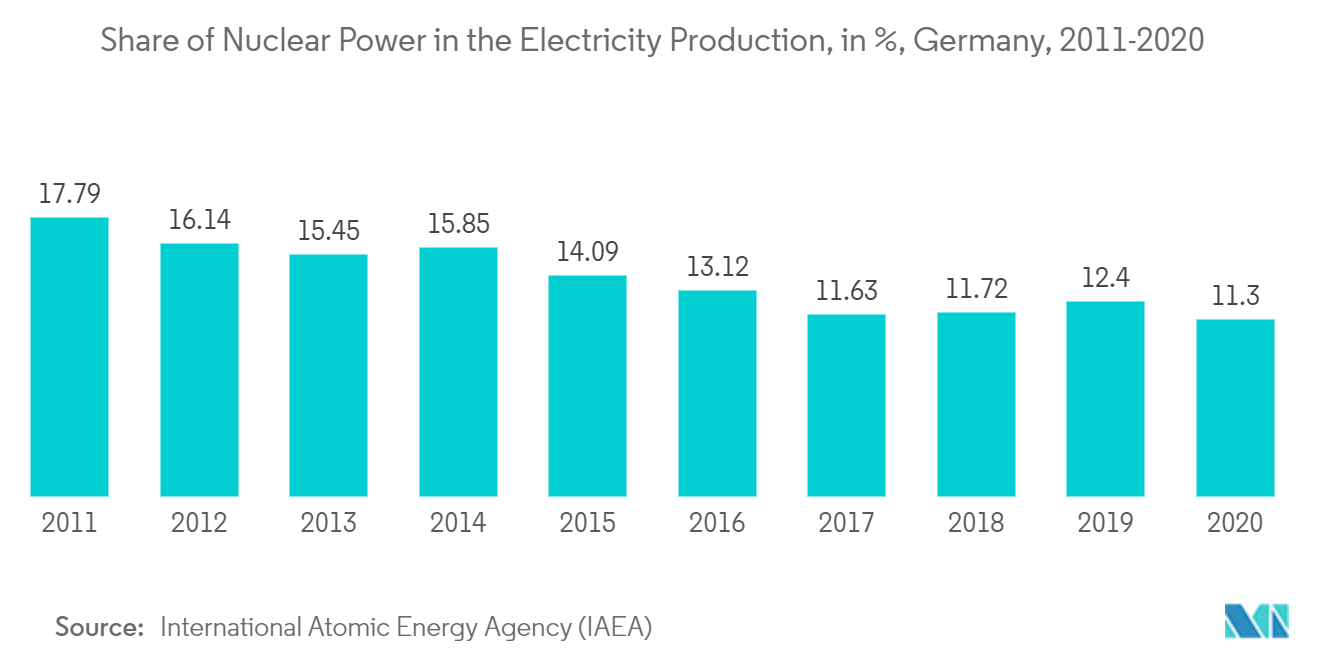
- According to International Atomic Energy Agency, the nuclear power contribution to the electricity mix witnessed a staggering downfall from around 17% to 11% in 2020. The German government has pledged to phase out nuclear power completely by 2022. Only three nuclear commercial power plants remain to be decommissioned.
- The three plants currently in operation are Isar-2, Emsland, and Neckarwestheim 2. The total combined capacity of the power plants is 4304MWe. The decommissioning of the nuclear power plants is scheduled for 2022 by the respective developers.
- The fast-paced decommissioning of the commercial power plants is also supported by the currently under-construction nuclear waste repository. This very crucial task is undertaken by the Commission on the Storage of High-level Radioactive Waste. The repository is expected to be constructed by the end of 2022.
- Such kinds of developments are likely to give a boost to the decommissioning of commercial nuclear power plants in the coming years.
Growth of Renewables Expected to Drive the Market
- Renewable energy sources have steadily increased their penetration in the power production of the country in the last decade. The technology development and the favorable policies and programs implemented by the government were the main contributors to the high growth.
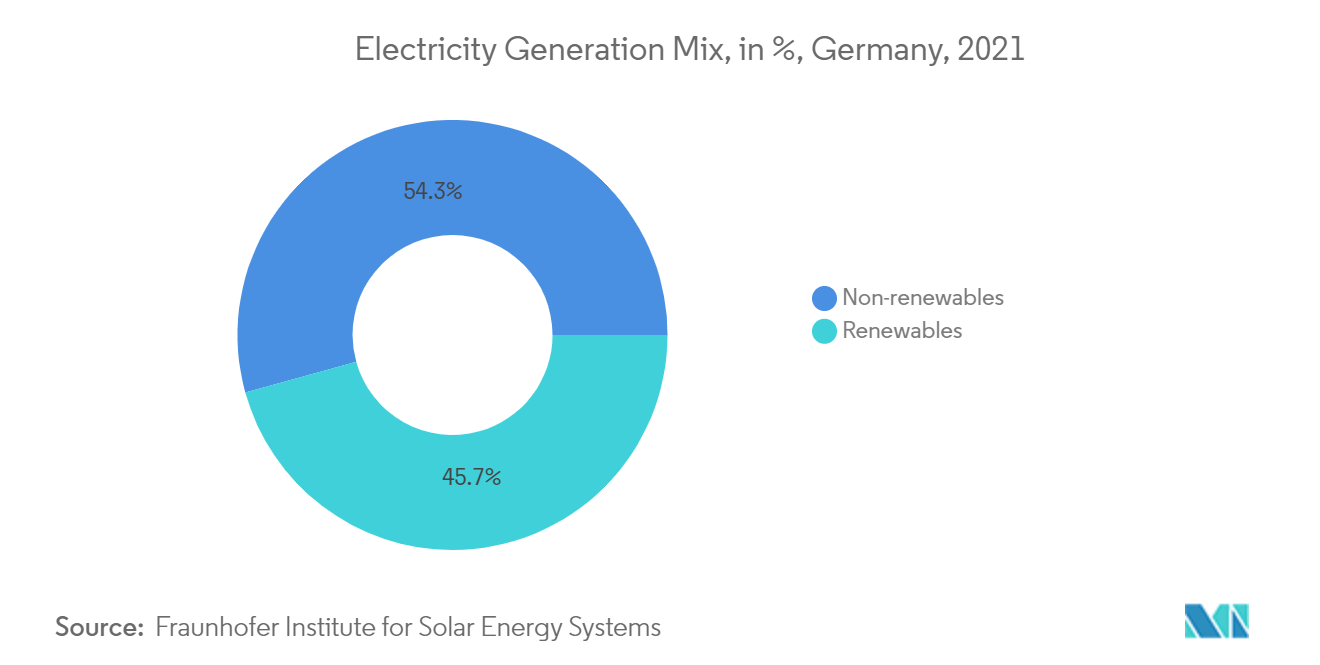
- The renewables' share in the net electricity generation mix was recorded as 45.7% in 2021. The German government has set a target to achieve climate neutrality by 2045 and expand the share of renewables in electricity generation to 80% in 2030.
- Wind and solar energy sources have witnessed the fastest growth in the renewable portfolio of the country on account of the concrete steps taken by the government. As an example, in July 2021, the European Union introduced new legislation to help meet its pledge to reduce the gas emissions that cause global warming by 55% over this decade. The plan also includes the expansion of solar and wind power in the North Sea region to reduce the GHG gas emissions in the power sector.
- The Renewable Energy Act (EEG) came into force in January 2021. The law aims at ensuring 100% renewable electricity supply and 100% renewable electricity consumption by 2050, largely with the help of wind energy development. The law favors the allotment of more land for the onshore wind power projects to reach the renewables targets.
- Such developments are likely to fuel the nuclear power reactor decommissioning market in the years to come.
Regulatory Landscape
Germanys nuclear decommissioning framework is anchored in the Atomic Energy Act (AtG), with decommissioning authorizations handled as licensing under Section 7(3) rather than via a stand-alone decommissioning law. Federal oversight is led by the Federal Office for the Safety of Nuclear Waste Management (BASE) and the Federal Ministry for the Environment, Nature Conservation, Nuclear Safety and Consumer Protection (BMUV), while licensing and day-to-day supervision are executed through competent Laender authorities and guided by established decommissioning guidance (Leitfaden zur Stilllegung).
Regulatory practice favors direct dismantling (Direkter Abbau) as the standard route, while safe enclosure (Sicherer Einschluss) is permitted only in exceptional cases, shaping project sequencing and procurement toward near-term dismantling and waste processing. In parallel, technical standard setting continues through the Kerntechnischer Ausschuss (KTA), including work scheduled in 2026 toward safety rules tailored to plants in decommissioning that are free of fuel elements, which supports more consistent expectations for post-defueling facilities across sites.
Value Chain Analysis
The Germany nuclear reactor decommissioning value chain begins with operator-led planning, characterization and licensing (typically a multi-year process), followed by defueling, decontamination, dismantling of conventional and nuclear-relevant systems, and site remediation and release from nuclear regulatory supervision. In practice, the chain is increasingly driven by post-operational activities across a large installed base: as of December 31, 2024, 33 nuclear power plant units were in decommissioning, with a smaller number already released from nuclear supervision, creating sustained demand for project management, radiological services, segmentation and cutting, packaging, and documentation for clearance or disposal pathways.
Downstream, waste management is a central organizing node, spanning on-site conditioning and interim storage, transport preparation, and interface with national disposal projects (including Konrad for non-heat-generating waste). Recent milestones illustrate the operational flow and bottlenecks: Brokdorf completed defueling of its storage pool in February 2026 by transferring fuel assemblies to on-site interim storage to enable the next decommissioning phase, and BASE reported completion of the final return of reprocessing waste containers to Brokdorf in June 2026. Alongside these steps, the commissioning of additional interim storage facilities for low and intermediate level waste at sites such as Isar (2022), Brunsbuettel (2024), and Emsland (2025) highlights the importance of storage availability and logistics capacity in pacing dismantling programs.
Competitive Landscape
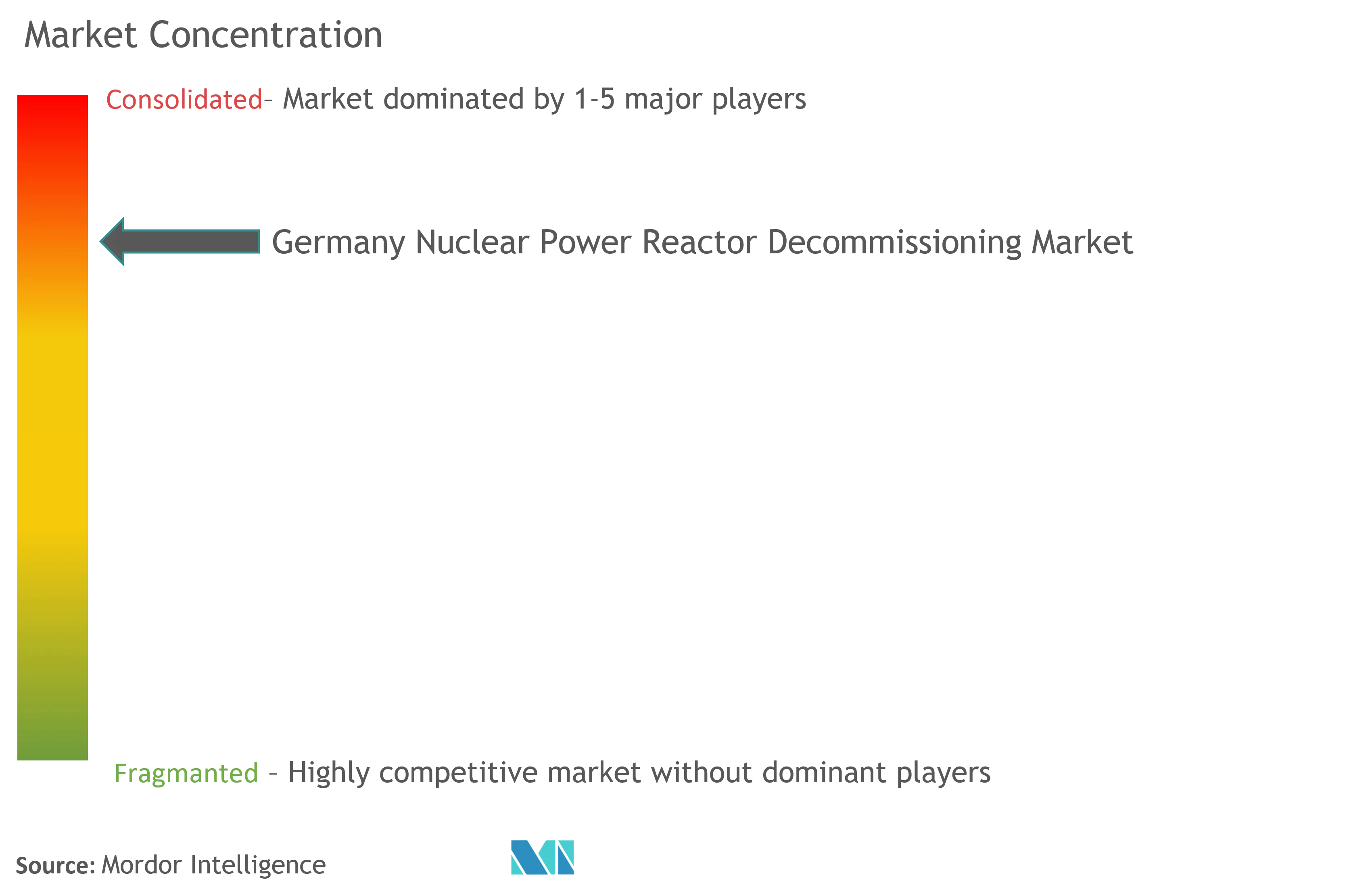
The German nuclear power reactor decommissioning market is moderately consolidated. Some of the key players in this market include RWE AG, EnBW Energie Baden-Württemberg AG, Energiewerke Nord GmbH (EWN), Orano Group, and E.ON SE.
Germany Nuclear Power Reactor Decommissioning Industry Leaders
-
EnBW Energie Baden-Württemberg AG
-
Energiewerke Nord GmbH (EWN)
-
Orano Group
-
E.ON SE
-
RWE AG
- *Disclaimer: Major Players sorted in no particular order
Market Opportunities and Future Outlook
With commercial generation ended and a large fleet already in dismantling, market activity in Germany concentrates on execution-heavy scopes: radiological characterization and decontamination, segmentation and dismantling of primary systems, waste conditioning and packaging, interim storage logistics, and documentation for clearance and site release under AtG and radiation protection requirements. The scale of ongoing work is underscored by BASE reporting 33 nuclear power plant units in decommissioning as of December 31, 2024, which keeps a sizable pipeline of multi-year projects across commercial and other reactor-related installations.
Near-term whitespace for service providers and technology suppliers is visible around permit-driven phase changes and post-defueling acceleration, where sites move from preparatory work into larger structural dismantling and waste flows. Examples include RWE receiving a license in September 2024 for the decommissioning and dismantling of the Emsland plant, and PreussenElektra obtaining a license in December 2025 for the second dismantling phase at Brunsbuettel, both of which broaden addressable scopes for specialized contracting and tooling. The completion of key waste logistics steps in 2026, such as the final return of high-level waste containers to the Brokdorf interim storage facility, also reinforces demand for transport, handling, and compliant interim storage support services that enable continuous dismantling progress.
Recent Industry Developments
- June 2026: PreussenElektra completed the final return of high-level radioactive waste containers from the UK (Sellafield) to the Brokdorf interim storage facility. Closing this international return program reduces open logistics dependencies and strengthens the sites readiness for later dismantling steps that increase waste handling intensity.
- May 2026: PreussenElektra received the second and final dismantling permit for the Grohnde nuclear power plant from the Lower Saxony Ministry for the Environment, Energy and Climate Protection. The authorization enables broader dismantling activities beyond earlier phases, supporting a transition from preparatory work into higher-volume component removal and waste conditioning.
- September 2024: RWE received the license for the decommissioning and dismantling of the Emsland nuclear power plant. The approval formalized the move into regulated dismantling execution, expanding tenderable scopes for decontamination, dismantling, and waste management services tied to the site.
Research Methodology Framework and Report Scope
Market Definition and Coverage
This market covers the paid services and project work needed to safely shut down, dismantle, and remediate nuclear power reactors in Germany, including planning, licensing support, decontamination, dismantling, and site restoration work tied to reactor decommissioning.
Scope exclusions: Excluded from sizing are long-term offsite spent fuel disposal services and non-reactor nuclear facility decommissioning that is not directly linked to a power reactor site.
Segmentation Overview
- Reactor Type
- Pressurized Water Reactor
- Pressurized Heavy Water Reactor
- Boiling Water Reactor
- High Temperature Gas-cooled Reactor
- Liquid Metal Fast Breeder Reactor
- Other Reactor Types
- Application
- Commercial Power Reactor
- Prototype Power Reactor
- Research Reactor
- Capacity
- Below 100MW
- 100-1000MW
- Above 1000MW
Data Sources, Market Sizing, and Validation
Desk Research
Desk research was used to build the fact base around Germany reactor shutdown timelines, decommissioning status, and the rules that shape sequencing of work and allowable methods. We relied on public and official sources such as the German Federal Ministry for the Environment, Nature Conservation, Nuclear Safety and Consumer Protection (BMUV), the Federal Office for the Safety of Nuclear Waste Management (BASE), and reports from the International Atomic Energy Agency (IAEA) to align terminology, milestones, and typical project phases.
We also reviewed operator and contractor disclosures such as annual reports, investor presentations, and press releases to identify project progress signals, budget ranges when disclosed, and contractor roles across work packages. For cross-checks, we used non-paywalled sources such as the OECD Nuclear Energy Agency (NEA) publications and Eurostat energy statistics to keep plant lists, capacity references, and closures consistent. We complemented this with paid company financials and a news subscription, plus a patent database, to track changes in technology and service intensity over time. These sources are not exhaustive, and many other public documents were reviewed for data collection, validation, and clarification.
Primary Interviews and Surveys
Primary work focused on validating the pace and cost intensity of major decommissioning steps in Germany, especially where public disclosures were limited or reported in different formats. We spoke with a mix of decommissioning service providers, engineering and project management specialists, waste handling partners, and informed stakeholders who track licensing and site activities. Their input helped us firm up assumptions on timing, unit costs, and realistic productivity ranges.
Because this is a single-country market, our outreach prioritized Germany-based participants, and the responses were used to confirm what portion of spending is likely to fall into each project phase during the study period.
Distribution of primary research fieldwork respondents
| Company type | Respondent position |
|---|---|
| Top tier: 27% | CXOs: 15% |
| Mid tier: 54% | Functional/Unit leaders: 27% |
| Smaller Players: 19% | Managers: 58% |
Market-Sizing & Forecasting
Sizing starts with a top-down build that reconstructs the demand pool from Germany reactor decommissioning schedules, unit capacity bands, and expected work phase sequencing, and then converts that activity path into annual spending. In practice, the model follows the project flow from post-shutdown preparation through dismantling and site remediation, which are then translated into year-by-year market value using phase-level cost intensity and typical duration ranges.
To keep totals realistic, results are corroborated with selective bottom-up checks. We mainly sampled known project packages, translated observed scope into approximate labor, equipment, and services value, and then checked that against plausible annual throughput. Inputs used in the model include the number of reactor units in decommissioning, capacity category (below 100 MW, 100 to 1000 MW, and above 1000 MW), expected decontamination and dismantling duration, waste handling and conditioning intensity, and inflation-adjusted service pricing where contracts and public references allow. When a project has incomplete public detail, we fill gaps using ranges confirmed in interviews and apply conservative midpoints until a new milestone or disclosure warrants an adjustment.
For forecasting, we use scenario analysis supported by a simple time-series smoothing check so step changes from project milestone clustering are captured without overreacting to single-year spikes. Assumptions on milestone timing and cost progression are finalized only after they align with licensing cadence, onsite readiness signals, and what practitioners describe as achievable execution pace.
Data Validation & Update Cycle
Validation is handled through cross-checks between the model outputs and independent signals, including publicly tracked reactor status, decommissioning milestone announcements, and the implied annual spend per unit capacity for comparable German projects. Outliers are flagged when annual values jump without a matching milestone change, and then the underlying drivers, such as phase mix, duration, or pricing, are reviewed and corrected.
Before sign-off, estimates go through a multi-step analyst review where assumptions are tested for internal consistency across years and against what interviewees indicated as feasible staffing and execution ranges. Reports are refreshed annually, and interim updates are triggered when material events occur (for example, a major licensing decision, a schedule shift, or a large contract announcement). Before delivery, a final pass is completed to ensure the latest public updates are reflected in the numbers and narrative.
Mordor Intelligence's Germany Nuclear Power Reactor Decommissioning Market Size Versus Other Published Estimates
Published market values for Germany reactor decommissioning can look far apart because the spending being counted is not always the same, and the timing of when spending is recognized also varies by publisher. Differences usually come from what gets included around waste handling, how multi-year projects are spread across calendar years, and how quickly the model is refreshed after new licensing or schedule updates.
Long-term offsite spent fuel disposal and national repository programs are a key driver of spread, since some estimates bundle these costs into decommissioning even though they behave like separate, policy-led programs. Another gap comes from whether prototypes and research reactors are counted alongside commercial units, and whether pricing is escalated using general inflation or project-phase specific cost progression. In our case, the escalation approach is checked against practitioner inputs, not only desk assumptions.
Benchmark comparison
| Source | Market Size | Gaps in Research Methodology |
|---|---|---|
| Mordor Intelligence | USD 0.00 B (2026) | |
| Industry Association A | USD 0.00 B (2026) | Often blends reactor dismantling with broader nuclear waste program outlays, which can pull in long-duration repository and transport costs that do not track yearly site decommissioning activity. |
| Global Consultancy B | USD 0.00 B (2027) | May smooth multi-year spending too aggressively and apply uniform price escalation, which can understate milestone-driven peaks when dismantling work and waste conditioning ramp up. |
The table shows that most variance is explained by what is counted as decommissioning versus adjacent waste programs, and by how spending is time-phased across the project calendar. Offsite spent fuel disposal sits outside Mordor Intelligence's scope, which keeps the estimate tied to plant-level decommissioning work that can be tracked through milestones, phase mix, and service pricing checks.
Key Questions Answered in the Report
What is the current Germany Nuclear Power Reactor Decommissioning Market size?
The Germany Nuclear Power Reactor Decommissioning Market is projected to register a CAGR of 3.41% during the forecast period (2026-2031)
Who are the key players in Germany Nuclear Power Reactor Decommissioning Market?
EnBW Energie Baden-Württemberg AG, Energiewerke Nord GmbH (EWN), Orano Group, E.ON SE and RWE AG are the major companies operating in the Germany Nuclear Power Reactor Decommissioning Market.
What years does this Germany Nuclear Power Reactor Decommissioning Market cover?
The report covers the Germany Nuclear Power Reactor Decommissioning Market historical market size for years: 2020, 2021, 2022, 2023 and 2024. The report also forecasts the Germany Nuclear Power Reactor Decommissioning Market size for years: 2026, 2027, 2028, 2029, 2030 and 2031.