
Germany MLCC Market Size and Share
Market Overview
| Study Period | 2020 - 2031 |
|---|---|
| Forecast Data Period | 2026 - 2031 |
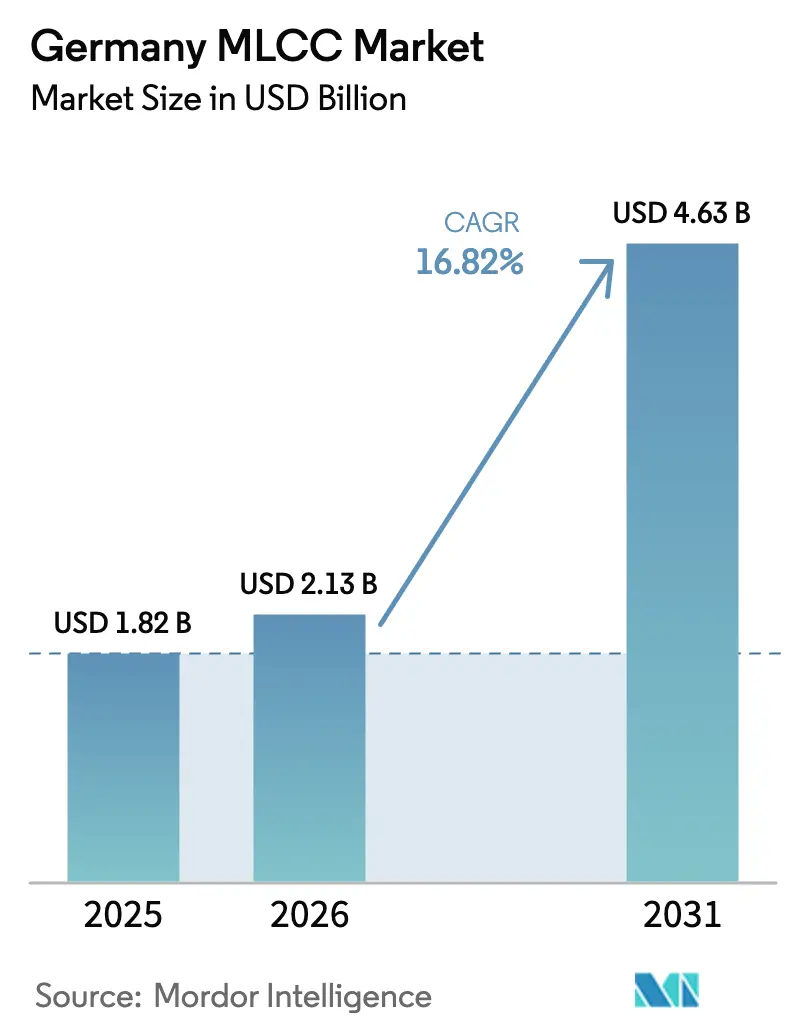
| Base Year Market Size (2025) | USD 1.82 Billion |
| Market Size (2026) | USD 2.13 Billion |
| Market Size (2031) | USD 4.63 Billion |
| Growth Rate (2026 - 2031) | 16.82 % |
| Market Concentration | Medium |
Major Players *Disclaimer: Major Players sorted in no particular order Image © Mordor Intelligence. Reuse requires attribution under CC BY 4.0. | |
Germany MLCC Market Analysis by Mordor Intelligence
The Germany MLCC market size was valued at USD 1.82 billion in 2025 and estimated to grow from USD 2.13 billion in 2026 to reach USD 4.63 billion by 2031, at a CAGR of 16.82% during the forecast period (2026-2031). Momentum stems from electrification of premium vehicles, nationwide 5G coverage reaching 91%, and a renewed Industry 4.0 push that keeps passive-component content rising in every factory cell. Automotive OEMs demand high-capacitance Class 1 devices for 48 V and emerging 800 V powertrains, while telecom operators specify low-ESR parts for millimeter-wave radios. Parallel EU supply-chain localization regulations are persuading Asian leaders to expand German or broader EU packaging lines, thereby mitigating extended global lead times. Raw-material volatility for barium titanate and precious metals persists; however, vertically integrated suppliers shield their margins through in-house powder synthesis and hedged palladium contracts.
Key Report Takeaways
- By dielectric type, Class 1 held 62.14% of the Germany MLCC market share in 2025 and is also expected to record the fastest growth rate of 18.02% through 2031.
- By case size, 201 devices captured a 55.92% revenue share in 2025, while the 402 footprint is projected to expand at an 17.96% CAGR through 2031.
- By voltage rating, low-voltage (≤100 V) parts commanded 58.71% of the Germany MLCC market size in 2025 and are expected to advance at an 17.98% CAGR during the forecast period.
- By capacitance range, low-range units accounted for 58.63% share in 2025; mid-range variants represent the quickest-growing bracket at an 17.93% CAGR through 2031.
- By mounting type, surface-mount technology led with a 41.12% market share in 2025, whereas metal-cap formats are expected to deliver the highest 17.71% CAGR to 2031.
- By end-user application, consumer electronics represented a 50.82% share in 2025; automotive applications are projected to register the strongest 18.21% CAGR through 2031.
Note: Market size and forecast figures in this report are generated using Mordor Intelligence’s proprietary estimation framework, updated with the latest available data and insights as of 2026.
Germany MLCC Market Trends and Insights
Drivers Impact Analysis*
| Driver | (~) % Impact on CAGR Forecast | Geographic Relevance | Impact Timeline |
|---|---|---|---|
| Electrification of Germany’s automotive sector | +4.2% | Nationwide OEM and Tier-1 supply chain | Medium term (2-4 years) |
| Industry 4.0 automation surge | +3.1% | Manufacturing corridors in Bavaria, Baden-Württemberg, NRW | Long term (≥4 years) |
| 5G handset and infrastructure roll-out | +2.8% | National telecom clusters; spillover to EU 5G nodes | Short term (≤2 years) |
| SiC/GaN power-module adoption | +2.1% | Automotive and industrial power-electronics hubs | Medium term (2-4 years) |
| Device miniaturization imperative | +2.3% | Consumer-electronics and medical-device design centers | Medium term (2-4 years) |
| EU supply-chain localization push | +1.9% | Germany as primary EU beneficiary | Long term (≥4 years) |
| Source: Mordor Intelligence | |||
Electrification of Germany’s Automotive Sector
Electric-vehicle output touched 1.25 million units in 2023, cementing Germany as the world’s second-largest EV producer after China. Each premium EV integrates 18,000–20,000 MLCCs, triple the count in internal-combustion models, while Euro 7 rules, effective November 2026, require additional on-board diagnostics that increase the density of passive components. Patent filings by German firms in traction inverters, 48 V boards, and battery-management ECUs underscore a sustained pipeline of high-capacitance 100 V devices qualified to AEC-Q200. Tier-1 suppliers are increasingly co-designing MLCC arrays with semiconductor manufacturers to match wide-bandgap SiC switching frequencies, thereby boosting demand for Class 1 C0G parts with low dissipation factors. This automotive pull-through underpins the fastest-growing end-user segment across the Germany MLCC market.
5G Handset and Infrastructure Roll-out
Bundesnetzagentur shows 91% population coverage by at least one 5G operator as of 2024. [1]Bundesnetzagentur, “Updates interactive mobile communications map,” bundesnetzagentur.de Base-station vendors source high-frequency, low-inductance MLCCs for massive-MIMO radios, while handset OEMs require sub-0402 decoupling capacitors to meet board-space limits. Industrial 5G licenses for plant-level networks drive additional orders for high-temperature MLCCs that can withstand the harsh conditions of factory floors as densification shifts toward 26–28 GHz. MLCCs with NP0 dielectric and minimal microphonic noise become crucial for maintaining signal integrity in phased-array power amplifiers. Together, these factors contribute a 2.8 percentage-point increase to the forecasted CAGR.
Industry 4.0 Automation Surge
German companies rate their digital maturity at 2.8/5.0, implying a deep runway for connected sensors and edge-compute modules. [2]DIHK, “DIHK-Digitalisierungsumfrage 2025,” dihk.de Siemens’s EUR 500 million Erlangen lighthouse achieved 69% productivity gains and a 42% reduction in energy consumption through the full deployment of its digital twin. Similar retrofits across Bavaria and Baden-Württemberg are spurring orders for ruggedized MLCCs, specified for 150 °C and 2,000-hour endurance. EU grants under the Chips Act further subsidize passive-component pilot lines adjacent to microcontroller fabs, fostering domestic sourcing. The compounded need for vibration-resistant MLCCs in servo-drives elevates the segment’s long-term contribution to growth.
Device Miniaturization Imperative
Murata’s 0.16 mm × 0.08 mm 006003-inch MLCC, introduced in 2024, reduced the volume by 75% compared to prior generations. [3]Murata Manufacturing, “World’s smallest multilayer ceramic capacitor,” murata.com Smartphones now embed up to 1,000 devices, but smart-watches and hearing aids require even denser populations, raising demand for ultra-thin layers and laser-trimmed electrodes. Automotive zonal-controller architectures also conserve PCB real estate, prompting OEMs to switch from 0603 parts to 0402 or 0201 footprints without compromising reliability. Suppliers with thin-layer forming and AI-driven inspection technologies capture these design-ins, contributing 2.3 percentage points to industry CAGR.
Restraints Impact Analysis*
| Restraint | (~) % Impact on CAGR Forecast | Geographic Relevance | Impact Timeline |
|---|---|---|---|
| Raw-material cost volatility | -2.1% | Global ceramic-powder and precious-metal flows | Short term (≤2 years) |
| Global capacity crunch and extended lead-times | -1.8% | Worldwide supply chains affecting German OEMs | Medium term (2-4 years) |
| Potential trade tensions with China | -1.5% | EU import routes for MLCC precursors | Short term (≤2 years) |
| Industrial energy-price inflation in Germany | -1.3% | Domestic sintering and plating facilities | Medium term (2-4 years) |
| Source: Mordor Intelligence | |||
Raw-material Cost Volatility
Barium-titanate powder prices have fluctuated by 37% since 2023, and palladium spot spikes add further stress, eroding German contract margins. Energy-intensive sintering lines face elevated electricity tariffs linked to the EU Emissions Trading System, forcing local producers to hedge their costs via long-term fixed-price renewable energy contracts. OEMs prefer partners with in-house powder plants who can guarantee stable formulations and batch-to-batch dielectric constants. Smaller specialty houses lacking integration are squeezed, prompting consolidation despite robust demand.
Global Capacity Crunch and Lead-times
Semiconductor shortages cascaded into passives, with MLCC lead times rising beyond 20 weeks in early 2024. German vehicle makers lost EUR 99 billion in revenue between 2021-2023 due to component gaps, compelling buffer-stock policies that tie up working capital. While major Asian producers have ramped up capacity in Malaysia and the Philippines, EU import dependence remains at nearly 84%. The resulting bottlenecks shave up to 1.8 percentage points off the forecast CAGR until new European lines come online post-2026.
*Our forecasts treat driver/restraint impacts as directional, not additive. The impact forecasts reflect baseline growth, mix effects, and variable interactions.
Segment Analysis
By Dielectric Type: Class 1 Stability Secures Premium Slots
Class 1 MLCCs held a 62.14% market share in the German MLCC market in 2025, reflecting their tight capacitance drift of ±30 ppm/°C, which is valued in radar, LiDAR, and precision drivetrain inverters. The German MLCC market size for Class 1 parts is projected to grow at a 18.02% CAGR through 2031 as the Euro 7 mandates push OEMs toward fail-operational sensor redundancy. Engineers embed C0G/NP0 capacitors inside motor-drive gate boards where 175 °C junctions demand unwavering dielectric performance.
Class 2 devices, making up the balance, ride the electric-vehicle boom as high-permittivity X7R powders furnish up to 47 µF per 0402 case. Battery-management systems require bulk decoupling near pack-level FETs, and German Tier 1s co-locate these stacks to minimize ESL. Although Class 2 shows slower growth, suppliers emphasize resin-coated variants to improve flex-crack resilience under mechanical shock, protecting their foothold in infotainment and telecom baseband cards.




By Case Size: 201 Dominant, 402 Fastest Rising
The 201 footprint retained a 55.92% share of the German MLCC market in 2025, as it balances automated pick-and-place yields and 25V rating sufficiency for most mobile RF chains. Nevertheless, 402 shipments clock an 17.96% CAGR, shrinking board area inside wearables and emerging zonal ECUs. Germany MLCC market size for 402 devices is forecast to nearly triple by 2030 as Murata’s 47 µF part validates high-density decoupling for SoC clusters.
Larger 1210 footprints persist in inverter and charging modules, where high ripple current needs broader terminals. Meanwhile, prototype 006003 devices are penetrating the hearables and medical capsule markets, selling at premium margins to offset CAPEX for advanced lithographic stacking.
By Voltage Rating: Low-Voltage Category Anchors Volume
Low-voltage (≤100 V) components commanded 58.71% of the German MLCC market size in 2025, due to the dominance of 12 V vehicle sub-nets and handset power-management ICs. This bracket is also the growth engine, expanding at an 17.98% CAGR, as 48 V mild-hybrid rails still specify ≤100 V capacitors for margin.
Mid-voltage (100–500 V) demand scales with the adoption of servo-drive retrofits, and high-voltage (>500 V) units experience niche uptake in DC fast chargers. TDK’s 10 µF/100 V 3225 product lines meet the smoothing requirements near GaN transistors, capturing a share in German EV wall-box production.
By Mounting Type: Surface-Mount Rules, Metal-Cap Gains Ground
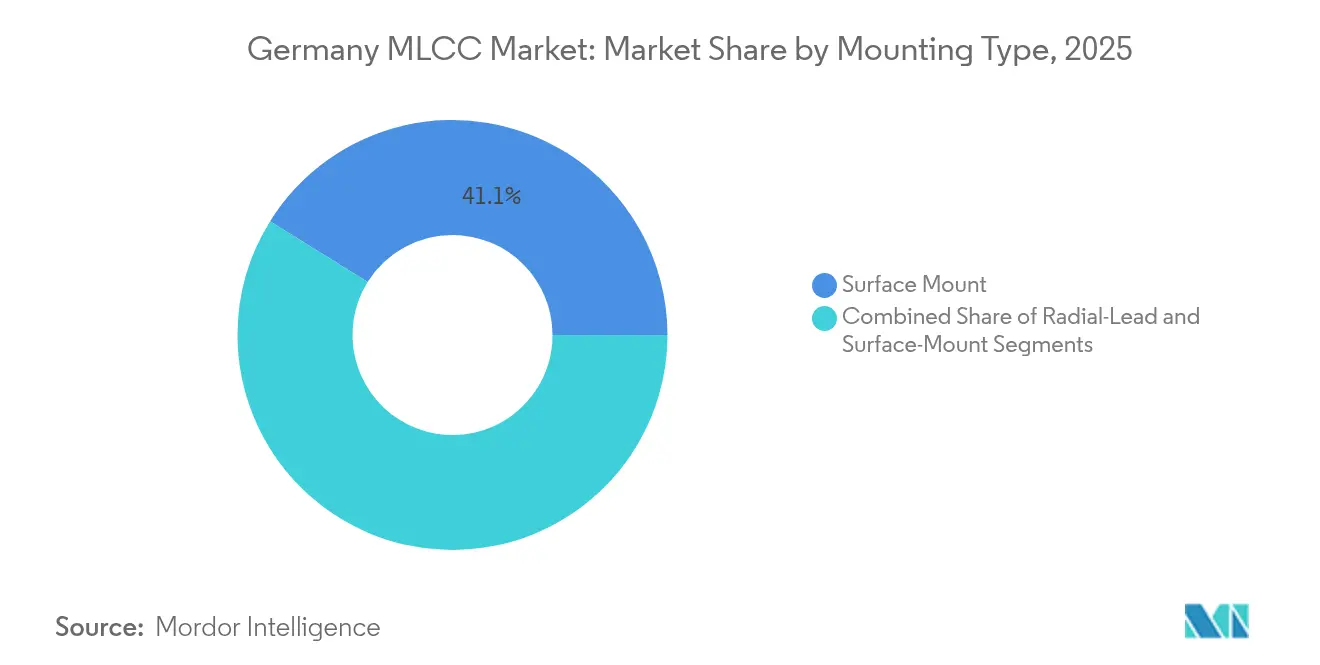
Surface-mount devices (SMDs) covered a 41.12% share of the German MLCC market in 2025, driven by SMT automation lines operating at 80,000 cph across EMS providers. Metal-cap formats, however, expand at an 17.71% CAGR as electronics engineers in Bavaria specify them for SiC modules that require thermal cycling robustness.
Radial-lead parts remain in use in railway signaling and wind-turbine control cabinets, where through-hole assembly facilitates serviceability. Flexible termination options across all mount types help limit board-level flex cracking under automotive thermal excursions.
By End-user Application: Automotive Momentum Reshapes Orderbooks
Consumer electronics held a 50.82% share in 2025, buoyed by smartphone refresh cycles and European tablet builds. Still, the Germany MLCC market size tied to automotive will overtake handsets by 2029, given its 18.21% CAGR. Premium EV dashboards integrate 5+ displays and zone controllers, resulting in MLCC counts per vehicle that far exceed consumer electronics averages.
Industrial controls absorb ruggedized parts as machine-tool OEMs retrofit OPC-UA nodes, while telecom infrastructure orders hinge on 5G mid-band densification. Medical, defense, and renewable-energy niches purchase lower volumes but drive the technology frontiers for high-reliability capacitors, which, over time, cascade into broader applications.
Competitive Landscape
Innovation and Customization Drive Future Success
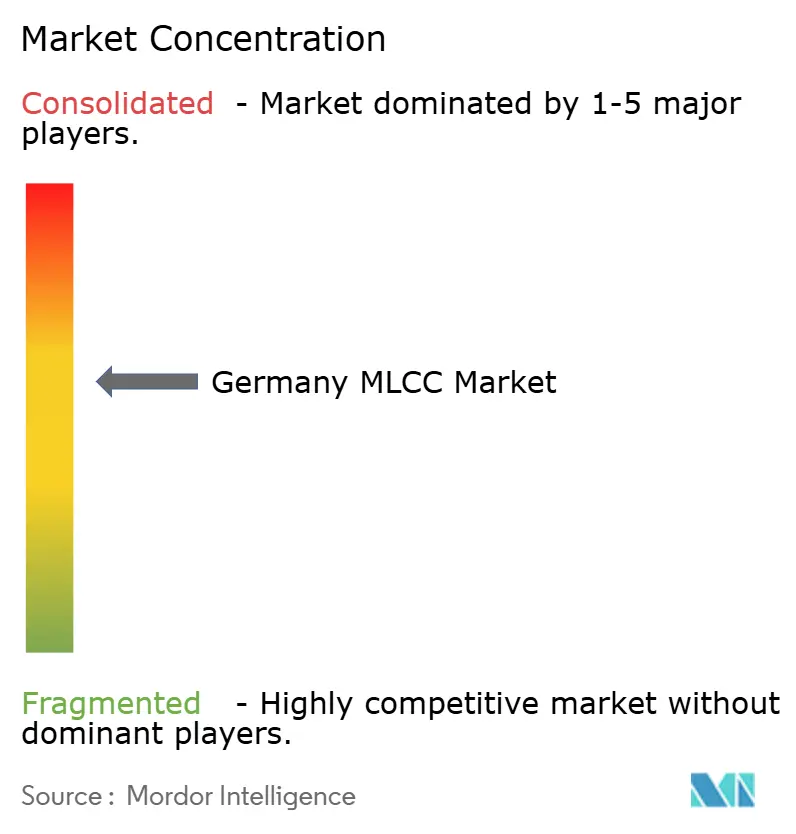
Market concentration remains moderate: the five largest suppliers collectively hold about 62% of the German MLCC market share, while boutique European players focus on defense and medical applications. Asian giants-Murata, TDK, Samsung Electro-Mechanics, and Taiyo Yuden-retain technology leadership through ultrathin dielectric layering and AI-enabled inspection. Vertically integrated players employ captive powder lines, which buffer barium-titanate price spikes and offer German OEMs stable, long-term pricing.
Strategically, suppliers localize application engineering labs near Stuttgart and Wolfsburg to co-design capacitor arrays with Tier 1 inverter specialists. Murata’s 2025 launch of mass-produced 47 µF/0402 parts underpins its pole position in miniaturization. TDK’s 100 V/10 µF CGA series secured design wins in 48 V power nets at two leading OEMs, driving share gains. Samsung Electro-Mechanics targets USD 750 million in automotive sales by scaling copper-electrode high-capacity MLCCs, which reduce the cost per µF for EV battery packs.
Emerging entrants leverage sintered-silver terminations to enhance vibration endurance, but must clear stringent AEC-Q200 tests that span 1,000 hours of high-humidity storage. Supply-chain localization discourse is intense: European Commission proposals to subsidize passives mirror incentives for chips, yet the CAPEX profile of ceramic lines means only scale players will commit. Overall rivalry hinges equally on process innovation, powder security, and customer proximity.
Germany MLCC Industry Leaders
Murata Manufacturing Co., Ltd.
Samsung Electro-Mechanics Co., Ltd.
Kyocera AVX Components Corporation
TDK Corporation
Yageo Corporation
- *Disclaimer: Major Players sorted in no particular order

Geography Analysis
Germany concentrates more than 45% of total European MLCC consumption, thanks to 4.1 million vehicles produced in 2023 and heavy exports to North America and China. Bavaria and Baden-Württemberg together host five of Europe’s top ten EV assembly plants; each gigafactory-style campus issues annual MLCC bids exceeding USD 100 million. Rhineland-Palatinate and Lower Saxony add incremental volumes through industrial-machinery clusters where servo-drives and PLC backplanes escalate board counts.
The Germany MLCC market size in Bavaria alone is projected to post a 17.28% CAGR as Munich’s semiconductor valley co-locates passives packaging to shorten lead-times. In contrast, northern port regions import higher finished components rather than fabricate locally, keeping their growth to mid-teens. EU regional-aid funds earmarked for passive-component diversification could tilt future share toward Saxony by 2028 once new fabs tied to the European Chips Act go live.
Cross-border dynamics still matter: 75% of German-assembled cars ship abroad, exposing MLCC demand to U.S. IRA subsidies and Chinese NEV credit policy swings. Any Sino-EU trade tension may accelerate nearshoring of electrode-plating stages to Polish and Czech plants, modifying intra-EU logistics yet keeping German design centers in control of qualification and purchasing.
Recent Industry Developments
- July 2025: Murata began world-first mass production of 47 µF MLCCs in 0402 size, shrinking board area by 60%.
- April 2025: TDK debuted 100 V/10 µF MLCCs in 3225 case for 48 V automotive rails, fully AEC-Q200 qualified
- January 2025: Bundesnetzagentur confirmed 91% population 5G coverage, strengthening telecom-grade MLCC demand.
- October 2024: Siemens Erlangen plant won World Economic Forum Lighthouse status after EUR 500 million digital upgrade.


Germany MLCC Market Report Scope
Class 1, Class 2 are covered as segments by Dielectric Type. 0 201, 0 402, 0 603, 1 005, 1 210, Others are covered as segments by Case Size. 500V to 1000V, Less than 500V, More than 1000V are covered as segments by Voltage. 100µF to 1000µF, Less than 100µF, More than 1000µF are covered as segments by Capacitance. Metal Cap, Radial Lead, Surface Mount are covered as segments by Mlcc Mounting Type. Aerospace and Defence, Automotive, Consumer Electronics, Industrial, Medical Devices, Power and Utilities, Telecommunication, Others are covered as segments by End User.| Class 1 |
| Class 2 |
| 201 |
| 402 |
| 603 |
| 1005 |
| 1210 |
| Other Case Sizes |
| Low Voltage (less than or equal to 100 V) |
| Mid Voltage (100 – 500 V) |
| High Voltage (above 500 V) |
| Metal-Cap |
| Radial-Lead |
| Surface-Mount (SMD) |
| Aerospace and Defence |
| Automotive |
| Consumer Electronics |
| Industrial |
| Medical Devices |
| Power and Utilities |
| Telecommunication |
| Other Applications |
| By Dielectric Type | Class 1 |
| Class 2 | |
| By Case Size | 201 |
| 402 | |
| 603 | |
| 1005 | |
| 1210 | |
| Other Case Sizes | |
| By Voltage Rating | Low Voltage (less than or equal to 100 V) |
| Mid Voltage (100 – 500 V) | |
| High Voltage (above 500 V) | |
| By Mounting Type | Metal-Cap |
| Radial-Lead | |
| Surface-Mount (SMD) | |
| By End-user Application | Aerospace and Defence |
| Automotive | |
| Consumer Electronics | |
| Industrial | |
| Medical Devices | |
| Power and Utilities | |
| Telecommunication | |
| Other Applications |


Market Definition
- MLCC (Multilayer Ceramic Capacitor) - A type of capacitor that consists of multiple layers of ceramic material, alternating with conductive layers, used for energy storage and filtering in electronic circuits.
- Voltage - The maximum voltage that a capacitor can safely withstand without experiencing breakdown or failure. It is typically expressed in volts (V)
- Capacitance - The measure of a capacitor's ability to store electrical charge, expressed in farads (F). It determines the amount of energy that can be stored in the capacitor
- Case Size - The physical dimensions of an MLCC, typically expressed in codes or millimeters, indicating its length, width, and height
| Keyword | Definition |
|---|---|
| MLCC (Multilayer Ceramic Capacitor) | A type of capacitor that consists of multiple layers of ceramic material, alternating with conductive layers, used for energy storage and filtering in electronic circuits. |
| Capacitance | The measure of a capacitor's ability to store electrical charge, expressed in farads (F). It determines the amount of energy that can be stored in the capacitor |
| Voltage Rating | The maximum voltage that a capacitor can safely withstand without experiencing breakdown or failure. It is typically expressed in volts (V) |
| ESR (Equivalent Series Resistance) | The total resistance of a capacitor, including its internal resistance and parasitic resistances. It affects the capacitor's ability to filter high-frequency noise and maintain stability in a circuit. |
| Dielectric Material | The insulating material used between the conductive layers of a capacitor. In MLCCs, commonly used dielectric materials include ceramic materials like barium titanate and ferroelectric materials |
| SMT (Surface Mount Technology) | A method of electronic component assembly that involves mounting components directly onto the surface of a printed circuit board (PCB) instead of through-hole mounting. |
| Solderability | The ability of a component, such as an MLCC, to form a reliable and durable solder joint when subjected to soldering processes. Good solderability is crucial for proper assembly and functionality of MLCCs on PCBs. |
| RoHS (Restriction of Hazardous Substances) | A directive that restricts the use of certain hazardous materials, such as lead, mercury, and cadmium, in electrical and electronic equipment. Compliance with RoHS is essential for automotive MLCCs due to environmental regulations |
| Case Size | The physical dimensions of an MLCC, typically expressed in codes or millimeters, indicating its length, width, and height |
| Flex Cracking | A phenomenon where MLCCs can develop cracks or fractures due to mechanical stress caused by bending or flexing of the PCB. Flex cracking can lead to electrical failures and should be avoided during PCB assembly and handling. |
| Aging | MLCCs can experience changes in their electrical properties over time due to factors like temperature, humidity, and applied voltage. Aging refers to the gradual alteration of MLCC characteristics, which can impact the performance of electronic circuits. |
| ASPs (Average Selling Prices) | The average price at which MLCCs are sold in the market, expressed in USD million. It reflects the average price per unit |
| Voltage | The electrical potential difference across an MLCC, often categorized into low-range voltage, mid-range voltage, and high-range voltage, indicating different voltage levels |
| MLCC RoHS Compliance | Compliance with the Restriction of Hazardous Substances (RoHS) directive, which restricts the use of certain hazardous substances, such as lead, mercury, cadmium, and others, in the manufacturing of MLCCs, promoting environmental protection and safety |
| Mounting Type | The method used to attach MLCCs to a circuit board, such as surface mount, metal cap, and radial lead, which indicates the different mounting configurations |
| Dielectric Type | The type of dielectric material used in MLCCs, often categorized into Class 1 and Class 2, representing different dielectric characteristics and performance |
| Low-Range Voltage | MLCCs designed for applications that require lower voltage levels, typically in the low voltage range |
| Mid-Range Voltage | MLCCs designed for applications that require moderate voltage levels, typically in the middle range of voltage requirements |
| High-Range Voltage | MLCCs designed for applications that require higher voltage levels, typically in the high voltage range |
| Low-Range Capacitance | MLCCs with lower capacitance values, suitable for applications that require smaller energy storage |
| Mid-Range Capacitance | MLCCs with moderate capacitance values, suitable for applications that require intermediate energy storage |
| High-Range Capacitance | MLCCs with higher capacitance values, suitable for applications that require larger energy storage |
| Surface Mount | MLCCs designed for direct surface mounting onto a printed circuit board (PCB), allowing for efficient space utilization and automated assembly |
| Class 1 Dielectric | MLCCs with Class 1 dielectric material, characterized by a high level of stability, low dissipation factor, and low capacitance change over temperature. They are suitable for applications requiring precise capacitance values and stability |
| Class 2 Dielectric | MLCCs with Class 2 dielectric material, characterized by a high capacitance value, high volumetric efficiency, and moderate stability. They are suitable for applications that require higher capacitance values and are less sensitive to capacitance changes over temperature |
| RF (Radio Frequency) | It refers to the range of electromagnetic frequencies used in wireless communication and other applications, typically from 3 kHz to 300 GHz, enabling the transmission and reception of radio signals for various wireless devices and systems. |
| Metal Cap | A protective metal cover used in certain MLCCs (Multilayer Ceramic Capacitors) to enhance durability and shield against external factors like moisture and mechanical stress |
| Radial Lead | A terminal configuration in specific MLCCs where electrical leads extend radially from the ceramic body, facilitating easy insertion and soldering in through-hole mounting applications. |
| Temperature Stability | The ability of MLCCs to maintain their capacitance values and performance characteristics across a range of temperatures, ensuring reliable operation in varying environmental conditions. |
| Low ESR (Equivalent Series Resistance) | MLCCs with low ESR values have minimal resistance to the flow of AC signals, allowing for efficient energy transfer and reduced power losses in high-frequency applications. |


Research Methodology
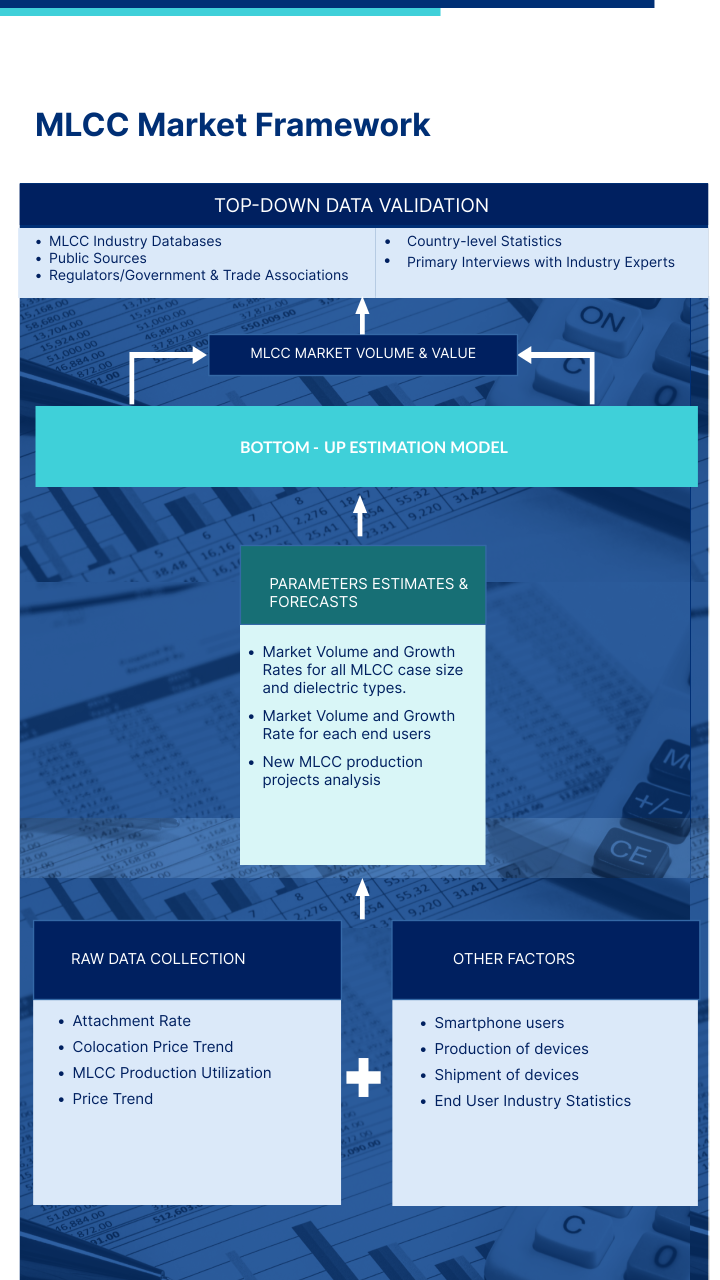
Mordor Intelligence has followed the following methodology in all our MLCC reports.
- Step 1: Identify Data Points: In this step, we identified key data points crucial for comprehending the MLCC market. This included historical and current production figures, as well as critical device metrics such as attachment rate, sales, production volume, and average selling price. Additionally, we estimated future production volumes and attachment rates for MLCCs in each device category. Lead times were also determined, aiding in forecasting market dynamics by understanding the time required for production and delivery, thereby enhancing the accuracy of our projections.
- Step 2: Identify Key Variables: In this step, we focused on identifying crucial variables essential for constructing a robust forecasting model for the MLCC market. These variables include lead times, trends in raw material prices used in MLCC manufacturing, automotive sales data, consumer electronics sales figures, and electric vehicle (EV) sales statistics. Through an iterative process, we determined the necessary variables for accurate market forecasting and proceeded to develop the forecasting model based on these identified variables.
- Step 3: Build a Market Model: In this step, we utilized production data and key industry trend variables, such as average pricing, attachment rate, and forecasted production data, to construct a comprehensive market estimation model. By integrating these critical variables, we developed a robust framework for accurately forecasting market trends and dynamics, thereby facilitating informed decision-making within the MLCC market landscape.
- Step 4: Validate and Finalize: In this crucial step, all market numbers and variables derived through an internal mathematical model were validated through an extensive network of primary research experts from all the markets studied. The respondents are selected across levels and functions to generate a holistic picture of the market studied.
- Step 5: Research Outputs: Syndicated Reports, Custom Consulting Assignments, Databases, and Subscription Platform





 Your data is secure and never sold or shared.


