
Market Overview
| Study Period | 2021 - 2031 |
|---|---|
| Forecast Data Period | 2026 - 2031 |
| Base Year Market Size (2025) | USD 10.30 Billion |
| Market Size (2026) | USD 10.69 Billion |
| Market Size (2031) | USD 12.85 Billion |
| Growth Rate (2026 - 2031) | 3.76 % |
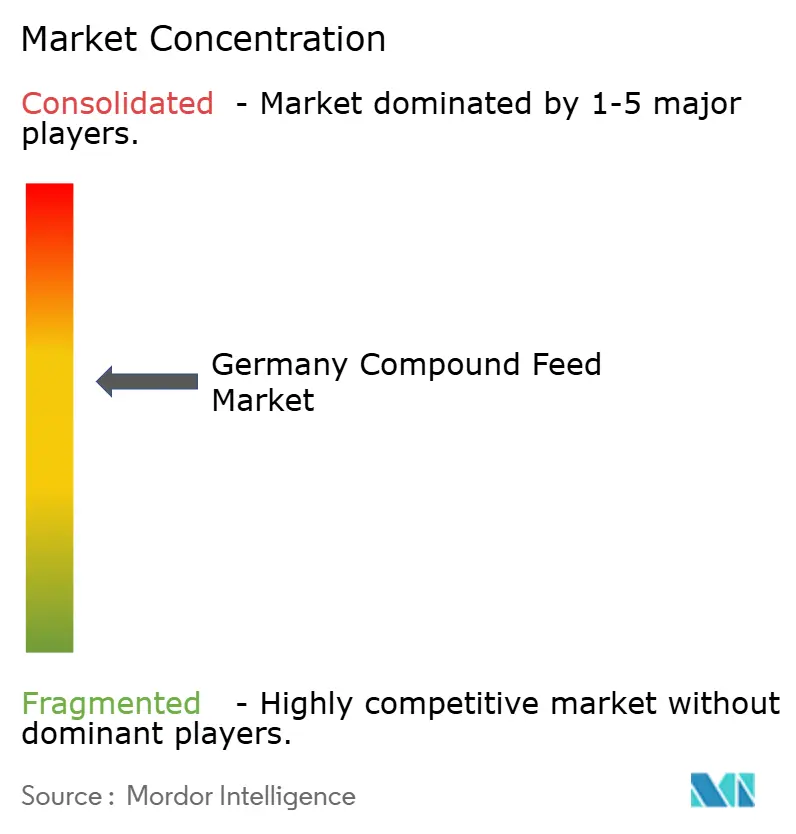
| Market Concentration | Medium |
Major Players *Disclaimer: Major Players sorted in no particular order Image © Mordor Intelligence. Reuse requires attribution under CC BY 4.0. | |
Germany Compound Feed Market Analysis by Mordor Intelligence
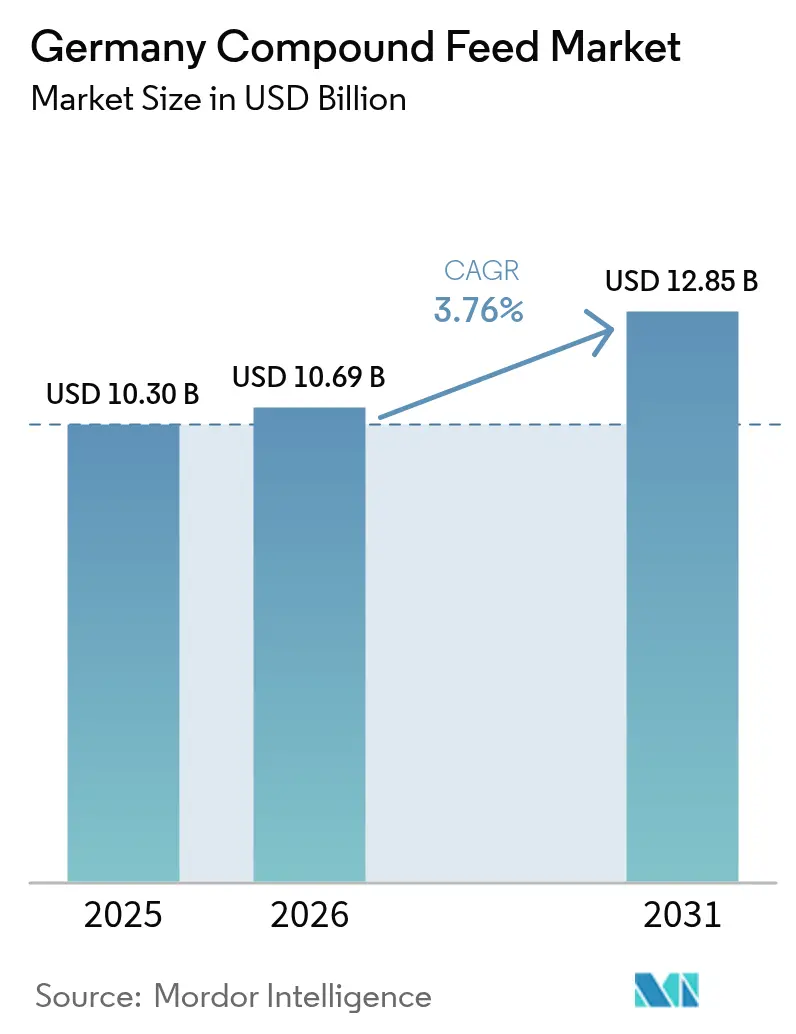
The Germany compound feed market size was valued at USD 10.30 billion in 2025 and estimated to grow from USD 10.69 billion in 2026 to reach USD 12.85 billion by 2031, at a CAGR of 3.76% during the forecast period (2026-2031). This measured expansion masks significant structural shifts beneath the surface, as traditional livestock feeding practices give way to precision nutrition technologies and sustainability-driven formulations. The market's evolution reflects Germany's position as a leading agricultural economy grappling with environmental regulations, changing consumer preferences, and technological innovation in animal nutrition. In Germany, the per capita consumption of poultry meat was 13.1 kg in 2023 and 13.6 kg in 2024, according to the Federal Agricultural Information Center (BZL). Digital ration-formulation tools, growing aquaculture output, and carbon-neutral certification schemes provide new revenue streams for suppliers able to validate environmental performance. Competitive intensity is moderate, with regional cooperatives defending farmer loyalty while multinationals leverage research scale and optimized sourcing networks. Policy incentives that refund capital outlays for on-farm feed mills reshape supply relationships, nudging the industry toward localized mixing capacities and ingredient traceability.
Key Report Takeaways
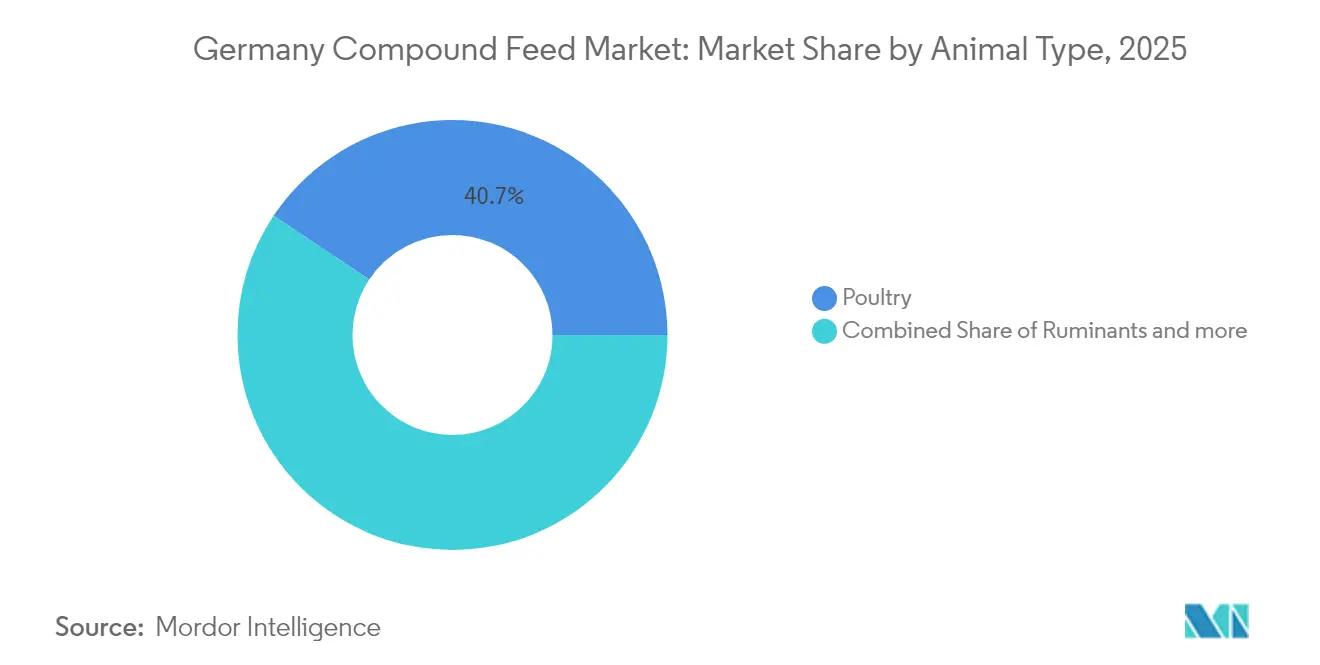
- By animal type, poultry feed led with 40.65% of Germany compound feed market share in 2025, and aquaculture feed is projected to expand at a 6.55% CAGR through 2031.
- By ingredient, cereals accounted for a 51.60% share of the Germany compound feed market size in 2025, while supplements featuring prebiotics and probiotics are projected to expand at an 8.43% CAGR through 2031.
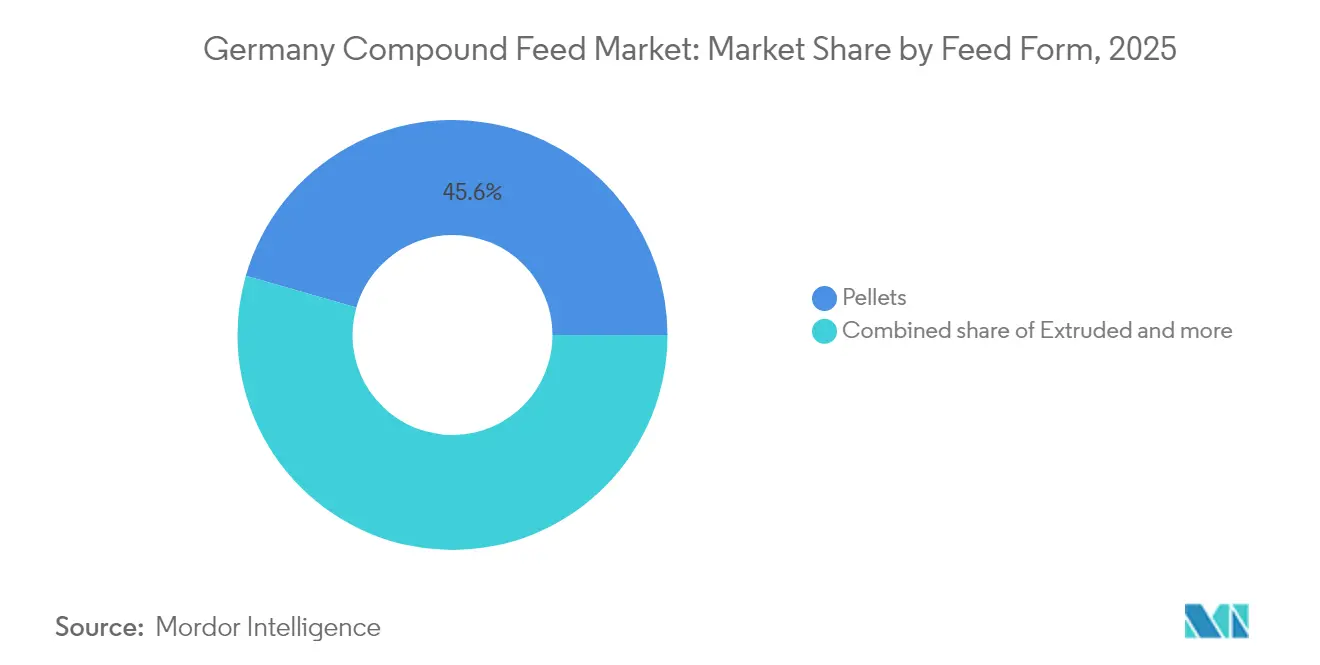
- By form, pellets command the largest Germany compound feed market size at 45.55% in 2025, while extruded feeds emerge as the fastest-growing segment with 8.15% CAGR through 2031.
Note: Market size and forecast figures in this report are generated using Mordor Intelligence’s proprietary estimation framework, updated with the latest available data and insights as of 2026.
Germany Compound Feed Market Trends and Insights
Drivers Impact Analysis*
| Driver | (~) % Impact on CAGR Forecast | Geographic Relevance | Impact Timeline |
|---|---|---|---|
| High demand for animal protein | +0.8% | Germany and wider European Union | Medium term (2-4 years) |
| Need to improve livestock feed efficiency | +0.6% | Germany with technology spillover to European Union | Short term (≤ 2 years) |
| Expansion of integrated poultry and swine mega-farms | +0.5% | Lower Saxony and North Rhine-Westphalia | Medium term (2-4 years) |
| Government incentives for on-farm feed mills | +0.4% | Germany under the Common Agricultural Policy | Long term (≥ 4 years) |
| Emergence of carbon-neutral meat certifications | +0.3% | Early adoption in Germany with European Union expansion | Long term (≥ 4 years) |
| AI-driven precision-feeding adoption | +0.2% | Germany as technology hub | Short term (≤ 2 years) |
| Source: Mordor Intelligence | |||
High Demand for Animal Protein
According to preliminary data from the Federal Agricultural Information Center (BZL), average per capita meat consumption in Germany in 2024 was 53.2 kg, a slight increase from 52.8 kg in 2022 [1]Source: Federal Agricultural Information Center, “Per Capita Meat Consumption in Germany 2024,” bmel.de, demonstrating the resilience of protein demand despite plant-based diet trends. This consumption level, significantly above the global average, sustains robust feed demand across livestock sectors. The protein demand creates opportunities for premium feed formulations that enhance meat quality and production efficiency. German consumers increasingly prioritize meat quality over quantity, driving demand for feeds that support animal welfare standards and premium product positioning. Feed manufacturers respond by developing specialized nutrition programs that optimize protein conversion ratios and support higher-value meat production. The trend toward quality over volume consumption patterns favors sophisticated feed solutions that command premium pricing in the market.
Need to Improve Livestock Feed Efficiency
Margin pressure across German livestock operations accelerates the adoption of precision feeding technologies and enzyme supplementation to optimize feed conversion ratios. Modern German farms increasingly deploy AI-driven feeding systems that adjust rations in real-time based on animal performance data and environmental conditions. Cargill's EUR 200 million (USD 216 million) investment in converting its Krefeld plant from corn to wheat processing in June 2024 reflects industry shifts toward more efficient grain utilization[2]Source: Cargill, “Cargill Converts Krefeld Facility From Corn to Wheat Processing With EUR 200 Million Investment,” cargill.com. Feed efficiency gains of 3-5% through precision nutrition technologies translate directly to improved farm profitability and reduced environmental impact per unit of protein produced. The integration of enzyme technologies, particularly phytases and proteases, enables better nutrient utilization while reducing feed costs and environmental excretion.
Expansion of Integrated Poultry And Swine Mega-Farms
Large-scale integrated poultry and swine operations continue expanding in Germany, creating concentrated demand points for bulk feed supplies and specialized nutrition programs. These mega-farms, particularly prevalent in Lower Saxony and North Rhine-Westphalia, require consistent, high-volume feed deliveries and technical support services that favor established suppliers with logistics capabilities. The consolidation trend benefits feed manufacturers through improved economies of scale and reduced distribution costs per metric tons delivered. Integrated operations also drive demand for customized feed formulations that optimize performance across specific genetic lines and production systems. The scale of these operations enables investment in on-site feed mills and storage facilities, supported by government incentive programs under the Common Agricultural Policy framework.
Government Incentives for On-Farm Feed Mills
In 2022, Germany's Agrarinvestitionsförderungsprogramm (AFP) provided 20-50% grants for agricultural investments, including feed mill equipment and storage facilities, while the Bundesprogramm Umbau Tierhaltung allocates EUR 1 billion (USD 1.08 billion) for animal welfare improvements with up to 60% funding for smaller investments [3]Source: Federal Ministry of Food and Agriculture, “Agricultural Investment Promotion Program and Federal Program for the Transformation of Animal Husbandry: Funding Details,” bmel.de. These programs enable farmers to invest in on-farm feed mixing capabilities, reducing dependence on commercial feed suppliers while improving cost control. The support particularly benefits smaller and medium-sized operations that can achieve better feed cost management through direct ingredient purchasing and custom mixing. European Union common agricultural policy (CAP) funding through eco-schemes and coupled payments provides additional support for livestock operations implementing sustainable feeding practices and precision nutrition.
Restraints Impact Analysis*
| Restraint | (~) % Impact on CAGR Forecast | Geographic Relevance | Impact Timeline |
|---|---|---|---|
| Rising consumer shift toward plant-based diets | -0.7% | Germany with European Union influence | Medium term (2-4 years) |
| Volatile grain and oilseed prices | -0.5% | Germany tied to global markets | Short term (≤ 2 years) |
| Stricter phosphorus-runoff regulations | -0.3% | Germany under European Union alignment | Long term (≥ 4 years) |
| Shrinking livestock herd under Germany’s animal-welfare roadmap | -0.6% | Germany nationwide | Long term (≥ 4 years) |
| Source: Mordor Intelligence | |||
Rising Consumer Shift Toward Plant-Based Diets
In Germany, according to a recent survey report, nearly 8 million people followed a vegetarian diet and 1.58 million people identified themselves as vegan in 2022. This dietary shift particularly impacts younger demographics and urban consumers, influencing long-term protein consumption patterns. Feed manufacturers respond by diversifying into plant-based protein ingredient supply chains and developing feeds for alternative protein production systems. The trend creates opportunities for feeds supporting higher-welfare, premium meat production that appeals to conscious consumers willing to pay premiums for quality over quantity. However, the overall impact reduces traditional feed volume growth and pressures commodity feed pricing in domestic markets.
Volatile Grain and Oilseed Prices
Grain and oilseed price volatility, exacerbated by the Ukraine conflict and weather disruptions, creates significant margin pressure for feed manufacturers and livestock producers. BayWa AG reported substantial inventory write-downs in 2023 as fertilizer and commodity prices fell from 2022 peaks, while feedstuff prices declined 12.2% year-over-year by end-2023. Price volatility complicates feed formulation planning and inventory management, forcing manufacturers to develop more flexible sourcing strategies and risk management capabilities. The uncertainty particularly impacts smaller feed manufacturers with limited hedging capabilities and working capital constraints. Alternative protein sources and local ingredient development gain importance as strategies to reduce exposure to global commodity price swings.
*Our forecasts treat driver/restraint impacts as directional, not additive. The impact forecasts reflect baseline growth, mix effects, and variable interactions.
Segment Analysis
By Animal Type: Poultry Dominance Spurs Innovation
Poultry feed represented 40.65% of Germany compound feed market share in 2025, sustaining a leadership position due to integrated production systems and consistent consumer demand. The segment scales efficiently, encouraging investment in amino acid-optimized broiler diets and welfare-driven layer formulations. Swine feed follows, but faces policy headwinds that motivate precision-feeding adoption to maximize output per animal. Ruminant feed markets center on dairy cows, where methane-reducing additives gain momentum, while beef producers pivot toward grass-fed badges to capture premium channels.
Aquaculture feed posts the fastest expansion at a 6.55% CAGR between 2026 and 2031, elevating its contribution to Germany compound feed market size as freshwater trout and carp farms modernize. Marine-derived omega-3 alternatives, insect meals, and microbial proteins enter formulations to meet sustainability metrics. Specialty segments such as pet and equine feed remain niche but lucrative, relying on tailored nutrients and functional additives. Diversified animal-type demand mitigates risk and enhances resilience for the Germany compound feed industry.



By Ingredient: Cereals Hold Ground While Functional Additives Surge
Cereals contributed 51.60% to Germany compound feed market size in 2025, anchoring energy supply with wheat, corn, and barley. Cakes and meals such as soybean and rapeseed meal dominate protein inputs but face scrutiny over deforestation and supply risk, encouraging trials with sunflower meal and distillers' grains. By-products, including wheat bran, extend circular-economy credentials and buffer cost spikes.
Supplements led ingredient growth at an 8.43% forecast CAGR, driven by prebiotics, probiotics, and enzymes that boost nutrient uptake and gut health. Evonik’s methionine capacity expansion, with a 35% lower carbon footprint than typical sources, exemplifies value-added innovation. Acidifiers, organic trace minerals, and phytogenic compounds further enrich diet functionality. The premium ingredient trajectory elevates revenue density, reinforcing upscale trends within the Germany compound feed market.
By Feed Form: Pellets Lead Market Share with Extruded Feed Growing in Aquaculture
Pellets command the largest market share at 45.55% in 2025, driven by superior storage efficiency, reduced waste during handling, and improved feed conversion ratios that deliver measurable cost savings for livestock and poultry operations. The pelleting process compresses feed ingredients under heat and pressure, creating dense, uniform particles that minimize segregation during transport and storage while reducing dust formation that can cause respiratory issues in animals. Pellets typically achieve 10-15% better feed conversion efficiency compared to mash feeds, translating to significant economic benefits for producers managing large-scale operations where marginal improvements compound across thousands of animals.
Extruded feeds emerge as the fastest-growing segment with 8.15% CAGR from 2026-2031, propelled by rapid aquaculture industry expansion and technological advances in extrusion processing that enhance nutrient digestibility and palatability. The extrusion process subjects feed ingredients to high temperature and pressure followed by rapid expansion, creating a porous structure that improves water stability and nutrient availability, particularly critical for fish and shrimp feeds where feed loss in water directly impacts profitability
Geography Analysis
Germany accounts for the lion’s share of compound feed consumption in Europe, underpinned by a diverse livestock mix and robust processing sectors. Lower Saxony leads poultry and swine output, benefiting from proximity to North Sea import ports that streamline soybean meal and corn flows. Bavaria excels in dairy and beef, integrating pasture resources with near-farm feed mill clusters. East German states contribute sizable grain surpluses that feed into intra-country trade flows, balancing supply–demand gaps and anchoring the Germany compound feed market.
Logistics infrastructure amplifies competitive advantages, Rhine-Main waterways shuttle cereals to inland mills, while autobahn networks enable rapid finished-feed delivery. This distribution efficiency curbs spoilage and supports just-in-time inventory, aligning with precision-feeding schedules. Climate variability, however, pushes the industry to diversify sourcing beyond domestic harvests, prompting storage investments and swap agreements for maize and soy derivatives. Feed makers increasingly hedge climatic exposure via import diversification, reinforcing supply stability for the Germany compound feed market.
European Union regulatory harmonization raises compliance costs but unlocks export potential. German suppliers leverage stringent domestic quality standards as differentiators when marketing to Central and Eastern Europe. Forward-looking firms pilot low-carbon feed programs that satisfy anticipated EU Green Deal criteria, positioning Germany as an innovation hub. Consequently, geographic dynamics blend domestic consumption heft with outward growth avenues, sustaining the strategic relevance of the Germany compound feed market.
Competitive Landscape
The German compound feed market is moderately consolidated, with a few prominent players holding most of the market share. ForFarmers N.V., Agravis Raiffeisen AG, Cargill Incorporated, Archer Daniels Midland Company, and Nutreco N.V. are the prominent players in the market studied. As per the key developments observed during the review period, mergers and acquisitions and product launches are the most adopted strategies by the dominant players in the market.
Digitalization distinguishes market leaders. ForFarmers’ Nutripower platform integrates animal data with ingredient curves, delivering real-time ration tweaks that enhance client loyalty. Cargill’s IoT-enabled feed management suites complement its Krefeld wheat facility upgrade, creating an end-to-end service continuum. BayWa invests through its AgriFoodTech Venture Alliance, targeting precision fermentation proteins to offset soybean reliance. The strategic playbook revolves around data analytics, ingredient innovation, and carbon accounting, reflecting evolving buyer priorities in the Germany compound feed market.
Acquisition pipelines remain active as mid-size mills seek exit routes to escape capex and compliance burdens. Multinationals eye regional specialists with deep farmer relationships, while cooperatives explore joint ventures to access functional additive portfolios. The competitive dialogue emphasizes sustainable sourcing certainties and traceable supply architectures, aligning with retailer mandates and policy horizons that will shape the Germany compound feed market through 2030.
Germany Compound Feed Industry Leaders
ForFarmers N.V.
Agravis Raiffeisen AG
Cargill Incorporated
Archer Daniels Midland Company
Nutreco N.V.
- *Disclaimer: Major Players sorted in no particular order

Recent Industry Developments
- January 2025: Reudink, a subsidiary of ForFarmers N.V., acquired a compound feed factory in Fürstenau, Lower Saxony, Germany, from A.Ricke Agrar GmbH & Co. KG to expand its organic animal feed production. The acquisition enables Reudink to enhance its customer service in the region. The company identified growth potential in the German market, with local production facilities being essential for expansion.
- November 2024: At EuroTier 2024, held in November in Hanover, Germany, Nutreco N.V's subsidiary Trouw Nutrition unveiled its latest feed product, Sprayfo Ultimo. Sprayfo Ultimo is a specialized calf milk, engineered to replicate the fatty acid profile and fat content of natural cow's milk. Its primary aim is to bolster rumen development and promote the overall health of calves.
- September 2024: ForFarmers and Team Agrar, a division of the DLG Group, have entered into a joint venture named ForFarmers Team Agrar, merging their feed operations in Germany. This joint venture will provide a diverse array of feed products catering to various livestock species. The companies are strengthening their collaboration, building on their previous partnership established through the HaBeMa joint venture.


Germany Compound Feed Market Report Scope
Compound feed is a mixture of raw materials and supplements fed to the livestock, sourced from either plant, animal, organic or inorganic substances or industrial processing, whether or not containing additives. The Germany Compound Feed Market is Segmented by Animal Type (Ruminants, Poultry, Swine, Aquaculture, and Other Animal Types), and Ingredient (Cereals, Cakes and Meals, By-Products, and Supplements). The report offers market sizing and forecasts in value (USD) and volume (metric ton) for the above-mentioned segments.
By Animal Type
| Ruminants |
| Poultry |
| Swine |
| Aquaculture |
| Other Animal Types |
By Ingredient
| Cereals |
| Cakes and Meals |
| By-products |
| Supplements |
By Feed Form
| Mash |
| Pellets |
| Crumbles |
| Extruded |
| Other Forms |
| By Animal Type | Ruminants |
| Poultry | |
| Swine | |
| Aquaculture | |
| Other Animal Types | |
| By Ingredient | Cereals |
| Cakes and Meals | |
| By-products | |
| Supplements | |
| By Feed Form | Mash |
| Pellets | |
| Crumbles | |
| Extruded | |
| Other Forms |


Key Questions Answered in the Report
What is the current value of the Germany compound feed market?
The Germany compound feed market size stands at USD 10.69 billion in 2026.
How fast is the Germany compound feed market anticipated to grow?
The market is forecast to expand at a 3.76% CAGR, reaching USD 12.85 billion by 2031.
Which animal type consumes the most compound feed in Germany?
Poultry feed captures 40.65% of Germany compound feed market share, making it the largest animal segment.
Which ingredient category is growing the fastest?
Supplements such as prebiotics and probiotics are projected to grow at an 8.43% CAGR through 2031.
How are sustainability trends affecting German feed formulation?
Retailer-driven carbon-neutral certifications and stricter phosphorus regulations push manufacturers toward low-carbon ingredients and enzyme-enhanced diets, boosting demand for functional additives.
What competitive strategies are leading companies using?
Market leaders invest in AI-enabled precision feeding, sustainable ingredient sourcing, and digital advisory platforms to secure farmer loyalty and meet retailer expectations.
Page last updated on:


 Your data is secure and never sold or shared.


