
Market Overview
| Study Period | 2019 - 2031 |
|---|---|
| Forecast Data Period | 2026 - 2031 |
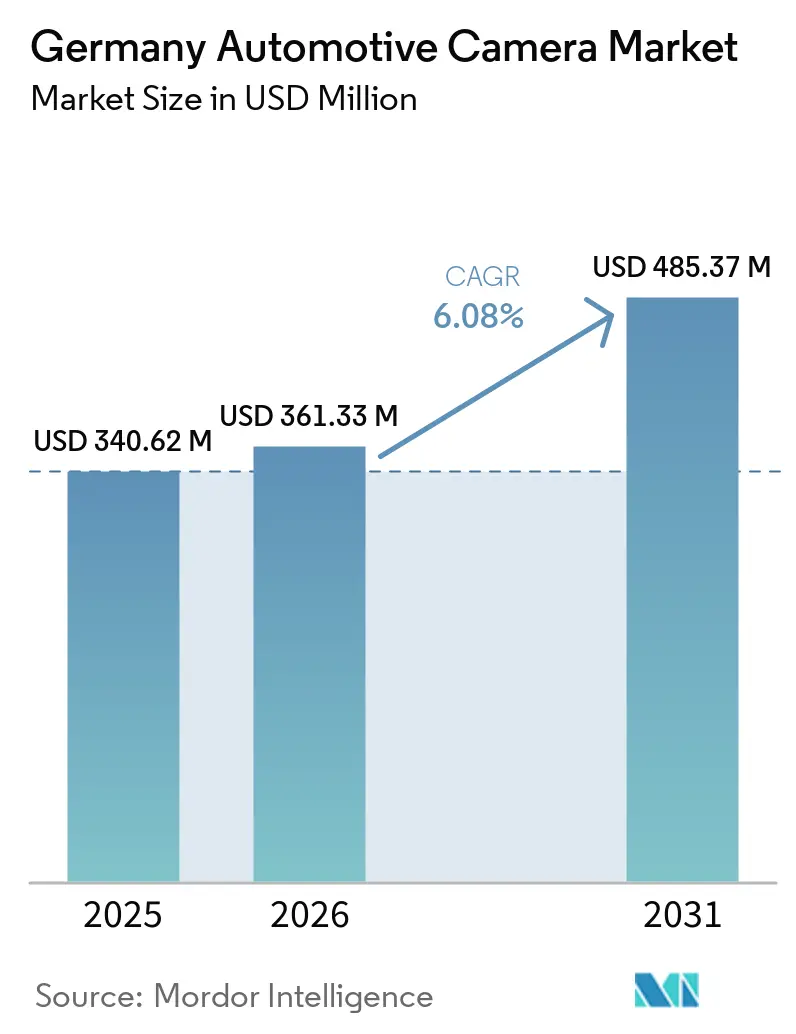
| Base Year Market Size (2025) | USD 340.62 Million |
| Market Size (2026) | USD 361.33 Million |
| Market Size (2031) | USD 485.37 Million |
| Growth Rate (2026 - 2031) | 6.08 % |
| Market Concentration | Medium |
Major Players *Disclaimer: Major Players sorted in no particular order Image © Mordor Intelligence. Reuse requires attribution under CC BY 4.0. | |
Germany Automotive Camera Market Analysis by Mordor Intelligence
The German automotive camera market size was valued at USD 340.62 million in 2025, is estimated at USD 361.33 million in 2026, and is projected to reach USD 485.37 million by 2031, growing at a CAGR of 6.08% from 2026 to 2031. Regulatory mandates under the EU General Safety Regulation, aggressive Level 3 roll-outs led by Mercedes-Benz, and falling CMOS sensor prices combine to lift camera fitment rates across both passenger and commercial vehicles. Front-mounted sensing modules remain the anchor for ADAS; however, the fastest incremental demand is shifting to interior driver-monitoring cameras that support attention detection and handover management. Module suppliers face a dual challenge: proving ISO 26262 compliance for safety-critical functions and securing long-lead image sensors from Asian foundries. Meanwhile, digital-twin calibration tools and insurer-funded dashcam programs open new volume pools that temper the system-integration risks borne by OEMs.
Key Report Takeaways
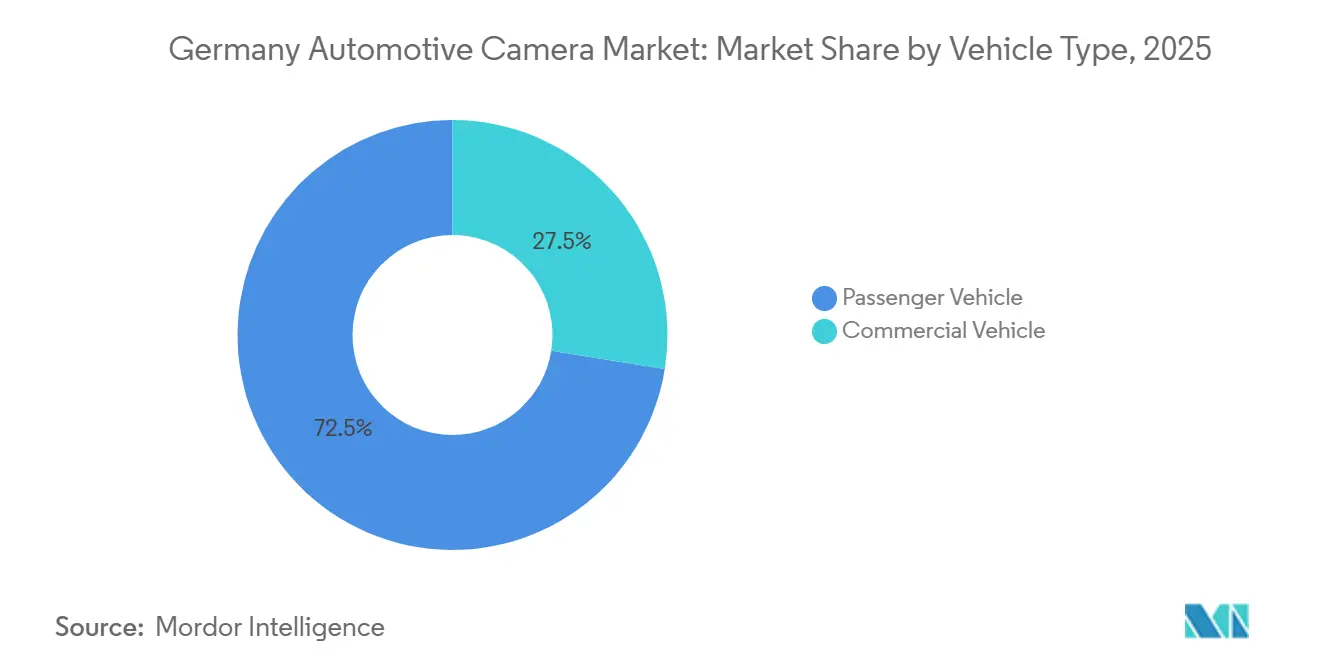
- By vehicle type, passenger vehicles led the German automotive camera market with a 72.48% share in 2025, while commercial vehicles are expected to advance at a 7.11% CAGR through 2031.
- By camera type, viewing cameras held 64.12% of the German automotive camera market size in 2025, and sensing cameras are projected to expand at an 8.23% CAGR.
- By application, ADAS commanded 55.39% of the revenue in 2025, whereas driver monitoring is forecast to accelerate at an 8.03% CAGR.
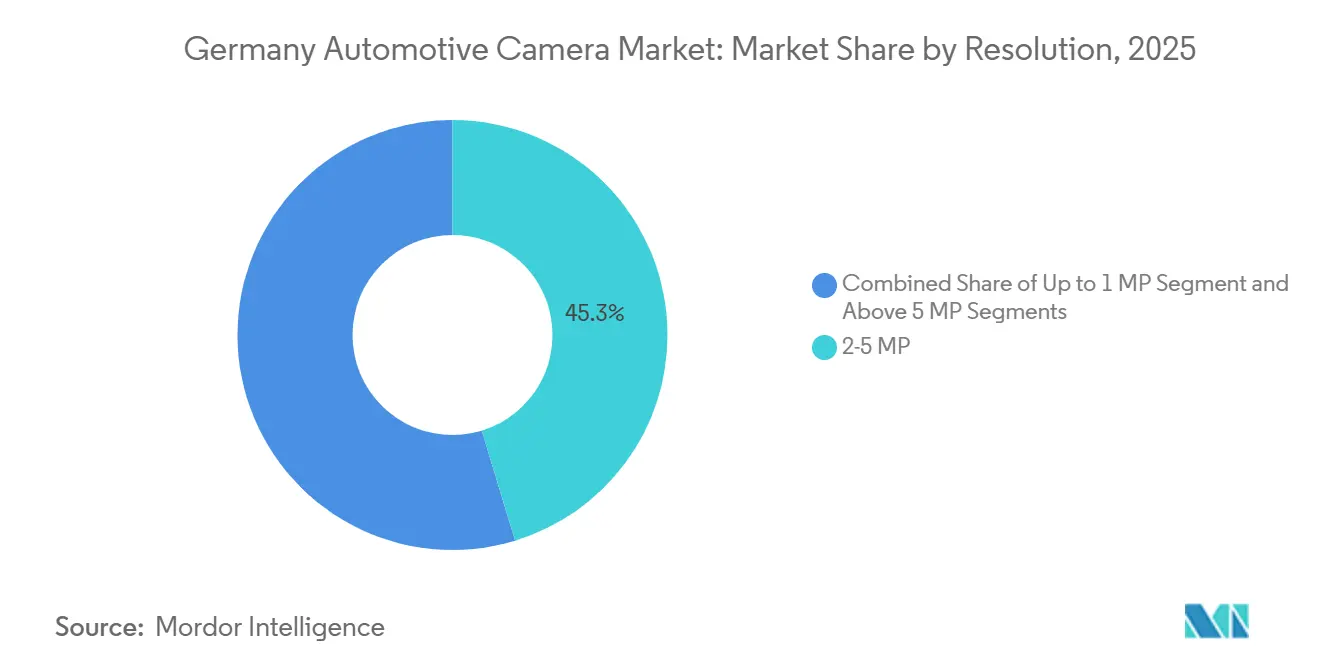
- By resolution, the 2-5 MP band accounted for 45.29% of the German automotive camera market size in 2025, and modules with resolutions above 5 MP are expected to rise at a 7.79% CAGR.
- By sales channel, OEM-fit captured 78.43% of the German automotive camera market share in 2025; aftermarket demand is growing at a 6.79% CAGR, driven by dashcam incentives.
- By mounting location, front cameras dominated with 58.87% of installations in 2025; however, interior units are climbing at a 7.83% CAGR in response to driver-monitoring mandates.
Note: Market size and forecast figures in this report are generated using Mordor Intelligence’s proprietary estimation framework, updated with the latest available data and insights as of 2026.
Germany Automotive Camera Market Trends and Insights
Drivers Impact Analysis*
| Driver | (~) % Impact on CAGR Forecast | Geographic Relevance | Impact Timeline |
|---|---|---|---|
| EU-GSR Rear-View and ADAS Mandate | +1.2% | National, aligned with EU-wide enforcement | Short term (≤ 2 years) |
| Germany OEM L3: Above 8 MP Tri-Cam | +1.1% | National, led by Mercedes-Benz and BMW series production | Long term (≥ 4 years) |
| Premium ADAS Cascading to Mid-Segment | +0.9% | National, concentrated in Bavaria and Baden-Württemberg OEM clusters | Medium term (2-4 years) |
| Lower CMOS ASPs + More Compute | +0.8% | National, with supply-chain linkages to Asia-Pacific foundries | Medium term (2-4 years) |
| Insurance Telematics: Camera Evidence | +0.6% | National, early adoption in commercial-fleet segments | Short term (≤ 2 years) |
| Digital Twin Calibration Driving Recall Tools | +0.5% | National, concentrated in authorized service networks | Medium term (2-4 years) |
| Source: Mordor Intelligence | |||
EU-GSR Mandated Rear-View and ADAS Cameras
Germany is set to enforce the EU General Safety Regulation, which recently took effect. This regulation mandates that every new vehicle type approval must include rear-view and lane-keeping cameras. As a result, what was once an optional feature has now become standard equipment. Consequently, a significant portion of passenger cars that would have previously been shipped without cameras will now be outfitted with multiple cameras. Suppliers have ramped up their capacities since the full-registration deadline. Furthermore, to meet the required performance benchmarks, module specifications are now focusing on sensors that offer wide-angle coverage. The design process has become more intricate, as replacements for traditional mirrors must provide visibility comparable to that of glass mirrors. This requirement not only increases validation costs but also tightens the optical tolerances[1].
Premium-Car ADAS Packages Cascading to Mid-Segment
German automakers are integrating established ADAS camera suites into their volume models, now priced in the affordable range. Volkswagen is standardizing forward cameras on its Golf and Tiguan models, while Opel is introducing surround-view parking in the Astra [2]. When a module achieves significant production volumes, economies of scale significantly reduce its per-unit cost. This allows OEMs to enhance safety features without increasing the vehicle's price. Additionally, data from insurers highlights a significant drop in collision claims for cars equipped with forward cameras, underscoring the perception of these systems as standard features rather than luxury add-ons.
Falling CMOS Sensor ASPs and Higher On-Board Compute
Prices for automotive-grade CMOS sensors have declined as process nodes in consumer electronics achieved AEC-Q100 qualification. The reduced costs enable OEMs to choose higher-resolution sensors, enhancing detection range. Additionally, integrated neural-processing units significantly lower image-transfer latency. Bosch's latest multipurpose camera, featuring an advanced AI core, demonstrates this new price-performance dynamic. It supports edge inference and object classification within its housing, achieving faster response times.
Germany OEM L3 Rollout Demanding Above 8 MP Tri-Cam Stacks
Mercedes-Benz began series production of Drive Pilot, incorporating independent high-resolution forward-facing cameras to meet ISO 26262 ASIL-D redundancy requirements. BMW plans to introduce a comparable multi-camera unit for Highway Assistant Pro, establishing high-resolution cameras as the benchmark for advanced automated-driving perception systems. The higher pixel count increases data rates, prompting suppliers to adopt faster SerDes links and more powerful image signal processors. These upgrades increase the module bill of materials.
Restraints Impact Analysis*
| Restraint | (~) % Impact on CAGR Forecast | Geographic Relevance | Impact Timeline |
|---|---|---|---|
| Semiconductor Supply-Chain Risks | -0.9% | National, with dependencies on Asia-Pacific foundries | Short term (≤ 2 years) |
| High Validation and ISO 26262 Burden | -0.7% | National, concentrated among Tier 1 and Tier 2 suppliers | Medium term (2-4 years) |
| Skilled-Labor Gap in ADAS Calibration | -0.6% | National, acute in Bavaria, Baden-Württemberg, and Lower Saxony service networks | Medium term (2-4 years) |
| GDPR In-Cabin Data Limits | -0.5% | National, aligned with EU-wide data-protection enforcement | Long term (≥ 4 years) |
| Source: Mordor Intelligence | |||
Semiconductor Supply-Chain Vulnerability
In the automotive image sensor market, major players such as Sony, Samsung, and OmniVision dominate, with the majority of production concentrated in Asia. Recently, lead times significantly increased, delaying the launches of several German models by several weeks. Continental reported a loss of EUR 180 million in revenue, attributing it to insufficient allocations, while noting that dual-sourcing provides only a partial remedy, necessitating re-validation [3].
High Validation Cost and ISO 26262 Compliance Burden
To secure an ASIL-B or ASIL-D rating, companies must invest significant time in testing and substantial financial resources in each module. This economic burden poses a challenge for smaller suppliers, further entrenching the dominance of established players. The need for documentation traceability has led to a notable increase in the number of engineering personnel. As a result, many firms are narrowing their product portfolios, opting to reuse designs that have already been validated.
*Our forecasts treat driver/restraint impacts as directional, not additive. The impact forecasts reflect baseline growth, mix effects, and variable interactions.
Segment Analysis
By Vehicle Type: Passenger Dominance Masks Commercial Acceleration
Passenger vehicle held 72.48% of the German automotive camera market in 2025; however, their 7.11% forecast CAGR is below the market-wide pace, as commercial vehicle are catching up. Sport utility vehicles, with wider blind zones, commonly integrate four- to six-camera surround-view systems, whereas sedans typically have two or three units. Fleet operators of vans and trucks are eligible for insurance rebates that reward the use of camera-based evidence, thereby shifting purchase priorities toward driver-monitoring and side-view modules. In heavy trucks, Daimler Truck made driver-facing cameras standard on the Actros, illustrating how safety metrics and liability exposure can override initial hardware costs. Commercial vehicle buyers apply total cost of ownership logic that assigns tangible savings to each avoided collision, so adoption momentum should continue to outpace the passenger-vehicle baseline.
The German automotive camera market size for commercial vehicles is therefore positioned to scale rapidly as EU Vision Zero targets place extra scrutiny on blind-spot fatalities in urban zones. Light vans are increasingly specifying pillar-mounted cameras that replace external mirrors, thereby trimming aerodynamic drag and fuel consumption. German postal and grocery fleets are piloting side-view plus rear-view digital mirrors, which have been shown to lower in-city accident rates. The resulting claims savings are then fed directly back into procurement budgets. Passenger cars will maintain volume leadership; however, the increase in cameras-per-vehicle is flattening, as most models already ship with rear and front modules. Incremental gains rely on adding interior monitoring, a regulatory-driven rather than consumer-driven feature.


By Camera Type: Sensing Modules Gain as ADAS Complexity Rises
Viewing cameras accounted for 64.12% of 2025 shipments because rear parking and mirror replacement still rely on driver-view video streams. However, sensing cameras that integrate object-detection algorithms are expected to grow at an 8.23% CAGR, in line with the adoption of Level 2+ and Level 3 functions. The German automotive camera market size for sensing modules is growing faster as AI processing shifts into the camera housing, offloads central ECUs, and enables redundancy. Bosch’s 16 TOPS multipurpose unit typifies the blurring of the line between viewing and sensing, as it can output video for user confirmation while executing neural networks locally.
The viewing segment will continue to grow in absolute terms, as every new car now requires a backup camera, yet margin pressure remains intense. Chinese low-cost entrants target rear-view modules at European OEM platforms, and commoditization forces Tier 1 suppliers to funnel R&D toward sensing variants where intellectual property can still command premium pricing. Hybrid “smart-view” designs that add low-power convolution engines help defend average selling prices while giving OEMs an upgrade path through over-the-air software releases.
By Application: Driver Monitoring Surges on EU-GSR Compliance
ADAS remained the most significant slice, accounting for 55.39% of 2025 revenue; however, its mid-single-digit expansion trails the 8.03% CAGR forecast for driver-monitoring systems. EU-GSR Article 6 mandates attention detection in any vehicle capable of Level 2 or higher autonomy, bringing near-infrared interior cameras into mainstream use. Mercedes-Benz Drive Pilot requires real-time gaze tracking to validate driver readiness for handover, and BMW’s upcoming Highway Assistant Pro follows the same logic. The German automotive camera market size is closely tied to monitoring, therefore accelerating as every logo moves to comply. Parking cameras continue to rise with the urbanization trend and have become a differentiator in compact SUVs, where curb rash and tight garages influence buying decisions.
Supplier economics also favor monitoring growth because algorithms that classify drowsiness and distraction are software-heavy, opening recurring revenue from feature unlocks. As cloud-based analytics remain constrained by privacy rules, on-edge inference is monetized through hardware upgrades, raising average module value by roughly one-third over a basic rear-view unit. ADAS still captures the bulk of unit volume but faces pricing pressure as lane-departure and AEB mature. Monitoring enjoys both higher margin and regulatory tailwind, setting up a long runway for sustained above-market expansion.
By Resolution: High-Definition Modules Capture L3 Demand
The 2-5 MP range led with 45.29% market share in 2025, matching Level 2 ADAS requirements for forward detection up to about 120 m. Level 3 systems now benchmark at 8 MP, so modules above 5 MP are projected to grow 7.79% through 2031—the German automotive camera market size associated with high-definition modules scales with each OEM announcing conditional autonomy. Mercedes-Benz, BMW, and Audi all feature 8 MP for forward perception, and side-view cameras increase from 1.3 MP to 2 MP to detect cut-in motorcycles. Higher resolution means a larger sensor die and faster SerDes, adding cost but also futureproofing vehicles for over-the-air perception improvements. Sub-1 MP rear cameras are losing share because display resolutions have moved beyond standard definition, forcing even entry trims into HD territory.
The resolution shift further differentiates sensing from viewing: sensing modules require pixels and compute resources, while rear cameras prioritize dynamic range for garage lighting. Suppliers that master wafer-level optics and stacked-sensor integration will capture market share as OEMs pursue a smaller footprint with higher clarity. As wafer yields for larger dies improve and fabs reach scale, cost gaps narrow, cementing HD as the default for any new Level 3 program.


By Sales Channel: OEM Integration Dominates Safety-Critical Functions
Factory installation accounted for 78.43% of 2025 shipments, as cameras are integrated into braking, steering, and display networks that OEMs must validate during type approval. Aftermarket growth of 6.79% CAGR is primarily driven by dashcams and retrofit reversing aids that are electrically isolated from core safety systems. The German automotive camera market share skew toward OEM remains pronounced because legal liability follows whoever integrates the sensor into the control loop. Calibration also poses a barrier: an aftermarket forward-collision camera demands specification-grade alignment that independent installers cannot guarantee without proprietary targets.
Dashcam momentum, spurred by insurer premium rebates, continues to drive the aftermarket's expansion in absolute numbers. Yet as OEMs release subscription-based cloud video services, the feature gap between factory and retrofit narrows. OEM channels keep a cost advantage through shared harnesses and single calibration sessions during end-of-line inspection. Accordingly, factory cameras are expected to hold above three-quarters of the revenue through 2031, while the aftermarket carves out specialty niches in older fleets.
By Mounting Location: Interior Cameras Accelerate on Monitoring Mandates
Front cameras led with 58.87% of 2025 installs because almost all ADAS functions are anchored on forward perception. Interior units, however, climb at a 7.83% CAGR as EU rules enforce driver attention checks. The German automotive camera market size for interior modules is expanding as OEMs incorporate near-infrared sensors into instrument panels or steering columns to monitor gaze and eyelid closure. Rear cameras now sit inside regulatory minimums, so their unit growth matches the total car output. Side cameras are gaining traction in trucks, where mirror replacement is shown to improve fuel economy, as evidenced by Daimler Trucks’ adoption of MirrorCam.
Interior cameras also open up new software territory in occupancy classification and airbag deployment optimization, encouraging OEMs to bundle multiple safety functions into a single sensor. Front cameras are evolving toward higher resolution and dual-lens redundancy, yet the fresh revenue upside lies within the cabin, where incremental hardware supports personalized infotainment and safety legislation. Supplier portfolios are therefore expanding in the near-infrared range with privacy-preserving AI cores.
Geography Analysis
Southern Germany led installations, with Bavaria and Baden-Württemberg together representing a significant portion of the national total. This dominance is primarily attributed to the clustering of BMW, Mercedes-Benz, and Audi plants near Munich, Stuttgart, and Ingolstadt. The proximity of Tier 1 suppliers facilitates streamlined joint development cycles, allowing prototypes to swiftly transition into production modules. Following closely is Lower Saxony, where Volkswagen integrates standard cameras into its Golf, Tiguan, and Passat lines. Meanwhile, Saxony and North Rhine-Westphalia are increasing their share as OEMs introduce advanced features into volume models at secondary sites, expanding the footprint of Germany's automotive camera market.
Regional supply chains benefit from talent pipelines at Stuttgart University and the Karlsruhe Institute of Technology, both of which produce computer-vision engineers vital for perception R&D. However, this concentration comes with its challenges: a semiconductor shortage caused delays in image-sensor deliveries, leading to halted BMW lines in Dingolfing. In response, Bavaria’s state government allocated subsidies for ADAS calibration equipment to independent workshops, alleviating service bottlenecks. Additionally, federal grants were announced to co-finance AI perception research, bolstering the technological edge essential to counteract cost competition from Asia.
Eastern Europe is witnessing a significant expansion: Magna’s newly established plant in the Czech Republic can deliver modules within a day's truck journey to German assembly lines. This proximity not only shortens logistics lead times but also mitigates geopolitical risks. While policy alignment and available labor suggest a broader distribution of camera module capacity beyond Germany, the domestic clusters are poised to retain the majority of high-value R&D and system-integration activities.
Competitive Landscape
Market Concentration
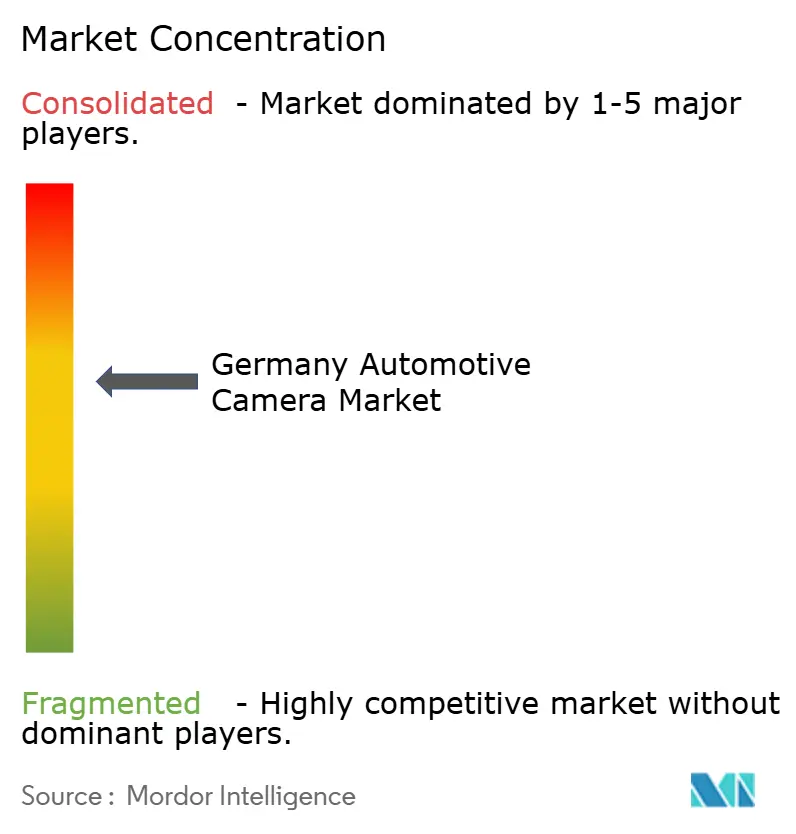
Robert Bosch GmbH, Continental AG, DENSO Corporation, Magna International Inc., and Valeo collectively hold a significant share of the German automotive camera market, indicating a moderate concentration. These established Tier 1 players maintain their market positions through long-term co-development contracts, finalizing camera specifications well in advance of production. Their strategies focus on integrating AI inference into camera modules, collaborating with sensor industry leaders to secure allocations, and establishing cost-effective assembly units in Eastern Europe. In contrast, disruptors like Mobileye and Sony are promoting integrated camera-compute solutions, bypassing traditional Tier 1 roles and appealing to OEMs eager to harness perception algorithms.
Achieving ISO 26262 certification poses a significant challenge, with high validation costs, as many new entrants are limited to non-safety niches, such as dashcams. Continental has invested heavily to expand its capacity for advanced contracts. ZF secured a major tri-cam stack deal with BMW. Bosch enhanced the AI throughput of its latest unit, and Valeo, in collaboration with Infineon, integrated camera and domain control onto a single microcontroller, achieving notable cost reductions. While Asian suppliers MCNEX and LG Innotek are targeting a foothold in Europe with local plants, challenges like liability issues and software deficiencies may hinder their progress in safety-critical areas. However, as OEMs push for dual sourcing, the dominance of established players may diminish over time.
Germany Automotive Camera Industry Leaders
-
DENSO Corporation
-
Continental AG
-
Robert Bosch GmbH
-
Magna International Inc.
-
Valeo SA
- *Disclaimer: Major Players sorted in no particular order
Recent Industry Developments
- August 2026: rFpro integrated Solectrix’s SXIVE (Simplified eXtensive Image and Video Engine) image-processing technology into its AV elevate platform. This integration enables engineers to design, model, and optimize the entire camera pipeline in a simulated environment. It supports the tuning of image signal processing (ISP) and camera parameters against edge cases, the training of perception models using SXIVE-processed synthetic data, and the testing of complete vision pipelines under highly variable conditions.
- August 2026: Valeo announced that it will showcase its latest solutions for heavy-duty trucks and light commercial vehicles at IAA Transportation 2026. The company will also introduce Adaptive Driving Beam (ADB) technology to the commercial vehicle market. Its portfolio for advanced driver-assistance systems (ADAS) and software-defined vehicle (SDV) technologies includes sensors and dedicated cleaning systems for LiDAR and cameras; the Valeo Smart Safety 360 (VSS360) solution for trucks; ADAS domain controllers; single-system-on-chip (SoC) ADAS and in-vehicle infotainment (IVI) solutions; and ADAS and parking software featuring AI-powered perception.
Germany Automotive Camera Market Report Scope
The Germany automotive camera market report is segmented by vehicle type (passenger vehicle and commercial vehicle), camera type (viewing and sensing), application (ADAS, and more), resolution (up to 1 MP, 2-5 MP, and above 5 MP), sales channel (OEM-fit and aftermarket), mounting location (front, rear, side, and interior/in-cabin). The market forecasts are provided in terms of value (USD).
By Vehicle Type
| Passenger Vehicle | Hatchback |
| Sedan | |
| Sports Utility Vehicle (SUV) | |
| Multi-Purpose Vehicle (MPV) | |
| Commercial Vehicle | Light Commercial Vehicle (LCV) |
| Medium and Heavy Commercial Vehicle (M&HCV) |
By Camera Type
| Viewing Camera |
| Sensing Camera |
By Application
| Advanced Driver-Assistance Systems (ADAS) |
| Parking and Surround View |
| Driver Monitoring |
By Resolution
| Up to 1 MP |
| 2-5 MP |
| Above 5 MP |
By Sales Channel
| OEM-Fit |
| Aftermarket |
By Mounting Location
| Front |
| Rear |
| Side |
| Interior / In-Cabin |
| By Vehicle Type | Passenger Vehicle | Hatchback |
| Sedan | ||
| Sports Utility Vehicle (SUV) | ||
| Multi-Purpose Vehicle (MPV) | ||
| Commercial Vehicle | Light Commercial Vehicle (LCV) | |
| Medium and Heavy Commercial Vehicle (M&HCV) | ||
| By Camera Type | Viewing Camera | |
| Sensing Camera | ||
| By Application | Advanced Driver-Assistance Systems (ADAS) | |
| Parking and Surround View | ||
| Driver Monitoring | ||
| By Resolution | Up to 1 MP | |
| 2-5 MP | ||
| Above 5 MP | ||
| By Sales Channel | OEM-Fit | |
| Aftermarket | ||
| By Mounting Location | Front | |
| Rear | ||
| Side | ||
| Interior / In-Cabin | ||
Key Questions Answered in the Report
What is the current value of the Germany automotive camera market?
The Germany automotive camera market size stands at USD 340.62 million in 2025 and is projected to reach USD 485.37 million by 2031.
Which vehicle segment is growing fastest for camera adoption?
Commercial vehicles post the quickest expansion as fleet operators deploy driver-monitoring and side-view cameras, outpacing passenger-car growth.
How are EU regulations influencing camera specifications?
The EU General Safety Regulation mandates rear-view and lane-keeping cameras, setting minimum 2 MP resolution and 120-degree field-of-view thresholds that suppliers must meet.
What challenges do suppliers face with semiconductor sourcing?
Automotive image sensors rely on a few Asian fabs, leading to 28-week lead times and delaying German vehicle launches.