
General Liability Insurance Market Size and Share
Market Overview
| Study Period | 2020 - 2031 |
|---|---|
| Market Size (2026) | USD 320.40 Billion |
| Market Size (2031) | USD 395.5 Billion |
| Growth Rate (2026 - 2031) | 4.30 % |
| Fastest Growing Market | Asia-Pacific |
| Largest Market | North America |
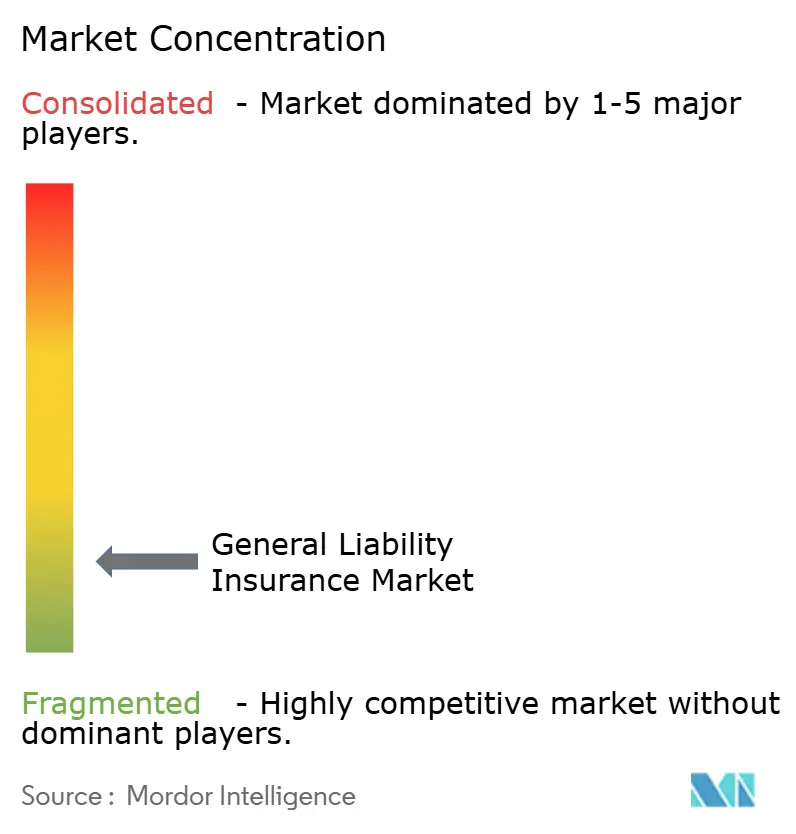
| Market Concentration | Low |
Major Players *Disclaimer: Major Players sorted in no particular order Image © Mordor Intelligence. Reuse requires attribution under CC BY 4.0. | |
General Liability Insurance Market Analysis by Mordor Intelligence
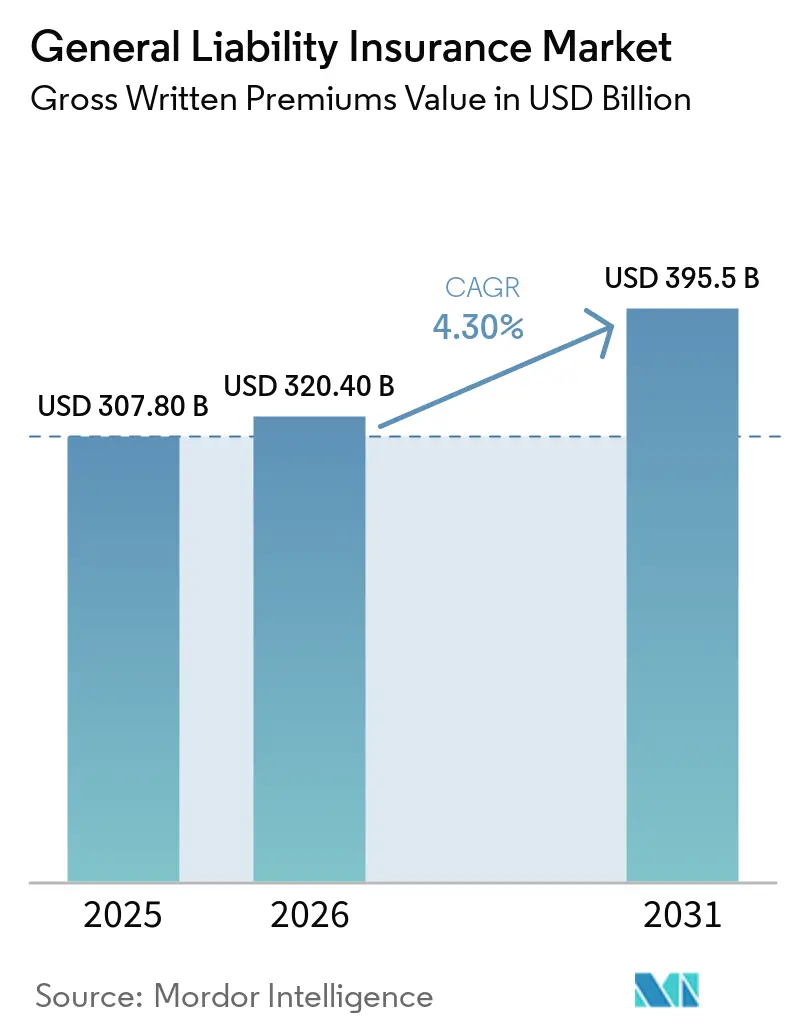
The General Liability Insurance Market size in terms of gross written premiums value is projected to expand from USD 307.80 billion in 2025 and USD 320.40 billion in 2026 to USD 395.5 billion by 2031, registering a CAGR of 4.30% between 2026 and 2031.
Demand is supported by third-party liability exposure, contractual proof-of-coverage requirements, and the formalization of businesses in developing economies. Insurers are also increasing premiums as they respond to higher claims costs, litigation, and reserve pressure. This can raise the reported value of the general liability insurance market without producing a corresponding improvement in underwriting profitability. Businesses continue to need liability cover to meet the conditions of leases, supplier relationships, and public contracts. The market's direction will depend on whether insurers can price these growing exposures while maintaining adequate capacity and clear policy terms.
Key Report Takeaways
- By policy type, commercial general liability captured 51.6% of the general liability insurance market share in 2025, while products and completed operations liability is projected to grow at 6.2% CAGR through 2031.
- By policy trigger, occurrence-based policies captured 79.8% of the general liability insurance market share in 2025, while claims-made policies are projected to grow at 5.8% CAGR through 2031.
- By enterprise size and policyholder type, SMEs captured 43.5% of the general liability insurance market share in 2025, while the public sector and nonprofit organizations are projected to grow at 6.0% CAGR through 2031.
- By distribution channel, agents and brokers captured 61.4% of the general liability insurance market share in 2025, while bancassurance, affinity, and embedded distribution are projected to grow at 8.2% CAGR through 2031.
- By industry vertical, construction and real estate captured 20.5% of the general liability insurance market share in 2025, while IT and telecommunications are projected to grow at 7.1% CAGR through 2031.
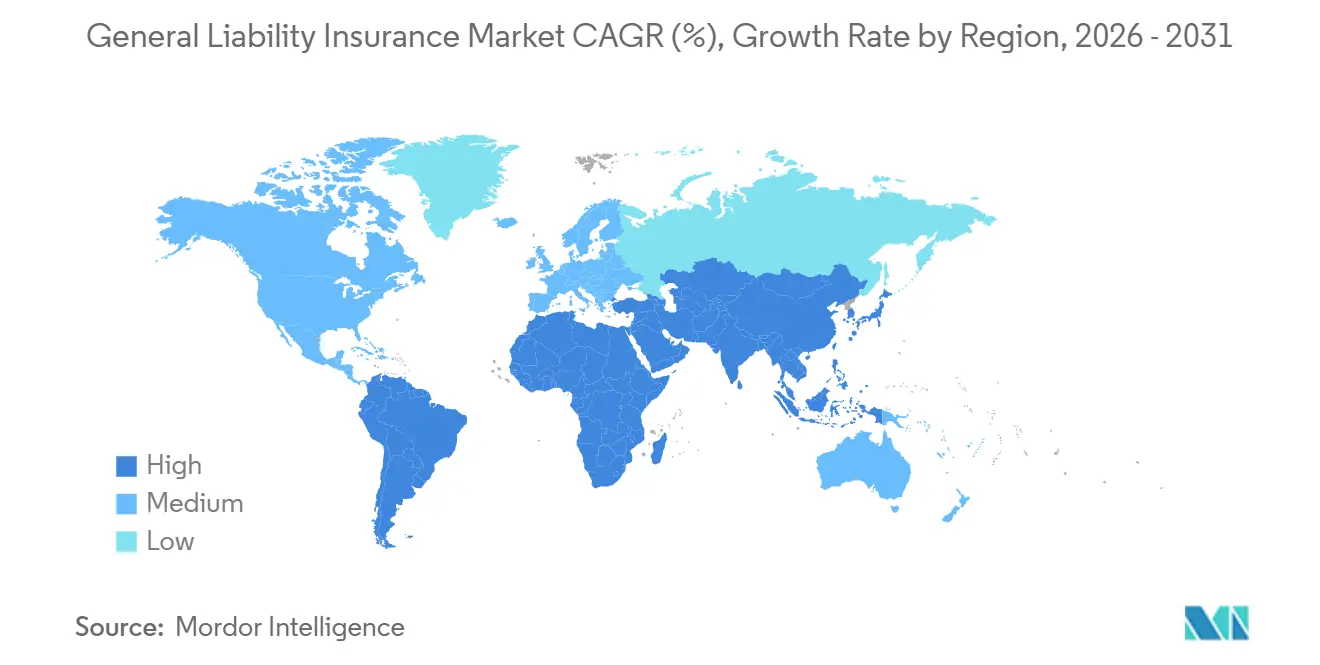
- By geography, North America captured 45.7% of the general liability insurance market share in 2025, while Asia-Pacific is projected to grow at 6.4% CAGR through 2031.
Note: Market size and forecast figures in this report are generated using Mordor Intelligence’s proprietary estimation framework, updated with the latest available data and insights as of January 2026.
Global General Liability Insurance Market Trends and Insights
Drivers Impact Analysis*
| Driver | (~) % Impact on CAGR Forecast | Geographic Relevance | Impact Timeline |
|---|---|---|---|
| Commercial and Business Liability Exposure | +0.8% | Global | Medium term (2-4 years) |
| Mandatory Liability Coverage and Contractual Proof of Insurance | +0.7% | North America and Europe | Short term (≤ 2 years) |
| Product, Service, And Supply Chain Complexity | +0.6% | Global, with a concentration in Asia-Pacific manufacturing and Europe | Medium term (2-4 years) |
| AI-Enabled and Technology-Related Liability Exposure | +0.5% | North America, Europe, and the Asia-Pacific | Long term (≥ 4 years) |
| Emerging Risks and Coverage Gaps | +0.4% | Global, with early gains in North America and Europe | Long term (≥ 4 years) |
| SME Growth and Business Formalization | +0.9% | Asia-Pacific, the Middle East and Africa, and South America | Medium term (2-4 years) |
| Source: Mordor Intelligence | |||
Commercial Activity And Contractual Coverage Requirements
Commercial activity increases the number of third-party liability exposures that businesses need to manage. New locations, products, services, suppliers, and customer contracts can create requirements for bodily injury, property damage, and personal injury cover. The United States property and casualty sector recorded 5% net written premium growth in 2025 and reached USD 1.11 trillion across commercial lines, while general liability and commercial auto retained positive rate movement in 2026[1]. Lease terms, subcontractor agreements, and vendor requirements can make coverage a condition of doing business. These requirements create recurring demand when insureds add suppliers, projects, or commercial relationships. The general liability insurance market is therefore connected to business formation, contracting activity, and the need for current proof of insurance.
Product Complexity, Supply Chains, And Emerging Risks
Product and service complexity can extend liability exposure across manufacturers, distributors, contractors, and service providers. Products and Completed Operations Liability is forecast to grow faster than the overall general liability insurance market as product recalls, technology components, and global supply chains make post-sale claims more relevant. Alliant's 2026.1 guidance includes products and completed operations coverage within standard CGL requirements[2]. A long supply chain can involve several parties, which increases the importance of contractual indemnity, additional-insured wording, and completed-work protection. Insureds may need more detailed cover when basic policy limits do not address the risks created by a specific product or service. These conditions support closer underwriting of suppliers, components, product documents, and post-sale obligations.
AI-Enabled And Technology-Related Liability Exposure
AI use is creating liability questions that affect insurers, policyholders, and specialist providers. RAND identified concerns involving artificial intelligence across bodily injury, intellectual property, and discrimination-related claims[3]. Standard CGL policies may not respond in the same way to every AI-related harm, which makes exclusions, limits, and endorsements important for buyers to review. Specialist programs are addressing risks such as model drift, hallucinations, and prompt injection, where standard coverage may be limited. Businesses must consider how technology-enabled products and services could affect customers, employees, and downstream users. The general liability insurance market is changing as insurers decide which technology risks belong in core policies and which require specialist placement.
SME Growth And Business Formalization
SMEs remain a major source of policy volume because many businesses need liability protection to obtain leases, licenses, customer contracts, or financing. Business formalization and digital compliance systems can bring more small firms into procurement and lending networks. Small commercial general liability accounts recorded renewal price changes of 5% to 10% in Q3 2025, compared with a 2.5% increase in the United States Consumer Price Index over the same period[4]. Digital systems can make it easier for straightforward policies to be issued during company registration, loan origination, or account opening. Complex risks still require specialist advice, but simpler issuance can reduce the time needed for small businesses to obtain coverage. The general liability insurance market can gain volume as more firms become eligible for commercial activity that requires documented insurance.
Restraints Impact Analysis*
| Restraint | (~) % Impact on CAGR Forecast | Geographic Relevance | Impact Timeline |
|---|---|---|---|
| Liability Claims, Inflation, and Litigation Costs | -1.1% | North America, with spillover to Europe and Asia-Pacific | Long term (≥ 4 years) |
| Large Loss Severity and Nuclear Verdicts | -0.9% | United States, with early emergence in the United Kingdom and Australia | Medium term (2-4 years) |
| Underwriting And Pricing Complexity | -0.6% | Global | Medium term (2-4 years) |
| Systemic And Aggregation Risk from Interconnected Exposures | -0.5% | Global, concentrated in technology-heavy markets | Long term (≥ 4 years) |
| Source: Mordor Intelligence | |||
Claims Inflation, Litigation Costs, And Large Loss Severity
Claims inflation and litigation costs can constrain capacity and place sustained pressure on underwriting results. Higher legal costs, more complex cases, and severe liability losses can require insurers to increase reserves and reassess the limits they are willing to provide. These pressures are most visible in long-tail risks and in excess and surplus lines, where loss development may be uncertain. Insurers can respond by tightening policy terms, reviewing claims history more closely, and seeking additional details about operations and contractual responsibilities. Buyers may then face more restrictive terms or more difficulty securing cover for complex exposures. The general liability insurance market must balance continued demand for protection with the cost of maintaining adequate reserves and sustainable capacity.
Underwriting, Pricing, And Aggregation Risk
Underwriting and pricing become more difficult when similar risks are connected across technology, supply chains, or service networks. A severe event can affect both primary coverage and excess layers, which encourages insurers to reassess attachments, exclusions, and risk selection. Claims-made structures and specialist programs can be attractive when insurers seek more control over long-tail uncertainty. Policyholders may need a combination of primary and excess policies to obtain the limits required by their contracts. Greater scrutiny of policy wording can become necessary where an exposure is shared across several products, services, or insured parties. These conditions can restrain the general liability insurance market even while businesses continue to seek liability protection.
*Our forecasts treat driver/restraint impacts as directional, not additive. The impact forecasts reflect baseline growth, mix effects, and variable interactions.
Segment Analysis
By Policy Type: CGL Supports Core Demand While Products Liability Grows Faster
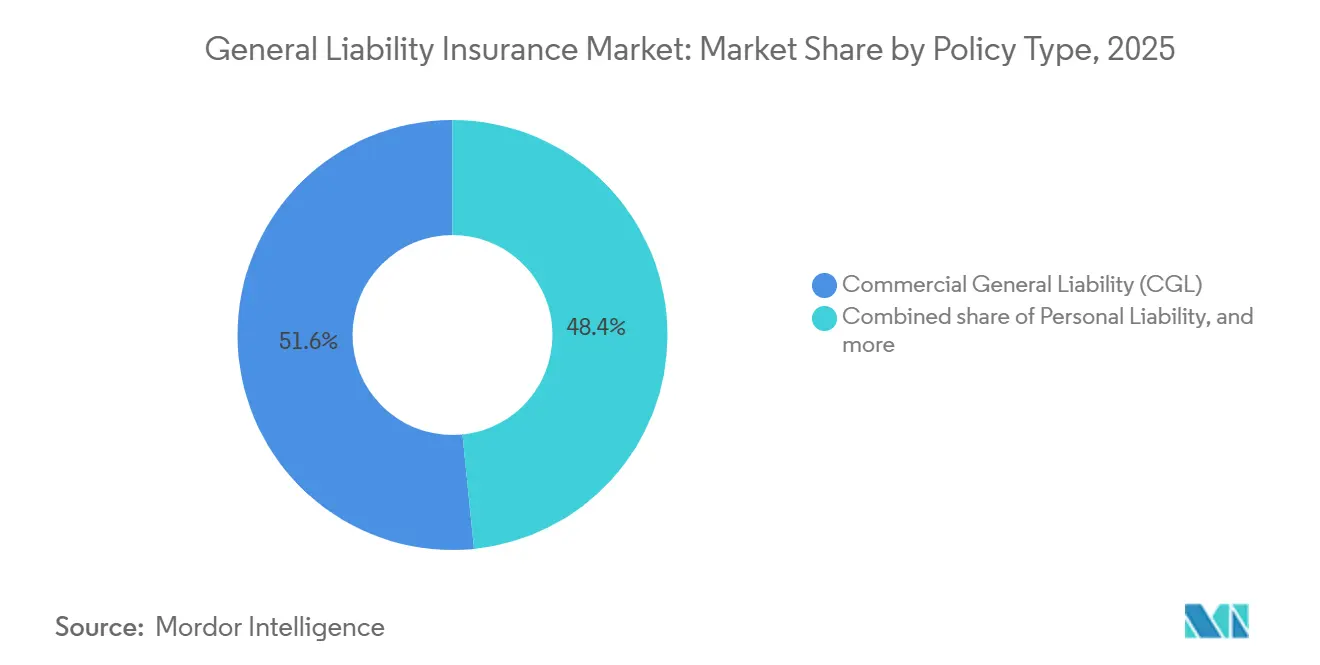
Commercial general liability held 51.6% of the general liability insurance market share in 2025. It remains the main form of coverage for businesses that need protection against bodily injury, property damage, and personal or advertising injury claims. Commercial leases, client agreements, and public procurement contracts commonly require a CGL certificate. Alliant's 2026.1 contract guidance recommends CGL limits of USD 2 million per occurrence for standard commercial contracts. The policy's broad scope supports its role as the core commercial liability product. Personal liability and other general or business liability policies hold smaller roles, including in markets where personal cover or umbrella arrangements are common.
Products and completed operations liability is projected to grow at 6.2% CAGR from 2026 to 2031. Its growth reflects the continuing need to cover claims that arise after goods are sold or work has been completed. Product recalls, technology-enabled products, and international supply chains can increase the duration and complexity of these exposures. The segment is relevant to manufacturers, contractors, distributors, and firms supplying products through multiple channels. Contractual requirements also reinforce demand because products and completed operations coverage is included in standard CGL requirements. This part of the general liability insurance industry is gaining attention as insureds seek protection that extends beyond the initial transaction or project. Claims can arise after work is complete or after a product reaches the end user. That timing makes completed-operations protection especially relevant to contract-driven business. Insureds need to match policy periods and limits to the work or products they provide. The coverage can also be important when several contractors or suppliers share responsibility for an outcome.
By Policy Trigger: Occurrence-Based Coverage Leads While Claims-Made Expands
Occurrence-based policies accounted for 79.8% of the general liability insurance market size in 2025. Businesses often prefer this form because coverage is linked to when the event occurs rather than when the claim is reported. This structure remains widely used in commercial contracts and public-sector agreements. Alliant's contract standards specify occurrence-form CGL as the required structure for commercial and public-sector arrangements. The established use of occurrence-based cover supports its large premium base. It also gives policyholders a familiar way to document liability protection for counterparties.
Claims-made policies are forecast to expand at 5.8% CAGR through 2031. Insurers can favor this structure in long-tail casualty lines because it can give them more control over the timing of claims reporting. The form is especially relevant to professional, technology, and health-related exposures. Buyers may see lower initial premiums, but they must also consider retroactive dates and the risk of gaps when changing carriers. The insurance structure requires careful review when an insured moves from one carrier or policy form to another. The general liability insurance market will continue to include both approaches as buyers and insurers weigh coverage certainty against reserving uncertainty. Occurrence-based cover remains familiar for many commercial buyers and their contractual counterparties. Claims-made cover can be more practical for selected long-tail risks, subject to careful continuity planning. Neither structure removes the need for accurate disclosure of operations and prior claims. The choice can materially affect how an insured manages a change in carrier or policy terms.
By Enterprise Size / Policyholder Type: SMEs Lead Volume While Public Entities Grow Faster
SMEs captured 43.5% of global premiums in 2025. They form the largest policyholder group because many small companies need general liability insurance to secure leases, licenses, supplier contracts, or enterprise customers. Large enterprises have substantial premium density per account, although they represent fewer insured entities. Households and individuals remain relevant where personal liability mandates or umbrella-policy requirements apply. SME accounts vary widely because a small firm may operate in construction, services, retail, or professional activities. This diversity requires insurers to assess both the size of the firm and the nature of its operations. Larger businesses can purchase substantial limits, but smaller firms provide much of the market's policy volume. The policyholder mix gives insurers several routes to growth across commercial and personal liability needs.
Public sector and nonprofit organizations are expected to grow at 6.0% CAGR through 2031. Grant agreements, public-private partnerships, and procurement frameworks can require these entities to maintain liability coverage. Infrastructure activity in North America, Europe, and Asia-Pacific broadens the number of public and nonprofit projects that need proof of insurance. Licensing rules can also incorporate minimum liability coverage for microbusinesses and service operators. These requirements support the general liability insurance market by linking coverage to eligibility for commercial or public activity. The segment's expansion is tied to contractual and regulatory requirements rather than only voluntary risk transfer decisions. Public entities often have visible responsibilities to residents, contractors, and service users. Nonprofit organizations may face similar requirements when they receive grants or manage public programs. These conditions can increase the need for documented limits and clear policy terms. Coverage demand can rise when organizations broaden the projects or services they deliver.
By Distribution Channel: Brokers Lead Current Premiums While Embedded Access Expands
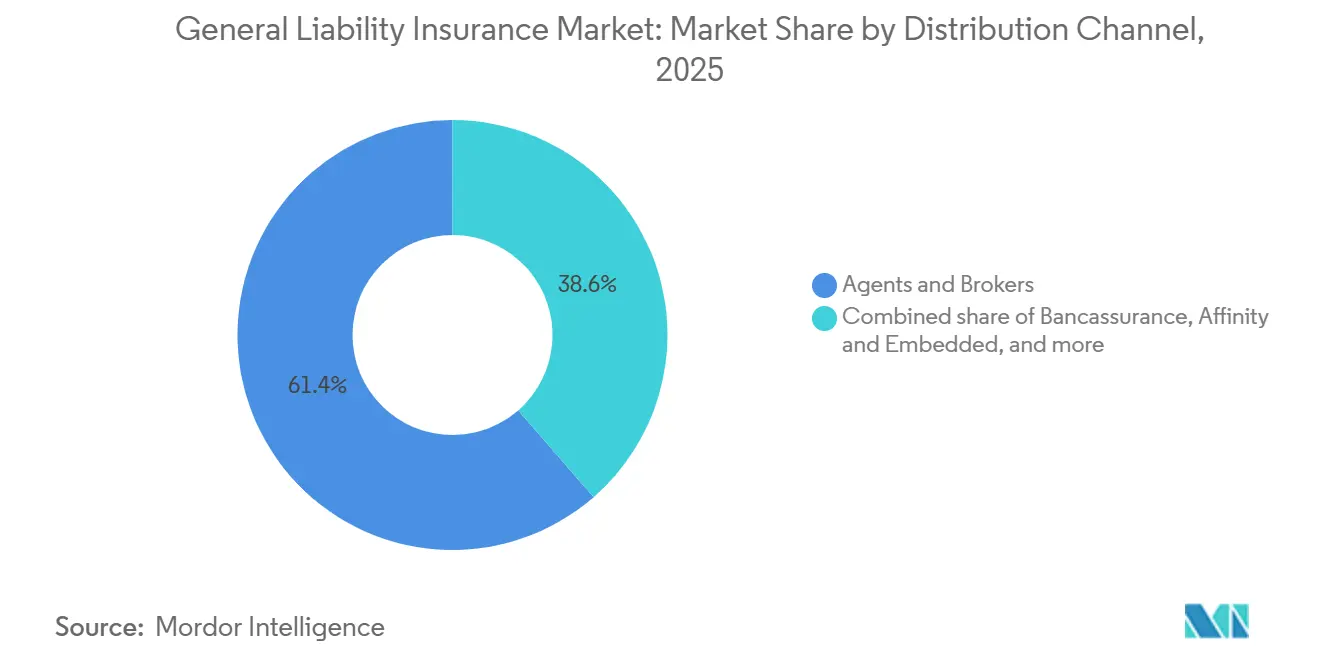
Agents and brokers held 61.4% of global premiums in 2025. Their role remains central where policy wording, certificate management, and claims support require specialist assistance. Brokers can help insureds compare limits, exclusions, endorsements, and capacity across carriers. MGAs and specialty intermediaries also serve complex risks, especially where traditional admitted carriers have reduced appetite. Direct sales remain concentrated in personal and microenterprise cover where policies are simpler. This distribution structure keeps professional intermediation important across much of the general liability insurance market. Complex commercial placements can require coordination among the insured, broker, carrier, and contract counterparties. Brokers also help clients document compliance with insurance requirements. MGAs can offer access to specialized underwriting where a standard placement is not suitable. The channels, therefore, serve different needs rather than replacing one another completely.
Bancassurance, affinity, and embedded distribution are projected to grow at 8.2% CAGR through 2031. Digital systems can quote, bind, and deliver liability coverage when an SME obtains a loan or opens a business account. This approach can reduce the time needed for simple coverage placement. It can also reach businesses that do not have an established broker relationship. The model may be affected by rules that require separate customer consent for insurance sold with lending products. The general liability insurance industry is therefore likely to use both broker-led advice and digital access models for different policyholder needs. Embedded distribution is most relevant when coverage can be matched to a clear business event. Broker involvement remains useful when limits, exclusions, or contractual obligations are more difficult to assess. A mixed distribution approach can broaden access without removing the need for specialist support. Insurers will need to manage consent and disclosure requirements as digital sales models develop.
By Industry Vertical: Construction Leads Premiums While IT And Telecommunications Expands
Construction and real estate held 20.5% of global premiums in 2025. The sector needs liability protection across contractors, subcontractors, project owners, suppliers, and completed work. Construction contracts commonly require proof of CGL coverage and completed-operations protection. The sector also faces loss exposure from job-site injuries, property damage, and work performed after a project is completed. Other important verticals include manufacturing, transportation and logistics, retail and wholesale, healthcare, energy and utilities, hospitality, financial services, and the public sector. The breadth of these exposures keeps the general liability insurance market relevant across a wide range of commercial activity. Construction is especially exposed because it combines work sites, subcontracting, completed work, and contractual insurance conditions. Manufacturers face product and distribution risks that can persist after sale. Service businesses may be exposed through customer interactions and work performed at client locations. Each vertical has different loss patterns, which supports the need for industry-specific underwriting.
IT and telecommunications is forecast to advance at 7.1% CAGR from 2026 to 2031. Software-enabled services, data infrastructure, and AI-generated outputs can create liability issues for providers and their clients. Carriers such as AIG and Chubb offer programs that address technology-sector compliance, network security liability, and service continuity exposures. Standard CGL policies may not provide a complete response to AI-related harms, which increases the importance of specialist cover. Healthcare and life sciences also remain relevant as patient interactions, medical devices, and clinical AI applications expand. These verticals extend the general liability insurance market into risks where technology, products, and professional activities overlap. Technology providers may need to consider how their services affect customers and other users. Health-related organizations can face exposures arising from products, services, and patient interactions. The relevant policy response can depend on the facts of each activity and the wording purchased. Insurers with specialized sector knowledge can be better placed to assess these varied exposures.
Geography Analysis
North America captured 45.7% of global premiums in 2025. The United States accounted for most of this regional position because of its large commercial base and litigious legal environment. Most accounts saw general liability renewal rate pressure of 5% to 8% during the first half of 2026. Construction, habitational, and hospitality accounts faced greater pressure than many other risks. Canada and Mexico add regional premium volume, while their liability systems have different legal and insurance characteristics. The region remains central to the general liability insurance market because businesses frequently require high limits and documented coverage. Insurers operating in the United States must price a broad range of sector-specific legal and claims exposures. This supports the continuing importance of specialist underwriting and excess capacity. The scale of the commercial economy also creates recurring demand as firms renew or update their cover.
Europe is the second-largest regional market, and its requirements vary significantly by country. Germany, the United Kingdom, and France account for much of the region's premium base. The United Kingdom market must address both United Kingdom and European Union compliance requirements following Brexit. The European Union's Product Liability Directive reforms expand relevant considerations for manufacturers and distributors. South America is led by Brazil, where employer liability requirements and the formalization of small businesses support demand. Argentina's currency volatility and macroeconomic conditions can make it harder for insurers to price and settle claims consistently. European insurers must adapt their offering to local regulation, contract conventions, and customer purchasing practices. The region continues to need both domestic capacity and cross-border expertise for complex commercial risks. These factors shape the pace and composition of liability premium growth across the region.
Asia-Pacific is projected to grow at 6.4% CAGR through 2031. China, India, and Southeast Asian markets support this expansion through industrialization, manufacturing activity, and rising product-safety and workplace standards. India's microenterprise formalization and public-private contracts add businesses that may need coverage. Japan's product recall activity and regulatory requirements support demand in a mature but still developing liability insurance base. The Middle East and Africa remain at an earlier stage, with Saudi Arabia, the United Arab Emirates, South Africa, and Egypt offering longer-term opportunities. The general liability insurance market in these areas depends on continued economic development, commercial activity, and insurance awareness. Local regulatory requirements can determine whether coverage is voluntary, contract-led, or linked to business licensing. Insurers must also tailor underwriting to the local legal environment and available distribution channels. Regional growth can be strongest where commercial formalization and insurance access develop together.
Competitive Landscape
The general liability insurance market is fragmented among established global and regional carriers. Chubb reported USD 13.1 billion in net premiums written during Q4 2025, an 8.9% increase from the prior year. Travelers, AIG, Allianz, Zurich, AXA, and Liberty Mutual also have broad commercial liability capabilities. Travelers stated that it gained United States commercial share faster than other leading carriers over the preceding 5 years, supported by AI-enabled underwriting and an expanded small-accounts platform. Competition is shaped by underwriting discipline, distribution reach, claims service, and the ability to support complex accounts. The largest carriers can combine global capacity with sector-specific underwriting resources. Their scale can support multinational clients that need consistent programs across several countries. It can also give them the data and claims resources needed to assess complicated risks. Smaller competitors can still compete through niche expertise, local distribution, or flexible policy design.
Specialist insurers and MGAs are active where large carriers limit their appetite. Hiscox, AXIS Capital, Arch Capital, and Markel use Lloyd's and excess and surplus capacity to underwrite difficult risks in habitational, healthcare, and technology lines. These firms can gain business by tailoring cover for classes that require more specialized underwriting. AI and emerging-technology liability cover is one area where product design continues to change. Digital distribution for SMEs is another area of competition, particularly for carriers that accept a different mix of premium volume and loss exposure. The general liability insurance market includes both global carriers with broad platforms and specialists focused on selected risk classes. This mix allows buyers to seek broad protection from large insurers or more tailored coverage from a specialist. Specialists may be particularly relevant when standard products have exclusions or limited appetite. The competitive environment is shaped by the capacity available for each class of risk as well as by price.
Leading companies are investing in underwriting technology and targeted growth plans. AIG identified the expansion of Underwriting by AIG Assist and related orchestration capabilities as priorities for 2026. Chubb described a multiyear effort to make its businesses more data-driven. Zurich's 2025-2027 plan targets Middle Market gross written premiums above USD 10 billion by 2027. These actions show that leading insurers are pursuing technology-led underwriting, targeted specialty capacity, and middle-market growth. The competitive position of each carrier depends on whether it can grow premiums while managing the claims and reserving risks in liability business. Investment in technology does not remove the need for sound underwriting judgment or clear policy terms. Growth plans also depend on the carrier's ability to serve brokers, insureds, and selected distribution partners. The leading firms are seeking growth while maintaining discipline in casualty portfolios.
General Liability Insurance Industry Leaders
-
Allianz SE
-
AXA SA
-
Chubb Limited
-
Zurich Insurance Group Ltd.
-
American International Group, Inc.
- *Disclaimer: Major Players sorted in no particular order
Recent Industry Developments
- February 2026: AIG completed the acquisition of a 35% equity stake in Convex, a specialty insurer, and a 9.9% ownership stake in Onex, Convex's majority shareholder, alongside a whole-account quota share agreement effective January 1, 2026. This capital-efficient structure provides AIG with meaningful premium growth from specialty casualty lines and is expected to be accretive to EPS and ROE in 2026.
- February 2026: Chubb Limited reported Q4 2025 consolidated net premiums written of USD 13.1 billion, up 8.9%, with property and casualty premiums up 7.7% and life insurance up 16.9%. The company recorded a record property and casualty combined ratio and attributed the results to product and geographic diversification across 54 countries and territories.
- December 2025: AIG reported full-year adjusted after-tax income per diluted share growth of 43% to USD 7.09, Core Operating ROE of 11.1%, and underwriting income of USD 2.3 billion, up 22%. The company reported a calendar-year combined ratio of 90.1% as it continued to reposition its casualty portfolio toward profitable segments.
- December 2025: Zurich Insurance Group recorded Business Operating Profit of USD 8.9 billion in FY-2025, up 14%, with Core ROE of 26.9%. The company published guidance for mid-single-digit insurance revenue growth in 2026 under its 2025-2027 plan, which targets Middle Market gross written premiums above USD 10 billion by 2027.
Global General Liability Insurance Market Report Scope
| Commercial General Liability (CGL) |
| Products and Completed Operations Liability |
| Personal Liability |
| Other General/Business Liability |
| Occurrence-Based |
| Claims-Made |
| Households and Individuals |
| Small and Medium-Sized Enterprises (SMEs) |
| Large Enterprises |
| Public Sector and Nonprofit Organizations |
| Agents and Brokers |
| MGAs and Specialty Intermediaries |
| Direct Sales |
| Bancassurance, Affinity and Embedded |
| Construction and Real Estate |
| Manufacturing |
| Transportation and Logistics |
| Retail and Wholesale Trade |
| Healthcare and Life Sciences |
| Information Technology and Telecommunications |
| Energy and Utilities |
| Hospitality, Leisure, and Entertainment |
| Financial Services |
| Public Sector and Nonprofit Organizations |
| Other Industry Verticals |
| North America | United States |
| Canada | |
| Mexico | |
| South America | Brazil |
| Argentina | |
| Rest of South America | |
| Europe | United Kingdom |
| Germany | |
| France | |
| Italy | |
| Spain | |
| Rest of Europe | |
| Asia-Pacific | China |
| Japan | |
| India | |
| South Korea | |
| Australia | |
| Indonesia | |
| Thailand | |
| Malaysia | |
| Singapore | |
| Vietnam | |
| Rest of Asia-Pacific | |
| Middle East and Africa | Saudi Arabia |
| United Arab Emirates | |
| Turkey | |
| South Africa | |
| Egypt | |
| Rest of Middle East and Africa |
| By Policy Type | Commercial General Liability (CGL) | |
| Products and Completed Operations Liability | ||
| Personal Liability | ||
| Other General/Business Liability | ||
| By Policy Trigger | Occurrence-Based | |
| Claims-Made | ||
| By Policyholder Type | Households and Individuals | |
| Small and Medium-Sized Enterprises (SMEs) | ||
| Large Enterprises | ||
| Public Sector and Nonprofit Organizations | ||
| By Distribution Channel | Agents and Brokers | |
| MGAs and Specialty Intermediaries | ||
| Direct Sales | ||
| Bancassurance, Affinity and Embedded | ||
| By Industry Vertical | Construction and Real Estate | |
| Manufacturing | ||
| Transportation and Logistics | ||
| Retail and Wholesale Trade | ||
| Healthcare and Life Sciences | ||
| Information Technology and Telecommunications | ||
| Energy and Utilities | ||
| Hospitality, Leisure, and Entertainment | ||
| Financial Services | ||
| Public Sector and Nonprofit Organizations | ||
| Other Industry Verticals | ||
| By Geography | North America | United States |
| Canada | ||
| Mexico | ||
| South America | Brazil | |
| Argentina | ||
| Rest of South America | ||
| Europe | United Kingdom | |
| Germany | ||
| France | ||
| Italy | ||
| Spain | ||
| Rest of Europe | ||
| Asia-Pacific | China | |
| Japan | ||
| India | ||
| South Korea | ||
| Australia | ||
| Indonesia | ||
| Thailand | ||
| Malaysia | ||
| Singapore | ||
| Vietnam | ||
| Rest of Asia-Pacific | ||
| Middle East and Africa | Saudi Arabia | |
| United Arab Emirates | ||
| Turkey | ||
| South Africa | ||
| Egypt | ||
| Rest of Middle East and Africa | ||
Key Questions Answered in the Report
What is the expected value of the general liability insurance market by 2031?
The market is forecast to reach USD 395.5 billion by 2031, growing at a 4.3% CAGR from 2026.
Which policy type holds the largest premium position?
Commercial General Liability led with 51.6% of global premiums in 2025.
Which distribution channel is growing fastest?
Bancassurance, Affinity, and Embedded Distribution is forecast to grow at 8.2% CAGR through 2031.
Which region is expanding fastest for general liability coverage?
Asia-Pacific is projected to grow at 6.4% CAGR through 2031.
Why do SMEs matter to liability insurers?
SMEs held 43.5% of global premiums in 2025 and often need coverage for contracts, leases, and licensing.
Which business vertical has the highest projected growth?
IT and Telecommunications is forecast to grow at 7.1% CAGR through 2031.