
GCC Polyethylene Terephthalate Market Size and Share
Market Overview
| Study Period | 2020 - 2031 |
|---|---|
| Forecast Data Period | 2026 - 2031 |
| Historical Data Period | 2020 - 2024 |
| Growth Rate | 4.08 % |
| Market Concentration | High |
Major Players *Disclaimer: Major Players sorted in no particular order Image © Mordor Intelligence. Reuse requires attribution under CC BY 4.0. | |
GCC Polyethylene Terephthalate Market Analysis by Mordor Intelligence
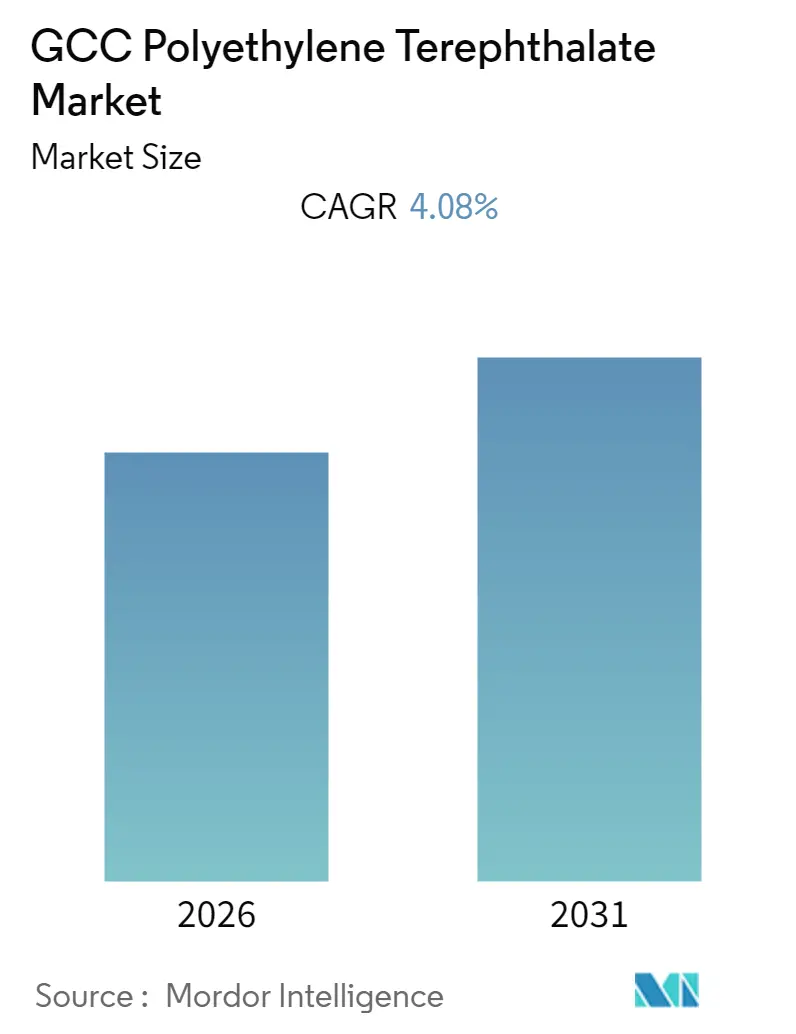
The GCC Polyethylene Terephthalate Market size is expected to register a CAGR of 4.08% during the forecast period.
- The bottles segment accounted for a major share of the market studied among the end-user industries currently, and it is expected to continue its dominance during the forecast period.
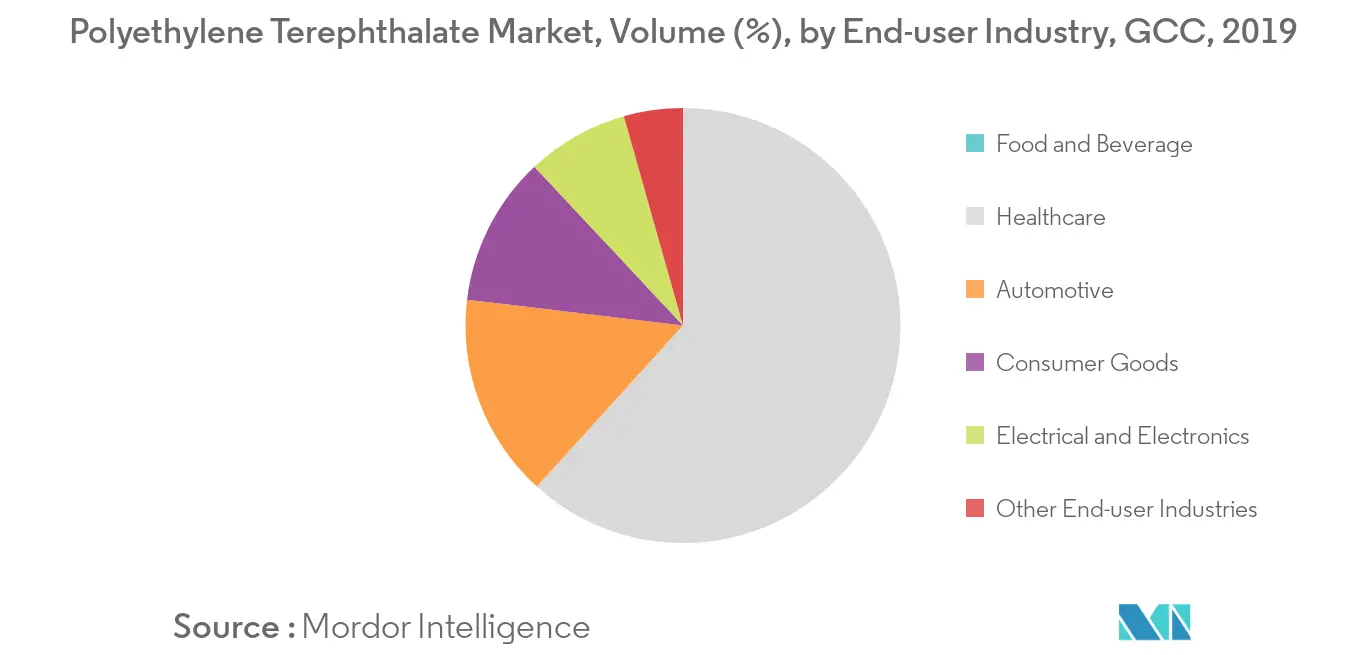
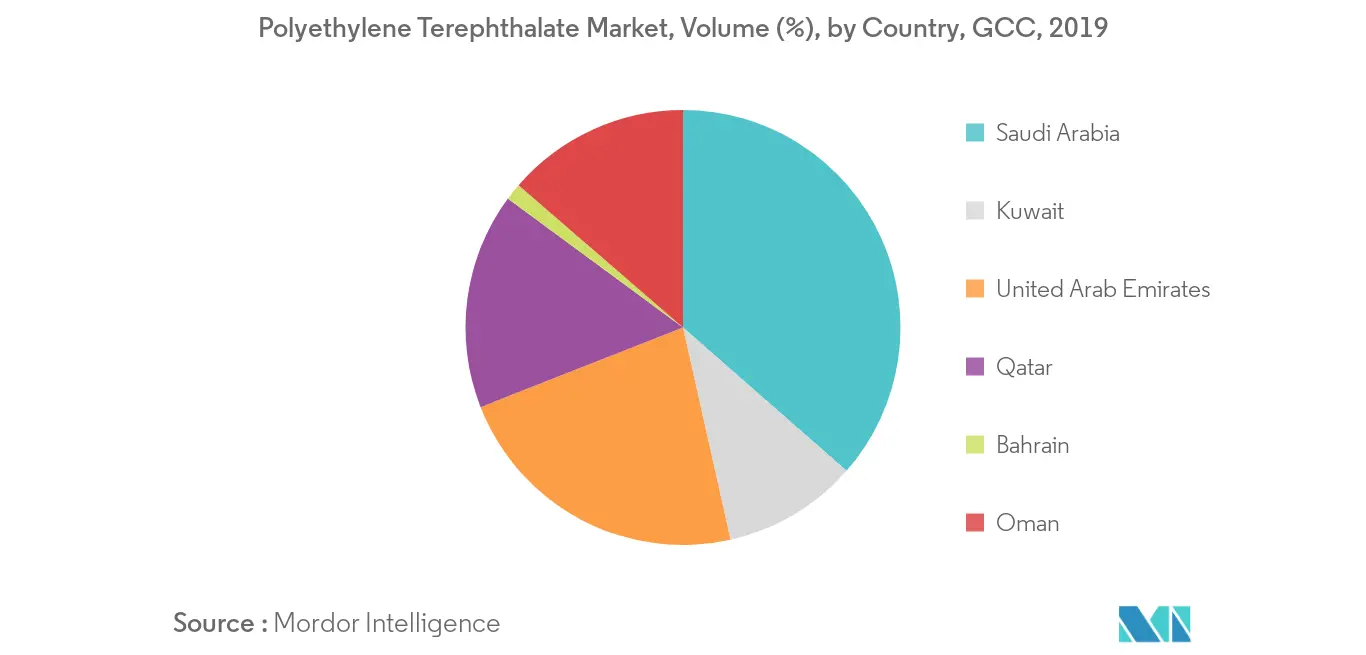
- Saudi Arabia dominated the studied market, owing to the high demand from the end-user industries, including food and beverage and healthcare.
Note: Market size and forecast figures in this report are generated using Mordor Intelligence’s proprietary estimation framework, updated with the latest available data and insights as of 2026.
GCC Polyethylene Terephthalate Market Trends and Insights
Soaring Demand from the Food and Beverage Industry
- PET is formed by combining purified terephthalic acid (PTA) or dimethyl terephthalate, and modified ethylene glycol, which makes it high-impact resistant and provides food contact safety.
- PET resin in the food and beverage industry is commonly used for packaging. The three major packaging applications of PET are as containers (bottles, jars, and tubs), thin-oriented films (bags and snack food wrappers), and semi-rigid sheet for thermoforming (trays and blisters).
- Mainly, these products include take-out containers, frozen foods, carbonated drinks and juices, ketchup, bottled water, jars, and baked good containers. They are also used in the food industry for clamshells, deli containers, as well as microwave food trays.
- Owing to the increasing demand from countries, such as Saudi Arabia, the United Arab Emirates, Kuwait, and Qatar, the food and beverage sector in the GCC region is expected to grow strongly, during the forecast period. Thus giving boost to GCC Polyethylene Terephthalate Market.
- In Saudi Arabia, the increasing population is one of the factors driving the huge demand for food and beverages, especially in the fast food and café segments.


Saudi Arabia to Dominate the Market
- Being an oil producing economy, from the initial phase itself, the country's interest in other industries was less. However, after the emergence and dominance of the non-OPEC countries, globally, and high volatility of crude oil prices, Saudi Arabia decided to diversify its portfolio to aid the economy grow uniformly.
- The market's openness and investment opportunities in Saudi Arabia are less, when compared to the other emerging economies. However, the government, in its 10th development plan, is reforming economic policies, with investments in diversified sectors, and is trying to attract private investments in the country, to make it a diversified economy that is not dependent on oil.
- Owing to the investments from the polyethylene terephthalate manufacturers in the country, the production capacity is expected to increase in the coming years. For instance, recently, on January 2019, Pan-Asia PET Resin (Guangzhou) Co., one of the leading PET bottle suppliers in China had launched a SAR 3.9 billion manufacturing plant in the country, which produce PET and PTA used in the packaging and fabric industries.
- The packaging industry has been witnessing substantial growth in Saudi Arabia, majorly driven by the increasing food manufacturing and processing and growing online food delivery services.
- The healthcare industry in Saudi Arabia accounts for the largest expenditure in the Middle Eastern region, and there is an increasing demand for the rise in hospital bed capacity and long-term care centers. The increasing healthcare expenditure in the country, along with the privatization of several public hospitals, is expected to drive the demand for healthcare equipment in the country, which, in turn, is expected to drive the market studied in the coming years.
- Owing to the increasing demand from the end-user industries, the GCC Polyethylene Terephthalate Market is likely to grow during the forecast period.
Value Chain Analysis
The GCC PET value chain starts with upstream aromatics and glycols, converting into PTA and then polymerizing into bottle-grade PET resin and film-grade PET for conversion into bottles, films/sheets, and other packaging formats. Competitive positioning is shaped by regional integration, with SABIC sourcing key feedstocks via long-term arrangements with Saudi Aramco and leveraging integrated infrastructure in Jubail and Yanbu, while JBF RAK LLC operates a backward-integrated Ras Al Khaimah, UAE complex with 360,000 TPA of bottle-grade PET resin and 72,000 TPA of BOPET film capacity. Oman also supports the chain through an export-oriented model, with PET production linked to port-connected logistics and storage used for regional distribution.
Midstream and downstream value creation is increasingly influenced by technology, logistics, and compliance. Energy-efficient process choices (for example, MTR technology cited for Alpek Polyester Middle East in Oman) and proximity to logistics hubs such as the Port of Salalah support supply reliability and cost positioning for converters and brand owners. On the distribution and end-market side, food-contact compliance acts as a practical bottleneck and entry barrier, with approvals tied to standards and conformity assessments (notably SFDA requirements in Saudi Arabia and UAE MOHAP processes) before resin can move into regulated packaging applications. At the same time, recycling and material recovery initiatives in the UAE are reshaping linkages between PET producers, converters, and recyclers by creating pathways for rPET integration and circular supply contracts.
Competitive Landscape
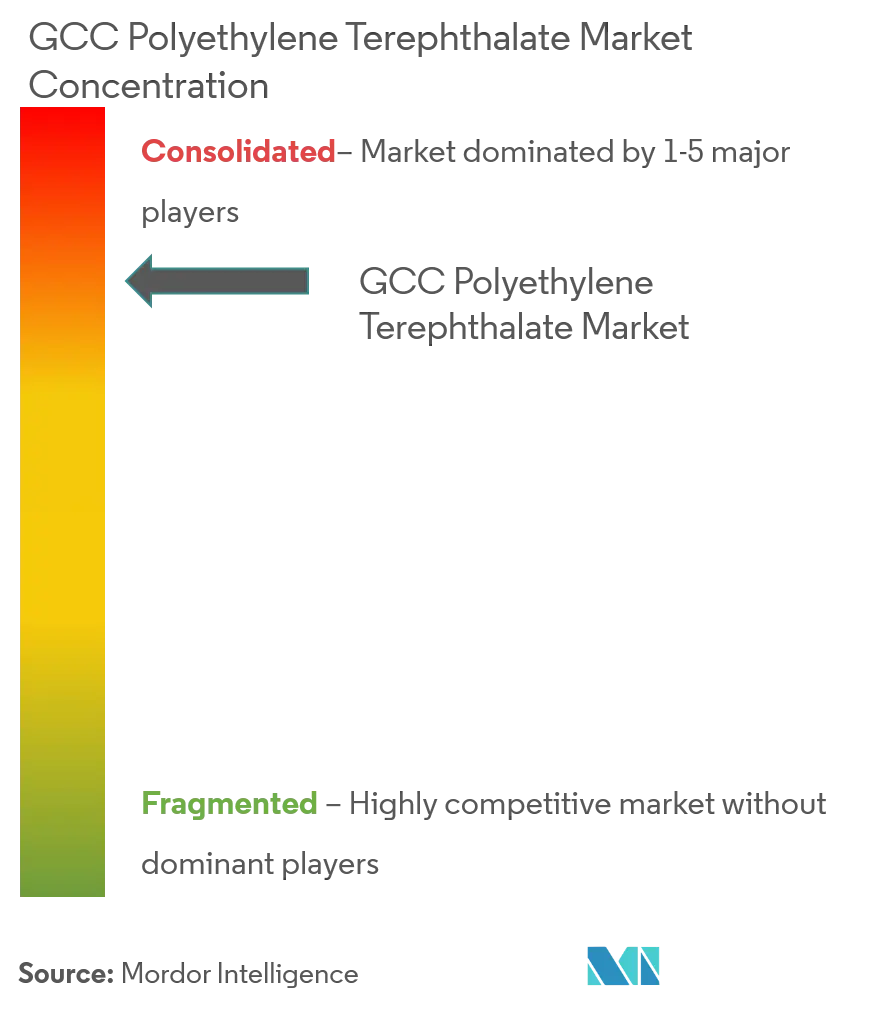
In terms of production capacity, the GCC Polyethylene Terephthalate Market is highly consolidated with the top two players accounting for a share of more than 65%. The key players include Octal, Pan-Asia Saudi Co. Ltd, SABIC, and JBF RAK.
GCC Polyethylene Terephthalate Industry Leaders
OCTAL
SABIC
PAN-ASIA SAUDI CO., LTD
- *Disclaimer: Major Players sorted in no particular order

Market Opportunities and Future Outlook
Circular packaging programs and food-contact recycled-content frameworks across the GCC create a narrower set of requirements that PET producers and converters can address through certified rPET supply and consistent compliance documentation. Veolia’s RECAPP platform signing a three-year contract with Agthia (Al Ain Water) to collect 20 million PET bottles annually, alongside recycler Repeet processing them into food-grade rPET pellets, provides a clear anchor for traceable closed-loop material demand. Separately, the UAE Ministry of Climate Change and Environment expanded permissions for food-contact recycled plastics beyond rPET to include rPP, rHDPE, and rLDPE, which supports packaging portfolios combining PET with other recycled polymers and raises the value of multi-resin sorting and certification capabilities within GCC industrial zones.
Upstream and intermediate capacity in Saudi Arabia also supports opportunities to strengthen local PET chain resilience and reduce reliance on imported intermediates for converters. Tasnee completed a USD 500 million ethylene expansion at the Saudi Ethylene and Polyethylene Company (SEPC) cracker in Al Jubail Industrial City in July 2026, increasing olefins capacity by 18%, while Arabian Industrial Fibers Company (Ibn Rushd) expanded its Yanbu complex by adding 400,000 tpy of PTA capacity to support PET production. With Saudi Arabia’s large end-use base in food and beverage packaging, developments in resin inputs improve the case for co-located resin-to-packaging investments, faster qualification cycles for food-contact grades, and supply arrangements that bundle virgin PET and rPET to meet brand sustainability and regulatory requirements.
Recent Industry Developments
- July 2026: Tasnee completed a USD 500 million ethylene expansion project at the Saudi Ethylene and Polyethylene Company (SEPC) cracker in Al Jubail Industrial City, raising olefins production capacity by 18%. The added upstream feedstock availability supports regional polymer value chains, including PET intermediates and packaging conversion ecosystems concentrated around Saudi industrial clusters.
- September 2025: The US Federal Register published preliminary results of the antidumping duty administrative review on polyethylene terephthalate resin from the Sultanate of Oman, covering OCTAL SAOC FZC. The proceeding highlighted how trade remedies can directly affect GCC export competitiveness and planning for producers with cross-border sales exposure.
- November 2024: Industry reporting highlighted the shift of PET production in Oman from primarily local supply to a more export-oriented posture, supported by port-linked logistics. This reinforced Oman’s role in regional supply balancing for PET resin and shaped procurement strategies for converters across the GCC that manage import and lead-time risk.


Research Methodology Framework and Report Scope
Market Definition and Coverage
For this study, the market covers polyethylene terephthalate (PET) materials and products sold within GCC countries for major downstream uses like packaging and durable goods. Market value is measured at the point of sale within the region.
Scope exclusions: We exclude non-PET substitute polymers, in-house captive transfers that are not priced as sales, and any double counting between resin and converted PET products.
Segmentation Overview
- Product Type
- Bottles
- Films and Sheets
- Household Containers
- Other Product Types
- End-user Industry
- Food and Beverage
- Automotive
- Electrical and Electronics
- Healthcare
- Consumer Goods
- Other End-user Industries
- Geography
- Saudi Arabia
- Kuwait
- United Arab Emirates
- Qatar
- Bahrain
- Oman
Data Sources, Market Sizing, and Validation
Desk Research
Desk research starts with assembling a factual base for GCC PET demand signals, packaging intensity, and trade flows, then locking the sizing logic. We used UN Comtrade trade statistics, national statistics portals in GCC countries, customs tariff schedules, and standards and policy releases related to packaging and recyclability, followed by technical references from peer-reviewed polymer and packaging journals.
To translate these signals into practical assumptions, we also reviewed company annual reports, investor presentations, and press releases that describe capacity, product mix, and plant utilization in the GCC region. Where available, we used paid subscriptions for company financials and intelligence and an import-export shipment-level database to cross-check large importers, exporters, and major product movements. These desk research sources are illustrative only, and additional public and paid references were also used for data collection, validation, and clarification.
Primary Interviews and Surveys
Primary interviews and surveys were used to challenge the desk assumptions on PET pricing, grade mix, and end-use split across GCC, including Saudi Arabia, the UAE, and the smaller markets. We spoke with a mix of producers, converters, distributors, and large end users to close gaps on utilization, import reliance, and how typical contract versus spot pricing plays out in the region, and then rechecked these points against the broader desk datasets.
Distribution of primary research fieldwork respondents
| Company type | Respondent position |
|---|---|
| Top tier: 25% | CXOs: 16% |
| Mid tier: 59% | Functional/Unit leaders: 28% |
| Smaller Players: 16% | Managers: 56% |
Market-Sizing & Forecasting
Sizing uses a top-down approach where GCC demand is reconstructed from production capacity, operating rates, and net trade. The value is then calculated using verified regional price bands. To keep the model grounded, we also run selective bottom-up checks using sampled average selling prices multiplied by estimated volumes for major application pools, followed by channel checks with converters and distributors.
Key inputs that shape the model include PET resin and converted product price movements in the Gulf, packaging demand indicators such as bottled beverage output and household packaged food consumption, import and export volumes by PET-linked HS codes, local capacity additions or maintenance shutdown timing, and evidence of recycled content targets that can shift grade mix. Since some data arrives with a lag, gaps are handled through conservative interpolation based on the nearest available trade and price series, then reviewed against interview feedback.
For forecasting, we use scenario analysis because pricing, trade direction, and utilization can change with feedstock costs and regional demand cycles. The forward path is set after aligning expected demand drivers with expert views on utilization and trade balance, then stress-testing against high and low price cases.
Data Validation & Update Cycle
Validation is carried out in layers so the final number does not depend on one data stream. We compare model outputs against independent signals such as trade balances, known plant operating realities, and application demand markers. Where we see anomalies, we flag them and revise until the logic is consistent across countries.
Before sign-off, another analyst reviews key assumptions, conversion factors, and currency timing so the variance is understood and documented. The study is refreshed annually, and interim updates are triggered when material events occur, including major capacity changes, policy shifts on packaging and recycling, or sharp price moves. Right before delivery, we complete a final refresh pass to ensure clients receive the latest updated view.
Mordor Intelligence's Gcc Polyethylene Terephthalate Market Size Versus Other Published Estimates
Published market sizes for GCC PET can differ widely because the scope is not treated the same across sources, and because pricing and trade assumptions are handled differently. The main differences usually come from what is counted as PET market value (resin only versus resin plus converted products), whether recycled PET is included in totals, and what year and currency timing are used for pricing.
A common gap driver in this market is that some estimates incorporate supply-side capacity or nameplate output into value without fully adjusting for utilization and net exports, which can overstate what is actually sold within GCC. Another driver is the treatment of bottles, films and sheets, and household containers. When resin and finished products are mixed, double counting can occur unless conversion factors and price points are separated, which is a modeling choice applied by Mordor Intelligence.
Benchmark comparison
| Source | Market Size | Gaps in Research Methodology |
|---|---|---|
| Mordor Intelligence | USD 0.00 B (2025) | |
| Regional Consultancy A | USD 4.20 B (2025) | This figure appears to rely on a broad value pool that can mix resin and downstream PET product values, and it may apply a single average price level without separating contract versus spot pricing across GCC. |
| Digital Publisher B | USD 2.50 B (2023) | The estimate is anchored to an earlier base year and uses a long-horizon CAGR, which can miss recent GCC trade shifts and near-term price swings that materially change the current-year value. |
Across the table, the spread is mainly explained by scope alignment, price timing, and whether utilization and net trade are used to tie supply to actual regional sales. Our approach keeps the steps traceable to clear demand and trade variables, making it easier for users to understand what is included and to repeat the logic when conditions change.


Key Questions Answered in the Report
What is the current GCC Polyethylene Terephthalate (PET) Market size?
The GCC Polyethylene Terephthalate (PET) Market is projected to register a CAGR of 4.08% during the forecast period (2026-2031)
Who are the key players in GCC Polyethylene Terephthalate (PET) Market?
OCTAL, SABIC and PAN-ASIA SAUDI CO., LTD are the major companies operating in the GCC Polyethylene Terephthalate (PET) Market.
What years does this GCC Polyethylene Terephthalate (PET) Market cover?
The report covers the GCC Polyethylene Terephthalate (PET) Market historical market size for years: 2019, 2020, 2021, 2022, 2023 and 2024. The report also forecasts the GCC Polyethylene Terephthalate (PET) Market size for years: 2025, 2026, 2027, 2028, 2029 and 2030.
Page last updated on:


 Your data is secure and never sold or shared.


