
Market Overview
| Study Period | 2019 - 2031 |
|---|---|
| Forecast Data Period | 2026 - 2031 |
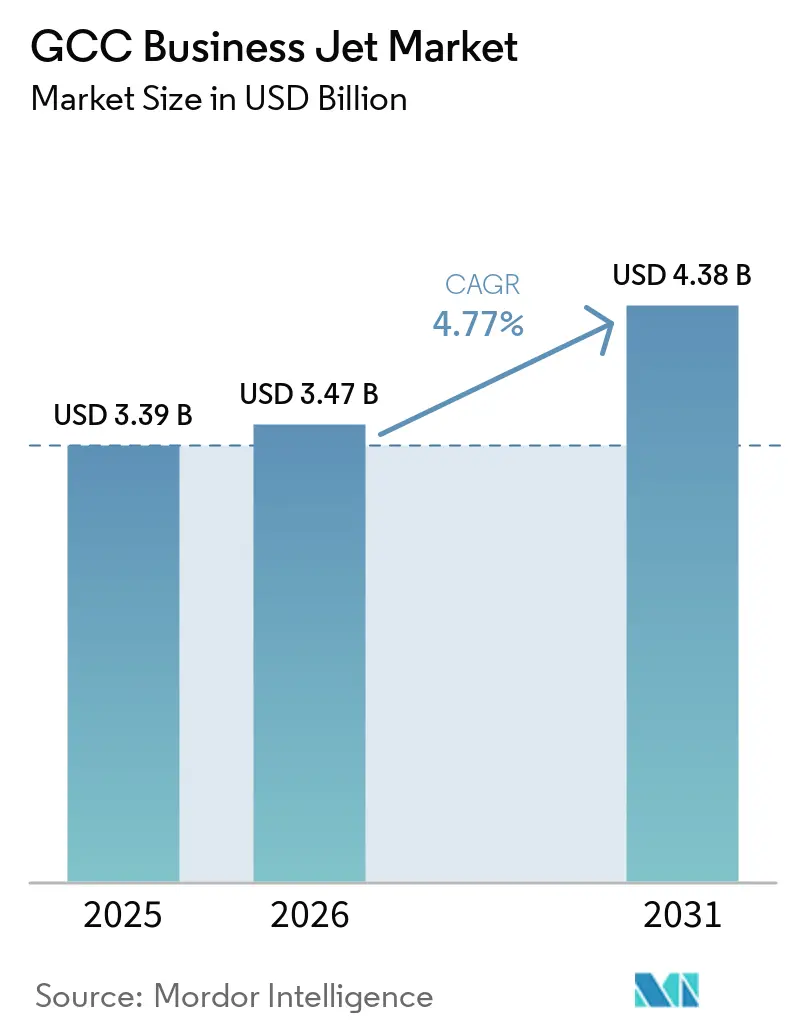
| Base Year Market Size (2025) | USD 3.39 Billion |
| Market Size (2026) | USD 3.47 Billion |
| Market Size (2031) | USD 4.38 Billion |
| Growth Rate (2026 - 2031) | 4.77 % |
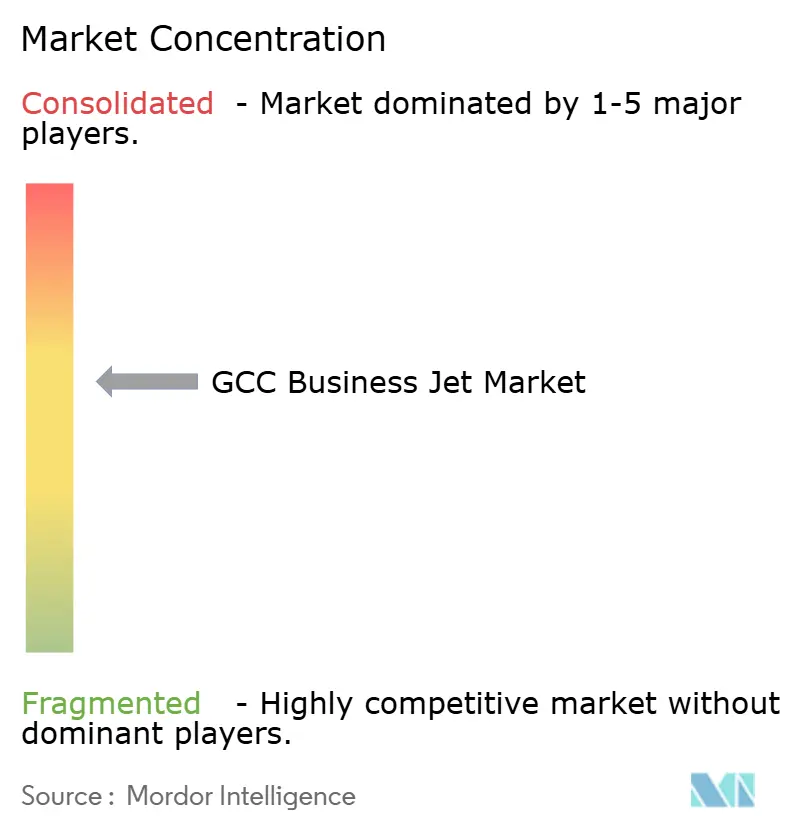
| Market Concentration | Medium |
Major Players *Disclaimer: Major Players sorted in no particular order Image © Mordor Intelligence. Reuse requires attribution under CC BY 4.0. | |
GCC Business Jet Market Analysis by Mordor Intelligence
The GCC business jet market size was valued at USD 3.39 billion in 2025 and is forecast to grow from USD 3.47 billion in 2026 to reach USD 4.38 billion by 2031, at a 4.77% CAGR over 2026-2031. Rising wealth concentration, national diversification programs, and corporate travel requirements support demand for aircraft and charter services across the region. Saudi Arabia’s domestic charter reforms have expanded the set of operators that can serve local routes, supporting new trip creation rather than only a shift from UAE hubs. Airport congestion is moving flights toward secondary locations, including Sharjah, Al Maktoum International, AlUla, and Muscat. This redistribution increases the value of FBO capacity, aircraft management, and maintenance services outside the main hubs. Longer OEM delivery queues also make pre-owned aircraft, leasing, and membership programs more relevant for buyers who need flexible access.
Key Report Takeaways
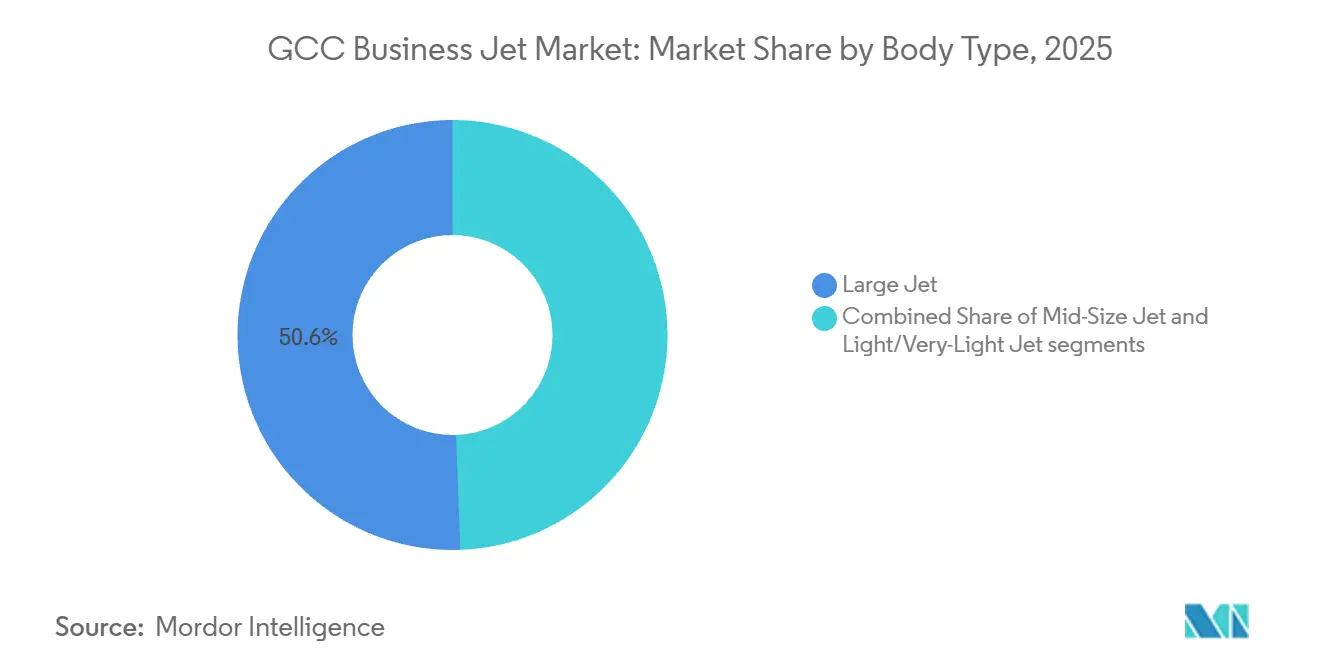
- By body type, large jets held 50.58% of the GCC business jet market share in 2025, while light and very-light jets are forecast to grow at a 5.98% CAGR through 2031.
- By end user, businesses and corporate entities held 40.73% of the GCC business jet market share in 2025, while charter/air-taxi operators are forecast to grow at a 6.89% CAGR through 2031.
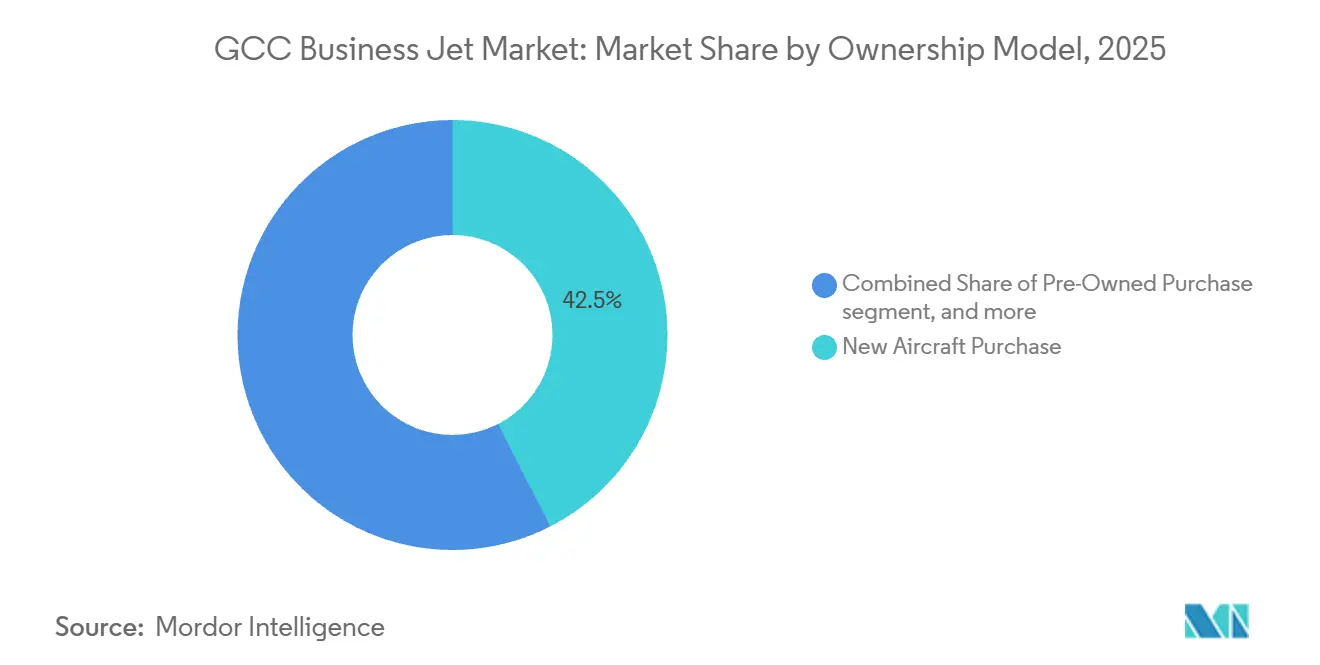
- By ownership model, new aircraft purchase accounted for 42.48% of regional revenue in 2025, while jet cards/memberships are forecast to grow at an 8.26% CAGR through 2031.
- By geography, the UAE held 37.19% of revenue in 2025, while Oman is forecast to grow at a 7.33% CAGR through 2031.
Note: Market size and forecast figures in this report are generated using Mordor Intelligence’s proprietary estimation framework, updated with the latest available data and insights as of January 2026.
GCC Business Jet Market Trends and Insights
Drivers Impact Analysis*
| Driver | (~) % Impact on CAGR Forecast | Geographic Relevance | Impact Timeline |
|---|---|---|---|
| Rising UHNW and family-office wealth concentration | +1.20% | UAE, Saudi Arabia, Qatar, Bahrain, and Kuwait | Long term (≥ 4 years) |
| Vision-2030 linked corporate mobility programs | +0.90% | Saudi Arabia, with spillover to the UAE and Oman | Medium term (2-4 years) |
| Expansion of dedicated FBO and MRO infrastructure | +0.70% | UAE, Saudi Arabia, and Oman | Medium term (2-4 years) |
| OEM supply-chain bottlenecks pushing pre-owned uptake | +0.60% | UAE and Saudi Arabia | Short term (≤ 2 years) |
| Islamic finance-backed operating lease structures | +0.50% | Saudi Arabia, Kuwait, and Bahrain | Long term (≥ 4 years) |
| SAF-ready long-range jets favored by ESG-conscious firms | +0.40% | UAE, Qatar, and European corridor connectivity | Long term (≥ 4 years) |
| Source: Mordor Intelligence | |||
Rising UHNW and Family-Office Wealth Concentration
Family offices across the GCC increasingly use private aviation as a working asset for investment, business, and family travel. The UAE had 183,000 millionaires in 2025, a 3.50% increase from 2024, which supported a large pool of potential business aviation users. This wealth base is concentrated in locations with established airports, charter operators, and aircraft-management capabilities. Family offices also tend to require schedules that commercial airlines cannot reliably provide for multi-city regional travel. These needs support demand for large-cabin aircraft, managed fleets, and flexible charter products in the GCC business jet market. As wealth passes to younger owners, membership and on-demand access models can become more relevant alongside direct ownership.
Vision 2030-Linked Corporate Mobility Programs
Saudi Arabia's aviation reforms have created a more open setting for corporate and charter travel. The General Authority of Civil Aviation's (GACA's) roadmap targets a USD 2 billion general aviation sector, 6 dedicated business aviation airports, 9 business aviation terminals, and 35,000 jobs by 2030. Foreign on-demand charter operators gained access to domestic Saudi routes from May 2025.[1]General Authority of Civil Aviation, “GACA Opens Domestic Aviation Market to International Charter Operators,” General Authority of Civil Aviation, gaca.gov.sa Saudi business-jet movements rose 24% in 2024 to 23,600 flights, while domestic movements rose 26%. The policy change lets operators serve routes among Riyadh, Jeddah, Dammam, AlUla, and other domestic destinations more directly. It also creates demand for ground handling, crew services, and maintenance, supporting a broader GCC business jet market ecosystem.
Dedicated FBO and MRO Infrastructure Expansion
New business aviation facilities are increasing the region’s ability to handle flights outside the most congested airports. Gama Aviation’s Sharjah Business Aviation Center became fully operational in April 2026 and provides a USD 60 million alternative for operators serving the UAE. The facility includes a 130,000-square-foot hangar and serves aircraft that may otherwise face scheduling constraints at Dubai International Airport. Al Maktoum International Airport also attracts business aviation activity because it offers a less-constrained location for FBO and maintenance investments. A wider airport network improves scheduling options and can reduce the need for repositioning for charter operators. This capacity expansion supports the GCC business jet market by helping convert demand into completed flights.
Islamic Finance-Backed Operating Lease Structures
Sharia-compliant financing offers an additional route for GCC operators and buyers to acquire aircraft. Dubai Islamic Bank completed an Islamic aircraft finance transaction with Turkish Airlines in July 2025 through a 12-year Ijarah lease structure. A syndicate that included Warba Bank arranged a USD 1 billion Islamic financing facility for Avolon in 2025.[2]Warba Bank, “Warba Bank as Mandated Lead Arranger of USD 1 Billion Financing for Avolon,” Warba Bank, warbabank.com These transactions demonstrate the availability of longer-term Islamic structures for aviation assets. Such structures can support operating leases, managed fleets, and new charter capacity without requiring outright ownership. They also align with the growing preference for access models that limit capital commitments. This financing base can support membership and lease activity in the GCC business jet market.
Restraints Impact Analysis*
| Restraint | (~) % Impact on CAGR Forecast | Geographic Relevance | Impact Timeline |
|---|---|---|---|
| Slot and airspace congestion at key GCC hubs | -0.80% | UAE, including DXB and DWC, and Saudi Arabia | Short term (≤ 2 years) |
| High import tariffs/VAT on pre-owned imports | -0.50% | UAE and Saudi Arabia, with spillover across the GCC | Medium term (2-4 years) |
| Qualified pilot shortage in Arabic-language ATP pool | -0.40% | GCC-wide, with highest intensity in Saudi Arabia | Medium term (2-4 years) |
| Emerging carbon-accounting mandates on corporate travel | -0.30% | Global, affecting GCC-originating international routes | Long term (≥ 4 years) |
| Source: Mordor Intelligence | |||
Slot and Airspace Congestion at Key GCC Hubs
Congestion at primary airports limits the number of business aviation flights that operators can schedule during peak periods. Dubai International Airport is a Level 3 coordinated airport, and general aviation flights are subject to restrictions and landing-fee surcharges. Similar scheduling limits at Abu Dhabi and many Saudi airports can increase crew positioning, fuel, and ground-handling costs. Sharjah provides a useful alternative, although passengers traveling to central Dubai may still face a 45 to 60-minute ground transfer. Congestion can therefore reduce schedule certainty and pressure charter margins in the GCC business jet market. Secondary airports mitigate part of this constraint, but their transport links and supporting services must expand with demand.
Qualified Pilot Shortage in the Arabic-Language ATP Pool
The regional aviation workforce is growing more slowly than fleet and route requirements. Boeing expects the Middle East to require more than 23,000 new pilots over the next 10 years. Business aviation often needs higher crew-to-aircraft ratios than commercial operations because flights are irregular and aircraft must meet client schedules. Domestic charter networks also need pilots who can meet local regulatory and language requirements. Operators may rely more heavily on international recruitment when locally qualified crews are limited. Higher compensation and recruitment costs can pressure operator margins as the GCC business jet market expands. Training capacity and clear licensing pathways will remain important to the region’s operating capacity.
*Our forecasts treat driver/restraint impacts as directional, not additive. The impact forecasts reflect baseline growth, mix effects, and variable interactions.
Segment Analysis
By Body Type: Large Cabins Anchor Revenue While Light Jets Gain Demand
Large jets accounted for 50.58% of revenue in 2025 because they meet the long-distance travel needs of sovereign entities, energy companies, and large family offices. Gulfstream confirmed that 14 G700 aircraft were based in the Middle East in November 2025, representing 20% of the global in-service G700 fleet. Qatar Executive operates 6 G700 aircraft and 15 G650ER aircraft within its 24-aircraft fleet. Mid-size aircraft, including the Bombardier Challenger 3500 and Dassault Falcon 2000, address regional corporate travel with a balance of cabin capacity and operating cost.
Light and very-light jets are forecast to grow at a 5.98% CAGR through 2031 in the GCC business jet market. Their economics are suited to shorter domestic and regional routes as FBO access improves at secondary airports. The Bombardier Challenger 3500 became the fastest super-mid-size business jet to reach 100 deliveries, and Aloula Aviation received the first Challenger 3500 registered in Saudi Arabia in June 2025.[3]Bombardier, “Bombardier Begins Landmark Deliveries of Three Challenger 3500 Aircraft to Aloula Aviation,” Bombardier, bombardier.com Embraer’s Phenom 300 has been the world’s best-selling business jet for 11 consecutive years, giving operators access to a widely supported light-jet platform. Light aircraft can serve charter subscribers on routes where a 90-minute flight replaces a much longer road journey. The result is a broader range of aircraft choices across the GCC business jet industry.


By End User: Corporate Demand Leads While Charter Adds New Capacity
Businesses and corporate entities accounted for 40.73% of the GCC business jet market size in 2025. Multinational energy companies, sovereign wealth funds, and regional conglomerates use dedicated aircraft for board and executive travel. Corporate movement has increased with Saudi investment in tourism, entertainment, and industrial projects. These users value schedule control and direct access to cities that have fewer convenient commercial connections. Individual owners remain an important group because the UAE’s resident wealth base continues to grow. Government and special-mission operators provide a more stable demand base, including capacity additions such as Royal Jet’s planned ACJ320neo deliveries.
Charter/air-taxi operators are forecast to grow at a 6.89% CAGR through 2031. Saudi domestic liberalization lowers entry barriers for operators serving point-to-point routes inside the KSA. VistaJet reported a 32% year-over-year increase in Saudi Program Members in the first half of 2025, before its domestic authorization. Each additional operator creates related demand for handling, maintenance, crew, and scheduling services. Training and Academic Institutions form a smaller but expanding customer group as Saudi aviation workforce programs develop. GACA regulations and the UAE Civil Aviation Regulations set out certification requirements for air operator and private operator activities.
By Ownership Model: New Purchases Lead While Memberships Expand Fastest
New aircraft purchase accounted for 42.48% of the GCC business jet market in 2025. The Helicopter Company, a Public Investment Fund company, signed a July 2026 letter of intent for up to 60 Bombardier Challenger and Global business jets. OEM delays support demand for pre-owned aircraft among buyers with immediate deployment needs.
The jet cards/membership segment is forecast to grow at an 8.26% CAGR through 2031. This option gives companies and family offices predictable access without placing a large asset on their balance sheet. Fractional ownership remains less developed because outright ownership and charter have traditionally been more familiar choices in the GCC. Vista placed a USD 1.20 billion firm order for 40 Challenger 3500 aircraft in February 2026, with options for 120 additional aircraft, valued at up to USD 4.72 billion. Larger managed fleets can make subscription programs more reliable across regional and international routes. Islamic leasing structures can further support operators that want fleet access without the currency and capital exposure of a full purchase.
Geography Analysis
The UAE accounted for 37.19% of the GCC business jet market in 2025 because it combines a large wealth base with a mature airport, FBO, and aircraft-management infrastructure. Dubai and Abu Dhabi remain major centers for charter, maintenance, and high-value international travel. ExecuJet Middle East manages more than 22 aircraft and plans to reach 30 by 2030. Al Maktoum International Airport supports traffic redistribution and creates room for new FBO and MRO investment. The UAE’s Civil Aviation Regulations also provide a well-developed operating framework for cross-border activity.
Saudi Arabia is the second-largest GCC geography and is becoming the region’s strongest demand catalyst. GACA’s roadmap links aviation capacity with the KSA’s wider development plans, including an investment in the Jeddah Aviation Zone. Domestic charter access enables foreign operators to serve point-to-point flights within Saudi Arabia. The 32% increase in VistaJet Saudi Program Members during the first half of 2025 showed early demand for flexible access models. Saudi facilities and service providers can capture more of the value that previously flowed through UAE hubs. The GCC business jet market, therefore, gains a second major operating center rather than relying on a single hub.
Oman is forecast to grow at a 7.33% CAGR through 2031, the highest rate among the GCC geographies. Muscat can absorb traffic that faces restrictions at Dubai and other Level 3 coordinated airports. Its location also supports charter connections with Europe, India, and East Africa. Qatar, Bahrain, and Kuwait remain smaller markets with different demand patterns. Qatar benefits from its LNG and financial sectors, Bahrain benefits from links to Saudi Arabia’s Eastern Province, and Kuwait has potential for finance-supported fleet growth. Capacity additions and economic diversification will determine how quickly these secondary locations grow.
Regulatory Landscape
The GCC regulatory environment is shaped primarily by national civil aviation authorities. In the UAE, the General Civil Aviation Authority (GCAA) governs operators under its Civil Aviation Regulations (CARs), including requirements for an Air Operator Certificate (AOC) or Private Operator Certificate (POC). The UAE has also been updating Air Operations regulations through its formal amendment process (including a 2024 notice of proposed amendment) to align operational requirements with ICAO Annex 6 and European AIR OPS, covering areas such as fuel management and all-weather operations.
In Saudi Arabia, the General Authority of Civil Aviation (GACA) administers its General Authority of Civil Aviation Regulations (GACAR), with operator approvals and authorizing documents handled through national processes and systems. A market-shaping change came in May 2025, when Saudi Arabia opened its domestic market to international on-demand charter flights by removing cabotage restrictions and expanding the domestic city pairs available to foreign charter operators. Regionally, the GCC approved in December 2025 the establishment of a unified civil aviation regulator headquartered in the UAE to harmonize policies and coordinate upper airspace management. Bahrain also launched its National Aviation Strategy 2026-2027 to align its aviation ecosystem with international standards and expand its hub network.
Value Chain Analysis
The GCC business jet value chain covers aircraft sourcing (OEM deliveries and pre-owned transactions), completion and cabin refurbishment, import and registration support, finance and leasing, operations management, FBO handling, and MRO and parts logistics. OEMs (Gulfstream, Bombardier, Dassault, Embraer, Textron) anchor supply, while regional management and charter specialists handle aircraft induction, crew and regulatory compliance, and utilization through charter and membership programs. Maintenance and support increasingly center on dedicated aviation clusters and airports that can handle hangar-intensive work and parts storage, which reduces reliance on congested primary airline hubs.
A growing share of value creation is shifting toward local MRO capacity, component availability, and logistics buffering. Dubai South's Mohammed Bin Rashid Aerospace Hub completed the first phase of its Aerospace Supply Chain zone in April 2025 (1,291,000 square feet across 11 facilities), strengthening the base for component workshops and MRO providers. Saudi Arabia launched the USD 1.3 billion Jeddah Aviation Zone in February 2025 to expand manufacturing, MRO, and training, while inventory and parts access has also been reinforced by transactions such as the July 2025 USD 110 million Sanad-AerCap agreement covering 6,000 aviation components. On the private aviation services side, Jetex was named the exclusive operator of the private aviation terminal at Red Sea International Airport in December 2024, tying FBO services directly to new destination infrastructure and adding further nodes to the regional business aviation network.
Competitive Landscape
The market concentration is moderate, with key OEMs such as Gulfstream, Bombardier, Dassault, Embraer, and Textron dominating supply. Competition is more fragmented among charter operators, aircraft managers, FBOs, brokers, and MRO providers. Gulfstream's aerospace segment's backlog reached USD 24 billion. The company delivered its 100th G700 during that quarter, reinforcing the importance of ultra-long-range aircraft for the region. OEM backlog conditions can strengthen pricing power and direct buyers toward used aircraft or access programs.
Facility coverage is a major basis for competition in the services tier. Gama Aviation opened its Sharjah Business Aviation Center in April 2026, offering an alternative to the operational constraints in Dubai. Saudi Arabia's airports and terminals offer international FBO providers an opportunity to establish a presence in Jeddah, AlUla, and at gateway airports near major developments. New FBO capacity can improve passenger handling, aircraft turnaround times, and maintenance access. These factors are especially important when primary hub slots remain constrained.
At the operator level, fleet age, network availability, digital booking, and regulatory approvals determine competitive strength. VistaJet's 70-aircraft global fleet includes 90 aircraft available within Saudi Arabia, which supports crew routing and maintenance planning. DC Aviation Al-Futtaim and Empire Aviation Group benefit from existing approvals, fleet-management experience, and maintenance relationships. New entrants can aggregate demand from corporate users, family offices, and leisure travelers through membership or charter products. However, operators without their own fleet or hangar relationships face a more difficult path to reliable scale. The GCC business jet industry is therefore open to new entrants, but established assets and approvals remain meaningful barriers.
GCC Business Jet Industry Leaders
Gulfstream Aerospace Corporation
Bombardier Inc.
Textron Inc.
Embraer S.A.
Dassault Aviation S.A.
- *Disclaimer: Major Players sorted in no particular order

Market Opportunities and Future Outlook
Capacity build-out and dedicated general aviation infrastructure create room for FBO operators, aircraft management companies, and MRO providers to broaden their reach beyond the traditional Dubai and Riyadh core. Dubai South is one visible example, where the Mohammed Bin Rashid Aerospace Hub recorded 20,289 business aviation movements in 2025, a 17% increase over 2024. This rise supports opportunities in hangar space, line maintenance, parts provisioning, and ground handling at business-aviation-focused facilities. Saudi Arabia's plan to develop six dedicated business aviation airports and nine new terminals also supports that services-led direction, alongside February 2026 updates such as the general aviation terminal at Dammam (OEDF) and an operator appointment.
Missionized and multi-role applications offer an adjacent opportunity for OEMs, integrators, and support providers, particularly for long-range large-cabin platforms adapted for surveillance and special missions. In November 2025, Bombardier Defense highlighted the Middle East as a target region for Global 6500-based defense and special-mission configurations, which links regional procurement and security requirements to downstream demand for modification, certification support, and sustainment. At the same time, operational volatility tied to airspace restrictions and regional disruptions keeps focus on dispatch reliability services, alternate-airport planning, and multi-hub redundancy, areas where operators and service providers can differentiate through resilient network design rather than depending on single-hub utilization.
Recent Industry Developments
- July 2026: Embraer reported delivery of 45 executive aircraft in Q2 2026, up from 38 units in Q2 2025. Higher delivery volume supports fleet expansion and replacement activity for light and mid-size jets used in regional charter and corporate missions. The update also indicates improved supply availability relative to the lead-time constraints that have been supporting pre-owned pricing in the region.
- November 2025: Gulfstream reported that 14 G700 aircraft, about 20% of its in-service G700 fleet at the time, were based in the Middle East. The concentration of a new flagship type in the region reinforces the GCC's role as an early-adopter market for long-range, large-cabin platforms. It also raises demand for type-specific training, line maintenance capability, and high-end completion and cabin support services locally.
- December 2024: Red Sea Global and Jetex announced an agreement naming Jetex as the exclusive operator of the private aviation terminal at Red Sea International Airport. This formalized a dedicated access point for business aviation at a major Saudi giga-project destination. It supports growth in point-to-point charter and strengthens the case for the utilization of secondary hubs alongside Riyadh and Jeddah.


Research Methodology Framework and Report Scope
Market Definition and Coverage
This market covers the revenue generated from business jet aircraft activity across the six GCC countries, measured in USD value terms. It includes demand linked to private and corporate travel where a business jet is the aircraft used for the mission.
Scope exclusions: We exclude rotorcraft, scheduled commercial airline operations, and general aviation aircraft that are not business jets.
Segmentation Overview
- By Body Type
- Large Jet
- Mid-Size Jet
- Light/Very-Light Jet
- By End User
- Individual Owners
- Businesses and Corporate Entities
- Charter/Air-Taxi Operators
- Training and Academic Institutions
- Government and Special-Mission Operators
- By Ownership Model
- New Aircraft Purchase
- Pre-Owned Purchase
- Fractional Ownership
- Jet Cards/Membership
- By Geography
- Saudi Arabia
- United Arab Emirates
- Qatar
- Bahrain
- Oman
- Kuwait
Data Sources, Market Sizing, and Validation
Desk Research
To set the base structure, we start with public aviation and macro data that helps explain fleet activity and replacement demand in the GCC. Sources used include, for example, civil aviation authority releases in the UAE and Saudi Arabia, airport and FBO traffic updates where available, customs and trade statistics for aircraft and parts, and aircraft registration and operator listing references.
We then layer in supporting documents such as annual reports and investor presentations from relevant aviation operators, airport operators, and service providers, along with industry association publications and reputable news coverage on deliveries, fleet additions, and new airport terminal capacity. Where needed, we also reference paid subscriptions for company financials and intelligence, patent databases, and contract and tender tracking to confirm large infrastructure and procurement announcements. These desk sources are illustrative and not exhaustive, and we use many additional public and paid references for cross-checks and clarification.
Primary Interviews and Surveys
Primary work is used to stress-test the desk assumptions and convert activity signals into a repeatable market model. We speak with operators, service providers, and industry experts across key GCC hubs, then validate trends like charter utilization, aircraft lead times, and how pricing typically moves before we lock the final view.
Distribution of primary research fieldwork respondents
| Company type | Respondent position | Region |
|---|---|---|
| Top tier: 38% | CXOs: 17% | |
| Mid tier: 44% | Functional/Unit leaders: 33% | |
| Smaller Players: 18% | Managers: 50% |
Market-Sizing & Forecasting
Sizing starts with a top-down build where active business jet fleet signals and mission activity indicators are converted into a value pool for the GCC, then apportioned across the six countries using airport activity and operator presence checks. To keep totals realistic, we corroborate the outcome with selective bottom-up approximations, such as sampled aircraft delivery values, typical pre-owned transaction ranges, and a simple ASP times volume check on charter activity.
Inputs used in the model include business jet fleet size and age profile, new and pre-owned aircraft availability, typical annual utilization patterns (hours and trips), charter and fractional adoption intensity, and observable pricing direction for aircraft and key services in the region. For forecasting, we rely on scenario analysis supported by expert views on demand drivers, then adjust the trajectory for known supply constraints, delivery backlogs, and changes in ownership preferences. If a bottom-up data point is missing in a country, we bridge the gap using proxy metrics like hub traffic share and fleet share, and then re-check it in follow-up calls.
Data Validation & Update Cycle
Results are validated through triangulation across the model outputs, independent activity signals, and what interviewees report as realistic ranges for utilization and pricing. If a country-level result looks inconsistent with fleet counts, delivery news, or the direction of airport activity, the assumptions are revisited and outliers are documented before sign-off.
Reports are refreshed annually, and interim updates are triggered when there are material events, such as major aircraft order announcements, sharp changes in delivery timing, or policy shifts affecting business aviation access. Before delivery, an analyst performs a fresh pass on key inputs and conversion factors so clients receive the latest updated view.
Mordor Intelligence's Gcc Business Jet Market Size Measured Against Other Published Estimates
Published market values for GCC business jets often look different because the scope is not set the same way, and the inputs used to translate fleet activity into dollars can vary a lot. Differences in what is counted, which year is treated as the base, and how pricing is moved forward typically explain most of the spread.
Charter-only views and broader general aviation views are the most common reasons numbers do not match, and some estimates also apply aggressive utilization growth without tying it back to fleet additions and delivery lead times. The big swings also come from currency timing and from whether pre-owned aircraft transactions and ownership products are added into the market value or kept separate.
Benchmark comparison
| Source | Market Size | Gaps in Research Methodology |
|---|---|---|
| Mordor Intelligence | USD 3.39 B (2025) | |
| Industry Research Publisher A | USD 1.40 B (2024) | Often presented as a narrower demand view centered on private jet travel spend, which can undercount pre-owned aircraft transactions and non-charter ownership pathways across all six GCC countries. |
| Industry Blog B | USD 0.73 B (2025) | Typically reflects a smaller subset focused on private jet market value and may exclude corporate and government missions, and it may also rely on simplified pricing without a fleet and utilization cross-check. |
The spread is mainly explained by what gets excluded, since charter-only or private-travel-only totals are smaller than a full business jet value pool. Rotorcraft and non-jet general aviation aircraft sit outside Mordor Intelligence's scope, which keeps the estimate tied to business jet demand signals that can be checked against fleet activity and pricing.


Key Questions Answered in the Report
What is the forecast growth rate for GCC business jets?
The GCC business jet market is forecast to grow at a 4.77% CAGR from 2026 to 2031, reaching USD 4.38 billion by 2031.
Which GCC country has the largest business jet demand?
The UAE led the region with a 37.19% revenue share in 2025, supported by established FBO, maintenance, and aircraft-management services.
Which aircraft category leads GCC business aviation?
Large jets led revenue with a 50.58% share in 2025 because they support long-range missions from the GCC to major global business centers.
Why are charter services expanding in Saudi Arabia?
Charter/air-taxi operators are forecast to grow at a 6.89% CAGR through 2031, supported by domestic access for foreign on-demand operators from May 2025.
Which ownership option is growing fastest in the GCC?
Jet cards/membership is the fastest-growing ownership option, with an 8.26% CAGR forecast through 2031.
What limits business aviation capacity in the GCC?
Slot congestion at major hubs and a shortage of qualified pilots can limit schedule availability and increase operating costs.
Page last updated on:


 Your data is secure and never sold or shared.


