
Cameroon Fruits And Vegetables Market Analysis by Mordor Intelligence
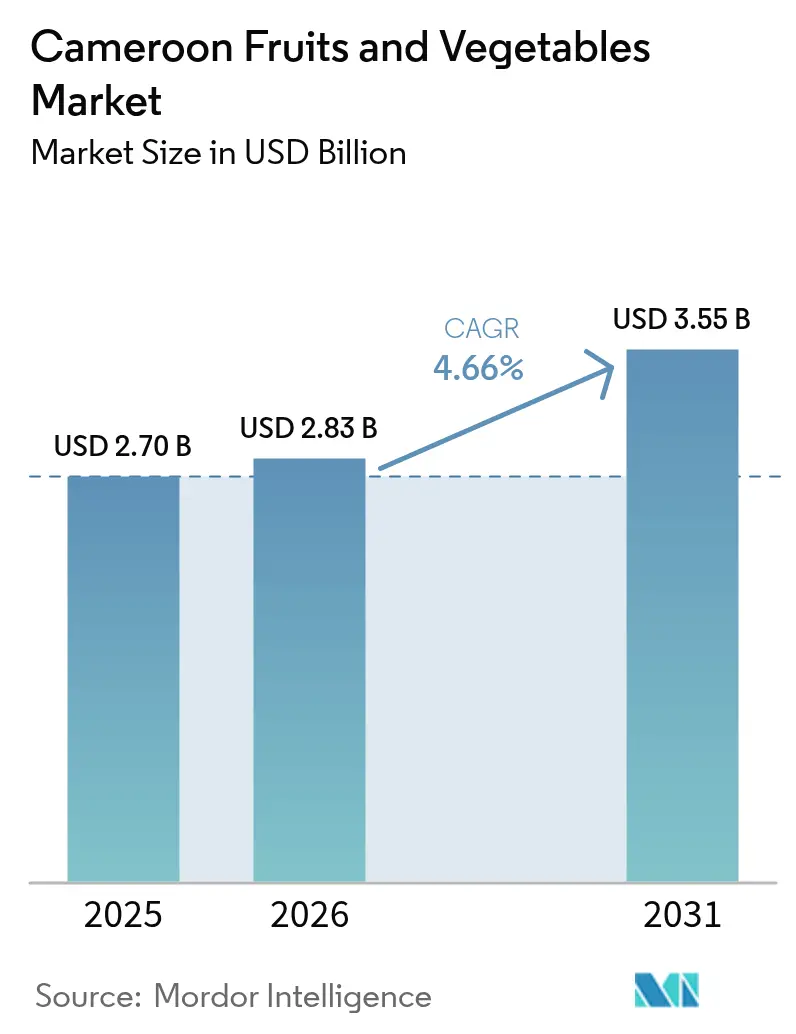
The Cameroon fruits and vegetables market size was valued at USD 2.70 billion in 2025 and estimated to grow from USD 2.83 billion in 2026 to reach USD 3.55 billion by 2031, at a CAGR of 4.66% during the forecast period (2026-2031). Growth stems from resilient household demand, fertile agro-ecological zones that enable year-round harvests, increasing European Union orders, and public spending on transport corridors and cold-chain infrastructure. Digital out-grower schemes and mechanization incentives further lift productivity, while the IMF Resilience and Sustainability Facility channels climate-adaptation finance into the sector[1]International Monetary Fund, “Cameroon: Resilience and Sustainability Facility,” imf.org. The market environment enables agritech companies to develop innovative technologies for small-scale farming. Regional trade agreements within Central Africa are anticipated to improve cross-border logistics and increase opportunities for exporting fresh produce.
Key Report Takeaways
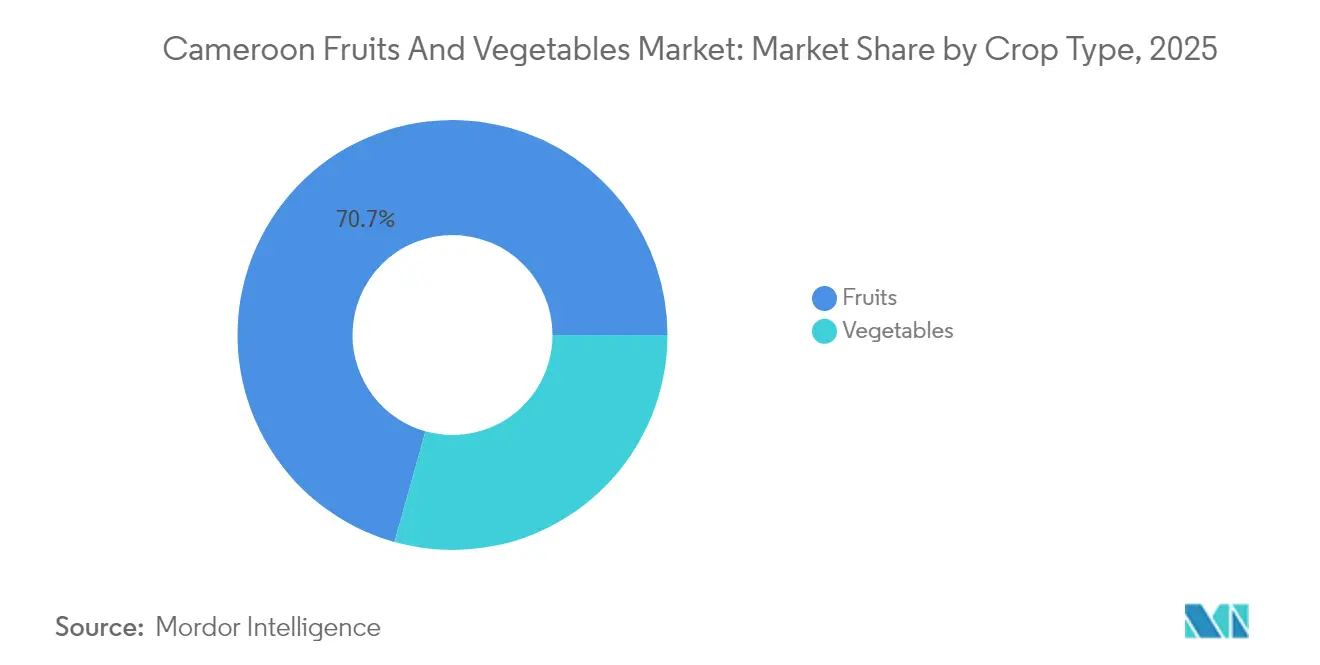
- By crop type, fruits led with 70.65% of the Cameroon fruits and vegetables market share in 2025, and vegetables are rising at a 4.74% CAGR through 2031.
Note: Market size and forecast figures in this report are generated using Mordor Intelligence’s proprietary estimation framework, updated with the latest available data and insights as of 2026.
Cameroon Fruits And Vegetables Market Trends and Insights
Drivers Impact Analysis*
| Driver | (~) % Impact on CAGR Forecast | Geographic Relevance | Impact Timeline |
|---|---|---|---|
| Rising Domestic Demand and Favorable Agro-climatic Zones | +1.2% | Littoral and Southwest | Medium term (2-4 years) |
| Export Demand from the European Union | +0.9% | Coastal export zones | Long term (≥ 4 years) |
| Improved Farm-to-port Road and Cold-chain Investments | +0.8% | Douala–Ndjamena corridor and coast | Medium term (2-4 years) |
| Digital Out-grower Schemes Linking Micro-farmers to Exporters | +0.6% | Center and West | Short term (≤ 2 years) |
| Mechanization Incentives | +0.5% | Northern and Northwest | Long term (≥ 4 years) |
| Climate-smart Farming Adoption | +0.4% | Climate-vulnerable northern belt | Long term (≥ 4 years) |
| Source: Mordor Intelligence | |||
Rising Domestic Demand and Favorable Agro-climatic Zones
Urbanization and population growth are steadily increasing the per-capita consumption of fresh produce. Cameroon benefits from five distinct agro-ecological zones, which enable year-round cultivation and help stabilize prices across seasons. The government's development strategy prioritizes local sourcing for public food programs, ensuring consistent demand for domestic growers. This approach reduces reliance on imports and supports rural incomes. Import-substitution policies are creating new opportunities for local agribusinesses to expand their operations. With favorable climate conditions and policy support, the domestic market is becoming a reliable growth engine for agricultural producers, especially in vegetables and staple crops.
Export Demand from the European Union
Cameroon's trade agreement with the European Union allows duty-free access for compliant agricultural exports, encouraging producers to target overseas markets. Exporters of bananas, pineapples, and avocados are capitalizing on this advantage, despite stricter environmental and safety regulations. New digital traceability systems are helping producers meet these standards, demonstrating a strong industry commitment to transparency. The steady rise in vegetable exports reflects the sector's ability to adapt and overcome regulatory hurdles. As supply chains become more digitized and efficient, Cameroon's agricultural sector is expanding its footprint in European markets while maintaining compliance with trade requirements.[2]UK Government, “Category B Project Supported: Incatema Agricultural Developments, Cameroon,” gov.uk
Improved Farm-to-port Road and Cold-chain Investments
Infrastructure upgrades are transforming Cameroon's agricultural logistics. Investments in key transport corridors are reducing travel times and spoilage, making exports more competitive[3]African Development Bank, “Agricultural Value Chain Development Project,” afdb.org . Private sector players have added cold storage facilities and solar-powered units near major ports, helping preserve perishable goods and reduce post-harvest losses. Reliable electricity from new hydroelectric projects is powering processing plants and ripening centers, thereby boosting value addition in crops such as tomatoes. These improvements enhance farm-to-port connectivity, enabling producers to meet international quality standards. With improved logistics and access to energy, Cameroon's agricultural exports are becoming more resilient and attractive to global buyers.
Digital Out-grower Schemes Linking Micro-farmers to Exporters
Digital platforms are connecting small-scale farmers directly with exporters, bypassing traditional intermediaries and improving income stability. Mobile applications now help match growers with buyers, provide real-time pricing data, and offer access to credit services. These tools are empowering cooperatives, including many led by women, to participate more actively in export markets. By shortening marketing chains and ensuring faster payments, digital out-grower schemes are boosting household earnings and encouraging the formalization of micro-farming operations. The success of early pilot programs suggests that technology-driven models can be scaled across regions, fostering inclusive growth and enhancing Cameroon's agricultural value chains.
Restraints Impact Analysis*
| Restraint | (~) % Impact on CAGR Forecast | Geographic Relevance | Impact Timeline |
|---|---|---|---|
| Macroeconomic Volatility and Exchange Rate Risks | -0.7% | Rural areas country-wide | Medium term (2-4 years) |
| Weak Value Addition and Processing Capacity | -0.6% | Major farm belts | Long term (≥ 4 years) |
| Phytosanitary Non-compliance Causing Export Rejections | -0.5% | Coastal export clusters | Short term (≤ 2 years) |
| Dependence on Imported Hybrid Seeds and Agro-inputs | -0.4% | Commercial farming zones | Medium term (2-4 years) |
| Source: Mordor Intelligence | |||
Macroeconomic Volatility and Exchange Rate Risks
Exchange rate fluctuations and market instability have a significant impact on prices in Cameroon's fruit and vegetable sector. The depreciation of the currency increases the costs of essential imported inputs, including fertilizers, irrigation equipment, packaging materials, and farm machinery. This directly affects the profitability of producers growing tomatoes, bananas, pineapples, avocados, and leafy greens. Fresh produce exporters face difficulties in revenue forecasting due to exchange rate uncertainty, reducing their global market competitiveness. In the domestic market, price fluctuations are intensified by limited hedging options and poor market integration, particularly affecting perishable crops. These factors discourage long-term investment and create financial planning challenges for smallholder farmers and agribusinesses.
Phytosanitary Non-compliance Causing Export Rejections
Cameroon faces challenges in meeting international food safety standards, leading to frequent export rejections. Lengthy certification processes and limited laboratory capacity hinder timely compliance with phytosanitary regulations. Many exporters struggle to obtain the necessary documentation, especially for crops such as bananas and tomatoes. While targeted investments in testing facilities have shown promise, scaling these efforts requires additional funding and trained personnel. Without robust inspection systems, Cameroon risks losing access to key markets. Strengthening national capacity for plant health monitoring and certification is essential to ensure consistent export quality and build trust with international buyers.
*Our forecasts treat driver/restraint impacts as directional, not additive. The impact forecasts reflect baseline growth, mix effects, and variable interactions.
Segment Analysis
By Crop Type: Fruits Lead While Vegetables Accelerate
Fruits accounted for 70.65% of the Cameroon fruits and vegetables market size in 2025, reflecting their significance in both domestic consumption and exports. Bananas and plantains continue as dietary staples across regions, supported by expanded plantation areas. Pineapple cooperatives have improved their operations through enhanced logistics coordination and transport to Douala port, resulting in better product quality and reduced freight costs. These factors make fruits a consistent and significant contributor to the Cameroon fruits and vegetables market share.
Vegetables demonstrate the highest growth rate, at 4.74% CAGR, with increased production of tomatoes and onions. Tomato cultivation exhibits high supply elasticity, as producers adjust their output in response to market prices. The vegetable segment is advancing through technological adoption, including a new phase of greenhouse installations in the Center region that extends growing periods for cucumbers and peppers. These developments indicate a shift toward market-oriented, quality-focused production.



Geography Analysis
The Coastal Littoral and Southwest regions form the core of the Cameroon fruits and vegetables market share, with advantages in farm concentration, port access, and reliable rainfall patterns. These conditions enable continuous crop production and a steady supply. Douala serves as the primary logistics center for export operations. Infrastructure improvements are anticipated to reduce transportation costs to neighboring markets, including the Central African Republic and Chad.
The Sahelian North specializes in onion, groundnut, and okra production, utilizing sandy soil conditions and increased mechanization. The region maintains production stability through climate-resilient solutions, including drip irrigation and solar-powered pumps, despite irregular rainfall patterns. These advancements are gradually transforming the Sahelian North into a dependable supplier for both domestic consumption and cross-border trade.
The Center and West highlands have implemented digital out-grower programs to consolidate smallholder production. These cooperatives implement GPS tracking for orchards and blockchain-compatible QR codes to comply with international traceability requirements, particularly for European markets. This technological integration enables access to higher-value contracts and strengthens formal supply chains. The adoption of technology and cooperative structures in these regions supports Cameroon's agricultural development and export capabilities.
Regulatory Landscape
Cameroon’s fruits and vegetables sector is overseen by the Ministry of Agriculture and Rural Development (MINADER), with product and input oversight anchored in the Direction de la Réglementation et du Contrôle de Qualité (DRCQ) for quality control, inspection, and compliance across agricultural value chains. The national direction for agricultural modernization and import substitution is set out in the Plan Intégré d’Import-Substitution Agropastoral et Halieutique (PIISAH) 2024-2026, which prioritizes scaling local production alongside export readiness.
For trade, exporters targeting Europe must follow EU-aligned norms under the Economic Partnership Agreement. Mandatory import conformity controls are conducted under the Programme for the Evaluation of Conformity of Goods prior to Shipment (PECAE), administered by the national standards body ANOR and carried out through approved inspection bodies such as SGS. In June 2025, SGS reiterated ANOR’s enforcement of pre-shipment product conformity and market surveillance measures under Prime Ministerial Decree No. 2019/143, increasing compliance requirements for imported inputs and packaging used across horticultural supply chains.
Value Chain Analysis
The value chain begins with input supply, where access and distribution for seeds, fertilizers, and phytosanitary products remain uneven, with input distributors concentrated in the Littoral and West regions. Production is largely driven by fragmented smallholders and emerging cooperatives, while training farms, seedling distribution, and good agricultural practices in programs support crops such as tomato, onion, pineapple, okra, pepper, and watermelon.
Aggregation and trading typically run through local collectors, cooperatives, and wholesale markets feeding urban consumption centers and export channels linked to Douala. Bottlenecks remain in rural roads, cold storage, and warehousing, which contribute to post-harvest losses and limit the flow of formal, quality-assured produce to exporters and modern retail. Processing and value addition are underdeveloped relative to fresh output, keeping margins sensitive to seasonality and logistics, while policy frameworks and projects focus on producer organization and agribusiness partnerships to improve aggregation, compliance, and market access.
Market Opportunities and Future Outlook
Processing and value addition represent a direct opportunity in a market where weak processing capacity is cited as a structural restraint, and where procurement activity signals movement toward more formal facilities. In April 2026, MINADER opened a national tender (No. 004/AONO/MINADER/CIPM/2026) for the acquisition and installation of a plantain chips processing unit in Nkoteng under the National Fruit Crops Development Project (P.N.D.C.F). The tender points to an investable pathway for packaged, shelf-stable fruit products, along with demand for local suppliers of equipment, packaging, and quality systems.
Digitization and strengthening of input systems are also creating routes for smallholder commercialization and compliance. In June 2026, the World Bank highlighted progress under the Project to Accelerate the Digital Transformation of Cameroon (PATNUC), which supports digital agricultural solutions for 35,000 smallholders through an e-voucher mechanism. In July 2026, actions on seed system capacity included MINADER distribution of 83 tons of foundation seeds in Adamawa, North, and Far North to support a 70,000-ton certified seed ambition. Together, these programs create clearer conditions for agritech providers, input companies, and producer organizations to integrate traceability, structured procurement, and quality control across horticultural supply chains, particularly in regions where public and multilateral programs are focusing resources.
Recent Industry Developments
- July 2026: The African Development Bank approved EUR 81.2 million for the Programme for the Development of Agro-Industry in the North (PDAS-1), including irrigation-oriented works such as multifunctional hillside dams. The financing supports higher farm-gate consistency for perishable crops in northern production basins and strengthens the investment case for aggregation, cold-chain, and localized processing.
- June 2026: MINADER announced a zero-tariff export window to China for agricultural products including fruits and spices, effective retroactively from May 1, 2026 (Ministerial Communique No. 0000051). The measure broadens destination-market options beyond traditional routes and raises the importance of export-grade packaging, phytosanitary compliance, and consolidated volumes for containerized trade.
- June 2025: SGS reiterated ANOR enforcement of mandatory pre-shipment product conformity assessment and market surveillance under the PECAE framework, referencing Prime Ministerial Decree No. 2019/143. Tighter conformity controls increase compliance requirements for imported agro-inputs and packaging materials, influencing cost structures and supplier selection across the fruits and vegetables value chain.


Research Methodology Framework and Report Scope
Market Definition and Coverage
This market is defined as the value of fruits and vegetables produced and marketed in Cameroon, covering both domestic consumption and trade-linked flows, and expressed in USD at the market level (aligned to observed price trends).
Scope exclusions: This sizing does not count processed fruit and vegetable foods as a separate packaged-food market, and it avoids double counting value added again at later processing stages.
Segmentation Overview
- By Crop Type
- Fruits
- Production Analysis
- Consumption Analysis
- Import Analysis
- Export Analysis
- Price Trend Analysis
- Vegetables
- Production Analysis
- Consumption Analysis
- Import Analysis
- Export Analysis
- Price Trend Analysis
- Fruits
Data Sources, Market Sizing, and Validation
Desk Research
Desk work starts with building a fact base on crop output, harvested area, and trade direction so the model has a realistic supply and demand envelope. We use public sources such as FAOSTAT, UN Comtrade, World Bank indicators, and Cameroon national agriculture and statistics publications, and then we cross-check against port and customs commentary where it is available.
After that, pricing context is added using reported farmgate and wholesale signals, inflation and exchange-rate series, and documented policy moves that can shift availability or margins. Company filings, investor presentations, association websites, and reputed press help validate where volumes tend to move and which crops are most active in trade. In a few cases, a paid subscription for company financials and a shipment-level trade view were referenced to sanity-check value ranges, and then the assumptions were adjusted back to what can be supported in open data. These desk sources are illustrative only, and many other public materials were also reviewed to fill gaps and confirm consistency.
Primary Interviews and Surveys
Expert interviews and surveys with producers, wholesalers, retailers, processors, exporters, and public agriculture officials in Cameroon test volumes, prices, trade flows, losses, and margins. We use responses to fill informal-trade and seasonal gaps, then reconcile assumptions with desk evidence. Re-contact follows when material inputs conflict.
Distribution of primary research fieldwork respondents
| Company type | Respondent position |
|---|---|
| Top tier: 28% | CXOs: 15% |
| Mid tier: 47% | Functional/Unit leaders: 30% |
| Smaller Players: 25% | Managers: 55% |
Market-Sizing & Forecasting
The core sizing is driven by a top-down reconstruction using Cameroon crop production volumes, trade flows, and observed price trends for fruits and vegetables, and then translated into annual market value in USD. Because the market is sensitive to seasonality and logistics, the model also factors in indicators such as harvested area shifts, yield swings, import reliance for selected items, export clearance tightness, and post-harvest loss ranges that were validated during interviews.
To keep the total grounded, we corroborate the outcome with selective bottom-up approximations, such as sampled crop-level volume multiplied by typical wholesale price bands, followed by channel checks on how much value is realized through formal versus informal routes. Where data is thin for a crop or route, gaps are handled by using conservative proxy ratios from similar crops and then pressure-testing them with traders who see multi-commodity flows.
For forecasting, scenario analysis is used so the outlook can reflect plausible paths for yields, transport and cold-chain improvements, and demand changes from urban consumption and cross-border trade. Assumptions are not left static, and expected price progression is reviewed with interview feedback so the forecast stays practical to replicate year by year.
Data Validation & Update Cycle
Validation is done through multiple checks, starting with internal consistency tests between volumes, prices, and implied per capita availability, and then compared against independent signals like trade movements and reported production direction. When large variances show up, the drivers are isolated by crop and by flow type, and we re-check the assumptions that most often cause drift, such as losses, conversion factors, and exchange-rate timing.
Before sign-off, the model and narrative are reviewed in steps by another analyst so calculation errors and weak links are caught early. The report is refreshed annually, and interim updates are triggered when material events occur, such as major policy shifts, sharp currency moves, or abnormal harvest outcomes. Right before delivery, a final pass is completed so clients receive the most current view available.
Mordor Intelligence's Cameroon Fruits and Vegetables Market Sizing Compared With Other Published Estimates
Published market values for Cameroon fruits and vegetables often do not match because the scope can shift between fresh-only and fresh plus minimally processed flows, and because different studies choose different base years and pricing points. Currency timing also matters, since converting local price signals into USD can move totals when exchange rates are volatile.
The main gap comes from whether the estimate blends in broader retail and channel markups and processed food value, where Mordor Intelligence counts value using crop-level production and trade signals aligned to market price trends without rolling packaged processing into the same total.
Benchmark comparison
| Source | Market Size | Gaps in Research Methodology |
|---|---|---|
| Mordor Intelligence | USD 2.70 B (2025) | |
| Global Consultancy A | USD 3.80 B (2026) | Uses a later starting year and a wider channel scope that can blend in additional distribution and handling value, which tends to lift the measured total versus a crop and trade anchored view. |
| Trade Publisher B | USD 2.48 B (2024) | Anchors on an earlier base year with a faster assumed ramp and can apply different price points or USD conversion timing, which can pull the starting value down even when volumes are similar. |
Taken together, the spread is mostly explained by timing and what gets counted as part of the produce value chain. When the model is tied back to observable crop output, trade direction, and realistic price bands that were checked with market participants, the result stays easier to trace and repeat across updates.


Key Questions Answered in the Report
What is the 2026 value of Cameroon fruits and vegetables market?
The Cameroon fruits and vegetables market size stands at USD 2.83 billion in 2026.
How fast will the market grow through 2031?
The market is on a 4.66% compound annual growth trajectory to USD 3.55 billion by 2031.
Which crop category grows the quickest?
Vegetables grow the fastest at 4.74% CAGR between 2026 and 2031.
Why does EU demand matter?
Duty-free access and premium prices in the EU reward producers who meet strict traceability and phytosanitary criteria.
How are smallholders integrated into formal trade?
Digital out-grower schemes pool output, share price data, and link farmers directly with exporters, boosting incomes and compliance readiness.
Page last updated on:





