
Fresh Mushrooms Market Size and Share
Fresh Mushrooms Market Analysis by Mordor Intelligence
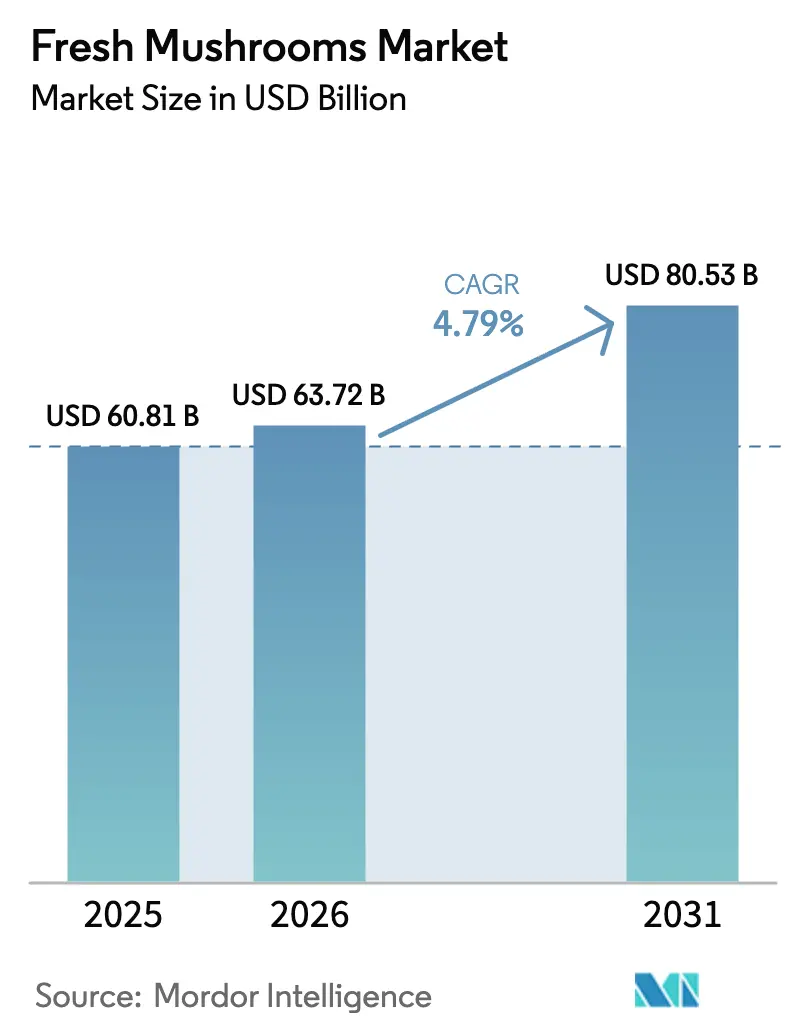
The fresh mushrooms market size is projected to expand from USD 60.81 billion in 2025 and USD 63.72 billion in 2026 to USD 80.53 billion by 2031, registering a CAGR of 4.79% between 2026 to 2031. This growth reflects a shift in global protein sourcing, driven by the adoption of indoor cultivation and fermentation technologies, which are reducing the reliance on traditional open-field production methods. Notable investments, such as Enifer's EUR 36 million (USD 38 million) fermentation facility in Finland and Infinite Roots' EUR 58 million (USD 62 million) Series B funding, underscore the growing capital allocation toward controlled environments that ensure stable yields and support premium product positioning. Retailers are strengthening direct-supply agreements with growers to secure consistent year-round volumes and maintain traceable quality standards. Meanwhile, consumer preferences are shifting toward immunity-boosting products and meat alternatives that incorporate mushroom-derived ingredients. Consequently, profitability is moving away from bulk commodity sales toward value-added contracts. This transition is intensifying competition between traditional button mushroom farms and emerging, venture-backed mycoprotein brands.
Key Report Takeaways
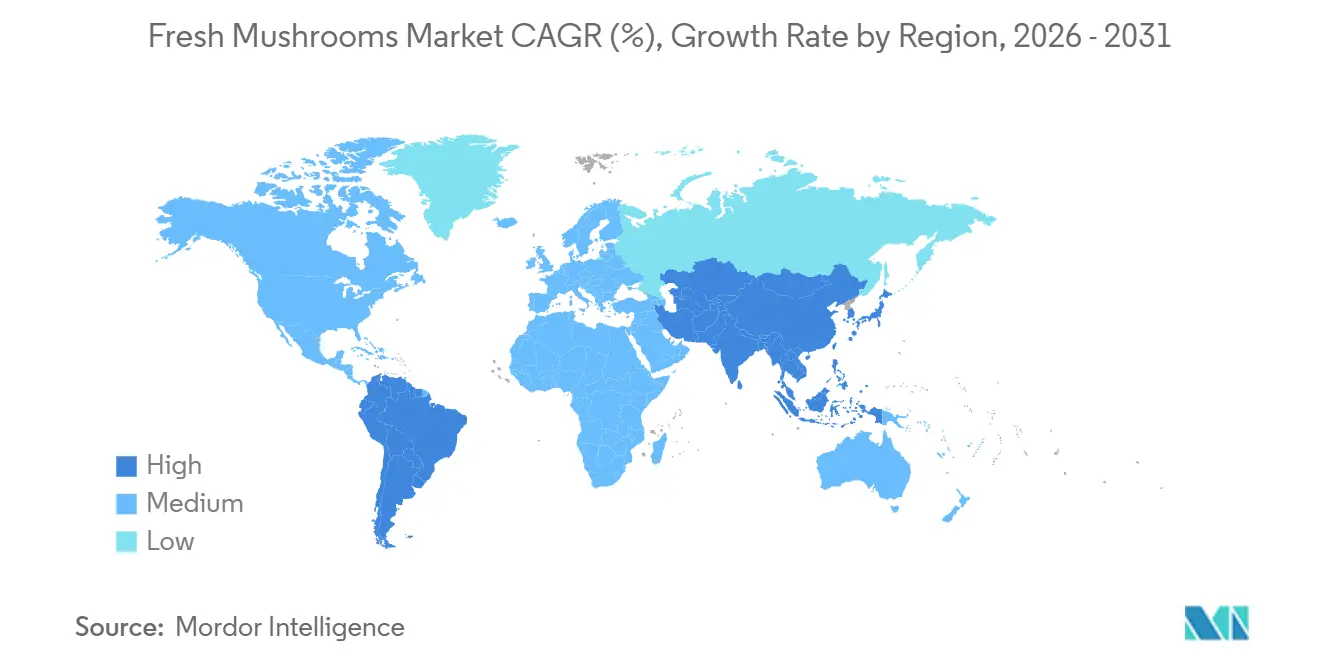
- By geography, Asia-Pacific commanded 74.4% of the fresh mushrooms market share in 2025, while South America is forecast to expand at a 5.2% CAGR from 2026 to 2031
Note: Market size and forecast figures in this report are generated using Mordor Intelligence’s proprietary estimation framework, updated with the latest available data and insights as of January 2026.
Global Fresh Mushrooms Market Trends and Insights
Drivers Impact Analysis*
| Driver | (~) % Impact on CAGR Forecast | Geographic Relevance | Impact Timeline |
|---|---|---|---|
| Rapid expansion of controlled-environment agriculture | +0.5% | North America, Europe, urban Asia-Pacific | Medium term (2-4 years) |
| Soaring demand for meat analogs and functional foods | +0.9% | North America and Europe, rising in Asia-Pacific | Medium term (2-4 years) |
| Emergence of mushroom-based high-protein concentrates | +0.6% | Europe and North America, pilot Asia-Pacific | Long term (≥ 4 years) |
| Growth of value-added farm-gate contracts with retailers | +0.4% | North America and Europe, nascent in South America and Asia-Pacific | Short term (≤ 2 years) |
| Government carbon-credit incentives for low-emission crops | +0.1% | Europe and select Asia-Pacific markets | Long term (≥ 4 years) |
| Mainstream adoption in immunity-boosting nutraceuticals | +0.5% | Global, peak in North America and Asia-Pacific | Short term (≤ 2 years) |
| Source: Mordor Intelligence | |||
Rapid Expansion of Controlled-Environment Agriculture
Indoor facilities mitigate weather-related risks and enable continuous harvest cycles, ensuring a stable supply for retailers and supporting the cultivation of premium crop varieties. Vertical farms utilizing light-emitting diode (LED) systems have reduced energy consumption by up to 40% while increasing the production of specialty crops in the United States, where output reached 900 million pounds during the 2024-2025 season. Enifer’s fermentation line, commissioned in 2024 and with a capacity of 3,000 metric tons per year, exemplifies the investment required to scale precision-controlled mycoprotein production, which depends on stringent temperature and carbon dioxide monitoring to maintain yield consistency. Locations offering affordable electricity and proximity to urban markets provide a sustainable cost advantage, prompting more growers to convert traditional barns into climate-controlled facilities. Over the medium term, the expansion of such facilities is projected to strengthen the fresh mushrooms market by addressing seasonal supply gaps and enhancing retailer product assortments.
Soaring Demand for Meat Analogs and Functional Foods
Mycelium-based proteins are increasingly replacing soy and pea isolates as brands emphasize whole-food and clean-label attributes. Meati Foods secured USD 100 million in April 2024 and expanded to 6,000 stores across the United States. Similarly, MyForest Foods raised USD 11 million in March 2025 and introduced its plant-based bacon to 1,200 outlets, demonstrating growing acceptance in mass-market channels. In 2023, MycoTechnology received European Union Novel Food approval, granting access to the bloc’s USD 4 trillion grocery market for fermented mycelium ingredients. These developments are transitioning mushroom proteins from niche products to mainstream options, fostering high-value demand and encouraging direct partnerships between growers and processors.
Growth of Value-Added Farm-Gate Contracts with Retailers
Supermarkets are eliminating intermediaries to secure volume and ensure traceability. In Australia, farm-gate revenue reached AUD 281 million (USD 188 million) in 2023, driven by direct procurement, which supported a per capita consumption of 3.2 kilograms[1]. Fixed contracts have facilitated investments in modified-atmosphere packaging and cold storage, reducing spoilage and increasing net returns. For growers, guaranteed offtake minimizes price risk and promotes diversification into specialty crops, enabling them to explore higher-value markets. For retailers, shorter supply chains reduce recall risks, enhance consumer confidence, and strengthen demand in the fresh mushrooms market by ensuring consistent product quality and availability.
Government Carbon-Credit Incentives for Low-Emission Crops
Button mushroom production generates approximately 0.7 pounds of carbon dioxide per pound, which is significantly lower than the emissions from livestock production[2]. Although dedicated credit schemes are limited, the European Union's agricultural policies and certain Asia-Pacific programs acknowledge low-carbon specialty crops. In Vietnam, initiatives that repurpose rice straw into oyster mushroom substrate not only reduce methane emissions from field burning but also create additional income opportunities. These programs not only address environmental concerns but also support sustainable agricultural practices and rural development. As methodologies advance, growers who document emission reductions may secure offsets, which can supplement produce revenue and improve the long-term prospects of the fresh mushrooms market.
Restraints Impact Analysis*
| Restraint | (~) % Impact on CAGR Forecast | Geographic Relevance | Impact Timeline |
|---|---|---|---|
| Volatile farm-gate prices due to energy-cost swings | -0.6% | Europe and North America | Short term (≤ 2 years) |
| Persistent post-harvest losses in humid climates | -0.5% | Asia-Pacific, Africa, and South America | Medium term (2-4 years) |
| Labor shortages in peak harvest windows | -0.4% | North America and Europe | Short term (≤ 2 years) |
| Mycotoxin-related food-safety recalls | -0.3% | Global, highest in Asia-Pacific exports | Short term (≤ 2 years) |
| Source: Mordor Intelligence | |||
Volatile Farm-Gate Prices Due to Energy-Cost Swings
Climate-control expenses account for up to 50% of operating costs in temperate regions, making them a significant factor in overall expenditure. The 2022-2023 European gas crisis led to reduced production in Poland and the Netherlands, as wholesale prices failed to keep pace with rising input costs, resulting in narrower profit margins and operational challenges[3]. Smaller operators face significant challenges in securing the necessary financing for these upgrades, which limits their ability to adopt energy-efficient technologies. Growers with renewable power purchase agreements benefit from lower and more stable costs, providing them with a competitive advantage. Nevertheless, the majority of growers remain exposed to fluctuations in spot energy prices, which erode profitability, increase financial uncertainty, and hinder capacity expansion in the fresh mushrooms market.
Mycotoxin-Related Food-Safety Recalls
Outbreaks of Listeria monocytogenes have led to several United States Food and Drug Administration import alerts for enoki mushrooms through 2024, resulting in product recalls and increased scrutiny during retail audits[4]. Similar warnings were issued in Ireland and the United Kingdom, highlighting risks across both domestic and imported supplies. These outbreaks have prompted increased scrutiny of supply chains, with producers and distributors facing heightened regulatory oversight. Increased investments in sanitation and traceability have raised costs, while reputational concerns have the potential to hinder category growth, exerting a modest impact on the fresh mushrooms market. Additionally, consumer awareness of food safety issues has grown, influencing purchasing decisions and driving demand for higher transparency in product sourcing.
*Our forecasts treat driver/restraint impacts as directional, not additive. The impact forecasts reflect baseline growth, mix effects, and variable interactions.
Geography Analysis
Asia-Pacific accounted for 74.4% of the fresh mushrooms market share in 2025, primarily driven by China's large-scale production and export base, which exceeds USD 1 billion annually. India's subsidy programs, offering up to 75% refunds on capital outlay for scheduled communities, are integrating thousands of smallholders into formal supply chains. Japan's 2023 production of 430,000 metric tons underscores strong domestic demand for varieties such as enoki, shimeji, and shiitake. Meanwhile, Australia's AUD 281 million (USD 188 million) farm-gate sector benefits from direct contracts with supermarkets, ensuring market stability. Investments in cold storage and modified-atmosphere packaging have reduced spoilage rates, which range from 20% to 30% in humid sub-regions. Infrastructure bottlenecks continue to limit export potential to North America and Europe.
South America is projected to experience the fastest regional growth, with a 5.2% CAGR from 2026 to 2031. In Brazil, demand for fresh and processed mushrooms is on the rise, particularly in ready-to-eat and meat analog products. Chile leverages its zero-tariff access to the United States under a free-trade agreement to serve as a re-export hub. Argentina's agricultural focus presents untapped potential, contingent on the development of domestic supply chains. In the Middle East and Africa, emerging players such as Turkey and South Africa are addressing local consumption levels, which remain below 0.5 kilograms per capita. Challenges in refrigerated logistics and financing persist, hindering rapid expansion in these regions.
Europe and North America collectively account for approximately one-fifth of global mushroom demand. In 2023, Poland led European exports with USD 603.7 million, followed by the Netherlands at USD 256.9 million. The United States harvested 900 million pounds of mushrooms in 2025, with production concentrated in Pennsylvania, California, and Florida. Canada's CAD 285 million (USD 210 million) mushroom sector focuses on niche organic products. Rising energy costs following the gas crisis have driven the adoption of energy-efficient technologies, such as light-emitting diodes and heat-recovery systems, which have reduced facility energy consumption by approximately 30% and alleviated margin pressures. Stricter import inspections for Listeria have prompted domestic producers to emphasize sanitation standards, which in turn has influenced retailer sourcing preferences.
Regulatory Landscape
Regulation in the fresh mushrooms market centers on food safety, grading, pesticide residues, and traceability requirements that affect domestic marketing and cross-border trade. In the United States, FDA oversight under FSMA Produce Safety standards and buyer-led GAP/GFSI expectations influence on-farm sanitation, water, and handling controls, while USDA AMS maintains commodity grade standards and published mushroom food safety guidance used across grower-shipper programs.
Recent policy actions are also adding tighter verification requirements. In April 2026, USDA AMS proposed revisions to the U.S. Standards for Grades of Mushrooms, following an American Mushroom Institute petition, updating definitions and defect scoring guidance for commercial types including button and portabella. In the European Union, Implementing Regulation (EU) 2026/765 strengthens official-control methods for sampling and analysis of pesticide residues, alongside the EU coordinated multiannual control program for 2026-2028, reinforcing exporter needs for compliant residue management and laboratory documentation. In China, GB/T 45197-2025 (implemented in 2025) formalizes circulation, grading, cold chain, and traceability specifications for fresh edible mushrooms, raising the bar for standardized logistics and recordkeeping in large domestic and export-oriented supply chains.
Value Chain Analysis
The fresh mushroom value chain runs from input suppliers (spawn, substrate raw materials such as straw and compost ingredients, casing materials, and climate-control equipment) through controlled-environment production steps (composting/substrate preparation, spawning, casing, pinning and cropping, harvesting) into rapid post-harvest handling (pre-cool, grading, packing) and refrigerated distribution to retailers, foodservice, and processors. The category remains labor intensive at harvest and highly time sensitive, so cold chain reliability and packhouse throughput largely determine shelf life and shrink reduction, especially in humid climates where spoilage risk is structurally higher.
Bottlenecks and power centers are converging around technology, labor, and compliance. Climate-control costs can represent up to 50% of operating costs in temperate regions, and the 2022-2023 European gas crisis highlighted exposure to energy volatility, accelerating retrofits such as LEDs and heat-recovery systems. Trade and compliance requirements add documentation and testing needs across the chain, including the formal US trade case process initiated in January 2026 following petitions on Canadian fresh mushroom imports. On the supply side, growth in established producer bases continues to reshape flows. For example, Statistics Canada reported 2025 production of 174,156 short tons (up 5.2% from 2024), supporting packer-distributor scale and increasing the importance of standardized grading, traceability, and year-round contracting with retailers.
Competitive Landscape
The fresh mushroom market comprises numerous small- and medium-sized growers, with button mushrooms sold at farm-gate prices averaging USD 2.50-3.50 per pound in 2024. Narrow profit margins leave producers vulnerable to fluctuations in labor and energy costs, prompting a shift toward cooperative marketing strategies and the gradual adoption of automation. Concurrently, venture-backed mycoprotein companies are securing funding by targeting plant-based meat alternatives in chain grocery stores, where higher price points help offset inefficiencies in scaling production.
Distinct strategies are evident among market participants. Leading exporters in Poland are leveraging Dutch spawn technology and automated climate control systems to maintain cost leadership. In contrast, farms in Pennsylvania and California, United States, are retrofitting facilities with light-emitting diode (LED) arrays and heat-recovery modules, reducing utility costs by approximately 30%. Mycoprotein companies are pursuing vertical integration strategies, for example, Enifer is constructing its own facility in Finland to optimize fermentation processes, while MyForest Foods collaborates with plant-based distributors to bypass traditional produce categories. Brand equity and proprietary strains are creating higher entry barriers, putting pressure on traditional growers that lack integrated processing capabilities.
Significant opportunities exist in post-harvest technologies and automation. Solutions such as modified-atmosphere packaging and chitosan coatings have the potential to reduce waste by nearly one-third. However, adoption remains limited in regions such as the Asia-Pacific, Africa, and South America due to financial constraints and regulatory challenges. Robotic pickers, currently in pilot testing, show potential for harvesting uniform button mushrooms but face difficulties with irregularly shaped specialty varieties. Advancements in these areas could enhance overall profitability and reduce market volatility, supporting growth across the fresh mushrooms market.
Market Opportunities and Future Outlook
Opportunities in fresh mushrooms are consolidating around scalable controlled-environment capacity, automation, and traceable packaging that protects shelf life and supports retailer compliance. Investment and build-out activity provide clear signals of where capacity and margins are being targeted: Highline Mushrooms brought a new automated facility in Leamington, Ontario, fully online in April 2026 with data-driven climate control and harvest forecasting. Guans Mushroom also reported more than one million square feet of growing rooms across four facilities in California and Canada and around 6 million pounds of annual King Oyster capacity (May 2026). Together, these moves emphasize demand for upstream substrate security, automated handling, and consistent specialty-variety output that can support premium retail assortments.
Regulation-linked packaging and verification are also creating near-term deployment lanes. In Belgium, a retailer consortium including Albert Heijn, Aldi, Carrefour, Colruyt, Delhaize, and Lidl ran a reusable mushroom packaging pilot in Mechelen in April 2026 using GS1 QR codes for traceability, connecting mushrooms with broader retailer packaging compliance programs and supporting pull-through for packers able to operationalize item-level traceability. At the same time, expansion programs and new entrants are widening the competitive set in emerging production hubs. Urban Farm-Produce (UK) rebranded in January 2026 and advanced a second production facility in Redditch, alongside a seed round aimed at scaling weekly output and adding substrate production, highlighting vertical integration as a route to reduce input-price exposure and improve supply reliability for retail and foodservice channels.
Recent Industry Developments
- June 2026: Global Champs acquired Baltic Champs from Auga Group, adding a scaled Lithuanian production base to its regional mushroom platform. The transaction was supported by EUR 5 million financing from Signet Bank aimed at operational technology and capacity expansion, tightening competitive pressure through consolidation and modernization in European supply.
- October 2025: Gibraltar Business Capital provided Monterey Mushrooms with a USD 22 million senior secured facility to support working capital and strategic capital investments, including equipment modernization. The financing strengthens the company's ability to fund efficiency upgrades that matter in a category where climate control and labor drive cost competitiveness.
- November 2024: South Mill Champs formed a strategic alliance with Mountain View Mushrooms to serve key Southwest US markets, including leasing and operating packing and warehousing facilities. The partnership expands regional distribution and packing capability, improving service levels for retailers and foodservice customers that require consistent refrigerated fulfillment.
Research Methodology Framework and Report Scope
Market Definition and Coverage
For this study, the fresh mushrooms market covers the value of mushrooms sold in fresh form for household, retail, and foodservice consumption, counted at the first commercial sale point in each country.
Scope exclusions: Processed mushrooms such as canned, dried, frozen, pickled, or ingredient extracts are not counted in this market value.
Segmentation Overview
- By Geography
- North America
- United States
- Production Analysis (Area Harvested, Yield, and Production Volume)
- Consumption Analysis (Consumption Value and Volume)
- Import Market Analysis (Import Value, Volume, and Key Supplying Markets)
- Export Market Analysis (Export Value, Volume, and Key Destination Markets)
- Wholesale Price Trend Analysis and Forecast
- Regulatory Framework
- List of Key Players
- Logistics and Infrastructure
- Seasonality Analysis
- Mexico
- Production Analysis (Area Harvested, Yield, and Production Volume)
- Consumption Analysis (Consumption Value and Volume)
- Import Market Analysis (Import Value, Volume, and Key Supplying Markets)
- Export Market Analysis (Export Value, Volume, and Key Destination Markets)
- Wholesale Price Trend Analysis and Forecast
- Regulatory Framework
- List of Key Players
- Logistics and Infrastructure
- Seasonality Analysis
- Canada
- Production Analysis (Area Harvested, Yield, and Production Volume)
- Consumption Analysis (Consumption Value and Volume)
- Import Market Analysis (Import Value, Volume, and Key Supplying Markets)
- Export Market Analysis (Export Value, Volume, and Key Destination Markets)
- Wholesale Price Trend Analysis and Forecast
- Regulatory Framework
- List of Key Players
- Logistics and Infrastructure
- Seasonality Analysis
- United States
- Europe
- United Kingdom
- Production Analysis (Area Harvested, Yield, and Production Volume)
- Consumption Analysis (Consumption Value and Volume)
- Import Market Analysis (Import Value, Volume, and Key Supplying Markets)
- Export Market Analysis (Export Value, Volume, and Key Destination Markets)
- Wholesale Price Trend Analysis and Forecast
- Regulatory Framework
- List of Key Players
- Logistics and Infrastructure
- Seasonality Analysis
- Netherlands
- Production Analysis (Area Harvested, Yield, and Production Volume)
- Consumption Analysis (Consumption Value and Volume)
- Import Market Analysis (Import Value, Volume, and Key Supplying Markets)
- Export Market Analysis (Export Value, Volume, and Key Destination Markets)
- Wholesale Price Trend Analysis and Forecast
- Regulatory Framework
- List of Key Players
- Logistics and Infrastructure
- Seasonality Analysis
- Italy
- Production Analysis (Area Harvested, Yield, and Production Volume)
- Consumption Analysis (Consumption Value and Volume)
- Import Market Analysis (Import Value, Volume, and Key Supplying Markets)
- Export Market Analysis (Export Value, Volume, and Key Destination Markets)
- Wholesale Price Trend Analysis and Forecast
- Regulatory Framework
- List of Key Players
- Logistics and Infrastructure
- Seasonality Analysis
- Germany
- Production Analysis (Area Harvested, Yield, and Production Volume)
- Consumption Analysis (Consumption Value and Volume)
- Import Market Analysis (Import Value, Volume, and Key Supplying Markets)
- Export Market Analysis (Export Value, Volume, and Key Destination Markets)
- Wholesale Price Trend Analysis and Forecast
- Regulatory Framework
- List of Key Players
- Logistics and Infrastructure
- Seasonality Analysis
- Poland
- Production Analysis (Area Harvested, Yield, and Production Volume)
- Consumption Analysis (Consumption Value and Volume)
- Import Market Analysis (Import Value, Volume, and Key Supplying Markets)
- Export Market Analysis (Export Value, Volume, and Key Destination Markets)
- Wholesale Price Trend Analysis and Forecast
- Regulatory Framework
- List of Key Players
- Logistics and Infrastructure
- Seasonality Analysis
- Ireland
- Production Analysis (Area Harvested, Yield, and Production Volume)
- Consumption Analysis (Consumption Value and Volume)
- Import Market Analysis (Import Value, Volume, and Key Supplying Markets)
- Export Market Analysis (Export Value, Volume, and Key Destination Markets)
- Wholesale Price Trend Analysis and Forecast
- Regulatory Framework
- List of Key Players
- Logistics and Infrastructure
- Seasonality Analysis
- France
- Production Analysis (Area Harvested, Yield, and Production Volume)
- Consumption Analysis (Consumption Value and Volume)
- Import Market Analysis (Import Value, Volume, and Key Supplying Markets)
- Export Market Analysis (Export Value, Volume, and Key Destination Markets)
- Wholesale Price Trend Analysis and Forecast
- Regulatory Framework
- List of Key Players
- Logistics and Infrastructure
- Seasonality Analysis
- United Kingdom
- Asia-Pacific
- China
- Production Analysis (Area Harvested, Yield, and Production Volume)
- Consumption Analysis (Consumption Value and Volume)
- Import Market Analysis (Import Value, Volume, and Key Supplying Markets)
- Export Market Analysis (Export Value, Volume, and Key Destination Markets)
- Wholesale Price Trend Analysis and Forecast
- Regulatory Framework
- List of Key Players
- Logistics and Infrastructure
- Seasonality Analysis
- India
- Production Analysis (Area Harvested, Yield, and Production Volume)
- Consumption Analysis (Consumption Value and Volume)
- Import Market Analysis (Import Value, Volume, and Key Supplying Markets)
- Export Market Analysis (Export Value, Volume, and Key Destination Markets)
- Wholesale Price Trend Analysis and Forecast
- Regulatory Framework
- List of Key Players
- Logistics and Infrastructure
- Seasonality Analysis
- Japan
- Production Analysis (Area Harvested, Yield, and Production Volume)
- Consumption Analysis (Consumption Value and Volume)
- Import Market Analysis (Import Value, Volume, and Key Supplying Markets)
- Export Market Analysis (Export Value, Volume, and Key Destination Markets)
- Wholesale Price Trend Analysis and Forecast
- Regulatory Framework
- List of Key Players
- Logistics and Infrastructure
- Seasonality Analysis
- Australia
- Production Analysis (Area Harvested, Yield, and Production Volume)
- Consumption Analysis (Consumption Value and Volume)
- Import Market Analysis (Import Value, Volume, and Key Supplying Markets)
- Export Market Analysis (Export Value, Volume, and Key Destination Markets)
- Wholesale Price Trend Analysis and Forecast
- Regulatory Framework
- List of Key Players
- Logistics and Infrastructure
- Seasonality Analysis
- China
- South America
- Brazil
- Production Analysis (Area Harvested, Yield, and Production Volume)
- Consumption Analysis (Consumption Value and Volume)
- Import Market Analysis (Import Value, Volume, and Key Supplying Markets)
- Export Market Analysis (Export Value, Volume, and Key Destination Markets)
- Wholesale Price Trend Analysis and Forecast
- Regulatory Framework
- List of Key Players
- Logistics and Infrastructure
- Seasonality Analysis
- Argentina
- Production Analysis (Area Harvested, Yield, and Production Volume)
- Consumption Analysis (Consumption Value and Volume)
- Import Market Analysis (Import Value, Volume, and Key Supplying Markets)
- Export Market Analysis (Export Value, Volume, and Key Destination Markets)
- Wholesale Price Trend Analysis and Forecast
- Regulatory Framework
- List of Key Players
- Logistics and Infrastructure
- Seasonality Analysis
- Chile
- Production Analysis (Area Harvested, Yield, and Production Volume)
- Consumption Analysis (Consumption Value and Volume)
- Import Market Analysis (Import Value, Volume, and Key Supplying Markets)
- Export Market Analysis (Export Value, Volume, and Key Destination Markets)
- Wholesale Price Trend Analysis and Forecast
- Regulatory Framework
- List of Key Players
- Logistics and Infrastructure
- Seasonality Analysis
- Brazil
- Middle East
- Turkey
- Production Analysis (Area Harvested, Yield, and Production Volume)
- Consumption Analysis (Consumption Value and Volume)
- Import Market Analysis (Import Value, Volume, and Key Supplying Markets)
- Export Market Analysis (Export Value, Volume, and Key Destination Markets)
- Wholesale Price Trend Analysis and Forecast
- Regulatory Framework
- List of Key Players
- Logistics and Infrastructure
- Seasonality Analysis
- United Arab Emirates
- Production Analysis (Area Harvested, Yield, and Production Volume)
- Consumption Analysis (Consumption Value and Volume)
- Import Market Analysis (Import Value, Volume, and Key Supplying Markets)
- Export Market Analysis (Export Value, Volume, and Key Destination Markets)
- Wholesale Price Trend Analysis and Forecast
- Regulatory Framework
- List of Key Players
- Logistics and Infrastructure
- Seasonality Analysis
- Turkey
- Africa
- Tanzania
- Production Analysis (Area Harvested, Yield, and Production Volume)
- Consumption Analysis (Consumption Value and Volume)
- Import Market Analysis (Import Value, Volume, and Key Supplying Markets)
- Export Market Analysis (Export Value, Volume, and Key Destination Markets)
- Wholesale Price Trend Analysis and Forecast
- Regulatory Framework
- List of Key Players
- Logistics and Infrastructure
- Seasonality Analysis
- Kenya
- Production Analysis (Area Harvested, Yield, and Production Volume)
- Consumption Analysis (Consumption Value and Volume)
- Import Market Analysis (Import Value, Volume, and Key Supplying Markets)
- Export Market Analysis (Export Value, Volume, and Key Destination Markets)
- Wholesale Price Trend Analysis and Forecast
- Regulatory Framework
- List of Key Players
- Logistics and Infrastructure
- Seasonality Analysis
- South Africa
- Production Analysis (Area Harvested, Yield, and Production Volume)
- Consumption Analysis (Consumption Value and Volume)
- Import Market Analysis (Import Value, Volume, and Key Supplying Markets)
- Export Market Analysis (Export Value, Volume, and Key Destination Markets)
- Wholesale Price Trend Analysis and Forecast
- Regulatory Framework
- List of Key Players
- Logistics and Infrastructure
- Seasonality Analysis
- Tanzania
- North America
Data Sources, Market Sizing, and Validation
Desk Research
We started with publicly available production, trade, and price signals so the model is anchored in measurable flows, not just opinions. Helpful references included sources such as FAOSTAT for mushroom production series, UN Comtrade for import and export values and volumes, national agriculture ministries and statistical offices for crop and food balance releases, and customs or port authority summaries where available.
To translate supply into market value, we also reviewed sources such as wholesale price bulletins, consumer price index food sub-baskets, and agricultural extension publications that discuss yield and cultivation cycles (especially for indoor cultivation). Company filings, investor presentations, and credible press coverage were used to sanity-check capacity additions, regional demand shifts, and channel changes. In some countries, we used paid subscriptions for company financials and intelligence, and for shipment-level import and export validation. These desk sources are not exhaustive, and many other public and paid references were used to collect data, confirm assumptions, and clarify unclear points.
Primary Interviews and Surveys
Our primary work focused on growers, packers, wholesalers, retail category teams, and foodservice procurement contacts, since these groups see real pricing and volume movements. Interviews and surveys were used to validate yield trends, post-harvest loss ranges, typical fresh premiums versus processed diversion, and how prices move through seasons and supply tightness across APAC, EMEA, and the Americas.
Distribution of primary research fieldwork respondents
| Company type | Respondent position | Region |
|---|---|---|
| Top tier: 36% | CXOs: 14% | APAC: 47% |
| Mid tier: 49% | Functional/Unit leaders: 35% | EMEA: 32% |
| Smaller Players: 15% | Managers: 51% | Americas: 21% |
Market-Sizing & Forecasting
Sizing was built using a top-down approach where production and trade data reconstruct the fresh supply pool by country, which is then converted into value using local wholesale and first-sale price ranges. Because mushrooms are highly perishable, adjustments were made for typical post-harvest losses and for the share that gets diverted into non-fresh formats when prices soften.
The totals were then corroborated with selective bottom-up approximations, mainly sampled grower and packer revenue checks, price per kilogram by major varieties, and channel mix checks for retail versus foodservice. For gaps in publicly reported production or price series, we applied proxy indicators such as greenhouse and controlled-environment acreage signals, input cost movements that influence compost and energy, and import reliance trends for markets that depend on cross-border supply.
Forecasting used scenario analysis supported by regression-style checks that link demand to variables such as population, income trends, fresh produce price inflation, foodservice recovery patterns, and cultivation capacity additions. Assumptions on price progression were kept transparent by separating volume growth from price changes, and then validating the direction with primary inputs before the final forecast is locked.
Data Validation & Update Cycle
Outputs were cross-checked against independent signals such as production growth rates, import intensity, and observed wholesale price bands to confirm that the implied consumption and value are realistic. When a country-level number looked unusual, the drivers were re-tested, and follow-up outreach was triggered to confirm whether it was caused by a one-time event like supply disruption, policy shifts, or a major capacity start-up.
Before sign-off, the model goes through a multi-step review where assumptions, conversions, and currency treatment are checked by another analyst, and any large variances versus historical patterns are explained in writing. Reports are refreshed annually, and interim updates are made when material events occur. Right before delivery, we run a fresh pass on key inputs so clients receive the latest updated view.
Mordor Intelligence's Fresh Mushrooms Market Size Compared Against Other Published Estimates
Published market sizes for fresh mushrooms often do not match because each publisher picks different boundaries for what counts as fresh, and they also use different price points and time windows. Even when the category name looks the same, the math can change based on whether the estimate leans more on production value, retail value, or mixed channel pricing.
Key gap drivers usually come from scope overlap with processed formats, differences in how imports and exports are netted out, and how fast prices are assumed to rise over the forecast period. Currency conversion timing also matters, and so does the update cycle, because a fast-changing crop price year can shift the base market value quickly.
Benchmark comparison
| Source | Market Size | Gaps in Research Methodology |
|---|---|---|
| Mordor Intelligence | USD 60.81 B (2025) | |
| Industry Research Group A | USD 44.31 B (2024) | Uses an earlier base year and appears to apply a narrower value capture, which can happen when pricing is closer to farmgate averages and when trade and loss adjustments are simplified. |
| Global Publisher B | USD 62.40 B (2025) | Shows a higher growth profile, which can be driven by more aggressive price escalation and a wider application mapping that may blur the line between fresh sales and diverted volumes to non-fresh formats. |
The table shows a wide spread even before looking at the forecast, and in Mordor Intelligence's model the market counts fresh mushrooms only at the first commercial sale, with explicit loss and trade consistency checks so the value is not inflated by double counting across channels. When the same supply pool is priced at different points in the chain, or when scope edges touch processed diversion, the final number can shift a lot. Our approach keeps the steps visible, which makes it easier to explain the estimate and re-run it when new production or price updates come in.
Key Questions Answered in the Report
What is the current value of the fresh mushrooms market?
The fresh mushrooms market size is USD 63.72 billion in 2026 with a projected value of USD 80.53 billion by 2031.
Which region leads global demand in 2025?
Asia-Pacific holds 74.4% of worldwide consumption in 2025 and remains the primary growth engine.
Which product type is growing fastest?
Specialty varieties such as oyster, shiitake, and lion’s mane outpace button mushrooms due to premium pricing and health appeal.
Why are energy costs a concern for growers?
Climate-control systems can represent up to 50% of production costs, and recent gas price spikes compressed margins in Europe and North America.
What innovation can reduce post-harvest losses?
Modified-atmosphere packaging and chitosan coatings can extend shelf life and cut spoilage by nearly one-third, especially in humid regions.