
France Extended Stay Hotel Market Size and Share
Market Overview
| Study Period | 2021 - 2031 |
|---|---|
| Forecast Data Period | 2026 - 2031 |
| Base Year Market Size (2025) | USD 4.31 Billion |
| Market Size (2026) | USD 4.65 Billion |
| Market Size (2031) | USD 6.48 Billion |
| Growth Rate (2026 - 2031) | 6.86 % |
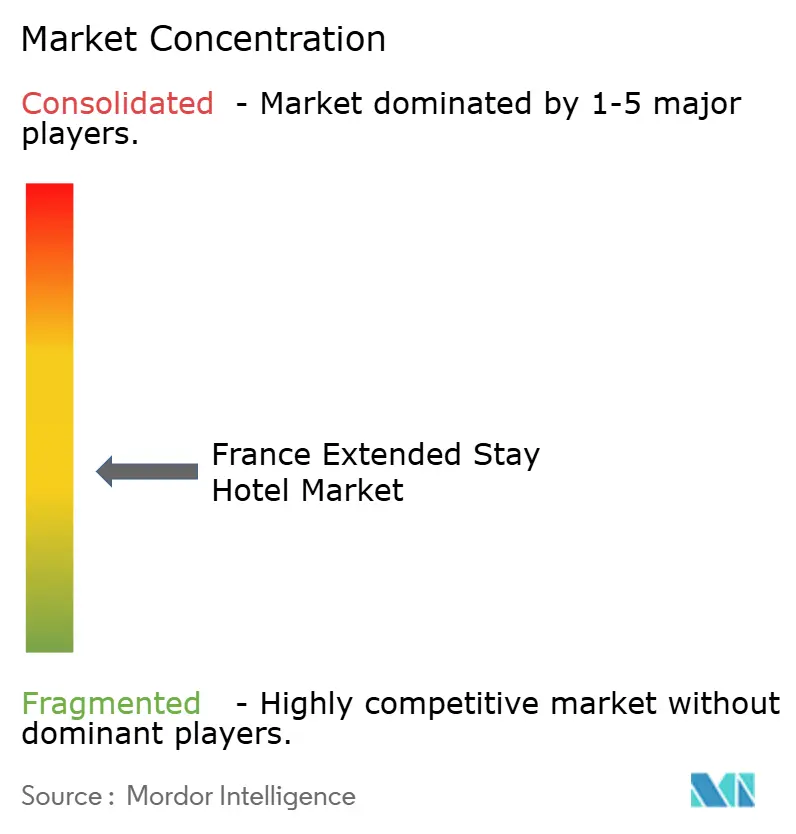
| Market Concentration | Medium |
Major Players *Disclaimer: Major Players sorted in no particular order Image © Mordor Intelligence. Reuse requires attribution under CC BY 4.0. | |
France Extended Stay Hotel Market Analysis by Mordor Intelligence
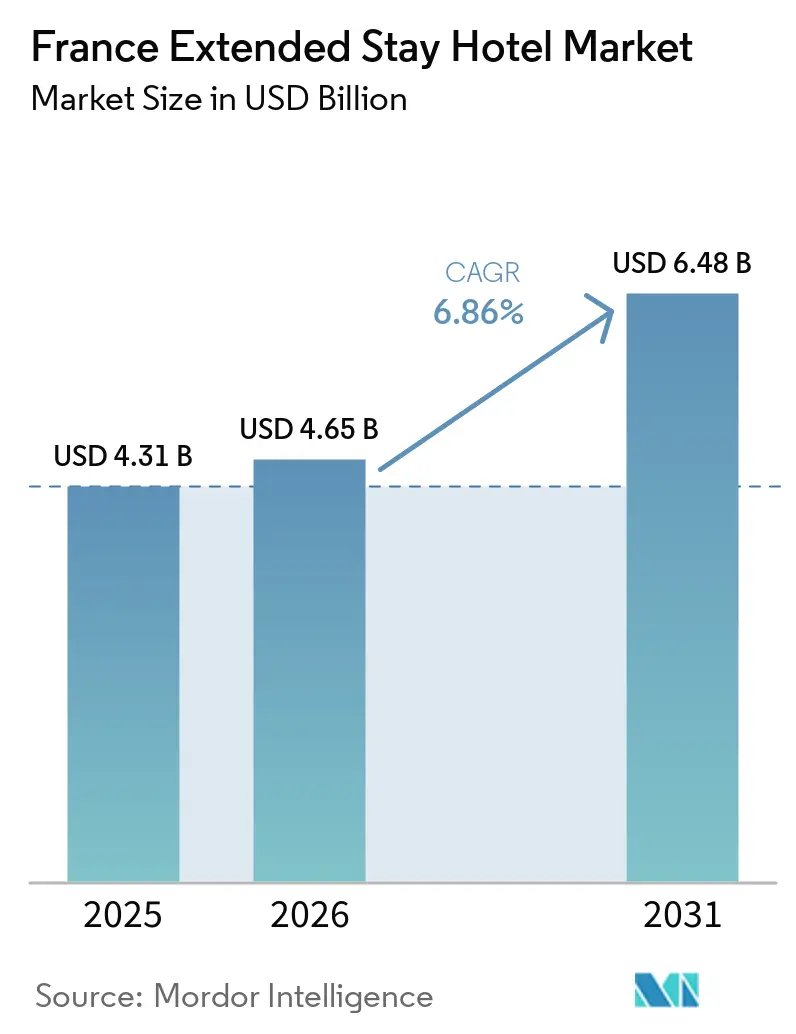
The France Extended Stay Hotel Market was valued at USD 4.31 billion in 2025 and estimated to grow from USD 4.65 billion in 2026 to reach USD 6.48 billion by 2031, at a CAGR of 6.86% during the forecast period (2026-2031). The market is shifting from nightly business hotel stays to residential-style accommodations that combine lodging, workspace, and kitchen facilities. Demand is driven by corporate hubs like Île-de-France, Toulouse, Lyon, and Marseille, where professionals often require multi-week or monthly stays. Supply is evolving as vacant office spaces in Paris are converted into serviced apartments and aparthotels, reducing entry barriers for operators repurposing older commercial properties[2]. Enhanced direct booking systems, loyalty program integration, and growing institutional interest are supporting market growth. Extended-stay assets are increasingly viewed as a stable urban hospitality option. However, stricter regulations on furnished rentals, energy compliance, and lease structures are narrowing the gap between residential and hospitality sectors, reshaping competition through 2031.
Key Report Takeaways
- By service level, Mid-Range Properties commanded a 46.41% share of the France Extended Stay Hotel Market in 2025, while Upscale and Luxury Formats are projected to grow at the highest CAGR of 7.20% in the France Extended Stay Hotel Market by 2031.
- By stay duration, Monthly Bookings commanded a 42.93% share of the France Extended Stay Hotel Market in 2025, while Quarterly and Longer-Term Stays are projected to grow at the highest CAGR of 7.12% in the France Extended Stay Hotel Market by 2031.
- By booking channel, Direct Digital Booking commanded a 44.82% share of the France Extended Stay Hotel Market in 2025, while OTAs are projected to grow at the highest CAGR of 7.48% in the France Extended Stay Hotel Market by 2031.
- By end user, Business Customers commanded a 38.14% share of the France Extended Stay Hotel Market in 2025, while Relocating Residents and Insurance-Displaced Guests are projected to grow at the highest CAGR of 7.79% in the France Extended Stay Hotel Market by 2031.
- By geography, Île-de-France commanded a 32.45% share of the France Extended Stay Hotel Market in 2025, while Southern France is projected to grow at the highest CAGR of 7.46% in the France Extended Stay Hotel Market by 2031.
Note: Market size and forecast figures in this report are generated using Mordor Intelligence’s proprietary estimation framework, updated with the latest available data and insights as of January 2026.
France Extended Stay Hotel Market Trends and Insights
Drivers Impact Analysis*
| Driver | (~) % Impact on CAGR Forecast | Geographic Relevance | Impact Timeline |
|---|---|---|---|
| Increasing demand from corporate travelers and relocations | +1.8% | Concentrated in Île-de-France and Southern France | Medium term (2-4 years) |
| Remote and Hybrid Work Extending Average Stay Length | +1.4% | National, with early gains in Paris, Lyon, Bordeaux | Medium term (2-4 years) |
| Preference for home-like stays with kitchens and workspaces | +1.0% | National, strongest in major metropolitan areas | Short term (≤ 2 years) |
| Urban supply reallocation toward flexible accommodation formats | +0.8% | Île-de-France, Bordeaux, Lille, Greater Paris | Short term (≤ 2 years) |
| Rising adoption of serviced apartments by institutional operators | +0.7% | France core cities, spillover to secondary cities | Long term (≥ 4 years) |
| Conversion of existing assets into extended-stay inventory | +0.6% | Île-de-France, Bordeaux, Lille | Short term (≤ 2 years) |
| Source: Mordor Intelligence | |||
Increasing demand from corporate travelers and relocations
France's position as a key destination for foreign direct investment supports its extended stay hotel market by attracting a steady influx of professionals, specialists, and project teams. A report says that, a significant number of foreign investment decisions in 2025, resulting in job creation and retention, which highlights sustained business-related mobility across the country[2]. These movements are crucial, as international assignees, commissioning engineers, and deployment teams often require accommodation for extended periods, such as weeks, months, or the duration of specific projects. Corporate hubs, including Toulouse, Lyon, Strasbourg, and the Seine-Saint-Denis area, experience the highest activity levels. In these areas, demand for long-stay accommodations frequently exceeds available inventory. This trend has increased the importance of serviced apartments and mid-range aparthotels, particularly in business districts, where they provide a practical alternative to traditional hotels.
Remote and Hybrid Work Extending Average Stay Length
Hybrid work is transforming how demand for long-term stays impacts the extended stay hotel market in France. Employees are no longer traveling solely for short, point-to-point meetings. Reports indicate that remote work became a significant trend in early 2024, with many private-sector employees working remotely at least occasionally. Additionally, a large portion of the workforce operates under formal return-to-office policies, with most employees expected to spend several days on-site each week by 2025[3]. This shift has increased the need for corporate housing, as professionals living far from their workplaces require flexible midweek accommodation to reduce daily commuting. As a result, there is a growing preference for properties designed for longer stays, offering amenities such as kitchens, workspaces, laundry facilities, and billing options suited for weekly or monthly occupancy.
Preference for home-like stays with kitchens and workspaces
Guest preferences are shifting toward accommodations that feel more like home, driving growth in the extended stay hotel market in France. This trend is evident in both business travel and relocation demand. Hotel operators are increasingly expected to provide essential amenities such as kitchens, laundry facilities, reliable internet, and workspaces within units. These features are becoming standard rather than optional. Adagio reported an increase in average stay duration for business travelers and growth in guest arrivals, indicating the established demand for longer stays in branded hotel portfolios. This model helps employers control trip costs by offering self-catering options that reduce additional expenses on food and beverages. It also makes these accommodations more attractive for relocation, training, and insurance-displacement needs, where the functionality of apartment-style units often outweighs the need for traditional hotel services.
Urban supply reallocation toward flexible accommodation formats
The extended stay hotel market in France is benefiting from the shift in urban real estate toward flexible accommodation formats. Île-de-France faced significant office space vacancies by the end of 2025, while the national office market experienced a notable surplus. This trend is encouraging property owners to explore alternative uses for vacant spaces. Converting offices into hotels or aparthotels is becoming increasingly viable, as office layouts are often more compatible with hospitality formats than with traditional residential conversions. Covivio initiated several office-to-hotel conversion projects in Paris and Boulogne-Billancourt during early 2026, allocating substantial capital expenditure and targeting attractive yields. One of these projects in Paris has already secured a pre-lease agreement with Mingle Group. These developments are expanding the availability of long-stay apartments in Paris and its surrounding areas, particularly in districts where office vacancies and corporate lodging demands are rising simultaneously. This shift highlights the growing adaptability of urban real estate to meet evolving accommodation needs.
Restraints Impact Analysis*
| Restraint | (~) % Impact on CAGR Forecast | Geographic Relevance | Impact Timeline |
|---|---|---|---|
| Strict furnished-rental and change-of-use regulation | -1.2% | National, acute in Paris and major urban centers | Long term (≥ 4 years) |
| High staffing, compliance, and energy-cost burden | -0.9% | National | Medium term (2-4 years) |
| Concentration of premium inventory in Paris and the Riviera | -0.5% | National, limits growth in secondary cities | Medium term (2-4 years) |
| Competitive pressure from short-term rentals and alternative lodging | -0.8% | Paris, Côte d'Azur, major tourist cities | Short term (≤ 2 years) |
| Source: Mordor Intelligence | |||
Strict furnished-rental and change-of-use regulation
Operators in France's extended stay hotel market face significant regulatory challenges, including hospitality rules, urban planning constraints, and furnished-rental laws. The bail mobilité framework, while relevant for corporate mobility and temporary accommodation, restricts stay duration and renewal flexibility in certain cases. The introduction of "résidences à vocation d'emploi" expanded legal options for employment-related stays, but local authority interpretations and implementation of rules continue to shape the operating environment[4]. Variations in change-of-use requirements across municipalities often delay or limit conversion projects, particularly in high-demand urban areas such as Paris and older building stock. Energy compliance adds further complexity, as the ban on new lettings for G-rated properties will reduce the availability of older furnished units eligible for use starting January 2025.
High staffing, compliance, and energy-cost burden
Operating cost pressures significantly impact France's extended stay hotel market. These properties face higher service demands compared to standard hotels, as guests staying for extended periods expect consistent maintenance, quality housekeeping, and uninterrupted operations. Meeting these expectations increases staffing requirements across the property. France's labor structure further escalates costs, with recruitment challenges and seasonal capacity limitations reported by many hospitality enterprises. Additionally, corporate-focused operators must adhere to procurement and quality standards, which add administrative and certification expenses to labor costs. Although energy costs have declined from their peak, they remain higher than in previous years, continuing to strain operating margins in urban and resort markets.
*Our forecasts treat driver/restraint impacts as directional, not additive. The impact forecasts reflect baseline growth, mix effects, and variable interactions.
Segment Analysis
By Service Level: Upscale Repositioning Redefines the Value Equation
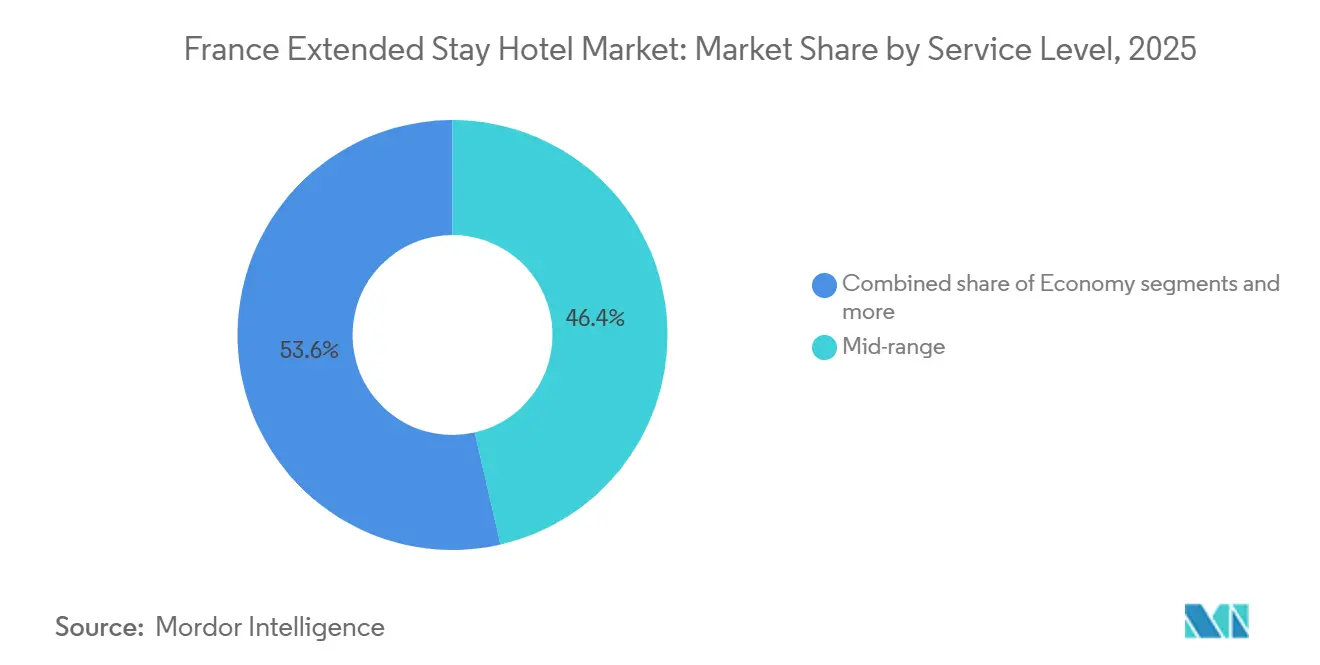
Mid-range properties accounted for 46.41% of the France extended stay hotel market size in 2025, serving corporate travelers, relocating residents, and mixed business-leisure users. Formats such as Adagio Original and Appart'City Confort dominate this segment, offering kitchens, flexible billing, and extended stay options at moderate pricing. These properties balance comfort and cost, aligning with the budget-conscious nature of many business assignments in France. Operationally, mid-range supply ensures occupancy stability in major urban areas.
Upscale and luxury properties are projected to grow at a 7.20% CAGR through 2031, making them the fastest-growing tier in the market. This segment includes brands such as Citadines and Adagio Premium, along with boutique operators catering to higher-value business travel and relocation needs. Demand is driven by preferences for residential-grade finishes, enhanced workspaces, and apartment-style layouts. These properties also benefit from conversion projects in central urban areas, where older office spaces are repurposed for hospitality use. The shift reflects changing customer preferences and evolving real estate trends.
Economy properties remain significant, serving trainers, trainees, public-sector personnel, and deployment-oriented workers needing affordable, practical lodging for extended periods. Their appeal lies in affordability, consistent standards, and proximity to business districts or transport hubs. However, tighter margins due to staffing and compliance costs challenge this segment, making it less favorable for growth compared to higher-tier options. The market exhibits a dual-speed profile, with mid-range properties anchoring volume while upscale and luxury segments grow rapidly. Operators are expanding mid-market offerings while enhancing higher-tier assets, reflecting customer demand for better finishes and quality in extended stays. Service differentiation is increasingly critical, particularly in cities with strong corporate demand and limited supply.

By Stay Duration: Monthly Bookings Mature While Quarterly Segments Emerge
Monthly stays accounted for 42.93% of the France extended stay hotel market size in 2025, reflecting a preference for predictable invoicing and stable occupancy. These stays cater to project assignments, business transfers, temporary housing needs, and corporate relocations, offering operators better planning and revenue visibility compared to short-term business travel. Monthly bookings remain the most commercially balanced demand segment for many operators.
Quarterly and longer-term stays are expected to grow at a 7.12% CAGR through 2031, driven by multi-phase industrial work, extended secondments, maintenance cycles, and relocations exceeding 30 days. These stays are significant in cities tied to aerospace, pharmaceuticals, logistics, and public administration, where staff movements align with projects. They also address insurance-related temporary housing needs, which often last several months, prompting operators to view properties as temporary residences.
Weekly stays serve consultants, technical teams, and project staff with active but short-term assignments. This segment often transitions into longer stays as project scopes or relocation timelines become clearer. While smaller in value than monthly bookings, weekly stays support lead generation and occupancy flexibility. Operators are adapting to these trends by adding features like laundry rooms, bike storage, parcel handling, and coworking spaces, which are essential for extended stays. Nemea’s model of combining extended-stay rooms with student housing highlights evolving asset designs for flexible occupancy. The 5.9 million annual address changes recorded in France underscore the growing role of temporary housing, reflecting a shift toward longer stays in the market.
By Booking Channel: Direct Digital Dominates, OTAs Accelerate in Long-Stay Discovery
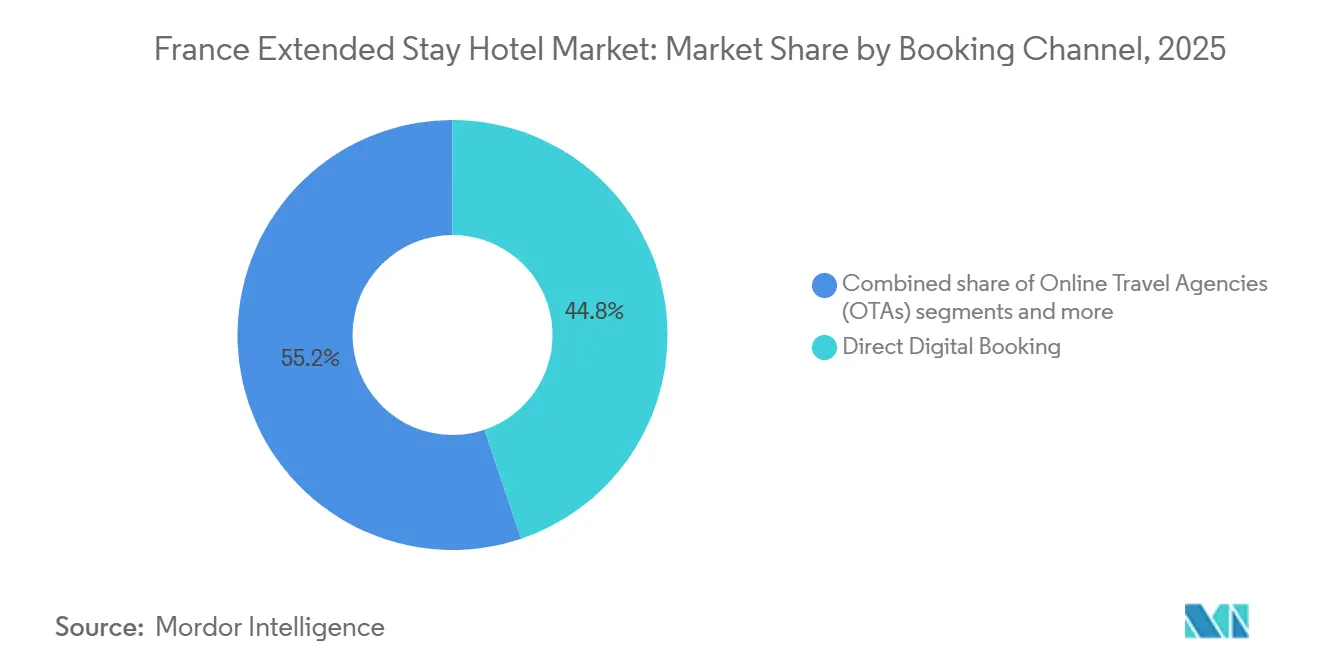
2025, making it the largest booking channel. This reflects operator investments in proprietary platforms, loyalty integration, and direct relationship management. Adagio reported 50% direct sales in 2025, highlighting the shift in branded distribution strategies. Direct digital channels are critical in long-stay hospitality due to the value of repeat business, simplified billing, and corporate client retention, especially for brands with scale and recognition across multiple French cities.
OTAs are the fastest-growing channel, with a projected CAGR of 7.48% through 2031. Improved search behavior for longer stays and algorithmic discovery have made weekly and monthly inventory more accessible to travelers. The expansion of Choice Hotels’ Quality Suites portfolio in France has increased extended-stay supply visibility through broader distribution systems, benefiting emerging or newly integrated assets in markets with developing brand pull. OTA growth reflects enhanced access and discovery rather than a decline in direct channels.
Offline and corporate contract bookings remain significant as many large employers and public institutions prefer centralized billing and negotiated travel terms. Long-stay demand often arises from procurement-led processes rather than casual searches. Corporate travel managers, public-sector buyers, and relocation partners prioritize duty-of-care compliance and account-level controls, giving operators with account management capabilities a competitive edge, particularly in business-heavy locations. While not the fastest growing, this channel remains commercially important. The France extended stay hotel market relies on balancing direct digital, OTA, and corporate contract channels. Each plays a distinct role, and operators managing all three effectively are better positioned for success.
By End User: Corporate Demand Consolidates While Relocation Segment Surges
Business customers accounted for 38.14% of the France extended stay hotel market share in 2025, remaining the largest end-user group. This reflects France’s role as a hub for foreign investment, project delivery, consulting, and industrial mobility. Business France’s 2025 investment data highlights employment-driven movements requiring extended stays. Corporate users drive demand as assignments increasingly necessitate living arrangements rather than standard hotel rooms, keeping business demand central to occupancy planning.
The relocating residents and insurance-displaced guest segment is expected to grow at a 7.79% CAGR through 2031, making it the fastest-growing end-user group. This growth reflects the rising need for temporary housing during moves, renovations, and ensured displacements. An estimated 5.9 million annual address changes in France underscore the growing demand for temporary and extended-stay accommodation. For this group, livability in extended-stay units is a key factor, driving faster growth compared to traditional travel segments.
Trainers and trainees contribute significantly to the market, driven by France’s training ecosystem, apprenticeship growth, and temporary housing needs near campuses and employers. This segment prefers cost-effective aparthotel formats. Government and defense users add stability through structured contracts and fixed-location assignments, reducing occupancy volatility despite their smaller market share.
Leisure travelers and families support the market during off-peak periods and in destinations where apartment-style accommodations suit group travel. In 2025, the client mix was 65% business and 35% leisure, with family and pet-friendly offerings attracting 9,000 leisure clients in six months. While leisure demand grows, corporate and relocation-driven occupancy continue to shape the market’s direction.
Geography Analysis
Île-de-France accounted for 32.45% of France's extended stay hotel market share in 2025, driven by Paris's role as a hub for corporate travel, financial services, and consulting. Adagio operated 21 properties in the region and planned three additional openings in 2026, indicating continued growth potential. Demand is supported by areas like La Défense, Nanterre, and Boulogne-Billancourt, where multi-week stays are common. Covivio’s five office-to-hotel conversion projects in Paris and Boulogne-Billancourt further strengthen the future supply pipeline. The region faces stricter supply regulations compared to other parts of France. Paris rent controls and restrictions on G-rated properties limit the availability of furnished inventory, curbing supply growth in key submarkets. These constraints influence operator strategies and increase the importance of conversion projects in commercial districts.
Southern France is projected to grow at a 7.46% CAGR through 2031, driven by aerospace demand in Toulouse, port and logistics activity in Marseille, and relocation needs in Nice and the Côte d'Azur. These cities expand long-stay demand beyond Paris, aligning with the market’s shift toward business-related stays.
Eastern France, including Lyon, Strasbourg, and Alsace, supports cross-border business, pharmaceutical activities, and EU-related travel. Western France, with Nantes and Rennes, is gaining relevance through aerospace subcontracting and corporate mobility. Central France, though smaller in share, is becoming an industrial support zone for multinational projects requiring extended accommodations. Regional business corridors are contributing more to market growth, complementing Paris's established position.
Competitive Landscape
The France extended stay hotel market is moderately concentrated in the branded segment and fragmented in the broader supply base. Pierre & Vacances – Center Parcs Group, through Adagio, held the largest share, followed by Appart'City, The Ascott Limited (via Citadines), Groupe Réside Études (via Residhome), and Nemea Group (via Nemea Appart'Hôtel). Together, these companies account for a significant portion of the market, though much of it remains outside the largest branded portfolios. The competitive landscape also includes Accor, Marriott International, Radisson Hotel Group, B&B Hotels Group, Staycity Group, and others, reflecting a diverse market with no single dominant operator.
Adagio combines scale, direct booking capabilities, and an expansion plan targeting over 180 aparthotels globally by 2030. The company reported strong revenue, occupancy, and guest numbers, with a notable share of direct sales. Appart'City differentiates itself with a multi-tier brand structure and Green Key certification, supporting ESG-linked procurement. The Ascott Limited, Groupe Réside Études, Réside Études Appart’Hôtels, and Odalys Group maintain relevance in their respective segments. Choice Hotels expanded its reach through Quality Suites with Zenitude, adding branded inventory in new destinations. Operators compete through brand strategies, channel management, product standardization, and location coverage.
Conversion-driven growth is shaping the market, with landlords repurposing office spaces into extended-stay formats. Covivio launched office-to-hotel projects, and CLS Holdings converted properties into serviced apartments. The competitive field includes hospitality groups, residence operators, and real estate-backed platforms like Staycity Group, B&B Hotels Group, and Groupe Duval. Larger players are expanding into secondary cities, addressing underserved areas. While competition is active, the market remains unsaturated across various demand pools and regions.
France Extended Stay Hotel Industry Leaders
-
Pierre & Vacances – Center Parcs Group
-
Appart'City
-
The Ascott Limited
-
Groupe Réside Études
-
Nemea Group
- *Disclaimer: Major Players sorted in no particular order
Recent Industry Developments
- March 2026: Adagio recently opened the Adagio Access Villeneuve-d'Ascq in the Lille metropolitan area, the third property under its Sergic partnership. France now has 84 Adagio properties, with three more Île-de-France openings planned by late 2026, highlighting the brand's growing presence in the Greater Paris market.
- April 2026: Covivio initiated office-to-hotel conversion projects in Paris and Boulogne-Billancourt, allocating significant capital expenditure with a target yield above 6%. The Paris-Raspail project secured a pre-completion lease with the Mingle Group, highlighting strong institutional demand for extended-stay accommodations from conversions before project completion.
- November 2025: Adagio introduced its 2030 strategic plan to expand its portfolio with additional properties over five years, aiming for significant growth in aparthotels across multiple countries. France remains the primary market, with plans for a global presence across its Original, Access, and Premium property categories.
- November 2025: Adagio expanded its France portfolio through a partnership with the Sergic Group, acquiring properties under the Adagio Access brand. This move increased its portfolio and strengthened its presence in the La Défense cluster with a new address in Nanterre.
France Extended Stay Hotel Market Report Scope
| Economy |
| Mid-range |
| Upscale and Luxury |
| Weekly |
| Monthly |
| Quarterly and Longer-term |
| Online Travel Agencies (OTAs) |
| Direct Digital Booking |
| Offline / Corporate Contract Booking |
| Business Customers |
| Trainers and Trainees |
| Government and Defense Personnel |
| Leisure Travelers and Families |
| Relocating Residents and Insurance-displaced Guests |
| Île-de-France |
| Southern France |
| Eastern France |
| Western France |
| Central France |
| By Service Level | Economy |
| Mid-range | |
| Upscale and Luxury | |
| By Stay Duration | Weekly |
| Monthly | |
| Quarterly and Longer-term | |
| By Booking Channel | Online Travel Agencies (OTAs) |
| Direct Digital Booking | |
| Offline / Corporate Contract Booking | |
| By End User | Business Customers |
| Trainers and Trainees | |
| Government and Defense Personnel | |
| Leisure Travelers and Families | |
| Relocating Residents and Insurance-displaced Guests | |
| By Geography | Île-de-France |
| Southern France | |
| Eastern France | |
| Western France | |
| Central France |
Key Questions Answered in the Report
What is the 2031 value of France’s extended stay hotel space?
The France extended stay hotel market is forecast to reach USD 6.48 billion by 2031, rising from USD 4.65 billion in 2026 at a 6.86% CAGR.
Which service level leads revenue in France?
Mid-range properties led with 46.41% of revenue in 2025, making them the core volume segment across business, relocation, and mixed-use demand.
Which stay duration is growing the fastest in France?
Quarterly and longer-term bookings are the fastest-growing duration type, with a projected 7.12% CAGR through 2031.
Why is Southern France gaining momentum for long-stay lodging?
Southern France is expected to grow at a 7.46% CAGR through 2031 because aerospace, life sciences, logistics, and relocation demand are spreading beyond Paris into Toulouse, Marseille, and nearby corridors.
How important is direct digital booking in France?
Direct digital booking was the largest channel in 2025 with 44.82% share, supported by stronger brand platforms, loyalty programs, and repeat corporate demand.
Which companies are active in France’s extended stay hotel space?
The tracked competitive set includes Accor, Marriott International, The Ascott Limited, Pierre & Vacances – Center Parcs Group, Radisson Hotel Group, B&B Hotels Group, Staycity Group, Appart’City, Nemea Group, Groupe Réside Études, Odalys Group, Louvre Hotels Group, Zenitude Groupe, Groupe Duval, Covivio Hotels, Advenis Résidences Services, Terres de France Group, Vicartem Group, Sergic Résidences Services, and Réside Études Appart’Hôtels.