
Foliar Spray Market Size and Share
Market Overview
| Study Period | 2020 - 2031 |
|---|---|
| Market Size (2026) | USD 8.51 Billion |
| Market Size (2031) | USD 11.01 Billion |
| Growth Rate (2026 - 2031) | 5.30 % |
| Fastest Growing Market | South America |
| Largest Market | Asia Pacific |
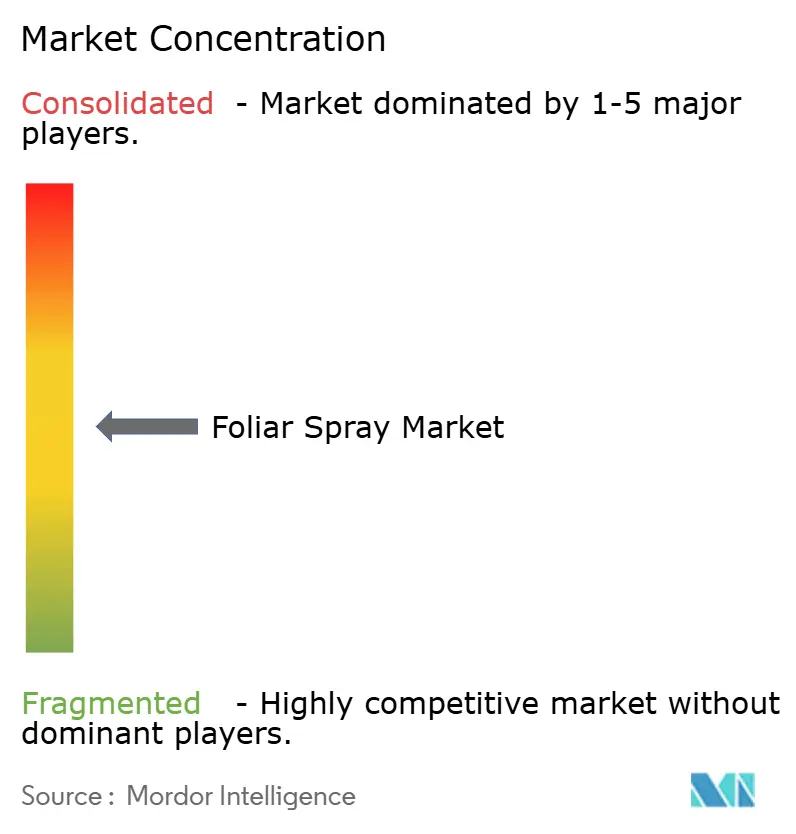
| Market Concentration | Medium |
Major Players *Disclaimer: Major Players sorted in no particular order Image © Mordor Intelligence. Reuse requires attribution under CC BY 4.0. | |
Foliar Spray Market Analysis by Mordor Intelligence
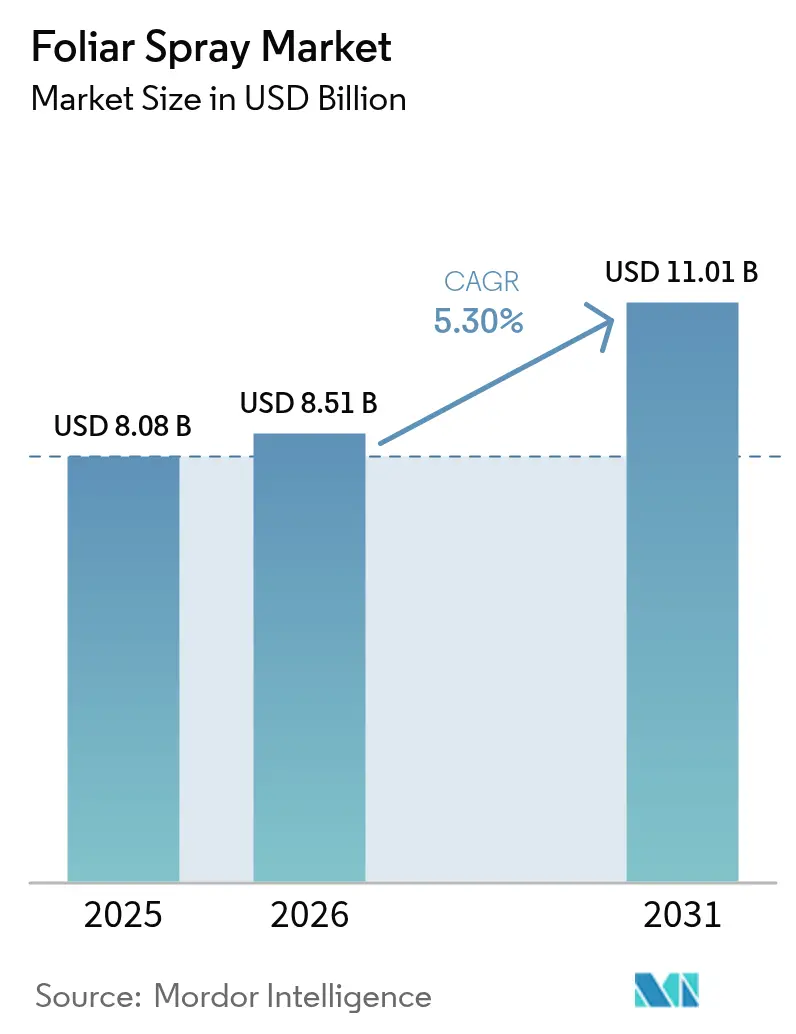
foliar spray market size in 2026 is estimated at USD 8.51 billion, growing from 2025 value of USD 8.08 billion with 2031 projections showing USD 11.01 billion, growing at 5.30% CAGR over 2026-2031. Uptake is being spurred by precision agriculture systems that let growers direct nutrients to leaves when root uptake is limited, cutting waste and improving nutrient-use efficiency. Demand is intensifying in high-value crops where minute improvements in quality lift grower margins, and in regions that rely on yield gains to meet food-security goals. Rapid innovation in nanocarriers, adjuvants and AI-enabled sprayers is shrinking application volumes while raising delivery accuracy, letting growers hit sustainability targets without sacrificing productivity. Governments are formalising micronutrient deficiency mitigation schemes, and bio-based formulations are expanding their share, even though synthetic products still dominate sales. These converging trends keep the foliar spray market steadily growing, even as fertigation and other delivery modes present structural competition.
Key Report Takeaways
- By chemical type, nitrogenous products held 34.62% of foliar spray market share in 2025, while micronutrients are projected to grow at a 5.63% CAGR through 2031.
- By product form, liquids commanded 74.35% of the foliar spray market in 2025; powders are forecast to expand at a 5.37% CAGR during 2026-2031.
- By source, synthetic formulations captured 88.62% of revenue in 2025, yet bio-based products are on track for a 5.44% CAGR.
- By application, horticulture crops accounted for 44.02% of the foliar spray market size in 2025, whereas orchard crops are set to register a 5.65% CAGR.
- By geography, Asia-Pacific led with 38.84% revenue share in 2025, and South America is expected to post the fastest 5.80% CAGR to 2031.
Note: Market size and forecast figures in this report are generated using Mordor Intelligence’s proprietary estimation framework, updated with the latest available data and insights as of 2026.
Market Trends and Insights
Drivers Impact Analysis of Foliar Spray Market*
| Drivers | (~) % Impact on CAGR Forecast | Geographic Relevance | Impact Timeline |
|---|---|---|---|
| Rising use in horticulture crops | +1.2% | Asia-Pacific and Europe | Medium term (2-4 years) |
| Micronutrient deficiency mitigation schemes | +0.8% | Asia-Pacific, Africa, South America | Medium term (2-4 years) |
| Demand for nutrient-dense produce | +1.0% | North America and Europe | Long term (≥ 4 years) |
| Agricultural expansion in developing nations | +0.7% | Asia-Pacific, Africa, South America | Medium term (2-4 years) |
| Higher nutrient-uptake efficiency | +0.9% | Global | Short term (≤ 2 years) |
| Source: Mordor Intelligence | |||
Growing Demand from Horticulture Crops
Horticulture already contributes nearly half of foliar spray consumption and continues to gain share as growers intensify specialty crop systems. Studies on organic strawberry production show yield gains of 262.42 g per plant after biostimulant foliar treatment, confirming strong economic incentives[1]Neslihan Kilic, “Improvement in Plant Growth, Yield, and Fruit Quality with Biostimulant Treatment in Organic Strawberry Cultivation,” HortScience, journals.ashs.org. Vegetable, berry, and floriculture producers also value the rapid correction of transient nutrient deficiencies that foliar programs provide during critical flowering or fruit-set stages. Technology firms answer this demand with drones that apply ultra-low-volume sprays guided by imaging analytics, reducing human exposure while raising canopy coverage accuracy. The result is a foliar spray market that continues to broaden its base in protected cultivation, greenhouses, and high-density outdoor orchards.
Surge in Micronutrient Deficiency Mitigation Schemes
Governments and NGOs are scaling programs that target zinc, iron, and iodine deficiencies in staple crops, turning foliar feeding into a public-health tool. Foliar application of zinc nanoparticles tripled grain zinc in lentils, showing how spray technology can address “hidden hunger” without genetically modifying plants. Subsidies for fortified sprays in India, Kenya, and Brazil are encouraging smallholders to adopt premixed micronutrient solutions, enlarging the foliar spray market in price-sensitive segments. Suppliers respond with single-dose sachets designed for backpack sprayers, lowering application errors and packaging waste.
Growing Demand for Nutrient-Dense and Superior Quality Crops
Premium retailers now differentiate produce on micro-nutrient content and shelf life, nudging growers toward foliar programs that fine-tune mineral ratios in fruits and vegetables. Targeted iodine sprays on tomatoes produced fruit that met dietary iodine recommendations without yield loss. Wineries report improved phenolic profiles after calcium-boron foliar blends, linking nutrition directly to market-facing quality metrics. These successes reinforce the value of the foliar spray market in premium crop supply chains that reward higher functional nutrition.
Increase in Agricultural Practices in Developing Countries
India, Nigeria, and Vietnam are mechanizing smallholder plots and expanding irrigated acreage, which boosts demand for easy-to-handle liquid foliar fertilizers. Indian contract manufacturers have added capacity to meet rising domestic orders, even as export volatility persists. Timely foliar correction of sulfur and magnesium is proving critical in paddy and maize systems where consecutive harvests deplete soils. This structural acreage expansion underpins long-run volume growth in the foliar spray market.
Restraints Impact Analysis of Foliar Spray Market*
| Restraints | (~) % Impact on CAGR Forecast | Geographic Relevance | Impact Timeline |
|---|---|---|---|
| Fertigation dominance | −0.6% | North America, Europe, parts of Asia-Pacific | Medium term (2-4 years) |
| Technical complexity and need for expertise | −0.4% | Global, higher impact in developing regions | Short term (≤ 2 years) |
| Limited applicability to all crop types | −0.3% | Global | Long term (≥ 4 years) |
| Source: Mordor Intelligence | |||
Fertigation Dominance in Certain Parts of the Globe
Drip-based fertigation remains entrenched in high-value greenhouse vegetables and turfgrass, where growers can deliver soluble nutrients continuously through irrigation lines[2]Chris Neff, “Exploring the Benefits of Fertigation,” USGA, usga.org. Precise dosing reduces leaching and labour, making fertigation a direct competitor to foliar programs. In regions with modern infrastructure, suppliers must position foliar sprays as complementary, targeting deficiencies that roots cannot correct quickly. Hybrid protocols in Spain and California now integrate low-dose foliar potassium during fruit colouring, indicating a path to coexistence rather than outright displacement.
Technical Complexity and Need for Expertise
Effective foliar application depends on droplet size, surfactant choice, weather timing, and leaf wetness, which can overwhelm smallholders who lack extension support. Misapplication not only wastes product but also risks phytotoxicity. Industry participants answer with mobile apps that calculate water volume and nozzle angle based on local humidity. Nonetheless, in remote areas where data coverage is weak, these knowledge barriers slow adoption and temper the pace at which the foliar spray market penetrates frontier regions.
*Our forecasts treat driver/restraint impacts as directional, not additive. The impact forecasts reflect baseline growth, mix effects, and variable interactions.
Foliar Spray Market Segment Analysis
By Chemical:
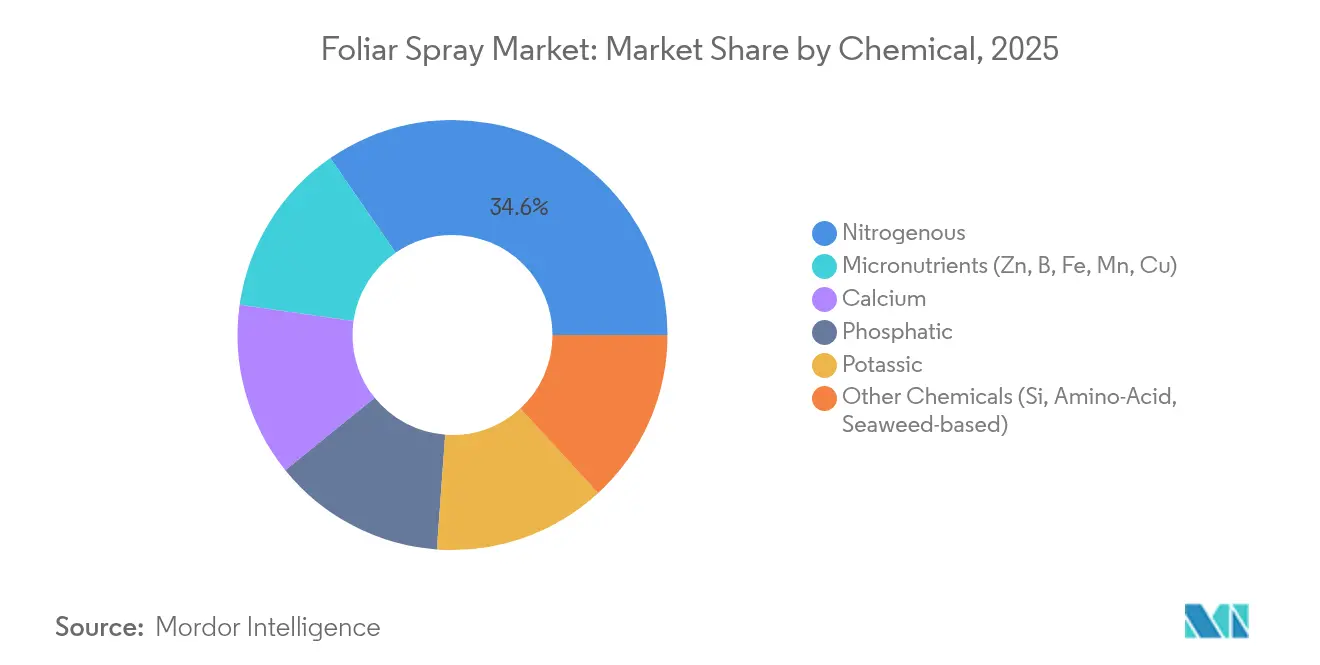
Micronutrients Gain Strategic ImportanceNitrogenous formulas contributed the largest 34.62% share of the foliar spray market size in 2025, thanks to their broad role in vegetative growth. Yet micronutrients are pacing the chemical category with a 5.63% CAGR, reflecting their outsized influence on quality traits and stress resilience. High-zinc and iron blends are now mandatory in public biofortification schemes targeting school feeding programs in Bangladesh and Rwanda. The foliar spray market is witnessing product launches that combine chelated zinc with amino acids, delivering faster leaf absorption and lower soil interaction. Phosphatic and potassic options hold steady demand in cereals, while emerging calcium borate sprays extend shelf life in berries by firming cell walls. Specialty lines such as seaweed and amino acid blends offer bioactive compounds that stimulate root exudation, diversifying the chemical portfolio without eroding the synthetic base.



By Product Type:
Liquid Dominance Meets Powder InnovationLiquid formulations dominate because they are ready-to-use and compatible with conventional boom sprayers, capturing 74.35% of foliar spray market share in 2025. Uptake is immediate, an advantage during abrupt nutrient stress events. Liquids also dovetail with drone and robot sprayers that need low-viscosity materials. Suppliers improve shelf stability through pH buffers and antimicrobial agents, allowing distribution into hot climates without cold storage. Fulvic acid-rich NPK liquids now include trace selenium, giving onion growers both macronutrient supply and micronutrient differentiation.
Powder technology, however, is regaining ground on cost and logistics, growing at a CAGR of 5.37%. Farmers in mountainous Peru prefer powders to avoid hauling bulky drums. Manufacturers offer dual packs: one pouch of micronutrient chelates and a second of wetting agents that dissolve just before application, minimising caking. As packaging moves to biodegradable films, powders could erode some liquid share, but co-existence is likely because each format serves distinct operational contexts in the foliar spray market.
By Source:
Bio-based Solutions Accelerate Despite Synthetic DominanceSynthetic inputs still hold 88.62% of sales due to predictable performance and lower price points, yet regulatory and retailer pressure is steering attention toward bio-based alternatives. The bio-based sub-segment is rising at a 5.44% CAGR on the back of essential oil, microbial, and protein hydrolysate technologies. Thyme Guard, a biodegradable thyme-oil spray, controls foliar pathogens and provides minor nutrient content, appealing to wine grape growers committed to residue-free protocols.
Carbon-footprint labelling in European supermarkets incentivises producers to adopt algae-based or amino-acid foliar feeds that cut embodied emissions. Seaweed extracts also contain natural osmo-protectants, reducing heat and drought stress in lettuce fields across Spain. As registration pathways for biologicals clarify, the foliar spray market is expected to witness a hybrid era in which synthetic chelates coexist with live microbial consortia, offering growers flexibility across certification schemes.
By Application:
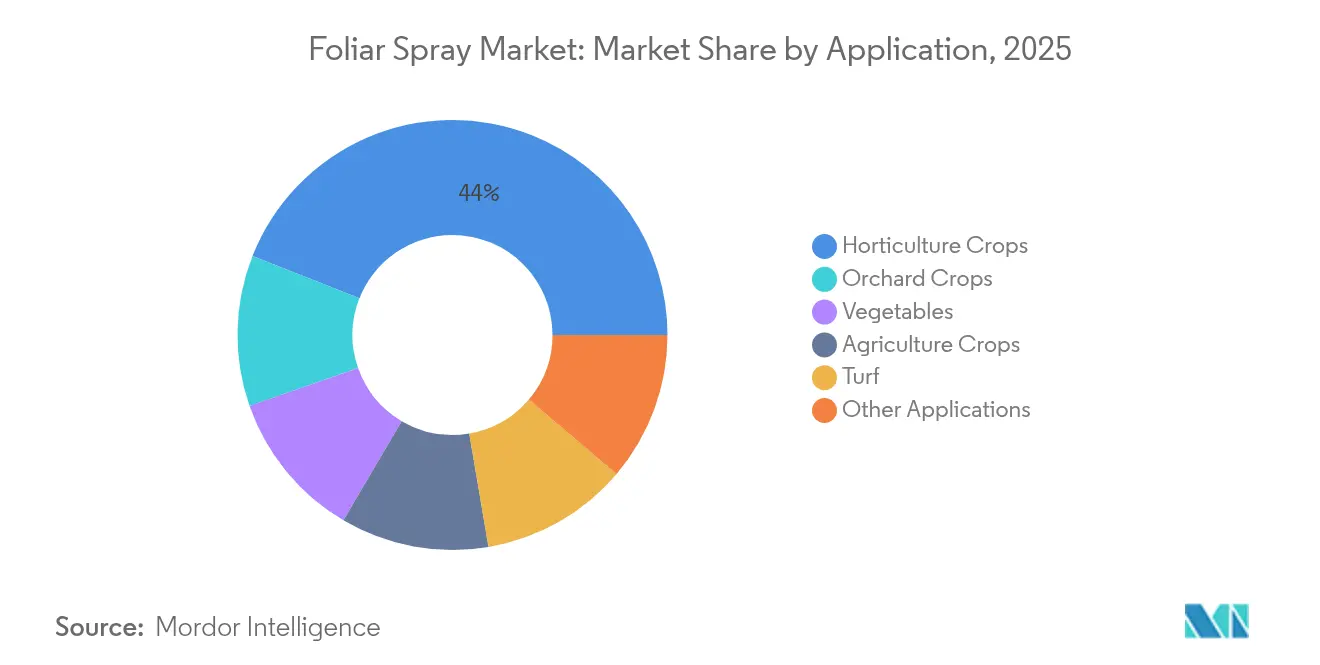
Horticulture Leads While Orchards AccelerateHorticulture crops such as vegetables, berries, and ornamentals accounted for 44.02% of the foliar spray market size in 2025 as quality premiums reward precise nutrient timing. Growers adopt weekly foliar calcium-magnesium blends to prevent tip burn in leafy greens under LED lighting. Hyperspectral imagery now verifies soluble solids in blueberries pre-harvest, letting growers adjust foliar potassium nitrate rates to shore up sweetness indexes.
Orchard crops are poised for the fastest 5.65% CAGR because leaf-applied micronutrients bypass soil mobility limits in perennial systems. Smart carts like Green Atlas map fruit load and direct variable-rate foliar zinc borate during pit-hardening, improving uniformity and packout grades.
Geography Analysis
APAC Foliar Spray Market
Asia-Pacific maintained a 38.84% revenue slice in 2025, anchored by intensive greenhouse vegetable clusters in China and India that rely on foliar zinc and boron during peak fruit-set. Chinese researchers improved apple yield on sandy soils by pairing biostimulants with carboxymethyl cellulose sprays, reinforcing adoption in northern orchards. Drone sprayers with adjustable droplet diameters and 10 m swath widths are lowering labour requirements and accentuating the precision narrative for the foliar spray market.
South America Foliar Spray Market
South America delivers the fastest regional CAGR at 5.80% as Brazil formalises its National Bio-inputs Program. More than 600 biological products are registered, and precision weed-spray rigs like Stara’s Imperador 4000 integrate AI sensors to target foliage in real time.
North America and EMEA Foliar Spray Market
North America and Europe share advanced precision frameworks, though regulatory pressure shapes product mixes differently. European Green Deal objectives push the adoption of ultra-precise spot sprayers that cut herbicide volumes by up to 90%. The Middle-East and Africa trail on volume but show strong relative growth as water scarcity legitimises foliar feeding’s low-volume profile. Date palm plantations in the United Arab Emirates apply boron foliar sprays at night to curb evaporation losses.
Value Chain Analysis
The foliar spray value chain starts with upstream feedstocks and actives, including high-purity NPK intermediates, micronutrient salts and chelates, adjuvants/surfactants, and bio-based inputs such as seaweed, essential oils, microbial strains, and protein hydrolysates. These materials flow to formulators that produce mainly liquid concentrates (the dominant format in 2025) and a smaller but growing set of powders and dual-pack solutions, followed by packaging (drums, IBCs, sachets) and quality/compliance testing for stability, solubility, and residue performance. Production and sourcing have become more complex across 2024-2025 due to disruptions affecting specialty fertilizer and biostimulant supply chains; for example, China implemented a two-month halt on specialty fertilizer exports in July 2025, pushing import-dependent markets to source from Europe, Russia, and West Asia at higher costs and reinforcing diversification and forward procurement in raw-material planning.
Downstream, distribution runs through agri-input distributors, co-ops, and retailer-dealer networks, with increasing pull from integrated agronomy platforms that link inputs with diagnostics and application services. Applicators include conventional boom and backpack sprayers and a growing set of drone and sensor-guided systems used heavily in horticulture and orchard crops where foliar timing is critical. Compliance and traceability requirements influence labeling and documentation for certain geographies; within Europe, implementation guidance for Regulation (EU) 2019/1009 continued to be refined, including a revised European Commission FAQs document endorsed in November 2025, which affects how manufacturers document product conformity and communicate product information to operators and authorities.
Competitive Landscape
The foliar spray market is moderately fragmented. Multinationals such as Bayer, Corteva, and Yara prioritise integrated crop-nutrition platforms rather than single-product pushes. Niche innovators exploit gaps with high-precision hardware or unique biological actives. Regional players attend to local needs. Cross-licensing of adjuvant technologies and generic chelates remains common, but data-rich prescription services now deliver a competitive edge.
Foliar Spray Industry Leaders
Yara
EuroChem Group
Haifa Negev technologies LTD
ICL
Mosaic
- *Disclaimer: Major Players sorted in no particular order
Foliar Spray Market Companies Covered in this Report
- AgroLiquid
- Andaman Ag Corporation
- Aries Agro Limited
- Bayer AG
- Coromandel International Ltd.
- Corteva
- EuroChem Group
- Grupa Azoty S.A.
- Haifa Negev technologies LTD
- ICL
- Mosaic
- Nutrien
- Nutrient TECH
- Sichuan Shucan Chemical Co., Ltd.
- Syngenta
- WinField United
- Yara

Market Opportunities and Future Outlook
White space is visible where foliar sprays can be positioned as a complementary tool alongside fertigation, targeting rapid correction of transient deficiencies and quality attributes in high-value systems. Horticulture and orchards already anchor consumption (horticulture held 44.02% share in 2025), creating room for more crop-stage specific programs that bundle micronutrient mixes (fastest-growing chemical segment) with surfactants and dose guidance for canopy architecture and weather windows. On the technology side, opportunities center on embedding foliar nutrition into precision workflows, including imaging-led prescriptions and robotics that improve leaf targeting and reduce waste; research trajectories around vision-based robotic targeting and advanced imaging of nanoparticle behavior support product and service differentiation for companies that pair formulations with diagnostics.
Bio-based and hybrid portfolios are another opportunity area, driven by retailer residue expectations and programs that encourage biological solutions. In South America, Brazil’s National Bio-inputs Program and the growing base of registered biological products support commercialization pathways for foliar biostimulants and multifunctional products that combine nutrition with stress mitigation. Regulatory initiatives also shape product design and market access: the EU’s Fertilising Products Regulation (EU) 2019/1009 continues to standardize requirements for fertilising products placed on the market, and the UK has been consulting on a UK Fertilising Product Regulations framework, both of which increase the value of compliant formulations, robust labeling, and traceable supply for suppliers serving Europe and adjacent export supply chains.
Recent Industry Developments in Foliar Spray Market
- July 2026: Yara International announced an agreement to acquire a Gulf Coast ammonia production facility in Texas City, Texas, for USD 1.3 billion. The asset underpins upstream nitrogen availability for downstream specialty and foliar nutrition portfolios, strengthening supply security and margin control across volatile feedstock cycles.
- December 2025: ICL launched NutroScan, an AI-powered, real-time plant nutritional diagnostic tool for the 2025/2026 crop season in Brazil. The launch supports data-led foliar nutrition programs by connecting in-field diagnostics to targeted nutrient recommendations and application timing.
- November 2024: Syngenta Canada launched YieldON, a seaweed-based liquid foliar biostimulant containing manganese, zinc and molybdenum for corn and wheat. The product broadened branded bio-based foliar options in broadacre crops and reinforced the shift toward nutrient-plus-biostimulant positioning.


Foliar Spray Market Report Scope and Research Methodology
Market Definition and Coverage
This market covers foliar spray products applied to plant leaves to deliver nutrients and related crop inputs, and it is measured as revenue earned from these products across major farming and horticulture settings.
Scope exclusions: Equipment used to apply sprays (sprayers, nozzles, and drones) and general field services are excluded from this sizing.
Segments Covered in This Report
- By Chemical
- Phosphatic
- Nitrogenous
- Potassic
- Calcium
- Micronutrients (Zn, B, Fe, Mn, Cu)
- Other Chemicals (Si, Amino-Acid, Seaweed-based)
- By Product Type
- Liquid
- Powder
- By Source
- Synthetic
- Bio-based / Organic
- By Application
- Horticulture Crops
- Agriculture Crops
- Orchard Crops
- Vegetables
- Turf
- Other Applications
- By Geography
- Asia-Pacific
- China
- India
- Japan
- South Korea
- Rest of Asia-Pacific
- North America
- United States
- Canada
- Mexico
- Europe
- Germany
- United Kingdom
- France
- Italy
- Rest of Europe
- South America
- Brazil
- Argentina
- Rest of South America
- Middle-East and Africa
- Saudi Arabia
- South Africa
- Rest of Middle-East and Africa
- Asia-Pacific
Data Sources, Market Sizing, and Validation
Desk Research
Desk research started with public agriculture statistics and agronomy references to ground the model in real crop area and input-use patterns. For sources, we used official publications such as FAOSTAT, USDA and ERS data releases, Eurostat, and national agriculture ministries. We also relied on fertilizer and crop input references from groups such as the International Fertilizer Association and the International Plant Nutrition Institute, using their agronomy-style materials for framing.
Next, we reviewed company annual reports, investor presentations, agriculture news coverage, and association websites to understand pricing direction, product-mix shifts (liquid versus powder), and adoption signals for foliar programs in key crops. For cross-checking financial and trade indicators, we also used paid subscriptions that compile company financials and intelligence, import-export shipment records, and patent databases to identify product pipeline activity and recurring formulation themes. The desk research sources listed here are illustrative, and additional public documents were reviewed to collect, validate, and clarify specific data points.
Primary Interviews and Surveys
Primary work focused on validating what foliar sprays are actually used for, how purchasing happens, and what drives price and volume in each region. Interviews with input suppliers, distributors, agronomists, and large farm decision makers across APAC, EMEA, and the Americas helped tighten assumptions on crop coverage, application frequency, and the nutrient mix before we finalized the model.
Distribution of primary research fieldwork respondents
| Company type | Respondent position | Region |
|---|---|---|
| Top tier: 27% | CXOs: 13% | APAC: 43% |
| Mid tier: 57% | Functional/Unit leaders: 38% | EMEA: 37% |
| Smaller Players: 16% | Managers: 49% | Americas: 20% |
Market-Sizing & Forecasting
Our core sizing uses a top-down demand pool build. It starts from crop acreage and crop intensity by region, then translates into realistic foliar application coverage. After addressable crop area is established, we convert it into value using inputs such as average application frequency, typical dose ranges by nutrient group, and an average selling price logic that reflects mix shifts between liquid and powder products.
To keep the output grounded, we corroborate totals using selective bottom-up checks. Supplier revenue disclosures, channel checks with distributors, and sampled price points are rolled up and compared against the demand build. When gaps appear in markets with limited disclosure, usually smaller countries, we bridge using nearby-country agronomy similarity and trade signals, then refine based on local interview feedback.
For forecasting, we run scenario analysis because a few drivers can change direction quickly. The main inputs we stress test include crop planting trends, fertilizer price cycles, adoption of bio-based foliar products, weather-linked stress events that affect foliar usage, and regulations that influence nutrient and crop protection choices. The final trajectory is aligned with what practitioners view as achievable over the period.
Data Validation & Update Cycle
Validation is done in layers so no single data stream can pull the result too far. Model outputs are checked against independent signals such as crop area trends, nutrient consumption direction, and regional trade or production indicators. Any unusual jumps are reviewed until there is a clear explanation.
Before sign-off, an analyst review pass is completed to test arithmetic accuracy, unit consistency, currency handling, and whether assumptions match what interviews supported. If a large variance appears versus a known market signal, we re-contact relevant respondents and recheck the assumption driving the mismatch. Reports are refreshed annually, with interim updates when material events occur, and a final pre-delivery sweep is done so clients receive the latest updated view.
Mordor Intelligence's Foliar Spray Market Size Compared Against Other Published Estimates
Published market sizes for foliar sprays can vary even when the topic name looks the same, because the boundary of what is counted is not always identical. Differences also come from how the demand pool is constructed, what pricing path is assumed, and how often key inputs are updated when agriculture cycles shift.
By tracking crop-area based demand signals and refreshing mix and pricing assumptions using interviews, Mordor Intelligence keeps the foliar spray total tied to product revenue from foliar-applied inputs, rather than drifting into adjacent categories such as application equipment or broad crop-care services.
Benchmark comparison
| Source | Market Size | Gaps in Research Methodology |
|---|---|---|
| Mordor Intelligence | USD 8.51 B (2026) | |
| Trade Journal A | USD 7.40 B (2025) | This estimate is presented as a single-point projection to 2025 with limited visibility on how product boundaries and price timing are handled, and it can differ if dosage, application frequency, or nutrient-mix assumptions are not validated region by region. |
| Industry Digest B | USD 8.20 B (2027) | The method appears to lean on a long-run growth curve from an older base year, which can understate recent mix shifts toward higher-value formulations and can also vary based on whether synthetic and bio-based products are consistently included across countries. |
The table shows that timing and scope are the two biggest reasons the numbers do not line up neatly, since one source cites 2025 while another anchors on a 2020 starting point. When the market is rebuilt from crop exposure, application behavior, and a transparent price and mix logic, the final value is easier to reconcile against real agronomy and channel feedback, and then it becomes more repeatable to update.


Key Questions Answered in the Report
How large is the foliar spray market in 2026?
The foliar spray market is valued at USD 8.51 billion in 2026 and is on course for a 5.30% CAGR.
Which region leads the foliar spray market?
Asia-Pacific leads with a 38.84% share in 2025, supported by intensive horticulture and government micronutrient programs.
What chemical segment is growing fastest?
Micronutrient formulations are the fastest, registering a projected 5.63% CAGR between 2026 and 2031.
Why are bio-based foliar sprays gaining ground?
Retailer residue limits, regulatory shifts and advances in essential-oil and microbial technology are pushing bio-based formulations toward a 5.44% CAGR.
Page last updated on:


 Your data is secure and never sold or shared.


