
FMCG Packaging Market Size and Share
Market Overview
| Study Period | 2020 - 2031 |
|---|---|
| Market Volume (2026) | 440.71 Million tonnes |
| Market Volume (2031) | 515.38 Million tonnes |
| Growth Rate (2026 - 2031) | 3.18 % |
| Fastest Growing Market | Middle East and Africa |
| Largest Market | Asia Pacific |
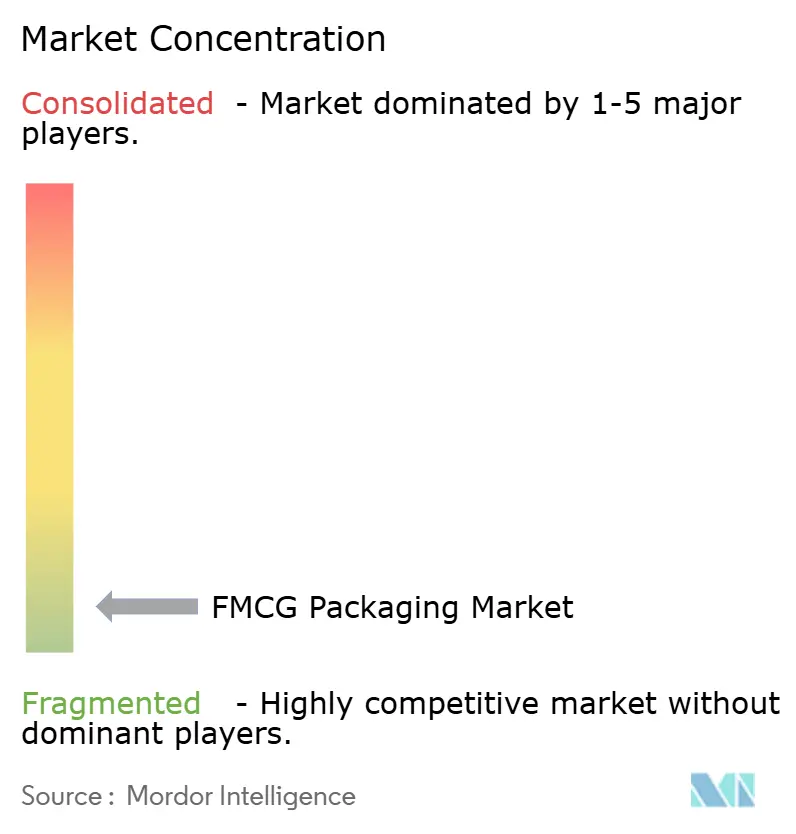
| Market Concentration | Low |
Major Players *Disclaimer: Major Players sorted in no particular order Image © Mordor Intelligence. Reuse requires attribution under CC BY 4.0. | |
FMCG Packaging Market Analysis by Mordor Intelligence
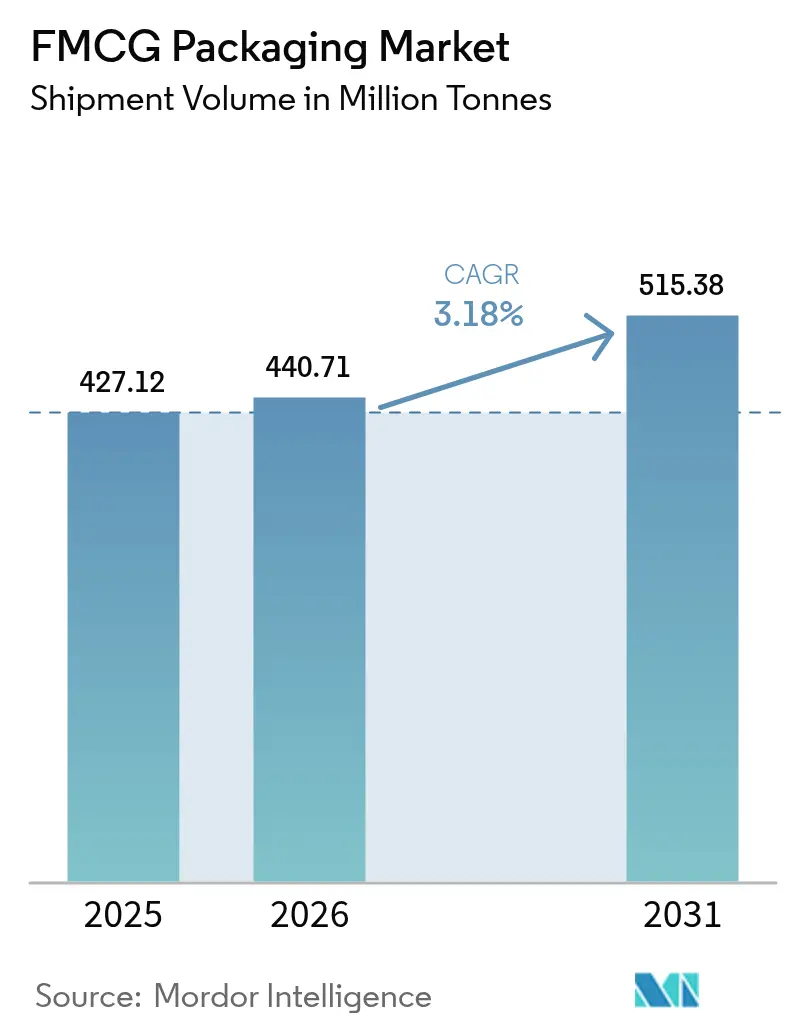
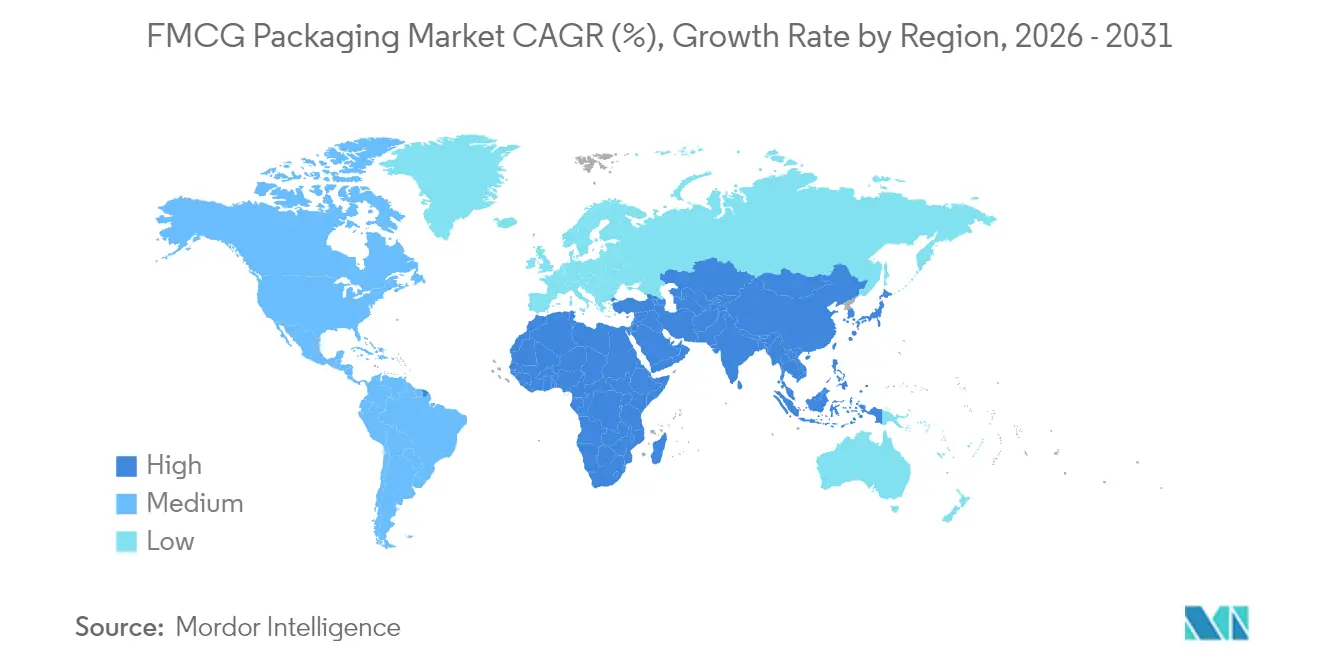
The FMCG packaging market size was valued at 427.12 million tonnes in 2025 and estimated to grow from 440.71 million tonnes in 2026 to reach 515.38 million tonnes by 2031, at a CAGR of 3.18% during the forecast period (2026-2031). Growth rests on steady household demand for packaged essentials, expanding e-commerce volumes, and policy measures that reward recyclable and refillable solutions. Large converters are redesigning formats to trim material use and freight costs while protecting goods that travel through longer, more complex supply chains. Bio-based substrates and chemical-recycled resins are moving from pilot to commercial scale, yet plastics remain indispensable in high-barrier and lightweight roles. Regional demand is led by Asia-Pacific thanks to rapid urbanization and small-household purchasing, while Middle East and Africa (MEA) offers the quickest tonnage expansion as modern retail spreads.
Key Report Takeaways
- By region, Asia-Pacific held 45.21% FMCG packaging market share in 2025; MEA is projected to grow at a 6.48% CAGR to 2031.
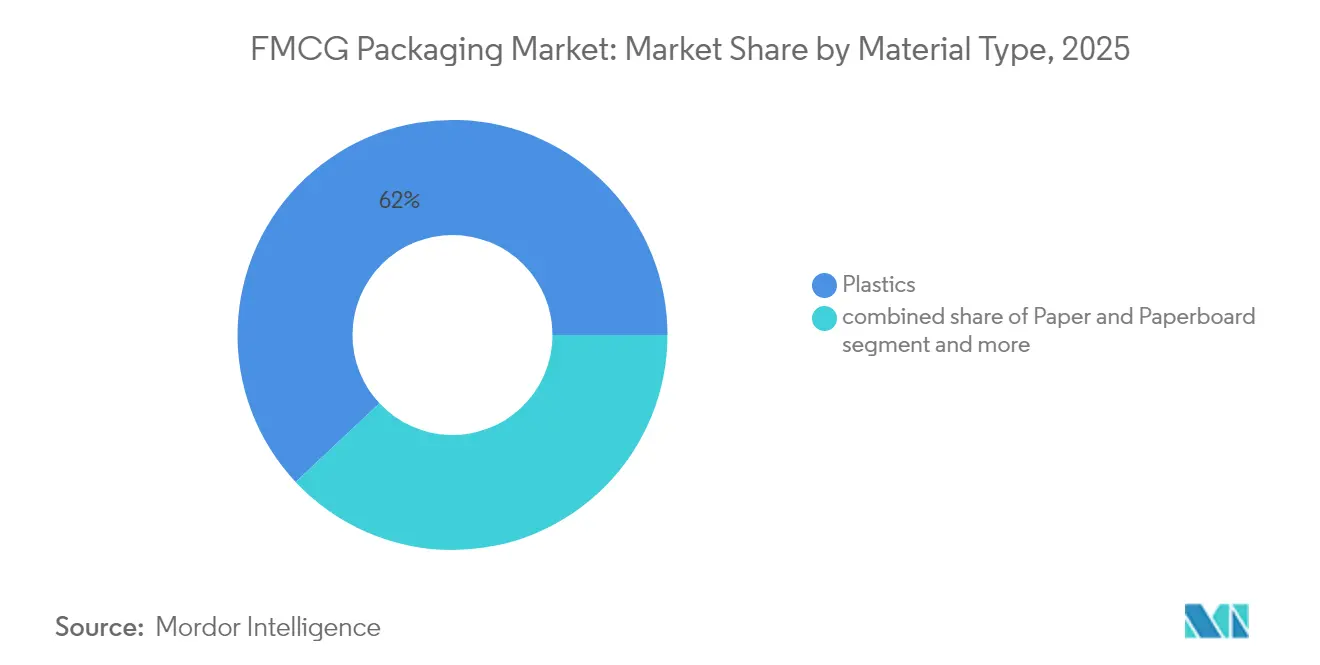
- By material type, plastics commanded 61.98% of the FMCG packaging market size in 2025; bio-based and compostable materials are set to expand at 6.73% CAGR through 2031.
- By packaging type, flexible formats led with 54.12% revenue share in 2025, whereas the same segment is forecast to post a 6.22% CAGR to 2031.
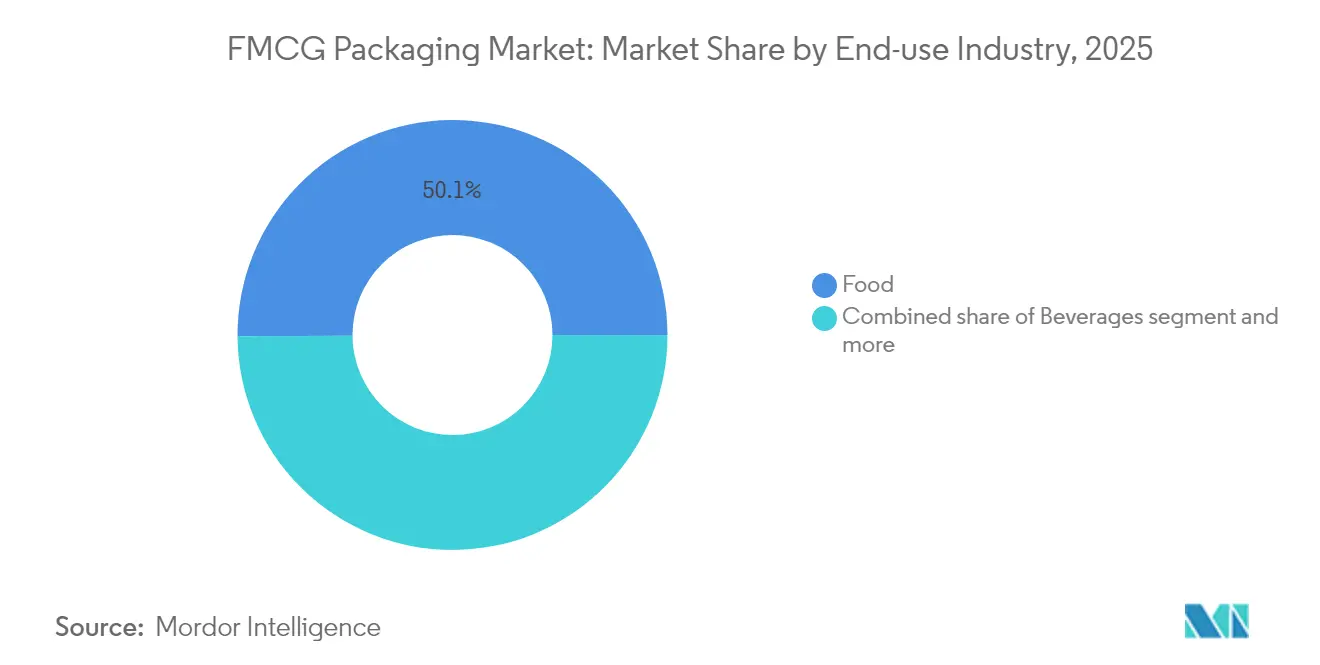
- By end-use industry, food accounted for 50.10% share of the FMCG packaging market size in 2025, while pharmaceuticals and healthcare are advancing at 5.43% CAGR to 2031.
- By distribution channel, direct sales represented 55.92% of 2025 revenue; indirect sales are forecast to rise at a 4.53% CAGR through 2031.
Note: Market size and forecast figures in this report are generated using Mordor Intelligence’s proprietary estimation framework, updated with the latest available data and insights as of 2026.
Market Trends and Insights
Drivers Impact Analysis of FMCG Packaging Market*
| Driver | (~) % Impact on CAGR Forecast | Geographic Relevance | Impact Timeline |
|---|---|---|---|
| Rapid Growth of E-commerce Requiring Protective, Lightweight Packs | 0.8% | Global, with concentration in North America & APAC | Medium term (2-4 years) |
| Urban Single-Serve Consumption Boom in Asia Boosting Convenience Formats | 0.7% | APAC core, spill-over to MEA | Long term (≥ 4 years) |
| RTD Beverage Surge Driving High-Barrier Pouch Adoption | 0.6% | Global, led by North America & Europe | Short term (≤ 2 years) |
| Premiumisation in Personal-Care Triggering Smart and Decorative Packs | 0.5% | Europe & North America, expanding to APAC | Medium term (2-4 years) |
| Cold-Chain Expansion in Emerging Markets Raising Multilayer Film Usage | 0.4% | APAC & MEA, with selective Latin America penetration | Long term (≥ 4 years) |
| Source: Mordor Intelligence | |||
Rapid Growth of E-commerce Requiring Protective, Lightweight Packs
Online retail now frames design briefs around parcel durability, dimensional weight limits, and friction-free returns. Brand owners specify cushioned mailers, air-column pouches, and fit-to-size cartons that slash void space and freight spend. Packaging plants add digital print lines so each shipper can carry scannable codes that confirm authenticity or trigger replenishment services. Smart indicators that reveal impact or temperature misuse are becoming standard on premium categories, a trend reinforced by parcel insurers who offer lower premiums for traceable packs. These needs keep flexible films and corrugated board in high demand and encourage resin suppliers to accelerate drop-in recycled grades that retain mechanical properties. [1]
Urban Single-Serve Consumption Boom in Asia Boosting Convenience Formats
Rising numbers of single-person households and congested commutes in China, India, and Southeast Asia spur uptake of portion-controlled pouches, cups, and sachets. Manufacturers are automating high-speed fill-seal lines to reach price points competitive with bulk packs while trimming food waste from partially used larger units. Retailers dedicate premium shelf space to resealable snack packs and ready-to-eat meals sized for one, pushing converters to enhance barrier layers that keep contents fresh until the last serving. Growth spills into home-care and personal-care items, where refill pods and travel-friendly minis fit hectic urban lifestyles. Demand for laminates that couple easy-tear openings with drop-resistance underpins a notable slice of incremental Asian capacity additions.
RTD Beverage Surge Driving High-Barrier Pouch Adoption
Functional and dairy-alternative drinks thrive on convenience and ambient stability. To lock in flavor and nutrients without refrigeration, producers specify multilayer films with oxygen-scavenging layers and aluminum-free barriers compatible with recycling streams. The format also supports cold-chain expansion in emerging markets, where reliable chillers remain scarce. Brand owners experiment with spout-pouches that allow on-the-go sipping, and digital inks enable limited-edition graphics that build social-media buzz. Equipment suppliers respond with modular filling systems that swap between metallized and transparent webs, granting operational flexibility amidst SKU proliferation. Resulting demand lifts orders for EVOH and bio-based tie-layers across Europe and North America.
Premiumisation in Personal-Care Triggering Smart and Decorative Packs
Skin-care, hair-care, and fragrance brands compete on shelf presence, prompting intricate embossing, metallization, and connected-pack features that tell ingredient provenance stories. NFC tags let consumers check product authenticity or engage in loyalty programs, while light-weight glass-look PET bottles lower carbon footprints versus traditional flint glass. Luxury labels still insist on tactile closures and matte soft-touch labels; suppliers therefore co-develop recyclable over-sleeves and water-based varnishes that achieve premium aesthetics without foil laminates. Growing male grooming segments in Western Europe and the US adopt functional airless pumps that protect sensitive active ingredients, further lifting demand for multilayer polypropylene components
Restraints Impact Analysis of FMCG Packaging Market*
| Restraint | (~) % Impact on CAGR Forecast | Geographic Relevance | Impact Timeline |
|---|---|---|---|
| Resin Price Volatility Creating Planning Uncertainty | -0.4% | Global, with acute impact in North America & Europe | Short term (≤ 2 years) |
| Recycling-Infrastructure Deficit in Developing Nations | -0.3% | APAC & MEA emerging markets, selective Latin America | Long term (≥ 4 years) |
| Single-Use-Plastic Bans Dampening Conventional Flexibles | -0.2% | Europe & select North American jurisdictions | Medium term (2-4 years) |
| Source: Mordor Intelligence | |||
Resin Price Volatility Creating Planning Uncertainty
Fluctuating crude-oil and naphtha benchmarks upset quarterly contract negotiations, prompting converters to hedge feedstock or accelerate substitution toward recycled and bio-based grades. Smaller firms lacking scale struggle to absorb spikes, which compress margins and slow capital investment. Sudden shortages of specialty additives, often linked to geopolitical events, force ad-hoc reformulations that risk downtime and customer penalties. In response, multinationals diversify sourcing and lock in multi-year supply pacts, while financial teams roll out cost-pass-through clauses keyed to industry indices. Such turbulence favors producers with integrated resin assets and strong working-capital positions.
Single-Use-Plastic Bans Dampening Conventional Flexibles
Europe’s Packaging and Packaging Waste Regulation mandates recyclability and minimum recycled content, pushing PVC shrink sleeves and PS yogurt cups toward phase-out. Parallel schemes in the United Kingdom introduce disposal fees that penalize hard-to-recycle laminates. Brand owners pivot to mono-material PE or PP films, but doing so can raise oxygen ingress, thereby demanding improved barrier coatings. Retailers add “recycle-ready” scorecards to vendor audits, elevating the strategic importance of design-for-recycling. While the rules squeeze margins on conventional flexibles, they create a runway for papers with dispersion barriers, compostable films, and refill systems now trialing across grocery chains.
*Our forecasts treat driver/restraint impacts as directional, not additive. The impact forecasts reflect baseline growth, mix effects, and variable interactions.
FMCG Packaging Market Segment Analysis
By Material Type:
Plastics Dominance Faces Sustainable DisruptionPlastics maintained a 61.98% share of the FMCG packaging market in 2025, reflecting unmatched strength-to-weight ratios and broad processability. Bio-based and compostable grades, though still niche, are expanding at 6.73% CAGR as converters commercialize PLA and PHA blends with enhanced oxygen and moisture barriers. Rigid metals find favor in premium beverage lines for infinite recyclability, and paperboard gains share where dry food or personal-care formats permit fiber-based walls. The FMCG packaging market continues to favor polyethylene and polypropylene in flexible laminates thanks to cost efficiency, but chemical recycling, now scaling in North America and Europe, promises high-quality post-consumer resins that moderate virgin demand. Innovations in reactive coating lines let paper cups hold acidic juices without plastic liners, opening another pathway for plastics displacement.
Plastics suppliers counter sustainability pressures by launching certified-circular PE and PP grades derived from pyrolysis oil, giving brand owners a drop-in route to lower emissions while retaining incumbent converting lines. The FMCG packaging market size for bio-based resins is projected to surpass 8.23 million tonnes by 2031 as governmental green-procurement rules take hold. Meanwhile, aluminum’s light-weight advantage in aerosol cans and pet-food trays aligns with refill stations that prefer robust formats surviving multiple cycles. Glass stays relevant where taste neutrality is prized, yet weight and breakage limit its volume share. Overall, material choice now hinges on balancing functional performance, regulatory compliance, and total carbon impact rather than unit price alone.

By Packaging Type:
Flexible Solutions Drive InnovationWith a 54.12% share in 2025, flexible formats dominate the FMCG packaging market and are tracking a 6.22% CAGR to 2031. Brand owners value lower material-to-product ratios, high graphics potential, and pack-out efficiency that allows more units per pallet. The shift to e-commerce adds demand for mail-friendly pillow packs and multi-layer sachets that endure automated sortation without extra void fill. Continuous-motion horizontal form-fill-seal (HFFS) lines supply snack and confectionery categories at speeds exceeding 1,500 packs per minute, highlighting the operational gains that recursive format optimisation delivers.
Rigid options still command niches where structure and reclosability are critical. PET bottles retain leadership in carbonated soft drinks, while glass jars project premium cues in gourmet sauces. Hybrid “rigid-in-flexible” pouch designs with molded caps combine both worlds, slicing weight by up to 70% versus equivalently sized glass containers. The FMCG packaging market size for rigid formats is forecast to post low-single-digit growth, reflecting saturation in mature categories but fresh opportunities in refillable personal-care dispensers. Equipment builders now offer modular filler blocs that handle fitment pouches, jars, and bottles on one line, letting converters hedge against demand swings across formats.
By End-use Industry:
Food Dominance Meets Pharma GrowthFood applications generated 50.10% of 2025 tonnage as grocery chains push longer ambient shelf life to curb shrink. Active-ingredient sachets that absorb oxygen, or liner sheets infused with antimicrobial agents, illustrate how packaging anchors waste-reduction strategies. Beverage players upgrade to aseptic cartons and retort pouches to tap rising demand for dairy alternatives and functional drinks that must remain stable without cold-chain. The FMCG packaging market size for pharmaceuticals and healthcare is expanding at 5.43% CAGR, propelled by insulin, vaccine, and biosimilar launches that impose strict sterility and traceability needs.
Cold-chain investments in Asia and MEA elevate multilayer films that manage moisture while permitting rapid heat transfer in blast freezers. In parallel, personal-care launches embrace airless pumps and mini tubes tailored to travel restrictions and subscription services. Household-care concentrates in refill pouches lower plastic use and shipping weight, aligning with corporate carbon pledges. Across industries, smart labels that log temperature or tampering events provide extra assurance for regulators and insurers. These converging trends encourage converters to widen material portfolios and co-develop applications with brand R&D teams.
By Distribution Channel:
Direct Sales Evolve Toward OmnichannelDirect sales captured 55.92% of 2025 volume as global FMCG groups relied on long-term supply contracts with integrated packaging majors. These ties favor joint innovation on machinery upgrades and closed-loop resin sourcing. Nevertheless, the FMCG packaging market sees indirect channels—distributors, printers, and online brokers—accelerating at 4.53% CAGR as small and medium brands outsource purchasing to concentrate on marketing. E-commerce marketplaces specify frustration-free guidelines that strip away excess layers and replace gloss laminates with mono-material films.
Omnichannel fulfillment requires packs that navigate warehouse automation yet deliver an engaging unboxing moment on arrival. Hence liners, tear tapes, and self-sealing flaps become critical functional add-ons. Third-party logistics providers increasingly bundle kitting and custom printing, shifting some influence over packaging specifications downstream. The FMCG packaging industry therefore invests in cloud platforms that link artwork revision, ordering, and tracking so that every stakeholder works off the same data set. Over the forecast period, competition between direct and indirect routes will hinge on service flexibility as much as on unit cost.
Geography Analysis
APAC FMCG Packaging Market
Asia-Pacific generated 45.21% of 2025 shipments, positioning the region as the anchor of the FMCG packaging market. China and India supply mammoth domestic demand and serve export flows, leveraging clusters of integrated resin crackers, film extruders, and converting plants. Urban micro-kitchens and on-the-go eating habits fuel single-serve pouch uptake, while national plastic-reduction mandates accelerate trials of paper-based flexibles. Rising disposable incomes enable trading-up to premium personal-care formats, deepening per-capita packaging intensity. Government-backed cold-chain corridors in India and Southeast Asia unleash further need for insulated shippers and tamper-evident seals.
North America FMCG Packaging Market
North America follows with a stable share rooted in broad e-commerce penetration and advanced corrugated capacity. The Smurfit-WestRock merger, valued at USD 20 billion, exemplifies the push for scale to dilute fixed costs and fund circular-economy R&D. Investments such as Green Bay Packaging’s USD 1 billion kraft linerboard mill in Arkansas strengthen domestic supply security and expand lightweight liner offerings. United States state regulations on recycled content in beverage containers catalyze PET reclaim projects, pushing local converters to lock in rPET feedstock. Canada and Mexico gain from near-shoring that relocates consumer-goods filling lines closer to core demand.
Europe FMCG Packaging Market
Europe’s mature market taps innovation to meet its stringent recyclability targets under the Packaging and Packaging Waste Regulation. Germany and France upgrade MRFs and chemical-recycling pilots to satisfy minimum recycled-content thresholds, while brand owners redesign individual packs to pass “sort-ability” tests. Premium confectionery chooses fiber-based wrapping with bio-barriers, and UK supermarkets roll out refill trials that test shopper uptake of returnable pouches. These initiatives stabilize overall tonnage but shift value toward higher-spec materials and linked digital services.
MEA FMCG Packaging Market
Middle East and Africa register the fastest 6.48% CAGR, albeit from a lower base, as organized retail expands and population growth drives packaged staples. Gulf states invest in state-of-the-art flexible plants that supply both domestic fast-food chains and export orders. South Africa and Kenya attract mobile filling units for milk and juice cartons that extend shelf life in areas lacking refrigeration. Foreign direct investment from European and Asian groups introduces multilayer extrusion technology, lifting local capabilities.
South America FMCG Packaging Market
South America offers steady upside as economic reforms in Brazil and Colombia revive consumer spending. Regional fiber availability supports cost-competitive corrugated, and sugar-cane-based bio-PE capacity in Brazil gives global brands a renewable-content narrative. Tariff structures still influence plant-location decisions, nudging converters to adopt multinational footprints that straddle Mercosur and Pacific Alliance blocs.
Regulatory Landscape
Regulation is tightening around recyclability, labeling, and chemical safety, with the European Union setting a near-term compliance milestone for FMCG packaging placed on the market. Regulation (EU) 2025/40 (Packaging and Packaging Waste Regulation) entered into force on 11 February 2025 and applies from 12 August 2026. It shifts many design-for-recycling and minimization practices from voluntary targets into binding requirements, and it is already increasing supplier audits focused on material composition and labeling readiness.
In the United States, food-contact compliance is moving toward more structured post-market oversight and more stringent testing expectations for certain paper and coated substrates. On 12 May 2026, the FDA finalized a systematic process for post-market assessment of food chemicals (including food contact substances) using an annual work plan approach. In 2026, it also advanced updates affecting migration limits and authorized substances in food-contact paper applications. Alongside agency actions, federal legislative activity such as H.R. 9231 (introduced 9 June 2026) signals additional momentum toward restricting specified substances used in food packaging, which increases the importance of documentation, accredited testing, and formulation optionality for converters and material suppliers.
Competitive Landscape
The FMCG packaging market remains fragmented with numerous regional specialists. The Smurfit-WestRock tie-up combines boxboard, corrugated, and containerboard assets across four continents, aiming to unlock logistics and R&D synergies. Kimberly-Clark’s USD 2 billion multi-site US expansion demonstrates how brand owners vertically integrate select packaging lines to safeguard supply and accelerate innovation. Meanwhile, Hotpack Global’s USD 100 million New Jersey plant exemplifies foreign entrants establishing local manufacturing to shorten lead times and reduce currency risk.
Technology leadership drives differentiation. American Packaging Corporation’s Utah Center of Excellence houses proprietary flexographic presses that deliver short-run, high-graphic pouches suited to personalized marketing. Graphic Packaging’s fully automated Texas facility integrates AI-driven quality control, trimming waste and energy use while shortening order-to-ship cycles. Active patenting in barrier chemistries and digital watermarking signals ongoing rivalry in both material science and data-rich traceability.
Sustainability pressures open lanes for smaller innovators. Lactips’ water-soluble films and start-ups offering paper-based spouted pouches secure pilot programs with multinational beverage groups. Chemical-recycler partnerships between resin majors and waste-management firms promise near-virgin quality recyclate, a capability likely to redraw supplier hierarchies once commercial scale is reached. Over the outlook period, successful players will marry circular-design credentials with cost-efficient global networks.
FMCG Packaging Industry Leaders
-
Amcor plc
-
Ball Corporation
-
Mondi Group
-
Sealed Air Corporation
-
International Paper Company
- *Disclaimer: Major Players sorted in no particular order
FMCG Packaging Market Companies Covered in this Report
- Amcor plc
- Ball Corporation
- Mondi Group
- International Paper Co.
- Sealed Air Corporation
- Constantia Flexibles
- Smurfit Westrock Plc
- Crown Holdings Inc.
- Coveris Holdings S.A.
- Graphic Packaging International LLC
- Tetra Pak International
- Stora Enso Oyj
- Sonoco Products Co.
- Huhtamaki Oyj
- Toyo Seikan Group HD
- Nampak Ltd
- Mpact Pty Ltd
- Albea S.A.
- Owens-Illinois (O-I)
- Verallia SA
- Napco National
- 3P Gulf Group
Market Opportunities and Future Outlook
Regulatory-driven redesign and compliance data creation are widening whitespace for suppliers that can provide recyclable structures, validated material disclosures, and scalable capacity across core FMCG end uses (food, beverages, personal care, and household care). The EU PPWR timeline is a concrete catalyst, with Regulation (EU) 2025/40 applying from 12 August 2026 and pushing brand owners and converters toward packaging minimization, material composition labeling, and formats that meet design-for-recycling rules. This is reinforcing demand for mono-material flexible structures (PE/PP), higher-barrier coatings that avoid hard-to-recycle laminates, and packaging systems that can support reuse or deposit return workflows where applicable.
Capacity moves in 2026 also show where suppliers are placing near-term bets across FMCG-relevant materials and formats. SIG commenced the first phase of expanding its Querétaro, Mexico plant in 2026, with a plan to double capacity from 1.5 billion to 3.0 billion packages by 2028, aligned with shelf-stable carton demand from beverage and liquid food brands. In rigid packaging, Vidrala announced a 180 million euro investment at its Caudete plant in Spain (furnace refurbishment from June 2026) to lift glass container capacity by 10% to 315,000 tonnes annually, while Crown Holdings announced a Northern India beverage can facility planned at 2.2 billion cans per year, pointing to where metal packaging scale is being added for fast-moving drink categories. In flexible packaging films, Oben Group signed an agreement for a new 12-meter BOPP line in Brazil with 94,000 tons of annual capacity, supporting high-volume snack, confectionery, and personal-care overwrap applications where downgauging and print performance remain key purchase criteria.
Recent Industry Developments in FMCG Packaging Market
- July 2026: Amcor published guidance for beverage producers on meeting EU Packaging and Packaging Waste Regulation (PPWR) reuse and deposit return scheme requirements. The update connects regulatory timelines to practical packaging choices, elevating the need for converters to align materials, labeling, and pack-system design with reuse-enabled supply chains.
- June 2026: Amcor partnered with UK-based Kelpi to evaluate a bio-based seaweed material for barrier performance in fiber-based packaging. The work targets a known bottleneck in fiber formats, barrier functionality without reverting to hard-to-recycle laminates, and supports brand owner moves toward recyclable paper-based packs.
- June 2025: Tetra Pak and Cayuga Milk Ingredients completed a USD 270 million aseptic-packaging expansion in New York, adding shelf-stable carton capability and creating 150 jobs. The added capacity strengthens North American supply of aseptic cartons used across liquid food and beverage FMCG categories and supports longer ambient shelf-life distribution models.
FMCG Packaging Market Report Scope and Research Methodology
Market Definition and Coverage
For this methodology, the FMCG packaging market covers packaging materials and formats used to pack, protect, and distribute fast moving consumer goods across food, beverages, personal care, household care, and other everyday categories, measured on a volume basis (tonnes).
Scope exclusions: It does not count packaging used mainly for industrial goods, bulk transport packs for B2B logistics only, or non packaging items such as processing equipment.
Segments Covered in This Report
- By Material Type
- Paper and Paperboard
- Plastics
- Polyethylene (LDPE/HDPE)
- Polypropylene (PP)
- Polyethylene Terephthalate (PET)
- Other Plastics (PVC, PS,etc)
- Metal
- Glass
- Bio-based and Compostable Materials
- By Packaging Type
- Flexible Packaging
- Pouches and Bags
- Films and Wraps
- Other Flexible Packaging
- Rigid Packaging
- Bottles and Jars
- Cans
- Trays and Containers
- Other Rigid Packaging
- Flexible Packaging
- By End-use Industry
- Food
- Beverages
- Personal Care and Cosmetics
- Household Care Products
- Pharmaceuticals and Healthcare
- Other End-use Industry
- By Distribution Channel
- Direct Sales
- Indirect Sales
- By Geography
- North America
- United States
- Canada
- Mexico
- Europe
- Germany
- United Kingdom
- France
- Italy
- Spain
- Russia
- Rest of Europe
- Asia-Pacific
- China
- India
- Japan
- South Korea
- Australia and New Zealand
- Rest of Asia-Pacific
- Middle East and Africa
- Middle East
- United Arab Emirates
- Saudi Arabia
- Turkey
- Rest of Middle East
- Africa
- South Africa
- Nigeria
- Egypt
- Rest of Africa
- Middle East
- South America
- Brazil
- Argentina
- Rest of South America
- North America
Data Sources, Market Sizing, and Validation
Desk Research
Desk work was used to build the starting point for the model and to set realistic ranges for volumes by material and end use. We relied on public sources such as UN Comtrade for trade flows, the World Bank and OECD for macro indicators, and FAO and national statistics offices for food production and consumption signals that connect to packaging demand.
To keep the material side consistent, we reviewed sources such as the International Aluminum Institute, the International Council of Glass Associations, and paper and plastics association publications where available. We also checked peer-reviewed journals that cover packaging materials and recycling rates. Company annual reports, investor presentations, and reputable press were used to track capacity additions, lightweighting, and substitution trends, and a paid subscription database was referenced for company financials, patent tracking, and selective shipment level signals when public data was not detailed enough. This list is indicative, and many other sources were also used for data collection, validation, and clarification during the research.
Primary Interviews and Surveys
Primary inputs were collected through interviews and structured surveys with packaging converters, material suppliers, brand owners, and channel participants to validate volumes, mix shifts, and realistic utilization assumptions. Because this is a global market, we covered demand and supply perspectives across APAC, EMEA, and the Americas, so that regional consumption patterns, export exposure, and regulation driven material choices could be checked consistently.
Distribution of primary research fieldwork respondents
| Company type | Respondent position | Region |
|---|---|---|
| Top tier: 26% | CXOs: 15% | APAC: 45% |
| Mid tier: 58% | Functional/Unit leaders: 28% | EMEA: 33% |
| Smaller Players: 16% | Managers: 57% | Americas: 22% |
Market-Sizing & Forecasting
Sizing was constructed using a top-down approach where FMCG consumption indicators and packaged product output were used to rebuild the addressable packaging demand pool, which was then translated into tonnes using material intensity and packaging mix assumptions. To keep the totals realistic, we corroborated the result with selective bottom-up approximations, including sampled converter throughput checks, indicative capacity utilization ranges, and ASP to volume cross-checks where revenue references existed, and then adjusted when the two views did not align.
Key inputs used in the model included packaged food and beverage output trends, personal care and household product demand growth, flexible versus rigid share shifts, material substitution trends (paper, plastics, metal, glass, and emerging bio based options), average packaging weight reductions due to lightweighting, and recycling and regulatory signals that influence material choice. Forecasts were developed using scenario analysis supported by variable-by-variable expectations gathered from primary discussions, which helped set practical bounds on mix changes and the pace of sustainability driven redesigns. Where direct volume datapoints were missing for a niche end use or a smaller geography, we filled gaps through proxy intensity ratios tied to consumption and trade, then ran a reasonableness check against converter presence and reported capacity additions.
Data Validation & Update Cycle
Outputs were validated through multiple checks so that obvious overcounts and undercounts were identified early. We compared the model results with independent signals such as material production direction, trade movement, and end market output patterns, and then investigated any large variances before final sign-off.
A second review pass is completed where assumptions, unit conversions, and mix splits are rechecked, and callbacks are triggered if a key input looks inconsistent with what respondents described. Reports are refreshed annually, with interim updates made when material events occur, such as major regulation changes, capacity shocks, or sharp shifts in resin or paper markets. Before delivery, a fresh update pass is performed so clients receive the latest consistent view.
Mordor Intelligence's Fmcg Packaging Market Estimate Compared With Other Published Estimates
Published market sizes for FMCG packaging often do not match because the underlying unit, scope, and conversion logic are not the same, even when the titles look similar. Differences also show up when one estimate mixes packaging for non FMCG uses into the same bucket, or when price and currency assumptions are pushed into the model without a clear volume anchor.
The main gap comes from revenue based totals that blend price inflation and broader consumer packaging scope, whereas Mordor Intelligence keeps this market tied to packaging demand expressed in tonnes and then checks the split by material and end use through converter and brand owner validation.
Benchmark comparison
| Source | Market Size | Gaps in Research Methodology |
|---|---|---|
| Mordor Intelligence | USD 440.71 M (2026) | |
| Industry Publisher A | USD 827.10 B (2025) | Uses a revenue lens in USD and may include wider consumer packaging definitions, so price changes, currency timing, and scope overlap can lift the reported total versus a volume anchored view. |
| Industry Publisher B | USD 495.90 B (2025) | Revenue sizing with a different base year and forecasting window, which can shift totals when ASP progression, inflation treatment, and material mix assumptions are not reconciled back to tonnes. |
The spread in the table is mainly explained by unit choice and how closely the scope is kept to FMCG only, which is why revenue based figures can look much larger. By keeping the steps traceable to consumption signals, packaging mix, and practical validation checks, the approach stays repeatable and easier to audit when assumptions need updating.
Key Questions Answered in the Report
What is the current FMCG packaging market size?
The FMCG packaging market reached 440.71 million tonnes in 2026 and is projected to hit 515.38 million tonnes by 2031.
Which region leads the FMCG packaging market?
Asia-Pacific leads with 45.21% share in 2025 due to its large consumer base and manufacturing scale.
What material dominates global FMCG packaging demand?
Plastics account for 61.98% of 2025 volume, although bio-based alternatives show the fastest growth.
Which packaging format is growing quickest?
Flexible packaging is expanding at a 6.22% CAGR, driven by material efficiency and e-commerce suitability.
Why is the pharmaceutical sector important for future growth?
Cold-chain expansion and stricter regulatory needs push pharmaceutical and healthcare demand at a 5.43% CAGR through 2031.