
Flat Glass Coatings Market Size and Share
Market Overview
| Study Period | 2021 - 2031 |
|---|---|
| Market Size (2026) | USD 4.47 Billion |
| Market Size (2031) | USD 9.71 Billion |
| Growth Rate (2026 - 2031) | 16.78 % |
| Fastest Growing Market | Asia-Pacific |
| Largest Market | Asia-Pacific |
| Market Concentration | High |
Major Players *Disclaimer: Major Players sorted in no particular order Image © Mordor Intelligence. Reuse requires attribution under CC BY 4.0. | |
Flat Glass Coatings Market Analysis by Mordor Intelligence
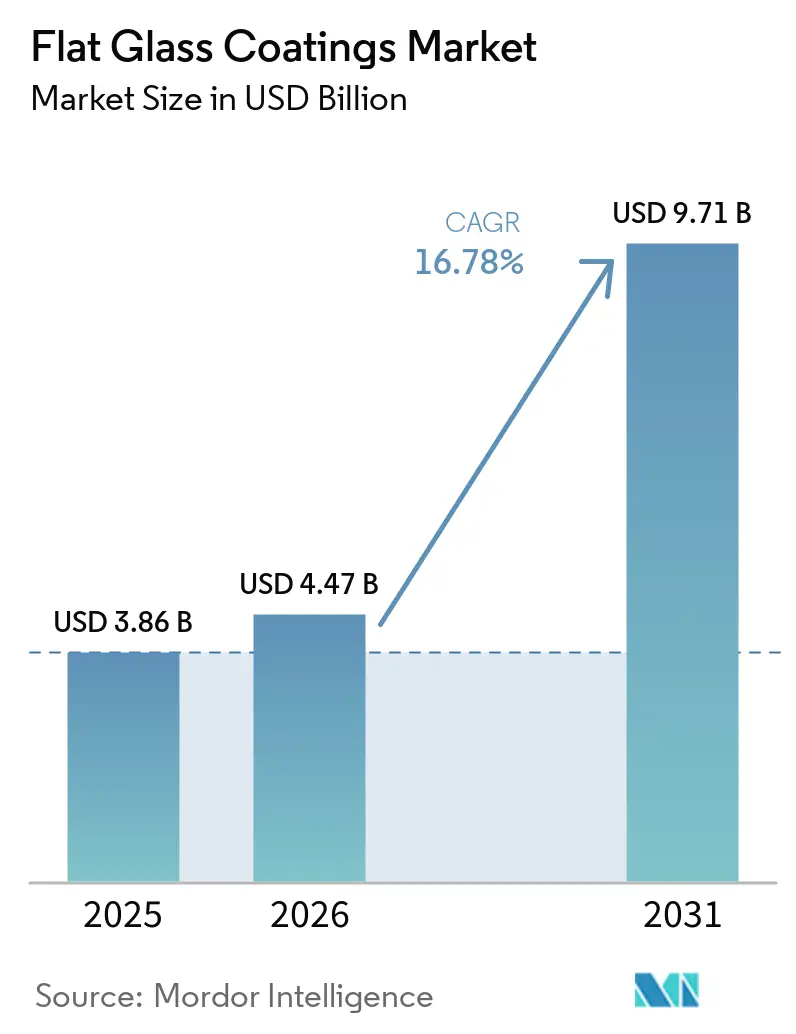
The flat glass coatings market size is expected to increase from USD 3.86 billion in 2025 to USD 4.47 billion in 2026 and reach USD 9.71 billion by 2031, at a CAGR of 16.78% during 2026 and 2031. Energy-efficient construction, solar photovoltaic expansion, and more complex automotive glazing are increasing the demand for functional glass coatings. Buildings account for nearly 30% of global energy demand, which keeps efficient window systems central to building investment decisions[1]. Low-emissivity and solar-control products are positioned to benefit because they support lower energy loss while adding functional value to flat glass. Suppliers are also expanding integrated coating capacity, which can improve control over product quality, throughput, and coating value within the glass supply chain. Silver cost exposure remains an important constraint because low-emissivity stacks depend on silver thin films, and smaller processors have fewer options to manage input-price movements.
Key Report Takeaways
- By resin type, acrylic held 40.72% of the flat glass coatings market share in 2025, while polyurethane recorded the highest projected CAGR at 17.85% through 2031.
- By technology, water-based coatings held 52.17% of revenue share in 2025, while nano coatings technology recorded the highest projected CAGR at 18.43% through 2031.
- By application, mirror coatings held 45.53% of revenue share in 2025, while automotive and transportation recorded the highest projected CAGR at 19.36% through 2031.
- By geography, the Asia Pacific held 56.16% of the revenue share in 2025 and is forecast to grow at a CAGR of 18.62% through 2031.
Note: Market size and forecast figures in this report are generated using Mordor Intelligence’s proprietary estimation framework, updated with the latest available data and insights as of January 2026.
Global Flat Glass Coatings Market Trends and Insights
Drivers Impact Analysis*
| Driver | (~) % Impact on CAGR Forecast | Geographic Relevance | Impact Timeline |
|---|---|---|---|
| Green Building Codes and Energy-Efficient Glazing | +4.5% | Global, with concentrated enforcement in Europe, China, and North America | Medium term (2-4 years) |
| Solar Photovoltaic Expansion and Anti-Reflective Glass Demand | +3.8% | Global, particularly China, India, Europe, and the United States | Medium term (2-4 years) |
| Advanced Automotive Glazing Adoption | +3.2% | Global, concentrated in Asia-Pacific, Europe, and North America | Short term (≤ 2 years) |
| Asia-Pacific Construction and Infrastructure Development | +2.8% | Asia-Pacific core, with spillover to the Middle East | Long term (≥ 4 years) |
| Coating-Line Integration with Glass Manufacturing | +1.8% | Global, with early activity in China, Europe, and Japan | Short term (≤ 2 years) |
| Source: Mordor Intelligence | |||
Green Building Codes and Energy-Efficient Glazing
The flat glass coatings market is supported by building rules that make energy performance a procurement requirement. The revised Energy Performance of Buildings Directive entered into force in May 2024 and requires national implementation by May 2026. This framework favors glazing that can help meet near-zero-emission building standards. The United States Department of Energy states that low-emissivity coatings can reduce energy loss by 30-50% while adding 10-15% to window costs [2]. These economics support flat glass coatings market use in commercial renovation projects where operating costs influence the glazing specification. LEED, BREEAM, and China’s Three-Star system also link building performance to certification outcomes, which gives coated glazing a clearer role in project design.
Solar Photovoltaic Expansion and Anti-Reflective Glass Demand
The flat glass coatings market gains demand from solar modules that use anti-reflective coated glass. The International Energy Agency projects nearly 4,600 GW of renewable capacity additions during 2025-2030, with solar photovoltaic systems representing nearly 80% of that expansion. Anti-reflective front glass affects the amount of sunlight that reaches the photovoltaic cell. Bifacial modules increase the coated area needed because they capture light on both sides of the panel. A 2025 United States patent describes a single-layer broadband coating with super-hydrophilic antifogging and weather stability properties, reducing the need for separate functional layers. China remains a major solar glass production center for the flat glass coatings market, while buyers in other regions are seeking more than one source to reduce supply concentration exposure.
Advanced Automotive Glazing Adoption
The flat glass coatings market benefits from electric vehicles that require larger and more functional glass surfaces. Global electric vehicle sales reached 17.1 million units in 2024. Panoramic roofs on premium electric vehicles can exceed 1 square meter, compared with 0.2-0.3 square meters for conventional sunroofs. This design increases the coated glass area used in each vehicle in the flat glass coatings market. Automotive glazing must also manage solar heat, ultraviolet light, and transparency for advanced driver-assistance sensors. Automotive approval requirements continue to raise the technical baseline for solar-reflective coated laminated windscreens supplied to vehicle manufacturers.
Asia Pacific Construction and Infrastructure Development
The flat glass coatings market is expanding in Asia-Pacific as infrastructure and commercial construction add demand for high-performance glazing. India’s FY2024-25 budget increased infrastructure capital expenditure by more than 11% year over year. Roads, airports, railways, and urban projects create demand for commercial and institutional glass in the flat glass coatings market. India still imports 40-50% of high-performance coated glass used in commercial construction, which leaves room for local coating capacity. China continues to support coated-glass demand through commercial construction, smart-city projects, and new-energy vehicle manufacturing infrastructure.
Restraints Impact Analysis*
| Restraint | (~) % Impact on CAGR Forecast | Geographic Relevance | Impact Timeline |
|---|---|---|---|
| Volatile Raw-Material and Energy Costs | -1.5% | Global, particularly affecting Asia-Pacific manufacturers with limited hedging access | Short term (≤ 2 years) |
| Volatile Organic Compound Restrictions on Solvent-Based Coatings | -1.2% | North America and Europe, with emerging enforcement in China and South Korea | Medium term (2-4 years) |
| Qualification Cycles for Automotive and Solar Applications | -0.9% | Global, with pronounced friction in automotive supply chains in Europe and North America | Medium term (2-4 years) |
| Source: Mordor Intelligence | |||
Volatile Raw-Material and Energy Costs
The flat glass coatings market faces input-cost pressure because silver is a functional thin-film material in magnetron-sputtered low-emissivity stacks. Photovoltaic paste manufacturing used 6,577 tons of silver in 2024, equal to 19% of the global silver supply. Demand from solar manufacturing can therefore raise pressure on the silver used in coating operations. Silica sand, soda ash, titanium dioxide, and metal oxide precursors also affect coating and glass production costs. Glass melting and vacuum sputtering consume substantial energy, making processors sensitive to industrial electricity costs. Smaller regional coaters in the flat glass coatings market are more exposed because fixed-price construction projects can limit their ability to pass through cost increases.
Volatile Organic Compound Restrictions on Solvent-Based Coatings
The flat glass coatings market is affected by tighter controls on volatile organic compounds in coating formulations. The United States Environmental Protection Agency finalized amendments to national volatile organic compound standards for aerosol coatings in January 2025. These rules add to the compliance demands facing solvent-based systems. Water-based products generally require less reformulation to meet stricter limits. Certain mirror backings and automotive coatings still depend on solvent-assisted surface penetration or specialized adhesion performance. Producers serving compliant and less-regulated regions may need dual production lines, increasing inventory and administrative costs.
*Our forecasts treat driver/restraint impacts as directional, not additive. The impact forecasts reflect baseline growth, mix effects, and variable interactions.
Segment Analysis
By Resin Type: Acrylic Provides Volume, While Polyurethane Serves Higher-Performance Uses
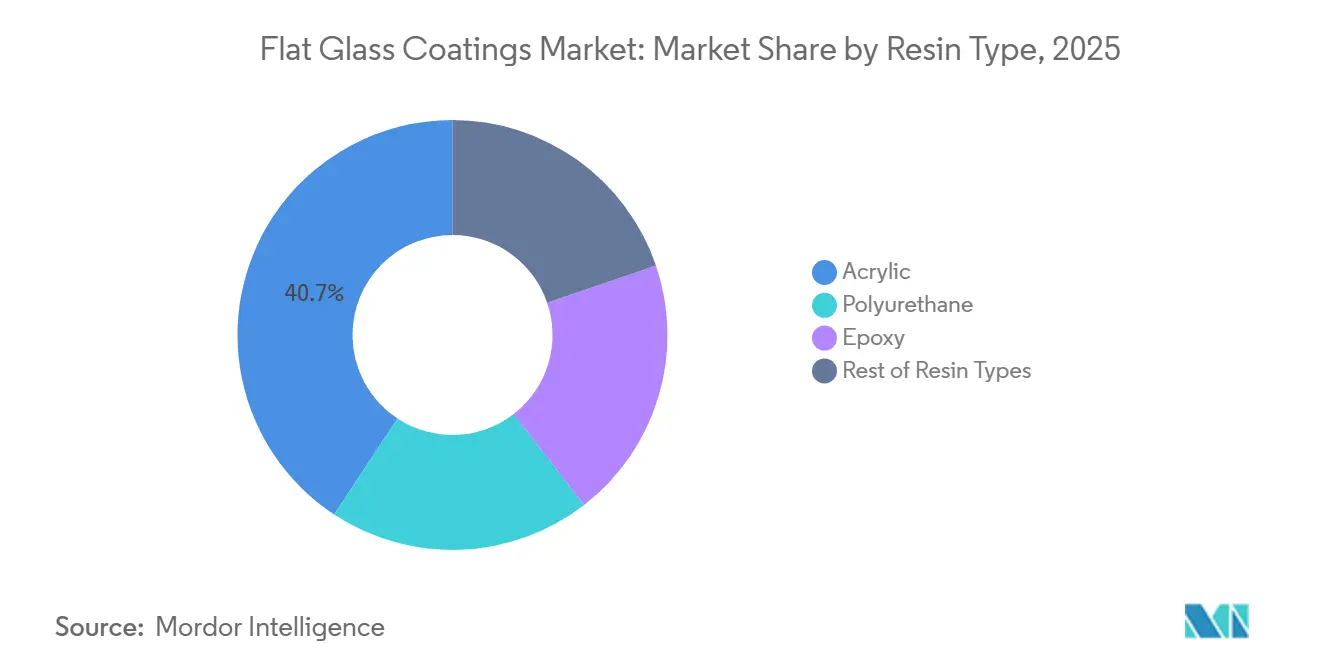
Acrylic held 40.72% of revenue share in 2025, supported by cost efficiency, ultraviolet stability, and compatibility with water-based dispersion systems. It remains widely used for architectural and decorative glass applications that require large volumes. Polyurethane is projected to grow at a CAGR of 17.85% through 2031, the highest rate among resin types. Its balance of flexibility, hardness, and weather resistance supports use in electric vehicle roofs, laminated solar glass, and exterior facade elements. The flat glass coatings industry uses epoxy mainly for mirror edge-sealing and backcoating, where chemical and moisture resistance matter more than flexibility. Epoxy continues to serve industrial and solar applications, although it remains a smaller part of the resin mix.
Other resin types include alkyd, polyester, and hybrid sol-gel chemistries. These materials are used in multifunctional products that combine thermochromic or electrochromic properties with the resin matrix. A 2026 AIChE Journal study reported a waterborne transparent anti-smudge coating using nano-silica sol and polymer nanoparticles for self-cleaning and passive radiative cooling. Such material development supports applications where conventional acrylic or polyurethane chemistry does not deliver all required functions. Waterborne 2-component polyurethane systems are becoming more relevant as suppliers respond to volatile organic compound requirements. This shift can reduce the cost difference with acrylic in premium automotive and architectural specifications. The flat glass coatings market, therefore, retains acrylic for broad-volume uses while polyurethane gains relevance in applications where performance conditions are more demanding.

By Technology: Water-Based Coatings Lead While Nano Coatings Gain Momentum
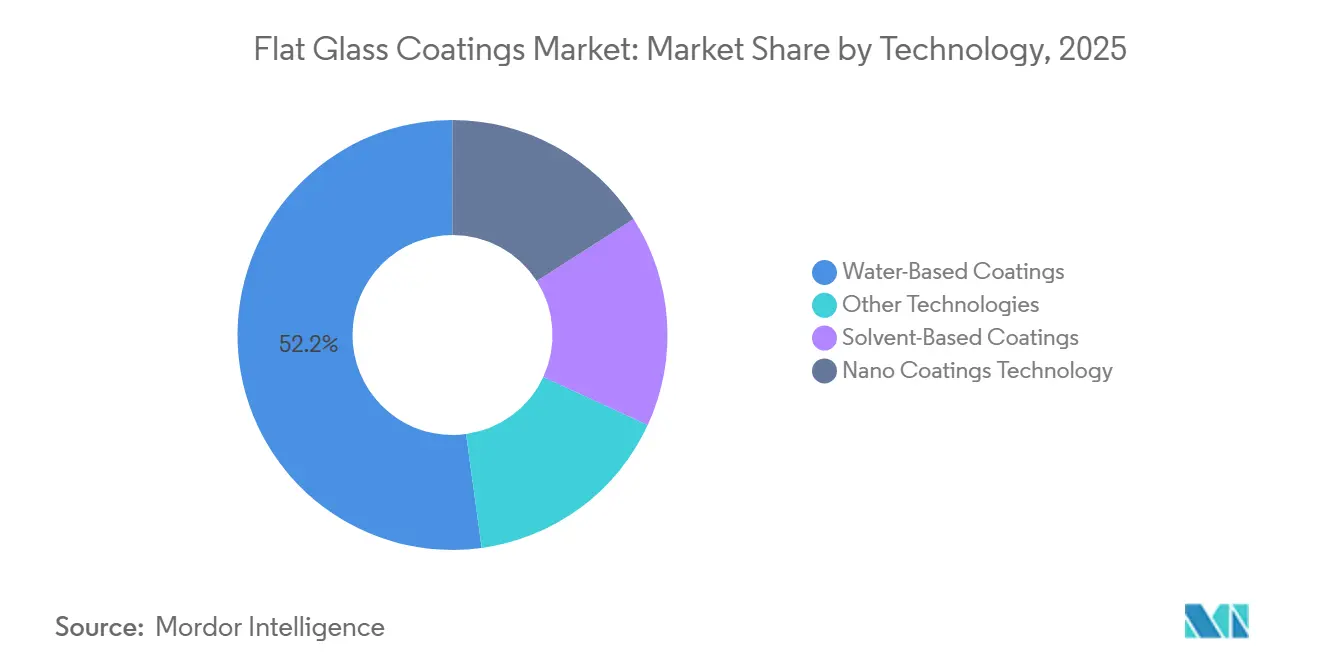
Water-based coatings held 52.17% of the revenue share in 2025. Their position reflects tightening environmental requirements that discourage high-volatile-organic-compound formulations in regulated regions. These coatings work with many architectural glass processes and commonly used equipment. They also support green-building certification requirements that influence commercial procurement. Solvent-based coatings remain relevant for specialized mirror backing, industrial applications, and substrates requiring solvent-assisted adhesion. However, their use is under pressure as compliance costs rise and manufacturers manage separate production systems.
Nano coatings technology is projected to expand at a CAGR of 18.43% through 2031, the fastest rate across the technology categories. The technology supports anti-reflective, self-cleaning, anti-fog, water-repellent, and heat-rejection functions that standard coating systems may not provide together. Current deployment is concentrated in solar photovoltaic glass, high-end facades, and automotive glass. A 2026 study in Nanotechnology demonstrated roll-to-roll ultraviolet nanoimprint lithography for replicating moth-eye antireflective structures on large areas. This approach addresses a production-scale barrier for antireflective nanostructures. Other technologies, including plasma-enhanced chemical vapor deposition and physical vapor deposition variants, remain relevant in high-specification uses but require significant capital investment. The flat glass coatings market benefits from water-based products at scale, while nano coating systems address applications with more specialized performance requirements.
By Application: Mirror Coatings Lead Current Demand While Automotive and Transportation Grow Fastest
Mirror coatings held 45.53% of the revenue share in 2025. Their scale reflects the broad installed base of coated float glass used in architectural interiors, bathrooms, retail settings, and hospitality properties. Replacement demand supports continued consumption across these end uses. Solar power applications rise with photovoltaic installations and require anti-reflective glass that directs more light toward cells. Bifacial module adoption increases coated-glass needs per panel because both glass surfaces can contribute to energy capture. Architectural applications include low-emissivity, solar-control, and anti-reflective coatings used in commercial and institutional facades.
Automotive and transportation is projected to expand at a CAGR of 19.36% through 2031, the highest among applications in the flat glass coatings market. Electric vehicle design is increasing the glass area used in the roof and cabin systems. A panoramic roof can exceed 1 square meter per vehicle, compared with 0.2-0.3 square meters for a conventional sunroof. This raises coating value per vehicle without requiring a proportional increase in vehicle production. Automotive approval requirements define performance expectations for solar-reflective coated laminated windscreens. Decorative uses continue to serve hospitality, retail, and residential demand. Other applications include electronics displays and transportation uses beyond road vehicles.
Geography Analysis
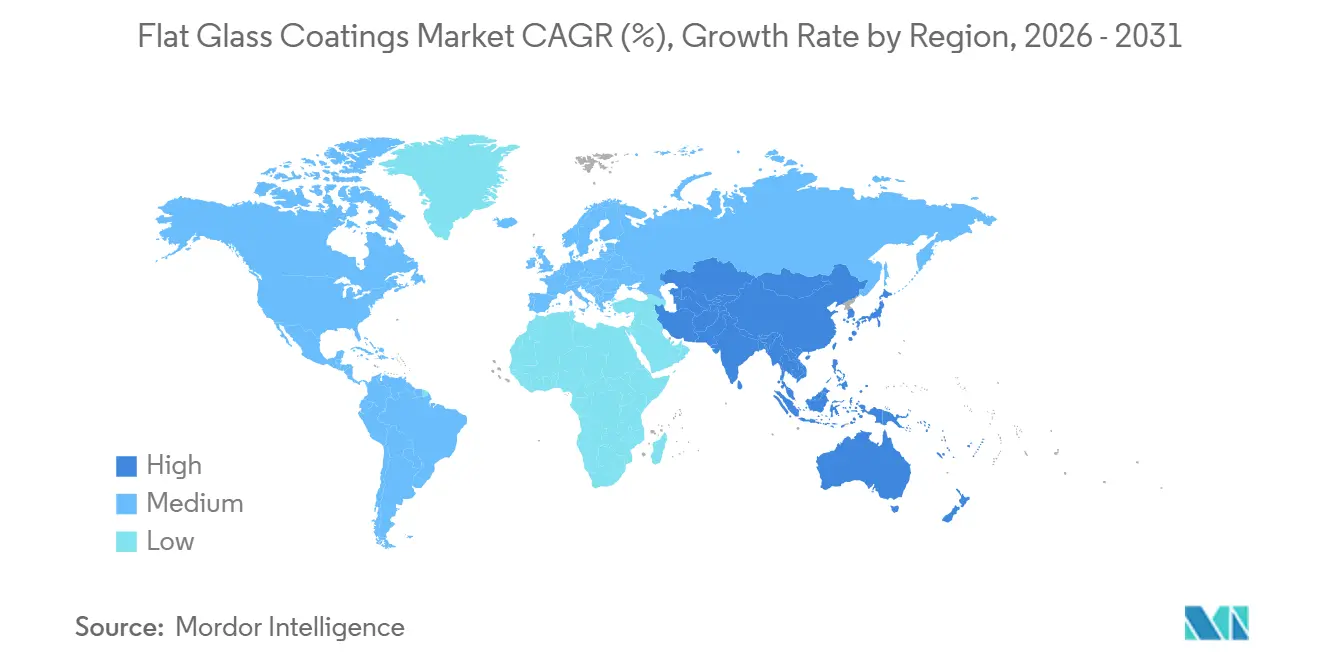
Asia Pacific held 56.16% of the flat glass coatings market share in 2025 and is projected to grow at a CAGR of 18.62% through 2031. China supports regional demand through its large flat-glass manufacturing base, electric vehicle production, and photovoltaic pipeline. The country’s building rules and commercial construction activity also increase demand for coated glazing. India’s FY2024-25 infrastructure capital expenditure increased by more than 11% year over year. This supports demand from transportation, urban development, and commercial projects, while imports of high-performance coated glass create an opening for local manufacturing investment.
North America is the 2nd-largest regional market in the flat glass coatings market. Demand comes from energy-efficient facade requirements, tighter volatile organic compound rules, and commercial renovation activity. The United States Department of Energy identifies window coatings as a measure that can reduce energy loss by 30-50%. Canada’s energy-code updates support high-performance glazing, while Mexico’s automotive manufacturing base supports demand for coated automotive glass. The shift from single-pane windows to insulating glass units can increase the number of coated surfaces within a replacement window assembly.
Europe is the 3rd-largest regional position, with Germany supported by automotive manufacturing, industrial glazing requirements, and low-emissivity architectural glass demand. The European Union’s revised buildings directive strengthens the policy basis for energy-efficient glazing, while NSG Group is investing PLN 160 million in its Sandomierz sputtering line for production scheduled in Q1 2027. South America, the Middle East, and Africa are smaller regions in the flat glass coatings market. Brazil’s construction activity and Saudi Arabia’s large building projects support demand for solar-control coatings in high-solar-load settings.
Competitive Landscape
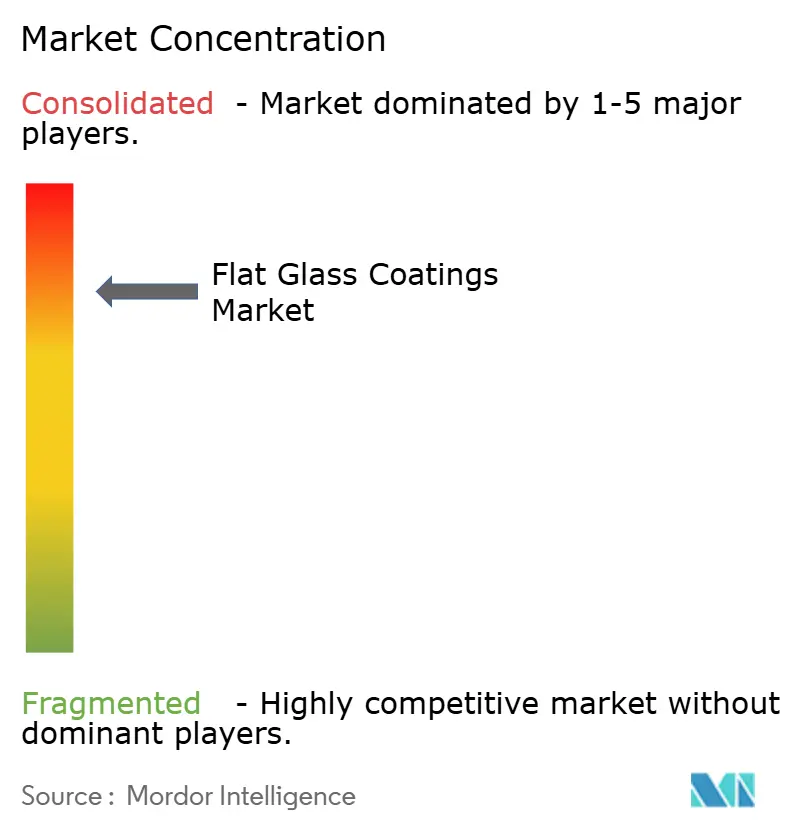
The flat glass coatings market is moderately consolidated, with the 5 leading companies holding 80% of global revenue in 2025. Guardian Glass, NSG Group, The Sherwin-Williams Company, Fenzi Group, and Ferro Corporation form the leading group, while regional coating specialists, nanotechnology entrants, and integrated glass makers compete across the remaining application niches. The leading suppliers are pursuing vertical integration into materials or glass fabrication and expanding into nano coatings and electric vehicle-grade formulations. NSG Group’s PLN 160 million investment in an automated sputtering line in Poland is a direct move to expand advanced coating capacity for European demand. The line is scheduled to begin production in Q1 2027.
Competition also centers on environmentally improved mirror systems and circular approaches that reduce dependence on primary silver. Fenzi Group presented its mirror coating and insulating-glass sealant portfolio through Fenzi China Paints and Sealants at China Glass 2026. This move reflects the value of tailored regional offerings for Chinese fabricators. Chinese nano-coating specialists are scaling porous silica sol-gel anti-reflective coatings for solar glass, increasing pressure on established suppliers that serve those applications. Suppliers with established technology, local service networks, and production capacity are better placed to meet demanding project specifications.
Intellectual property remains relevant in solar-control and antireflective coating development, and Guardian Glass filed WO2026083269A1 in April 2026 for an antireflective coated article intended to reduce the use of high-index dielectric layers. The design may reduce processing requirements for low-reflectivity glass. Vitro received U.S. Patents 12560747 and 12623959 in 2025 for solar-control coating designs that use nickel-chromium alloy multilayer structures. These filings show continued investment in differentiated solar-control products.
Flat Glass Coatings Industry Leaders
-
PPG Industries, Inc.
-
Guardian Industries, LLC
-
Nippon Sheet Glass Co., Ltd.
-
The Sherwin-Williams Company
-
FENZI S.p.A
- *Disclaimer: Major Players sorted in no particular order
Recent Industry Developments
- June 2026: Apollo Funds announced a definitive agreement to acquire NSG Group (Nippon Sheet Glass) in a transaction valued at approximately USD 3.7 billion in enterprise value, Apollo's largest private equity investment in Japan to date. The deal is expected to accelerate capital investment in coating technology modernization and architectural glass capacity under private ownership.
- September 2025: NSG Group announced a PLN 160 million (USD 43.7 million) investment in a fully automated sputtering coating line at its Pilkington Polska facility in Sandomierz, Poland, targeting production commencement in Q1 2027 and serving growing European architectural glass demand ahead of EPBD national implementation deadlines.
Global Flat Glass Coatings Market Report Scope
Flat Glass Coatings are specialized coatings applied to flat glass surfaces to enhance properties such as thermal insulation, solar control, light transmission, reflectivity, durability, scratch resistance, and aesthetic appearance. They are commonly applied to architectural, automotive, solar, and other industrial flat glass products.
The Flat Glass Coatings Market is segmented by resin type, technology, application, and geography. By resin type, the market is segmented into acrylic, polyurethane, epoxy, and rest of resin types. By technology, the market is segmented into water-based coatings, solvent-based coatings, nano coatings technology, and other technologies. By application, the market is segmented into mirror coatings, solar power, architectural, automotive and transportation, decorative, and other applications. By geography, the market is segmented into Asia Pacific, North America, Europe, South America, the Middle East and Africa. The report also covers the flat glass coatings market size and forecasts for the flat glass coatings market in 15 countries across major regions. For each segment, the market sizing and forecasts have been done on the basis of value (USD).
| Acrylic |
| Polyurethane |
| Epoxy |
| Rest of Resin Types |
| Water-Based Coatings |
| Solvent-Based Coatings |
| Nano Coatings Technology |
| Other Technologies |
| Mirror Coatings |
| Solar Power |
| Architectural |
| Automotive and Transportation |
| Decorative |
| Other Applications |
| Asia-Pacific | China |
| India | |
| Japan | |
| South Korea | |
| ASEAN Countries | |
| Rest of Asia-Pacific | |
| North America | United States |
| Canada | |
| Mexico | |
| Europe | Germany |
| United Kingdom | |
| France | |
| Italy | |
| NORDIC Countries | |
| Rest of Europe | |
| South America | Brazil |
| Argentina | |
| Rest of South America | |
| Middle East and Africa | Saudi Arabia |
| South Africa | |
| Rest of Middle East and Africa |
| By Resin Type | Acrylic | |
| Polyurethane | ||
| Epoxy | ||
| Rest of Resin Types | ||
| By Technology | Water-Based Coatings | |
| Solvent-Based Coatings | ||
| Nano Coatings Technology | ||
| Other Technologies | ||
| By Application | Mirror Coatings | |
| Solar Power | ||
| Architectural | ||
| Automotive and Transportation | ||
| Decorative | ||
| Other Applications | ||
| By Geography | Asia-Pacific | China |
| India | ||
| Japan | ||
| South Korea | ||
| ASEAN Countries | ||
| Rest of Asia-Pacific | ||
| North America | United States | |
| Canada | ||
| Mexico | ||
| Europe | Germany | |
| United Kingdom | ||
| France | ||
| Italy | ||
| NORDIC Countries | ||
| Rest of Europe | ||
| South America | Brazil | |
| Argentina | ||
| Rest of South America | ||
| Middle East and Africa | Saudi Arabia | |
| South Africa | ||
| Rest of Middle East and Africa | ||
Key Questions Answered in the Report
What is the present and forecasted market size of flat glass coatings market?
The flat glass coatings market is projected to increase from USD 4.47 billion in 2026 to USD 9.71 billion by 2031, registering a 16.78% CAGR. Demand is supported by building efficiency requirements, solar photovoltaic glass, and more complex automotive glazing. Coating suppliers are also increasing capacity to serve higher-value glazing specifications.
Which resin type led flat glass coatings revenue?
Acrylic led the resin mix with a 40.72% share in 2025. Polyurethane is projected to grow fastest at a 17.85% CAGR through 2031 because it is suited to weather-resistant automotive, solar, and facade uses. Epoxy remains relevant in mirror edge-sealing and backcoating where moisture resistance is required.
Which coating technology is growing fastest?
Nano coatings technology is projected to grow at a 18.43% CAGR through 2031. It supports anti-reflective, anti-fog, self-cleaning, water-repellent, and heat-rejection functions in solar, architectural, and automotive glass. Water-based coatings remained the leading technology category with a 52.17% share in 2025.
Which region leads demand for flat glass coatings?
Asia-Pacific led with 56.16% share in 2025 and is projected to grow at an 18.62% CAGR through 2031. China’s glass manufacturing, solar production, and electric vehicle activity support the region’s scale. India’s infrastructure development and imported high-performance glass needs support additional regional demand.