
Size and Share of Offline Coated Glass Market For Building Application
Market Overview
| Study Period | 2022 - 2032 |
|---|---|
| Market Volume (2027) | 0.7 Billion square meters |
| Market Volume (2032) | 1.01 Billion square meters |
| Growth Rate (2027 - 2032) | 7.73 % |
| Fastest Growing Market | Asia-Pacific |
| Largest Market | Asia-Pacific |
| Market Concentration | Medium |
Major Players *Disclaimer: Major Players sorted in no particular order Image © Mordor Intelligence. Reuse requires attribution under CC BY 4.0. | |
Analysis of Offline Coated Glass Market For Building Application by Mordor Intelligence
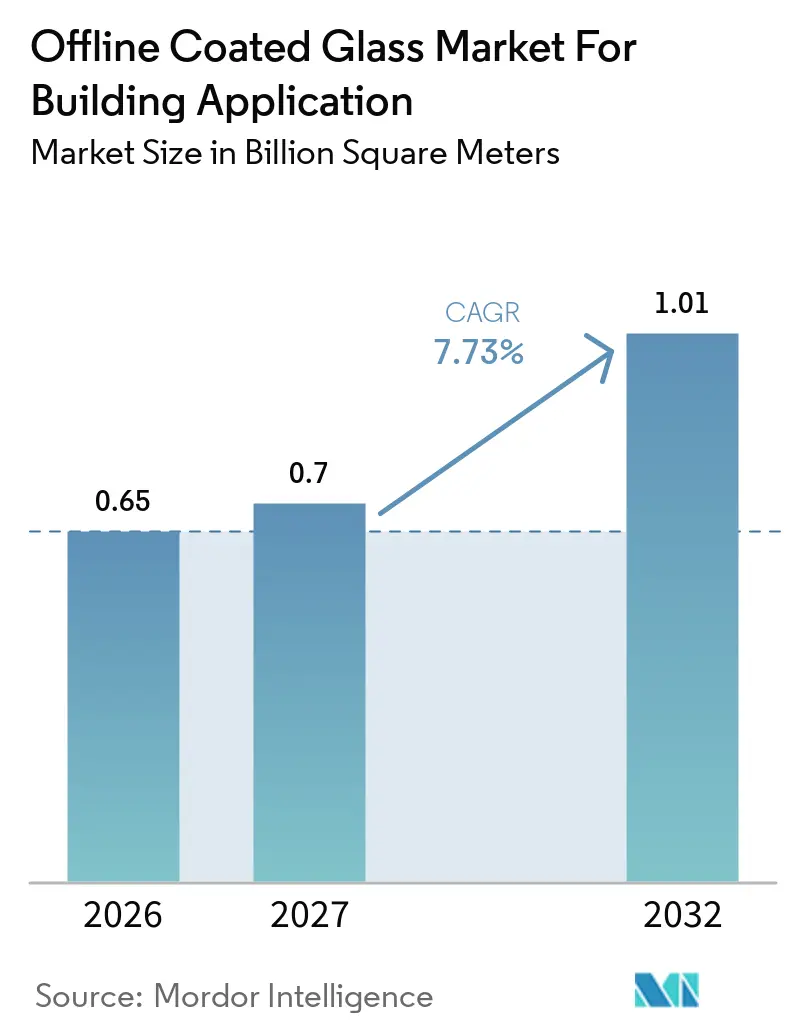
The Offline Coated Glass Market for Building Applications was estimated at 0.65 billion square meters in 2026 and is projected to grow from 0.70 billion square meters in 2027 to 1.01 billion square meters by 2032, at a CAGR of 7.73% during the forecast period (2027-2032). The offline coated glass market for building applications is supported by magnetron sputtering vacuum deposition (MSVD), which applies precise multilayer silver stacks to cold float glass under high vacuum. This process delivers emissivity and solar heat gain performance that pyrolytic coatings cannot match at comparable thicknesses. Energy regulations in North America, Europe, and Asia-Pacific set U-value and solar heat gain targets that support demand for this product. As a result, offline-coated glass for building applications has shifted from a premium specification to a compliance-driven purchase on many projects. Renovation activity, stricter building standards, and broader use of higher-performance glazing in commercial facades further support demand.
Key Report Takeaways
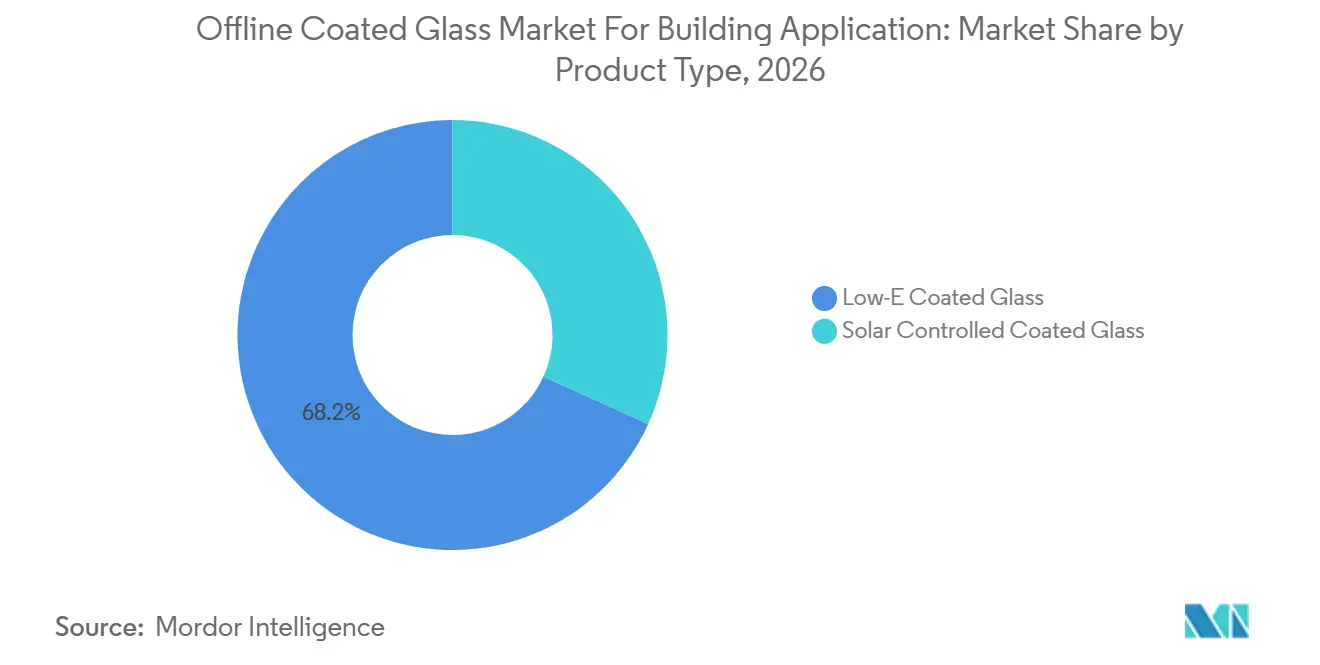
- By product type, Low-E coated glass held 68.21% of the market share in 2026, while solar-controlled coated glass is projected to grow at an 8.34% CAGR through 2032.
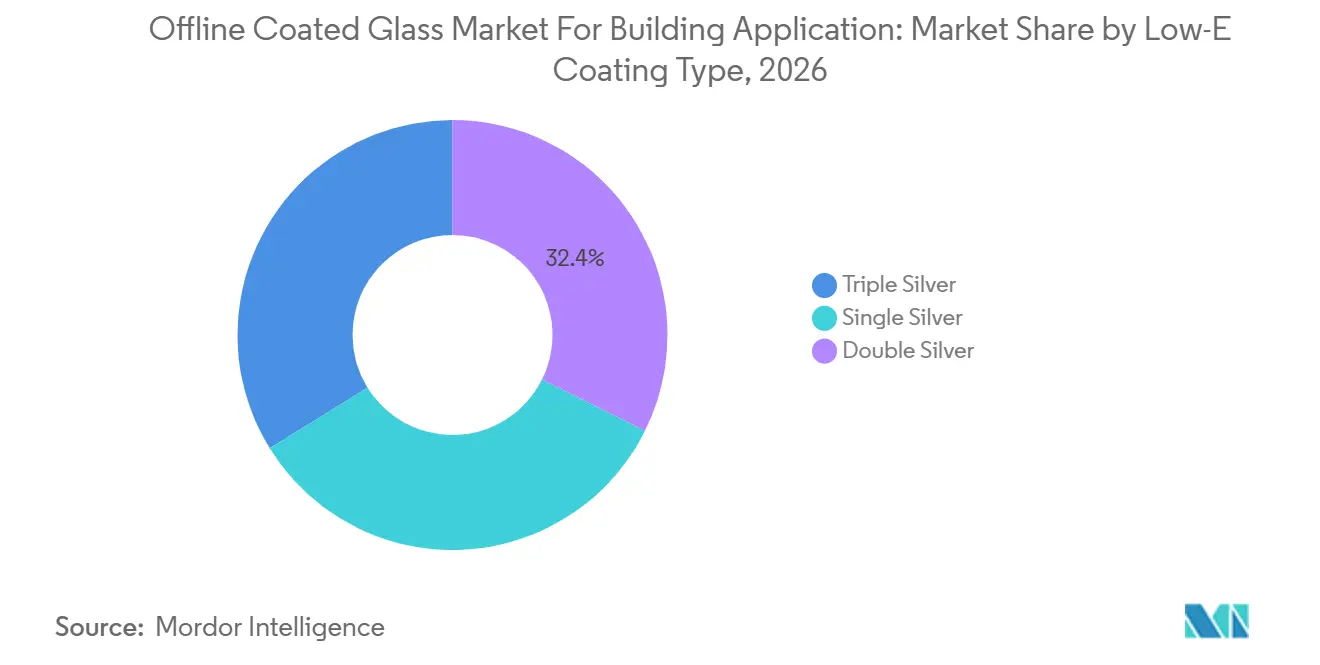
- By Low-E coating type, double silver held 32.35% of the market share in 2026, while triple silver is projected to grow at an 8.77% CAGR through 2032.
- By geography, Asia-Pacific held 45.78% of the market share in 2026 and is projected to grow at an 8.62% CAGR through 2032.
Note: Market numbers in this report are based on Mordor Intelligence's proprietary estimation framework, which combines nine months of actuals with Q4 projections for base year 2026.
Insights and Trends of Offline Coated Glass Market For Building Application
Drivers Impact Analysis*
| Drivers | (~) % Impact on CAGR Forecast | Geographic Relevance | Impact Timeline |
|---|---|---|---|
| Tightening Building-Envelope Energy Codes | +2.0% | Global, strongest in North America, Europe, and China | Short term (≤ 2 years) |
| Commercial Retrofit and Net-Zero Renovation Demand | +1.5% | EU core, with effects in North America and selected Asia-Pacific countries | Medium term (2-4 years) |
| Growth of Double-Silver and Triple-Silver Performance Glazing | +1.2% | Global | Medium term (2-4 years) |
| Expansion of Energy-Efficient Construction in Asia-Pacific | +1.8% | Asia-Pacific, especially China, India, and ASEAN, with effects in the Middle East and Africa | Short-term (≤ 2 years) and medium-term (2-4 years) |
| Jumbo-Format Magnetron Sputtered Vacuum Deposition (MSVD) and Optical Stack Optimization | +0.8% | Global, led by commercial high-rise construction | Medium term (2-4 years) and Long term (≥ 4 years) |
| Source: Mordor Intelligence | |||
Tightening Building-Envelope Energy Codes
Regulatory alignment across major construction markets is a central driver of demand for offline coated glass in building applications. The 2024 International Energy Conservation Code tightened prescriptive fenestration U-factor requirements to 0.30 W/m²K for Climate Zones 5-8, a threshold that hard-coat insulating glass units can struggle to meet without additional measures. California's 2025 Building Energy Efficiency Standards, effective January 1, 2026, set U-factors as low as 0.30 in coastal zones and a universal maximum of 0.40. The revised Energy Performance of Buildings Directive requires EU countries to transpose its provisions by May 2026 and directs the renovation of the 16% worst-performing nonresidential buildings by 2030. The European Commission's guidance identifies replacement of outdated glazing with high-performance alternatives to improve U-values and g-values. These requirements increase the importance of coating performance in project specifications and reduce the scope for unverified alternatives.
Commercial Retrofit and Net-Zero Renovation Demand
Older commercial buildings create a renovation pipeline that supports the offline coated glass market for building applications beyond a single new-construction cycle. European Commission data indicate that 85% of EU buildings were built before 2000, and 75% have poor energy performance. This building stock has a significant need for envelope improvements, including window and facade replacements. Japan's Xenobe project, completed in March 2025, received Zero Energy Building (ZEB) Ready certification for a 57-year-old commercial building[1]. The project projected an annual CO₂ reduction of 58%, or 137 metric tons, through building-envelope work, including glazing upgrades. Retrofit projects provide a steadier source of orders than new residential construction, as building owners must address operating efficiency and asset requirements even during weaker construction periods.
Growth of Double-Silver and Triple-Silver Performance Glazing
The shift from single-silver to multilayer-silver architectures is changing the product mix in the offline coated glass market for building applications. Triple-silver coatings combine low infrared transmission with usable visible light transmission, making them suitable for demanding facade designs. CSG Glass reports infrared transmittance below 0.06 gIR for its triple-silver Low-Emissivity (Low-E) products. This performance helps buildings control heat gain without relying on deeply reflective tinted glass. Higher-performance coatings also suit projects that require low U-values and low solar heat gain simultaneously. The resulting product premium can partly offset exposure to silver costs and encourage producers to shift coating capacity toward double-silver and triple-silver products.
Expansion of Energy-Efficient Construction in Asia-Pacific
Construction regulations in Asia-Pacific are increasingly defining material performance with greater precision. China's updated Green Building Materials Assessment Standard for windows and doors took effect on February 1, 2026, introducing stricter performance parameters for fenestration in certified green buildings. India's Energy Conservation Building Code is being adopted by smaller commercial and mixed-use developments, broadening the addressable market for efficient glazing. Research by Asahi India Glass examined large-area magnetron sputtering for heat-reflective solar-control coatings used on architectural facade glass. The work evaluated coatings against the ISO 9050, National Fenestration Rating Council (NFRC), and EN 410 standards, indicating a regional focus on verified optical performance. These conditions support the offline coated glass market for building applications in China, India, and ASEAN, as builders place greater emphasis on solar control and energy efficiency.
Restraints Impact Analysis*
| Restraints | (~) % Impact on CAGR Forecast | Geographic Relevance | Impact Timeline |
|---|---|---|---|
| High Capital Intensity of Vacuum-Coating Lines | -1.5% | Global, most restrictive for emerging-market entrants | Long term (≥ 4 years) |
| Volatility in Silver, Indium, Tin, and Energy Costs | -1.0% | Global, most acute where the local silver and indium supply is limited | Short term (≤ 2 years) |
| Pre-Tempering Oxidation and Handling Sensitivity | -0.5% | Global, most pronounced where logistics chains are long | Medium term (2-4 years) |
| Source: Mordor Intelligence | |||
High Capital Intensity of Vacuum-Coating Lines
Magnetron Sputtered Vacuum Deposition (MSVD) equipment represents a capital-intensive segment of the flat-glass value chain. Coating lines carry substantial fixed costs and demanding technical requirements, making high utilization essential. The need to maintain throughput makes it difficult for smaller regional processors to enter the market without secured contract volume. Established suppliers can distribute output across multiple countries and product tiers and integrate float-glass production, coating, processing, and customer-specification support. This structure favors integrated participants and sustains barriers to entry in the offline-coated glass market for building applications.
Volatility in Silver, Indium, Tin, and Energy Costs
Silver, indium, tin, and energy costs present ongoing margin risks for producers and processors. Silver serves as the infrared-reflective layer in Low-E coatings, meaning price fluctuations directly affect coating input costs. Indium, used in certain dielectric oxide layers, adds exposure to constrained supply chains. MSVD lines require sustained operation in a vacuum chamber at high electrical loads, making utility-rate changes a significant factor in unit processing costs, particularly for non-integrated processors. Pre-tempering oxidation of silver layers shortens handling windows and adds logistics requirements, which can disadvantage fabricators with longer delivery chains.
*Our forecasts treat driver/restraint impacts as directional, not additive. The impact forecasts reflect baseline growth, mix effects, and variable interactions.
Segment Analysis
By Product Type: Low-E Coatings, Anchor Commercial Specification Globally
Low-E-coated glass accounted for 68.21% of the offline coated glass market share for building applications in 2026. This reflects its broad use in insulating glass units for commercial facades and residential windows across climate zones. The 2024 International Energy Conservation Code (IECC) and ASHRAE compliance pathways strengthen the case for soft-coat Low-E products in many U.S. double-pane applications, as these rules favor products that can meet prescribed thermal performance within a standard insulating glass configuration. National Fenestration Rating Council (NFRC) performance documentation also supports traceability for code-compliant permits, which can favor established suppliers with certified test data and reliable coating quality.
Solar-controlled coated glass has the highest projected growth within this segment, at an 8.34% CAGR during 2027-2032. The offline coated glass market for this application is expanding, with reduced solar heat gain as the primary design requirement. Typical uses include hot-climate high-rise facades, airport terminals, and commercial canopies. Research by Asahi India Glass found that large-area magnetron-sputtered solar-control coatings can provide solar heat reduction and color neutrality for facade applications[2]. Demand is particularly relevant in ASEAN and Gulf markets, where cooling loads are significant, and daylight access remains important. The segment also benefits from solar heat gain limits, which make reflective and tinted glazing less attractive for some projects.

By Low-E Coating Type: Triple Silver Rewrites the Premium Glass Economics
Double silver held 32.35% of the Low-E coating type segment in 2026. It remains the volume base of MSVD output because it offers better U-values and solar control than single silver at a more manageable cost premium, making it a common choice in mid-tier commercial projects and residential double-pane replacement programs. Single silver continues to serve cost-sensitive housing and temperate climates where local regulations have less demanding thermal requirements. Its role is more limited in projects where standards require very low U-values and solar heat gain coefficients. The offline coated glass market for building applications is therefore gradually shifting toward products with more advanced silver stacks.
Triple silver is the fastest-growing coating type, with an 8.77% CAGR from 2027 to 2032. The offline coated glass market for triple silver is growing as premium projects seek low U-values, low solar heat gain, and high visible light transmission simultaneously. CSG Glass identifies triple-silver products with infrared transmittance below 0.06 gIR. This configuration meets net-zero building specifications and high-performance curtain walls, where substantial daylight loss is unacceptable. It also supports better price realization than lower-performance coatings when buyers prioritize verified envelope outcomes. Regulatory changes continue to narrow the conditions under which single silver alone can meet building requirements.
Geography Analysis
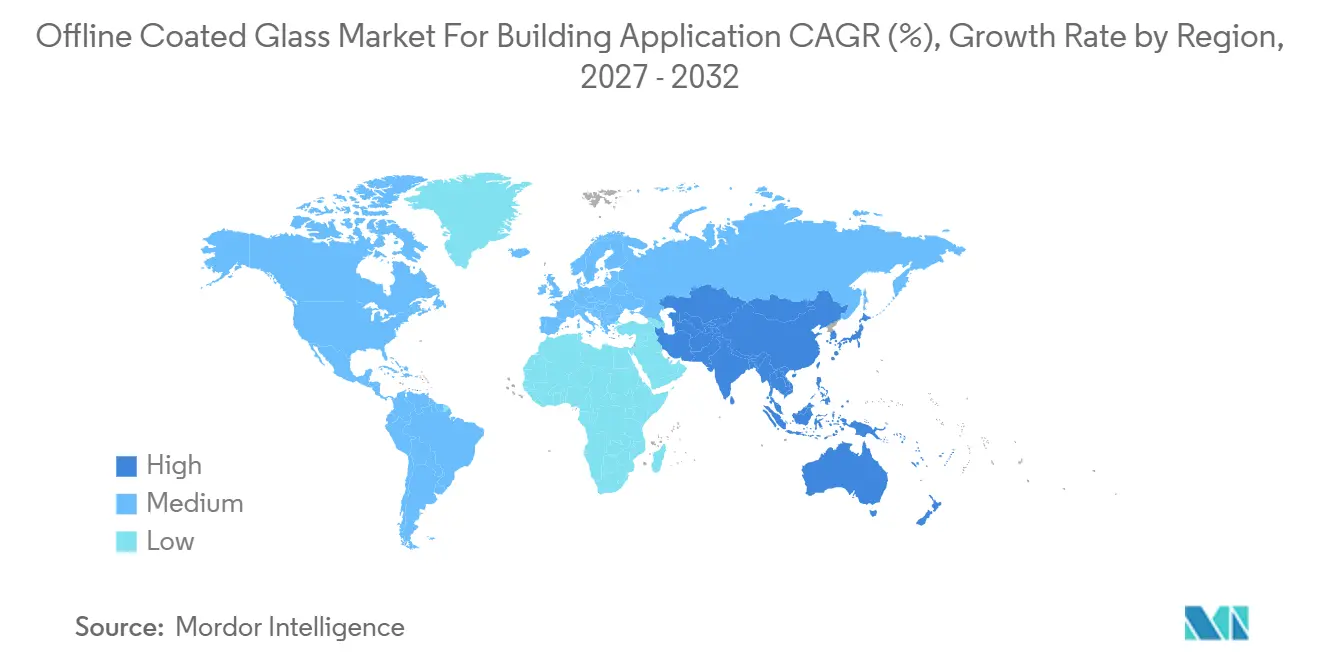
Asia-Pacific held 45.78% of the offline coated glass market share for building applications in 2026 and is projected to grow at an 8.62% CAGR during 2027-2032. China's tightening green-building standards are raising material and fenestration performance requirements, supporting higher-quality coated glass specifications. India is an important demand center, as the Energy Conservation Building Code is being extended to smaller commercial and mixed-use developments. Growth in premium housing and commercial real estate is also expanding the use of Low-E glazing. Japan contributes through retrofit activity and its Zero Energy Building (ZEB) Ready pathway, with the Xenobe renovation serving as an example of a certified upgrade of an older commercial building.
North America and Europe have mature regulatory environments for the offline coated glass market in building applications. The 2024 International Energy Conservation Code (IECC) adoption cycle has strengthened demand for soft-coat products in U.S. construction and replacement work. California's 2025 standards tighten prescriptive thermal requirements for permits filed on or after January 1, 2026. In Europe, the Energy Performance of Buildings Directive (EPBD) targets low-performing nonresidential buildings and renovation measures. The high proportion of inefficient EU building stock supports demand for facade and window upgrades. Nordic markets maintain a high-performance baseline, where double-silver and triple-silver products meet established cold-climate specifications.
South America, the Middle East, and Africa represent smaller but growing areas of demand. Brazil supports demand through commercial projects that use green-building specifications. Gulf markets require solar-control products due to high cooling requirements and widespread use of facade glazing. Supply availability and delivery time remain important purchasing factors in these regions. Producers that can provide dependable coated lites may improve their position with fabricators that have limited local sourcing options. The offline coated glass market for building applications therefore has an opportunity to expand in markets where project specifications advance faster than local coating capacity.
Competitive Landscape
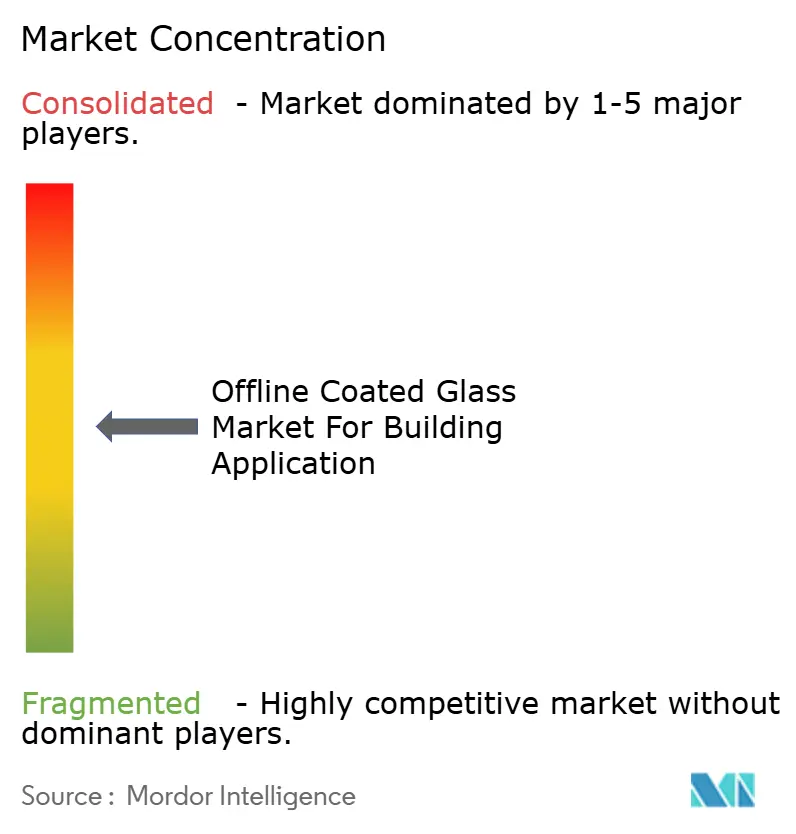
The offline coated glass market for building applications is moderately fragmented. AGC Inc., Saint-Gobain, and Guardian Industries operate globally through integrated float-glass and coated-glass manufacturing, with established relationships with major facade contractors and specification channels. Xinyi Glass, CSG Holding, Şişecam, and Jinjing Group compete on a regional scale, with lower manufacturing costs and expanding multilayer-coating capability. These suppliers have different geographic strengths but share technical expertise in coating stacks and quality control. Market concentration is discussed after the citation list, as no combined player-share figure is available.
Competition is moving beyond basic production capacity. Jumbo-format MSVD equipment serves architectural projects requiring uninterrupted curtain-wall panels and large high-rise facades. Larger substrates reduce visible interruptions from mullions and create opportunities in premium building design. Optical stack design is also a competitive factor, as architects require neutral color, controlled solar gain, and adequate daylight simultaneously. Research into selective solar-control coatings reflects the importance of coating design over output volume alone. These factors make technical capability relevant to competition in the offline coated glass market for building applications.
Integrated producers are positioned to manage commodity exposure and handling requirements. Their scale supports sourcing, coating, processing, and regional delivery within a single operating network. Smaller processors face greater pressure when silver or energy costs rise, or when coated glass requires fast handling before tempering. The need to maintain coating quality during transport reinforces the value of a reliable local supply. Growth opportunities remain in South America and Sub-Saharan Africa, where MSVD sourcing is limited. The competitive balance is likely to depend on delivered performance, supply reliability, and the ability to meet code-based product specifications.
Leaders of Offline Coated Glass Market For Building Application
-
Saint-Gobain
-
AGC Inc.
-
Guardian Industries
-
Nippon Sheet Glass Co., Ltd.
-
Vitro, S.A.B. de C.V.
- *Disclaimer: Major Players sorted in no particular order
Recent Industry Developments
- August 2026: AGC Glass Europe announced an investment to upgrade its magnetron coater at Lodelinsart, Belgium. The upgrade, operational by Q3 2026, extends the plant's coated glass range to new high-performance architectures and improves manufacturing flexibility for complex multi-layer coated products. AGC describes Lodelinsart as a recognized source of silver-based low-emissivity and solar-control coatings.
- June 2026: June 2026 – Şişecam commissioned its 7 million square meters per year coated glass line in Tarsus, Mersin, bringing its global coated glass capacity to 48.1 million square meters across 7 production lines, with a focus on European architectural glass demand.
Scope of Report on Offline Coated Glass Market For Building Application
Offline coated glass is a type of architectural glass in which metallic and metal-oxide films are applied to the glass surface after the float glass manufacturing process is complete, typically using a vacuum magnetron sputtering (PVD) method.
The offline coated glass market for building applications is segmented by product type, low-E coating type, and geography. By product type, the market is segmented into solar-controlled coated glass and low-E coated glass. By low-E coating type, the market is segmented into single silver, double silver, and triple silver. The report also covers the market size and forecasts for offline coated glass for building applications in 15 countries across major regions. The market sizes and forecasts are provided in terms of Volume (Square Meters).
| Solar-Controlled Coated Glass |
| Low-E Coated Glass |
| Single Silver |
| Double Silver |
| Triple Silver |
| Asia-Pacific | China |
| India | |
| Japan | |
| South Korea | |
| ASEAN Countries | |
| Rest of Asia-Pacific | |
| North America | United States |
| Canada | |
| Mexico | |
| Europe | Germany |
| United Kingdom | |
| France | |
| Italy | |
| NORDIC Countries | |
| Rest of Europe | |
| South America | Brazil |
| Argentina | |
| Rest of South America | |
| Middle East and Africa | Saudi Arabia |
| South Africa | |
| Rest of Middle East and Africa |
| By Product Type | Solar-Controlled Coated Glass | |
| Low-E Coated Glass | ||
| By Low-E Coating Type | Single Silver | |
| Double Silver | ||
| Triple Silver | ||
| By Geography | Asia-Pacific | China |
| India | ||
| Japan | ||
| South Korea | ||
| ASEAN Countries | ||
| Rest of Asia-Pacific | ||
| North America | United States | |
| Canada | ||
| Mexico | ||
| Europe | Germany | |
| United Kingdom | ||
| France | ||
| Italy | ||
| NORDIC Countries | ||
| Rest of Europe | ||
| South America | Brazil | |
| Argentina | ||
| Rest of South America | ||
| Middle East and Africa | Saudi Arabia | |
| South Africa | ||
| Rest of Middle East and Africa | ||
Key Questions Answered in the Report
What is current market size of Offline Coated Glass for Building Application Market?
The Offline Coated Glass Market for Building Applications was estimated at 0.65 billion square meters in 2026 and is projected to grow from 0.70 billion square meters in 2027 to 1.01 billion square meters by 2032, at a CAGR of 7.73% during the forecast period (2027-2032).
Which product type leads this sector?
Low-E-coated glass leads with a 68.21% share in 2026 because it is widely used in insulating glass units.
Which coating type is growing fastest?
Triple silver is forecast to grow at an 8.77% CAGR through 2032 as projects seek low U-values and low solar heat gain together.
Which region has the strongest demand outlook?
Asia-Pacific holds a 45.78% share in 2026 and is forecast to expand to an 8.62% CAGR through 2032.