
Photovoltaic Coating Market Size and Share
Market Overview
| Study Period | 2021 - 2031 |
|---|---|
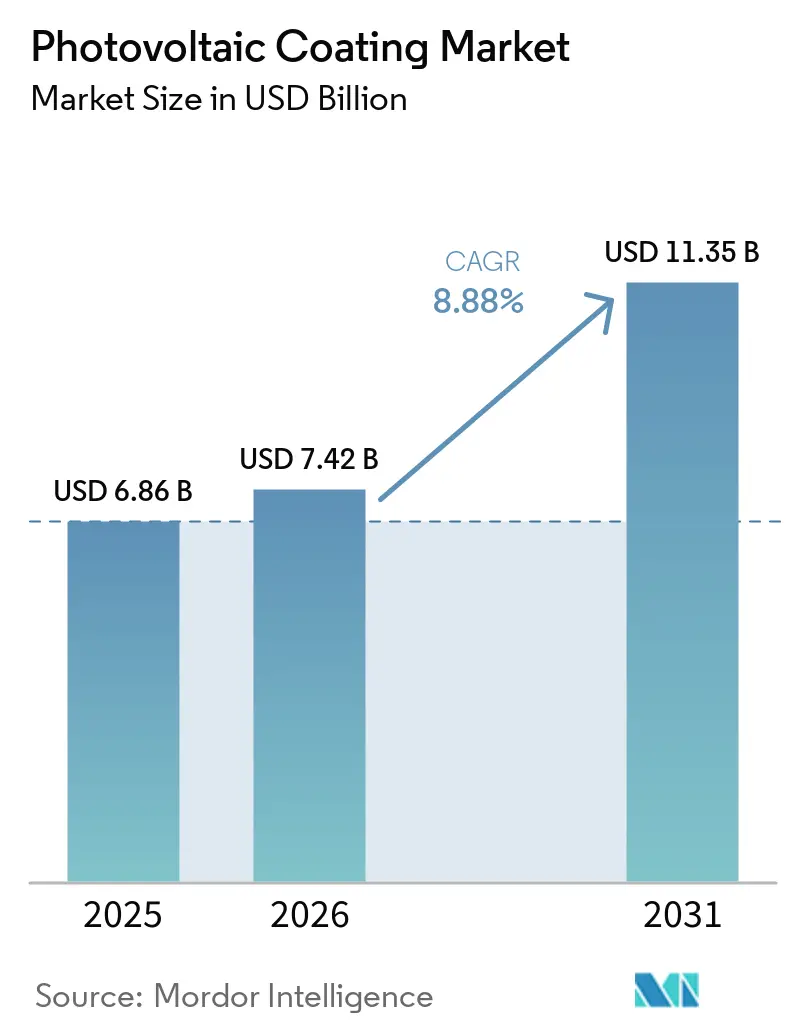
| Market Size (2026) | USD 7.42 Billion |
| Market Size (2031) | USD 11.35 Billion |
| Growth Rate (2026 - 2031) | 8.88 % |
| Fastest Growing Market | Asia-Pacific |
| Largest Market | Asia-Pacific |
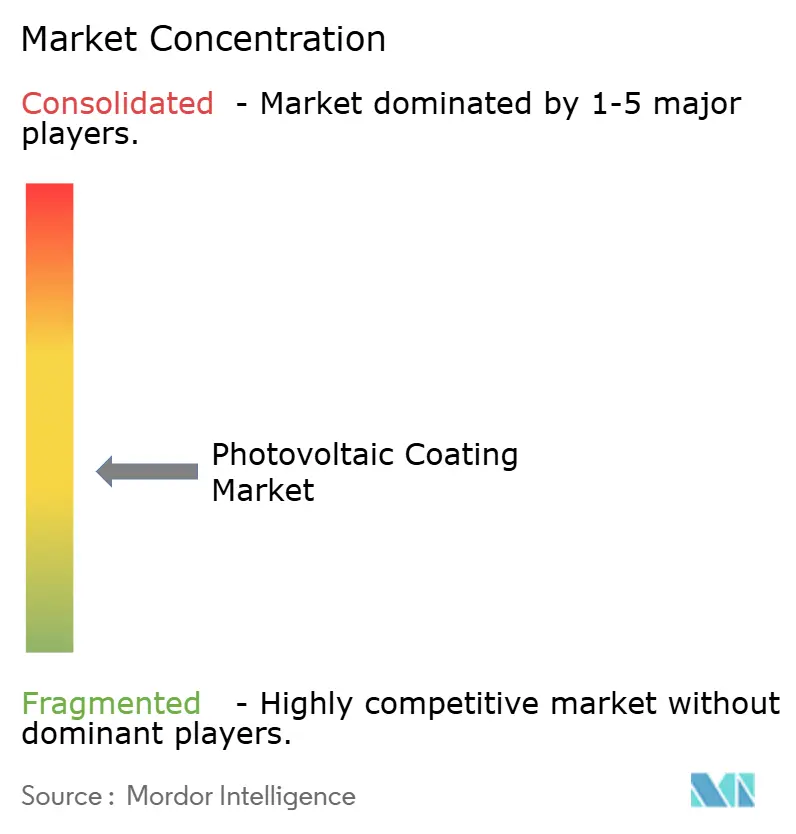
| Market Concentration | Medium |
Major Players *Disclaimer: Major Players sorted in no particular order Image © Mordor Intelligence. Reuse requires attribution under CC BY 4.0. | |
Photovoltaic Coating Market Analysis by Mordor Intelligence
The photovoltaic coating market size was valued at USD 6.86 billion in 2025 and is estimated to grow from USD 7.42 billion in 2026 to USD 11.35 billion by 2031, at a CAGR of 8.88% during the forecast period (2026-2031). The photovoltaic coating market is supported by the continued expansion of solar generation capacity and the larger glass surface area used in newer module designs. Global solar photovoltaic additions reached 698 GW in 2025, bringing cumulative installed capacity beyond 3 TW and increasing the addressable surface area for functional glass treatments. Manufacturers are placing greater emphasis on coatings that improve optical performance, manage heat, or reduce soiling, as these features can affect energy yield over a module's operating life. The photovoltaic coating market also benefits from tighter product qualification requirements, as utility developers increasingly seek documented compatibility between coatings and module bills of materials. Price pressure in the module supply chain and durability requirements remain key constraints on adoption, particularly where developers prioritize upfront cost over lifetime performance.
Key Report Takeaways
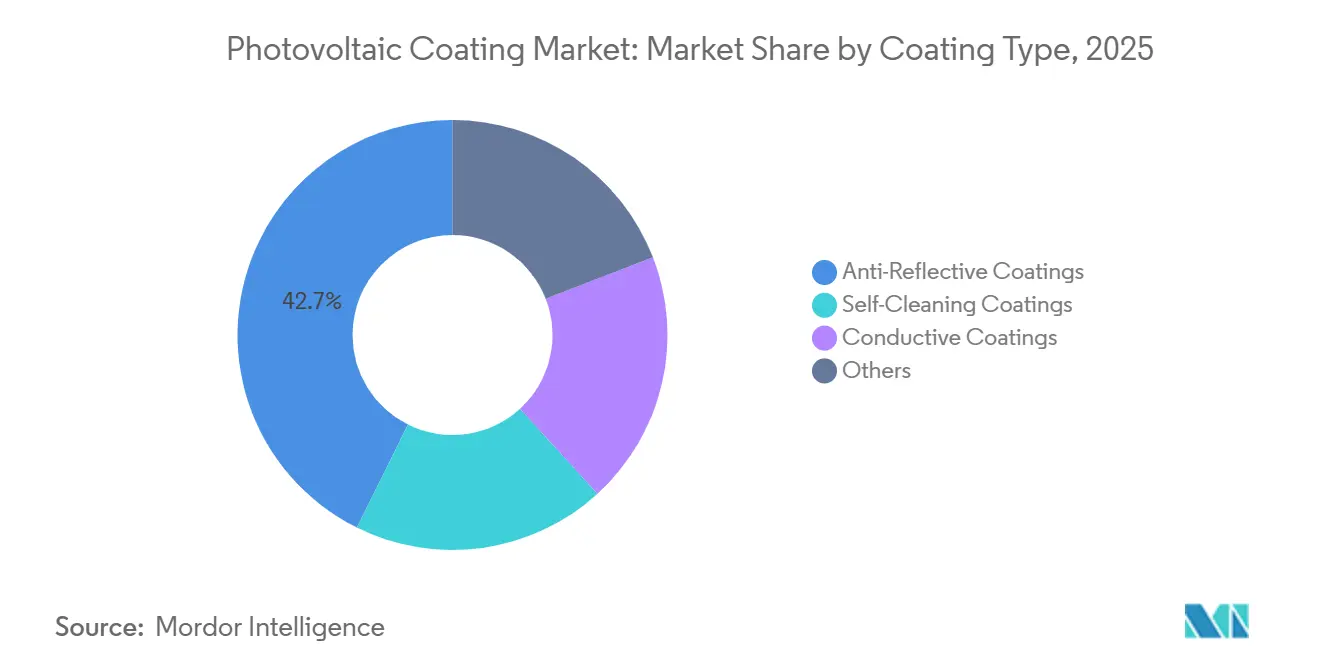
- By coating type, anti-reflective coatings held 42.67% of the photovoltaic coating market share in 2025, while self-cleaning coatings are forecast to grow at a CAGR of 9.35% through 2031.
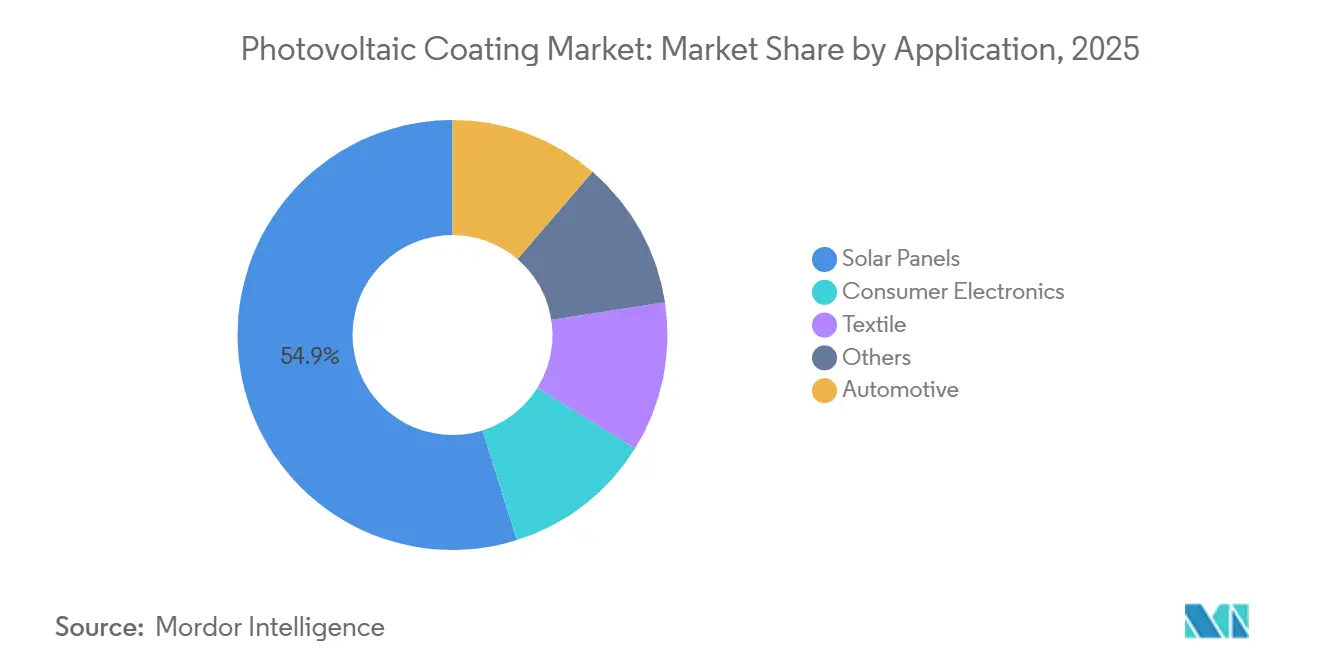
- By application, solar panels accounted for 54.85% of the photovoltaic coating market share in 2025, while automotive photovoltaic applications are forecast to grow at a CAGR of 9.96% through 2031.
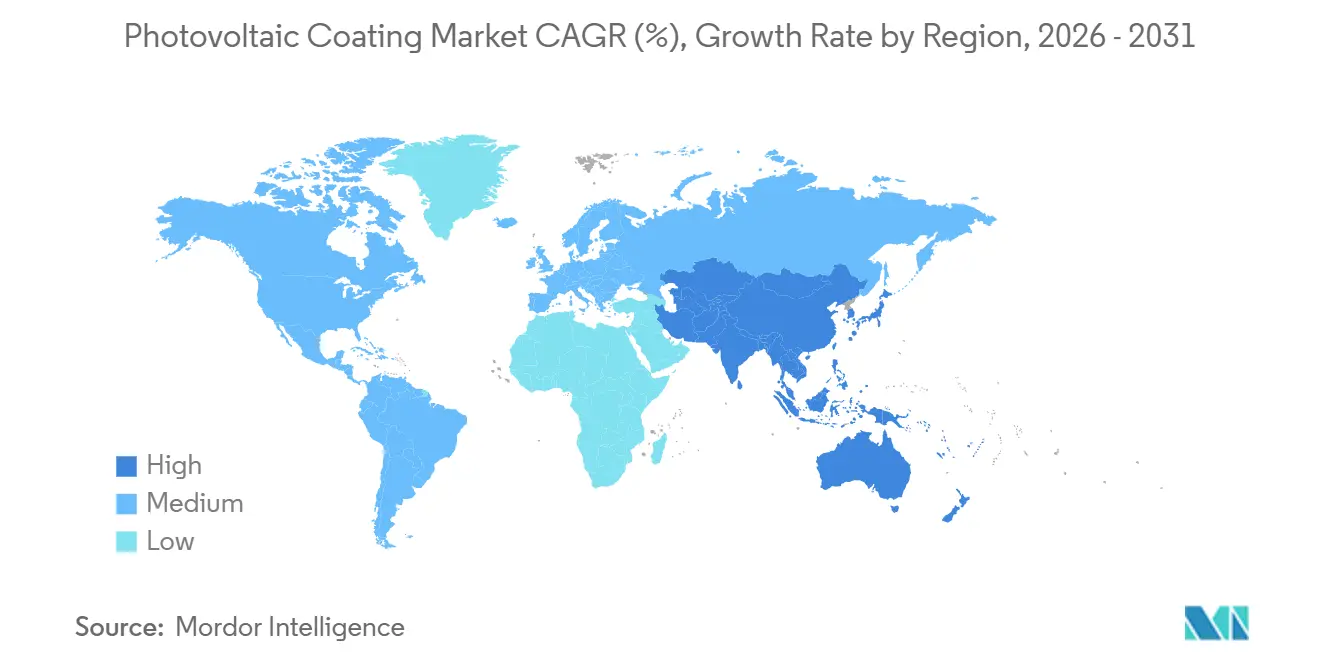
- By geography, Asia-Pacific held 41.34% of the photovoltaic coating market share in 2025 and is forecast to grow at a CAGR of 9.67% through 2031.
Note: Market size and forecast figures in this report are generated using Mordor Intelligence’s proprietary estimation framework, updated with the latest available data and insights as of January 2026.
Global Photovoltaic Coating Market Trends and Insights
Drivers Impact Analysis*
| Drivers | (~) % Impact on CAGR Forecast | Geographic Relevance | Impact Timeline |
|---|---|---|---|
| Solar Photovoltaic (PV) Capacity Expansion and Module Manufacturing Growth | +2.5% | Global, with the highest intensity in China, India, and ASEAN | Short term (≤ 2 years) |
| Efficiency Gains from Anti-Reflective and Multifunctional Coatings | +2.0% | Global, strongest in North America and Europe | Medium term (2-4 years) |
| Water Scarcity and Rising Solar-Panel Cleaning Costs | +1.5% | Middle East and North Africa, with relevance in South Asia and arid Asia-Pacific areas | Short term (≤ 2 years) |
| Growth of Bifacial, TOPCon, Heterojunction Technology (HJT), and Perovskite Modules | +1.8% | Global, concentrated in China and emerging in Europe and the United States | Medium term (2-4 years) |
| Coating Qualification as a Bankability Differentiator for New Module Technologies | +1.2% | North America, Europe, and Australia, where bill-of-materials due diligence is stringent | Long term (≥ 4 years) |
| Source: Mordor Intelligence | |||
Solar PV Capacity Expansion and Module Manufacturing Growth
Solar photovoltaic additions reached 698 GW in 2025, bringing cumulative global capacity beyond 3 TW. This deployment base provides the photovoltaic coating market with a large and growing quantity of module glass requiring functional surface treatment. Even a limited increase in coating adoption in new installations can create substantial demand, as each coated module has a large glass area. China installed 415 GW of capacity in 2025, making domestic demand central to suppliers' quantities and procurement practices. India added 55.9 GW in 2025, and its dusty operating conditions strengthen the use case for anti-soiling treatments. The International Energy Agency expects solar additions to remain above 600 GW annually through the mid-2030s, which supports sustained demand beyond the report period.
Efficiency Gains from Anti-Reflective and Multifunctional Coatings
Anti-reflective products remain important to the photovoltaic coating market because light lost at the cover glass cannot be recovered by downstream cell improvements. A 2026 peer-reviewed study also showed how optimized combinations of dielectric coatings can be tuned for solar spectral performance[1]Abhinav Thakur, Manasvi Raj, Shubham Kumar, et al., “Enhancing Photovoltaic Parameters Through Anti-Reflective Coatings, A DFT and Machine Learning-Based Study,” Journal of Physics and Chemistry of Solids, sciencedirect.com.. These results make coating selection more relevant when manufacturers seek higher yield without changing the module footprint. Multifunctional layers can also combine anti-reflection with thermal management, which is useful where high module temperatures reduce electrical output. Procurement teams can therefore assess coating costs against expected energy yield, cleaning reduction, and operating conditions, rather than treating the coating as a purely cosmetic input.
Water Scarcity and Rising Solar-Panel Cleaning Costs
The photovoltaic coating market gains support where dust accumulation reduces output and routine cleaning requires scarce water. Peer-reviewed field and site studies reported annual energy losses of 15% to 35% in arid and semi-arid settings when soiling is not controlled. Traditional water cleaning can require 3,000 to 10,000 liters per MW for each cleaning cycle, placing a recurring burden on plant operations. A 2025 study found an increase in June generation from hydrophilic nano-coated panels at a Turkish university site over a 4-month observation period, with no water-based cleaning. China issued T/CERS 0144-2025 in December 2025 to define application protocols, technical requirements, test methods, and generation-gain assessment for self-cleaning nano coatings in crystalline-silicon photovoltaic power plants. The standard provides plant owners with a clearer basis for comparing products and can reduce uncertainty in procurement decisions.
Growth of Bifacial, TOPCon, HJT, and Perovskite Modules
The shift from p-type PERC cells to n-type designs alters the performance requirements in the photovoltaic coating market. TOPCon accounted for 80% of newly installed global cell production capacity by the end of 2025, underscoring the importance of controlling front-surface reflection losses. Bifacial modules accounted for 48% of worldwide installations in 2025, and glass-glass designs increase the relevant treatment area because both surfaces can require coatings. Higher-performing architectures direct attention toward coatings with tighter optical control and reliable adhesion across the module's life. Perovskite tandem cells reached a certified laboratory efficiency of 34.85%, but commercial scale-up still requires durable protection against moisture ingress. A 2026 commercialization study identified the lack of validated links between short-term laboratory testing and IEC-qualified results as a key challenge for emerging perovskite modules.
Restraints Impact Analysis*
| Restraints | (~) % Impact on CAGR Forecast | Geographic Relevance | Impact Timeline |
|---|---|---|---|
| Premium Coating Cost Relative to Declining Module Prices | -1.3% | Southeast Asia, South America, and the Middle East and Africa, with a weaker effect in Europe and North America | Short term (≤ 2 years) |
| Long-Duration Durability Validation and Warranty Risk | -0.9% | Global, with the greatest relevance in utility-scale North America and Europe, where bill-of-materials testing is mandatory | Long term (≥ 4 years) |
| Retrofit-Line Integration and Coating-Application Uniformity Constraints | -0.7% | Asia-Pacific for curved glass and bifacial products, Europe for curved building-integrated photovoltaic facades, and automotive applications globally | Medium term (2-4 years) |
| Source: Mordor Intelligence | |||
Premium Coating Cost Relative to Declining Module Prices
Module spot prices were USD 0.07-0.08/W for much of 2024 before recovering to a weighted-average of USD 0.09/W in 2025, according to the International Technology Roadmap for Photovoltaic (ITRPV). Premium coatings that add USD 0.005 to USD 0.010/W per watt face close scrutiny from developers focused on upfront project costs. This constraint is more visible in emerging markets, where capital expenditure often outweighs lifecycle performance in purchasing decisions. Developers in Europe and North America place greater emphasis on independently verified yield and operating data. Rising silver costs also reduced the margin available for module makers to absorb additional material costs in 2025. This pricing pressure slows uptake in the photovoltaic coating market, even when the technical value of a product is clear.
Long-Duration Durability Validation and Warranty Risk
Factory-applied coatings must support module performance guarantees that typically extend for 25 to 30 years. Suppliers need to demonstrate long-term optical stability and reliable coating-to-glass compatibility over that period. For new Per- and Polyfluoroalkyl Substances (PFAS)-free self-cleaning formulations, demonstrating environmental compliance and field durability extends certification and development timelines by 3 to 5 years. European restrictions and U.S. guidance on PFAS narrow the range of approved chemistries for hydrophobic and fluoropolymer coatings. A 2026 Kiwa PVEL assessment recorded at least one delamination failure among 45% of assessed module manufacturers, underscoring the importance of interface reliability during qualification. New suppliers without proprietary, bill-of-materials-specific field evidence struggle to enter tier-one procurement channels.
*Our forecasts treat driver/restraint impacts as directional, not additive. The impact forecasts reflect baseline growth, mix effects, and variable interactions.
Segment Analysis
By Coating Type: Anti-Reflective Commands Share, Self-Cleaning Accelerates
Anti-reflective coatings held 42.67% of the photovoltaic coating market share in 2025. Their position reflects widespread use of module glass across large areas in both original equipment manufacturing and retrofit applications. These coatings reduce reflection losses at the outer surface, supporting energy yield under operating conditions. Ongoing research on anti-reflective architectures continues to improve the ability to tailor dielectric layers for the solar spectrum. Within the photovoltaic coating industry, this performance role distinguishes anti-reflective layers from treatments selected primarily for cleaning or appearance. Their broad applicability across standard crystalline-silicon modules sustains their position.
Self-cleaning coatings are forecast to grow at a CAGR of 9.35% through 2031. The photovoltaic coating market size for this coating type is supported by utility projects in dry regions where dust accumulation can materially reduce annual generation. Hydrophilic and hydrophobic coatings aim to reduce the frequency or intensity of manual cleaning, although their performance depends on local weather and dust characteristics. China's T/CADZ 0077-2026 defined technical requirements, test methods, inspection criteria, and classifications for self-cleaning nanocoatings on photovoltaic glass. Conductive coatings serve a smaller role but remain important as transparent electrode layers in Heterojunction Technology (HJT) and thin-film module designs. Other products, including hydrophobic, anti-fogging, and ultraviolet-protective coatings, serve selected residential and consumer electronics applications where appearance and durability influence selection.



By Application: Solar Panels Dominate, Automotive Gains Strategic Momentum
Solar panels accounted for 54.85% of the photovoltaic coating market share in 2025. This application benefits from the scale of global module production and the demand for coatings during manufacturing and field deployment, increasing the potential treatment area as both front and rear glass surfaces may require functional layers. The photovoltaic coating market is, therefore, closely tied to module design choices and total installation figures. Anti-reflective, self-cleaning, and protective coatings can each serve solar panels depending on the operating environment and manufacturer specifications. This breadth of use keeps the solar panel application ahead of smaller, specialized applications.
Automotive photovoltaic applications are forecast to grow at a CAGR of 9.96% through 2031. Vehicle-integrated photovoltaic systems require coatings that accommodate curved glass, meet adhesion and safety requirements, and handle changing light conditions. IEA-PVPS published technology considerations for vehicle-integrated photovoltaics in March 2026, identifying standardization gaps related to curvature tolerance, safety, and dynamic shading. Consumer electronics remain a technically demanding but quantity-limited application for thin flexible layers and transparent conductors. Textile, building-integrated photovoltaic, agricultural solar, and other applications remain at earlier commercial stages. These uses could expand as coating technologies become better suited to flexible and non-planar substrates.
Geography Analysis
Asia-Pacific led the photovoltaic coating market with a 41.34% share in 2025 and is forecast to expand at a 9.67% CAGR through 2031. China installed 415 GW of new photovoltaic capacity in 2025, bringing cumulative capacity to 1,463 GW, according to IEA-PVPS. This installation scale gives China a central role in demand, standards, and supplier qualification across the photovoltaic coating market. India added 55.9 GW in 2025, where high dust exposure supports demand for anti-soiling products. China's T/CERS 0144-2025 and T/CADZ 0077-2026 standards formalized requirements for self-cleaning nano coatings in power plants and on photovoltaic glass. Japan has 102.7 GW of cumulative capacity and is a mature market for coatings suited to high-humidity coastal soiling conditions.
North America and Europe have a strong demand for high-performance, premium-specification coatings. Germany added 17 GW in 2025 and held 117.3 GW of cumulative capacity, while its planned deployment pipeline supports demand for factory-applied and retrofit solutions. Spain installed 14 GW in 2025, making southern Europe relevant for anti-soiling applications in semi-arid operating conditions. European PFAS restrictions are placing pressure on suppliers that depend on legacy fluoropolymer chemistry, creating a pathway for alternatives that can meet both performance and compliance requirements. In North America, domestic-content incentives under the Inflation Reduction Act can strengthen the position of suppliers that qualify for local manufacturing or sourcing.
The Middle East, Africa, and South America present operating conditions where cleaning and water management are major considerations. Saudi Arabia added nearly 7 GW of solar capacity in 2025, supported by state utility programs. Desert environments can experience high output losses when dust accumulates and cleaning is delayed. Brazil installed 13.8 GW in 2025, and its semi-arid interior shares some operating characteristics with dry solar regions elsewhere. South Africa exceeded 3 GW of solar photovoltaic installations in 2025, underscoring the need for systematic operations and maintenance practices. In these regions, self-cleaning coatings can reduce cleaning frequency and water use where both are constrained.

Competitive Landscape
The photovoltaic coating market is moderately fragmented. Companies such as 3M, AGC, BASF, PPG Industries, and Saint-Gobain hold advantages through broad materials capabilities, established customer relationships, and integrated supply arrangements. Suppliers with documented qualification data are better positioned to win contracts from module manufacturers and utility developers. The competitive focus is shifting from formulation to evidence of long-term performance, compatibility, and production consistency. This favors firms that can support customers from material development through module qualification, while also leaving room for smaller suppliers that address specialized retrofit or local application needs.
In February 2026, BASF announced a partnership with Xfloat Ltd. to incorporate Tinuvin 2730 ED light stabilizers into floating photovoltaic platform structures. This move reflects how materials suppliers are expanding into floating photovoltaic systems alongside conventional solar glass applications. In September 2025, Arkema announced a partnership with Catalyxx to develop a bio-based acrylic resin value chain for lower-carbon coating resins in new energy applications, including solar. These developments place product development alongside supply chain resilience and lifecycle considerations. In April 2026, Guardian Glass filed a Patent Cooperation Treaty (PCT) patent application for a lower-cost anti-reflective coating architecture designed to provide low visible reflectivity without heat treatment. This patent activity reflects continued effort to make optical performance accessible across a broader range of glass formats.
Specialty providers can compete where installation speed, customization, and local service matter more than global supply scale. Pellucere Technologies offers the MoreSun Sol dual-layer anti-reflective and anti-soiling system for factory solar glass, while nanopool GmbH offers a silicon dioxide-based liquid glass nano-coating for solar retrofit applications[2]nanopool GmbH, “Solar, Nano Coatings and Liquid Glass Technology,” nanopool GmbH, nanopool.eu.. Chinese specialty suppliers also benefit from domestic demand and the country's efforts to formalize standards for self-cleaning products. The opportunity for combined anti-reflective, self-cleaning, and passive-cooling layers remains commercially relevant but requires independently validated durability. Suppliers that can deliver fluorine-free hydrophobic performance may benefit as regulations limit some existing chemistry options. Overall, the photovoltaic coating market remains competitive, with large suppliers retaining qualification strengths while specialized firms serve distinct technical and regional needs.
Photovoltaic Coating Industry Leaders
AGC Inc.
Saint-Gobain
PPG Industries, Inc.
FENZI S.p.A.
3M
- *Disclaimer: Major Players sorted in no particular order

Recent Industry Developments
- May 2026: China's National Standardization Body published T/CADZ 0077-2026, specifying technical requirements, test methods, and inspection criteria for self-cleaning nano coatings on photovoltaic glass. The standard covers contact angle, optical performance, hardness, adhesion, and abrasion resistance, and took effect on May 31, 2026.
- December 2025: Nanopool GmbH expanded the commercial deployment of its NP PV Liquid Glass coating for large-scale solar retrofit applications. The silicon-dioxide-based product is designed to improve light transmission and provide passive anti-soiling and antistatic protection for utility solar fleets in Europe and the Middle East.


Global Photovoltaic Coating Market Report Scope
A photovoltaic coating is a specialized thin-film or liquid application that either improves the efficiency of existing solar panels or converts ordinary surfaces, such as windows and walls, into active, electricity-generating solar devices.
The photovoltaic coating market is segmented by coating type, application, and geography. By coating type, the market is segmented into anti-reflective coatings, self-cleaning coatings, conductive coatings, and others. By application, the market is segmented into solar panels, automotive, consumer electronics, textile, and others. The report also covers market size and forecasts for photovoltaic coating across 15 countries in major regions. The market sizes and forecasts are provided in terms of value (USD).
| Anti-Reflective Coatings |
| Self-Cleaning Coatings |
| Conductive Coatings |
| Others |
| Solar Panels |
| Automotive |
| Consumer Electronics |
| Textile |
| Others |
| Asia-Pacific | China |
| India | |
| Japan | |
| South Korea | |
| ASEAN Countries | |
| Rest of Asia-Pacific | |
| North America | United States |
| Canada | |
| Mexico | |
| Europe | Germany |
| United Kingdom | |
| France | |
| Italy | |
| NORDIC Countries | |
| Rest of Europe | |
| South America | Brazil |
| Argentina | |
| Rest of South America | |
| Middle East and Africa | Saudi Arabia |
| South Africa | |
| Rest of Middle East and Africa |
| By Coating Type | Anti-Reflective Coatings | |
| Self-Cleaning Coatings | ||
| Conductive Coatings | ||
| Others | ||
| By Application | Solar Panels | |
| Automotive | ||
| Consumer Electronics | ||
| Textile | ||
| Others | ||
| By Geography | Asia-Pacific | China |
| India | ||
| Japan | ||
| South Korea | ||
| ASEAN Countries | ||
| Rest of Asia-Pacific | ||
| North America | United States | |
| Canada | ||
| Mexico | ||
| Europe | Germany | |
| United Kingdom | ||
| France | ||
| Italy | ||
| NORDIC Countries | ||
| Rest of Europe | ||
| South America | Brazil | |
| Argentina | ||
| Rest of South America | ||
| Middle East and Africa | Saudi Arabia | |
| South Africa | ||
| Rest of Middle East and Africa | ||


Key Questions Answered in the Report
What is current market size of Photovoltaic Coating Market?
The photovoltaic coating market size was valued at USD 6.86 billion in 2025 and is estimated to grow from USD 7.42 billion in 2026 to USD 11.35 billion by 2031, at a CAGR of 8.88% during the forecast period (2026-2031).
Which coating type led photovoltaic coating demand in 2025?
Anti-reflective coatings led demand with a 42.67% share in 2025, owing to their widespread use on solar module glass.
Why are self-cleaning coatings used on solar panels?
They can reduce dust-related generation losses and reduce the need for water-based cleaning in dry, dusty operating environments.
Which application accounted for the largest demand for photovoltaic coatings?
Solar panels accounted for 54.85% of demand in 2025, supported by high global module deployment and glass surface requirements.
Page last updated on:





