
Fintech As A Service Market Size and Share
Market Overview
| Study Period | 2020 - 2031 |
|---|---|
| Market Size (2026) | USD 23.52 Billion |
| Market Size (2031) | USD 43.56 Billion |
| Growth Rate (2026 - 2031) | 13.12 % |
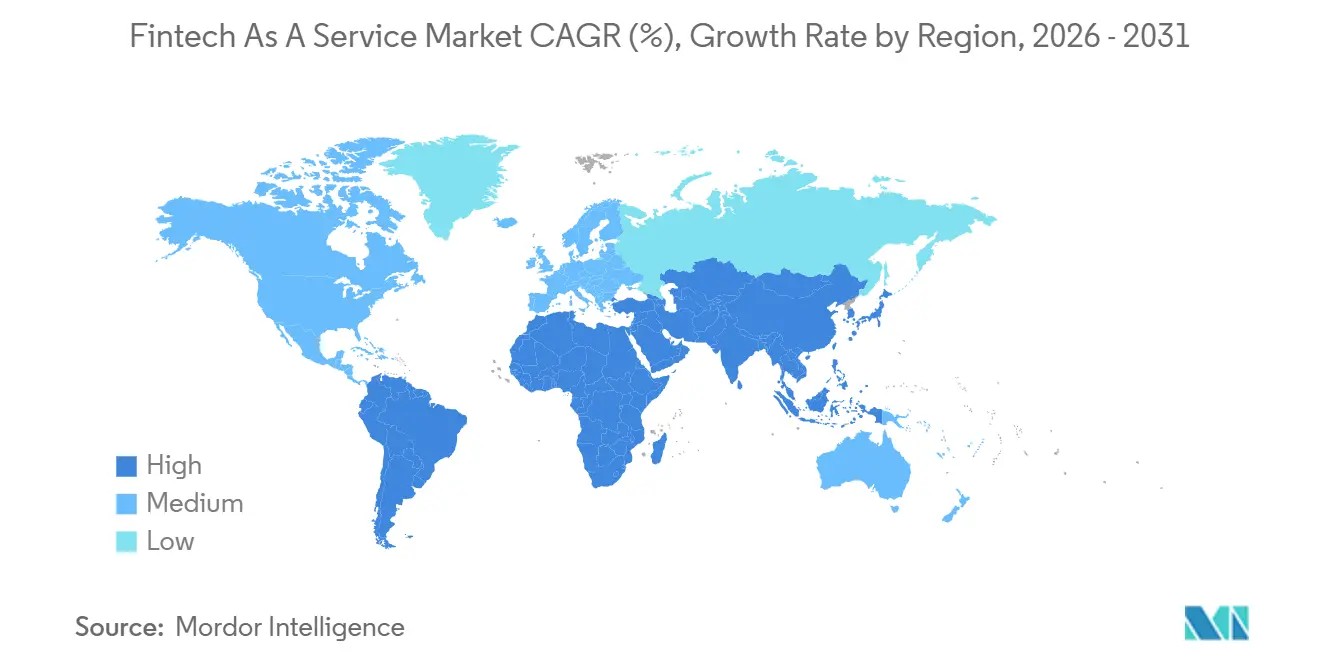
| Fastest Growing Market | South America |
| Largest Market | North America |
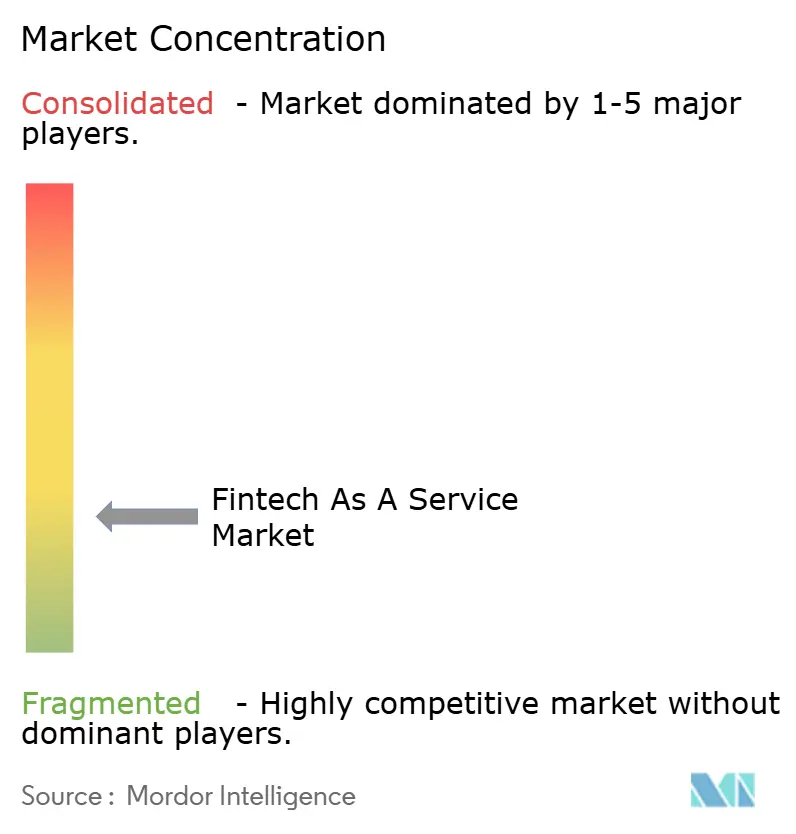
| Market Concentration | Low |
Major Players *Disclaimer: Major Players sorted in no particular order Image © Mordor Intelligence. Reuse requires attribution under CC BY 4.0. | |
Fintech As A Service Market Analysis by Mordor Intelligence
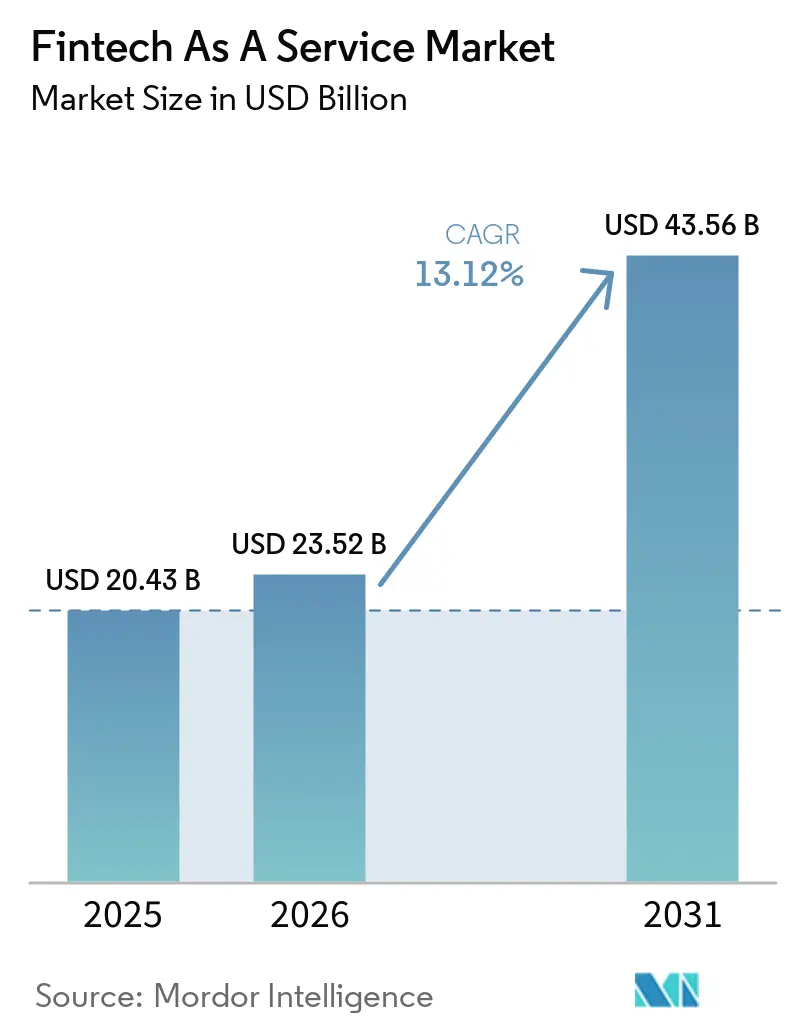
The Fintech As A Service Market size is projected to be USD 20.43 billion in 2025, USD 23.52 billion in 2026, and reach USD 43.56 billion by 2031, growing at a CAGR of 13.12% from 2026 to 2031.
The Fintech as a Service market is moving from internally built financial technology stacks toward services that enterprises can license and integrate. This change allows enterprises outside financial services to add payments, lending, and account functions to existing customer journeys. Embedded finance, open banking requirements, and real-time payment systems support demand for modular infrastructure. North America led the Fintech as a Service market in 2025, while South America recorded the strongest regional growth outlook. Regulation remains important because clear obligations can reduce uncertainty for enterprises that depend on third-party financial infrastructure.
Key Report Takeaways
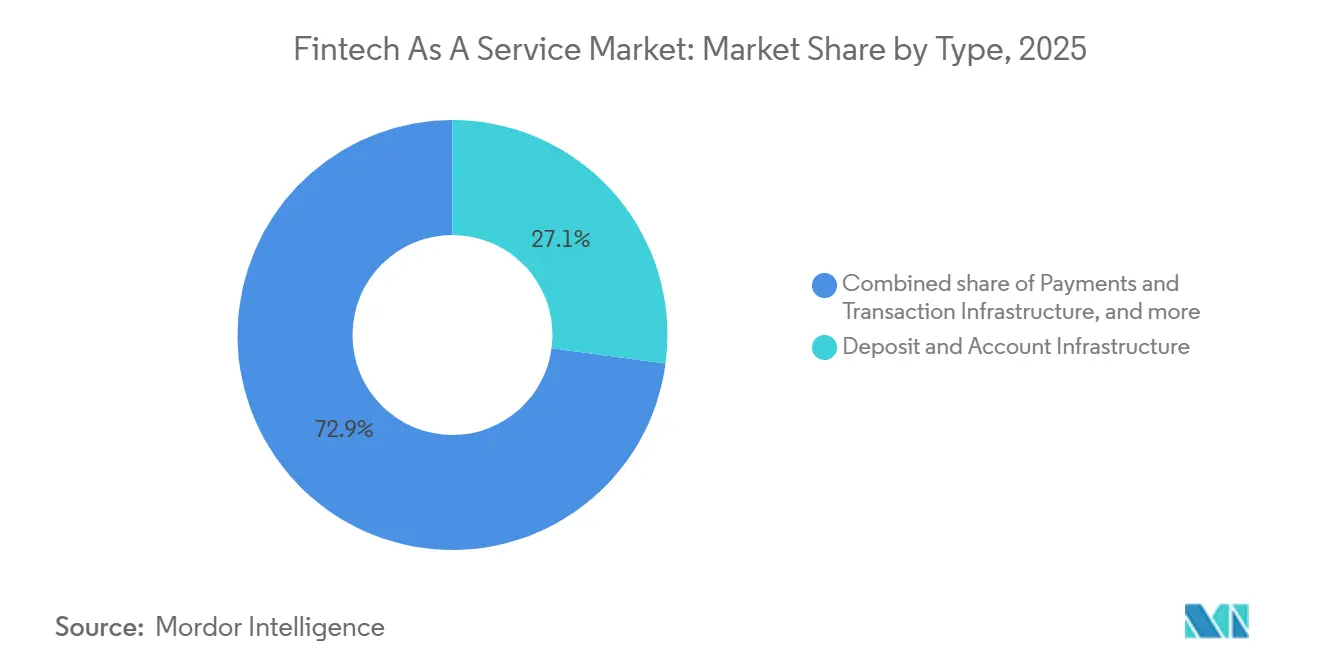
- By type, deposit and account infrastructure captured 27.1% of the fintech as a service market share in 2025, while digital asset infrastructure is projected to grow at a 23.4% CAGR through 2031.
- By end user, banks and other deposit-takers held 38.0% of the fintech as a service market share in 2025, while non-financial enterprises and platforms recorded the highest projected CAGR at 17.6% through 2031.
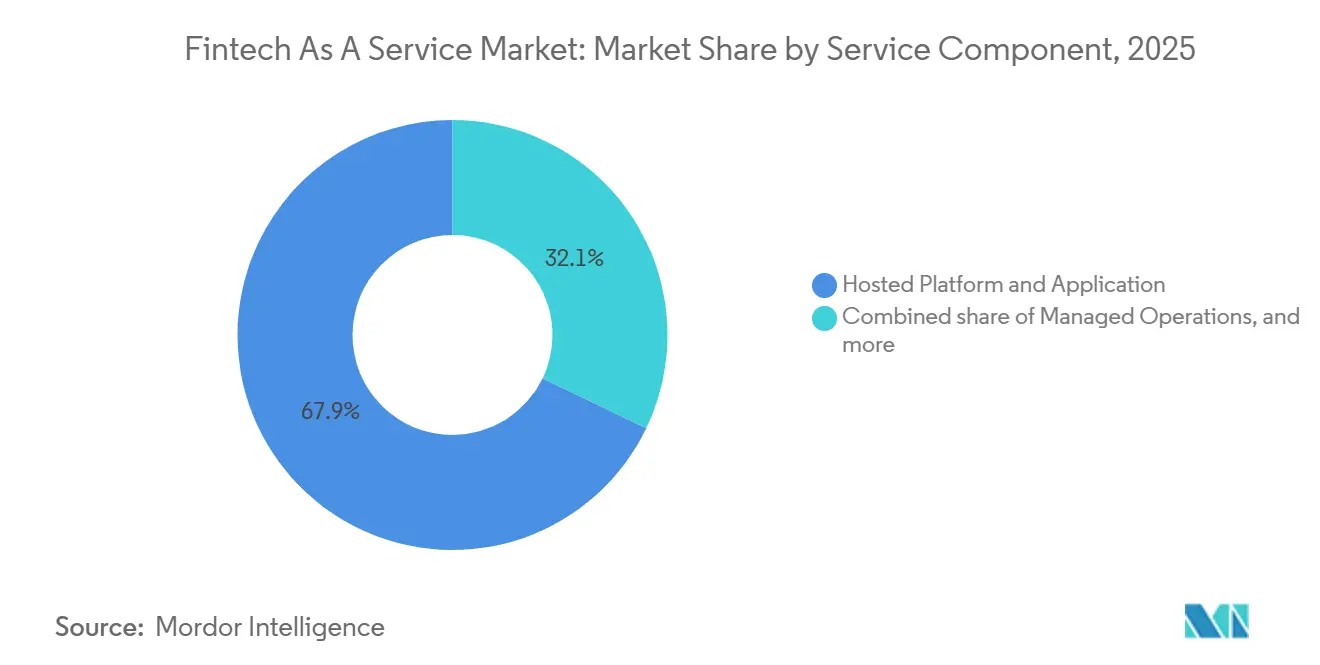
- By service component, hosted platform and application accounted for 67.9% of the fintech as a service market size in 2025, while managed operations is advancing at a 15.8% CAGR through 2031.
- By deployment model, public cloud accounted for 52.3% of the fintech as a service market size in 2025 and is forecast to expand at a 15.1% CAGR through 2031.
- By geography, North America accounted for 45.91% of the fintech as a service market size in 2025, while South America is projected to grow 18.09% CAGR through 2031.
Note: Market size and forecast figures in this report are generated using Mordor Intelligence’s proprietary estimation framework, updated with the latest available data and insights as of January 2026.
Global Fintech As A Service Market Trends and Insights
Drivers Impact Analysis*
| Driver | (~) % Impact on CAGR Forecast | Geographic Relevance | Impact Timeline |
|---|---|---|---|
| Growing Embedded Finance Adoption | +4.2% | Global | Medium term (2-4 years) |
| Demand for API-Based Financial Infrastructure | +2.8% | Global, with North America and Europe as core markets | Medium term (2-4 years) |
| Real-Time and Digital Payment Ecosystems | +2.1% | Asia-Pacific and South America core, with spillover to MEA | Short term (≤ 2 years) |
| Open Banking and Open Finance Ecosystems | +1.9% | United Kingdom, EU, Brazil, Australia, with spillover to Asia-Pacific and MEA | Medium term (2-4 years) |
| Faster Financial Product Development | +1.5% | Global, concentrated in North America and Asia-Pacific | Short term (≤ 2 years) |
| Scalable and Resilient Financial Infrastructure | +1.3% | Global | Long term (≥ 4 years) |
| Source: Mordor Intelligence | |||
Growing Adoption of Embedded Finance
Non-financial enterprises are using embedded finance to make payments, accounts, and credit available within their own products. This use case makes the Fintech as a Service market relevant to retail businesses, software providers, logistics operators, and digital platforms. Integrated financial functions can support customer retention and create new sources of revenue for these enterprises. The move also shifts demand toward providers that can combine technical delivery with compliance capabilities. Buyers are more likely to prefer vendors with established controls when financial products are offered to large customer groups. This preference supports providers that offer an end-to-end operating model rather than a narrow application programming interface.
Increasing Demand for API-Based and Modular Financial Infrastructure
Financial institutions and enterprise buyers are seeking systems that connect with existing technology without requiring full core replacement. The Fintech as a Service market benefits when institutions use application programming interfaces to add services in stages. A modular approach allows an organization to introduce a function without changing every underlying process at once. Providers must still demonstrate reliable integration, service-level commitments, and clear support for compliance activities. These requirements make proven connections to core banking systems an important selection factor. The result favors vendors that have reusable integration capabilities across multiple financial environments.
Expansion of Real-Time and Digital Payment Ecosystems
Real-time payment rails provide the transaction speed that many embedded finance services require. India’s UPI reached 741 participating banks by July 2026 and processed 24,162 crore transactions in FY2026[1]https://www.businesstoday.in/latest/economy/story/741-banks-on-upi-how-india-built-the-worlds-biggest-real-time-payments-ecosystem-551210-2026-08-25. The system is also operational in 11 countries, extending its relevance beyond domestic payments. Mature payment systems help enterprises offer faster payouts and support working-capital products. They can also reduce settlement risk in modular platform integrations. These conditions expand the practical use of the Fintech as a Service market for organizations that do not want to hold overnight float.
Expansion of Open Banking and Open Finance Ecosystems
Open banking creates a wider need for secure connections between financial institutions and approved third parties. The Fintech as a Service market can provide the connectivity and compliance tools required for those connections. Brazil’s Banking-as-a-Service rules established compliance obligations for operators, with a December 2026 implementation deadline[2]https://okai.com.br/banco-central/documentos/2025-11-28/resolucao-conjunta-n-16. Europe’s Financial Data Access framework is expected to extend data portability beyond bank accounts to insurance, investments, pensions, and mortgages. This wider scope can increase demand for systems that manage consent, data exchange, and operational controls. Institutions are preparing API layers before final compliance timelines are fully settled.
Restraints Impact Analysis*
| Restraint | (~) % Impact on CAGR Forecast | Geographic Relevance | Impact Timeline |
|---|---|---|---|
| Legacy System Integration Complexity | -2.1% | Global, most acute in North America and Europe | Short term (≤ 2 years) |
| Cybersecurity, Data Privacy, and Compliance Risks | -1.4% | Global | Medium term (2-4 years) |
| Regulatory Fragmentation and Cross-Border Compliance | -0.8% | EU, United Kingdom, Asia-Pacific, North America | Medium term (2-4 years) |
| Dependence on Third-Party Financial Partners | -0.5% | Global | Long term (≥ 4 years) |
| Source: Mordor Intelligence | |||
Complexity of Integrating FaaS Platforms with Legacy Financial Systems
Legacy integration remains an immediate operational constraint for the Fintech as a Service market. Many large banks use systems built on older technology stacks and batch processing routines. These environments can conflict with the real-time data exchange expected by modern financial services platforms. Undocumented business logic and hidden data dependencies can delay schema changes during migration programs. Integration costs can therefore lengthen enterprise decision cycles and raise project risk. Providers with pre-built adapters for major core systems are better positioned where buyers want to avoid greenfield integration.
Cybersecurity, Financial-Data Privacy and Compliance Risks
Fintech as a Service platforms can hold or process sensitive information for several institutional clients. This concentration creates operational and reputational exposure when access controls or data flows are not adequately managed. Multi-tenant delivery models require clear separation between clients and consistent control over encryption and data access. Regulated buyers also expect evidence that a provider can meet audit and security requirements. ISO/IEC 27001 certification has become an important procurement consideration in regulated sectors. These requirements can raise entry costs for smaller vendors and make compliance investment a continuing operating requirement.
*Our forecasts treat driver/restraint impacts as directional, not additive. The impact forecasts reflect baseline growth, mix effects, and variable interactions.
Segment Analysis
By Type: Digital Asset Infrastructure Leads the Growth Outlook
Deposit and Account Infrastructure held 27.1% in 2025, making it the largest service type in the Fintech as a Service market. This position reflects the need for account opening, virtual IBAN issuance, and ledger management before other financial products are added. Banks and non-bank providers require these functions to deliver controlled account services. Payments and Transaction Infrastructure also benefit from the same modular delivery approach. Card Issuing and Processing Infrastructure supports programs that require card controls and transaction processing. Lending and credit infrastructure allow platforms to add financing functions to customer journeys. Insurance Infrastructure remains smaller, but it can expand as businesses offer contextual protection products. Investment and Wealth Infrastructure has a similar role where platforms introduce investment services. Digital Asset Infrastructure is projected to grow at a 23.4% CAGR through 2031, the fastest rate among service types. Monthly stablecoin volume reached USD 7.2 trillion in February 2026, exceeding USD 6.8 trillion for the United States ACH network[3]https://www.marqeta.com/blog/marqeta-partners-with-zerohash-for-stablecoin-cards-heres-what-it-means-for-card-programs.
Digital asset services are becoming part of the broader institutional infrastructure rather than separate crypto functions. Regulatory clarity under the EU Markets in Crypto-Assets regulation and the United States GENIUS Act supports this movement. These frameworks provide more defined licensing conditions for providers of digital asset services. This environment can encourage financial institutions to move stablecoin settlement and tokenization programs into production. Broadridge expanded its tokenization capabilities in May 2026 to process tokenized and conventional securities under one control framework. That approach shows how digital asset capability can be delivered within established operational controls. The Fintech as a Service market can therefore support a recurring service model for regulated digital asset activity. Providers will need to maintain licensing, processing, and control standards across both conventional and tokenized assets. The growth outlook does not remove the need for careful operational governance. It instead increases the importance of providers that can meet institutional requirements.


By End User: Non-Financial Platforms Drive the Fastest Expansion
Banks and Other Deposit-Takers held 38.0% of the Fintech as a Service market in 2025. These institutions use service layers to extend API access and speed product development without replacing their core systems. They also need tools that help them meet open banking obligations. Insurance and Reinsurance Undertakings form a separate demand group for financial data and distribution capabilities. Other Regulated Financial Institutions use the same infrastructure to connect products and compliance processes. Public-Sector Institutions can use regulated digital rails for disbursement programs. Non-Financial Enterprises and Platforms are projected to grow at a 17.6% CAGR through 2031. Retail, logistics, and software businesses are embedding payments, lending, and account tools into existing offerings. These functions can improve retention and diversify revenue sources. Their adoption makes enterprise operating needs a central consideration for providers.
Vertical software platforms, marketplaces, and gig-economy operators are key users of embedded financial services. Their needs vary by transaction type, user base, and regulatory environment. This variation gives vendors an opportunity to package financial functions for specific business settings. Visa and Airwallex began a 2026 collaboration to develop embedded finance solutions for freight and shipping platforms. The initiative reflects demand for financial infrastructure in complex B2B operating environments. Such deployments can make switching providers more difficult once financial functions are integrated with daily workflows. Temenos also launched AI Agents and Copilots in 2026 for core banking workflows and financial crime monitoring. This development shows how automation is becoming part of the infrastructure used by financial institutions. The Fintech as a Service market must support both product delivery and the ongoing operating needs of clients. Those needs include integration, monitoring, and controlled access to financial data.
By Service Component: Managed Operations Gains Importance
Hosted Platform and Application held 67.9% in 2025, reflecting its central role in the Fintech as a Service market. Much of the category’s revenue comes from platform licenses and software access for banking, payments, and compliance applications. Connectivity services support links between the platform, client systems, and financial partners. Implementation and Professional Services remain important for enterprises with complex legacy environments. Managed Operations is projected to grow at a 15.8% CAGR through 2031. Clients increasingly expect vendors to handle ongoing compliance monitoring, fraud surveillance, reconciliation, and anti-money laundering operations. This preference can reduce the need for a client to build dedicated internal teams for every activity. It also makes service delivery more closely tied to the client’s daily operations. Providers must therefore show that their operating controls can be maintained over time.
Managed services can create recurring revenue beyond initial implementation and software licensing. They also address the operational burden of managing regulatory duties across jurisdictions. Mambu secured Swift Enabler Programme certification in July 2026 for cloud-native Swift Alliance Cloud connectivity in GCC financial institutions. The certification allows Mambu to manage infrastructure, security, and compliance requirements for clients. This example shows how a provider can convert technical implementation work into ongoing service delivery. Buyers may favor this model when internal compliance staffing becomes difficult or costly. The Fintech as a Service market is therefore not limited to software access. It also includes the continuing operational work required to keep financial services functioning. Managed Operations can become more influential where a buyer values a single accountable provider. This does not replace internal oversight, but it can shift routine responsibilities to the vendor. The segment’s growth reflects that change in buyer preference.
By Deployment Model: Public Cloud Holds the Leading Position and Fastest Growth
Public Cloud held 52.3% in 2025 and is projected to grow at a 15.1% CAGR through 2031. It combines the largest deployment share with the fastest growth rate in the Fintech as a Service market. Public cloud platforms can scale with transaction volumes and support deployment across multiple regions. This capability helps enterprises enter new markets without equivalent capital investment in their own infrastructure. It also supports rapid provisioning when a client introduces new products. These characteristics align with the needs of non-financial enterprises and growth-focused fintech companies. Private Cloud remains relevant for institutions with data residency or operational resilience requirements. Hybrid Cloud can support large banks that are updating customer-facing layers while retaining established core systems. The deployment choice depends on regulatory expectations, risk preferences, and the client’s existing technology environment.
Public cloud adoption is closely connected to the operating model of the provider and its clients. A cloud-based service can shift infrastructure spending toward usage that changes with demand. This model can be useful for organizations that need to add capacity without building it internally. Buyers still require security controls and evidence that the environment meets regulatory expectations. ISO/IEC 27001 and Cloud Security Alliance frameworks are relevant in this procurement process. Pre-certified cloud environments can reduce part of the audit work required for enterprise deployment. The Fintech as a Service market benefits when providers combine cloud scalability with documented controls. Private and hybrid models continue to serve clients who require a different balance of control and flexibility. No single model is suitable for every regulated institution. The continuing lead of Public Cloud reflects demand for scale, multi-region deployment, and faster service rollout.
Geography Analysis
North America held 45.9% of the Fintech as a Service market in 2025. The region combines a large group of platform providers with enterprise buyers that operate at an institutional scale. The United States has an established sponsor-bank ecosystem that supports product development by fintechs and non-financial enterprises. FedNow reached 1,725 member institutions in Q1 2026 and processed 2.73 million transactions worth USD 271.3 billion in that quarter. RTP processed 128 million transactions worth USD 480 billion in the same period. Canada adds an expanding digital banking cohort, while Mexico’s SPEI rails are creating early demand for modular payment infrastructure. The CFPB’s Section 1033 rule remains an unresolved variable for open finance strategies after its 2024 finalization and reconsideration from August 2025.
South America is the fastest-growing regional part of the Fintech as a Service market, with Brazil as its primary engine. Brazil’s formal Banking-as-a-Service rules create defined compliance requirements for operators. This clarity can lower uncertainty for firms that are considering third-party financial infrastructure. Pix, Chile’s Fintech Act, and Colombia’s regulatory sandbox are supporting a wider embedded finance environment in the region. Europe is led by activity in the United Kingdom and Germany. PSD3 requirements and the expected FIDA framework are encouraging institutions to prepare open finance-ready API infrastructure. These needs support demand for connectivity, consent management, and compliance tools. The regional picture shows that regulation can encourage adoption when the applicable obligations are clear.
Asia-Pacific contains national markets with different levels of payment and open data infrastructure. India’s UPI represents a major source of transaction density for banks and fintechs that want to add financial overlays. Australia extended its Consumer Data Right to non-bank lenders in July 2026, and consumer data sharing is scheduled to begin in November 2026. The Middle East and Africa remain earlier in development, but it offers a longer-term opportunity for the Fintech as a Service market. The Central Bank of the UAE completed Project Aperta in June 2026 as an internationally interoperable open finance initiative. The project positions standardized API infrastructure as a possible model for cross-border connectivity. Saudi Arabia’s SAMA roadmap and South Africa’s growing fintech ecosystem also support gradual infrastructure development. These regional markets require providers to adapt to local regulatory and payment conditions.

Competitive Landscape
The Fintech as a Service market remains highly fragmented, with no single provider holding a dominant market position. Stripe, Adyen, FIS, and Fiserv have advantages through direct payment scheme connectivity, banking licenses, and coverage across several jurisdictions. These capabilities can reduce the cost and complexity of delivering services at scale. Long enterprise relationships can also make a platform difficult to replace after it is integrated into operating processes. Adyen launched Adyen Agentic in June 2026, offering modular APIs for transactions through conversational AI platforms. The product was designed with the OpenAI Agentic Commerce Protocol and is compatible with Meta’s AI checkout. This move places payment and compliance infrastructure within AI-mediated commerce. It also reflects the need for vendors to address changing enterprise transaction channels.
Opportunity remains in vertical B2B embedded finance, multi-currency cross-border services, and compliance support for firms operating in several jurisdictions. These areas require both technical integration and practical regulatory coverage. Stripe’s Bridge unit obtained conditional OCC approval in February 2026 to establish a national trust bank. The approval may support future custody of digital assets, stablecoin issuance, and reserve management within a federal framework. Digital-dollar rails could become an additional infrastructure option for cross-border payments. Cloud-native specialists such as Mambu, ClearBank, and Airwallex compete by combining technical integration with regional licensing coverage. Their model can offer an alternative to clients who do not want to assemble multiple point solutions. Competition, therefore, depends on the ability to provide a controlled service across technology, regulation, and operations.
Fiserv and Mastercard announced a global partnership in August 2026 to integrate Mastercard Merchant Cloud into Fiserv’s Commerce Hub. The partnership gives merchants one connection to Mastercard services across online, mobile, and in-store channels. Adyen introduced Intelligent Money Movement in April 2026 to connect payments, liquidity management, and payouts on one platform. The product operates continuously and was deployed for Etsy, Expedia Group, and Vinted. These actions show that leading vendors are extending beyond individual payment functions. They are building broader platforms that connect transaction processing, operational management, and client services. The Fintech as a Service market rewards providers that can demonstrate resilience and accountability across that wider scope.
Fintech As A Service Industry Leaders
PayPal Holdings, Inc.
Mastercard Incorporated
Stripe, Inc.
Fiserv, Inc.
Block, Inc.
- *Disclaimer: Major Players sorted in no particular order

Recent Industry Developments
- August 2026: Fiserv and Mastercard announced a strategic global partnership integrating Mastercard Merchant Cloud into Fiserv's Commerce Hub, giving enterprise merchants a single connection to Mastercard's advanced services across online, mobile, and in-store channels. The partnership deepens Fiserv's role with large global merchants who would otherwise distribute payment volumes across competing platforms.
- June 2026: Adyen launched Adyen Agentic, a suite of modular APIs enabling enterprises to transact through conversational AI platforms without rebuilding commerce infrastructure. Compatible with Meta's AI checkout and co-developed with the OpenAI Agentic Commerce Protocol, it positions Adyen as the infrastructure layer for AI-mediated commerce at enterprise scale.
- April 2026: Adyen launched Intelligent Money Movement, a treasury product connecting payments, liquidity management, and payouts on a single platform. Deployed for Etsy, Expedia Group, and Vinted, it settles funds up to 3 days faster than the industry average and operates 24/7, leveraging Adyen's direct banking licenses in the United States, United Kingdom, and Europe.
- February 2026: Stripe's Bridge unit obtained conditional OCC approval to establish a national trust bank, authorizing future custody of digital assets, stablecoin issuance, and stablecoin reserve management within a federal regulatory framework.


Global Fintech As A Service Market Report Scope
| Deposit and Account Infrastructure |
| Payments and Transaction Infrastructure |
| Card Issuing and Processing Infrastructure |
| Lending and Credit Infrastructure |
| Insurance Infrastructure |
| Investment and Wealth Infrastructure |
| Digital-Asset Infrastructure |
| Banks and Other Deposit-Takers |
| Insurance and Reinsurance Undertakings |
| Other Regulated Financial Institutions |
| Non-Financial Enterprises and Platforms |
| Public-Sector Institutions |
| Hosted Platform and Application |
| Connectivity, Implementation and Professional Services |
| Managed Operations |
| Public Cloud |
| Private Cloud |
| Hybrid Cloud |
| North America | United States |
| Canada | |
| Mexico | |
| South America | Brazil |
| Argentina | |
| Rest of South America | |
| Europe | United Kingdom |
| Germany | |
| France | |
| Italy | |
| Spain | |
| Rest of Europe | |
| Asia-Pacific | China |
| Japan | |
| India | |
| South Korea | |
| Australia | |
| Indonesia | |
| Thailand | |
| Malaysia | |
| Singapore | |
| Vietnam | |
| Rest of Asia-Pacific | |
| Middle East and Africa | Saudi Arabia |
| United Arab Emirates | |
| Turkey | |
| South Africa | |
| Egypt | |
| Rest of Middle East and Africa |
| By Type | Deposit and Account Infrastructure | |
| Payments and Transaction Infrastructure | ||
| Card Issuing and Processing Infrastructure | ||
| Lending and Credit Infrastructure | ||
| Insurance Infrastructure | ||
| Investment and Wealth Infrastructure | ||
| Digital-Asset Infrastructure | ||
| By End User | Banks and Other Deposit-Takers | |
| Insurance and Reinsurance Undertakings | ||
| Other Regulated Financial Institutions | ||
| Non-Financial Enterprises and Platforms | ||
| Public-Sector Institutions | ||
| By Service Component | Hosted Platform and Application | |
| Connectivity, Implementation and Professional Services | ||
| Managed Operations | ||
| By Deployment Model | Public Cloud | |
| Private Cloud | ||
| Hybrid Cloud | ||
| By Geography | North America | United States |
| Canada | ||
| Mexico | ||
| South America | Brazil | |
| Argentina | ||
| Rest of South America | ||
| Europe | United Kingdom | |
| Germany | ||
| France | ||
| Italy | ||
| Spain | ||
| Rest of Europe | ||
| Asia-Pacific | China | |
| Japan | ||
| India | ||
| South Korea | ||
| Australia | ||
| Indonesia | ||
| Thailand | ||
| Malaysia | ||
| Singapore | ||
| Vietnam | ||
| Rest of Asia-Pacific | ||
| Middle East and Africa | Saudi Arabia | |
| United Arab Emirates | ||
| Turkey | ||
| South Africa | ||
| Egypt | ||
| Rest of Middle East and Africa | ||


Key Questions Answered in the Report
What is the projected value of the Fintech as a Service market by 2031?
The category is projected to reach USD 43.6 billion by 2031, growing from USD 23.5 billion in 2026 at a 13.1% CAGR.
Which service type is growing fastest?
Digital Asset Infrastructure is projected to grow at a 23.4% CAGR through 2031.
Which end users are driving the strongest growth?
Non-Financial Enterprises and Platforms are projected to grow at a 17.6% CAGR through 2031 as they embed financial functions into customer services.
Why is Public Cloud important for financial service platforms?
Public Cloud held 52.3% in 2025 and is projected to grow at 15.1% through 2031 because it supports scale and multi-region deployment.
Which region led global demand in 2025?
North America led with a 45.9% share in 2025, supported by sponsor-bank networks and real-time payment infrastructure.
What are the main barriers to adoption?
Legacy system integration, cybersecurity and data privacy obligations, regulatory fragmentation, and dependence on financial partners can delay deployments.
Page last updated on:





