
Financial Auditing Professional Services Market Size and Share
Market Overview
| Study Period | 2020 - 2031 |
|---|---|
| Market Size (2026) | USD 114.40 Billion |
| Market Size (2031) | USD 149.5 Billion |
| Growth Rate (2026 - 2031) | 5.50 % |
| Fastest Growing Market | Middle East and Africa |
| Largest Market | North America |
| Market Concentration | High |
Major Players *Disclaimer: Major Players sorted in no particular order Image © Mordor Intelligence. Reuse requires attribution under CC BY 4.0. | |
Financial Auditing Professional Services Market Analysis by Mordor Intelligence
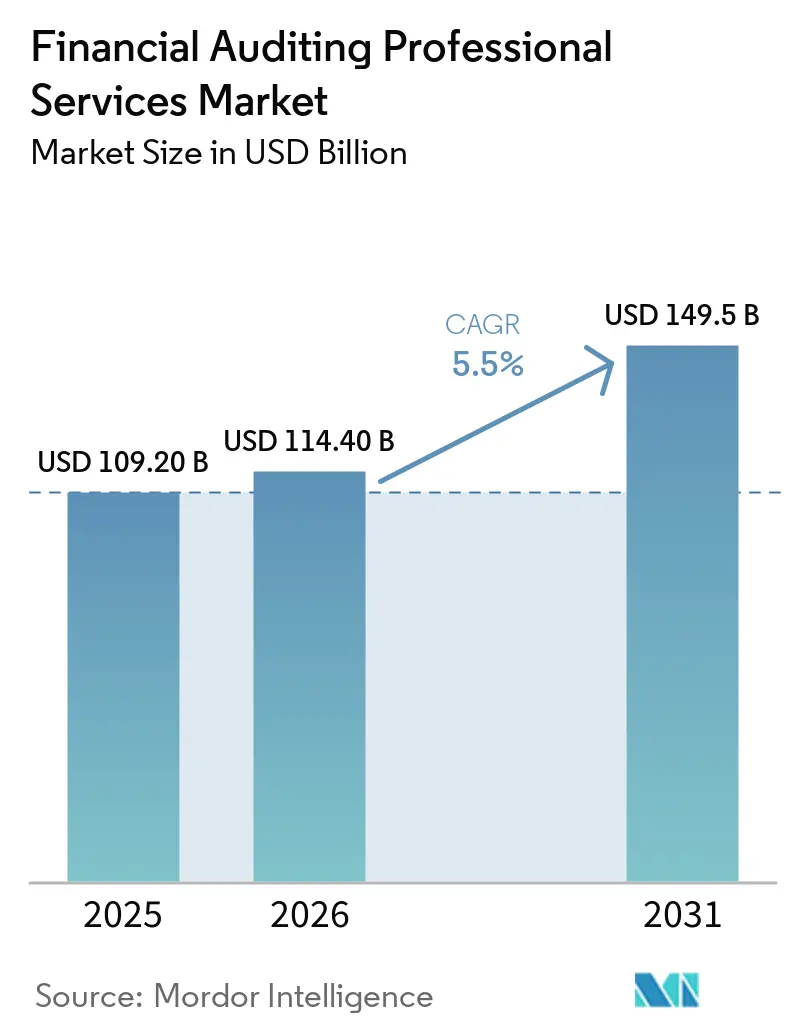
The financial auditing professional services market size was valued at USD 109.2 billion in 2025 and is estimated to grow from USD 114.4 billion in 2026 to reach USD 149.5 billion by 2031, at a CAGR of 5.5% during the forecast period (2026-2031). Regulatory requirements are expanding across established and emerging economies, which increases the need for statutory audits and readiness work. Cross-border operations also create more complex reporting and evidence requirements for multinational businesses. Technology is widening the scope of audit procedures, particularly where firms use data analytics and artificial intelligence to examine larger data sets. The financial auditing professional services market is also shaped by a limited supply of qualified professionals, rising scrutiny of audit quality, and continued investment by large networks in technology and quality-management systems.
Key Report Takeaways
- By engagement type, general-purpose financial-statement audits captured 67.2% of the financial auditing professional services market share in 2025, while reviews of historical financial information are projected to grow at a 7.2% CAGR through 2031.
- By mandate type, statutorily and regulatorily required mandates held 71.6% of the financial auditing professional services market share in 2025, while contractually required mandates are projected to grow at a 6.7% CAGR through 2031.
- By auditee size, large enterprises accounted for 68.7% of the financial auditing professional services market share in 2025, while mid-sized enterprises are projected to grow at a 6.3% CAGR through 2031.
- By end-use industry, banking, financial services, and insurance captured 23.4% of the financial auditing professional services market share in 2025, while technology, media, and telecommunications is projected to grow at a 6.9% CAGR through 2031.
- By geography, North America captured 44.1% of the financial auditing professional services market share in 2025, while the Middle East and Africa region is projected to grow at a 7.6% CAGR through 2031.
Note: Market size and forecast figures in this report are generated using Mordor Intelligence’s proprietary estimation framework, updated with the latest available data and insights as of January 2026.
Global Financial Auditing Professional Services Market Trends and Insights
Drivers Impact Analysis*
| Driver | (~) % Impact on CAGR Forecast | Geographic Relevance | Impact Timeline |
|---|---|---|---|
| Increasing Regulatory And Financial Reporting Complexity | +1.3% | Global, most acute in North America and Europe | Short term (≤ 2 years) |
| Expansion Of Cross-Border Operations And Capital Markets | +0.9% | Global, with spillover to the Middle East and Africa and Asia-Pacific | Medium term (2-4 years) |
| Rising Demand For Fraud Risk Assessment And Financial Transparency | +0.8% | Global, with strong relevance in North America and Asia-Pacific | Short term (≤ 2 years) |
| Adoption Of AI, Data Analytics, And Continuous Audit Techniques | +0.7% | Global, led by technology-focused markets | Medium term (2-4 years) |
| Growing Audit Complexity From Cloud-Based And Digital Financial Systems | +0.5% | Global, particularly North America and Asia-Pacific, with spillover to the Middle East and Africa | Medium term (2-4 years) |
| Increasing Demand For Continuous Auditing, Assurance And Real-Time Financial Monitoring | +0.6% | Global, particularly technology-focused markets in North America, Europe and Asia-Pacific | Medium term (2–4 years) |
| Source: Mordor Intelligence | |||
Increasing Regulatory And Financial Reporting Complexity
Mandatory reporting rules are becoming more detailed across jurisdictions, making regulatory complexity a major support for the financial auditing professional services market. The Public Company Accounting Oversight Board adopted amendments to QC 1000 in September 2026, establishing a principles-based quality-management framework for registered public accounting firms that becomes effective on December 15, 2026. The amendments require firms to evaluate their quality-control systems each year, which increases the need for documented processes and implementation support. The International Auditing and Assurance Standards Board also proposed revisions to ISA 330, ISA 500, and ISA 520 in August 2026 to address technology use in audit evidence[1]. These revisions encourage clients to engage audit teams earlier when changing reporting rules that affect controls, evidence, and disclosure requirements.
Expansion Of Cross-Border Operations And Capital Markets
Cross-border business activity raises demand for coordinated audit work where entities report across several jurisdictions. IFRS reporting across more than 100 countries requires multinational groups to align accounting records, audit evidence, and reporting procedures[2]. The IAS 21 currency-exchangeability amendments, effective from 2025, increase recurring reconciliation and disclosure work in 2026 for subsidiaries operating in restricted-currency jurisdictions. Group audit requirements also remain important for companies headquartered in the United Kingdom with component auditors in other countries. In Saudi Arabia, Vision 2030-linked ventures and the Financial Oversight Law increase the importance of audit-quality IFRS reporting for tenders and private investment activity.
Rising Demand For Fraud Risk Assessment And Financial Transparency
Fraud risk assessment is expanding beyond conventional financial statement misstatement as businesses rely on more complex digital systems. KPMG identified artificial intelligence governance and cybersecurity as the 2 leading risk categories in its 2026 internal audit work for technology, media, and telecommunications organizations[3]. Digital systems can provide extensive audit trails, but those records require specialized skills and tools to interpret properly. Prudential requirements for banking, financial services, and insurance organizations also connect stress testing, internal controls, and financial assurance. These conditions encourage audit committees to request broader reviews before a reporting problem becomes a regulatory issue.
Adoption Of AI, Data Analytics, And Continuous Audit Techniques
Artificial intelligence, data analytics, and continuous audit tools are changing how audit teams perform testing and evaluate evidence. EY completed a global rollout of enterprise-scale agentic artificial intelligence across its Assurance practice in April 2026, supporting 130,000 professionals on 160,000 engagements in more than 150 countries[4]. The system processes more than 1.4 trillion journal-entry data lines each year, supporting broader testing of transaction populations. Deloitte has also committed more than USD 3 billion to generative artificial intelligence through FY2030 and is integrating these capabilities into its Omnia platform. These investments raise client expectations for data-led audit work, while firms still need clear controls over methodology, output quality, and professional judgment.
Restraints Impact Analysis*
| Restraint | (~) % Impact on CAGR Forecast | Geographic Relevance | Impact Timeline |
|---|---|---|---|
| Shortage Of Qualified Audit And Technology-Risk Professionals | -0.8% | Global, most acute in North America and Europe | Short term (≤ 2 years) |
| Auditor Independence, Liability, And Reputation Exposure | -0.5% | Global, with heightened sensitivity in North America and the European Union | Long term (≥ 4 years) |
| Confidentiality And Data-Security Risks In Digital Audit Environments | -0.7% | Global, led by Asia-Pacific and North America | Medium term (2-4 years) |
| Limitations In Explainability And Reliability Of AI-Assisted Audit Procedures | -0.6% | Global, with near-term regulatory attention in North America and Europe | Medium term (2-4 years) |
| Source: Mordor Intelligence | |||
Shortage Of Qualified Audit And Technology-Risk Professionals
The shortage of audit and technology-risk professionals limits how quickly firms can expand engagement capacity. The Controllers Council recorded a Talent Shortage Index of 77% in its 2026 study, compared with a Talent Surplus Index of 108% in 2025. The average number of open accounting and finance positions per company rose to 17 in 2026 from 5 in 2025 and 2 in 2024. The profession has lost more than 300,000 accountants and auditors since 2020, while retirements and fewer CPA candidates continue to reduce available capacity. The Institute of Chartered Accountants in England and Wales reported in July 2026 that retirements exceed new trainees in many jurisdictions, extending this staffing pressure beyond North America.
Auditor Independence, Liability, And Reputation Exposure
Independence requirements limit the consulting services that audit firms can provide to their audit clients. This restricts cross-selling opportunities and requires firms to manage commercial objectives within professional standards. The International Ethics Standards Board for Accountants revised its ethics code, and the International Auditing and Assurance Standards Board issued related narrow-scope amendments in January 2026. The amendments address the use of external experts in audit and review engagements and the circumstances that can create independence concerns. Liability and reputation risks remain especially significant for mid-tier and regional firms because one serious audit failure can affect client retention, insurance capacity, and market standing.
*Our forecasts treat driver/restraint impacts as directional, not additive. The impact forecasts reflect baseline growth, mix effects, and variable interactions.
Segment Analysis
By Engagement Type: Statutory Audits Anchor Revenue, Specialized Reviews Accelerate
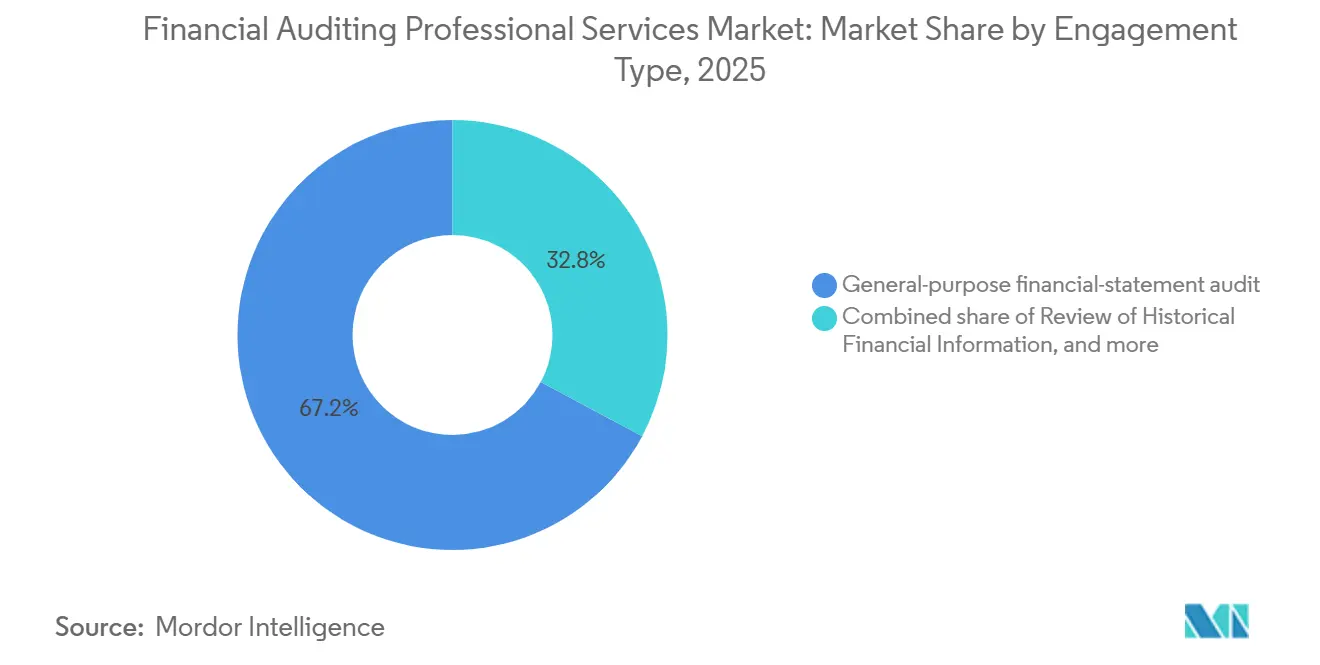
General-purpose financial-statement audits represented 67.2% of the financial auditing professional services market size in 2025. Annual opinion audits remain the core assurance service for public companies, regulated financial institutions, and large private enterprises. Their role reflects filing obligations, investor expectations, and the need for independent assurance over annual financial statements. Reviews of historical financial information are projected to grow at a 7.2% CAGR through 2031, which exceeds the overall rate. Private-equity due diligence, lender covenant verification, and IPO readiness work support demand for reviews that provide substantial assurance without a full audit opinion.
The January 2026 amendments to ISRE 2400 address the use of external experts in review engagements, placing greater attention on the design and documentation of these assignments. Special-purpose audits and local-GAAP statutory audits serve multinational groups that must meet jurisdiction-specific filing obligations. These engagements can operate alongside a group audit because component entities may have separate legal reporting requirements. Agreed-upon procedures and compilation assignments address more limited assurance and compliance needs, including tender and grant-related submissions. PwC reported USD 19.8 billion in assurance revenue for FY2025, with growth in new assurance areas that include sustainability and artificial intelligence-related work.
By Mandate Type: Regulatory Mandates Dominate, Contractual Demand Accelerates
Statutorily and regulatorily required mandates held 71.6% of the financial auditing professional services market size in 2025. Governments and sector regulators have embedded audit obligations into corporate governance, financial-sector supervision, and not-for-profit reporting. This structure makes mandatory audits the largest source of recurring demand across regions. Updated Public Company Accounting Oversight Board standards will become effective in December 2026 and extend public-company audit requirements in the United States. The scale of statutory demand is therefore expected to remain stable as reporting and quality-management rules evolve.
Contractually required mandates are projected to grow at a 6.7% CAGR through 2031, the highest rate within this segmentation. Loan covenants, bond agreements, private-equity arrangements, and government contracts often require audited or audit-quality information outside formal statutory rules. These arrangements connect financing availability and governance commitments with a need for independent assurance. Voluntary and governing-body-initiated audits remain smaller, but they are relevant for donor-funded organizations, family-owned companies, and businesses preparing for investment or succession. In the United Arab Emirates, Ministerial Decision No. 84 of 2025 shifted certain corporate-tax audit requirements from voluntary practice toward mandatory compliance for taxable persons with annual revenue above AED 50 million (USD 13.6 million).
By Auditee Size: Large Enterprises Lead, Mid-Sized Companies Narrow The Gap
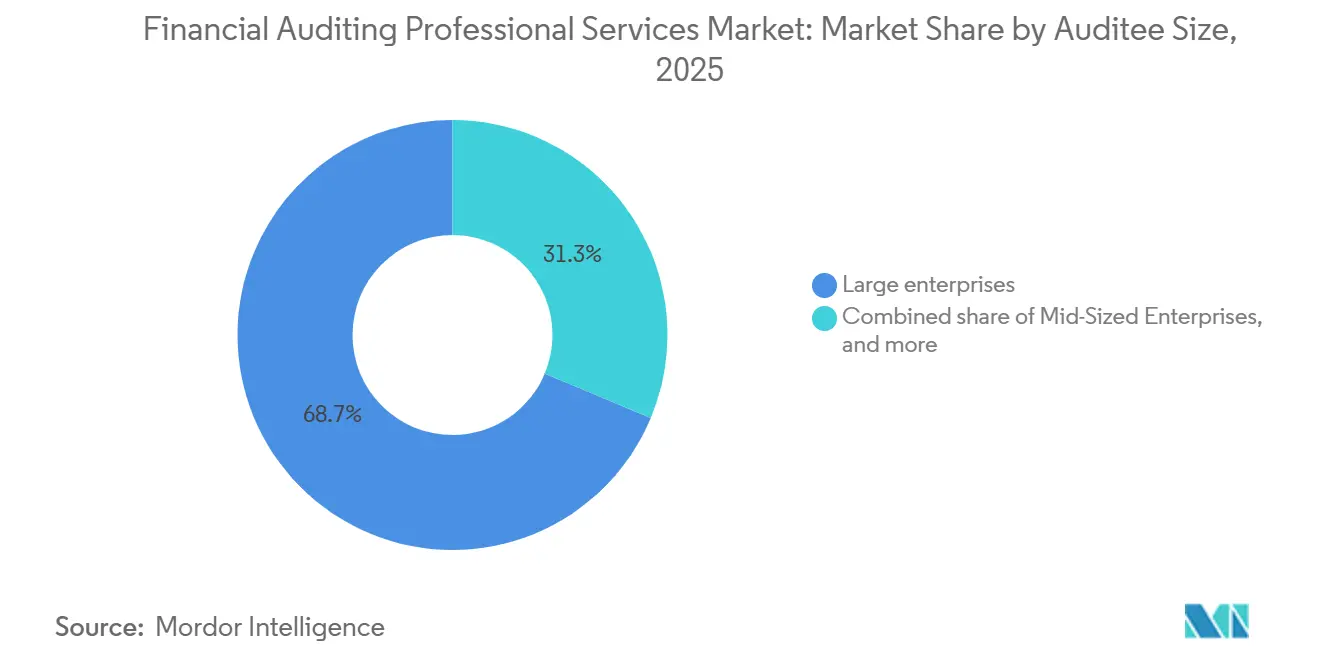
Large enterprises captured 68.7% of the financial auditing professional services market share in 2025. Complex financial structures and operations across several countries increase the scope of their audit work. Listed companies also face integrated audit and internal-control requirements in the United States, the United Kingdom, and the European Union. Their need for specialist knowledge in valuation, consolidation, and regulatory reporting supports higher engagement intensity. These factors keep large enterprises central to the financial auditing professional services industry.
Mid-sized enterprises are projected to grow at a 6.3% CAGR through 2031 as audit thresholds expand in developing economies and private-equity ownership raises assurance expectations. Smaller businesses remain comparatively underserved because traditional manual work can be uneconomic for the client and the audit firm. Technology-enabled delivery models are beginning to address this issue, though they have not closed the gap at scale. Forvis Mazars reported 11% global revenue growth to USD 5.7 billion in FY2025, with audit among its primary growth contributors. Its United Kingdom practice reported 21% growth in audit and assurance during FY2025 after investments in data analytics, artificial intelligence tools, and a global audit platform.
By End-Use Industry: BFSI Commands Demand, TMT Changes Engagement Scope
Banking, financial services, and insurance accounted for 23.4% of the financial auditing professional services market size in 2025. Prudential rules require annual audits for licensed financial entities and create extensive requirements for controls and financial reporting. Financial-instrument valuation also requires specialist knowledge that increases engagement complexity. Global financial institutions must meet overlapping requirements from national and cross-border supervisory bodies. These conditions maintain banking, financial services, and insurance as the largest end-use field for the financial auditing professional services market.
Technology, media, and telecommunications are projected to grow at a 6.9% CAGR through 2031, making it the fastest-growing end-use field. Software revenue recognition, artificial intelligence governance, digital-asset reporting, and cybersecurity controls are expanding the work required on these assignments. Deloitte reported that technology, media, and telecommunications accounted for 53% of Standard & Poor’s 500 market capitalization in 2026, compared with 19% in 2008. Manufacturing, healthcare and life sciences, and energy and utilities also represent large audit populations with complex inventory, financial-control, environmental disclosure, and project-finance requirements. KPMG found that artificial intelligence governance and cybersecurity remained the 2 leading internal audit risk categories for technology, media, and telecommunications organizations in 2026.
Geography Analysis
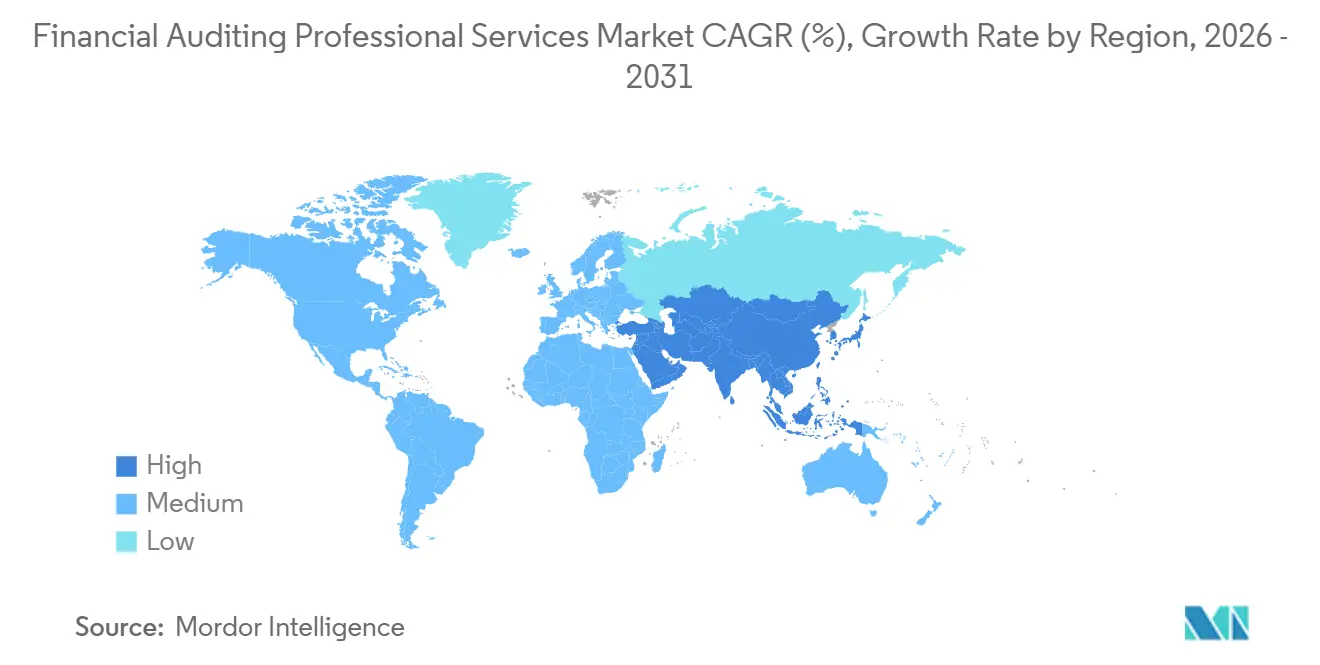
North America held 44.1% of the financial auditing professional services market share in 2025. The region is supported by the United States Securities and Exchange Commission oversight of public company issuers and Sarbanes-Oxley integrated audit requirements for accelerated filers. The United States also has a large concentration of listed businesses and globally important financial institutions. Deloitte reported USD 38.8 billion in Americas revenue in FY2025, while PwC generated USD 25.6 billion in the Americas region. Canada’s audit requirements and Mexico’s digital invoicing enforcement add to the regional demand base beyond the United States.
Europe remains the 2nd-largest regional block in the financial auditing professional services market. European Union sustainability reporting rules and United Kingdom audit standards expand the assurance work attached to annual reporting cycles. Germany’s audit and tax advisory field grew 6.1% in FY2025 to EUR 22.6 billion (USD 24.2 billion), showing continued demand despite a difficult economic environment. Asia-Pacific is the 3rd-largest regional block, supported by India’s mandatory audit requirements, regulatory consolidation among Chinese firms, and growing listings in Southeast Asia. The Asia-Pacific region also faced pressure on Big Four revenue in FY2025 because of currency headwinds.
The Middle East and Africa region is projected to grow at a 7.6% CAGR through 2031, the fastest geographic rate in the financial auditing professional services market. Saudi Arabia’s Financial Oversight Law took effect on April 11, 2026, and established a risk-based public-fund oversight framework coordinated by the Ministry of Finance, SOCPA, and ZATCA. The framework expands audit-quality obligations for firms working in the Kingdom. The Dubai Financial Services Authority published its 9th Audit Monitoring Report in July 2026, requiring transparency reports from auditors of DIFC-listed companies and identifying artificial intelligence in audit as a 2026 priority. South America is supported by Brazil’s statutory audit framework and IFRS use among listed companies, while amended IAS 21 requirements add complexity for businesses in Argentina.
Competitive Landscape
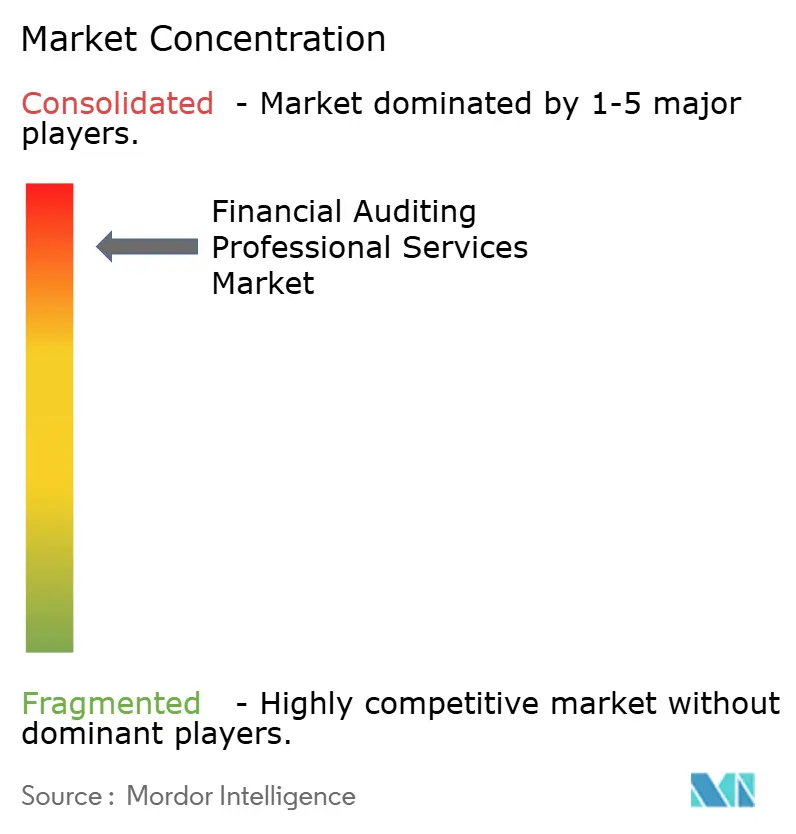
The financial auditing professional services market is concentrated at the top tier, where Deloitte, EY, PwC, and KPMG lead global audit networks. Deloitte reported USD 70.5 billion in global revenue in FY2025 and 3.8% growth in Audit and Assurance. EY reported USD 53.2 billion in global revenue, while PwC reported USD 56.9 billion in total revenue and USD 19.8 billion in assurance revenue. KPMG reported USD 39.8 billion across its service lines in FY2025. These firms have the scale to support global clients, invest in technology, and maintain large quality-management and standards teams.
Consolidation among mid-tier firms is changing the competitive position of firms below the Big Four. Grant Thornton Advisors announced its acquisition of CBIZ in July 2026, and the combined business is positioned to exceed USD 5 billion in the United States annual revenue. RSM added Mexico to its transatlantic partner-owned platform in June 2026, extending a structure launched across the United States, United Kingdom, Canada, and Ireland in January 2026. BDO added more than 1,300 professionals through its acquisition of HORNE LLP in November 2025, strengthening its government and southeastern United States capabilities. If the Grant Thornton transaction closes as expected, CBIZ should be treated as part of Grant Thornton in later competitive assessments.
Technology investment is a central part of competition in the financial auditing professional services market. EY’s April 2026 rollout embedded agentic artificial intelligence in EY Canvas across 160,000 audit engagements. EY and Microsoft also announced a USD 1 billion-plus, 5-year initiative in May 2026 to extend Copilot to more than 400,000 EY staff. Forvis Mazars reported 21% audit and assurance growth in its United Kingdom practice in FY2025, linking the result to data analytics, artificial intelligence tools, and a global audit platform. Large firms retain an advantage where quality-management requirements demand substantial investment, but mid-tier firms can compete for mid-enterprise clients when they combine technology investment with differentiated assurance delivery.
Financial Auditing Professional Services Industry Leaders
-
PwC
-
Deloitte
-
E&Y
-
KPMG
-
BDO
- *Disclaimer: Major Players sorted in no particular order
Recent Industry Developments
- September 2026: PCAOB adopted amendments to QC 1000, A Firm's System of Quality Control, effective December 15, 2026, rescinding the External QC Function requirement, reducing documentation retention from 7 to 5 years, and allowing firms to select their annual evaluation date, subject to SEC approval. The changes reduce compliance costs while preserving investor protection obligations.
- August 2026: IAASB released proposed revisions to ISA 330, ISA 500, and ISA 520 for public consultation, completing a decade-long modernization of the International Standards on Auditing by embedding technology-adaptive audit evidence requirements. Comments are requested by December 15, 2026.
- July 2026: Grant Thornton Advisors announced the acquisition of CBIZ, positioning the combined entity as the 5th-largest United States professional services provider with more than USD 5 billion in domestic annual revenue.
- May 2026: EY and Microsoft announced a USD 1 billion-plus, 5-year alliance to scale enterprise AI, extending Copilot to more than 400,000 EY staff following a 15% productivity uplift recorded in the initial 150,000-user deployment.
Global Financial Auditing Professional Services Market Report Scope
| General-Purpose Financial-Statement Audit |
| Special-Purpose, Component and Statutory Local-GAAP Audit |
| Review of Historical Financial Information |
| Compilation With an Attest / Compilation Report |
| Agreed-Upon Procedures on Financial Information |
| Standalone Financial-Reporting-Control Attest |
| Other In-Scope Financial Assurance |
| Statutorily / Regulatorily Required |
| Contractually Required |
| Voluntary / Governing-Body Initiated |
| Large Enterprises |
| Mid-Sized Enterprises |
| Small and Micro Enterprises |
| Banking, Financial Services and Insurance |
| Technology, Media and Telecommunications |
| Manufacturing |
| Healthcare and Life Sciences |
| Retail, Consumer and Hospitality |
| Energy, Utilities and Natural Resources |
| Real Estate and Construction |
| Transportation and Logistics |
| Professional and Business Services |
| Education and Not-For-Profit |
| Public Bodies Audited by Licensed Independent Firms |
| Other Industries |
| North America | United States |
| Canada | |
| Mexico | |
| South America | Brazil |
| Argentina | |
| Rest of South America | |
| Europe | United Kingdom |
| Germany | |
| France | |
| Italy | |
| Spain | |
| Rest of Europe | |
| Asia-Pacific | China |
| Japan | |
| India | |
| South Korea | |
| Australia | |
| Indonesia | |
| Thailand | |
| Malaysia | |
| Singapore | |
| Vietnam | |
| Rest of Asia-Pacific | |
| Middle East and Africa | Saudi Arabia |
| United Arab Emirates | |
| Turkey | |
| South Africa | |
| Egypt | |
| Rest of Middle East and Africa |
| By Engagement Type | General-Purpose Financial-Statement Audit | |
| Special-Purpose, Component and Statutory Local-GAAP Audit | ||
| Review of Historical Financial Information | ||
| Compilation With an Attest / Compilation Report | ||
| Agreed-Upon Procedures on Financial Information | ||
| Standalone Financial-Reporting-Control Attest | ||
| Other In-Scope Financial Assurance | ||
| By Mandate Type | Statutorily / Regulatorily Required | |
| Contractually Required | ||
| Voluntary / Governing-Body Initiated | ||
| By Auditee Size | Large Enterprises | |
| Mid-Sized Enterprises | ||
| Small and Micro Enterprises | ||
| By End-Use Industry | Banking, Financial Services and Insurance | |
| Technology, Media and Telecommunications | ||
| Manufacturing | ||
| Healthcare and Life Sciences | ||
| Retail, Consumer and Hospitality | ||
| Energy, Utilities and Natural Resources | ||
| Real Estate and Construction | ||
| Transportation and Logistics | ||
| Professional and Business Services | ||
| Education and Not-For-Profit | ||
| Public Bodies Audited by Licensed Independent Firms | ||
| Other Industries | ||
| By Geography | North America | United States |
| Canada | ||
| Mexico | ||
| South America | Brazil | |
| Argentina | ||
| Rest of South America | ||
| Europe | United Kingdom | |
| Germany | ||
| France | ||
| Italy | ||
| Spain | ||
| Rest of Europe | ||
| Asia-Pacific | China | |
| Japan | ||
| India | ||
| South Korea | ||
| Australia | ||
| Indonesia | ||
| Thailand | ||
| Malaysia | ||
| Singapore | ||
| Vietnam | ||
| Rest of Asia-Pacific | ||
| Middle East and Africa | Saudi Arabia | |
| United Arab Emirates | ||
| Turkey | ||
| South Africa | ||
| Egypt | ||
| Rest of Middle East and Africa | ||
Key Questions Answered in the Report
What is the projected size of financial auditing professional services in 2031?
The sector is projected to reach USD 149.5 billion by 2031, growing at a 5.5% CAGR from 2026.
Which engagement type has the largest share of financial auditing professional services?
General-purpose financial-statement audits held 67.2% share in 2025, equal to USD 73.4 billion.
What is driving demand for financial audits?
Regulatory change, cross-border reporting, fraud-risk assessment, and the use of data analytics are expanding audit requirements.
Which client group has the highest projected growth rate?
Mid-sized enterprises are projected to grow at a 6.3% CAGR through 2031 as audit thresholds and institutional assurance requirements expand.
Which end-use field is growing fastest?
Technology, media, and telecommunications is projected to grow at a 6.9% CAGR through 2031.
Which region will grow fastest through 2031?
The Middle East and Africa region is projected to grow at a 7.6% CAGR through 2031, supported by new audit oversight requirements.