
Feed Processing Machinery Market Size and Share
Market Overview
| Study Period | 2021 - 2031 |
|---|---|
| Market Size (2026) | USD 29.98 Billion |
| Market Size (2031) | USD 40.02 Billion |
| Growth Rate (2026 - 2031) | 5.92 % |
| Fastest Growing Market | Africa |
| Largest Market | Asia Pacific |
| Market Concentration | Medium |
Major Players *Disclaimer: Major Players sorted in no particular order Image © Mordor Intelligence. Reuse requires attribution under CC BY 4.0. | |
Feed Processing Machinery Market Analysis by Mordor Intelligence
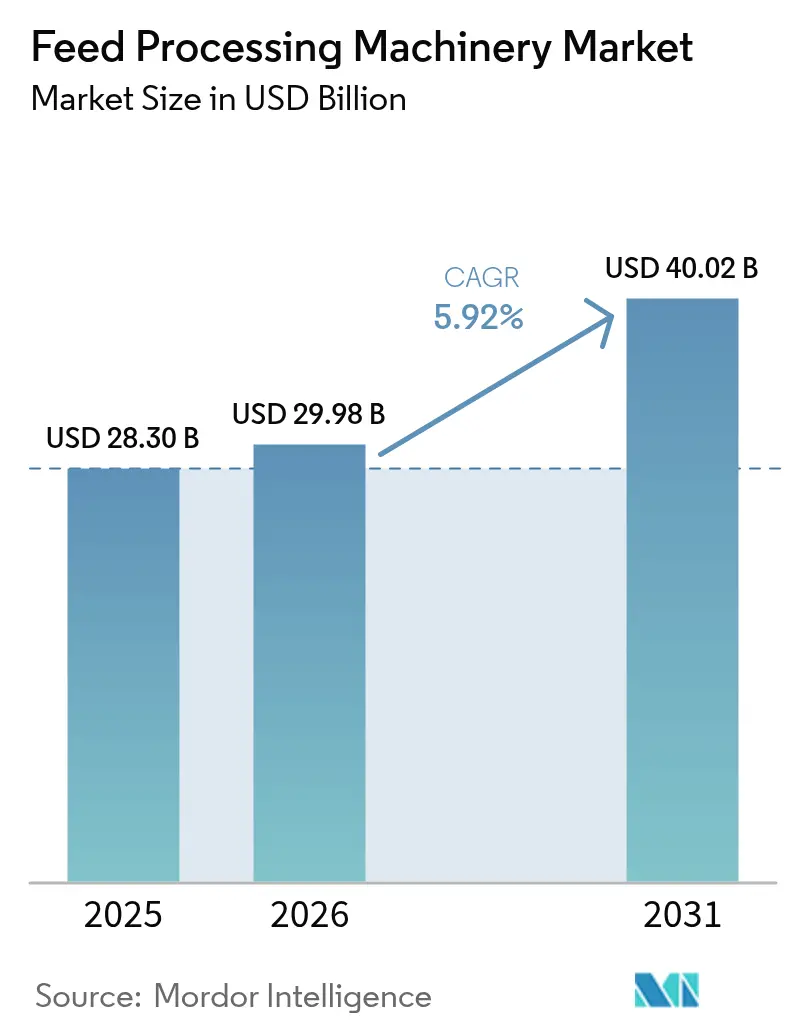
The feed processing machinery market size in 2026 is estimated at USD 29.98 billion, growing from 2025 value of USD 28.30 billion with 2031 projections showing USD 40.02 billion, growing at 5.92% CAGR over 2026-2031. This growth is driven by advancements in automation, the expansion of integrated mega-farms, and increasing demand for aquaculture, particularly for floating and micro-pellet production lines. Modern continuous, IoT-enabled systems capable of rapid recipe changeovers are replacing traditional batch configurations, while machine-learning applications are reducing energy consumption and minimizing unplanned downtime. Capital investments are highest in the Asia-Pacific region, with significant scaling in China's pork industry and Vietnam's shrimp sector. Africa is leading in growth percentage, supported by subsidy programs funding cooperative mills. Equipment providers offering solutions with predictive maintenance, traceability, and flexible batching in modular designs are securing contracts, despite challenges such as fluctuating stainless-steel prices and extended component lead times.
Key Report Takeaways
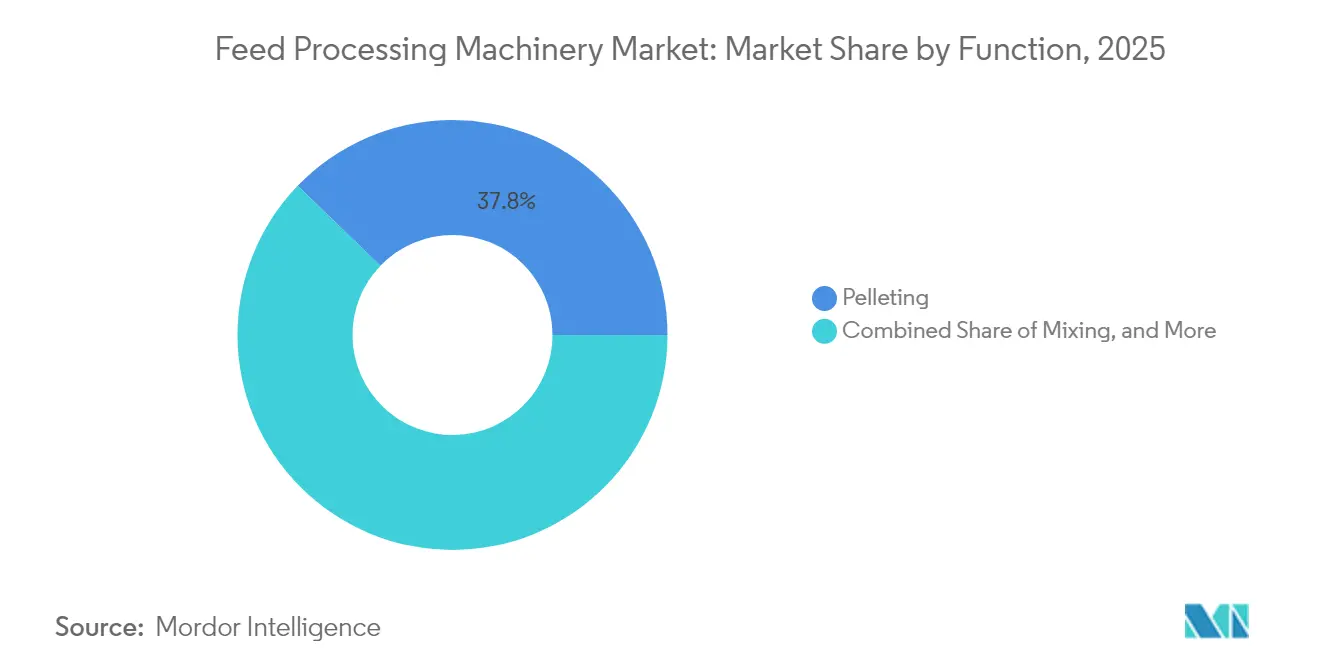
- By function, pelleting equipment held 37.80% of the feed processing machinery market share in 2025, while extrusion systems are projected to expand at an 8.35% CAGR through 2031.
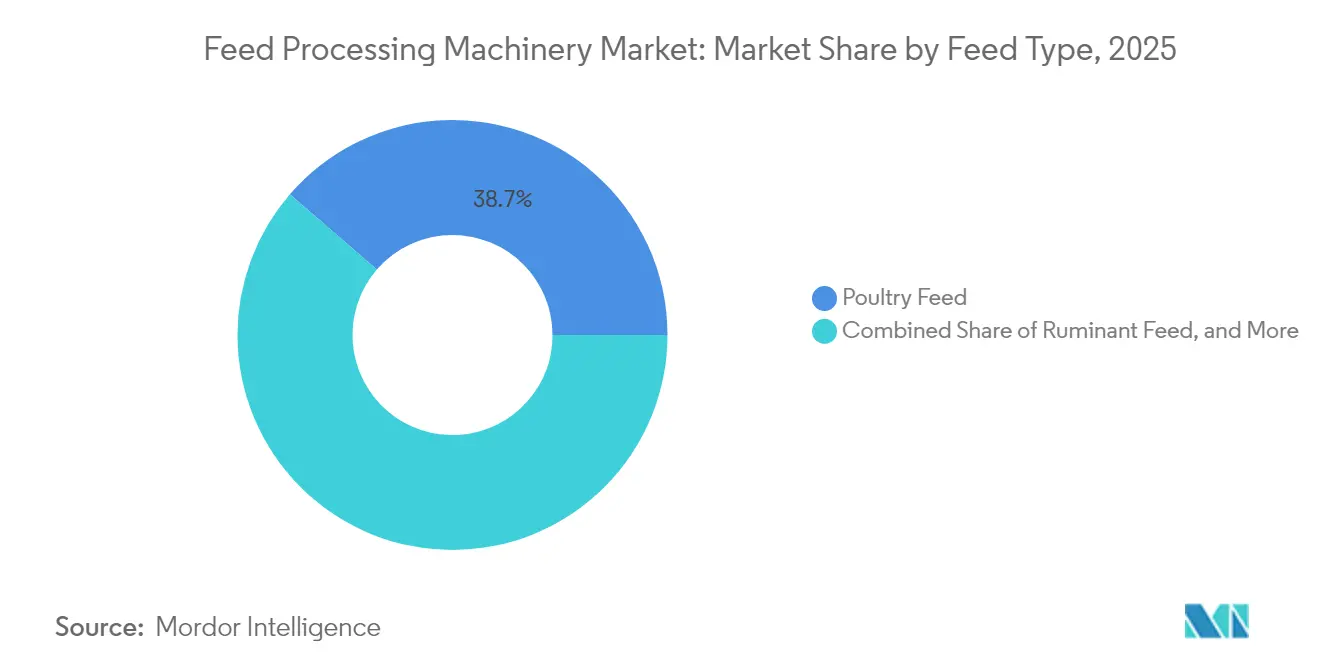
- By feed type, poultry feed accounted for 38.65% of the feed processing machinery market size in 2025, whereas aquaculture feed is forecast to grow at a 9.05% CAGR to 2031.
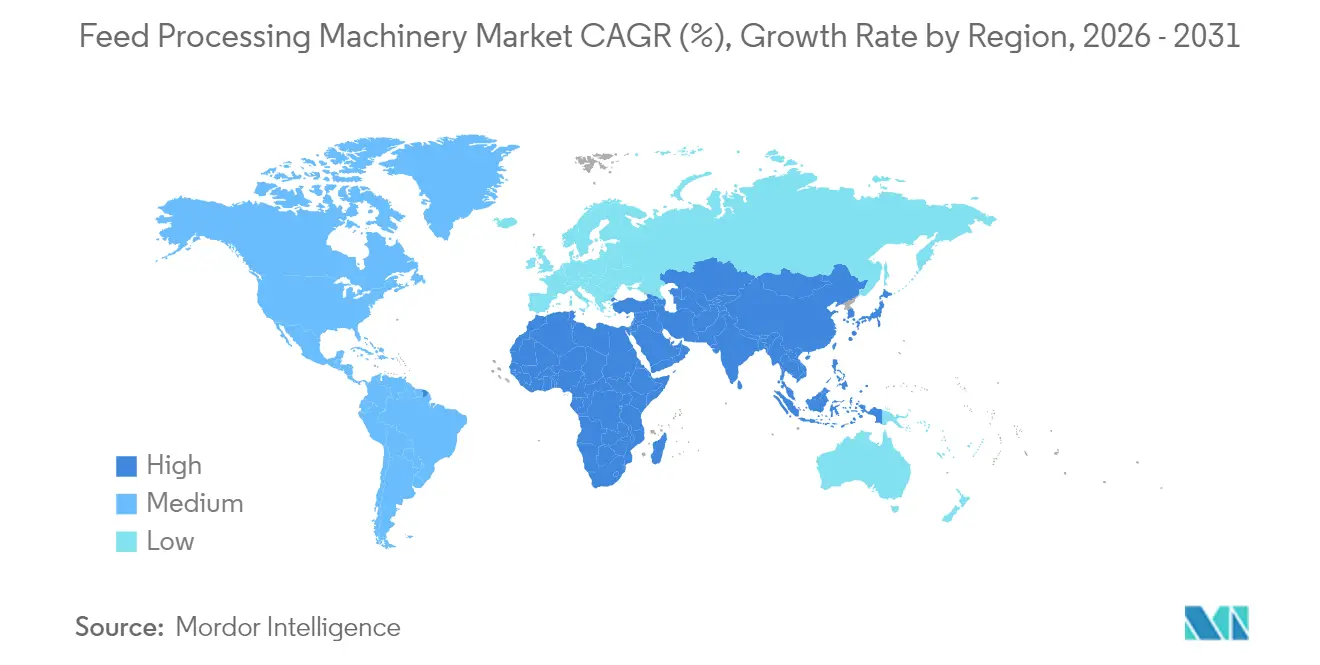
- By geography, the Asia-Pacific region generated 45.75% of global revenue in 2025; Africa is projected to post the fastest regional CAGR of 8.45% from 2025 to 2031.
Note: Market size and forecast figures in this report are generated using Mordor Intelligence’s proprietary estimation framework, updated with the latest available data and insights as of 2026.
Market Trends and Insights
Drivers Impact Analysis of Feed Processing Machinery Market*
| Driver | (~) % Impact on CAGR Forecast | Geographic Relevance | Impact Timeline |
|---|---|---|---|
| Rapid Shift Toward Fully Automated and IoT Enabled Feed Mills | +1.2% | Global with early uptake in North America, Europe, and China | Medium term (2-4 years) |
| Expansion of Industrial Livestock Mega Farms | +1.4% | Asia Pacific core nations plus Brazil and Mexico | Long term (≥ 4 years) |
| Rising Demand for Floating and Micro-Pellet Lines in Aquafeed | +0.9% | Asia Pacific and South America | Medium term (2-4 years) |
| Surge in Precision Nutrition Formulations Requiring Flexible Batching | +0.8% | North America and the European Union then Asia Pacific | Short term (≤ 2 years) |
| Government Incentives for Domestically Built Agro-Machinery | +0.7% | India, China, Brazil, Nigeria, and Kenya | Long term (≥ 4 years) |
| AI Driven Predictive Maintenance Reducing Unplanned Downtime | +0.6% | Global with focus on large plants | Medium term (2-4 years) |
| Source: Mordor Intelligence | |||
Rapid Shift Toward Fully Automated and IoT Enabled Feed Mills
Fully networked mills with edge-computing controllers are transforming throughput efficiency. Bühler’s PelletingPro adjusts die compression every 30 seconds, reducing energy consumption by 8% and pellet breakage by 12%. Andritz’s Metris suite monitors 40 sensor points per mill, reducing unscheduled stoppages by 30% during a 2024 trial in Thailand. CPM’s real-time vision system automatically adjusts steam injection when pellet durability declines. For mega-farms operating continuously, these improvements in uptime are essential. Compliance with ISO 22000 standards and upcoming EU traceability regulations has made the use of automated quality logs a procurement requirement. Mid-sized mills without these capabilities risk losing supply contracts.
Expansion of Industrial Livestock Mega-Farms
In 2024, farms in China with over 5,000 sows accounted for 68% of the country's pork production, driving increased demand for pellet mills with a capacity of 40-60 metric tons per hour[1]Source: China Ministry of Agriculture and Rural Affairs, “Livestock Statistics 2024,” moa.gov.cn. Brazil's JBS invested in a poultry complex equipped with twin-shaft mixers and automated micro-dosing systems. Meanwhile, Vietnam's CP Group implemented Wenger twin-screw extruders to enhance the production of piglet starter feed. High-volume operations benefit from internalizing feed costs, utilizing advanced automation, and adjusting feed recipes daily based on growth data. While this model is less prevalent in India's fragmented poultry industry, it is now being supported by subsidized loan programs.
Rising Demand for Floating and Micro-Pellet Lines in Aquafeed
The aquaculture feed market is experiencing rapid growth as producers of shrimp, tilapia, and salmon increasingly adopt floating pellets that remain stable for up to eight hours. New installations in countries such as Vietnam, Ecuador, and Norway are predominantly utilizing twin-screw extruders, which control starch gelatinization at temperatures between 120°C and 140°C. Floating feed diets reduce feed waste by 18% and enhance feed conversion ratios. Micro-pellet production lines for hatcheries depend on fine pulverizers to achieve particle sizes ranging from 0.3 to 0.8 millimeters. Regulatory initiatives, including the Food and Agriculture Organization’s Blue Transformation program, which aims to reduce reliance on fishmeal, are driving demand for more adaptable extruder technologies.
Government Incentives for Domestically Built Agro-Machinery
Subsidy programs are driving orders toward domestic suppliers. India’s Production-Linked Incentive scheme offers 15% capital support for machinery incorporating at least 60% local content, resulting in increased bookings for Lark Engineering[2]Source: Department of Food Processing Industries India, “Production-Linked Incentive Scheme,” mofpi.nic.in. Similarly, China’s Made in China 2025 initiative has enhanced the agricultural machinery sector, enabling Jiangsu Muyang to achieve a 22% growth in domestic orders in 2024.
Restraints Impact Analysis of Feed Processing Machinery Market*
| Restraint | (~) % Impact on CAGR Forecast | Geographic Relevance | Impact Timeline |
|---|---|---|---|
| Volatility in Stainless Steel and Fabricated Metal Prices | −0.9% | Global with sharp swings in Europe and North America | Short term (≤ 2 years) |
| High Up-Front Cost Limiting Adoption Among Small and Mid Feed Mills | −1.1% | India, Indonesia, Philippines, and Sub-Saharan Africa | Long term (≥ 4 years) |
| Dependence of Machinery Demand on Animal Protein Price Cycles | −0.7% | North America, Brazil, and European Union | Medium term (2-4 years) |
| Lengthy Procurement Lead Times Due to Supply Chain Disruptions | −0.6% | Global with emphasis on European component sourcing | Short term (≤ 2 years) |
| Source: Mordor Intelligence | |||
Volatility in Stainless Steel and Fabricated Metal Prices
Stainless steel costs increased by 18% year-over-year in early 2024 due to a tightening nickel supply and rising energy costs in Europe[3]Source: London Metal Exchange, “Stainless Steel Price Index 2024,” lme.com. Austenitic grades, including 304 and 316L, account for approximately 45% of a pellet mill's bill of materials. Andritz implemented a 12% surcharge, leading South American buyers to postpone projects, while smaller Asian fabricators experienced margin reductions of up to 300 basis points. Currency fluctuations further exacerbated costs, increasing landed expenses for import-reliant buyers and encouraging a shift toward domestic alternatives.
High Up-Front Cost Limiting Adoption Among Small and Mid Feed Mills
Turnkey pellet lines with a capacity of 10 metric tons per hour are priced starting at USD 800,000, while twin-screw extruders begin at USD 1.5 million. These costs exceed the annual revenue of many mills in regions such as South Asia and Africa. In 2024, India’s rural credit agency declined 68% of feed-mill loan applications due to insufficient collateral, prompting operators to lease second-hand Chinese equipment at high interest rates[4]Source: NABARD, “Feed-Mill Credit Rejections 2024,” nabard.org. In countries with subsidized programs, such as those offered by the Brazilian Development Bank or China’s Agricultural Development Bank, adoption rates tend to be higher. A two-tier technology landscape remains, dividing automated mega-farms from manually operated smallholder farms.
*Our forecasts treat driver/restraint impacts as directional, not additive. The impact forecasts reflect baseline growth, mix effects, and variable interactions.
Feed Processing Machinery Market Segment Analysis
By Function:
Pelleting Dominates, Extrusion Accelerates on Aquafeed DemandPelleting equipment accounted for 37.80% of the feed processing machinery market share in 2025, highlighting its importance in poultry, swine, and ruminant diets. Pellets enhance feed conversion ratios by up to 12%, making them a critical component in animal nutrition. The market size for pelleting lines is projected to grow in alignment with the overall feed processing machinery market through 2031. This growth is supported by the continued requirement for conditioners that inject steam at 90°C and coolers that reduce moisture levels below 12%, ensuring compliance with ISO 22000 standards. Suppliers are focusing on differentiation through innovations such as quick-change dies and energy-efficient paddles. Bühler’s DPMS modules enable die set changes within 30 minutes, while CPM’s Turbo Conditioner has increased throughput by 15% by enhancing mash uniformity. Integrated cooling and drying modules help prevent mold formation during storage, and real-time vision systems are employed to monitor pellet durability.
Extrusion systems are anticipated to achieve the highest CAGR of 8.35%, driven by twin-screw designs that meet the specific requirements of aquaculture for floating pellets and micro-feeds. The market share for extrusion systems is expanding as twin-screw barrels can be reconfigured for different diets, such as shrimp, tilapia, or salmon, without requiring disassembly. This reduces changeover times from hours to minutes. The advancements align with the increasing precision in nutrition programs, which demand tighter particle-size tolerances.



By Feed Type:
Poultry Leads, Aquaculture Surges on Protein TransitionPoultry feed accounted for 38.65% of the feed processing machinery market size in 2025, driven by broiler production surpassing 101 million metric tons and the widespread use of pellets with durability exceeding 95%. Integrators emphasize the use of premium compression dies and steam conditioning to eliminate fines that disrupt automated feeding processes. Layer operations utilize larger pellets enriched with calcium, while United States feed costs, constituting 65-70% of total production expenses, continue to pressure mill efficiency. The poultry-related feed processing machinery market is projected to grow steadily as integrators retrofit older facilities with IoT sensors to address labor shortages.
Aquaculture feed is experiencing the fastest growth, with a 9.05% CAGR. Shrimp, tilapia, and salmon farmers are transitioning from trash fish to formulated diets, increasing demand for extruders capable of managing buoyancy and preserving heat-sensitive vitamins. Vietnam represented one-quarter of Bühler’s aquafeed extruder bookings in 2024, while Ecuador’s tilapia farms reduced feed waste by 18% through the adoption of slow-sinking pellets. The use of novel ingredients, such as insect and algae proteins, necessitates flexible extruders designed to prevent die clogging, positioning suppliers with modular barrel systems to capitalize on this emerging segment of the feed processing machinery market.
Geography Analysis
APAC Feed Processing Machinery Market
Asia-Pacific accounted for 45.75% of the feed processing machinery market share in 2025, led by China’s production of compound feed and the consolidation into 5,000-sow complexes requiring on-site mills with capacities of 40-60 metric tons per hour. India’s Production-Linked Incentive program boosted demand for locally manufactured equipment, while Vietnam’s aquaculture feed production reached 6.8 million metric tons, supported by state subsidies for twin-screw extruders. Thailand and Indonesia continue to expand their poultry and swine industries, whereas Japan and South Korea are retrofitting older mills with predictive maintenance systems to address labor shortages. The feed processing machinery market in the Asia-Pacific region is projected to grow further, driven by livestock intensification and stricter food safety regulations.
Africa Feed Processing Machinery Market
Africa, while smaller in absolute market size, leads in growth with a CAGR of 8.45%. Nigeria’s livestock development plan and Kenya’s climate-smart initiatives are channeling funds toward hammer mills, mixers, and pelletizers, promoting the adoption of cooperative farming practices. South Africa’s 12 million metric tons of feed now supplies neighboring countries. Challenges such as electricity unreliability and spare parts shortages extend downtime; mobile service hubs from Bühler and Andritz are improving response times in Kenya, Tanzania, and Ghana. As subsidy programs mature, regional manufacturers such as Ottevanger and Prokop are increasing their market share.
The Americas and Europe Feed Processing Machinery Market
In North America, the United States integrators are adopting CPM’s SmartBatch technology for amino-acid dosing based on carcass analytics, while Canada’s dairy sector is implementing precise batching systems for total mixed rations. In Europe, the European Union’s Farm to Fork strategy, which mandates feed ingredient traceability by 2027, is driving investments in automation across countries such as Germany and Spain. South America, led by Brazil’s feed production, benefits from low-interest loans provided by the Brazilian Development Bank, which are being used to modernize mills in the Northeast region. Chile and Ecuador are accelerating the adoption of aquafeed, while Argentina is upgrading its grinding lines to meet beef export requirements.

Regulatory Landscape
Regulation shaping feed processing machinery demand is tightening around feed safety, preventive controls, traceability, and plant safety design. In Canada, the Feeds Regulations, 2024 (SOR/2024-132) introduced written preventive control plan requirements across feed manufacturing, storage, and labeling, raising documentation and validation expectations that flow into equipment selection, including automated quality logs, controlled dosing, and hygienic design.
Competitive Landscape
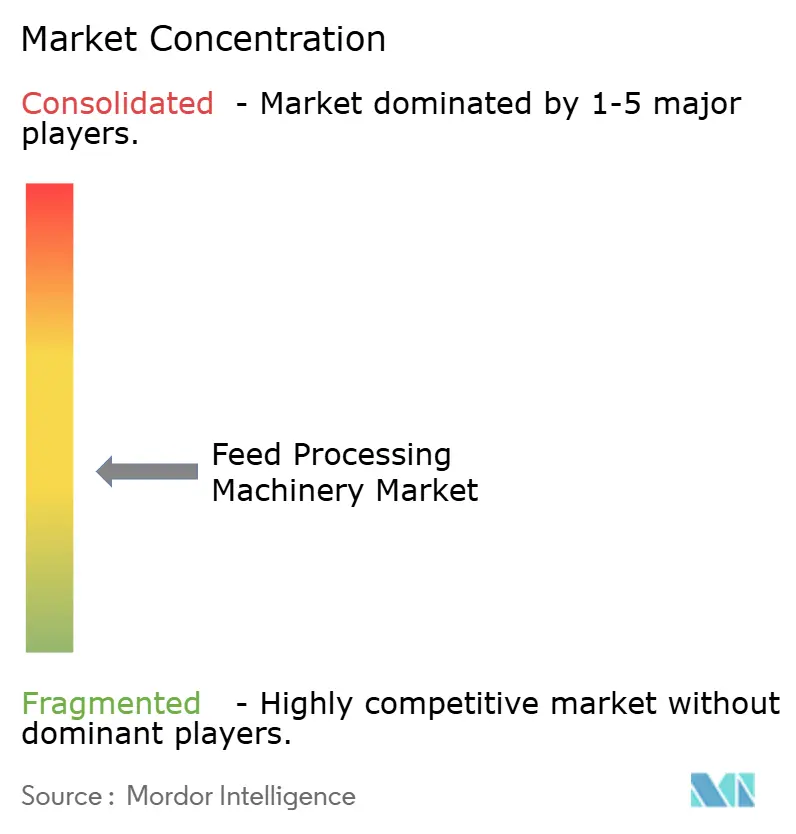
The feed processing machinery market exhibits moderate concentration, with the top five suppliers, Bühler Holding AG, Andritz AG, CPM Holdings, Inc. (American Securities LLC), Jiangsu Muyang Group Co., Ltd., and Amandus Kahl GmbH & Co. KG (KAHL Holding GmbH) accounting for a significant share of the 2024 revenue. This highlights a moderately concentrated competitive landscape. Bühler leads the market, driven by the adoption of PelletingPro and DOSIMIX across Europe and Asia. Andritz follows closely, supported by its large-capacity pellet mills and aquafeed extruders. CPM has a strong presence in North America through poultry and swine franchises, while Jiangsu Muyang benefits from domestic subsidies. Amandus Kahl caters to premium poultry and aquaculture clients by supplying high-compression mills with durability indices exceeding 97%.
Key competitive strategies in the market include digital overlays, modular plant designs, and financing bundles. Bühler and Ynsect have co-developed extruder setups for insect protein pellets, aiming to capture a two-million-metric tons market opportunity by 2030. Wenger, now part of Marel, has introduced containerized two-metric ton-per-hour mills designed for remote cooperatives, appealing to NGOs and development banks. Smaller firms, such as Van Aarsen and Dinnissen from the Netherlands and Germany, are gaining traction in the pet food segment, where frequent recipe changes favor agile mixers and micro-dosing systems.
Patent filings reflect an ongoing innovation race within the market. In 2024, Andritz filed twelve patents related to die coatings that extend lifespan by 30%. Bühler patented a vision system capable of scanning pellet cracks at a speed of 100 meters per minute and adjusting steam levels in real-time. Clextral registered a barrel geometry designed to process insect protein without clogging. ISO Committee 293 is drafting an energy-efficiency benchmark, which could further differentiate suppliers capable of delivering lower kilowatt-hour consumption per metric ton of output.
Feed Processing Machinery Industry Leaders
Bühler Holding AG
Andritz AG
CPM Holdings, Inc. (American Securities LLC)
Jiangsu Muyang Group Co., Ltd.
Amandus Kahl GmbH & Co. KG. (KAHL Holding GmbH)
- *Disclaimer: Major Players sorted in no particular order
Feed Processing Machinery Market Companies Covered in this Report
- Andritz AG
- Bühler Holding AG
- CPM Holdings, Inc. (American Securities LLC)
- Jiangsu Muyang Group Co., Ltd.
- Wenger Manufacturing, Inc. (Marel HF)
- Amandus Kahl GmbH & Co. KG. (KAHL Holding GmbH)
- Skiold Group A/S (Solix Group AB)
- Dinnissen B.V. (Triott Group)
- Clextral S.A.S. (Legris Industries Group)
- Van Aarsen Group B.V.
- The Ken Bratney Co.
- LA MECCANICA S.R.L. DI REFFO
- Jiangsu Zhengchang Group Co., Ltd..
- Lark Engineering Co. (India) Pvt. Ltd.
- FAMSUN Co., Ltd. (Yenher Holdings Berhad)

Market Opportunities and Future Outlook
Opportunities are concentrated in upgrades that translate compliance and product-performance requirements into measurable plant capabilities: automated documentation for ISO 22000-aligned feed safety programs, traceability-ready batching and micro-dosing, and dust and explosion risk mitigation in grinding and handling lines. The demand signal from floating and micro-pellet aquafeed also supports twin-screw extruder platforms and modular extrusion designs in select markets, particularly where changeover time needs to be reduced to accommodate novel inputs such as insect and algae proteins.
Recent Industry Developments in Feed Processing Machinery Market
- May 2026: CPM Holdings Inc. was sold to Rosebank Industries plc for about USD 2.1 billion. The sale transfers ownership to Rosebank and marks a shift in CPM's capital allocation framework and strategic focus across manufacturing footprint and automation initiatives in feed and adjacent process equipment segments.
- May 2026: CPM completed the acquisition of CFE, an EMEA-based provider focused on aftermarket service and equipment refurbishment. This deal expands CPM's regional service capacity and enables lifecycle offerings for feed mills operating at high utilization.
- April 2025: ANDRITZ received an order from Alwadi Poultry Farms Company (Saudi Arabia) for a complete high-capacity feed mill rated at 90 TPH, with commissioning scheduled for the first half of 2026. The project underscores continued investment in large integrated capacity in the Middle East and reinforces demand for turnkey lines that integrate pelleting, batching, and plant automation.


Feed Processing Machinery Market Report Scope and Research Methodology
Market Definition and Coverage
This market covers machinery and equipment used in commercial feed mills to process raw materials into finished animal feed, mainly through grinding, mixing, pelleting, and extrusion, and it is measured in value terms across major regions.
Scope exclusions: It excludes on-farm improvised tools, routine maintenance services, and general-purpose plant utilities that are not dedicated to feed processing steps.
Segments Covered in This Report
- By Function
- Pelleting
- Pellet Mills
- Pellet Dies
- Conditioners
- Others (Coolers, Dryers)
- Mixing
- Mixers
- Dosing and Batching
- Others (Dust-filters)
- Grinding
- Hammer Mills
- Fine Pulverizers
- Others (Roller Mills, Screens)
- Extrusion
- Extruders
- Fat Sprayers
- Others (Pre-conditioners)
- Pelleting
- By Feed Type
- Ruminant Feed
- Poultry Feed
- Swine Feed
- Aquaculture Feed
- Other Animal Feed
- By Geography
- North America
- United States
- Canada
- Mexico
- Rest of North America
- Europe
- Germany
- United Kingdom
- France
- Italy
- Spain
- Rest of Europe
- Asia-Pacific
- China
- Japan
- India
- Rest of Asia-Pacific
- South America
- Brazil
- Argentina
- Rest of South America
- Middle East
- Saudi Arabia
- United Arab Emirates
- Rest of Middle East
- Africa
- South Africa
- Egypt
- Rest of Africa
- North America
Data Sources, Market Sizing, and Validation
Desk Research
Desk research was used to map the industry footprint, pin down consistent scope definitions, and build an initial set of demand and supply signals. We mainly relied on public sources such as FAOSTAT, USDA and other agriculture ministries, Eurostat, and UN Comtrade trade statistics, along with industry bodies such as IFIF and regional feed associations, to anchor feed production, livestock trends, and cross-border equipment flows.
In parallel, we reviewed company annual reports, investor presentations, product catalogs, and credible press coverage to understand the typical machinery lines and how replacement cycles are described. Where public disclosures were limited, a paid company financials and intelligence subscription was used to keep revenue directionally consistent. We also checked a patent database to detect shifts in pelleting and extrusion technology. These examples are not exhaustive, and other sources were used for data collection, validation, and research clarification.
Primary Interviews and Surveys
Primary work was run through expert interviews and structured surveys with feed mill operators, machinery distributors, integrators, and domain specialists tracking mill expansions and capex timing. Because this is a global market, we covered demand signals and pricing logic across APAC, EMEA, and the Americas, then used those inputs to close gaps from public data and to pressure-test assumptions on utilization, replacement, and typical line configurations.
Distribution of primary research fieldwork respondents
| Company type | Respondent position | Region |
|---|---|---|
| Top tier: 31% | CXOs: 20% | APAC: 45% |
| Mid tier: 48% | Functional/Unit leaders: 38% | EMEA: 30% |
| Smaller Players: 21% | Managers: 42% | Americas: 25% |
Market-Sizing & Forecasting
The core model starts with a top-down demand pool built from feed production by animal type and region, and then it is converted into machinery spend using practical equipment intensity and renewal cycles. Because feed output and capacity expansion drive purchases, indicators such as compound feed production volumes, livestock and aquaculture output trends, feed mill capacity additions, typical line utilization, and observed replacement intervals were used as key inputs (illustrative, not exhaustive).
After the first pass, we corroborated the results with selective bottom-up checks, such as rolling up sampled supplier and channel revenues, and validating typical average selling prices against the mix of grinding, mixing, pelleting, and extrusion lines described in the field. Where direct country detail was weak, gaps were handled by proxying from nearby markets with similar feed structures and then adjusting for trade exposure and local manufacturing presence. For forecasting, scenario analysis was applied around feed demand growth and capex sentiment, supported by primary expert consensus on how quickly efficiency upgrades and capacity additions are likely to translate into regional buying.
Data Validation & Update Cycle
Outputs were triangulated across multiple checks, including feed production direction, equipment trade signals, and the implied machinery spend per ton of feed, which we review for abnormal jumps. If a variance could not be explained by a known expansion cycle, currency movement, or pricing change, respondents were re-contacted and inputs were reworked before sign-off.
A multi-step review is followed so the model logic, assumptions, and math are checked by another analyst, and then key totals are sanity-checked against independent market signals. Reports are refreshed annually, and interim updates are made when material events occur that can change demand or pricing. Before delivery, a fresh pass is completed so clients receive the latest updated view.
Mordor Intelligence's Feed Processing Machinery Market Sizing Compared With Other Published Estimates
Published numbers for feed processing machinery often do not match because the scope can be set differently, and the spending conversion logic is not always visible. Differences usually come from what counts as a complete feed mill line, how auxiliary equipment is treated, and whether the estimate is tied back to feed output and replacement behavior.
Some external estimates appear to bundle in a wider set of food and animal feed related processing equipment, or they use a narrower equipment-only view that misses a large part of installed mill upgrades. In Mordor Intelligence, the value is counted only when the machinery is clearly linked to feed processing functions (grinding, mixing, pelleting, extrusion) and then aligned to feed type demand and regional capacity activity before totals are finalized.
Benchmark comparison
| Source | Market Size | Gaps in Research Methodology |
|---|---|---|
| Mordor Intelligence | USD 28.30 B (2025) | |
| Global Consultancy A | USD 24.76 B (2025) | This estimate looks more conservative, which can happen when auxiliary processing equipment and upgrade spend are treated as optional or excluded, and when replacement timing is not explicitly tied to feed output and utilization patterns. |
| Industry Publisher B | USD 29.50 B (2025) | The higher value can be driven by broader inclusion of adjacent equipment categories and different pricing progression assumptions, especially if average selling prices are escalated uniformly without checking regional mix and function-level configuration differences. |
The table indicates that much of the spread can be explained by what is counted as in-scope equipment and by how spend is translated from feed activity into machinery demand. By keeping the sizing steps traceable to feed production signals, line utilization, and realistic replacement behavior, the final number stays balanced and repeatable even when public data is uneven across countries.


Key Questions Answered in the Report
What is the current value of the feed processing machinery market?
It is valued at USD 29.98 billion in 2026 with a forecast to reach USD 40.02 billion by 2031.
Which segment holds the largest revenue share?
Pelleting equipment leads with 37.80% of the feed processing equipment market share in 2025.
Which feed type is growing the fastest?
Aquaculture feed processing posts the highest 9.05% CAGR through 2031 as shrimp, tilapia, and salmon producers switch to formulated diets.
Why are IoT and AI features critical for mills?
Machine-learning platforms lower energy use, cut unplanned downtime by up to 30%, and provide traceability required by ISO 22000.
Page last updated on:





