
Extruded Plastics Market Size and Share
Market Overview
| Study Period | 2022 - 2032 |
|---|---|
| Market Size (2027) | USD 207.95 Million |
| Market Size (2032) | USD 255.81 Million |
| Growth Rate (2027 - 2032) | 4.23 % |
| Fastest Growing Market | Asia-Pacific |
| Largest Market | Asia-Pacific |
| Market Concentration | Low |
Major Players *Disclaimer: Major Players sorted in no particular order Image © Mordor Intelligence. Reuse requires attribution under CC BY 4.0. | |
Extruded Plastics Market Analysis by Mordor Intelligence
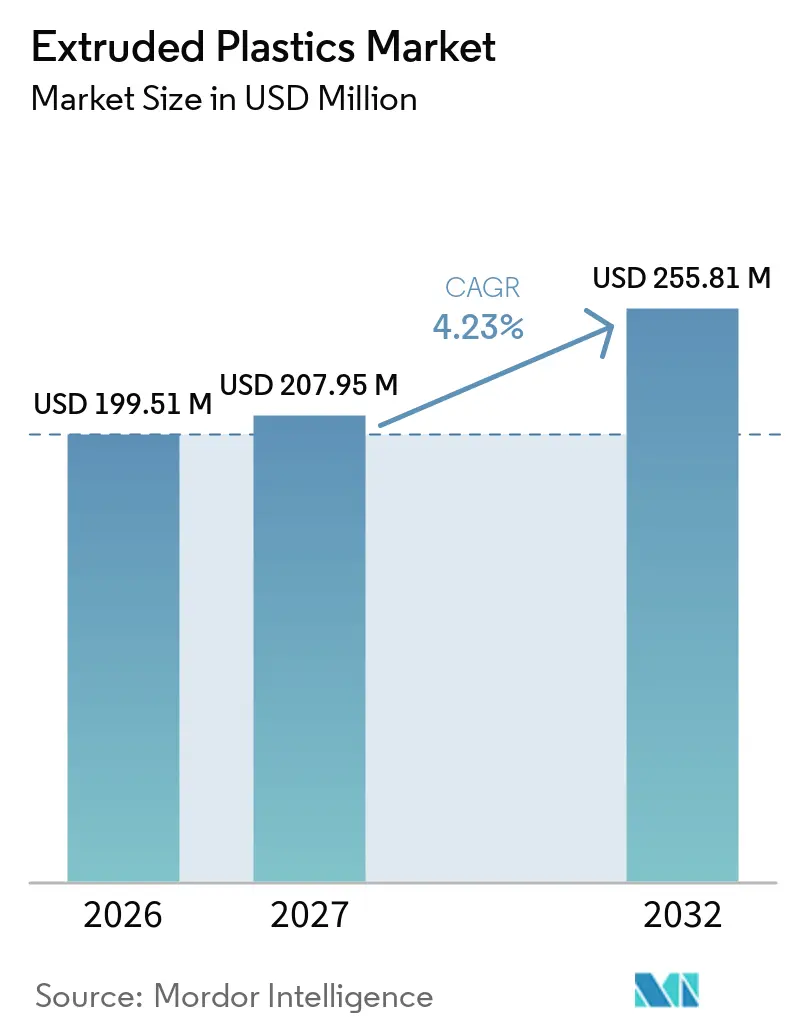
The Extruded Plastics Market size was valued at USD 199.51 billion in 2026 and is estimated to grow from USD 207.95 billion in 2027 to reach USD 255.81 billion by 2032, at a CAGR of 4.23% during the forecast period (2027-2032). The extruded plastics market serves a broad set of applications, including packaging films, pressure pipes, sheets, profiles, wire coatings, and medical tubing. Demand is supported by the need for lighter packaging, reliable water and energy infrastructure, and engineered materials for vehicles and electrical equipment. Producers are also adapting their product lines as packaging rules place greater emphasis on recyclable formats and recycled content. This shift favors resin grades and processing methods that can meet performance requirements while supporting material recovery. Competition differs across the value chain because large resin suppliers have scale advantages, while converters often compete through application knowledge, product quality, and customer service.
Key Report Takeaways
- By resin type, polyethylene held 42.34% of the extruded plastics market share in 2026, while polypropylene is projected to advance at a 4.84% CAGR through 2032.
- By extrusion process, blown-film extrusion held 35.71% of the extruded plastics market share in 2026 and is projected to advance at a 4.79% CAGR through 2032.
- By application, film and sheet held 40.12% of the extruded plastics market share in 2026 and is projected to advance at a 5.15% CAGR through 2032.
- By end-user industry, packaging held 34.88% of the extruded plastics market share in 2026, while construction is projected to advance at a 5.34% CAGR through 2032.
- By geography, Asia-Pacific held 48.56% of the extruded plastics market share in 2026, while North America is projected to advance at a 4.77% CAGR through 2032.
Note: Market numbers in this report are based on Mordor Intelligence's proprietary estimation framework, which combines nine months of actuals with Q4 projections for base year 2026.
Global Extruded Plastics Market Trends and Insights
Drivers Impact Analysis*
| Driver | (~) % Impact on CAGR Forecast | Geographic Relevance | Impact Timeline |
|---|---|---|---|
| Growth in Flexible and Protective Packaging Demand | +1.2% | Global | Short to Medium term (≤ 3 years) |
| Expansion of Infrastructure and Construction Applications | +0.9% | Asia-Pacific core; spillover to South America and MEA; North America secondary | Medium term (2–4 years) |
| Lightweighting in Automotive and Electric Vehicles | +0.7% | North America, Europe, and China core; ASEAN emerging | Medium term (2–4 years) |
| Growth of Electrical, Electronics and Healthcare Applications | +0.6% | Asia-Pacific core; North America and Europe | Medium term (2–4 years) |
| Recycled-Content and Circular-Polymer Adoption | +0.5% | Europe (regulatory front-runner); Global spillover | Long term (≥ 4 years) |
| Source: Mordor Intelligence | |||
Growth in Flexible and Protective Packaging Demand
Flexible packaging remains a large source of demand for the extruded plastics market because mailers, cushioning, stretch hoods, and food packaging all rely on extruded films. Online retail and quick-commerce distribution increase the need for compact protective formats that can be produced at high volumes. Packaging converters are moving from incompatible laminate structures toward mono-material polyethylene designs that can enter established recycling streams. This transition requires multilayer co-extrusion equipment with tighter control of layer design and resin selection. Exxon Mobil Corporation introduced its Signature Polymers portfolio in January 2026, including 25-micron machine-direction-oriented polyethylene films developed with Hosokawa Alpine and BW Converting for recyclable packaging formats. These product developments show why the extruded plastics market is increasingly shaped by joint work between resin suppliers, machinery providers, and converters.
Expansion of Infrastructure and Construction Applications
Infrastructure investment supports demand for extruded high-density polyethylene and polyvinyl chloride products used in water, drainage, cable, and building systems. Plastic pipes offer corrosion resistance, long service life, and heat-fused joints that can reduce leakage risks in water networks. The U.S. Census Bureau reported an annualized USD 729.80 billion in private nonresidential construction spending in April 2026, with utility and transportation activity contributing to project demand. Large-diameter pipe systems require specialized extrusion lines, certified quality control, and technical installation support. Those barriers can create better pricing conditions than standard film production. The extruded plastics market, therefore, benefits when infrastructure budgets translate into long-term procurement for durable pipe and profile applications.
Lightweighting in Automotive and Electric Vehicles
Automotive manufacturers use extruded polymers to reduce component weight and meet demanding requirements for heat resistance and safety. Battery electric vehicles require specific parts, including battery-module housings, charge-port covers, and high-voltage cable conduits. These applications support demand for flame-retardant and thermally stable polypropylene grades. Foamed polypropylene components can weigh 60% to 90% less than solid alternatives, supporting vehicle lightweighting programs.
Growth of Electrical, Electronics and Healthcare Applications
Wire and cable systems use extruded polyvinyl chloride, cross-linked polyethylene, and specialty polymers for insulation and jacketing. Grid renewal, telecommunications expansion, and data-center power systems increase requirements for cables that can manage higher voltage and heat. Healthcare also provides opportunities for controlled high-quality tubing production. A 2025 study in Engineering Research Express found that medical-grade polyvinyl chloride tubing made with 25% post-consumer recycled material met the stated acceptance criteria for Class I non-invasive medical devices. The study also reported a 22% reduction in plastic waste and annual cost savings exceeding USD 442,000 per production line. These results widen the discussion around recycled feedstock in applications that have historically required strict consistency.
Restraints Impact Analysis*
| Restraint | (~) % Impact on CAGR Forecast | Geographic Relevance | Impact Timeline |
|---|---|---|---|
| Volatility in Polymer Feedstock Prices | -0.8% | Global (Asia and Europe most exposed); North America partially insulated | Short term (≤ 2 years) |
| Environmental Compliance and Extended Producer Responsibility Costs | -0.6% | Europe and North America (UK, EU, seven US states); regulatory influence broadening globally | Medium term (2–4 years) |
| Inconsistent Quality of Post-Consumer Recycled Feedstock | -0.4% | Global | Long term (≥ 4 years) |
| Source: Mordor Intelligence | |||
Volatility in Polymer Feedstock Prices
Ethylene and propylene costs can change quickly because their production economics depend on naphtha, crude oil, and natural gas liquids. Asian and European producers are generally more exposed to naphtha-linked price movements, while many U.S. Gulf Coast producers use natural gas liquids. Volatile feedstock prices can lead converters to reduce inventories, lower operating rates, or defer purchases of new equipment. Producers with stable resin access and efficient operations can protect supply commitments during periods of price disruption. The extruded plastics market also faces uneven margin pressure because not every converter can pass higher resin costs through to customers at the same pace.
Environmental Compliance and Extended Producer Responsibility Costs
Extended Producer Responsibility programs add a material-linked cost to packaging supplied into regulated markets. The United Kingdom published a 2025 base fee of GBP 423 (approximately USD 558) per metric ton for plastic packaging under its packaging EPR framework[1]. Recyclability-linked fee modulation is scheduled to influence product economics from 2026 to 2027. Mono-material polyethylene and polypropylene structures are better placed to meet these requirements than difficult-to-separate multilayer formats. The requirement encourages redesign, traceability, and investment in recycled-content supply chains. It can also increase commercial pressure on converters that continue to rely on formats with weak end-of-life outcomes.
*Our forecasts treat driver/restraint impacts as directional, not additive. The impact forecasts reflect baseline growth, mix effects, and variable interactions.
Segment Analysis
By Resin Type: Polyethylene Leads Revenue While Polypropylene Supports Specialty Demand
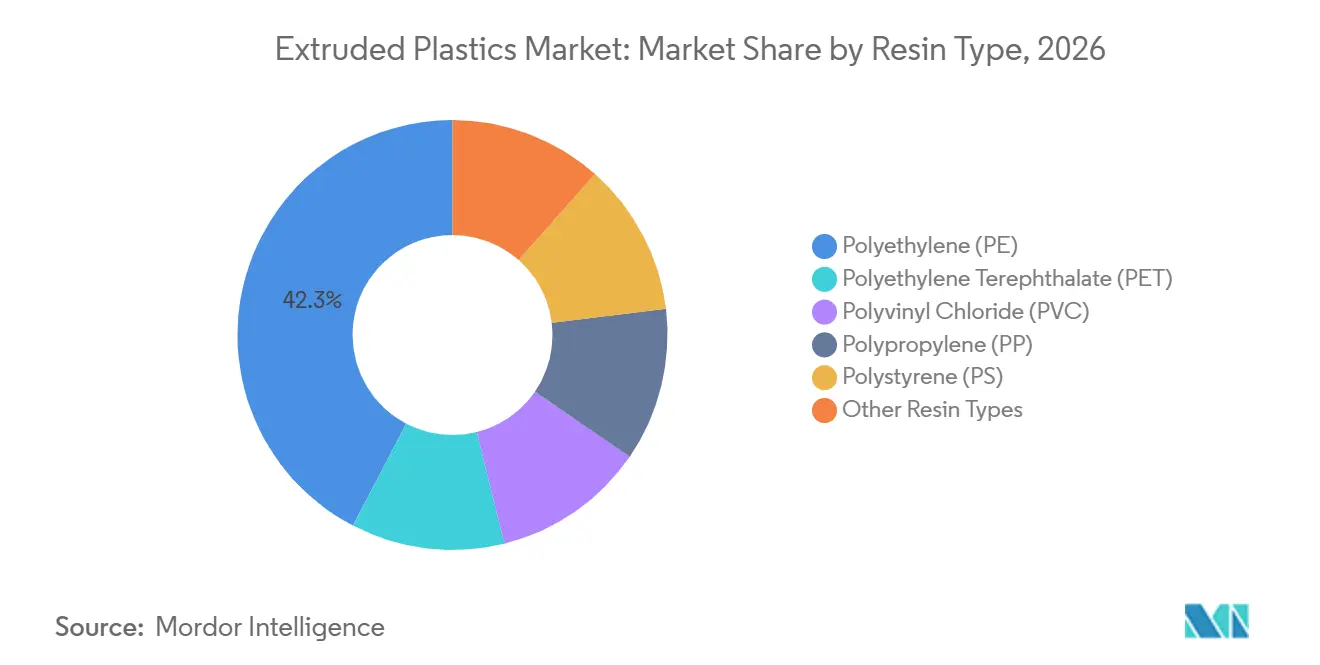
Polyethylene held 42.34% of the extruded plastics market share in 2026, reflecting its established role in film and pipe production. Linear low-density polyethylene supports stretch wrap and multilayer food packaging because it provides flexibility and puncture resistance. High-density polyethylene is widely used in pressure pipes and similar products that require stiffness and chemical resistance. Low-density polyethylene remains important in extrusion coating and specialty films that require clarity and flexibility. Polyvinyl chloride serves rigid pipe, window-profile, and wire-insulation applications where fire performance and long service life are important. Polystyrene and polyethylene terephthalate are used in packaging and thermoforming formats where stiffness and optical properties matter. The broad range of resin choices allows converters to select material properties around the needs of each application. It also means that resin availability can change product costs across several end uses at the same time.
Polypropylene is projected to expand at a 4.84% CAGR through 2032, making it the fastest-growing resin category in the extruded plastics industry. Its lower density can support lightweight parts, while its higher thermal tolerance is useful in automotive and healthcare uses. These properties support applications such as battery-related parts, under-the-hood components, and products that need sterilization resistance. In July 2025, LyondellBasell Industries Holdings B.V. announced that its GXLYB (Genox LyondellBasell New Material Co., Ltd.) joint venture received U.S. Food and Drug Administration No Objection Letters for mechanically recycled polypropylene and high-density polyethylene processes. The approvals enable CirculenRecover materials to be considered for personal-care and cosmetics packaging applications, subject to the relevant regulatory conditions. Borouge and Borealis GmbH introduced Recleo in December 2025 as a recycled polyolefin brand intended for use with virgin grades in film extrusion. These actions show that recycled polyolefins are becoming part of mainstream resin portfolio development. They also increase the importance of traceability and processing consistency for converters.

By Extrusion Process: Blown-Film Extrusion Retains Its Broad Packaging Role
Blown-film extrusion held 35.71% of the extruded plastics market in 2026 and serves a broad set of flexible packaging formats. The process can produce single-layer and multilayer films for grocery bags, agricultural films, stretch hoods, and protective packaging. Its continuous production process supports high-volume output and provides useful flexibility in film properties. Bubble cooling enables orientation that improves film strength and handling characteristics. Converters use the process for polyethylene structures that need a balance between toughness, thickness, and cost. Growing requirements for recyclable packaging are increasing attention on all-polyethylene multilayer structures. These designs require careful selection of compatible layers to maintain film performance and recyclability. The process remains relevant because packaging customers need both material efficiency and dependable supply.
Blown-film extrusion is projected to advance at a 4.79% CAGR through 2032, supported by capacity investment in flexible packaging centers. Multilayer co-extrusion can support barrier, sealing, and strength functions within a single film design. It can also increase processing complexity because layer compatibility affects adhesion and final material recovery. Cast-film extrusion supports applications that require surface clarity and controlled dimensions, including food packaging, hygiene products, and industrial release films. Sheet extrusion provides thicker gauges for thermoforming, construction cladding, and industrial partitions. Equipment suppliers are developing more flexible machinery platforms that can adapt to different film formats. This matters to converters because changing customer needs can make dedicated capacity less attractive. The extruded plastics market benefits when processors can serve multiple formats without creating unnecessary material loss.
By Application: Film and Sheet Anchor Market Share and Growth
Film and sheet held 40.12% of the extruded plastics market in 2026 and is projected to advance at a 5.15% CAGR through 2032. Food packaging remains a major outlet because it requires controlled barrier, sealing, and food-contact performance. Regulatory attention to migration and certain additives is encouraging converters to use higher-specification film grades. These materials can offer more stable performance than standard commodity film products. Agricultural films also support crop protection, moisture management, and silage applications. Construction films are used in vapor barriers and related building uses. The scale of these outlets ensures that film demand remains central to resin purchasing decisions. It also increases the commercial importance of recycling systems for flexible materials.
Pipe applications have a different demand pattern because they are tied to long asset lives and infrastructure spending. High-density polyethylene and polyvinyl chloride are key materials for water, drainage, and cable-protection systems. Aging municipal networks in developed economies require replacement, while growing cities need new installations. Supply conditions can tighten when pipe and film producers compete for similar polymer feedstocks. Mitsubishi Chemical Group Corporation completed a USD 20.3 million expansion at its Reading, Pennsylvania, facility, establishing a Center of Excellence for general and advanced engineering plastics extrusion. Specialized applications can support higher value per kilogram, but they require tighter process control and closer customer qualification.
By End-User Industry: Packaging Remains the Largest Outlet and Construction Grows Faster
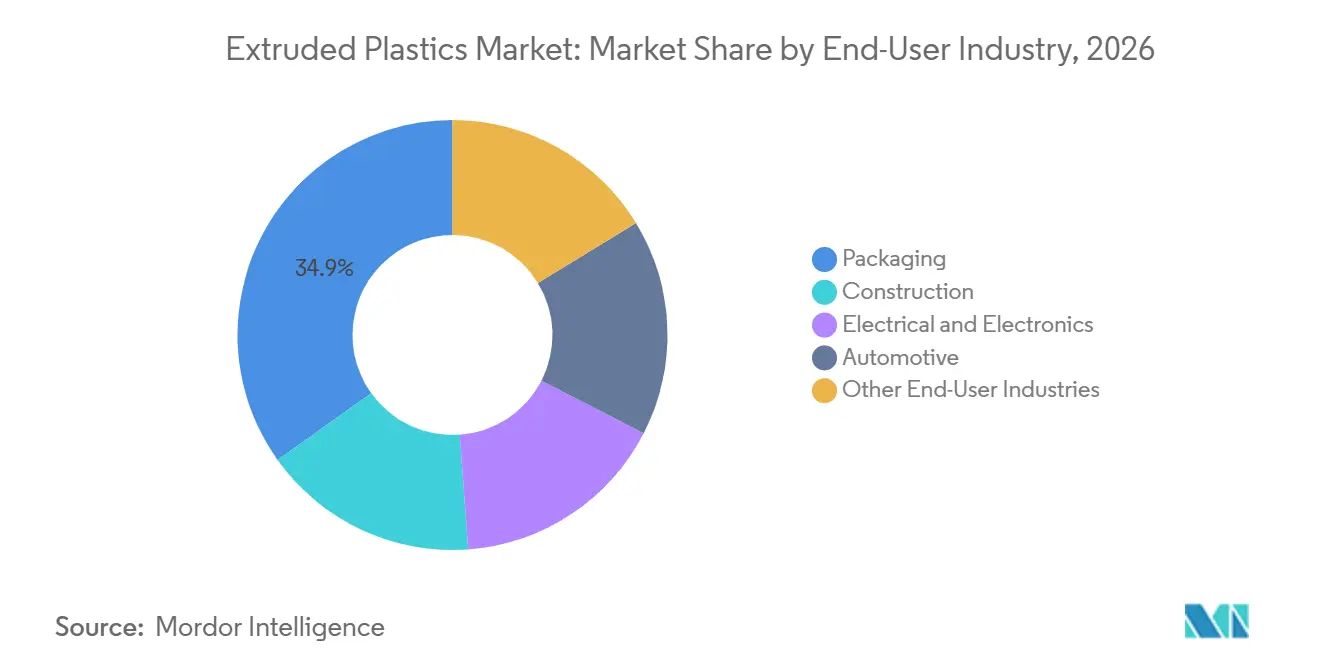
Packaging held 34.88% of the extruded plastics market share in 2026. The segment uses films, sheets, and rigid formats across food, consumer goods, e-commerce, and industrial distribution. Flexible packaging depends on a reliable supply of polyethylene and polypropylene resins with consistent processing properties. Brand owners are also seeking formats that meet recyclability and recycled-content requirements without reducing package performance. This raises the importance of mono-material designs and quality-controlled recycled feedstock. Packaging demand is spread across many consumer categories, which provides some resilience when any single end market weakens. At the same time, fee programs and material restrictions can quickly alter preferred package structures. The extruded plastics market responds through resin development, new film designs, and converter investment.
Construction is projected to advance at a 5.34% CAGR through 2032, supported by infrastructure programs and wider use of plastic building products. Pipes, window profiles, insulation boards, drainage systems, and geomembranes all contribute to demand. Building codes are increasingly focused on tested material performance rather than customary material choices. This can support wider use of plastic products where they meet strength, durability, and fire-safety requirements. Electrical and electronics demand comes from grid upgrades, cable replacement, and new data-center power systems. Automotive demand is changing as electric vehicles increase the need for battery-related components and high-temperature cable protection. Agriculture, healthcare, mining, and renewable energy remain additional end-user outlets. In July 2026, LyondellBasell Industries Holdings B.V., Mondelēz International, Amcor, and Taghleef Industries announced a flexible packaging collaboration using CirculenRevive polymers. The collaboration demonstrated food-contact packaging with 75% recycled content, supported by International Sustainability and Carbon Certification PLUS mass-balance certification.
Geography Analysis
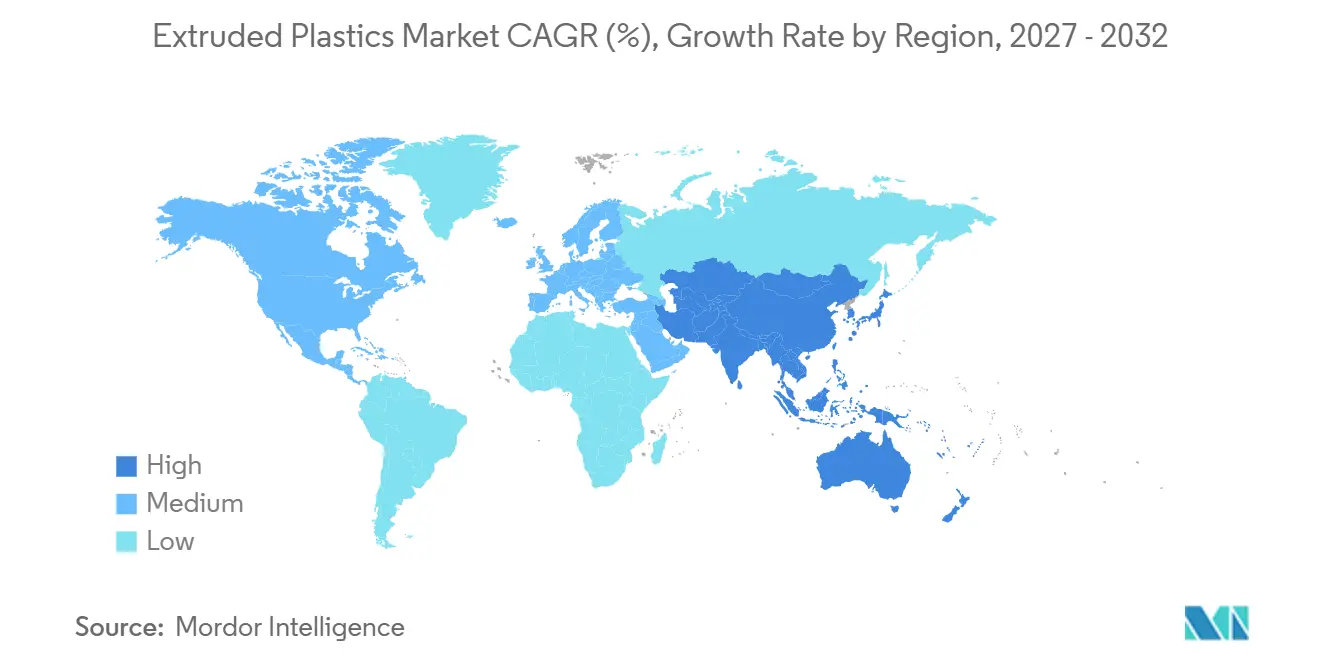
Asia-Pacific held 48.56% of the extruded plastics market share in 2026, supported by its extensive polymer conversion base and broad manufacturing activity. China is an important production and conversion center for packaging, construction, automotive, and consumer goods applications. India adds demand through urban development, expanding retail distribution, and investment in water networks. Japan and South Korea contribute higher-value output in medical tubing, automotive films, and electronics-related profiles. Vietnam and Thailand continue to attract investment in packaging conversion for export-oriented food and consumer goods supply chains. The regional mix gives the extruded plastics market exposure to both high-volume commodity products and specialized applications. It also increases the importance of reliable local resin supply and converter capacity. Producers operating across the region need to adjust products to different regulatory requirements, end-user specifications, and collection systems.
North America is projected to advance at a 4.77% CAGR through 2032. The region benefits from established resin production, a capital-intensive converting base, and demand from infrastructure, packaging, and automotive manufacturing. U.S. producers using natural gas liquids can have a cost advantage when crude-linked feedstock prices rise. Canada contributes to the demand for pipe, geomembranes, and construction products used in mining, oil sands, and building activity. Mexico supports growth through its automotive manufacturing base and demand for packaging and industrial products. Packaging Extended Producer Responsibility requirements in several U.S. states create a complex compliance environment for suppliers. Companies must account for different fee structures and recyclability definitions when serving customers across the region. This pushes resin suppliers and converters to provide more detailed material documentation and design support.
Europe remains a key market for higher-specification packaging and design-for-recycling investment. Regulation (EU) 2025/40, the Packaging and Packaging Waste Regulation, is steering converters toward recyclable mono-material polyethylene and polypropylene structures[2]. The framework can reduce the use of difficult-to-recycle barrier laminates when compliant alternatives meet product requirements. South America provides demand through agricultural films, construction applications, and fast-moving consumer goods packaging. Brazil and Argentina are important outlets because their agricultural and consumer sectors use a range of flexible films, pipes, and profiles. The Middle East and Africa also offer scope for new demand as infrastructure investment and local petrochemical development increase. Saudi Arabia and the United Arab Emirates are investing in infrastructure while Gulf producers seek more downstream conversion opportunities. Regional market conditions remain diverse, so success depends on matching product design, price, and service to local requirements.
Competitive Landscape
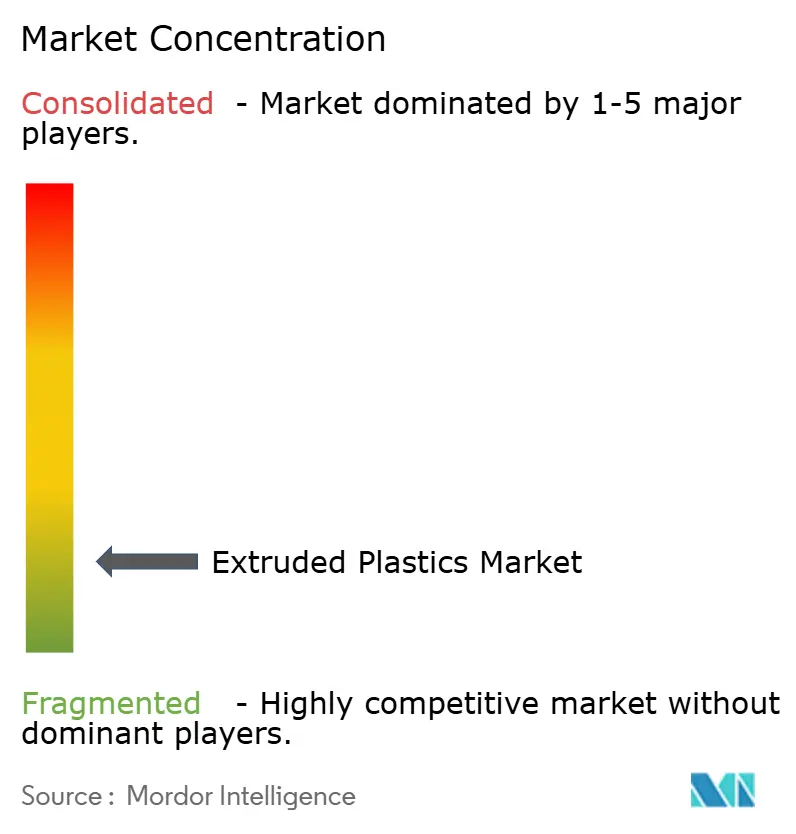
The extruded plastics market is highly fragmented, with the top five players including Westlake Corporation, Formosa Plastics Corporation, JM EAGLE, INC., LyondellBasell Industries Holdings B.V., and Sigma Plastics Group. Downstream converters are more numerous and often compete in regional or product-specific niches. This structure means resin suppliers focus on feedstock integration, technology, and portfolio quality, while converters focus on operational efficiency and customer specifications. BASF introduced Ultradur RC1 compounds in September 2026, with grades containing up to 30% post-consumer recycled polyethylene terephthalate for automotive structural applications. The launch reflects the value placed on materials that can meet engineering requirements while using recycled feedstock. Producers are also building customer relationships around qualification support, processing guidance, and documented sustainability claims. These capabilities can matter as much as resin price for regulated or technically demanding applications.
Borealis GmbH is expanding its recyclable polypropylene capability through the planned High Melt Strength polypropylene line at Burghausen. The line is intended to strengthen supply for foamed polypropylene applications in automotive, consumer products, and construction. LyondellBasell Industries Holdings B.V. has pursued circular-polymer applications through its CirculenRecover and CirculenRevive product platforms. These initiatives address customer demand for recycled content, food-contact support, and verifiable mass-balance claims. Exxon Mobil Corporation has also introduced machine-direction-oriented polyethylene film solutions intended to support recyclable mono-material packaging. The strategy across these examples is to improve the performance of recyclable materials rather than treat circularity as a separate product category. It can deepen customer relationships because processors need close technical support when changing established material structures.
Extruded Plastics Industry Leaders
-
Westlake Corporation
-
Formosa Plastics Corporation
-
JM EAGLE, INC.
-
LyondellBasell Industries Holdings B.V.
-
Sigma Plastics Group
- *Disclaimer: Major Players sorted in no particular order
Recent Industry Developments
- July 2026: LyondellBasell Industries Holdings B.V. collaborated with Mondelēz International, Amcor, and Taghleef Industries to develop flexible packaging using recycled CirculenRevive polymers. The development supports the extruded plastics market by increasing demand for recycled polymer films used in flexible packaging.
- April 2025: The Japan Steel Works’ certified extruder service provider opened an after-sales facility in Haryana, India, to support polyolefin extrusion equipment. The facility strengthened local maintenance and technical support, supporting continued expansion of plastic extrusion capacity in India.
Global Extruded Plastics Market Report Scope
Extruded plastics are polymer products formed by forcing molten or softened plastic through a shaped die to produce continuous profiles and structures. The extrusion process enables consistent production of plastic products with controlled dimensions and properties for a wide range of industrial and commercial uses.
The Extruded Plastics Market is segmented by resin type, extrusion process, application, end-user industry, and geography. By resin type, the market is segmented into polyethylene (PE), including low-density polyethylene, high-density polyethylene, and linear low-density polyethylene, polyvinyl chloride (PVC), polypropylene (PP), polystyrene (PS), polyethylene terephthalate (PET), and other resin types. By extrusion process, the market is segmented into blown-film extrusion, cast-film extrusion, sheet extrusion, and other extrusion processes. By application, the market is segmented into pipe, film and sheets, and other applications. By end-user industry, the market is segmented into packaging, construction, electrical and electronics, automotive, and other end-user industries. The report also covers the market size and forecasts for extruded plastics across 19 countries. For each segment, the market sizing and forecasts have been done on the basis of value (USD).
| Polyethylene (PE) | Low-Density Polyethylene |
| High-Density Polyethylene | |
| Linear Low-Density Polyethylene | |
| Polyvinyl Chloride (PVC) | |
| Polypropylene (PP) | |
| Polystyrene (PS) | |
| Polyethylene Terephthalate (PET) | |
| Other Resin Types |
| Blown-Film Extrusion |
| Cast-Film Extrusion |
| Sheet Extrusion |
| Other Extrusion Processes |
| Pipe |
| Film and Sheet |
| Other Applications |
| Packaging |
| Construction |
| Electrical and Electronics |
| Automotive |
| Other End-User Industries |
| Asia-Pacific | China |
| India | |
| Japan | |
| South Korea | |
| ASEAN Countries | |
| Rest of Asia-Pacific | |
| North America | United States |
| Canada | |
| Mexico | |
| Europe | Germany |
| United Kingdom | |
| France | |
| Italy | |
| Spain | |
| NORDIC Countries | |
| Russia | |
| Rest of Europe | |
| South America | Brazil |
| Argentina | |
| Rest of South America | |
| Middle East and Africa | Saudi Arabia |
| United Arab Emirates | |
| South Africa | |
| Egypt | |
| Rest of Middle East and Africa |
| By Resin Type | Polyethylene (PE) | Low-Density Polyethylene |
| High-Density Polyethylene | ||
| Linear Low-Density Polyethylene | ||
| Polyvinyl Chloride (PVC) | ||
| Polypropylene (PP) | ||
| Polystyrene (PS) | ||
| Polyethylene Terephthalate (PET) | ||
| Other Resin Types | ||
| By Extrusion Process | Blown-Film Extrusion | |
| Cast-Film Extrusion | ||
| Sheet Extrusion | ||
| Other Extrusion Processes | ||
| By Application | Pipe | |
| Film and Sheet | ||
| Other Applications | ||
| By End-User Industry | Packaging | |
| Construction | ||
| Electrical and Electronics | ||
| Automotive | ||
| Other End-User Industries | ||
| By Geography | Asia-Pacific | China |
| India | ||
| Japan | ||
| South Korea | ||
| ASEAN Countries | ||
| Rest of Asia-Pacific | ||
| North America | United States | |
| Canada | ||
| Mexico | ||
| Europe | Germany | |
| United Kingdom | ||
| France | ||
| Italy | ||
| Spain | ||
| NORDIC Countries | ||
| Russia | ||
| Rest of Europe | ||
| South America | Brazil | |
| Argentina | ||
| Rest of South America | ||
| Middle East and Africa | Saudi Arabia | |
| United Arab Emirates | ||
| South Africa | ||
| Egypt | ||
| Rest of Middle East and Africa | ||
Key Questions Answered in the Report
What is the size of the extruded plastics market?
The extruded plastics market was valued at USD 199.51 billion in 2026 and is estimated to grow from USD 207.95 billion in 2027 to USD 255.81 billion by 2032, at a CAGR of 4.23% during 2027-2032.
Which resin held the largest share in 2026?
Polyethylene held 42.34% of the market share in 2026.
Which extrusion process is projected to advance fastest through 2032?
Blown-film extrusion is projected to advance at a 4.79% CAGR through 2032.
Which application held the largest share in 2026?
Film and sheet held 40.12% of the market share in 2026.