
Market Overview
| Study Period | 2020 - 2031 |
|---|---|
| Forecast Data Period | 2026 - 2031 |
| Base Year Market Size (2025) | USD 2.26 Billion |
| Market Size (2026) | USD 2.4 Billion |
| Market Size (2031) | USD 3.22 Billion |
| Growth Rate (2026 - 2031) | 6.05 % |
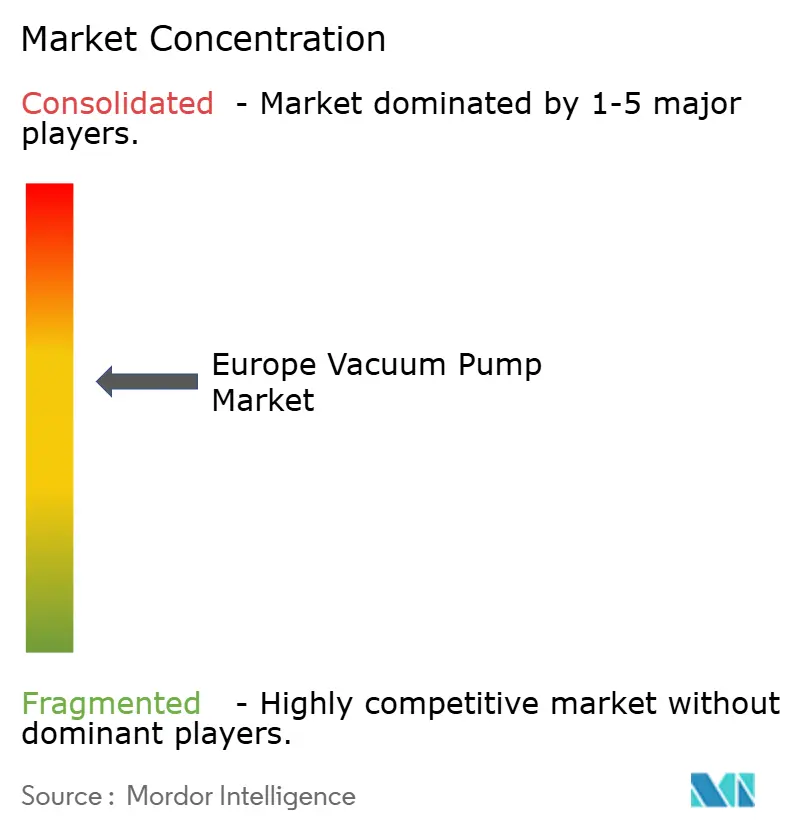
| Market Concentration | Medium |
Major Players
*Disclaimer: Major Players sorted in no particular order Image © Mordor Intelligence. Reuse requires attribution under CC BY 4.0. |
|
Europe Vacuum Pump Market Analysis by Mordor Intelligence
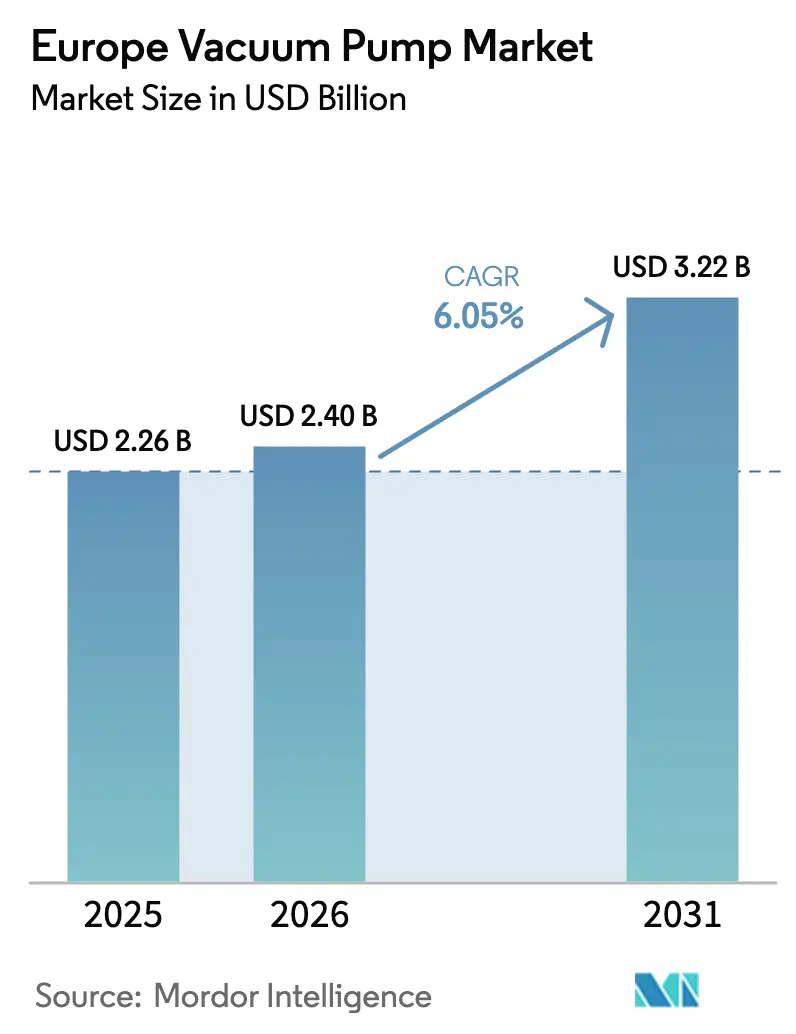
The Europe vacuum pump market size was valued at USD 2.26 billion in 2025 and estimated to grow from USD 2.4 billion in 2026 to reach USD 3.22 billion by 2031, at a CAGR of 6.05% during the forecast period (2026-2031). Persistent fab expansions, battery‐cell gigafactories, and hydrogen-electrolyser roll-outs keep demand resilient despite margin pressure from Asian imports. Semiconductor manufacturers specify ever-lower base pressures, which accelerates turbomolecular pump adoption, while EU PFAS rules are steering users toward dry, oil-free designs. Germany’s industrial ecosystem anchors current volume, but pan-EU decarbonisation programs, quantum-computing research, and pharmaceutical freeze-drying capacity upgrades diversify the addressable base. As a result, the Europe vacuum pump market continues to pivot from commodity equipment to high-performance, service-centric offerings that raise switching costs and embed suppliers deeper into customer workflows.
Key Report Takeaways
- By pump type, rotary vane units led with 31.45% revenue share in 2025, while turbomolecular pumps are projected to expand at a 7.42% CAGR through 2031.
- By vacuum level, rough-vacuum applications captured 45.30% of the Europe vacuum pump market share in 2025, but high and ultra-high vacuum segments are advancing at an 8.35% CAGR to 2031.
- By end-user industry, semiconductor and electronics accounted for 27.10% of the Europe vacuum pump market size in 2025; battery cell manufacturing is the fastest-growing application at a 7.05% CAGR.
- By drive and lubrication, oil-sealed pumps still held 54.20% share of the Europe vacuum pump market size in 2025, yet dry pumps are expanding at an 8.02% CAGR.
- By geography, Germany contributed 23.70% of the Europe vacuum pump market in 2025, while the Netherlands is forecast to record the highest 7.12% CAGR through 2031.
Note: Market size and forecast figures in this report are generated using Mordor Intelligence’s proprietary estimation framework, updated with the latest available data and insights as of 2026.
Europe Vacuum Pump Market Trends and Insights
Drivers Impact Analysis*
| Driver | ( ~ ) % Impact on CAGR Forecast | Geographic Relevance | Impact Timeline |
|---|---|---|---|
| Surge in semiconductor & MEMS fab expansions | 1.80% | Germany, Netherlands, France | Medium term (2-4 years) |
| Shift toward dry, oil-free pumps in clean processes | 1.20% | EU-wide, strongest in Germany, Netherlands | Long term (≥ 4 years) |
| Pharma & biotech freeze-drying capacity build-out | 0.90% | Germany, Switzerland, France, UK | Medium term (2-4 years) |
| Hydrogen-electrolyser gigafactories need high vacuum | 0.70% | Netherlands, Denmark, Germany | Long term (≥ 4 years) |
| Source: Mordor Intelligence | |||
Surge in Semiconductor and MEMS Fab Expansions
Europe’s push to secure 20% of global chip output drives unprecedented vacuum demand. GlobalFoundries is investing EUR 1.1 billion (USD 1.2 billion) to raise Dresden capacity to 1.5 million wafers annually, while Infineon’s EUR 5 billion (USD 5.4 billion) Smart Power Fab comes online in 2026, each specifying 10⁻⁷ mbar base pressures for advanced nodes. [1]Infineon Technologies AG, “Infineon receives building permit for final construction phase of Smart Power Fab in Dresden”, Infineon, infineon.com New wide-band-gap lines such as Nexperia’s SiC/GaN facility tighten particulate-control tolerances, lifting turbomolecular pump penetration. The Europe vacuum pump market therefore realigns around high-flow, contamination-free systems that bundle pumps with abatement and condition-monitoring modules.
Shift Toward Dry, Oil-Free Pumps in Clean Processes
EU Regulation 2024/573 phases out long-chain PFAS lubricants and imposes recovery mandates, accelerating the migration from oil-sealed to dry pumps. Dry screw, claw, and scroll technologies mitigate vapor contamination and lower disposal costs, a key selling point for pharmaceutical and food processors facing stricter hazard-analysis audits. OEMs such as Pfeiffer Vacuum respond with DuoVane oil-free rotary designs that retain familiar maintenance intervals while eliminating PFAS exposure risks. As compliance windows close, Europe vacuum pump market participants monetize retrofit services and predictive-maintenance subscriptions.
Pharma and Biotech Freeze-Drying Capacity Build-Out
EMA quality directives push drug makers to add redundancy and contamination control to freeze-dryers, where chamber pressures fluctuate between 10⁻¹ and 10⁻³ mbar. OEMs like Leybold promote dry-running pumps that prevent hydrocarbons from entering sterile zones and endure thermal shocks from –50 °C to +60 °C cycles. Pump makers capture value through validation support, GMP documentation, and rapid-response field service. The Europe vacuum pump industry leverages these high-margin aftermarket streams to offset price competition in standard rotary segments.
Hydrogen-Electrolyser Gigafactories Need High Vacuum
EU-funded SOEC projects demand 10⁻⁶ mbar environments during cell sintering and sealing, linking vacuum performance directly to electrolyser efficiency. The TopSOEC program’s EUR 94 million (USD 102 million) grant exemplifies the shift toward mass-manufactured green hydrogen systems, while EBARA’s 16 billion yen (USD 105 million) liquid-hydrogen test center underlines the equipment roadmap. Suppliers able to engineer corrosion-resistant, helium-tight pumps earn first-mover advantages as national hydrogen strategies scale to 10 million tonnes output by 2030.
Restraints Impact Analysis*
| Restraint | ( ~ ) % Impact on CAGR Forecast | Geographic Relevance | Impact Timeline |
|---|---|---|---|
| High CAPEX of advanced dry/turbo pumps | –0.8% | EU-wide, particularly Germany, France | Short term (≤ 2 years) |
| Asian import price pressure squeezing margins | –0.6% | EU-wide, strongest in price-sensitive segments | Medium term (2-4 years) |
| Source: Mordor Intelligence | |||
High CAPEX of Advanced Dry/Turbo Pumps
Turbomolecular pumps cost 3-5 times more than oil-sealed rotary units, reflecting magnetic-bearing and position-control complexity. PFAS-free seals add 15-25% to bill-of-materials, slowing adoption in SMEs with stretched payback horizons. Although semiconductors absorb these premiums, cost-sensitive packaging, plastics, and woodworking lines defer upgrades, limiting near-term penetration for high-end models in the Europe vacuum pump market.
Asian Import Price Pressure Squeezing Margins
VDMA data show 2024 vacuum revenues slipping despite stable pump output as low-cost Asian brands undercut European list prices by up to 30% in rotary vane and liquid-ring categories. Local champions defend share through acquisitions—Atlas Copco closed 33 deals in 2024 alone—and by bundling equipment with 24/7 service contracts. Nonetheless, commoditized segments face persistent gross-margin compression that narrows R&D budgets.
*Our forecasts treat driver/restraint impacts as directional, not additive. The impact forecasts reflect baseline growth, mix effects, and variable interactions.
Segment Analysis
By Pump Type: Rotary Dominance Faces Kinetic Challenge
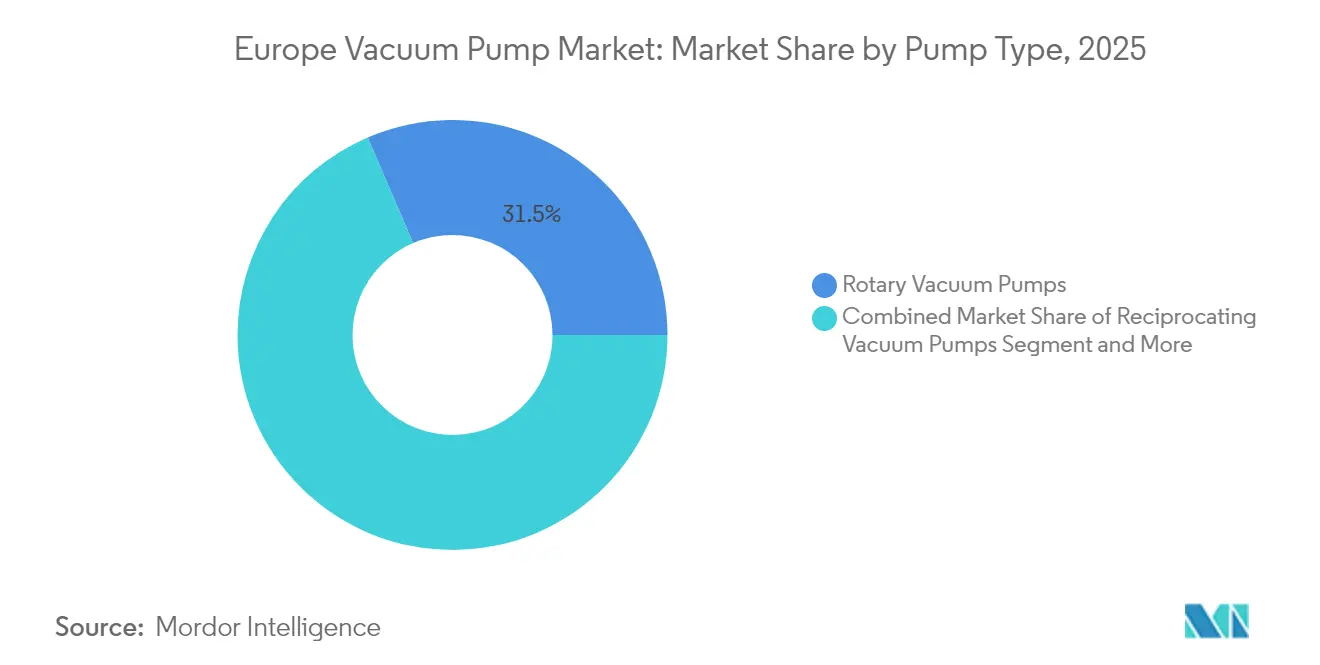
Rotary vane designs held 31.45% revenue in 2025, underpinning the largest slice of the Europe vacuum pump market. The familiar architecture serves packaging, material handling, and general industrial tasks where 10⁻¹ to 10⁻³ mbar suffices. Yet turbomolecular units post a 7.42% CAGR through 2031 as fabs, quantum-computing labs, and surface-science tools impose ultra-high vacuum thresholds. Hybrid rotary-screw designs such as Pfeiffer’s DuoVane promise oil-free operation while preserving port-to-port interchangeability, easing migration costs.
Within kinetic pumping, turbo, diffusion, and ejector technologies fill the <10⁻⁷ mbar niche, justifying premium price-points. Entrapment pumps—getter and cryo—extend the spectrum to 10⁻¹⁰ mbar for gravitational-wave observatories and cold-atom systems. As specialist requirements proliferate, the Europe vacuum pump market size for kinetic and entrapment categories is projected to outgrow rotary sales by value after 2030, even though volumetric shipments remain lower.



By Vacuum Level: High-Vacuum Applications Accelerate
Rough-vacuum duties represented 45.30% revenue in 2025, anchored by food packaging and thermoforming lines. Medium vacuum applications—coatings, analytical instruments, legacy semiconductor steps—span 10⁻³ to 10⁻⁷ mbar and integrate roots-blowers or multistage dry screws as backing pumps. High and ultra-high segments, however, are growing at an 8.35% CAGR as advanced logic nodes, EUV lithography, and MBE systems scale.
Quantum-computing prototypes now specify continuous 10⁻¹⁰ mbar environments, necessitating bakeable chambers and low-outgassing pump materials. The Europe vacuum pump market size for ultra-high vacuum services thus expands alongside European Research Council programs, while high-vacuum growth parallels AI chip volumes at 12 nm and below. Process toolmakers respond by offering modular pump racks that cascade from fore-vacuum to turbo stages, compressing footprint and simplifying service.
By End-User Industry: Semiconductor Leadership, Battery Growth
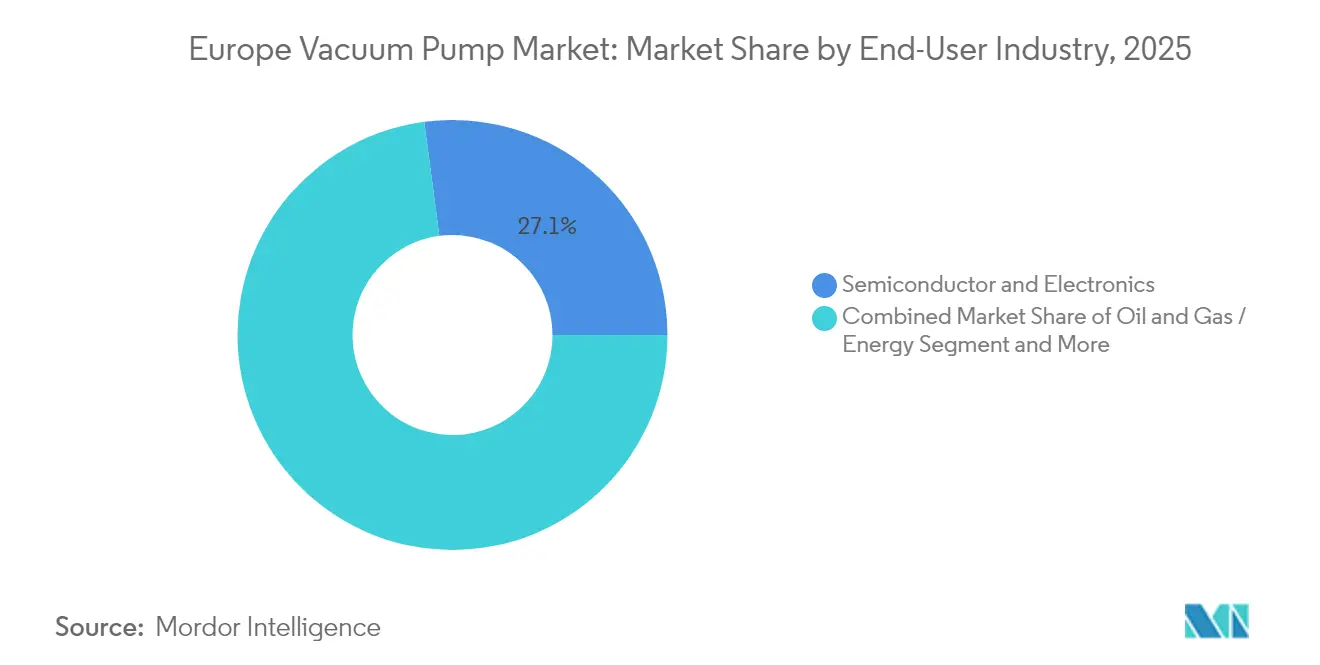
Semiconductors captured 27.10% value in 2025, reaffirming their role as the strategic anchor tenant of the Europe vacuum pump market. Each 30,000 m² fab module requires hundreds of pumps across etch, deposition, and implant stations; tool density escalates further at advanced nodes. Battery cell manufacturing, aided by EUR 450 million (USD 488 million) EIB funding for the Douai plant, records a 7.05% CAGR as electrolyte drying and pouch sealing add vacuum stages.
Chemical and petrochemical operators modernize distillation and solvent-recovery loops, demanding corrosion-resistant screws and liquid-ring systems. Pharma multiplies freeze-drying skids for biologics, while food packaging maintains a steady pull for rotary vane workhorses. This end-market diversity shields suppliers from single-sector cyclicality and sustains a balanced revenue pyramid across the Europe vacuum pump industry.
By Drive/Lubrication: Dry Transition Accelerates
Oil-sealed machines still represent 54.20% 2025 revenue, favored for simplicity and lower first cost. Yet dry screws, claws, and scrolls log an 8.02% CAGR under PFAS scrutiny. Semiconductor fabs already mandate dry pumps to avert backstreaming, and pharmaceutical users follow to meet GMP hazard-analysis thresholds. Based on announced retrofit programs, the Europe vacuum pump market share for dry configurations may surpass 50% of new installations by 2028, although the installed base evolves more slowly due to long service lives.
Service models also diverge: oil-sealed units need frequent oil changes, whereas dry pumps require periodic seal kit and bearing cartridge swaps. OEMs exploit this by bundling long-term service agreements that lock in revenue and ensure genuine-part usage, offsetting shorter mechanical overhaul cycles.
Geography Analysis
Germany generated 23.70% of the Europe vacuum pump market in 2025 thanks to dense automotive, semiconductor, and chemical clusters. GlobalFoundries and Infineon expansions intensify local turbomolecular demand, while battery-pack automation in Saxony adds rough-vacuum volume. German OEMs leverage DAkkS-certified calibration services to uphold precision requirements, turning service responsiveness into a differentiator. A skilled-labor deficit, however, caps ramp-up speed and reinforces vendor lock-in.
The Netherlands leads growth with a 7.12% CAGR through 2031. Hydrogen-hub projects around Rotterdam and ternary-cathode battery lines along the North Sea Canal necessitate corrosion-resistant, oil-free pumps at scale. EU-sponsored SOEC programs embed Dutch-Danish supply chains that favor European pump suppliers, buffering them against low-cost imports. Local integrator Induvac extends aftermarket reach through 24-hour on-call service, illustrating how niche providers thrive alongside global brands.
France, Italy, Spain, and the UK form a mature consumption block where pharmaceuticals, aerospace, and renewable-energy OEMs ensure steady orders. The French Douai gigafactory alone requires upward of 600 pumps across electrode production and electrolyte filling. Italy’s precision machining sector specifies oil-free screws for vacuum heat treatment, while Spain’s wind-blade factories use roots blowers for composite infusion. The UK pharmaceutical cluster maintains high-vacuum demand for analytical QC despite Brexit-related logistics friction. Eastern Europe, including Poland and Romania, posts above-average expansion as supply chains migrate eastward; Busch Group’s Romanian service hub pre-positions capacity for this shift.
Regulatory Landscape
Vacuum pumps and integrated vacuum systems sold into Europe are shaped by EU product-safety and conformity frameworks that influence design, documentation, and aftersales responsibilities. The Machinery Regulation (EU) 2023/1230, which applies from 20 January 2027, tightens requirements around technical documentation, conformity assessment, and placing machinery on the EU internal market, raising compliance workload for OEMs and system integrators serving semiconductor, pharma, and battery customers.
For vacuum systems that include pressurized assemblies (for example, certain packaged systems and ancillary pressure-bearing components), the Pressure Equipment Directive (PED) 2014/68/EU remains a key reference for equipment made available on the market. Harmonized safety expectations for vacuum pumps are often addressed through standards such as EN 1012-2:1996+A1:2009, which supports risk reduction and safeguards in industrial installations and can influence procurement and acceptance testing across European end-user industries.
Value Chain Analysis
The Europe vacuum pump value chain runs from precision component inputs, including machined housings, rotors, ceramic or specialty bearings, seals, and power electronics such as variable-speed drives and controllers, to pump and package manufacturing, distribution, and integration into OEM tools and skids. It also depends on a large aftermarket spanning service, spares, and refurbishment. Regional manufacturing is anchored by established suppliers with significant production and engineering footprints in Germany (including Leybold, Pfeiffer Vacuum, and Busch), alongside additional production activity across Europe such as Italy and the Netherlands, which supports a substantial share of local demand.
Bottlenecks tend to cluster in high-tolerance and electronics-heavy subassemblies, where lead times for precision-machined rotors, ceramic bearings, advanced drives, and electronic controllers can stretch to roughly 20-35 weeks, affecting delivery schedules for fabs and gigafactories that commission capacity in phases. EU-based manufacturing supplies an estimated 60-70% of regional consumption, while imports from Switzerland, Japan, and the United States help cover high-end specialty needs. Dependence on imported vacuum valves is indicated at around 15-25%, which reinforces the strategic importance of local sourcing, safety-stock policies, and service hubs for uptime-critical installations.
Competitive Landscape
The Europe vacuum pump market is moderately concentrated around Atlas Copco, Pfeiffer Vacuum+Fab Solutions, Busch Group, Leybold, and Edwards. Collectively these five suppliers exceed 60% revenue, but no single firm dominates all technology classes. Atlas Copco’s 2024–2025 acquisition spree, including Oerlikon’s vacuum segment, widens its portfolio and complements compressor lines to deliver “plant-air-to-process-vacuum” packages. Busch’s tri-brand architecture unifies rough, claw, and turbo offerings, improving cross-selling while preserving niche brand equity.
Technology differentiation centers on magnetic bearing turbopumps, chemical-resistant coatings, and embedded analytics. Patent filings for active-magnetic suspension reduce vibration and extend service intervals, enabling higher throughput in EUV lithography. Digital twins hosted on OEM cloud platforms provide runtime diagnostics and energy-efficiency benchmarking, allowing vendors to sell outcome-based contracts rather than spare parts alone.
Asian entrants leverage cost leadership in commoditized segments, prompting European incumbents to focus on advisory services, application engineering, and regulatory compliance support. Partnerships with toolmakers and line integrators lock pumps into proprietary recipes, raising switching barriers. White-space opportunities emerge in quantum-computing dilution refrigerators and liquid-hydrogen logistic chains, both demanding ultra-high vacuum and cryogenic capability that few low-cost providers can match.
Europe Vacuum Pump Industry Leaders
-
Atlas Copco AB
-
Pfeiffer Vacuum GmbH
-
Flowserve Corporation
-
Busch Group
-
Edwards Vacuum
- *Disclaimer: Major Players sorted in no particular order

Market Opportunities and Future Outlook
A clear whitespace in Europe is contamination-controlled, oil-free vacuum architectures paired with qualification-grade service capabilities for semiconductor and electronics clusters in Germany and the Netherlands, where fab protocols and qualification timelines raise switching costs. Evidence of a tightening replacement and upgrade cadence is visible in semiconductor-grade vacuum systems, with average replacement intervals cited as shifting from about 7-8 years toward 6-7 years. That change supports retrofit programs, connected-condition monitoring, and long-term service agreements tied to uptime and particle-control metrics.
Regulatory and operational pressures also create room for redesigns and upgrades. The Machinery Regulation (EU) 2023/1230 becomes applicable from 20 January 2027, increasing the value of compliant documentation packs, validated safety functions, and standardized conformity workflows for pump OEMs and integrators. At the same time, major manufacturers are allocating more attention to circularity and energy efficiency across their portfolios, creating space for remanufacturing, exchange programs, and efficiency-led replacements (including variable-speed drives and higher-efficiency motors) in high-duty industrial applications, while keeping chemical compatibility for processes in pharmaceuticals, chemicals, and battery manufacturing.
Recent Industry Developments
- June 2026: Atlas Copco launched the GHS 402-902 VSD+ screw vacuum pump series with IE5 motor and HEX@ connectivity. The new high efficiency, connected pumps meet demanding EUV and high-end semiconductor requirements. The launch strengthens European market leadership and expands service-based models through connected equipment.
- April 2026: Pfeiffer Vacuum+Fab Solutions introduced the DuoVane C series, chemically resistant rotary vane vacuum pumps. The pumps target chemical and pharma fabrication lines across Europe, increasing reliability in harsh process environments. The expansion broadens portfolio relevance and enables cross-selling opportunities in the EU market.
- March 2026: Atlas Copco released the DHS 3000 VSD+ dry screw vacuum pump for massive flow industrial applications. The high-flow dry pump supports large-scale manufacturing and reduces oil dependency. The move diversifies Atlas Copco's technology mix and reinforces its reach into dry, oil-free solutions for heavy industry.


Research Methodology Framework and Report Scope
Market Definition and Coverage
For this study, the market covers revenue generated from vacuum pumps sold and deployed across Europe for industrial and specialized applications, where vacuum is created to support production, processing, or research activities.
Scope exclusions: We exclude aftermarket services, spare parts, installation labor, and full vacuum system integration bundles where the pump value cannot be separated cleanly.
Segmentation Overview
-
By Pump Type
-
Rotary Vacuum Pumps
- Rotary Vane Pumps
- Screw and Claw Pumps
- Roots Pumps
-
Reciprocating Vacuum Pumps
- Diaphragm Pumps
- Piston Pumps
-
Kinetic Vacuum Pumps
- Ejector Pumps
- Turbomolecular Pumps
- Diffusion Pumps
-
Dynamic Pumps
- Liquid Ring Pumps
- Side Channel Pumps
-
Specialised / Entrapment Pumps
- Getter Pumps
- Cryogenic Pumps
-
Rotary Vacuum Pumps
-
By Vacuum Level
- Rough Vacuum (≥10⁻³ mbar)
- Medium Vacuum (10⁻³ – 10⁻⁷ mbar)
- High and Ultra-High Vacuum (<10⁻⁷ mbar)
-
By End-user Industry
- Semiconductor and Electronics
- Oil and Gas / Energy
- Chemical and Petrochemical
- Pharmaceutical and Biotechnology
- Food and Beverage Packaging
- Power Generation
- Wood, Paper and Pulp
- Other Manufacturing (Automotive, Aerospace, etc.)
-
By Drive / Lubrication
- Oil-Sealed Pumps
-
Dry (Oil-free) Pumps
- Dry Scroll Pumps
- Dry Screw Pumps
- Dry Claw Pumps
-
By Country
- Germany
- United Kingdom
- France
- Italy
- Spain
- Netherlands
- Russia
- Rest of Europe
Data Sources, Market Sizing, and Validation
Desk Research
Desk research starts by mapping demand pools across key European manufacturing and process sectors, and then linking those use cases to vacuum pump replacement cycles. We relied on public, non-paywalled sources such as Eurostat industrial production series, UN Comtrade trade flows for relevant HS categories, the European Patent Office for filing trends tied to vacuum technologies, and publications from bodies like VDMA and SEMI Europe where applicable.
To keep the model grounded, we also reviewed annual reports, investor presentations, and product catalogs to understand typical price bands and how dry and oil-sealed designs are positioned. In a few cases, paid subscriptions were used in an allowed way for company financials and intelligence, patent lookups, and shipment-level import and export checks to confirm the direction of volumes. The sources listed here are illustrative, and additional public and paid references were used for collection, validation, and clarification.
Primary Interviews and Surveys
Primary interviews and surveys were used to stress-test the desk assumptions that drive market value, especially what buyers treat as a pump sale versus a packaged system, and how pricing moves with energy efficiency and contamination control requirements. We spoke with OEM-side experts, channel partners, and large end users across major European economies. This clarified replacement timing, typical order sizes, and the split between new capacity additions and routine change-outs.
Distribution of primary research fieldwork respondents
| Company type | Respondent position |
|---|---|
| Top tier: 33% | CXOs: 13% |
| Mid tier: 45% | Functional/Unit leaders: 29% |
| Smaller Players: 22% | Managers: 58% |
Market-Sizing & Forecasting
Sizing is built using a top-down approach where industrial output and trade data are reconstructed into an equipment demand pool, then adjusted for vacuum pump penetration and replacement needs across key applications. To keep totals grounded, we cross-check with selective bottom-up approximations, such as sampled average selling price (ASP) by pump class multiplied by expected shipment volumes, then corrected through channel feedback to avoid overcounts.
Key inputs include machinery output trends in Europe, relevant import and export movements, capacity additions in vacuum-intensive end uses (including semiconductors and pharmaceuticals), observed energy-efficiency upgrade activity, and replacement cycles shaped by environment and duty. Where pricing is harder to observe directly, gaps are filled with interview-backed ASP bands, then weighted by the country mix and pump type mix so extreme prices do not dominate results.
Forecasts use scenario analysis supported by regression checks on industrial production and capex indicators, followed by refinements based on expert expectations for expansion timing and purchasing behavior. When drivers did not align, we kept assumptions conservative and documented them so the model remains repeatable.
Data Validation & Update Cycle
Validation is done through consistency checks across multiple angles, so any unusual jumps are reviewed against independent signals such as trade flows, industrial production shifts, and major project timing. If a variance falls outside a reasonable band, we revisit the related inputs, and in some cases re-contact respondents to confirm whether the change reflects reality or a definition mismatch.
Before sign-off, the model goes through multi-step internal reviews where assumptions, unit conversions, and country totals are rechecked, followed by a final sanity pass on the forecast curve. Reports are refreshed annually, and interim updates are made when material events could change demand or pricing. Right before delivery, a final review is completed so clients receive the most current view available at that time.
Mordor Intelligence's Europe Vacuum Pump Market Sizing Compared With Other Published Estimates
Published market values for Europe vacuum pumps can differ substantially, even when they appear to describe the same region, because cut lines are not identical and timing choices vary. Differences often show up in how exchange rates are applied, whether ASP changes are updated for the current ordering environment, and whether the final totals are cross-checked against shipment signals.
A refresh-led gap is also common in this space because procurement cycles and pricing adjustments can move faster than report update schedules, which creates a spread in the current-year number. By rechecking currency timing and re-validating ASP bands against recent distributor feedback and trade movement patterns, Mordor Intelligence keeps the 2025 value aligned with what equipment buyers were paying during the period.
Benchmark comparison
| Source | Market Size | Gaps in Research Methodology |
|---|---|---|
| Mordor Intelligence | USD 2.26 B (2025) | |
| Trade Publisher A | USD 2.05 B (2025) | Uses a narrower priced equipment scope that appears to underweight higher-ASP dry and high-vacuum configurations, and it relies on older currency conversion timing for cross-country aggregation. |
| Industry Group B | USD 2.62 B (2025) | Rolls in a wider equipment boundary that can blend packaged vacuum systems with standalone pumps, and it applies a faster ASP uplift that is not consistently checked against trade and channel feedback. |
Looking across the three values, the spread is mainly explained by what gets counted as a pump sale versus a packaged system, and by how quickly pricing and currency assumptions are refreshed. Our approach stays repeatable by tying the value build to observable demand signals, then using interviews to confirm the ASP and replacement logic before the final total is locked.


Key Questions Answered in the Report
What is the current value of the Europe vacuum pump market?
The market is valued at USD 2.4 billion in 2026 and is projected to reach USD 3.22 billion by 2031, registering a 6.05% CAGR.
Which pump type leads the Europe vacuum pump market?
Rotary vane pumps retain leadership with 31.45% 2025 revenue, although turbomolecular designs are the fastest-growing at a 7.42% CAGR.
How big is the semiconductor end-user segment?
Semiconductors represented 27.10% of the Europe vacuum pump market size in 2025, driven by ongoing fab expansions and advanced node investments.
Why are dry vacuum pumps gaining traction?
EU PFAS regulations and contamination-control requirements push users toward oil-free pumps that eliminate fluorinated lubricants and lower total compliance costs.
Which country offers the strongest growth outlook?
The Netherlands shows the highest 7.12% CAGR through 2031, supported by hydrogen-hub projects and new battery manufacturing capacity.
Page last updated on:





