
Europe Tissue and Hygiene Paper Market Size and Share
Market Overview
| Study Period | 2020 - 2031 |
|---|---|
| Forecast Data Period | 2026 - 2031 |
| Base Year Market Size (2025) | USD 54.44 Billion |
| Market Size (2026) | USD 55.83 Billion |
| Market Size (2031) | USD 72.34 Billion |
| Growth Rate (2026 - 2031) | 5.32 % |
| Market Concentration | Low |
Major Players *Disclaimer: Major Players sorted in no particular order Image © Mordor Intelligence. Reuse requires attribution under CC BY 4.0. | |
Europe Tissue and Hygiene Paper Market Analysis by Mordor Intelligence
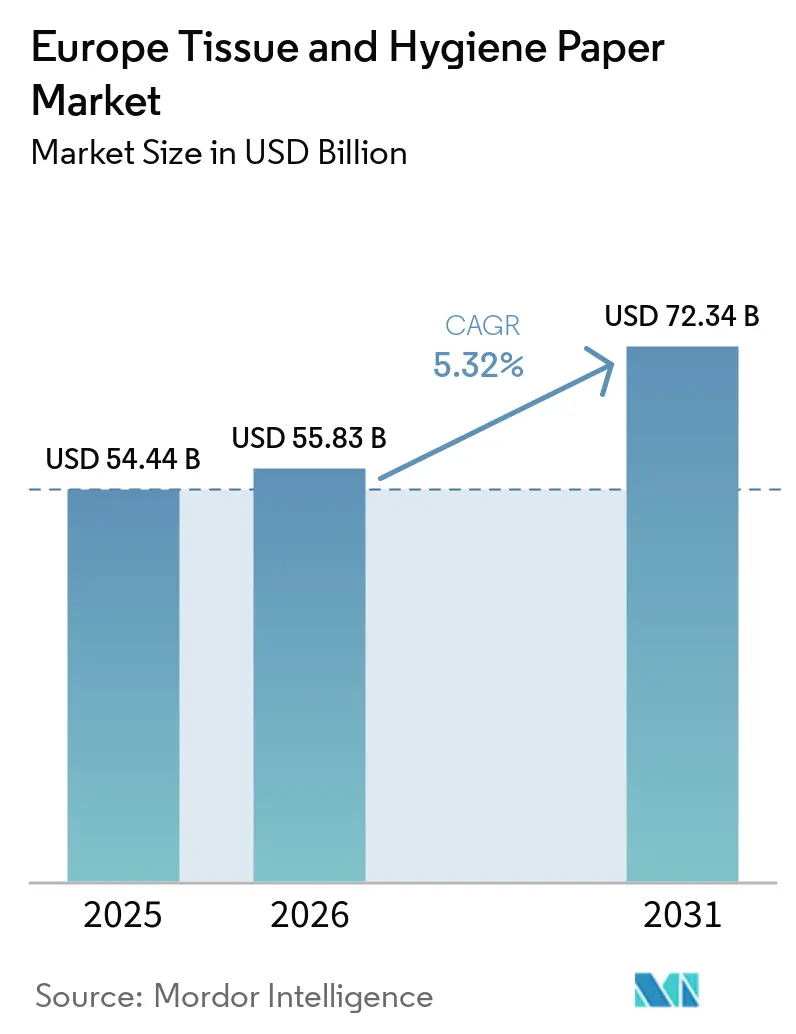
The Europe Tissue And Hygiene Paper Market size is expected to grow from USD 54.44 billion in 2025 to USD 55.83 billion in 2026 and is forecast to reach USD 72.34 billion by 2031 at 5.32% CAGR over 2026-2031. Robust elderly-care spending, the structural switch to recycled fiber under European Union sustainability mandates, and the gradual rebound of hospitality demand form the core expansion pillars. Producers are accelerating vertical integration into waste-paper collection to lock in fiber security, while premium incontinence formats are widening unit margins despite raw-material volatility. At the same time, pulp and electricity price swings, private-label shelf gains, and looming Phase IV carbon-price escalations are squeezing operating spreads and forcing aggressive cost-to-serve optimization. The interplay of these drivers and restraints defines a competitive field where scale, sustainability readiness, and channel agility increasingly determine winners.
Key Report Takeaways
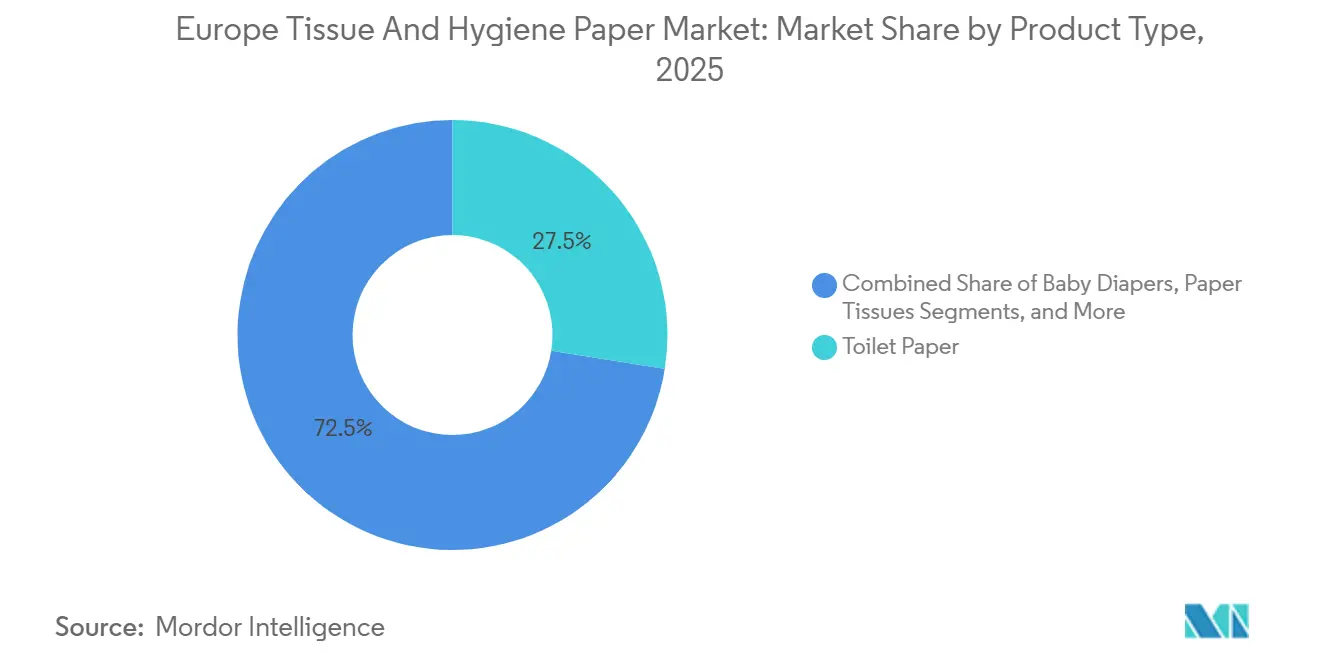
- By product type, toilet paper held 27.50% of Europe tissue and hygiene paper market share in 2025, while incontinence products are projected to grow at 7.80% CAGR through 2031.
- By raw material, recycled fiber commanded 46.80% share of Europe tissue and hygiene paper market size in 2025 and is expected to expand at 5.40% CAGR to 2031.
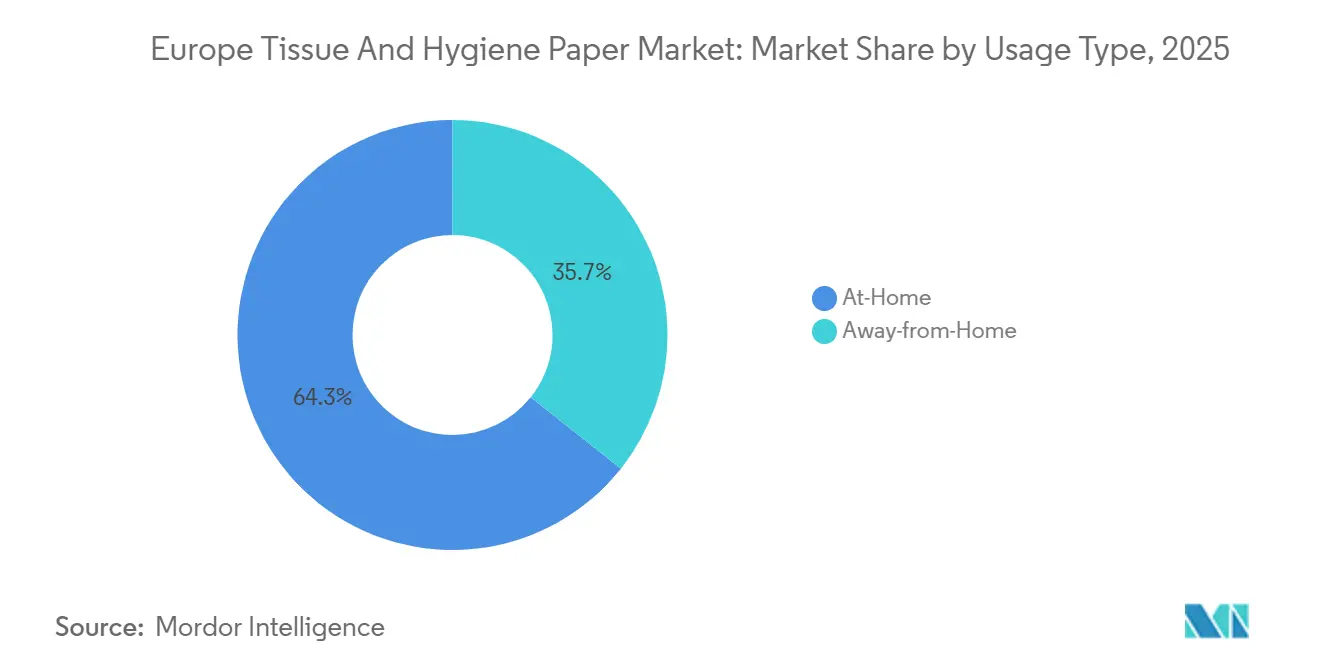
- By usage type, at-home consumption accounted for 64.32% of Europe tissue and hygiene paper market size in 2025, whereas away-from-home demand is rising at 5.90% CAGR to 2031.
- By end-use industry, residential households commanded 58.20% share of Europe tissue and hygiene paper market size in 2025, whereas Healthcare and Aged-Care Facilities demand is rising at 6.5% CAGR to 2031.
- By Country, Germany led with 24.78% revenue share in 2025, and Poland is forecast to record the fastest 6.90% CAGR to 2031.
Note: Market size and forecast figures in this report are generated using Mordor Intelligence’s proprietary estimation framework, updated with the latest available data and insights as of January 2026.
Market Trends and Insights
Drivers Impact Analysis of Europe Tissue and Hygiene Paper Market*
| Driver | (~) % Impact on CAGR Forecast | Geographic Relevance | Impact Timeline |
|---|---|---|---|
| Aging Population Boosting Adult-Incontinence Demand | +1.2% | Germany, Italy, Spain, France, Nordic countries | Long term (≥ 4 years) |
| Heightened Hygiene Awareness | +0.8% | Western Europe urban centers | Medium term (2-4 years) |
| EU Deforestation Rules Accelerating Recycled Tissue Uptake | +0.7% | European Union-wide | Long term (≥ 4 years) |
| Surge in E-Commerce and D2C Retail Channels | +0.6% | United Kingdom, Germany, France, Netherlands, Poland, Spain | Medium term (2-4 years) |
| Tourism Rebound Elevating AFH Tissue Demand | +0.5% | Spain, Italy, France, Greece, Portugal, Croatia | Short term (≤ 2 years) |
| Rapid Adoption of Digital Watermarks to Improve Paper Recycling | +0.4% | Germany, Netherlands, France, Belgium, United Kingdom | Medium term (2-4 years) |
| Source: Mordor Intelligence | |||
Aging Population Boosting Adult-Incontinence Demand
Europe’s demographic shift is translating directly into higher consumption of absorbent hygiene products for adults. The European Association of Urology estimated that 55–60 million residents lived with incontinence in 2023, costing EUR 69.1 billion (USD 77.9 billion) with a forecast jump to EUR 87 billion (USD 98.1 billion) by 2030.[1] German and Italian long-term-care facilities are upgrading to premium briefs that promise longer wear intervals, a change that cuts nursing labor and lifts average selling prices. Multinationals have responded by dedicating new converting lines to high-absorbency SKUs and bundling product-plus-service contracts with healthcare procurement agencies. The resulting 7.80% CAGR for incontinence products materially outpaces the broader Europe tissue and hygiene paper market.
Heightened Hygiene Awareness
Post-pandemic behaviors have locked in structurally higher tissue usage per capita. European consumption stabilized at 14.3 kilograms in 2024, helped by sustained preference for single-use towels in foodservice and clinical environments. Compliance with ISO 22000 and ISO 13485 has moved from voluntary to baseline procurement criteria, especially in hospitals that replaced cotton cloths with disposable alternatives. Urban households continue to stockpile facial tissues and paper towels as remote-work norms persist. Collectively, these factors lift unit demand in both retail and professional hygiene segments, supporting a +0.8% contribution to forecast CAGR.
EU Deforestation Rules Accelerating Recycled Tissue Uptake
The European Union Deforestation Regulation, effective December 2024, obliges operators to submit granular due-diligence statements for wood-based inputs, steering mills toward recovered fiber to cut compliance friction.[2] Large producers that locked in recycled feedstock ahead of the December 2025 deadline have carved short-term cost advantages, while small and medium plants face a June 2026 cutoff. Recycled fiber already holds 46.80% share and is advancing at 5.40% CAGR, aided by investments in de-inking and quality-control technology. The rule also spurs mill ownership stakes in waste-paper collection to guarantee chain-of-custody integrity.
Surge in E-Commerce and D2C Retail Channels
Digital retail penetration for fast-moving consumer goods crossed double-digit thresholds in the United Kingdom, Germany, and the Netherlands by 2025. Brands now push subscription packs of toilet paper and diapers that trim fulfillment costs and enhance consumer loyalty, a model that lifted Procter and Gamble’s Baby, Feminine and Family Care organic sales by 3% in fiscal Q1 2025. Smaller challengers exploit social-commerce algorithms and recyclable shipping formats to sidestep shelf-space battles, supporting a +0.6% CAGR tailwind for the Europe tissue and hygiene paper market.
Restraints Impact Analysis of Europe Tissue and Hygiene Paper Market*
| Restraint | (~) % Impact on CAGR Forecast | Geographic Relevance | Impact Timeline |
|---|---|---|---|
| Volatile Pulp and Energy Prices Squeezing Margins | -1.0% | European Union-wide, high exposure in Germany, Poland, Italy | Short term (≤ 2 years) |
| Decarbonization CAPEX Pressure under EU-ETS Phase IV | -0.8% | Finland, Sweden, Germany, France | Long term (≥ 4 years) |
| Environmental and PFAS Concerns over Disposables | -0.6% | Nordic countries, Germany, Netherlands, Belgium, France | Medium term (2-4 years) |
| Private-Label Price Wars in Mature Retail | -0.5% | United Kingdom, Germany, France, Spain | Short term (≤ 2 years) |
| Source: Mordor Intelligence | |||
Volatile Pulp and Energy Prices Squeezing Margins
Wholesale electricity in Europe peaked near EUR 400 per MWh in August 2022 before easing to 70–120 EUR per MWh in early 2023, while northern bleached softwood kraft pulp mirrored that turbulence. AFRY Consulting calculated that tissue production costs jumped 43% for virgin grades during 2020-2021. Although hedging contracts and cogeneration projects soften shocks, the lag in retail price passthrough compresses EBITDA and deters discretionary capital spend, subtracting a full percentage-point from forecast CAGR.
Decarbonization CAPEX Pressure under EU-ETS Phase IV
Carbon allowances averaged EUR 63.85 per tonne in December 2023 and could touch EUR 90-100 per tonne by 2030. Tissue mills, which rely on steam drying and large thermal loads, must invest in biomass boilers, heat-recovery systems, and renewable electricity procurement.[3] Essity’s SEK 3.3 billion (USD 316 million) program illustrates the magnitude of mandatory spend. Although these projects cut long-run emissions charges, their near-term cash drain curtails growth and trims CAGR by 0.8% over the outlook horizon.
*Our forecasts treat driver/restraint impacts as directional, not additive. The impact forecasts reflect baseline growth, mix effects, and variable interactions.
Europe Tissue and Hygiene Paper Market Segment Analysis
By Product Type:
Incontinence Products Accelerate Amid Aging DemographicsIn 2025, toilet paper generated the highest revenue, yet incontinence products exhibit the steepest trajectory at 7.80% CAGR through 2031. Europe tissue and hygiene paper market size for incontinence products is projected to rise sharply as care homes adopt premium, high-absorbency designs. The demographic shift places sustained pressure on supply chains for superabsorbent polymers and breathable films.
Manufacturers now bundle sensor-enabled briefs and digital ordering portals to deepen procurement contracts with healthcare institutions. Conversely, baby diapers weaken due to falling fertility in Western Europe, prompting SKU premiumization to protect value. Tissue converters on the continent thus manage a two-speed portfolio, defending commoditized toilet paper volumes while chasing margin in adult-care lines.

By Raw Material:
Recycled Fiber Gains Ground on Regulatory TailwindsRecycled fiber accounted for 46.80% of Europe tissue and hygiene paper market share in 2025, and its share is widening on the back of EU forest-risk commodity rules. Europe tissue and hygiene paper market size linked to recycled fiber is set for 5.40% CAGR, overshadowing kraft and sulfite pulp grades.
Quality improvements emerge from better sorting: the HolyGrail 2.0 digital watermark pilots in Germany and the Netherlands demonstrated near-infrared detection accuracy above 95%. Nordic mills still deploy virgin fiber for strength-critical formats, yet even these producers integrate de-inked pulp into mid-tier SKUs to lower carbon intensity and reduce ETS liabilities.
By Usage Type:
Away-From-Home Segment OutperformsAt-home channels captured 64.32% of Europe tissue and hygiene paper market size in 2025 thanks to pandemic-era stocking, but away-from-home demand recovers at 5.90% CAGR as tourism and office occupancy rebound. Hotels in Spain and Italy shifted from linen to disposable napkins to accelerate table turns, expanding jumbo-roll sales to distributors.
Hospitals tightened infection-control norms, prompting a switch to single-use towels under ISO 13485 frameworks. Producers respond with high-capacity dispensers and dispenser-as-a-service models that cut refilling labor, thereby boosting stickiness with facility managers.
By End-Use Industry:
Healthcare and Aged-Care Facilities Lead Value GrowthResidential households still represent 58.20% of Europe tissue and hygiene paper market size in 2025, but their growth plateaus as penetration saturates in Western Europe. Healthcare and aged-care sites climb at 6.50% CAGR through 2031, absorbing premium wipes and underpads aligned with reimbursement schemes.
Hospital procurement increasingly specifies traceable, PFAS-free substrates to future-proof against regulatory action, creating product differentiation levers for compliant suppliers. Hospitality and foodservice follow closely, underpinned by international tourist arrivals surpassing 200 million in 2024, which translated into higher napkin and towel turnover in hotels and quick-service restaurants.
Geography Analysis
Germany Tissue and Hygiene Paper Market
Germany remains the anchor of the Europe tissue and hygiene paper market, contributing 24.78% of revenue in 2025 and benefiting from 1.5 million tonnes of annual tissue capacity. Its mature retail mix balances branded loyalty and aggressive private-label pricing, while its recovered-paper infrastructure underpins recycled-fiber growth.
Poland Tissue and Hygiene Paper Market
Poland is the fastest-expanding geography at 6.90% CAGR, driven by rising disposable incomes, retail modern-trade penetration, and fresh capacity investments such as Sofidel’s recent 60,000-tonne mill extension. The country’s central location within the customs union enables efficient distribution to both Western and Eastern customers.
Southern Europe, Nordics and Eastern Europe Tissue and Hygiene Paper Market
Southern Europe gains momentum from tourism. Spain, Italy, and France together absorb significant away-from-home volumes as hotels update hygiene protocols. Nordic nations post the highest per-capita usage thanks to cultural cleanliness norms and premium positioning of eco-certified products. Eastern European markets beyond Poland, including the Czech Republic and Romania, represent medium-term upside once logistics and waste-paper collection networks mature.
Regulatory Landscape
The European regulatory environment is tightening around circularity and traceability for tissue and hygiene products, along with the packaging that carries them. Regulation (EU) 2025/40, the Packaging and Packaging Waste Regulation (PPWR), entered into force on 11 February 2025 and moves requirements for packaging composition, recyclability, and waste management from a directive-based framework to a directly applicable EU regulation, with general application from 12 August 2026.
Secondary legislation and implementation materials are developing ahead of the 12 August 2026 applicability date. The European Commission issued PPWR guidance (C/2026/3702) on 10 June 2026 to support economic operators and Member States, and the PPWR also sets out a timetable for harmonized labeling via implementing acts due by 12 August 2026, shaping how tissue and hygiene paper brands present disposal and sorting information across EU markets.
Value Chain Analysis
The value chain starts with fiber inputs, including virgin pulp (kraft/sulfite) and recovered paper, then moves into tissue base paper manufacturing (pulping or de-inking, stock preparation, tissue machines, drying). Converting follows, with rewinding, embossing, laminating, cutting, and packaging into retail and away-from-home formats. European Tissue Symposium (ETS) members represent a large share of regional output (about 90% of production), with mill footprints concentrated in Germany, Italy, the Nordics, and fast-growing Central Europe. Distributors and facility-service players also act as key routes to market for away-from-home and healthcare channels.
Downstream, the chain is increasingly shaped by compliance documentation and packaging requirements under PPWR (Regulation (EU) 2025/40). From 12 August 2026, packaging placed on the EU market requires conformity assessment and declarations of compliance. Capacity and footprint decisions continue to underpin supply resilience, including Metsa Group inaugurating its expanded Mariestad, Sweden tissue mill in May 2026 (lifting annual capacity to about 145,000 tonnes) and Fripa awarding ANDRITZ a contract in July 2025 for a new tissue machine at Miltenberg, Germany, to support modernization and efficiency improvements in converting-ready reel supply.
Competitive Landscape
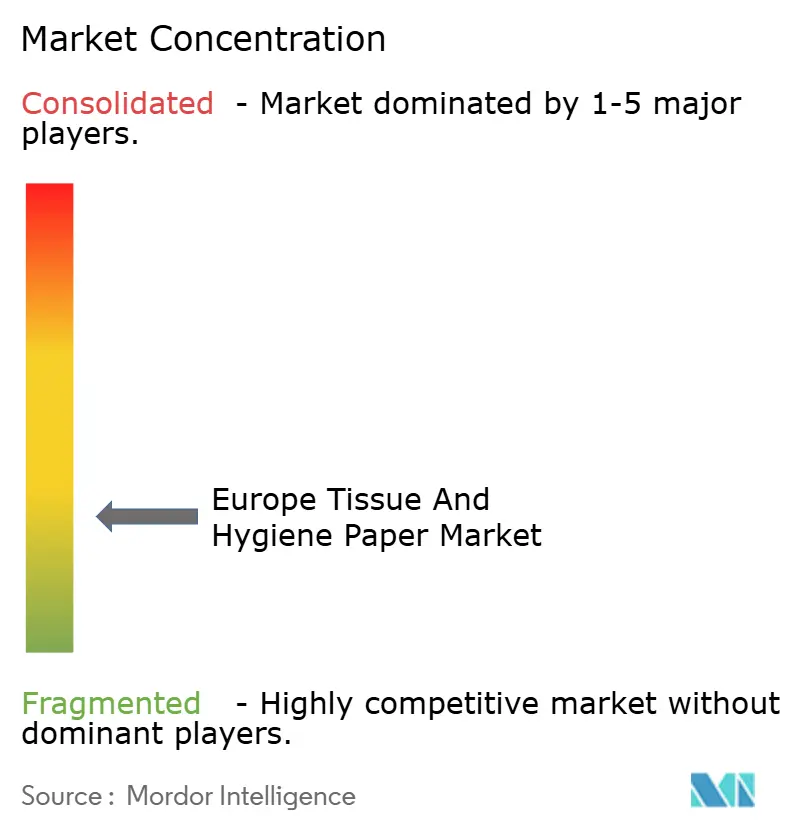
The field shows moderate concentration as global majors such as Essity, Kimberly-Clark, and Procter and Gamble compete with regional specialists such as Sofidel and WEPA. Essity delivered SEK 38.5 billion (USD 3.7 billion) in Q3 2024 sales, assisted by 5.8% organic growth in Professional Hygiene. Private-label penetration remains an existential challenge in mature markets like the United Kingdom, where branded toilet-tissue volume fell by 9.4 million packs in 2024.
Sustainability investments differentiate front-runners: Essity and Metsä Group have announced fossil-free roadmaps, while producers join HolyGrail 2.0 to standardize digital watermarks. Technology adoption extends to mill automation and predictive maintenance, enabling tighter fiber-blend control. Niche disruptors leverage direct-to-consumer models for organic baby diapers and biodegradable feminine products, bypassing retailer margin demands.
Collaborative projects emerge as strategic hedges. Producers co-finance shared recovered-paper depots and renewable-energy clusters near mills to pool risk. Compliance with ISO 22000 and ISO 13485 increasingly appears in tenders, pushing mills to certify quality systems as a competitive prerequisite.
Europe Tissue and Hygiene Paper Industry Leaders
-
Sofidel Group
-
Kimberly Clark Corporation
-
Metsa Group
-
Industrie Cartarie Tronchetti SpA
-
Lucart SpA
- *Disclaimer: Major Players sorted in no particular order
Europe Tissue and Hygiene Paper Market Companies Covered in this Report
- Sofidel Group
- Kimberly-Clark Corporation
- WEPA Hygieneprodukte GmbH
- Metsa Group
- Industrie Cartarie Tronchetti SpA
- Lucart SpA
- Essity AB
- Renova
- Procter & Gamble
- Cartiere Carrara SpA
- Industrie Celtex SpA
- Johnson & Johnson Services Inc.
- Ontex Group
- Tosama DOO
- Drylock Technologies NV
- Georgia-Pacific LLC
- Kruger Products Inc.
- Ahlstrom-Munksj
- Cascades Inc.
- The Navigator Company SA
Market Opportunities and Future Outlook
Packaging redesign and compliance services tied to Regulation (EU) 2025/40 (PPWR) create actionable room for tissue and hygiene paper manufacturers and packaging suppliers. The timing is clear as the PPWR reaches general application on 12 August 2026, with implementation guidance published by the European Commission on 10 June 2026. This shift lifts demand for packaging that is demonstrably recyclable and correctly labeled across EU member states, favoring suppliers that can provide validated specifications, documentation readiness, and multi-country artwork control for high-volume hygiene SKUs.
Industrial investments and ownership changes are also reshaping regional capacity positioning and supply-chain integration, supporting localized converting hubs and upgraded reel supply. Navigator announced a EUR 115 million investment (March 2026) for a new tissue machine at Aveiro, Portugal, and Metsa Group inaugurated the modernized Mariestad tissue mill in Sweden in May 2026, reinforcing a push toward modern, efficient lines linked to demand centers. At the same time, European Commission clearance for Suzano to acquire Kimberly-Clark’s IFP tissue business (May 2026) and the July 2026 start of Arbex as the operating platform point to active portfolio reconfiguration, expanding the scope for supplier requalification, private-label tenders, and pulp-to-tissue integration strategies in Europe.
Recent Industry Developments in Europe Tissue and Hygiene Paper Market
- July 2026: Arbex began operating on July 1, 2026 as an independent tissue and hygiene business created through a USD 3.4 billion joint venture between Suzano and Kimberly-Clark. The launch formalized a new operating structure for the former Kimberly-Clark IFP assets, with implications for sourcing strategies, brand stewardship, and customer contracts across European retail and professional channels.
- May 2026: The European Commission granted unconditional Phase I approval for Suzano’s acquisition of Kimberly-Clark’s International Family Care & Professional (IFP) tissue business, which includes European operations. Regulatory clearance removed a key closing condition and accelerated the ownership change in a major supplier base for both consumer tissue and away-from-home professional hygiene portfolios.
- May 2026: Metsa Group inaugurated the expanded and modernized tissue paper mill in Mariestad, Sweden, adding a new tissue machine and converting lines and doubling annual capacity to about 145,000 tonnes. The investment strengthens regional supply reliability for Scandinavian demand and raises the competitive bar on energy and resource efficiency at modern European tissue sites.
Europe Tissue and Hygiene Paper Market Report Scope and Research Methodology
Market Definition and Coverage
For this study, the market covers the yearly value of tissue and hygiene paper products sold across Europe through retail and institutional channels, including at-home and away-from-home use.
Scope exclusions: We exclude industrial sack paper, specialty filter paper, and printing grades from the totals.
Segments Covered in This Report
- By Product Type
- Baby Diapers
- Feminine Hygiene
- Household Paper
- Incontinence Products
- Paper Tissues
- Paper Napkins
- Paper Towels
- Facial Tissues
- Specialty and Wrapping Tissues
- Toilet Paper
- By Raw Material
- Kraft Pulp
- Sulfite Pulp
- Recycled Fiber
- Other Raw Materials
- By Usage Type
- At-Home
- Away-from-Home
- By End-Use Industry
- Residential Households
- Hospitality and Foodservice
- Healthcare and Aged-Care Facilities
- Other End-Use Industry
- By Country
- United Kingdom
- Germany
- France
- Italy
- Spain
- Netherlands
- Denmark
- Sweden
- Russia
- Poland
- Rest of Europe
Data Sources, Market Sizing, and Validation
Desk Research
Desk work starts with building the demand and supply context for tissue and hygiene paper across Europe, and then aligning it with what is measurable in public datasets. We rely on sources such as Eurostat for production, trade, and consumer indicators, national statistics offices for household spending proxies, and customs trade databases for import and export direction checks.
We also review disclosures and public updates from trade bodies and institutions, including CEPI, FAO, and OECD series, which help explain pulp availability, energy exposure, and broader paper consumption movements. Company annual reports, investor presentations, and reputable press are used to map capacity additions, mill conversions, and private label expansion that can shift pricing and mix. In a few places, a paid subscription database is used to sanity check company financials, shipment signals, and patent activity tied to absorbency and recycled fiber processing. These desk sources are illustrative, and many other public references were used to collect, cross-check, and clarify inputs.
Primary Interviews and Surveys
Primary calls and short surveys are used to pressure-test the desk assumptions on price moves, channel mix, and product substitution, and then to confirm what should sit inside the Europe boundary. We speak with stakeholders across manufacturing, converting, distribution, and institutional buying, and we keep coverage balanced across major European markets so the model is not driven by a single country pattern.
Distribution of primary research fieldwork respondents
| Company type | Respondent position |
|---|---|
| Top tier: 28% | CXOs: 13% |
| Mid tier: 58% | Functional/Unit leaders: 30% |
| Smaller Players: 14% | Managers: 57% |
Market-Sizing & Forecasting
The core build uses a top-down approach where production and trade statistics, category consumption signals, and channel splits are reconstructed into a Europe-wide value pool, then converted into USD using consistent timing rules. To keep the totals practical, we corroborate them with selective bottom-up approximations, such as sampled price-per-pack by category multiplied by observed volume proxies, and supplier and converter roll-ups where disclosures allow it.
Inputs that matter most in this market include pulp and recovered paper pricing direction, energy cost pass-through, private label share movement, away-from-home demand recovery (hospitality and offices), and demographic indicators tied to adult incontinence demand. Where unit volumes are hard to observe, gaps are handled through conservative proxying, followed by checks with interview feedback to avoid overstating premiumization or discounting.
For forecasting, we use scenario analysis supported by a multivariate regression view on the key drivers, then align the final path with what industry experts consider realistic for pricing and mix over the forecast window. The model is kept repeatable so an analyst can re-run it when a new price shock, capacity event, or regulation update changes the base case.
Data Validation & Update Cycle
Outputs are validated through multiple checks, where we compare implied consumption and price levels against independent indicators such as trade flows, packaging and tissue demand signals, and known capacity changes. If a country or category shows an unusual swing, the assumptions are revisited, and we re-contact sources to confirm whether the change reflects a real market movement or a data timing issue.
Before sign-off, the numbers go through step-by-step analyst review so input sources, conversion logic, and key assumptions are traceable. Reports refresh annually, and interim updates are made when material events occur, such as major price resets, mill closures, or policy changes. Right before delivery, we do a fresh pass so clients receive the latest updated view rather than an older snapshot.
Mordor Intelligence's Europe Tissue and Hygiene Paper Market Size Measured Against Other Published Estimates
Published market values for tissue and hygiene paper in Europe can look different because the timing of price inputs, currency conversion windows, and what is counted as tissue versus adjacent paper grades is not consistent across studies. Differences also show up when one estimate leans more on retail-shelf pricing, while another leans on manufacturer sales values or a narrower channel view.
In our work, the refresh cadence and the way recent pulp and energy driven price steps are normalized across countries is a major factor, and currency timing is kept consistent so the same inflation wave is not counted twice. That is a modeling choice applied by Mordor Intelligence. The spread also widens when estimates include extra categories like industrial grades, or when they exclude institutional consumption that matters for away-from-home demand.
Benchmark comparison
| Source | Market Size | Gaps in Research Methodology |
|---|---|---|
| Mordor Intelligence | USD 54.44 B (2025) | |
| Trade Journal A | USD 54.36 B (2024) | Uses an earlier-year snapshot and a retail-led view that can understate institutional demand, and it can carry different currency conversion timing during high inflation periods. |
| Industry Portal B | USD 101.07 B (2025) | Appears to use a broader hygienic paper scope, which can fold in adjacent paper grades beyond tissue and hygiene products, thereby inflating the addressable value for a tissue-only definition. |
The comparison shows that the tight cluster comes from similar product boundaries and year selection, while the large jump is mainly explained by a wider category umbrella. By keeping scope rules explicit, aligning the year and FX timing, and validating price and mix shifts with market checks, our estimate stays traceable to a clear demand pool and can be replicated with the same input logic.
Key Questions Answered in the Report
What is the forecast growth rate for the Europe tissue and hygiene paper market through 2031?
The market is expected to record a 5.32% CAGR, rising from USD 55.83 billion in 2026 to USD 72.34 billion in 2031.
Which product category is growing fastest in Europe’s tissue sector?
Incontinence products lead with a projected 7.80% CAGR, driven by an aging population and healthcare procurement upgrades.
How large is recycled fiber’s role in European tissue production?
Recycled fiber already accounts for 46.80% of output value and is set to expand at 5.40% CAGR under EU deforestation rules.
Which country is the quickest-growing market for tissue in Europe?
Poland is forecast to expand at 6.90% CAGR thanks to retail modernization, rising incomes, and new mill investments.