
Europe Sustainable Mattress Market Size and Share
Market Overview
| Study Period | 2020 - 2031 |
|---|---|
| Forecast Data Period | 2026 - 2031 |
| Base Year Market Size (2025) | USD 2.77 Billion |
| Market Size (2026) | USD 2.97 Billion |
| Market Size (2031) | USD 4.19 Billion |
| Growth Rate (2026 - 2031) | 7.14 % |
| Market Concentration | Low |
Major Players *Disclaimer: Major Players sorted in no particular order Image © Mordor Intelligence. Reuse requires attribution under CC BY 4.0. | |
Europe Sustainable Mattress Market Analysis by Mordor Intelligence
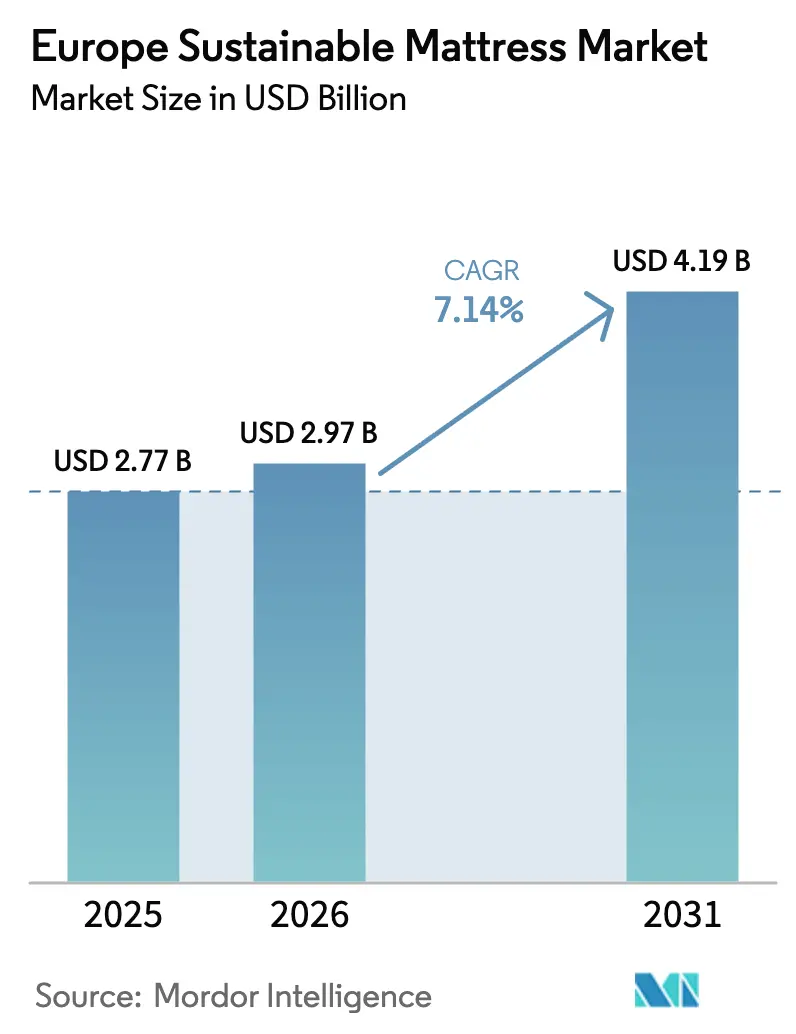
The Europe sustainable mattress market size is expected to grow from USD 2.77 billion in 2025 to USD 2.97 billion in 2026 and is forecast to reach USD 4.19 billion by 2031 at 7.14% CAGR over 2026-2031. Demand accelerates as the Ecodesign for Sustainable Products Regulation (ESPR) mandates digital product passports for mattresses from 2027, pushing producers to disclose full life-cycle data [1]European Parliament and Council, “Ecodesign for Sustainable Products Regulation Text,” europarl.europa.eu . Consumer appetite for transparent, low-impact products, premium spending on sleep wellness, and the rise of bed-in-a-box logistics collectively lift the sustainable mattress market above broader bedding growth rates. Germany’s mature recycling infrastructure and strong purchasing power anchor regional demand, while Spain records the quickest adoption amid a younger, eco-focused demographic profile. Natural latex leads material choices thanks to durability and biodegradability, yet upcycled latex captures momentum as chemical-recycling pilots scale across Germany and the Netherlands. Commercial buyers in healthcare and hospitality accelerate orders to meet ESG targets, giving the B2B direct channel double-digit growth. Ongoing consolidation—exemplified by Tempur Sealy’s USD 5 billion Mattress Firm deal—signals tightening competition even as the broader competitive field remains fragmented.
Key Report Takeaways
- By raw material, latex captured 31.65% of the sustainable mattress market share in 2025, while other raw materials are projected to advance at a 11.7% CAGR through 2031.
- By size, queen-size mattresses led with 39.20% revenue share in 2025; king-size mattresses are forecast to expand at a 8.55% CAGR to 2031, underscoring premiumization.
- By end-user, residential purchases accounted for 76.25% of the sustainable mattress market size in 2025, yet commercial demand is growing at 8.1% CAGR on the back of ESG-led procurement.
- By distribution channels, retail channels led with 82.10% revenue share in 2025; B2B direct sales posted the quickest pace at 10.35% CAGR, outstripping the overall sustainable mattress market.
- By geography, Germany held 26.60% of the regional sustainable mattress market in 2025, while the United Kingdom is poised for the fastest 11.21% CAGR to 2031.
Note: Market size and forecast figures in this report are generated using Mordor Intelligence’s proprietary estimation framework, updated with the latest available data and insights as of 2026.
Europe Sustainable Mattress Market Trends and Insights
Drivers Impact Analysis*
| Driver | (~) % Impact on CAGR Forecast | Geographic Relevance | Impact Timeline |
|---|---|---|---|
| Rising Environmental Awareness Among European Consumers | +1.2% | Germany and the Nordics strongest | Medium term (2-4 years) |
| Stringent EU Circular-Economy & Ecolabel Policies | +1.8% | EU-wide, early BENELUX adoption | Long term (≥ 4 years) |
| Premiumisation & Wellness-Oriented Spending On Sleep Products | +1.5% | Western Europe's core, spreading south | Short term (≤ 2 years) |
| Expansion Of D2C E-Commerce Logistics & “Bed-In-A-Box” Models | +1.1% | The UK and Germany are leading | Medium term (2-4 years) |
| Breakthrough Chemical-Recycling Pilots For PU Mattress Foam | +0.9% | Germany and the Netherlands pilots | Long term (≥ 4 years) |
| ESG-Driven Procurement In Healthcare & Hospitality Chains | +0.7% | Major EU metro areas | Medium term (2-4 years) |
| Source: Mordor Intelligence | |||
Rising Environmental Awareness Among European Consumers
Europeans consider sustainability important and are buying eco-friendly products, indicating a shift toward low-impact goods. Eighty-six percent of Europeans consider sustainability important, and 29% actively purchase eco-friendly products, indicating a shift toward low-impact goods. Mattress decisions carry added weight because of long replacement cycles and intimate health links, letting brands translate environmental storytelling into palpable value. QR-code product passports and material origin disclosures resonate strongly with digital-native buyers. Austria’s public-sector push to cut healthcare carbon footprints reinforces the trend, pulling sustainable choices into residential channels.
Stringent EU Circular-Economy & Ecolabel Policies
The Ecodesign for Sustainable Products Regulation (ESPR) makes mattresses an early priority, obligating digital passports that record composition, recyclability, and end-of-life routes by 2027. Producers such as Aquinos Bedding plan to tag 1 million units via QR and RFID to pre-empt the deadline. EU Ecolabel certification, covering more than 102,000 products, confers brand distinction yet imposes documentation costs that favour scale operators' environment. France, Belgium, and the Netherlands require certified recycling for discarded mattresses, stimulating downstream infrastructure investment. From July 2026, large enterprises may no longer destroy unsold stock, catalyzing circular designs across the value chain.
Premiumisation & Wellness-Oriented Spending On Sleep Products
Consumers increasingly link sleep to holistic wellness, explaining the rapid 9.0% CAGR for king-size units through 2030. Higher disposable income segments are prepared to pay premiums for natural latex, organic cotton, and ethically sourced wool. Contract hotel buyers echo the pattern, adopting foam-free mattresses that support both guest comfort and carbon targets. As wellness budgets trump other discretionary categories, sustainable mattress market values continue climbing despite inflation. The commercial share uptick illustrates institutional willingness to translate health benefits into procurement policy.
Expansion Of D2C E-Commerce Logistics & “Bed-In-A-Box” Models
Compressed-foam technology allows home delivery through parcel networks, slashing transport emissions and packaging waste. Direct channels grew 10.9% CAGR as brands bypass intermediaries and supply chain layers. Emma Sleep’s Westfield London flagship blends online speed with tactile trial, birthing hybrid commerce. E-commerce buyers also demand sustainable packaging, pushing brands to adopt recycled cardboard and water-based inks. Regulatory scrutiny tightens on marketing claims, seen in the UK Competition and Markets Authority’s case against Emma Sleep, signalling an era of stricter oversight.
Restraints Impact Analysis*
| Restraint | (~) % Impact on CAGR Forecast | Geographic Relevance | Impact Timeline |
|---|---|---|---|
| High Price Premium Vs Conventional Mattresses | -1.4% | Price-sensitive markets: Southern & Eastern Europe | Short term (≤ 2 years) |
| Volatile Pricing & Supply Of Natural Latex / Organic Fibres | -0.8% | Global supply chains are affecting all EU markets | Medium term (2-4 years) |
| Complex Multi-Material Construction Limits Recyclability | -0.6% | EU-wide, particularly affecting circular-economy initiatives | Long term (≥ 4 years) |
| Source: Mordor Intelligence | |||
High Price Premium Vs Conventional Mattresses
Retail tags for sustainable lines sit 40-60% above synthetic foam models, creating affordability tension in price-sensitive regions. The gap stems from costlier inputs, ecolabel audits, and sub-scale runs. Purchase intent surveys show enthusiasm outrunning real conversion when budgets tighten. Financing plans and entry-level models target fence-sitters, yet maintaining margins while lowering ticket prices remains difficult. Economic headwinds, therefore, dampen near-term acceleration in the sustainable mattress market.
Volatile Pricing & Supply of Natural Latex / Organic Fibres
Climate-related yield swings pushed latex prices up to 45% in 2024, compressing manufacturer margins[2]BASF, “Chemical Recycling of Mattress Foams,” basf.com. Natural latex and organic cotton are subject to sharp price swings because their supply depends on weather patterns, farming yields, and geopolitical stability in key producing regions. Certified organic cotton faces similar pressure; less than 1% of global cotton acreage meets organic standards, so even small production shocks ripple quickly through prices. These fluctuations force European mattress makers to carry larger inventories and lock in long-term contracts, tying up more working capital than synthetic inputs with steadier pricing.
*Our forecasts treat driver/restraint impacts as directional, not additive. The impact forecasts reflect baseline growth, mix effects, and variable interactions.
Segment Analysis
By Raw Material: Latex Leadership Drives Innovation
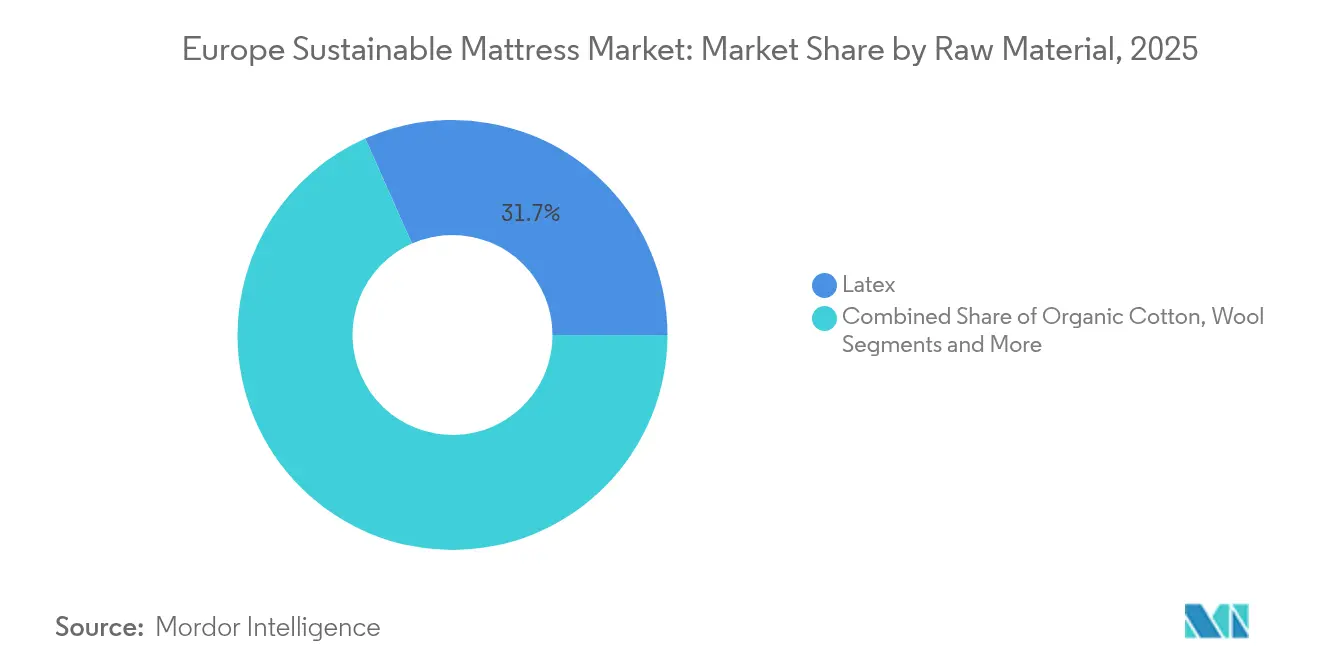
Latex commanded 31.65% of the sustainable mattress market share in 2025, reflecting consumer trust in its durability, breathability, and antimicrobial qualities. Upcycled latex is forecast to climb as chemical-recycling processes from Aarhus University enter commercial production, recovering feedstock at industrial yields. The sustainable mattress market size for latex-based units is projected to widen in line with regulatory preferences for biodegradable content. Wool maintains an eco-friendly niche as buyers value moisture control and thermal regulation. Coconut fibre and hemp fill plant-based propositions, whereas Liège University’s biobased polyurethane foams introduce isocyanate-free alternatives that cure in under two minutes.
Demand patterns vary across Europe. Nordic consumers, who post longer replacement cycles, gravitate to latex because of durability. Southern markets on tighter budgets prefer blended constructions that temper cost without sacrificing ecolabel eligibility. Suppliers adopt multi-material layering designed for easier disassembly, supporting future recycling mandates while preserving comfort profiles. Leading producers also integrate QR-enabled passports that disclose exact latex origin, verifying sustainable forestry and fair-labour compliance.



By Size: King-Size Growth Reflects Premiumisation
Queen units held 39.20% of volume in 2025, benefiting from standardised European bed frames and urban floor-space limits. The sustainable mattress market size for queen offerings remains sizable through 2031, even as king models surge. King formats show 8.55% CAGR because affluent buyers associate a larger surface area with superior sleep wellness. Northern European homes, which feature bigger bedrooms, accelerate the shift. Manufacturers reinforce king uptake with bundling promotions that pair mattresses with adjustable slatted bases made from certified timber, enhancing perceived value.
Single and double mattresses attract students and city dwellers with compact rooms. The segment retains relevance amid mounting urbanization, yet grows modestly compared to premium sizes. Custom dimensions cater to high-end renovation projects and accessible-housing retrofits, providing a small but steady revenue stream. BekaertDeslee’s Balance cover technology tailors stretch and breathability ratios to specific thicknesses, illustrating innovation even within traditional size lines.
By End-User: Commercial Acceleration Drives Growth
Residential customers contributed 76.25% of 2025 revenue, mirroring personal buying habits and multi-year replacement rhythms. Digital natives lean on influencer reviews and third-party ecolabel badges for decision support, rewarding transparent brands. The sustainable mattress market size in residential channels continues to climb, though at a slower pace than commercial. Hospitals and hotels chart an 8.1% CAGR as procurement teams embed carbon metrics into tender criteria. Hypnos offers foam-free hospitality ranges that meet durability and recyclability benchmarks.
ESG compliance compels facilities to document carbon savings, catalyzing demand for mattresses with recycled steel springs and biodegradable fiber layers. Commercial life-cycle costing models, recognizing lower disposal fees and longer service intervals, further justify higher upfront expenditure. Supplier contracts increasingly specify end-of-life take-back, creating annuity-style relationships that stabilize revenue streams for manufacturers.

By Distribution Channel: Direct Sales Transformation
B2C/Retail channels outlets still hold an 82.10% share thanks to showroom trials and high-touch sales staff. Yet online channels accelerate as bed-in-a-box formats solve legacy freight constraints. The sustainable mattress market size captured via pureplay e-commerce is poised to double between 2025 and 2030 as free returns and virtual sleep consultations reduce purchase friction. Direct manufacturer-to-business sales grow even faster at 10.35% CAGR, reflecting institutional buyers’ preference for traceable supply and bulk-order pricing.
Brands employ omnichannel tactics such as pop-up stores and mobile testing labs to bridge tactile and digital experiences. IKEA’s USD 1 billion recycling investment underpins reverse-logistics programs that let consumers return used units during new purchases, fostering loyalty while securing recyclable feedstock. Expect blended commerce formats to dominate future shopping journeys as regulation and consumer ethics align.
Geography Analysis
Germany contributes the largest 26.60% sustainable mattress market share in 2025, a position reinforced by the country’s 69% municipal-waste recycling rate that supplies a ready framework for mattress take-back and material recovery. German buyers value third-party labels, allowing EU Ecolabel products to command meaningful price premiums and fund further eco-design upgrades. BASF’s Brandenburg plant recovers polyols from discarded polyurethane foams, underscoring local prowess in chemical-recycling technology that feeds directly into the sustainable mattress market size for latex-hybrid and foam models. A mature retail base lets brands pilot mattress-as-a-service subscriptions, testing circular revenue streams while meeting the ESPR’s 2027 digital-passport deadline. Combined, these factors keep German growth steady even as penetration levels plateau at the high end of the regional curve.
The United Kingdom registers the fastest 11.21% CAGR through 2031, fueled by strong e-commerce logistics and rising wellness spending despite post-Brexit regulatory divergence. Emma Sleep’s Westfield London showroom blends tactile trials with D2C fulfilment and signals mainstream acceptance of bed-in-a-box formats that cut transport emissions. Regulatory vigilance is tightening in parallel; the Competition and Markets Authority’s case against Emma Sleep over discount claims underscores higher compliance expectations and should raise overall product-quality benchmarks. Hospitality chains such as Hypnos Contract Beds promote 100% foam-free, sustainable ranges, expanding commercial demand and lifting the sustainable mattress market size in the UK’s hotel segment. Tailored standards that mesh domestic needs with EU methodologies help sustain buyer confidence in ecolabels even as rules evolve locally. BENELUX countries are early adopters of digital product passports and closed-loop models such as RetourMatras, enabling higher collection rates and lower landfill fees. Nordic buyers pay the highest premiums and favour Nordic Swan-certified models, reflecting a mature sustainability culture.
Regulatory Landscape
The European regulatory backdrop for sustainable mattresses is increasingly shaped by the EU Ecodesign for Sustainable Products Regulation (ESPR), Regulation (EU) 2024/1781, which entered into force on 18 July 2024 and sets the framework for product-specific ecodesign requirements. In the ESPR Working Plan 2025-2030 (adopted 15 April 2025), mattresses are listed as a priority product group, which has accelerated industry work around Digital Product Passport (DPP) data models and traceability expectations.
Alongside ESPR, end-of-life governance is strengthening through Extended Producer Responsibility (EPR) approaches enabled under the Waste Framework Directive framework. Member States can set national schemes that shift collection, sorting, and recycling costs onto producers and other placing-on-the-market entities. The timelines are also becoming more operational, with preparatory work for a mattress delegated act starting in 2026 and product-specific requirements staged later (with cited planning toward adoption in 2029 and application from 2031), encouraging earlier investment in disassembly-ready designs, documentation systems, and compliant recycling routes.
Value Chain Analysis
The sustainable mattress value chain in Europe begins with raw-material inputs (natural latex, organic fibers, steel springs, and increasingly recycled polyols and recycled textiles). It then moves through foam and spring component fabrication, mattress assembly, and branding by manufacturers such as Emma Sleep, Tempur Sealy, Hilding Anders, and Silentnight. Distribution runs through traditional retail showrooms and fast-growing D2C and bed-in-a-box logistics, where compressed packaging and parcel networks reduce handling steps and increase the importance of packaging suppliers and last-mile partners.
Downstream, circular-economy and EPR-linked economics are reshaping the chain. Collection and take-back services, dismantling and sorting (foam, springs, textiles), and recycling or refurbishment are no longer peripheral activities, they sit at the center of cost and compliance. ESPR-driven DPP implementation also pushes data continuity across tiers, requiring upstream supplier disclosure and standardized durability and repairability information to travel with the product. That raises the strategic value of waste-management and recycler partners that can provide auditable end-of-life outcomes.
Competitive Landscape
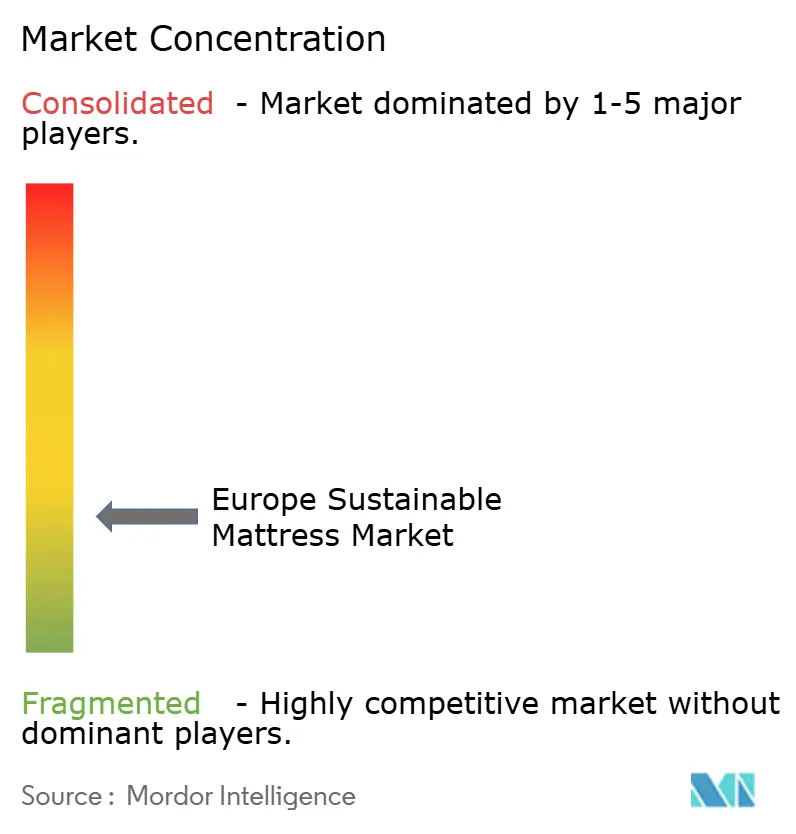
Industry structure remains fragmented even after Tempur Sealy’s USD 5 billion Mattress Firm acquisition that added more than 3,000 retail outlets to its portfolio. Large incumbents pursue horizontal deals to gain omnichannel reach and sustainability skills. IKEA’s Ingka Group committed USD 1 billion to European recycling plants, securing feedstock and strengthening brand credibility. Direct-to-consumer challengers such as Emma Sleep and Simba build differentiation on B Corp status and carbon-neutral logistics, trading scale for agility.
Vertical integration is a rising theme. Harrison Spinks cultivates its own hemp and flax, reducing input volatility while broadcasting farm-to-bed transparency. Technology partnerships matter as well; RAMPF Group supplies recycled polyols from PET waste, lowering Scope 3 emissions for mattress brands. Recticel’s PUReSmart initiative explores chemical recycling consortiums to pool R&D budgets and speed commercialisation. As ESG reporting becomes mandatory across Europe, certification prowess and circular-economy execution will separate leaders from laggards.
Europe Sustainable Mattress Industry Leaders
Emma Sleep GmbH
Tempur Sealy International Inc.
Hilding Anders International AB
Silentnight Group
Leggett & Platt Incorporated
- *Disclaimer: Major Players sorted in no particular order

Market Opportunities and Future Outlook
The most immediate whitespace sits in compliance-enabling services and in product architectures built around the Digital Product Passport, since mattresses are a priority product group in the ESPR Working Plan 2025-2030 (adopted 15 April 2025). Brands and suppliers that can operationalize DPP-ready bill-of-materials, durability testing records aligned with established methodologies such as EN 1957/ISO approaches used in the sector, and recyclability instructions have a clearer route to support sustainability claims and streamline B2B procurement documentation.
Circular supply chains are also starting to look more investable as recycled-content and take-back models move from pilot to scaled execution. In June 2026, IKEA France introduced the HOJEHALL mattress made with 80% recycled content through a circular collaboration with RetourMatras and Ecomaison, showing how retailer scale can pull recycled feedstock and recycler capacity into mainstream assortments. As more Member States adopt or expand mattress-focused EPR schemes under the Waste Framework Directive framework, opportunities increase for specialized collectors, dismantlers, chemical-recycling partners, and component suppliers that can deliver auditable material recovery. This also helps manufacturers reduce multi-material complexity through modular, easier-to-separate constructions.
Recent Industry Developments
- July 2026: LOOP-it (BRANTNER Green Solutions and NEVEON) reports its Oberwölbling, Austria facility is operational, processing up to 500 mattresses daily to recover materials like foam and metal; 87% CO2-emission reduction vs incineration. Mattress recycling milestone. The advances closed-loop circular supply chain and reduces lifecycle emissions for European mattresses.
- June 2026: IKEA France launches HÖJEHALL mattress produced with 80% recycled content via circular collaboration with RetourMatras and Ecomaison. The launch underscores recycled-content mattress adoption in Europe. The collaboration demonstrates scalable recycled-material sourcing and circular supply chain for European bedding.
- April 2026: BEDGEAR Expanded into Turkey through a strategic partnership with İşbir Yatak, debuting Performance Sleep Essentials in 22 retail locations. The expansion broadens cross-border distribution. Strengthens regional presence in mattress accessories and sleep-essentials.


Research Methodology Framework and Report Scope
Market Definition and Coverage
For this study, the market covers mattresses sold in Europe that are positioned and purchased as sustainable options, mainly due to materials used, certifications, and circularity practices across production and end of life.
Scope exclusions: Mattress toppers, pillows, bed frames, and general bedding accessories are excluded, and recycled material inputs are not counted separately outside the finished mattress value.
Segmentation Overview
- By Raw Material
- Organic Cotton
- Wool
- Latex
- Other Raw Materials (coconut fiber, hemp, etc.)
- By Size
- Single
- Double
- Queen
- King
- Other Sizes
- By End-User
- Residential
- Commercial
- By Distribution Channel
- B2B/Directly from the Manufacturers
- B2C/Retail Consumers
- Specialty Bedding and Mattress Stores
- Multi-brand Stores/Home Centers
- Online
- Other Distribution Channels
- By Geography
- United Kingdom
- Germany
- France
- Spain
- Italy
- BENELUX (Belgium, Netherlands, and Luxembourg)
- NORDICS (Denmark, Finland, Iceland, Norway, and Sweden)
- Rest of Europe
Data Sources, Market Sizing, and Validation
Desk Research
Desk research started with building a fact base on Europe bedding consumption, housing turnover, and renovation activity, which helps translate replacement demand into a realistic mattress demand pool. Public sources such as Eurostat, the European Environment Agency, European Commission policy pages (including ecodesign and product sustainability rules), and national statistics offices were used to anchor macro assumptions that affect purchase cycles.
We also reviewed evidence on materials and sustainability claims through sources such as EU Ecolabel documentation, standards and testing references from recognized bodies, and relevant peer-reviewed papers on latex, foams, and bio-based inputs. To tighten the company side of the model, we used company annual reports, public sustainability disclosures, press releases, and selected paid subscriptions that support company financials, patent tracking, and import-export shipment signals where needed. The desk sources listed are illustrative, and additional public and paid references were used for cross-checks, validation, and clarification.
Primary Interviews and Surveys
Primary work focused on sellers, brand teams, component suppliers, and channel participants (specialty stores and online focused retailers) to confirm what is actually counted as a sustainable mattress in the market. We used these conversations to validate pricing ladders, the share of certified or low impact materials, and how demand differs between replacement buying and hospitality or institutional orders across major European countries.
Distribution of primary research fieldwork respondents
| Company type | Respondent position |
|---|---|
| Top tier: 32% | CXOs: 13% |
| Mid tier: 53% | Functional/Unit leaders: 38% |
| Smaller Players: 15% | Managers: 49% |
Market-Sizing & Forecasting
Sizing began with a top-down build that converts Europe mattress replacement demand into value using country-level households, replacement cycles, and channel mix. We then filtered it to the sustainable portion using observed adoption rates and certification-led definitions.
Once the demand pool was constructed, average selling prices were applied using price bands that reflect the actual mix of latex, hybrid, and foam-based offerings, and then adjusted for VAT handling consistency and cross-border pricing differences.
To keep the totals grounded, we corroborated the outputs with selective bottom-up checks such as sampling brand lineups to map ASP ranges, using channel checks to validate promotional intensity, and reviewing a short list of supplier and retailer revenue splits where disclosures allowed. Inputs that mattered most in this market included replacement frequency by country, housing and renovation indicators, share of certified materials in mainstream catalogs, online versus offline mix shifts, and observed price premiums for sustainably positioned products.
For forecasting, we used scenario analysis, because regulation-driven changes (like product sustainability requirements and recycling obligations) can shift adoption speed. We smoothed year-to-year paths using simple trend fitting on the validated variables.
Data Validation & Update Cycle
Model outputs were reviewed through triangulation across macro demand signals, channel behavior, and what primary respondents described as realistic sustainable mix levels by country. Outliers were flagged, checked against known events (such as raw material price moves or sudden channel discounting), and then recalculated with revised assumptions that could be explained back to the source logic.
Before sign off, the numbers went through a multi-step analyst review, including consistency checks across countries and a sanity check against the broader Europe mattress market direction. Reports are refreshed annually, and interim updates are made when a material event changes the demand outlook or pricing structure. Right before delivery, a fresh pass is completed so clients receive the latest updated view.
Mordor Intelligence's Europe Sustainable Mattress Market Size Compared Against Other Published Estimates
Published market sizes can look different even when the topic sounds the same, because the boundary around what qualifies as sustainable is not uniform, and the pricing level used in the math can vary by source. Differences also come from base year selection, inflation handling, and how fast adoption is assumed to rise in countries with strong eco rules.
Retail price anchors, observed certification uptake in product catalogs, and channel-level pricing checks are the evidence that keeps Mordor Intelligence tied to the sustainable mattress value actually sold in Europe, rather than counting broader mattress retail or adjacent bedding categories. The spread in other numbers is usually driven by mixing retail value with manufacturer value, treating all natural material mattresses as sustainable without a clear filter, or applying aggressive price premium increases without matching them to channel promotions and material cost patterns.
Benchmark comparison
| Source | Market Size | Gaps in Research Methodology |
|---|---|---|
| Mordor Intelligence | USD 2.77 B (2025) | |
| Regional Consultancy A | USD 3.00 B (2025) | Uses a broader interpretation of sustainability, which can pull in products marketed as eco friendly without a consistent certification or circularity filter, thereby lifting the counted unit base. |
| Trade Journal B | USD 16.33 B (2025) | This figure is derived by converting a Europe mattress retail value estimate (nearly EUR 14 B) into USD, which reflects total mattress retail sales rather than the sustainably positioned subset and can also vary with exchange rate timing. |
The comparison shows that most of the gap comes from scope and price point, not from arithmetic errors. When the sustainable screen is applied consistently and prices are aligned to actual channel behavior, the resulting market size becomes easier to trace and update in a repeatable way as conditions change.


Key Questions Answered in the Report
What is the current size of Europe’s sustainable mattress market?
The sustainable mattress market stands at USD 2.97 billion in 2026 and is projected to reach USD 4.19 billion by 2031 at a 7.14% CAGR.
Which material leads the sustainable mattress market share?
Latex is the top material with 31.65% share in 2025 because of its durability, breathability, and biodegradability.
Why are king-size sustainable mattresses growing faster than other sizes?
Premiumisation and wellness spending drive a 8.55% CAGR for king-size units as consumers seek larger sleep surfaces for better comfort.
How are EU regulations shaping the sustainable mattress industry?
The Ecodesign for Sustainable Products Regulation will require digital product passports by 2027, pushing manufacturers toward full transparency and recyclability.
Which sales channel is expanding most rapidly?
B2B direct sales to healthcare and hospitality buyers show the highest 10.35% CAGR, supported by ESG procurement mandates.
What limits growth in price-sensitive regions?
High premiums over conventional mattresses and volatile costs for natural inputs deter adoption in Southern and Eastern Europe despite rising interest in sustainability.
Page last updated on:





