
Europe Stump Cutter/Grinder Market Size and Share
Market Overview
| Study Period | 2019 - 2032 |
|---|---|
| Forecast Data Period | 2027 - 2032 |
| Base Year Market Size (2026) | USD 642 Million |
| Market Size (2027) | USD 686.94 Million |
| Market Size (2032) | USD 963.47 Million |
| Growth Rate (2027 - 2032) | 7.00 % |
| Market Concentration | Medium |
Major Players *Disclaimer: Major Players sorted in no particular order Image © Mordor Intelligence. Reuse requires attribution under CC BY 4.0. | |
Europe Stump Cutter/Grinder Market Analysis by Mordor Intelligence
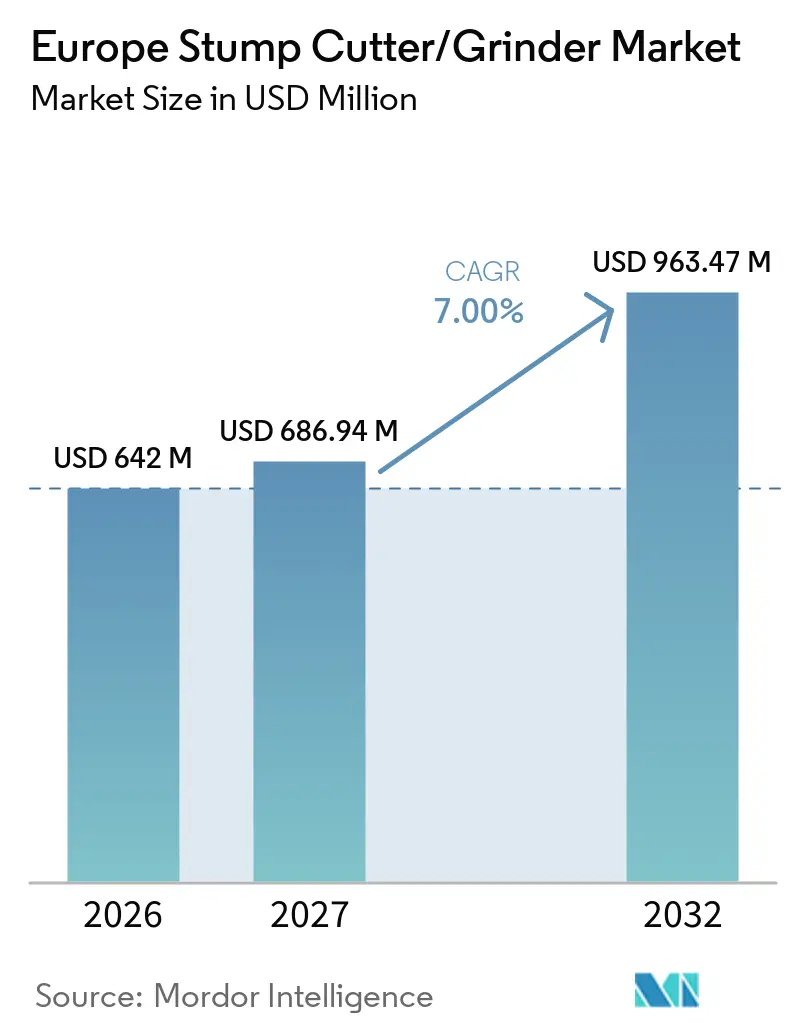
The Europe stump cutter/grinder market was valued at USD 642.00 million in 2026 and is projected to grow from USD 686.94 million in 2027 to USD 963.47 million by 2032, registering a CAGR of 7.00% from 2027 to 2032. The market has been experiencing steady growth, driven by several factors including the increased demand for land clearing and the rise of construction and landscaping activities. The market for stump cutters/grinders is closely tied to industries like forestry, agriculture, and landscaping, where these machines are primarily used for removing tree stumps and roots after tree cutting.
As European cities continue to expand, there is a high demand for land development, often involving tree cutting. Stump grinders are critical in removing stumps from cleared land, making it suitable for construction or landscaping. Large infrastructure projects, such as roads and residential developments, need stump grinders to clear land efficiently. In places like the UK and Germany, urban development projects are often accompanied by tree removal, which fuels the demand for stump-grinding equipment.
The increasing development of landscaped gardens, public spaces, and recreational areas in residential and commercial properties has driven the demand for stump grinding equipment. Stump grinders remove stumps that interfere with new plantings or construction, maintaining the visual appeal of these spaces. Landscaping companies in Europe use stump grinders to provide complete tree removal services, driving the market growth. Major European cities, including Paris and Lyon, are investing in public green spaces, with plans to create over 1,000 new parks in the upcoming years. These urban development projects require significant tree and stump removal operations, increasing the demand for stump grinders.
Note: Market numbers in this report are based on Mordor Intelligence's proprietary estimation framework, which combines nine months of actuals with Q4 projections for base year 2026.
Market Trends and Insights
European Forestry Production Drives Stump Grinder Demand
The growth in European forestry production drives the demand for stump cutters and grinders, as these machines are essential for land clearing, post-logging stump removal, and forest management. The demand for timber and wood products in Europe continues to increase due to construction, furniture manufacturing, and renewable energy requirements, resulting in expanded logging operations. This expansion in logging activities increases the need for post-harvest stump removal, directly impacting stump grinder demand.
Sweden, one of Europe's major timber producers, harvests around 70 million cubic meters of timber annually. The Swedish Forest Agency reports that 60% of Sweden's forested land supports timber production. These extensive logging operations require significant stump removal activities, increasing stump grinder sales in the country. Germany, Europe's largest timber producer, has a forestry industry that contributes over USD 10.81 billion (EURO 10 billion) to the economy. According to the Federal Statistical Office (Destatis), timber logging in German forests increased from 60.1 million cubic meters in 2020 to 78.7 million cubic meters in 2022.
Europe has been transitioning to renewable energy sources, which has spiked the demand for biomass and wood-based energy products. This has further driven timber production, and consequently, logging activities. Stump grinders are essential in clearing stumps for reforestation, as well as for efficient biomass production. Finland is a leader in wood-based bioenergy production. As per, the United Nations Economic Commission for Europe (UNECE), the country’s forestry sector produced 11.9 million cubic meters of sawn wood in 2021, much of which is used for biomass energy. As the demand for biomass continues to rise, stump grinders are required to clear the land for replanting and land management.



Germany Dominates the Market
Germany maintains a significant position in the European stump cutter and grinder market through its engineering precision and high-quality machinery production. Companies like Vermeer, Fae Group, and Bandit maintain a strong European presence and partner with German firms for technological development. German-manufactured stump grinders are recognized for their reliability, durability, and performance in challenging environments, including forests and construction sites.
The expansion of German cities, including Berlin, Munich, and Frankfurt, has intensified the demand for stump grinders. The German Federal Statistical Office reported that 77.77% of Germany's population lived in urban areas in 2023, underscoring the need for infrastructure and landscaping work. This urban growth has created additional demand for stump-grinding services in land preparation.
Germany's ongoing investment in infrastructure projects, including road construction, railways, highways, and urban renewal initiatives, requires extensive land clearing. The A3 Autobahn Expansion project demonstrates this trend, where stump grinders were instrumental in removing tree stumps to facilitate construction progress.


Competitive Landscape
Market Concentration
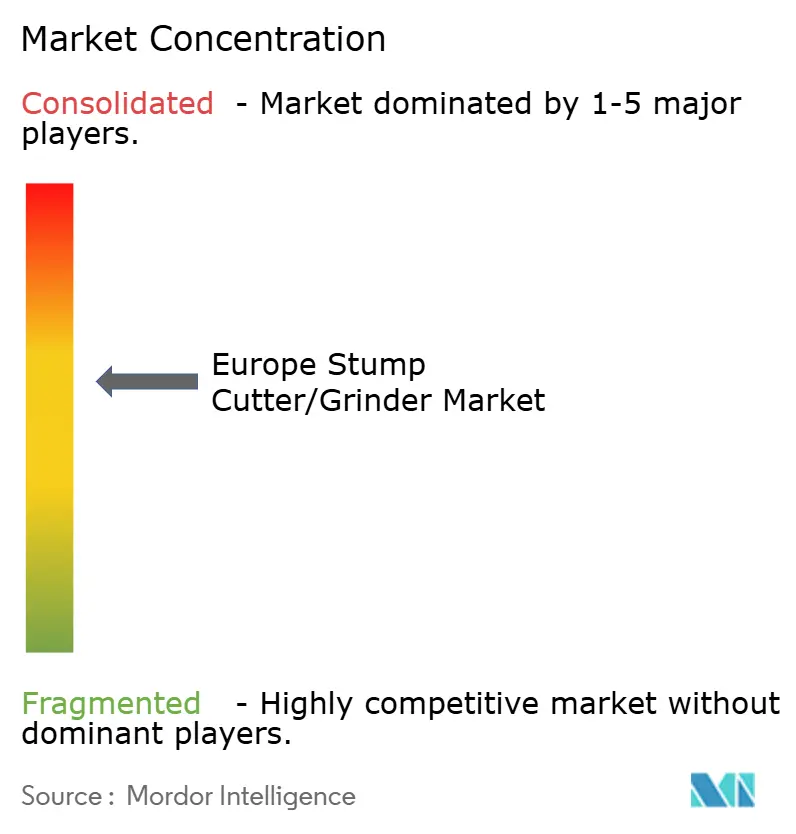
The stump cutter/grinder market is moderately consolidated, with Bandit Industries, Morbark, JO BEAU, Vermeer, and The Toro Company as the major players. These companies compete to strengthen their market positions, with product innovation being a key strategy adopted by the major players.
Europe Stump Cutter/Grinder Industry Leaders
-
JO BEAU
-
Vermeer
-
Bandit Industries
-
Morbark
-
The Toro Company
- *Disclaimer: Major Players sorted in no particular order
Europe Stump Cutter/Grinder Market Companies Covered in this Report
- JO BEAU
- Vermeer
- Bandit Industries
- Morbark
- The Toro Company
- J.P. Carlton Company
- Predator Power Ltd
- Tracmaster Ltd
- Fecon
- Ferrirotor Srl
- FSI Power-Tech ApS
- Woodland Mills Inc.
Recent Industry Developments in Europe Stump Cutter/Grinder Market
- August 2024: FSI launched the FSI B31-980 stump cutter to meet market demand. The hydraulically-driven cutter wheel on the FSI B31 eliminates the need for daily maintenance, minimizing operating costs and reducing time spent in the workshop.
- November 2023: Vermeer launched the SC1052 stump cutter, which is an ideal solution for tree care professionals. It can remove many stumps efficiently and grinds large stumps with minimal repositioning. Featuring a 115-horsepower (85.8-kW) Origin 4.3L gas engine with an 18.1-gallon (68.5-L) fuel tank, the exclusive Vermeer cutting system (VCS) and SmartSweep control system, the SC1052 is the largest cutter in the Vermeer product line.
Europe Stump Cutter/Grinder Market Report Scope
Stump grinders and stump cutters are machines designed to remove tree stumps by grinding them into small chips. The Europe Stump Cutter/Grinder Market is segmented by geography into Germany, the United Kingdom, France, Italy, Spain, Russia, and the Rest of Europe.
Segmentation Overview
| Germany |
| United Kingdom |
| France |
| Italy |
| Spain |
| Russia |
| Rest of Europe |
| Geography | Germany |
| United Kingdom | |
| France | |
| Italy | |
| Spain | |
| Russia | |
| Rest of Europe |
Key Questions Answered in the Report
What is the size of the Europe stump cutter/grinder market?
The Europe stump cutter/grinder market was valued at USD 642.00 million in 2026 and is projected to reach USD 963.47 million by 2032, registering a CAGR of 7.00% from 2027 to 2032.
What are stump cutters/grinders used for?
Stump cutters/grinders are machines designed to remove tree stumps by grinding them into small chips. They are used in forestry, landscaping, agriculture, construction, and land-clearing activities.
Who are the key players in the market?
JO BEAU, Vermeer, Bandit Industries, Morbark, and The Toro Company are the major companies operating in the Europe Stump Cutter/Grinder Market.
Which country dominates the Europe stump cutter/grinder market?
Germany is identified as the dominant market in Europe, supported by its engineering capabilities, forestry industry, infrastructure development, and demand for landscaping and land-clearing equipment.