
Forestry Machinery Market Size and Share
Market Overview
| Study Period | 2021 - 2031 |
|---|---|
| Market Size (2026) | USD 12.54 Billion |
| Market Size (2031) | USD 15.66 Billion |
| Growth Rate (2026 - 2031) | 4.54 % |
| Fastest Growing Market | Asia-Pacific |
| Largest Market | North America |
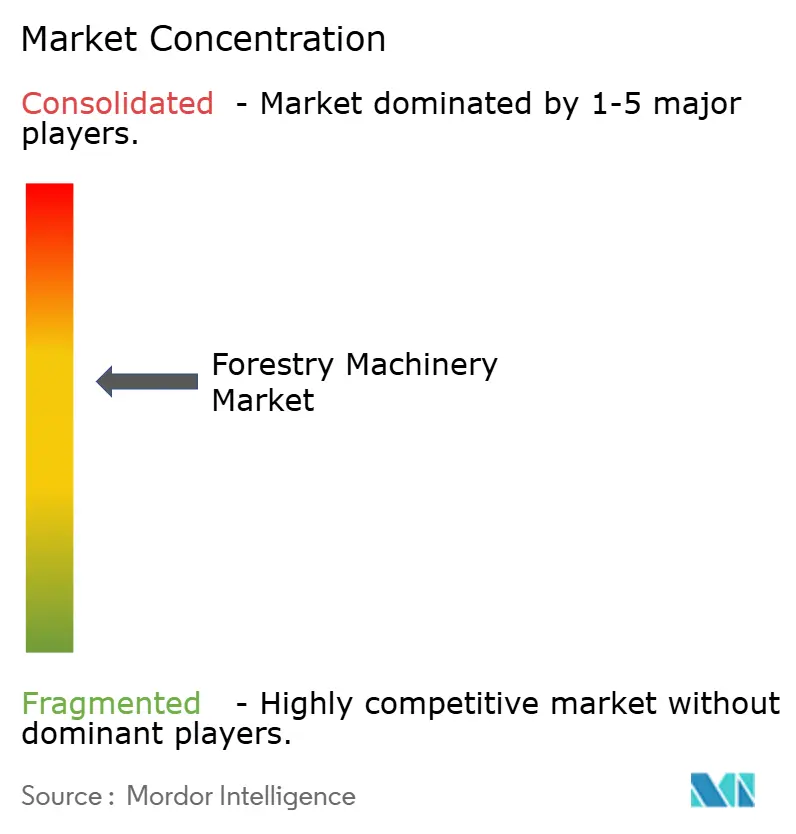
| Market Concentration | Medium |
Major Players *Disclaimer: Major Players sorted in no particular order Image © Mordor Intelligence. Reuse requires attribution under CC BY 4.0. | |
Forestry Machinery Market Analysis by Mordor Intelligence
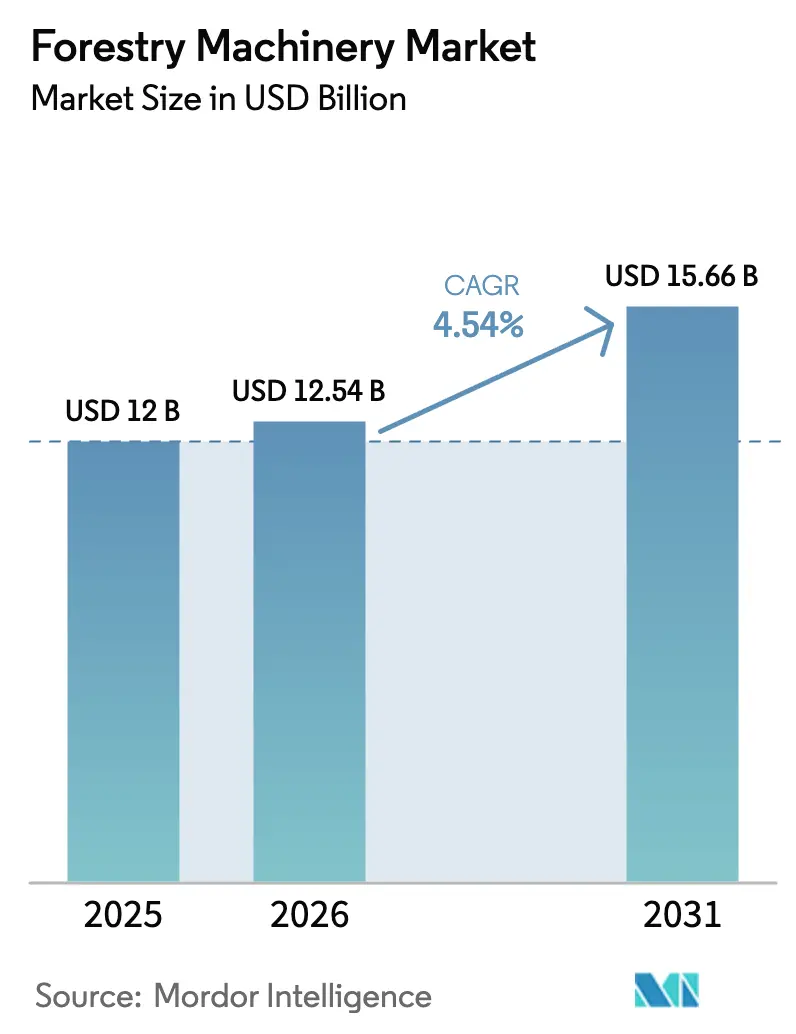
The forestry machinery market size in 2026 is estimated at USD 12.54 billion, growing from 2025 value of USD 12.0 billion with 2031 projections showing USD 15.66 billion, growing at 4.54% CAGR over 2026-2031. Market growth is driven by persistent labor shortages, which encourage the adoption of automation, stricter environmental regulations mandating low-emission equipment, and the necessity to replace aging machinery fleets in both developed and developing regions. The European Timber Trade Federation (ETTF) forecasts total European softwood consumption at 41 million cubic meters in 2024, with a 1.1% increase anticipated in 2025. This high production volume requires advanced forest machinery to meet the growing demand for wood products. North American and European operators are implementing integrated digital platforms to meet certification requirements and improve operational efficiency. In the Asia-Pacific and South America regions, producers are transitioning from manual logging to cut-to-length systems to meet export requirements for traceable chain-of-custody documentation. The market maintains competitive balance as forestry equipment producers focus on developing electric and autonomous solutions rather than engaging in price competition.
Key Report Takeaways
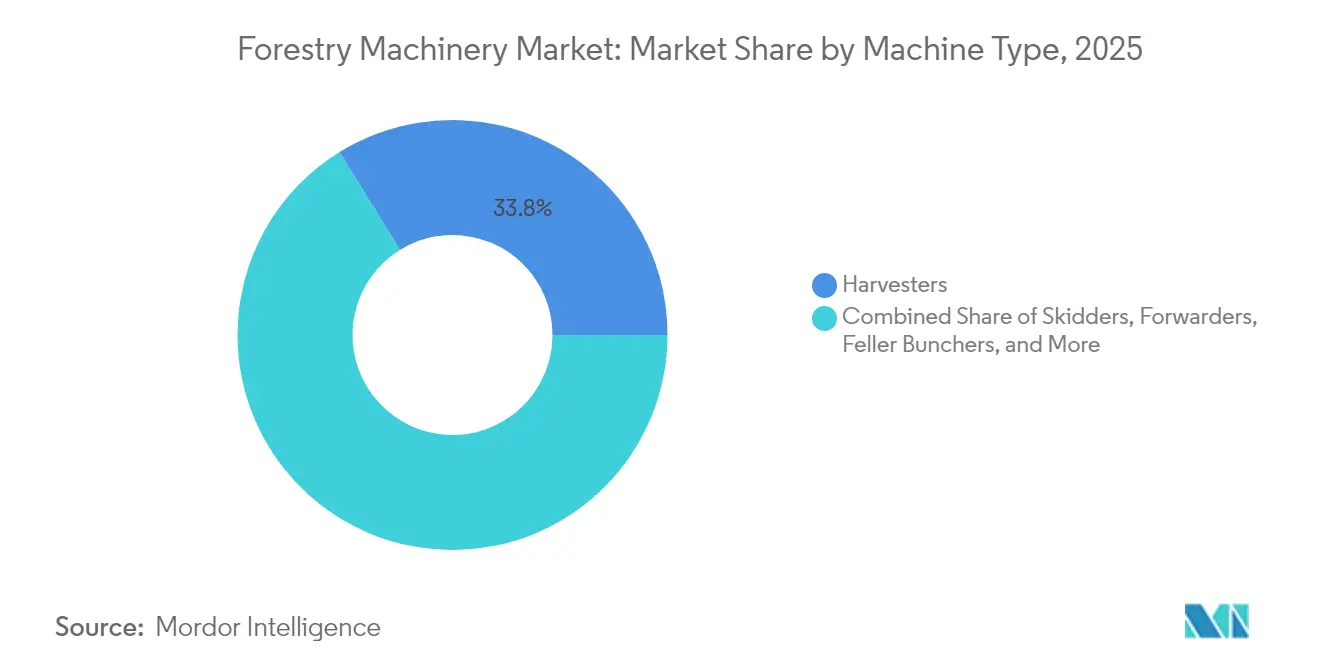
- By machine type, harvesters held 33.80% of the forestry machinery market share in 2025, while forwarders are projected to expand at a 7.65% CAGR through 2031.
- By power source, diesel systems accounted for 77.30% of the forestry machinery market size in 2025, and battery-electric solutions are forecast to grow at a 10.25% CAGR to 2031.
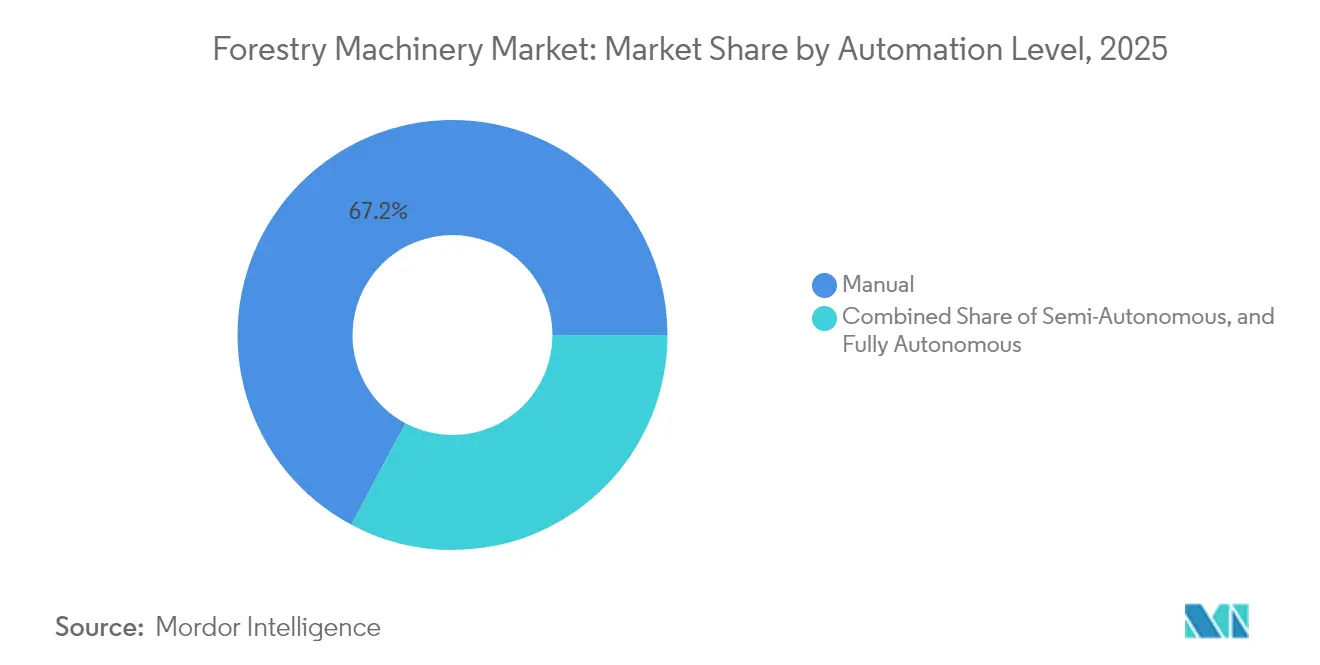
- By automation level, manual operations controlled a 67.20% share in 2025, whereas fully autonomous platforms are projected to rise at a 9.05% CAGR through 2031.
- By end user, contract logging firms captured a 41.10% share in 2025, while forest ownership groups are set to grow at a 9.75% CAGR between 2026 and 2031.
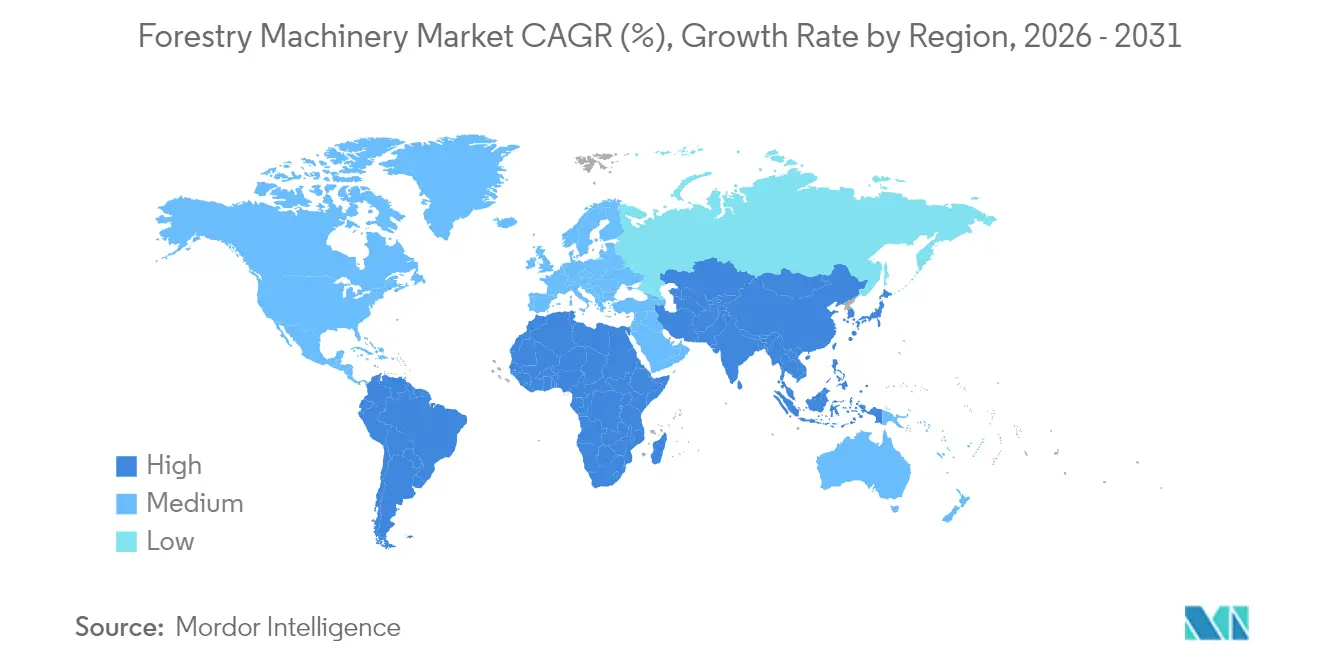
- By geography, North America commanded a 36.50% share in 2025, and Asia-Pacific is on track for a 7.05% CAGR through 2031.
- Market concentration is moderate, with the top five companies such as Deere & Company, Komatsu Ltd., Caterpillar Inc., Tigercat International Inc., and Ponsse Plc collectively holding majority of the market share in 2025.
Note: Market size and forecast figures in this report are generated using Mordor Intelligence’s proprietary estimation framework, updated with the latest available data and insights as of 2026.
Market Trends and Insights
Drivers Impact Analysis of Forestry Machinery Market*
| Driver | (~) % Impact on CAGR Forecast | Geographic Relevance | Impact Timeline |
|---|---|---|---|
| Surge in mechanized logging in emerging economies | +1.1% | Asia-Pacific, South America, and Africa | Medium term (2-4 years) |
| Rising global demand for certified timber products | +0.8% | Global, with emphasis on Europe and North America | Long term (≥ 4 years) |
| Government re-afforestation incentives and subsidies | +0.5% | North America, Europe, and China | Short term (≤ 2 years) |
| Electrification of off-highway machinery fleets | +1.0% | Europe, North America, and Scandinavia | Medium term (2-4 years) |
| Labor-shortage–led adoption of autonomous machineries | +0.6% | North America, Europe, and Australia | Short term (≤ 2 years) |
| Digital twin deployment for predictive maintenance | +0.4% | Global, led by developed markets | Long term (≥ 4 years) |
| Source: Mordor Intelligence | |||
Surge in Mechanized Logging in Emerging Economies
Mechanization rates in China increased as government mandates strengthened sustainable forest management requirements. Productivity gains in Brazilian eucalyptus plantations demonstrate measurable benefits - forwarder output reaches 60.97 m³ per effective work hour when individual tree volume exceeds 0.58 m³, compared to 42.06 m³ at lower volumes. Operational costs in developing regions have decreased, becoming lower than in several developed markets. Paraguay's plantation area quadrupled as investors targeted returns from mechanized eucalyptus stands. Equipment manufacturers developed lighter forwarders and oscillating bogies that reduce soil compaction for local terrain conditions, enabling emerging operators to achieve both productivity and environmental standards.
Rising Global Demand for Certified Timber Products
Forest Stewardship Council certification increased oak log prices by 19.28% and beech log prices by 12.30% in Turkey in 2023, demonstrating that certification premiums can offset investments in precision equipment. The European Deforestation Regulation, which takes effect in December 2024, requires exporters to provide geolocation and traceability data, necessitating the implementation of digital recorders and satellite systems[1]Source: Department of Agriculture, Fisheries and Forestry, “European Union Deforestation Regulation,” agriculture.gov.au. Certification requirements in Japan and Western Europe promote the use of selective cutting equipment and low-impact vehicles to maintain forest quality. Major buyers now incorporate audit systems that process data, making machine-generated logging records essential for market access.
Government Re-Afforestation Incentives and Subsidies
The United States Department of Agriculture's USD 80 million Wood Innovations Grants program for 2025 reduces the payback period for new harvesters to less than four years for eligible operators[2]Source: Council of Western State Foresters, “Policy Update July 2025,” westernforesters.org. North Carolina provides reimbursement to landowners for planting while permitting the use of federal Environmental Quality Incentive Program funds for precision thinning equipment. Federal tax deductions for reforestation expenses improve after-tax returns, encouraging family forest owners to purchase midsize forwarders rather than outsource timber transportation. Grant requirements typically include fuel consumption limits and digital reporting requirements, which encourage the adoption of hybrid drives and telematics systems.
Electrification of Off-Highway Machinery Fleets
Swedish Cellulose Corporation (SCA) deployed electric timber trucks, which covered 46,000 km in Sweden, resulting in a 55 metric tons reduction in CO₂ emissions annually. The company's second prototype, equipped with integrated cranes, aims to reduce emissions by 170 metric tons[3]Source: SCA, “Electric Timber Trucks,” sca.com. In May 2025, Volvo Construction Equipment introduced mid-size electric material handlers and an electric articulated hauler, advancing their battery technology beyond the testing phase. In 2024, Komatsu developed battery-electric drilling rigs, while Sennebogen implemented energy recovery systems. Manufacturers are focusing on modular battery packs and regenerative hydraulics to match diesel performance. Establishing charging infrastructure in remote locations remains a challenge. The inclusion of mobile charging trailers and depot micro-grids in tender specifications is contributing to increased adoption.
Restraints Impact Analysis of Forestry Machinery Market*
| Restraint | (~) % Impact on CAGR Forecast | Geographic Relevance | Impact Timeline |
|---|---|---|---|
| High upfront and lifecycle ownership costs | -1.1% | Global, particularly emerging markets | Short term (≤ 2 years) |
| Volatility in soft-wood commodity prices | -0.7% | North America, Europe, and Russia | Medium term (2-4 years) |
| Shortage of skilled operators for advanced machines | -0.6% | Developed markets and rural regions | Long term (≥ 4 years) |
| Cyber-security gaps in telemetry-enabled equipment | -0.4% | Global, emphasis on connected fleets | Medium term (2-4 years) |
| Source: Mordor Intelligence | |||
High Upfront and Lifecycle Ownership Costs
Tracked harvesters in the southeastern United States range from USD 316,000 to USD 763,000. In Brazil, maintenance accounts for 33.5% of hourly operating costs for John Deere models with over 30,000 operating hours. Research from the Czech Republic indicates that personnel costs comprise 35-66% of forwarder operating expenses, making operator efficiency essential for return on investment. Machine size and brand influence value retention, with larger carriers maintaining higher resale values despite requiring greater initial capital. Financing packages combining telematics subscriptions and residual-value guarantees help manage costs, but small contractors continue to face limited credit availability.
Volatility in Soft-Wood Commodity Prices
Spruce prices increased due to export restrictions and supply chain disruptions, followed by a decline in lumber futures. Hardwood production faces potential supply constraints due to mill closures reducing capacity, which creates uncertainty in harvest agreements. Commercial companies plan their budgets, but regional factors such as wildfires and regulatory changes continue to affect demand patterns. These price fluctuations impact capital expenditure decisions, as operators remain cautious about long-term debt commitments during periods of volatile timber costs.
*Our forecasts treat driver/restraint impacts as directional, not additive. The impact forecasts reflect baseline growth, mix effects, and variable interactions.
Forestry Machinery Market Segment Analysis
By Machine Type:
Demand Concentrates on Harvesters Yet Forwarders AccelerateHarvesters generated 33.80% of the forestry machinery market share in 2025 as manufacturers embedded precision felling heads and real-time length-diameter optimization algorithms. The forwarder segment is projected to grow at a 7.65% CAGR through 2031, as plantation operators adopt integrated cut-to-length systems that minimize soil impact and reduce skidder usage. The technological advancement in the industry is exemplified by Deere's C7.1 twin turbo harvester engine, which delivers 30% higher swing torque while reducing maintenance time by 15%.
Feller bunchers maintain their market position in Southern pine operations due to specific tree characteristics and stand density requirements. Their market share may decline as harvesting heads develop enhanced multi-tree handling capabilities. Swing machines and loaders continue to serve specialized processing requirements at roadside locations, while mulchers maintain consistent demand from municipal wildfire prevention programs. Equipment manufacturers' order backlogs indicate increasing preference for versatile carriers that accommodate interchangeable harvesting, forwarding, and hoe-chucking attachments, helping operators manage market fluctuations effectively.



By Power Source:
Battery-Electric Moves from Pilot to ProcurementDiesel engines maintain a 77.30% share in the forestry machinery market in 2025, primarily due to operational duty cycles exceeding current battery capabilities. Battery-electric solutions are growing at a 10.25% CAGR. The introduction of Volvo's EW240 Electric Material Handler demonstrates the viability of heavy battery-powered equipment, while mobile charging trailers become standard offerings in dealer catalogs. Hybrid systems function as transitional technology, with Sennebogen's Green Hybrid energy recovery system reducing fuel consumption by up to 30% in crane operations.
Financial institutions now incorporate carbon credit revenue streams in their equipment financing programs for low-emission machines. This shift has led to powertrain selection decisions based on total environmental ownership costs rather than initial purchase price. In Scandinavia, public land contract bids award additional points for zero-emission harvesters, indicating regulatory influences that may accelerate the transition away from diesel faster than economic factors alone would predict.
By Automation Level:
Assisted Functions Evolve into Full AutonomyManual operations account for 67.20% of the forestry machinery market size in 2025, while fully autonomous systems are growing at a 9.05% CAGR due to advances in deep learning technology. Deere's Intelligent Boom Control reduces tree processing cycle times significantly while maintaining operator supervision. Ponsse's Thinning Density Assistant combines Global Navigation Satellite System (GNSS) waypoints and optical sensors to monitor and document residual stand conditions, integrating compliance requirements with operational efficiency.
Labor shortages and insurance cost reductions are driving automation adoption. Insurance providers in the Pacific Northwest offer reduced premiums for machines equipped with remote operation capabilities. Equipment suppliers now offer autonomy features through tiered software subscriptions, creating recurring revenue streams while reducing initial investment costs for smaller operations.
By End User:
Ownership Patterns Shift Toward Forest OwnersContract logging firms held 41.10% of the forest machinery market share in 2025, while forest ownership groups recorded a 9.75% CAGR as they integrated harvesting operations to maintain certified supply chains. Large timberland investment management organizations prefer to own machines directly to collect data for carbon credit verification models. Sawmills and pulp companies maintain limited fleets primarily for in-yard handling operations rather than forest harvesting.
Equipment owners without in-house maintenance capabilities prioritize extended warranty coverage and uptime guarantees. Original equipment manufacturers (OEMs) respond by offering 36-month preventive maintenance packages and predictive analytics dashboards, targeting owner-operators who prioritize operational transparency over hourly contract rates.
Geography Analysis
North America Forestry Machinery Market
North America holds a 36.50% share in the forestry machinery market in 2025 due to established mechanized practices and autonomous harvester trials addressing labor shortages. The region benefits from USD 80 million in federal grants for 2025 and tax incentives that reduce payback periods for electrified carriers. Canada's fivefold increase in temporary foreign workers indicates persistent labor constraints, supporting automated equipment adoption. Dealers manage inventory against Deere's projected decline for 2025, and demand for telematics module retrofits remains strong as operators focus on equipment uptime.
APAC Forestry Machinery Market
Asia-Pacific shows the highest growth rate at 7.05% CAGR, with China's commercial harvest mechanization exceeding 60%. Komatsu anticipates continued market expansion based on wood demand, labor constraints, and enhanced safety requirements. Japanese certification premiums currently limit harvester upgrades, and domestic manufacturers identify export opportunities in the Asia Pacific's expanding plantation sector.
Europe Forestry Machinery Market
Europe maintains robust replacement cycles driven by certification requirements. The European Union Deforestation Regulation, effective December 2024, mandates GPS-accurate harvest data, increasing demand for modern cabs with StanForD-compatible logging systems. Sweden and Finland are pioneers in electric truck implementations, with SCA's timber haulers reducing their annual emissions by 55 metric tons. Ponsse reported EUR 336.0 million (USD 393.4 million) in order intake from Nordic countries during the first half of 2024, demonstrating stable replacement demand despite weakness in the construction sector.
South America and MEA Forestry Machinery Market
South America optimizes operations through uniform eucalyptus plantations supporting high-capacity, automated fleets. Brazil sets productivity standards for cost efficiency, while Paraguay's expanding cultivation area creates opportunities for Original Equipment Manufacturers (OEM) financing services. The Middle East and Africa markets remain early-stage, with reforestation programs supported by donor funding creating specific opportunities for light skidders and multipurpose loaders.

Regulatory Landscape
Regulation increasingly ties forestry operations to machine-level safety, road-circulation compliance, and auditable traceability, pushing OEMs to embed compliant controls, sensors, and documentation workflows into equipment and digital platforms. In the European Union, the European Deforestation Regulation taking effect in December 2024 raises the compliance bar for geolocation and chain-of-custody data, supporting adoption of StanForD-compatible logging systems, telematics, and integrated digital recorders across harvesting and forwarding fleets.
On the product and machine-safety side, EU Machinery Regulation (EU) 2023/1230 (consolidated text updated as of May 29, 2026) strengthens health and safety design requirements for machinery, while agricultural and forestry tractors remain under Regulation (EU) No 167/2013. EU Regulation 2025/14 (adopted December 19, 2024) sets technical requirements for non-road mobile machinery intended to circulate on public roads, and EU Regulation 2025/1117 (April 3, 2025) amends braking and functional safety requirements for agricultural and forestry vehicles. International standards also reinforce design obligations, including ISO 11680:2025 for forestry machinery safety and ISO/FDIS 14982-1:2025 for electromagnetic compatibility (effective February 12, 2026), which shape validation and type-approval testing for increasingly connected machines.
Competitive Landscape
The market demonstrates moderate concentration, with the top 5 players holding a majority share in the forestry machinery market in 2024. These key players include Deere & Company, Komatsu Ltd., Caterpillar Inc., Tigercat International Inc., and Ponsse Plc. Deere & Company maintains market leadership through its agricultural machinery expertise and extensive North American dealer network. Komatsu Ltd. and Caterpillar Inc. leverage their forestry equipment capabilities and global manufacturing presence. Tigercat International Inc. and Ponsse Plc compete through specialized forestry equipment manufacturing, focusing on technological innovation and application-specific solutions.
The industry is experiencing significant changes through electric and autonomous systems. In 2024, Hitachi Construction Machinery's partnership with Dimaag for 1.7-metric tons zero-emission excavators demonstrates the industry's shift toward electrification. In 2025, Volvo CE partnered with Unicontrol to integrate 3D machine control technology, showcasing the trend of equipment manufacturers collaborating with software providers.
Umea University's development of a 16-metric-tons autonomous machine control system using deep reinforcement learning indicates potential disruption from non-traditional market entrants. Companies, including Komatsu, are investing in Smart Forestry digital platforms, incorporating predictive maintenance, precision harvesting, and integrated fleet management systems to enhance operational efficiency and equipment utilization.
Forestry Machinery Industry Leaders
Deere & Company
Komatsu Ltd.
Caterpillar Inc.
Tigercat International Inc.
Ponsse Plc
- *Disclaimer: Major Players sorted in no particular order
Forestry Machinery Market Companies Covered in this Report
- Deere & Company
- Komatsu Ltd.
- Caterpillar Inc.
- Tigercat International Inc.
- Ponsse Plc
- Volvo Construction Equipment AB (AB Volvo)
- Hitachi Construction Machinery Co., Ltd. (Hitachi Ltd.)
- Kubota Corporation
- Barko Hydraulics LLC (Heico Companies)
- Rottne Industri AB
- Kawasaki Heavy Industries, Ltd.
- Doosan Bobcat Inc. (Doosan Group)
- LKT Holding s. r. o.
- Kesla Oyj
- Sennebogen Maschinenfabrik GmbH

Market Opportunities and Future Outlook
Automation is extending beyond traditional harvesters and forwarders, particularly in silviculture and regeneration, where labor exposure and repeatable quality outcomes support mechanization. Deere & Companys acquisition of Risutec Oy assets and intellectual property (February 2026) points to OEM interest in mechanized tree planting, extending the addressable equipment and software stack into reforestation workflows that connect with carbon and certification reporting. Industry research programs also reinforce this direction: Forest Growers Research (FGR) reported progress in November 2025 within its nine-year Automation and Robotics program, spanning multiple automated forestry products (including automated quick couplers and cable yarder systems) slated for commercial delivery by December 2027.
Low-impact operations and electrification create additional product and service openings as tender requirements and certification compliance reward reduced soil disturbance and data-rich operations. Komatsu Forests completed acquisition of Malwa Forest AB (April 1, 2026), adding compact, lightweight cut-to-length thinning equipment aligned with minimizing soil impact and root damage, while Ponsse introduced the PONSSE Mammoth (May 2026) to address high-capacity forwarding needs in difficult terrain with CVT and updated loader technology. Autonomy-related advances also broaden the technical frontier: AirForestry reported a fully autonomous harvest sequence using electric drones in a real forest production environment (May 2026), and 2026 academic work demonstrated supervised autonomous thinning platforms and validated automated coverage path planning for mechanized regeneration, supporting supplier roadmaps for supervised autonomy, interoperability of machine data, and new service revenue from software subscriptions and compliance-grade reporting.
Recent Industry Developments in Forestry Machinery Market
- May 2026: Ponsse announced new products for responsible forestry, including the PONSSE Mammoth forwarder in the 25-ton load-carrying category and the H8 harvester head with updated automatic control features. The launch expands Ponsse coverage from thinning and mid-size forwarding into heavier-duty extraction use cases where large stems and difficult terrain demand higher payload and upgraded hydraulics. It also reinforces the shift toward software-assisted machine functions as a selling point alongside mechanical performance.
- April 2026: Komatsu Forest completed the acquisition of Malwa Forest AB, adding compact and lightweight cut-to-length thinning machines to its portfolio. The deal strengthens Komatsus positioning in low-impact Nordic operations, where minimizing soil disturbance and root damage is a key operational constraint. Portfolio breadth improves Komatsus ability to serve both high-productivity harvesting and specialized thinning requirements with a single dealer and platform strategy.
- February 2026: Deere & Company acquired intellectual property and certain assets of Risutec Oy related to mechanized tree planting technology. The acquisition extends Deeres forestry offering into silviculture, targeting labor-intensive regeneration activities where automation reduces manual workload and improves consistency. Integrating planting equipment with precision forestry software and dealer support also creates a pathway for bundled solutions that connect machine data to certification and reporting workflows.


Forestry Machinery Market Report Scope and Research Methodology
Market Definition and Coverage
For this study, the forestry machinery market covers purpose-built machines used to harvest, extract, load, and move timber inside forest operations and at the log landing, with values captured in USD for the equipment sold into these workflows.
Scope exclusions: We exclude hand tools and consumer-grade equipment, along with general-purpose construction machines unless they are configured and sold for forestry-specific work.
Segments Covered in This Report
- By Machine Type
- Skidders
- Forwarders
- Feller Bunchers
- Harvesters
- Swing Machines
- Loaders
- Other Machine Type
- By Power Source
- Diesel
- Hybrid
- Battery-Electric
- By Automation Level
- Manual
- Semi-Autonomous
- Fully Autonomous
- By End User
- Contract Logging Firms
- Forest Ownership Groups
- Pulp and Paper Companies
- Sawmills
- By Geography
- North America
- United States
- Canada
- Mexico
- Rest of North America
- Europe
- Germany
- Sweden
- Finland
- United Kingdom
- France
- Spain
- Russia
- Rest of Europe
- Asia-Pacific
- China
- Japan
- India
- South Korea
- Rest of Asia-Pacific
- South America
- Brazil
- Argentina
- Rest of South America
- Middle East
- Saudi Arabia
- United Arab Emirates
- Turkey
- Rest of Middle East
- Africa
- South Africa
- Egypt
- Rest of Africa
- North America
Data Sources, Market Sizing, and Validation
Desk Research
Desk research sets the fact base for the model, especially on timber production, logging activity, and equipment adoption by region. We typically refer to public sources such as FAO forestry statistics, United States Forest Service publications, Eurostat forestry datasets, World Bank macro indicators, and national forest inventories and agencies in major timber economies.
To translate activity into an equipment demand pool, we also review company annual reports, investor presentations, and product brochures to understand product-line positioning and typical replacement cycles. Trade press and association websites help confirm near-term signals like mill capacity expansions, harvesting restrictions, and mechanization trends. Where needed, we supplement this with paid subscriptions for company financials, patent databases, and shipment-level import and export records to check trade flows for key machine categories. These examples are not exhaustive, and other sources were also used to collect, validate, and clarify data points.
Primary Interviews and Surveys
Primary work is used to pressure-test assumptions that are hard to see in public data, such as average selling price bands by machine class, financing and procurement timing, and the practical split between new purchases and fleet replacement. We speak with a mix of OEM-side organizations, dealer and service networks, and end users like logging contractors and forest owners across APAC, EMEA, and the Americas, so the model reflects different harvesting systems and terrain realities.
Distribution of primary research fieldwork respondents
| Company type | Respondent position | Region |
|---|---|---|
| Top tier: 31% | CXOs: 21% | APAC: 45% |
| Mid tier: 47% | Functional/Unit leaders: 26% | EMEA: 35% |
| Smaller Players: 22% | Managers: 53% | Americas: 20% |
Market-Sizing & Forecasting
The core build starts with a top-down demand reconstruction, where timber harvest volumes, mechanization rates, and machine-intensity by harvesting method are converted into annual equipment demand by major region and machine class. Once that structure is in place, the totals are corroborated through selective bottom-up checks, such as sampled unit shipments multiplied by typical ASP ranges, dealer channel checks, and supplier roll-ups in markets where coverage is clearer.
Inputs that matter in this market include industrial roundwood production, logging permit and harvest restrictions, contractor fleet age and replacement cycles, utilization levels tied to seasonality, and the mix shift toward cut-to-length systems and higher automation. Pricing is handled through a simple ASP progression that reflects inflation, feature upgrades, and currency timing, and then it is sanity-checked with interview feedback and published equipment list prices when available. For forecasting, we mainly use scenario analysis with a light multivariate overlay, so demand is flexed based on timber output outlook, housing and packaging-linked wood demand, and policy constraints that affect harvest levels. When a bottom-up signal is missing for a smaller country, we fill the gap using per-unit intensity proxies from comparable markets and then re-balance at the regional total.
Data Validation & Update Cycle
Validation is done through multiple checks so the final number is not driven by one data series. We compare outputs against independent signals like timber production trends, machinery import patterns, and reported order commentary from public filings, and then investigate outliers before sign-off.
A second analyst reviews the model logic, inputs, and calculations, and any questions are taken back to select interviewees when results move outside reasonable bands. The report is refreshed annually, and interim updates are made when there are material events, such as major regulation changes, sharp FX moves, or demand shocks in key timber regions. Before delivery, a final pass is completed so clients receive an updated view aligned to the latest public and primary signals.
Mordor Intelligence's Forestry Machinery Market Size Measured Against Other Published Estimates
Published market sizes for forestry machinery can look far apart, even when they are discussing similar equipment types. In most cases, the gap comes from what is counted as forestry-specific equipment, which year is treated as the anchor, and how pricing and currency are handled across regions.
Some estimates expand the scope into adjacent site-prep, wood processing, or forest-fire equipment, and that naturally lifts the total. In Mordor Intelligence, the 2026 value is tied to forestry-dedicated machines used for harvesting, extraction, and log handling, and it is checked against timber production signals and trade flows before the forecast is extended.
Benchmark comparison
| Source | Market Size | Gaps in Research Methodology |
|---|---|---|
| Mordor Intelligence | USD 12.54 B (2026) | |
| Industry Publisher A | USD 11.12 B (2024) | Uses an earlier base year and a 2024-2029 window, and the total can shift depending on how mid-cycle price increases and FX conversion timing are applied across regions. |
| Research Group B | USD 14.69 B (2024) | Applies a broader equipment basket that can include site preparation, wood processing, and fire management equipment, which increases the addressable value beyond core harvesting and extraction machines. |
The comparison shows that most of the spread is explained by scope expansion and by the chosen base year. By keeping the equipment list tied to forestry work phases and then validating the totals with observable activity indicators, the final number stays traceable to clear inputs that can be rechecked and updated each year.


Key Questions Answered in the Report
How large is the forestry machinery market in 2026 and how fast is it growing?
The forestry machinery market size is USD 12.54 billion in 2026 and is projected to grow at a 4.54% CAGR to reach USD 15.66 billion by 2031.
Which machine category leads revenue today?
Harvesters account for 33.80% of the projected 2025 revenue, driven by the extensive adoption of cut-to-length methods in mechanized logging operations.
What power source is gaining traction fastest?
Battery-electric platforms are advancing at an 10.25% CAGR as fleets seek lower emissions and stable fuel costs.
Which region offers the strongest growth outlook to 2031?
Asia-Pacific is projected to post a 7.05% CAGR, driven by rapid mechanization in China and expanding plantations across the region.
How significant is autonomy in upcoming purchasing decisions?
Fully autonomous systems show the highest segment CAGR at 9.05% because operators need solutions that relieve labor shortages and enhance safety.
Who are the top industry players by revenue?
Deere & Company, Komatsu Ltd., Caterpillar Inc., Tigercat International Inc., and Ponsse Plc together hold majority of global revenue, reflecting a moderately concentrated supplier landscape.
Page last updated on:


 Your data is secure and never sold or shared.


