
Europe Servo Presses Market Size and Share
Market Overview
| Study Period | 2020 - 2031 |
|---|---|
| Forecast Data Period | 2026 - 2031 |
| Base Year Market Size (2025) | USD 0.68 Billion |
| Market Size (2026) | USD 0.71 Billion |
| Market Size (2031) | USD 0.89 Billion |
| Growth Rate (2026 - 2031) | 4.62 % |
| Market Concentration | Medium |
Major Players *Disclaimer: Major Players sorted in no particular order Image © Mordor Intelligence. Reuse requires attribution under CC BY 4.0. | |
Europe Servo Presses Market Analysis by Mordor Intelligence
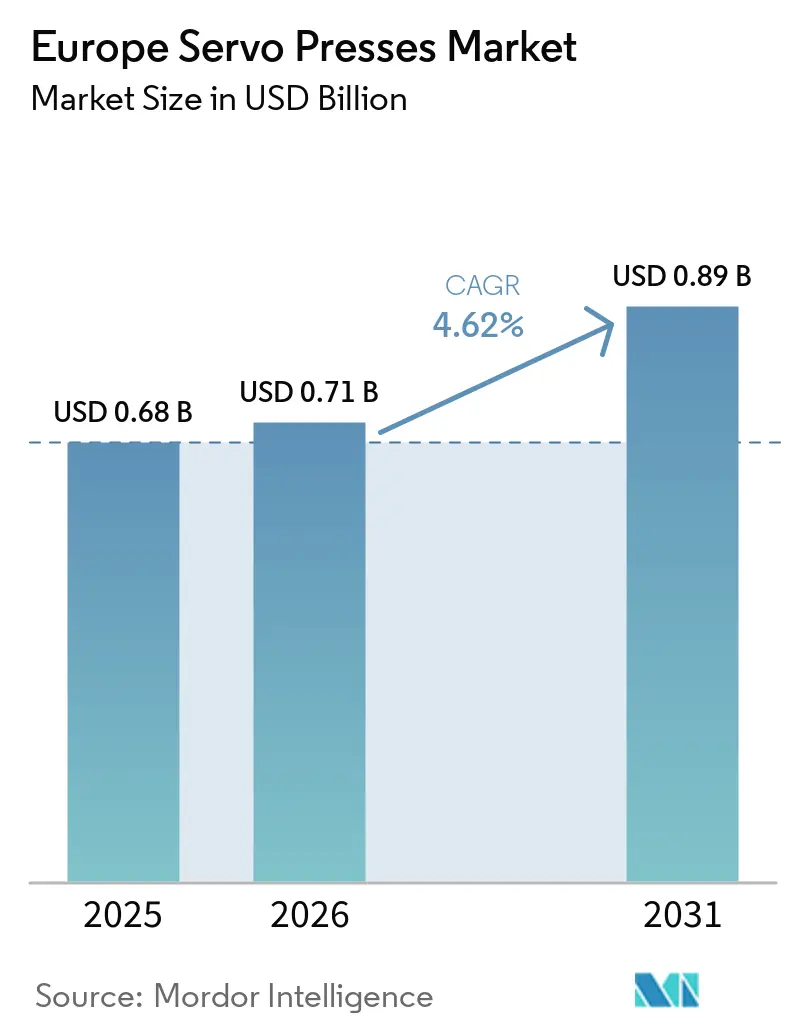
The Europe Servo Presses Market size is expected to grow from USD 0.68 billion in 2025 to USD 0.71 billion in 2026 and is forecast to reach USD 0.89 billion by 2031 at 4.62% CAGR over 2026-2031.
The Europe servo presses market is supported by automotive, aerospace, and precision-engineering production, where manufacturers need repeatable forming and better process control. Vehicle electrification is changing investment priorities because battery enclosures, body structures, and e-drive parts require tighter tolerances and greater material strength. Equipment buyers are also placing more weight on programmable motion, in-die force measurement, and energy recovery than on the initial purchase price alone. Germany remains the largest national base, while Spain is expected to grow the fastest as EV body-panel and transfer-line investment increases. The Europe servo presses market also benefits from replacement demand because older mechanical and hydraulic equipment cannot provide the data, flexibility, or energy performance expected in new production programs.
Key Report Takeaways
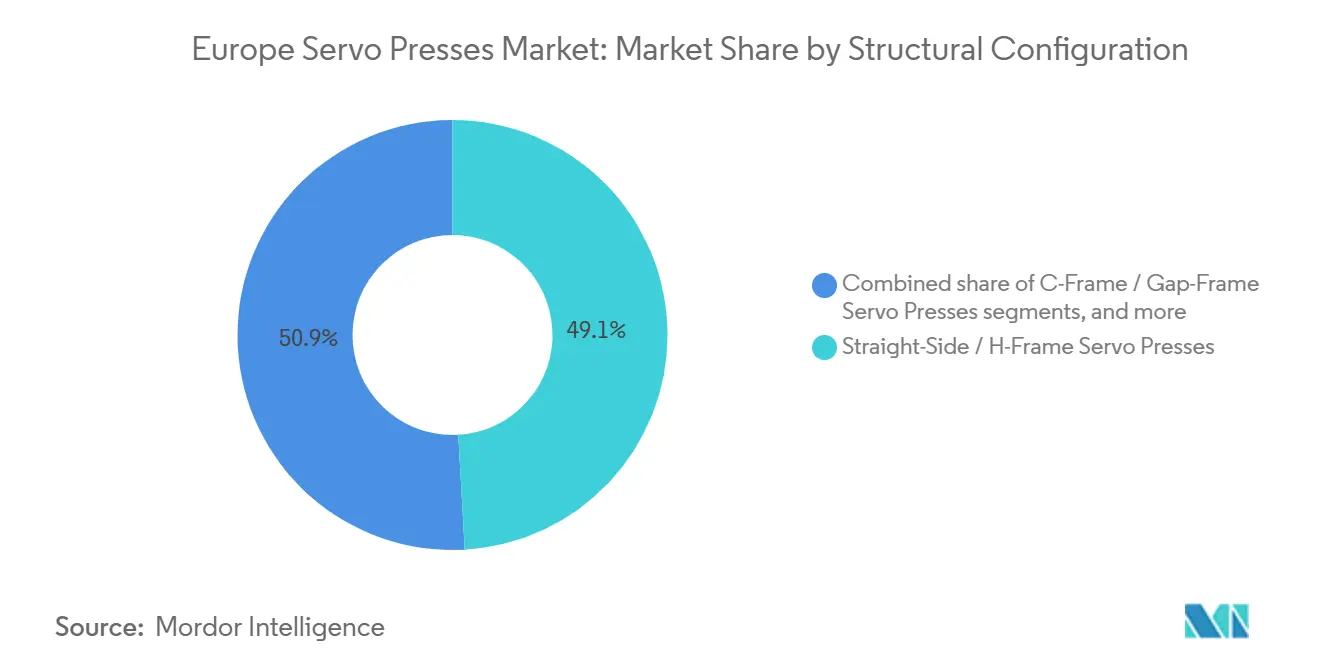
- By frame/structural configuration, straight-side or H-frame servo presses held 49.1% of the Europe servo presses market share in 2025, and are also forecast to grow at a 5.7% CAGR through 2031.
- By servo press technology/system type, servo-mechanical metal forming presses held 49.5% of the Europe servo presses market size in 2025, while electromechanical/electric servo assembly presses are forecast to grow at a 8.8% CAGR through 2031.
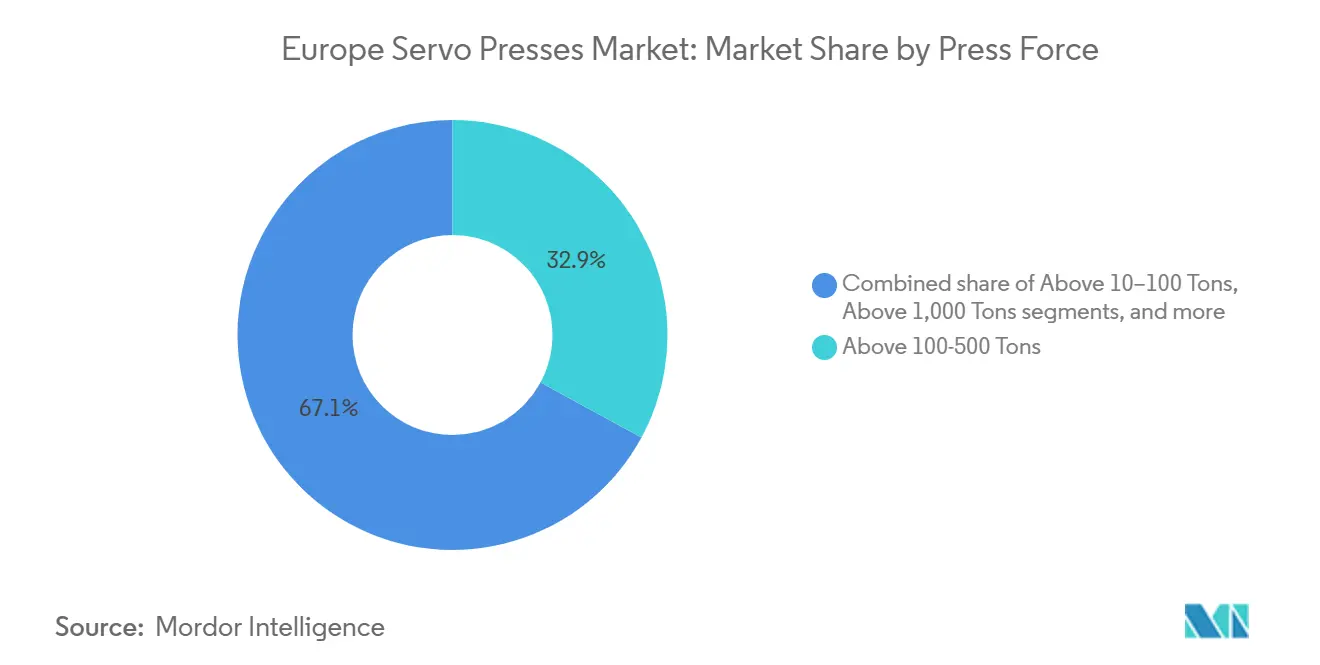
- By press force/capacity, the above 100-500 tons segment held 32.9% of the Europe servo presses market share in 2025, while the above 1,000 tons segment is forecast to grow at a 7.7% CAGR through 2031.
- By application, stamping, blanking, and punching held 33.6% of the Europe servo presses market share in 2025, while other precision and specialized pressing applications are forecast to grow at a 8.6% CAGR through 2031.
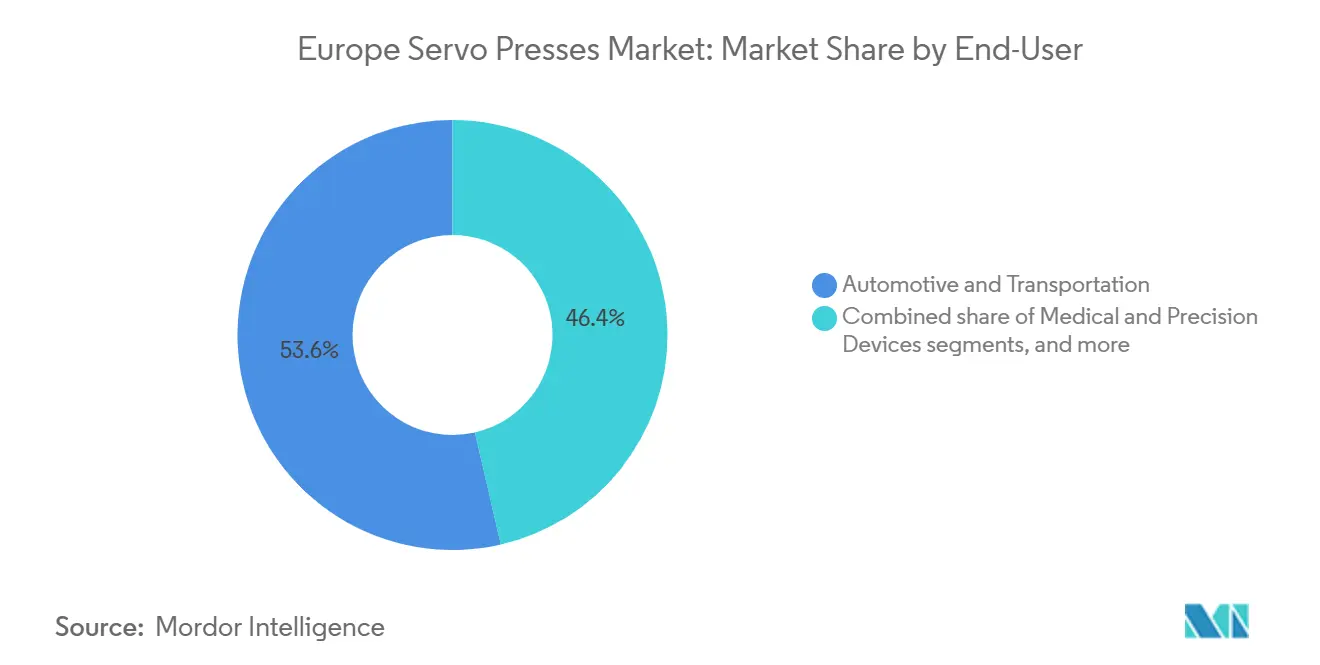
- By end user, automotive and transportation held 53.6% of the Europe servo presses market share in 2025, while medical and precision devices are forecast to grow at a 11.7% CAGR through 2031.
- By geography, Germany held 27.4% of the Europe servo presses market share in 2025, while Spain is forecast to grow at a 5.7% CAGR through 2031.
Note: Market size and forecast figures in this report are generated using Mordor Intelligence’s proprietary estimation framework, updated with the latest available data and insights as of January 2026.
Europe Servo Presses Market Trends and Insights
Drivers Impact Analysis*
| Driver | (~) % Impact on CAGR Forecast | Geographic Relevance | Impact Timeline |
|---|---|---|---|
| Electrification and the light-weighting of European vehicle platforms | +1.1% | Germany, France, Spain, Slovakia, Czech Republic | Medium term (2-4 years) |
| Industry 4.0 press-shop automation and traceability | +0.9% | Germany, Italy, Sweden, France | Medium term (2-4 years) |
| Energy-efficient replacement of legacy hydraulic and mechanical presses | +0.7% | Germany, Italy, the Netherlands, and Denmark | Short term (≤ 2 years) |
| Battery, bipolar-plate, and e-motor lamination production | +0.6% | Germany, Poland, France, Spain | Long term (≥ 4 years) |
| Aerospace, medical, and precision-component manufacturing | +0.4% | France, Germany, the United Kingdom, and Belgium | Medium term (2-4 years) |
| Retrofit-led modernization of installed press bases | +0.3% | Italy, Germany, the United Kingdom | Short term (≤ 2 years) |
| Source: Mordor Intelligence | |||
Electrification and the light-weighting of European vehicle platforms
European vehicle programs are increasing demand for forming systems that can handle stronger alloys and maintain closer dimensional control. Battery enclosures, EV body structures, and subframe parts place greater demands on slide motion and forming consistency than many legacy vehicle parts. BMW began series production of its Gen6 electric engine at Plant Steyr in August 2025 and committed USD 1.1 billion for e-drive development and production between 2022 and 2030. Toyota announced a USD 748 million expansion of its Kolin plant in September 2025 for its first European battery-electric vehicle production program. These projects support demand for precision lamination, rotor-stator assembly, and structural component forming. The Europe servo presses market, therefore, gains from vehicle programs that require both flexible press lines and reliable output at production speed.[1]Toyota Motor Europe, “Toyota Announces New Battery Electric Vehicle to Be Produced in Europe,” Toyota Newsroom Europe, newsroom.toyota.eu
Industry 4.0 Press-Shop Automation and Traceability
Traceability requirements are making data capture a necessary capability in automotive, aerospace, and battery supply chains. The SEAT and CUPRA PXL servo press at Martorell captures 3,000 data points for each stamping, supporting real-time production control and maintenance planning. ANDRITZ Schuler deployed its Metris Visual Die Protection system at Smart Press Shop in Germany in July 2025, where camera-based monitoring detects cracks and foreign objects before damage spreads. Audi also deployed a TÜV-certified virtual programmable logic controller in its Böllinger Höfe body shop in 2025 using Siemens Edge Cloud 4 Production. These examples show why older presses without certified data systems may be less suitable for new contracts. This requirement gives the Europe servo presses market a replacement path that is based on quality records and safety, as well as equipment output.
Energy-Efficient Replacement of Legacy Hydraulic and Mechanical Presses
European manufacturers are examining energy use more closely when replacing hydraulic and mechanical equipment. Servo drives use power as needed for motion instead of keeping a pump or flywheel at a constant load. AP&T received an order in November 2025 for a 1,500-ton servo press line from VDL VDS in the Netherlands, where constrained grid capacity made energy efficiency an engineering requirement. ANDRITZ Schuler commissioned a kinetic energy recovery system on a 6,500-ton forging press in July 2025 that can reduce power demand by up to 40% compared with conventional equipment of the same tonnage. Energy data also matters to suppliers that must document operational emissions for customers and reporting needs. This makes efficiency a practical selection factor across the Europe servo presses market.
Battery, Bipolar-Plate, and E-Motor Lamination Production
Battery, hydrogen, and e-motor production are adding applications that use high-speed and tightly controlled forming. POSCO INTERNATIONAL completed a drive-motor-core plant in Brzeg, Poland, with an annual capacity of 1.2 million units and orders for 35 million cores through 2033. Fraunhofer IPT presented the MatriXpress system in October 2025, with an 800-ton forming force, 60 strokes per minute, and accuracy below 10 µm. Fagor Arrasate supplies high-speed rotor and stator lamination lines as well as bipolar-plate forming systems, linking battery-electric and hydrogen investment to similar equipment needs. These applications add to conventional automotive demand rather than replacing it. Their development broadens the opportunity set for the Europe servo presses market.
Restraints Impact Analysis*
| Restraint | (~) % Impact on CAGR Forecast | Geographic Relevance | Impact Timeline |
|---|---|---|---|
| High upfront capital cost and long replacement cycles | -0.8% | Pan-European, especially small and medium-sized Tier-2 and Tier-3 suppliers | Medium term (2-4 years) |
| Payback uncertainty under volatile European energy prices | -0.5% | Germany, the Netherlands, Italy, and Belgium | Medium term (2-4 years) |
| Skilled controls and maintenance workforce shortage | -0.4% | Germany, France, Italy, Poland | Long term (≥ 4 years) |
| Imported motion-control components and cybersecurity exposure | -0.3% | Germany, Sweden, Netherlands | Long term (≥ 4 years) |
| Source: Mordor Intelligence | |||
High Upfront Capital Cost and Long Replacement Cycles
The cost of a fully configured servo system remains a barrier for smaller press-shop operators. Heavy press equipment can remain in use for 15-25 years, which encourages companies to defer replacement even when a newer system offers lower lifecycle costs. European Central Bank research found that a 1% energy-driven rise in industrial producer prices reduced European firms' capital expenditure by 4.1% after 1 year. European Investment Bank research published in 2025 also found that uncertainty about energy prices can discourage long-term climate and efficiency investment. Retrofit packages can reduce the immediate cost by retaining the installed frame, but they do not remove all funding pressure. This restraint limits replacement decisions in the Europe servo presses market, particularly among Tier-2 and Tier-3 suppliers.[2]European Central Bank, “Energy Shocks, Corporate Investment and Potential Output,” ECB Economic Bulletin, ecb.europa.eu
Payback Uncertainty Under Volatile European Energy Prices
Servo press savings are clear only when the electricity price used in a buyer's payback model remains credible. The European Central Bank reported that EU retail electricity and gas prices averaged more than twice the United States levels between 2020 and mid-2022. The International Monetary Fund identified persistent price volatility linked to European market design and the role of gas in marginal price setting in 2025. A change in the reference energy price can extend the payback period beyond normal corporate approval limits. Large OEMs can manage this risk more easily than mid-sized manufacturers with limited energy hedging. This uncertainty can delay orders in the Europe servo presses market even when the equipment has strong technical benefits.
*Our forecasts treat driver/restraint impacts as directional, not additive. The impact forecasts reflect baseline growth, mix effects, and variable interactions.
Segment Analysis
By Frame / Structural Configuration: Straight-Side Architecture Sustains Dominant Position in High-Tonnage Lines
Straight-side and H-frame presses held 49.1% of the Europe servo presses market size by frame type in 2025. Their rigid structure supports large-format blanking, transfer operations, and deep drawing, where eccentric loads are common. Automotive body-in-white production remains the main reason these systems are specified for larger lines. The architecture is also suited to EV body structures and battery enclosures that use extended dies and stronger materials. C-frame and gap-frame machines remain important in lower-tonnage assembly, joining, and medical-device work because they provide three-sided die access. Column and post-type presses serve smaller precision forging and powder compaction uses, while other special geometries address aerospace composite work and specialized forming requirements.
Straight-side presses are also the fastest-growing frame category, registering a 5.7% CAGR through 2031 because large EV body-panel and structural-module programs use wide-table transfer lines. AP&T's 1,500-ton straight-side press line for VDL VDS shows the continuing need for high-capacity equipment that also manages energy use. The Martorell PXL press shows that high rigidity can be combined with 15 strokes per minute and 5-minute die changes. Demand for this configuration benefits when users need flexible motion profiles without compromising structural stability. Large multi-station dies also require a frame that can maintain alignment when loads are uneven across the working area. This need is especially relevant for extended battery and body components that combine several forming steps within a single production line. Competition increasingly rests on force-measurement resolution, programmable motion, and connected controls rather than frame mechanics alone. This keeps the straight-side format central to high-tonnage investment.



By Servo Press Technology / System Type: Servo-Mechanical Leadership Coexists with Rapid Electromechanical Uptake
Servo-mechanical metal forming presses held 45.9% of the Europe servo presses market size by technology in 2025. They serve high-tonnage automotive body, forging, and structural uses where slide stiffness and load capacity are essential. Crankshaft and link mechanisms remain useful where forces exceed 1,000 tons, and all-electric machines have not matched the same operating range. Servo-hydraulic equipment also retains a role in deep drawing and hydroforming, especially where variable motion and hydraulic force are needed. Improved servo-pump drives have made these systems more efficient than conventional hydraulic power units. The technology mix, therefore, remains broad because the applications have different tonnage, precision, and cleanliness requirements.
Electromechanical and electric servo assembly presses are the fastest-growing technology category, registering an 8.8% CAGR through 2031. Medical devices, electronics, and precision power-module assembly favor oil-free systems with cleanroom suitability and accurate force control. SCHMIDT Technology's ServoPress 602 provides a maximum force of 300 N, position repeatability of ±1 µm, and force repeatability of 0.4 N for fine-mechanics work. These capabilities are useful where a small force variation can affect component quality or the record needed for batch release. They also reduce the risk that hydraulic oil contamination conflicts with clean manufacturing requirements. Hybrid systems provide an intermediate route for installed hydraulic frames because they can improve efficiency and programmability without requiring a full replacement. ANDRITZ Schuler introduced its HFA plus+ fine blanking series in January 2026 with a servo-controlled hydraulic-pump drive that improves energy efficiency by a double-digit percentage while raising stroke rates. The Europe servo presses industry is therefore seeing a gradual move toward all-electric systems in lower-tonnage precision applications. At the same time, mechanical and hybrid options retain a strong position in heavier work.
By Press Force / Capacity: Mid-Range Tonnage Anchors Revenue While Ultra-High Capacity Grows Fastest
Presses above 100-500 tons held 32.9% of the Europe servo presses market size by capacity in 2025. This range includes common press sizes for body panels, structural parts, and general industrial stamping. Automotive manufacturers use single-acting presses from 200 to 400 tons for door panels, roof rails, and crossmembers. Dual-action equipment up to 500 tons is used for deep drawing operations. Established European suppliers have an advantage in this range because buyers value local service, application engineering, and data connectivity. These factors are often more important than the price of the lowest equipment.
Presses above 1,000 tons are the fastest-growing force band, registering a 7.7% CAGR through 2031. New EV underbody structures, battery enclosures, and high-strength steel rear-floor assemblies require larger tandem and transfer systems. Craemer Attendorn invested in an 800-ton Arisa servo press for steel and non-ferrous sheet forming in Germany during 2025. The above 500-1,000-ton range also benefits as Spain, Germany, and Italy add capacity for new vehicle programs. These larger systems help suppliers form broad panels and structural modules without separating production across several smaller presses. Their value lies in supporting accurate forming at the scale needed for automotive production lines. By contrast, the up-to-10-ton category is supported by medical, electronics, and precision joining work. The Europe servo presses market remains most competitive in the above 10-100-ton range, where appliance parts, small automotive parts, and connectors create more price-sensitive demand.
By Application: Stamping Anchors Volume While Precision and Specialized Applications Pull Fastest Growth
Stamping, blanking, and punching held 33.6% of the Europe servo presses market share by application in 2025. The category reflects the scale of automotive body and structural component production in Europe. Servo motion allows fast travel in open space and controlled deceleration during the forming stage. Deep drawing and sheet forming are the next-largest application group, covering door panels, battery cooling plates, fuel-cell housings, and appliance drums. Forging and cold forming remain important for heavy-duty components, although the product mix is moving toward EV knuckles, stub axles, and subframe nodes made with advanced high-strength alloys. These applications keep conventional vehicle production relevant to the Europe servo presses market even as manufacturers invest in new powertrains.
Other precision and specialized pressing applications are the fastest-growing application category, registering an 8.6% CAGR through 2031. This group includes bipolar-plate forming, micro-contact embossing, implantable-device housing, and semiconductor lead-frame blanking. Fraunhofer IPT's MatriXpress illustrates the combination of compact equipment design and high forming force required for bipolar-plate production. Assembly, press-fitting, and joining also benefit from electronics and EV power-module work in Central and Eastern Europe. These tasks often require controlled force and repeatable results at a smaller scale than automotive panel stamping. They also rely on digital process records when components are used in regulated medical, energy, or electronic products. Powder compaction is a smaller but stable use connected to bearings, filters, and machinery components. The fastest-growing applications are smaller today, but their combination of hydrogen, medical, and electronics demand expands the addressable scope of the Europe servo presses market.
By End User: Automotive Dominance Coexists with Fastest-Growing Medical Segment
Automotive and transportation held 53.6% share of the end user in 2025. The segment leads investment because body, chassis, and powertrain suppliers need systems that can support multiple models and changing part designs. EV-platform consolidation requires flexible press configurations that can operate across several programs without extensive mechanical retooling. Electrical and electronics is the next-largest end-user group, supported by PCB, connector, and power-module capacity for data centers, renewable energy inverters, and EV electronics. Aerospace and defense remain a high-value niche for structural forming, riveting, and assembly. Aerospace parts require consistent forming and assembly quality because production volumes are lower, but individual component requirements are strict. Airbus opened a nearly 12,000 m² production hangar in Augsburg in September 2025 to support its A320 Family ramp-up to 75 aircraft per month by 2027.
Medical and precision devices are the fastest-growing end-user segments, with an 11.7% forecast CAGR through 2031. The sector needs per-cycle force and displacement records, along with cleanroom-compatible, oil-free drive systems. ISO 13485 and the EU Medical Device Regulation reinforce these equipment requirements because manufacturers need documented quality control. Ireland's medical technology cluster includes facilities operated by Pfizer, Johnson & Johnson, and Medtronic, creating concentrated demand for precise electromechanical assembly presses. Industrial machinery and general manufacturing provide steady replacement demand, especially where greenfield investment creates new stamping-cell requirements. Appliances and consumer durables remain cost-sensitive and have longer replacement cycles. The Europe servo presses industry gains from medical-device expansion because compliance requirements directly shape equipment selection.
Geography Analysis
Germany held 27.4% of the Europe servo presses market share in 2025. Its position reflects a dense base of automotive OEM press shops, machine-tool producers, and precision-engineering manufacturers. BMW's Gen6 e-drive production in Steyr, Volkswagen's platform plans, and battery-enclosure requirements support demand for flexible forming equipment. Italy and France were the next-largest national markets, with Italy benefiting from its press OEM and integrator base and France from aerospace, energy, and automotive production. Safran's June 2025 opening of a titanium compressor-blade plant in Belgium shows how aerospace investment can add precision-forming demand across nearby supply chains.
Spain is the fastest-growing national geography, with a 5.7% forecast CAGR through 2031. New EV body-press and transfer-line installations, factory conversion activity, and Spain's automotive-electrification program support this growth. Fagor Arrasate connects Spanish manufacturing to battery-electric and hydrogen programs through rotor-stator lamination and bipolar-plate presses. Russia remains commercially negligible to European suppliers because of trade restrictions following the 2022 war. The Europe servo presses market, therefore, depends more heavily on Western and Central European investment pipelines during the forecast period.
The rest of Europe contains smaller but strategically important markets. Sweden is AP&T Group's home base, Switzerland hosts BRUDERER and Kistler, and the Netherlands supplies demand for truck and EV components. Poland is gaining e-motor lamination demand through POSCO INTERNATIONAL's Brzeg facility, while Denmark and Nordic countries make selective sustainability-led investments. This mix combines high-volume automotive investment with specialized precision applications across the Europe servo presses market.
Competitive Landscape
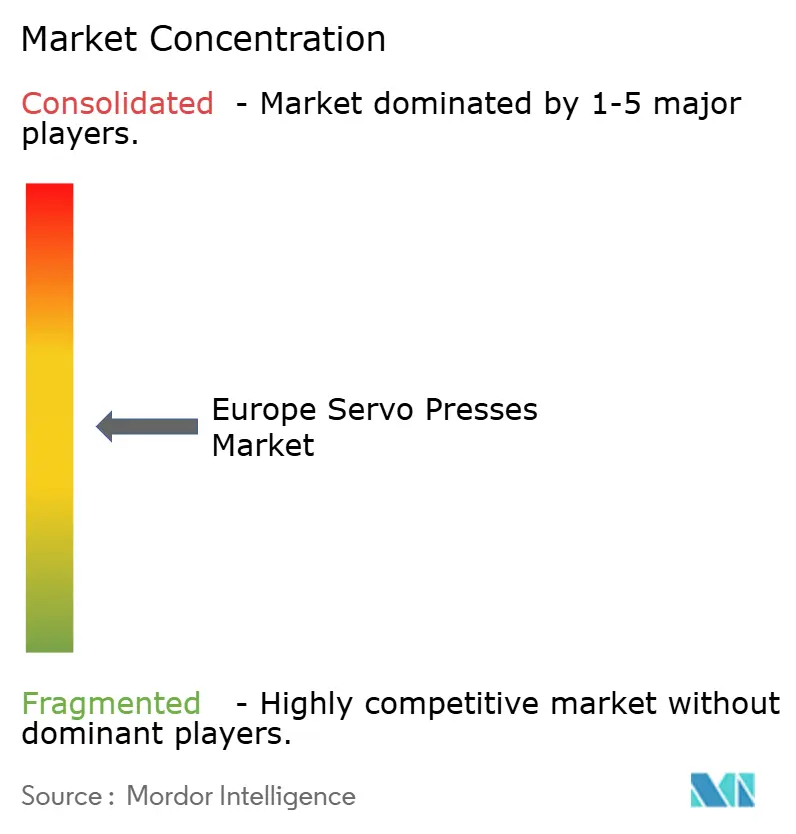
The Europe servo presses market is moderately consolidated in the upper-tonnage tier. ANDRITZ Schuler, AIDA Engineering, Fagor Arrasate, and AP&T Group compete for major body-press, transfer-line, and lamination-line projects. In the 10-500-ton range, TOX PRESSOTECHNIK, BRUDERER, and PROMESS compete with Japanese manufacturers that have European distribution networks. Buyers assess lead time, programming flexibility, certification readiness, and local service alongside equipment price. Larger suppliers can use their installed base and engineering teams to support complex projects from planning through commissioning.
Digital service is becoming a more important part of the competitive model. ANDRITZ Schuler's Metris ecosystem combines die protection, energy monitoring, and predictive maintenance, as demonstrated at Smart Press Shop in Germany in July 2025. In January 2026, ANDRITZ Schuler and Feintool introduced the HFA plus+ fineblanking concept, with Schuler serving as general contractor and Feintool contributing tooling and process expertise. AP&T's 2025 VDL VDS project combined a 1,500-ton press, servo cushion, automated feed units, and stacking automation.
Retrofit specialists are increasing competitive pressure by upgrading press frames with servo drives and digital controls at 30-50% of new-press cost. Duplomatic's 2025 revamp of a 400-ton hydraulic press with Daikin hybrid servo pumps reduced energy use, cycle-time variation, and noise while retaining the original frame. Regulation (EU) 2023/1230 becomes mandatory on January 20, 2027, and will require cybersecurity, functional-safety, and AI-related requirements in machine documentation and conformity declarations. NIS2 also extends cybersecurity responsibilities to networked manufacturing operations. These rules favor suppliers that can provide certified controls, secure remote service, and documentation for connected equipment.[3]Duplomatic Oleodinamica, “Success Story: Hydraulic Revamping of a 400-Ton Press with Daikin Hybrid Technology,” Duplomatic, duplomatic.eu
Europe Servo Presses Industry Leaders
ANDRITZ Schuler Group
AIDA Engineering, Ltd.
Fagor Arrasate S. Coop.
AP&T Group
TOX PRESSOTECHNIK GmbH and Co. KG
- *Disclaimer: Major Players sorted in no particular order

Recent Industry Developments
- January 2026: ANDRITZ Schuler further developed its HFA fineblanking press range with Feintool, launching the HFA plus+ series with press forces of 3,200–15,500 kN and output of up to 85 strokes per minute. The new servo-controlled hydraulic-pump drive improves energy efficiency by a double-digit percentage while supporting higher stroke rates. Under the renewed cooperation, Feintool provides process and tooling expertise as required, while ANDRITZ Schuler manufactures the HFA presses and acts as general contractor for turnkey fineblanking systems. The presses target applications including automotive seat-belt and seat-adjustment components, gears, and transmission components.
- November 2025: AP&T received an order from Dutch sheet-metal specialist VDL VDS for a 1,500-ton servo press line incorporating a full servo cushion, blank destacker, three AP&T SpeedFeeder units, and automated stacking. The servo cushion recovers drawing energy as electricity rather than dissipating it as heat, supporting lower energy consumption and allowing VDL VDS to meet annual production targets despite limited electrical capacity at its site. Delivery and installation are scheduled for fall 2026.


Europe Servo Presses Market Report Scope
The Europe Servo Presses Market Report is Segmented by Frame (C-Frame, H-Frame, and More), by System Type (Servo-Hydraulic Presses, and More), by Press Force (Up to 10 Tons, and More), by Application (Forging and Cold Forming, and More), by End-User Industry (Automotive and Transportation, and More), and by Geography (Germany, Italy, and More). The Report Offers Market Size and Forecasts in Value (USD) for all the Above Segments.
| C-Frame / Gap-Frame Servo Presses |
| Straight-Side / H-Frame Servo Presses |
| Column / Post-Type Servo Presses |
| Other Servo Press Configurations |
| Servo-Mechanical Metal Forming Presses |
| Electromechanical / Electric Servo Assembly Presses |
| Servo-Hydraulic Presses |
| Hybrid Servo Presses |
| Up to 10 Tons |
| Above 10-100 Tons |
| Above 100-500 Tons |
| Above 500-1,000 Tons |
| Above 1,000 Tons |
| Stamping, Blanking, and Punching |
| Deep Drawing and Sheet Forming |
| Forging and Cold Forming |
| Assembly, Press-Fitting and Joining |
| Powder Compaction |
| Other Precision and Specialized Pressing Applications |
| Automotive and Transportation |
| Electrical and Electronics |
| Aerospace and Defense |
| Medical and Precision Devices |
| Industrial Machinery and General Manufacturing |
| Appliances and Consumer Durables |
| Other End-Use Industries |
| Germany |
| Italy |
| France |
| United Kingdom |
| Russia |
| Spain |
| Rest of Europe |
| By Frame / Structural Configuration | C-Frame / Gap-Frame Servo Presses |
| Straight-Side / H-Frame Servo Presses | |
| Column / Post-Type Servo Presses | |
| Other Servo Press Configurations | |
| By Servo Press Technology / System Type | Servo-Mechanical Metal Forming Presses |
| Electromechanical / Electric Servo Assembly Presses | |
| Servo-Hydraulic Presses | |
| Hybrid Servo Presses | |
| By Press Force / Capacity | Up to 10 Tons |
| Above 10-100 Tons | |
| Above 100-500 Tons | |
| Above 500-1,000 Tons | |
| Above 1,000 Tons | |
| By Application | Stamping, Blanking, and Punching |
| Deep Drawing and Sheet Forming | |
| Forging and Cold Forming | |
| Assembly, Press-Fitting and Joining | |
| Powder Compaction | |
| Other Precision and Specialized Pressing Applications | |
| By End User | Automotive and Transportation |
| Electrical and Electronics | |
| Aerospace and Defense | |
| Medical and Precision Devices | |
| Industrial Machinery and General Manufacturing | |
| Appliances and Consumer Durables | |
| Other End-Use Industries | |
| By Geography | Germany |
| Italy | |
| France | |
| United Kingdom | |
| Russia | |
| Spain | |
| Rest of Europe |


Key Questions Answered in the Report
What is the forecast for the Europe servo presses market?
The Europe servo presses market is expected to grow from USD 0.71 billion in 2026 to USD 0.89 billion by 2031 at a 4.6% CAGR. Growth is supported by equipment replacement and investment in EV, aerospace, and precision manufacturing programs.
Which frame configuration leads to demand in Europe?
Straight-side and H-frame presses led with 49.1% share in 2025, supported by high-tonnage automotive and structural forming work. Their rigid design helps maintain alignment during demanding multi-station production processes.
Which end-user sector is the largest buyer of servo presses in Europe?
Automotive and transportation led with 53.6% share in 2025 because vehicle body, chassis, and powertrain suppliers require flexible forming systems. The sector also uses press lines that can support changing model and material requirements.
Which end-user application is expanding the fastest?
Medical and precision devices are projected to grow at an 11.7% CAGR through 2031, supported by traceability and cleanroom requirements. Oil-free drives and documented force records are important purchasing factors for these users.
Why are manufacturers replacing hydraulic and mechanical presses?
Buyers seek programmable motion, force monitoring, traceability, and energy efficiency that legacy equipment often cannot provide. The benefits matter most where process records, grid limits, or controlled motion are operational requirements.
Which European country is expected to grow the fastest?
Spain is forecast to grow at a 5.7% CAGR through 2031, supported by EV body-press installations and automotive factory conversion activity. Its capabilities in lamination and bipolar-plate systems also support broader demand.
Page last updated on:


 Your data is secure and never sold or shared.


