
Europe Hydraulic Presses Market Size and Share
Market Overview
| Study Period | 2020 - 2031 |
|---|---|
| Forecast Data Period | 2026 - 2031 |
| Base Year Market Size (2025) | USD 593 Million |
| Market Size (2026) | USD 620 Million |
| Market Size (2031) | USD 761.60 Million |
| Growth Rate (2026 - 2031) | 4.20 % |
| Market Concentration | Medium |
Major Players *Disclaimer: Major Players sorted in no particular order Image © Mordor Intelligence. Reuse requires attribution under CC BY 4.0. | |
Europe Hydraulic Presses Market Analysis by Mordor Intelligence
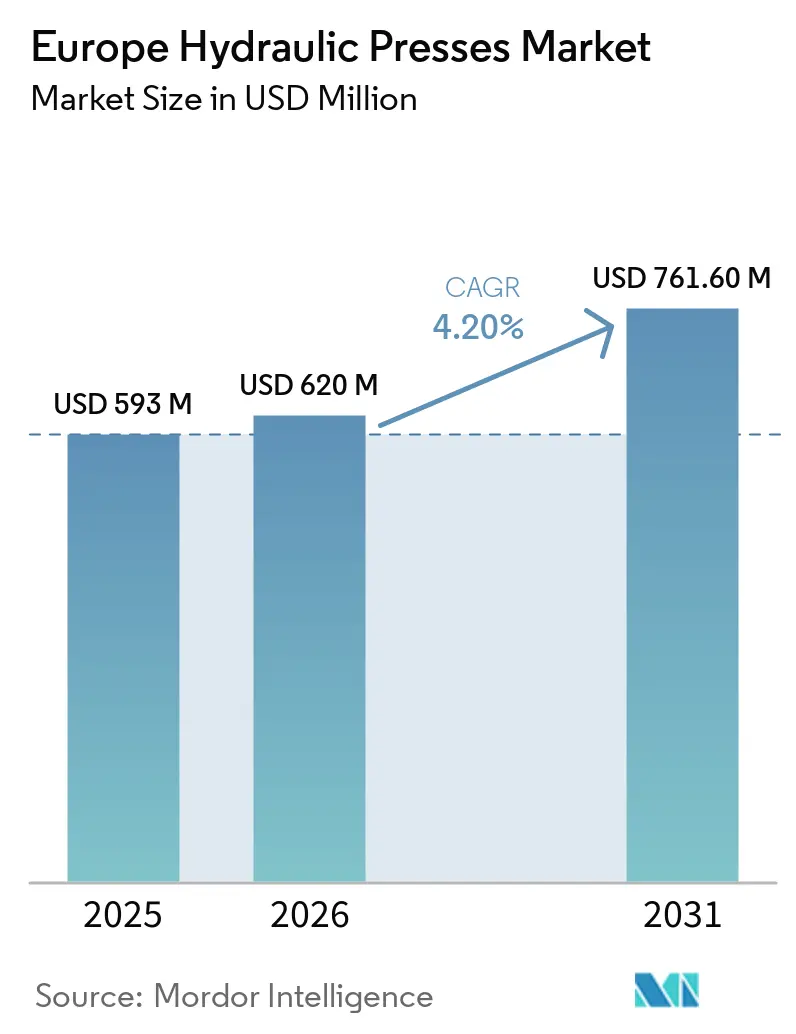
The Europe hydraulic presses market size was valued at USD 593.0 million in 2025, and is estimated to grow from USD 620.0 million in 2026 to reach USD 761.6 million by 2031, at a CAGR of 4.20% during the forecast period (2026-2031).
Automotive electrification is changing capital plans in press shops because battery trays, underbody structures, and mixed-material parts need dedicated forming capacity. Higher defense procurement and recovering aircraft production are supporting demand for large, specialized systems with stringent quality controls. European suppliers combine controls and tooling expertise in Germany, Italy, and Spain with new capacity investment in Central and Eastern Europe. Energy-efficient servo-hydraulic upgrades also give suppliers a route to serve established plants that are modernizing existing equipment. High purchase costs, compliance requirements, and shortages of qualified technicians will continue to slow some purchasing.
Key Report Takeaways
- By frame configuration, C-frame and gap-frame presses held 31.5% of the Europe hydraulic presses market share in 2025, while other specialized configurations are forecast to grow at a 5.1% CAGR through 2031.
- By tonnage, the 101–500 ton class accounted for 34% of the Europe hydraulic presses market size in 2025, while presses above 2,000 tons are forecast to expand at a 5.2% CAGR through 2031.
- By application, sheet metal forming and deep drawing held 24.5% of the Europe hydraulic presses market share in 2025, while hydroforming is forecast to advance at a 5.5% CAGR through 2031.
- By end-use industry, automotive and transportation held 28.5% of the Europe hydraulic presses market share in 2025, while aerospace and defense are forecast to grow at a 5.6% CAGR through 2031.
- By geography, Germany held 25.5% of market revenue in 2025, while Spain is forecast to record the fastest growth at a 5% CAGR through 2031.
Note: Market size and forecast figures in this report are generated using Mordor Intelligence’s proprietary estimation framework, updated with the latest available data and insights as of January 2026.
Europe Hydraulic Presses Market Trends and Insights
Drivers Impact Analysis*
| Driver | (~) % Impact on CAGR Forecast | Geographic Relevance | Impact Timeline |
|---|---|---|---|
| EV Battery and Structural Component Replatforming | +1.2% | Germany, Poland, Slovakia, the Czech Republic, and Spain | Medium term (2-4 years) |
| Press-Shop Automation and Predictive Maintenance | +0.9% | Germany, France, Italy | Short term (≤ 2 years) |
| Central and Eastern European Capacity Investment | +0.7% | Poland, Romania, the Czech Republic, Slovakia, and Hungary | Medium term (2-4 years) |
| Aerospace, Defense, and High-Integrity Forging Demand | +0.5% | France, the United Kingdom, Germany, Spain, and Austria | Long term (≥ 4 years) |
| Energy-Efficient Servo-Hydraulic Upgrades | +0.4% | European Union, especially Germany and Benelux | Short term (≤ 2 years) |
| Composite and Advanced-Material Compression Molding | +0.3% | France, the United Kingdom, and Germany | Long term (≥ 4 years) |
| Source: Mordor Intelligence | |||
EV Battery, Lightweighting, and Structural-Component Replatforming
Platform electrification is increasing demand for hydraulic press investment across European automotive supply chains. PowerCo commissioned its Salzgitter unified-cell facility in 2025, creating local requirements for battery housing and structural underbody trays that need new tooling and forming processes. Large-format prismatic cells and cell-to-pack designs require battery structures with different geometries from those used in internal-combustion vehicles. Aluminum closure panels and high-strength-steel rocker structures also require different force, bed size, and blank-holder settings. Press shops cannot always address those requirements through simple changes to existing tooling. Hydraulic systems provide programmable force and speed over the working stroke, which supports the forming of complex structural parts. This gives the Europe hydraulic presses market a durable replacement opportunity beyond normal changes in vehicle production volumes.
Industry 4.0 Press-Shop Automation and Predictive Maintenance
Digital systems became more established in European press shops during 2025. Smart Press Shop in Halle uses Metris Visual Die Protection to monitor tools with cameras and stop lines when it detects foreign objects, scrap accumulation, or cracks. The system helps prevent die damage before it leads to a longer production interruption. The SEAT and CUPRA facility in Martorell generates 3,000 data points during each stamping cycle and uses them to support production monitoring as the plant prepares for full battery electric vehicle output from 2026. Research published in 2026 showed that hybrid models using press sensor data can estimate the remaining useful life of critical forming components.[1]Raoua Zerrad, Kamar Diaz, Akram Chhaybi, et al., “Maintenance 4.0 for Automotive Press Machines: Hybrid RUL Estimation of Critical Component,” Life Cycle Reliability and Safety Engineering, doi.org. These capabilities are making die protection, automated die change, and connected monitoring more important in new press specifications. They also increase the value of suppliers that can combine machinery, controls, and ongoing support.
Reshoring and Central and Eastern European Capacity Investment
Central and Eastern Europe continues to attract manufacturing capacity that needs mid-range hydraulic presses. RTX invested USD 25 million in September 2026 to expand its Niepołomice facility in Poland for precision parts and complex tubular assemblies for commercial and military engines. The company also announced a USD 100 million expansion in Rzeszów for isothermal-forged aerospace components. Hyundai Mobis opened an electric-vehicle motor plant in Slovakia in 2025 with an annual capacity of 280,000 PE systems. These projects add demand for metal forming among component producers that are locating production nearer to European vehicle and aerospace customers. The Europe hydraulic presses market is therefore likely to see much of this investment in the 100–500 ton range. Those buyers need modern control systems and reliable local service, even when they do not require aerospace-grade high-force presses.
Aerospace, Defense, and High-Integrity Forging Demand
Aerospace and defense programs are creating high-value hydraulic press opportunities with long procurement cycles. Safran Aircraft Engines announced an EUR 150 million (USD 176.45 million) investment in April 2026 for a 30,000-ton hydraulic press at Gennevilliers. The press is expected to produce 14,000 strategic parts each year for LEAP, Rafale, Mirage, and A400M programs when it enters service in 2029. Breitenfeld Edelstahl commissioned a 40MN forging press in Austria during 2026 for energy technology, aviation, and special machine applications. The equipment can forge shafts up to 10 meters and ingots up to 25 tons. Aerospace traceability expectations and press-safety standards favor suppliers that can meet demanding material-integrity and documentation requirements. The Europe hydraulic presses market benefits because these applications need specialized equipment that cannot be readily replaced by lower-force alternatives.
Restraints Impact Analysis*
| Restraint | (~) % Impact on CAGR Forecast | Geographic Relevance | Impact Timeline |
|---|---|---|---|
| High Capital Cost and Long Replacement Cycles | -0.8% | European Union, especially Southern, Central, and Eastern Europe | Long term (≥ 4 years) |
| Skilled Hydraulic, Controls, and Maintenance Labor Shortage | -0.6% | European Union, especially Germany, France, and Italy | Medium term (2-4 years) |
| CNC, Power-Electronics, and High-Grade Steel Supply Exposure | -0.4% | European Union, concentrated in Germany and Benelux | Short term (≤ 2 years) |
| Competition from Alternative Forming Technologies | -0.3% | Germany, Italy, Scandinavia | Long term (≥ 4 years) |
| Source: Mordor Intelligence | |||
High Capital Cost and Long Replacement Cycles
Industrial hydraulic presses require substantial capital commitments across all tonnage classes. Mid-range systems cost hundreds of thousands of euros, while aerospace and forging systems can require investments in the tens of millions of euros. Safran’s EUR 150 million (USD 176.45 million) Gennevilliers commitment illustrates the scale of spending possible for strategically important forging capacity. Regulation (EU) 2023/1230 applies from January 20, 2027, and identifies cold-metalworking presses among the high-risk machinery categories subject to conformity assessment requirements.[2]European Union Agency for Safety and Health at Work, “Regulation 2023/1230/EU: Machinery,” EU-OSHA Legislation Portal, osha.europa.eu.Compliance can add engineering work, certification costs, and commissioning time to new projects. Small and medium-sized manufacturers often delay replacement when acquisition costs and qualification requirements rise together. Hydraulic presses can remain in service for 20–30 years, which limits demand based solely on normal replacement cycles.
Skilled Hydraulic, Controls, and Maintenance Labor Shortage
A shortage of hydraulic engineers, controls programmers, and maintenance technicians limits equipment installation and effective utilization. The European Labour Authority identified manufacturing and engineering as occupations with persistent shortages across member states in its 2025 report, which it published in June 2026.[3]European Labour Authority, “Labour Shortages and Surpluses in Europe 2025,” EURES Annual Report, employment-social-affairs.ec.europa.eu. It linked the shortages to demographic change, skills mismatches, and limited worker mobility. Eurostat reported in February 2026 that manufacturing laborers had the largest increase in vacancy rates among occupational groups between 2019 and 2023, rising 4.2 percentage points.[4]Eurostat, “Job Vacancy Rate: Main Ups and Downs by Occupation,” Eurostat News, ec.europa.eu. Cedefop expects replacement demand from retirements to intensify pressure in metal-forming and maintenance occupations through the mid-2030s. For buyers and equipment suppliers, the shortfall can lengthen installation schedules, reduce early machine utilization, and increase dependence on specialist service teams. Workforce reskilling is important, but its benefits will take longer than a typical equipment-purchasing cycle.
*Our forecasts treat driver/restraint impacts as directional, not additive. The impact forecasts reflect baseline growth, mix effects, and variable interactions.
Segment Analysis
By Frame / Structural Configuration: C-Frame Leads as Specialty Presses Gain Ground
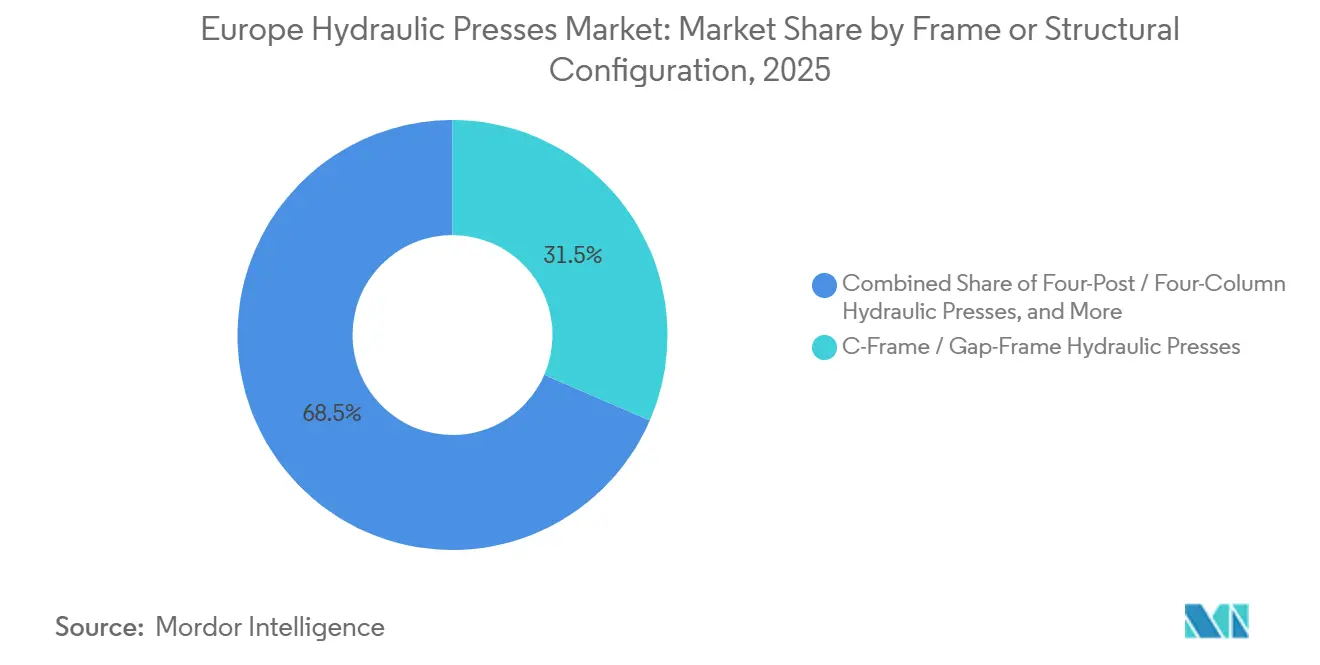
C-frame and gap-frame presses held 31.5% of the Europe hydraulic presses market size in 2025. Their open, three-sided access supports general stamping, assembly work, automotive body panels, and other applications that require efficient material handling. This layout also supports fast die changes in plants with frequent production changes. H-frame and straight-side presses serve work that needs greater rigidity and repeatable platen alignment. They are used for precision blanking, deep drawing, and electric-motor lamination stacking. Four-post and four-column presses distribute force across larger platens for forging and composite molding. Two-post and benchtop systems remain relevant for toolrooms, assembly work, and lower-force production.
Other specialized configurations are forecast to grow at a 5.1% CAGR through 2031 within the Europe hydraulic presses industry. These systems include custom multi-axis transfer presses, hybrid hydraulic-electric equipment, and hot-platen designs for aerospace work. Their growth reflects rising part complexity instead of the highest unit volumes. Specialized presses help users manage complex materials, different production sequences, and application-specific quality requirements. Composite and advanced-material programs need controlled temperature, closing speed, and pressure across the full forming cycle. That need supports custom press designs that standard catalog systems cannot always provide. Suppliers with application engineering expertise are better placed to compete for these projects. The Europe hydraulic presses market, therefore, has a growing premium segment alongside its broader general-purpose press base.



By Tonnage / Press Force: Mid-Range Tonnage Dominates While High-Force Presses Accelerate
The 101–500 ton class held 34% of the Europe hydraulic presses market size in 2025. This range covers automotive body panels, structural components, industrial machinery parts, and general fabrication. It serves the broadest set of production volumes within European manufacturing. Presses up to 100 tons support smaller stamping, electrical components, and laboratory operations. The 501–1,000 ton and 1,001–2,000 ton classes serve heavier vehicle structures, rail components, and construction-equipment parts. Buyers in these ranges balance force requirements with footprint, cycle time, and tooling needs. The range also matches demand from growing suppliers in Central and Eastern Europe.
Presses above 2,000 tons are forecast to expand at a 5.2% CAGR through 2031 in the Europe hydraulic presses industry. Demand comes from aerospace forging, large composite parts, and other applications that require substantial force and platen capacity. Safran’s planned 30,000-ton press demonstrates the value concentrated in these larger projects. These purchases involve long lead times, technical specifications, and extended service arrangements. Customers also expect material traceability and established quality systems. Engineering-to-order manufacturers have an advantage because catalog systems do not meet every high-force requirement. This makes the high-force segment more dependent on a limited group of qualified suppliers. It also gives the Europe hydraulic presses market a source of value growth even when order volumes remain limited.
By Application / Forming Process: Deep Drawing Anchors Demand While Hydroforming Gains Traction
Sheet metal forming and deep drawing held 24.5% of the Europe hydraulic presses market size in 2025. Automotive body shops use these processes for door inners, roof panels, closures, and floor assemblies in high-strength steel and aluminum. Their established production base supports steady requirements for conventional forming equipment. Forging has an important role in high-tonnage applications for landing gear, engine parts, drivetrains, and defense structures. Bending and straightening serve structural steel fabrication, rail maintenance, and pipe-forming work. Punching, blanking, and coining support precise electrical, electronics, and fastener production. Powder compaction and press-fitting continue to support ceramics, powder metallurgy, and industrial assembly.
Hydroforming is forecast to grow at a 5.5% CAGR through 2031 in the Europe hydraulic presses market. Hollow rocker panels, crash-management tubes, and battery-enclosure longitudinal can deliver a 15–25% weight advantage over stamped-and-welded assemblies. Lighter structures support electric-vehicle range objectives and reduce the number of joining steps in some components. Compression molding is also gaining importance for sheet molding compound and thermoplastic parts in vehicles, rail equipment, and wind-energy applications. Fraunhofer IPT introduced MatriXpress in October 2025 with up to 800 tons of force and 60 strokes per minute in a machine weighing less than 10 tons. The system targets bipolar plates for hydrogen fuel-cell and electrolyzer production. These applications require close control of temperature, speed, and hold pressure. The Europe hydraulic presses market can benefit as producers scale equipment for newer energy and mobility components.
By End-Use Industry: Automotive Remains Core While Aerospace Spending Rises
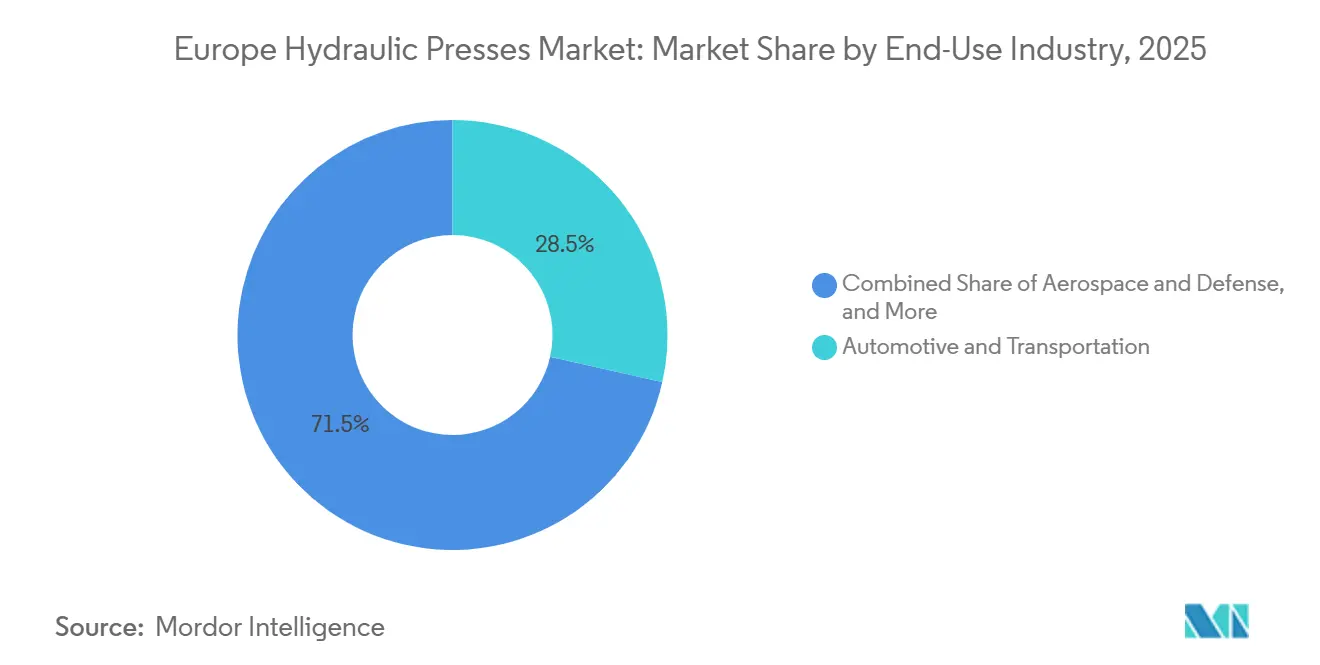
Automotive and transportation held 28.5% of the Europe hydraulic presses market share in 2025. Battery electric vehicle architectures need structural frames, battery floors, and enclosures that require dedicated forming operations. This supports demand for new equipment and for changes to existing press lines. Industrial machinery and general manufacturing provide a stable middle tier through job-shop forging, tooling components, and general metalwork. Electrical and electronics demand is linked to localized electric drivetrains, motor laminations, connectors, and battery components. Plastics, rubber, and composites are gaining use in automotive interiors, rail vehicles, and wind-turbine nacelles. Energy and power equipment requires pressing for transformer laminations, wind-tower flanges, and cable components.
Aerospace and defense are forecast to grow at a 5.6% CAGR through 2031 in the Europe hydraulic presses market. Defense procurement, commercial aircraft production, and material-supply security are supporting domestic forging and forming investments. High-integrity components have demanding requirements for traceability, repeatability, and processing documentation. Rail, marine, powder metallurgy, ceramics, and advanced materials add specialized demand tied to infrastructure and strategic-material programs. These customer groups often need equipment designed for a specific process rather than a broadly standardized press. Their projects can be smaller in number, yet high in value and technical content. Suppliers that can combine design, tooling, controls, and service have a stronger position in these end-use areas. The Europe hydraulic presses market retains its automotive base while developing further opportunities in aerospace and defense.
Geography Analysis
Germany held 25.5% of the Europe hydraulic presses market share in 2025. Its position reflects dense automotive press-shop activity in Bavaria and Baden-Württemberg, alongside a large mechanical-engineering base. The country combines domestic demand with an established supply base for tooling, controls, and press equipment. Smart Press Shop in Halle integrates real-time die protection, autonomous tooling-crane movements, and digital production systems for aluminum and steel panels. The facility supplies panels for Porsche, Tesla, Mercedes, and BMW, according to ANDRITZ. Italy and France form a second cluster of demand, based on precision engineering, specialty fabrication, and aerospace investment.
Spain is forecast to grow at a 5.0% CAGR through 2031 in the Europe hydraulic presses market. Its growth is linked to the Martorell automotive corridor and the shift toward battery electric vehicle production. The facility’s 3,000 data points per stamping cycle support production monitoring as its electric-vehicle program develops. France has a growing high-tonnage opportunity through Safran’s planned Gennevilliers project. The United Kingdom remains relevant through aerospace, defense, and automotive supply chains. Finland serves a smaller, quality-focused base in paper machinery, energy equipment, and shipbuilding. Russia’s addressable commercial base for European suppliers remains constrained by trade restrictions and supply-chain isolation.
Poland, the Czech Republic, Romania, Slovakia, and Hungary form the accelerating Central and Eastern European cluster. RTX’s confirmed investment in Niepołomice and its Rzeszów expansion strengthen Poland’s role in precision aerospace manufacturing. Hyundai Mobis’ Slovak facility adds another electric-vehicle anchor for downstream metal forming demand. The region combines EU-regulatory alignment with new capacity development across automotive and defense supply chains. This creates demand for mid-range presses, modern controls, and local service capacity. The Europe hydraulic presses market has a broad geographic base, but Central and Eastern Europe is where new greenfield projects are most visible. Germany, France, and Spain remain important for higher-value automation, aerospace, and vehicle-platform investments.
Competitive Landscape
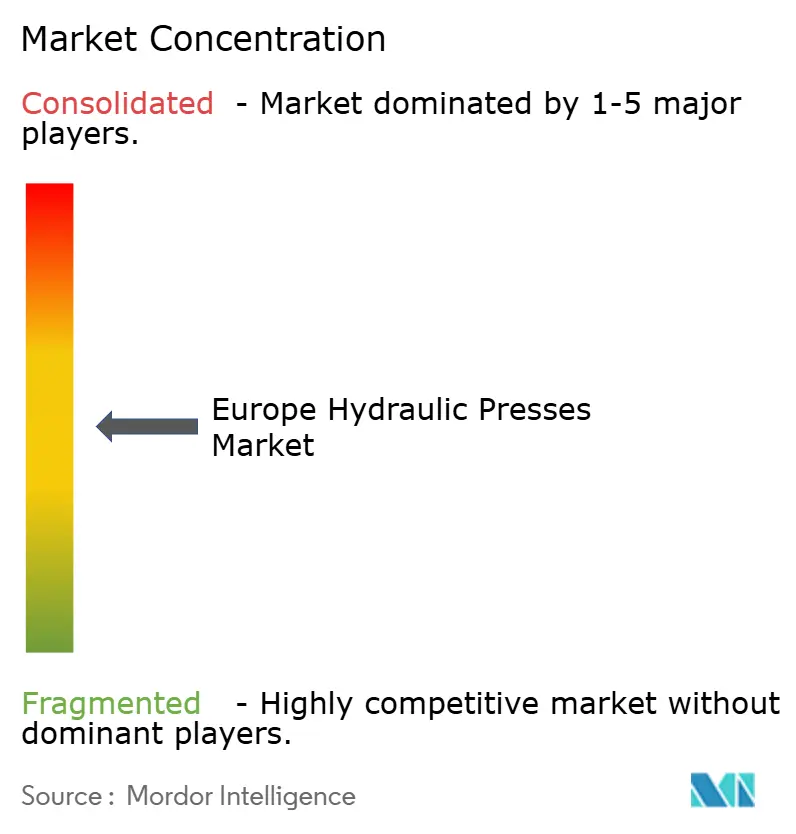
The Europe hydraulic presses market is moderately fragmented, with major European original equipment manufacturers holding strong positions in high-tonnage and servo-hydraulic systems. German suppliers benefit from established controls expertise and installed relationships with automotive and aerospace customers. ANDRITZ Schuler launched the HFA plus+ fineblanking series in January 2026 with servo-controlled hydraulic pump drives, standard connected monitoring interfaces, and stroke rates up to 85 strokes per minute. The series covers press forces from 3,200 to 15,500 kN. The company also partnered with WF Maschinenbau in 2026 for a tube-forming system aimed at defense applications. These moves strengthen its position in energy efficiency, connected operation, and specialized defense demand.
Italian manufacturers, including Mecolpress and Mecomec F.P., operate in forging and composite applications where material-specific tooling knowledge matters. Fagor Arrasate and LASCO Umformtechnik compete in mid-range automotive supply-chain applications where lead time and service responsiveness are important. DORST Technologies has a differentiated position in powder-compaction presses for advanced ceramics and technical materials. This niche has limited substitution risk compared with general-purpose forming equipment. A large share of the installed press base predates variable-speed pump systems and modern servo-hydraulic controls. That creates opportunities for retrofit suppliers and regional service specialists. Regulation (EU) 2023/1230 will apply renewed conformity assessment requirements to substantial modifications from January 2027.
Retrofit projects can offer a lower upfront cost than full replacement while improving energy use and productivity. They also require careful engineering reviews where modifications change the safety or compliance status of legacy systems. Connected sensor hardware and press-shop analytics are increasing competition in maintenance services, once supplied mainly by equipment manufacturers. Buyers are likely to evaluate equipment life-cycle support, software capability, and compliance knowledge alongside press performance. Large suppliers have advantages in high-force projects that require engineering-to-order.
Europe Hydraulic Presses Industry Leaders
ANDRITZ Schuler Group
SMS group GmbH
Siempelkamp
Fagor Arrasate
LASCO Umformtechnik GmbH
- *Disclaimer: Major Players sorted in no particular order

Recent Industry Developments
- September 2026: RTX's Pratt & Whitney invested USD 25 million to expand its Niepołomice, Poland, facility for complex tubular assemblies and precision components for GTF, F135, and PW800 engine programs. The expansion, supported by Poland's Investment Zone Programme, will add more than 120 jobs and become operational in 2028. The investment supplements the separately announced USD 100 million expansion at Rzeszów for isothermal-forged aerospace components, making Poland Pratt & Whitney's primary CEE precision-manufacturing hub with more than 9,500 RTX employees in-country.
- April 2026: Safran Aircraft Engines announced an EUR 150 million (USD 176.45 million) investment to acquire a 30,000-ton hydraulic press for its Gennevilliers site. The project creates 130 jobs from 2026 and targets operational status by 2029. The press will produce 14,000 strategic parts annually for CFM LEAP, Rafale, Mirage, A400M, and GE90 programs, nearly doubling site production capacity across engine families by 2035.
- January 2026: ANDRITZ Schuler launched the HFA plus+ fineblanking press series. It uses servo-controlled hydraulic pump drives for double-digit energy-efficiency gains, offers press forces from 3,200 to 15,500 kN, reaches up to 85 strokes per minute, and includes standard connected monitoring interfaces.
- October 2025: Fraunhofer IPT unveiled MatriXpress, a compact press system that weighs less than 10 tons, delivers up to 800 tons of force, and reaches 60 strokes per minute. The system targets bipolar plate forming for hydrogen fuel-cell and electrolyzer production


Europe Hydraulic Presses Market Report Scope
| C-Frame / Gap-Frame Hydraulic Presses |
| H-Frame / Straight-Side / Gib-Guided Hydraulic Presses |
| Four-Post / Four-Column Hydraulic Presses |
| Two-Post / Column Hydraulic Presses |
| Benchtop / Workshop Hydraulic Presses |
| Other Specialized Hydraulic Press Configurations |
| Up to 100 Tons |
| 101–500 Tons |
| 501–1,000 Tons |
| 1,001–2,000 Tons |
| Above 2,000 Tons |
| Sheet Metal Forming and Deep Drawing |
| Forging |
| Bending and Straightening |
| Punching, Blanking and Coining |
| Compression Molding |
| Powder Compaction |
| Hydroforming |
| Assembly, Press-Fitting and General Pressing |
| Other Specialized Applications |
| Automotive and Transportation |
| Aerospace and Defense |
| Industrial Machinery and General Manufacturing |
| Electrical and Electronics |
| Plastics, Rubber and Composites |
| Construction and Heavy Equipment |
| Energy and Power Equipment |
| Rail and Marine |
| Powder Metallurgy, Ceramics and Advanced Materials |
| Other End-Use Industries |
| Germany |
| Italy |
| France |
| United Kingdom |
| Spain |
| Russia |
| Finland |
| Rest of Europe |
| By Frame / Structural Configuration | C-Frame / Gap-Frame Hydraulic Presses |
| H-Frame / Straight-Side / Gib-Guided Hydraulic Presses | |
| Four-Post / Four-Column Hydraulic Presses | |
| Two-Post / Column Hydraulic Presses | |
| Benchtop / Workshop Hydraulic Presses | |
| Other Specialized Hydraulic Press Configurations | |
| By Tonnage / Press Force | Up to 100 Tons |
| 101–500 Tons | |
| 501–1,000 Tons | |
| 1,001–2,000 Tons | |
| Above 2,000 Tons | |
| By Application / Forming Process | Sheet Metal Forming and Deep Drawing |
| Forging | |
| Bending and Straightening | |
| Punching, Blanking and Coining | |
| Compression Molding | |
| Powder Compaction | |
| Hydroforming | |
| Assembly, Press-Fitting and General Pressing | |
| Other Specialized Applications | |
| By End-Use Industry | Automotive and Transportation |
| Aerospace and Defense | |
| Industrial Machinery and General Manufacturing | |
| Electrical and Electronics | |
| Plastics, Rubber and Composites | |
| Construction and Heavy Equipment | |
| Energy and Power Equipment | |
| Rail and Marine | |
| Powder Metallurgy, Ceramics and Advanced Materials | |
| Other End-Use Industries | |
| By Geography | Germany |
| Italy | |
| France | |
| United Kingdom | |
| Spain | |
| Russia | |
| Finland | |
| Rest of Europe |


Key Questions Answered in the Report
What is the projected growth rate for hydraulic presses in Europe?
The Europe hydraulic presses market is forecast to grow at a 4.2% CAGR from 2026 to 2031, reaching USD 761.6 million.
Which press-force category leads demand in Europe?
The 101–500 ton category led with 34.0% share in 2025 because it serves automotive, fabrication, and industrial machinery production.
Why are hydraulic presses important for electric vehicles?
Battery trays, structural frames, and mixed-material parts require controlled force and forming profiles that hydraulic systems can provide.
Which application is expected to grow fastest through 2031?
Hydroforming is projected to grow at a 5.5% CAGR, supported by lightweight structural parts for electric vehicles.
Which end-use sector is growing fast for hydraulic press suppliers?
Aerospace and defense are forecast to grow at a 5.6% CAGR through 2031, supported by forging and strategic material requirements.
Which country has the largest regional demand base?
Germany held 25.5% share in 2025, supported by automotive press shops and its mechanical-engineering ecosystem.
Page last updated on:





