
Asia-Pacific Servo Presses Market Size and Share
Market Overview
| Study Period | 2020 - 2031 |
|---|---|
| Forecast Data Period | 2026 - 2031 |
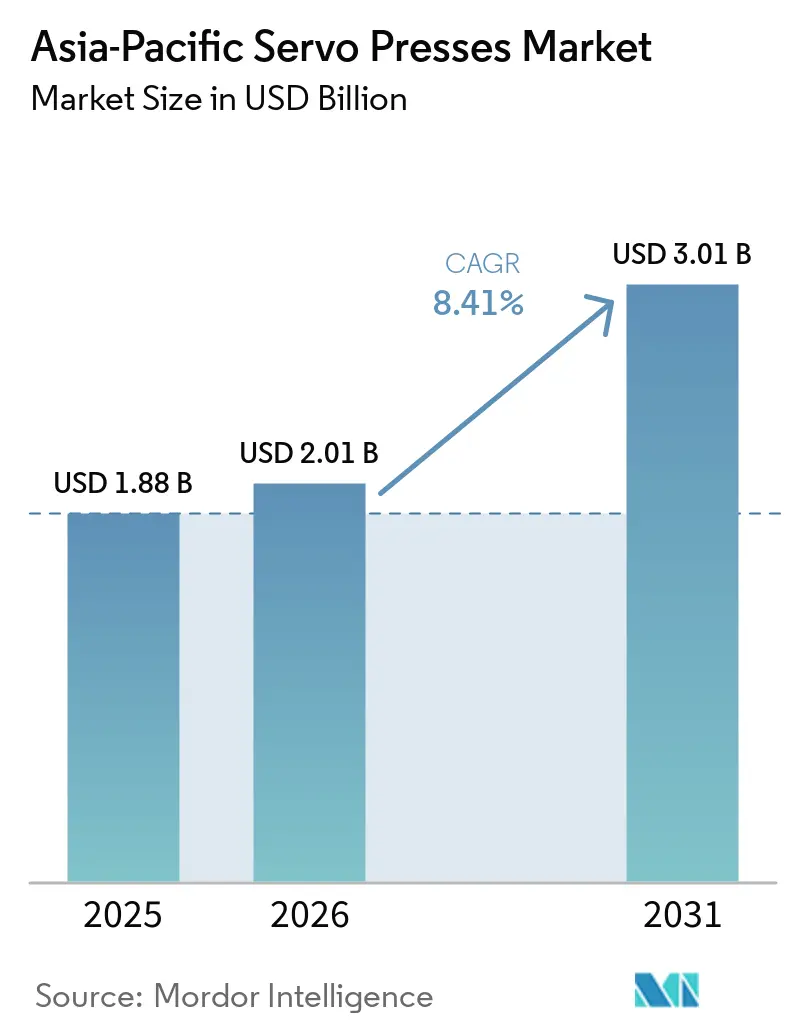
| Base Year Market Size (2025) | USD 1.88 Billion |
| Market Size (2026) | USD 2.01 Billion |
| Market Size (2031) | USD 3.01 Billion |
| Growth Rate (2026 - 2031) | 8.41 % |
| Market Concentration | Medium |
Major Players *Disclaimer: Major Players sorted in no particular order Image © Mordor Intelligence. Reuse requires attribution under CC BY 4.0. | |
Asia-Pacific Servo Presses Market Analysis by Mordor Intelligence
The Asia-Pacific Servo Presses Market size is expected to grow from USD 1.88 billion in 2025 to USD 2.01 billion in 2026 and is forecast to reach USD 3.01 billion by 2031 at 8.41% CAGR over 2026-2031.
The Asia-Pacific servo presses market is supported by electric vehicle production, semiconductor investment, and the replacement of older hydraulic and mechanical lines with programmable systems. Government programs for vehicle manufacturing and smart factories are strengthening demand for new equipment and retrofits across the region. The Asia-Pacific servo presses market also benefits when manufacturers need controlled force, repeatable movement, and production records for automotive, electronics, and medical components. Japanese suppliers continue to protect high-specification positions through motor, control, and direct-drive technologies, while Chinese builders are gaining ground in mid-range equipment. High equipment costs, skills shortages, heat control during continuous operation, and component lead times may slow some purchase decisions, although financing, subsidies, and local supply development provide support.
Key Report Takeaways
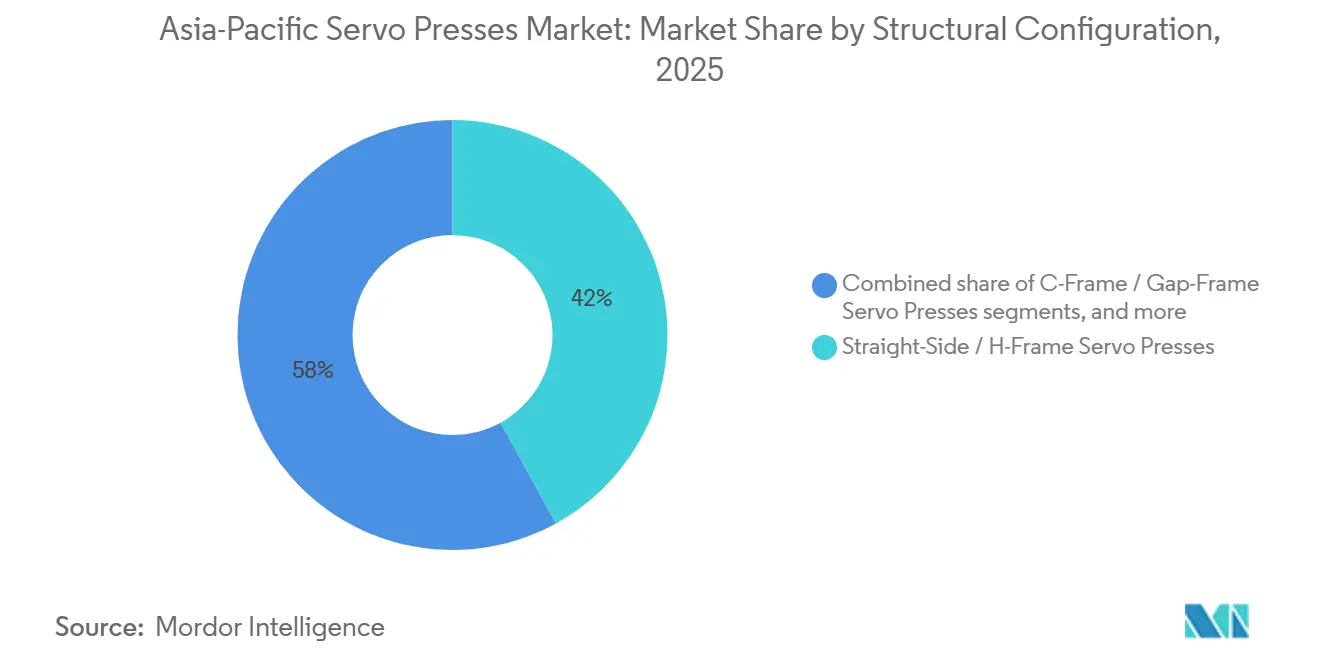
- By frame/structural configuration, straight-side or H-frame servo presses held 42.0% of the Asia-Pacific servo presses market share in 2025, and are also forecast to grow at a 9.7% CAGR through 2031.
- By servo press technology/system type, servo-mechanical metal forming presses held 49.4% of the Asia-Pacific servo presses market size in 2025, while electromechanical/electric servo assembly presses are forecast to grow at a 12.5% CAGR through 2031.
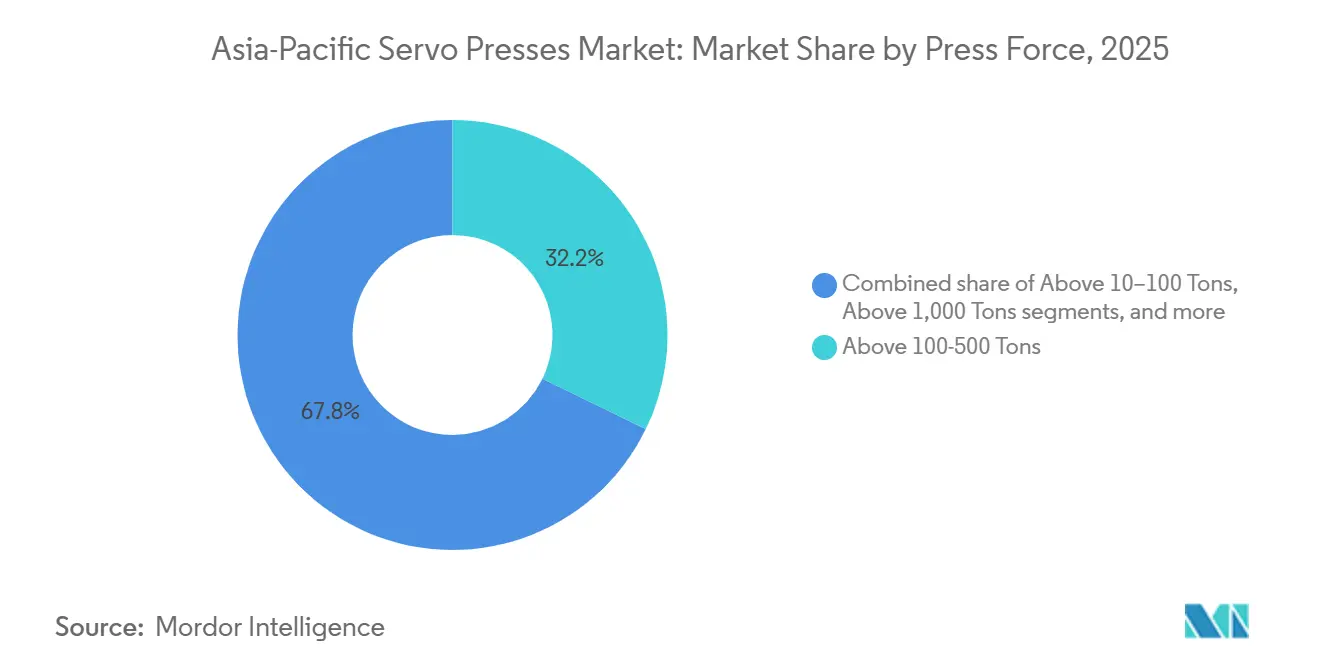
- By press force/capacity, the above 100-500 tons segment held 32.2% of the Asia-Pacific servo presses market share in 2025, while the above 1,000 tons segment is forecast to grow at an 11.9% CAGR through 2031.
- By application, stamping, blanking, and punching held 35.0% of the Asia-Pacific servo presses market share in 2025, while other precision and specialized pressing applications are forecast to grow at a 12.5% CAGR through 2031.
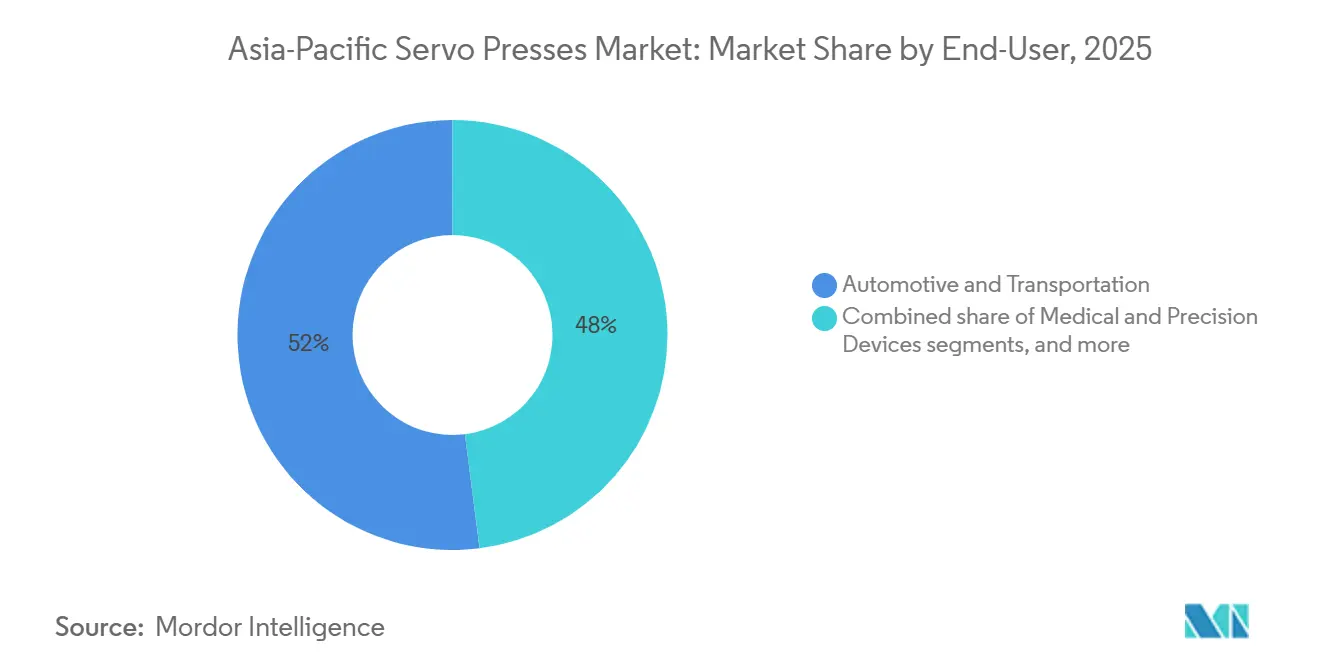
- By end user, automotive and transportation held 52.0% of the Asia-Pacific servo presses market share in 2025, while medical and precision devices are forecast to grow at a 16.0% CAGR through 2031.
- By geography, China held 53.0% of the Asia-Pacific servo presses market share in 2025, while India is forecast to grow at an 11.3% CAGR through 2031.
Note: Market size and forecast figures in this report are generated using Mordor Intelligence’s proprietary estimation framework, updated with the latest available data and insights as of January 2026.
Asia-Pacific Servo Presses Market Trends and Insights
Drivers Impact Analysis*
| Driver | (~) % Impact on CAGR Forecast | Geographic Relevance | Impact Timeline |
|---|---|---|---|
| Vehicle Electrification and EV Component Production | +2.2% | China, India, South Korea, ASEAN | Short term (≤ 2 years) |
| Precision Electronics and Semiconductor Equipment Production | +1.8% | China, Taiwan, South Korea, Japan | Short term (≤ 2 years) |
| Industry 4.0 Adoption and Closed-Loop Process Control | +1.4% | China, Japan, South Korea, Taiwan | Medium term (2-4 years) |
| Energy Efficiency and Lower Hydraulic-System Dependence | +1.0% | Asia-Pacific, strongest in China, Japan, and India | Medium term (2-4 years) |
| Servo Retrofit Demand in the Installed Press Base | +0.7% | China, Japan, and the core ASEAN countries | Medium term (2-4 years) |
| Localization of Servo Motors, Drives, and High-Tonnage Press Supply | +0.5% | China and India, with spillover to ASEAN | Long term (≥ 4 years) |
| Source: Mordor Intelligence | |||
Vehicle Electrification and EV Component Production
Electric vehicle production is a central source of demand for the Asia-Pacific servo presses market. Battery enclosures, motor housing, busbar terminals, bipolar plates, and structural reinforcements require controlled forming and traceable production steps. India’s automobile and auto-component incentive program had approved 82 applicants by September 2025 and supported the production of more than 1.36 million electric vehicles[1]Ministry of Heavy Industries, “PLI Scheme for Automobile and Auto Component Industry,” Press Information Bureau, pib.gov.in. BYD commissioned an integrated electric vehicle complex in Subang, Indonesia, in May 2026, including stamping operations with 130 dies shipped from Shenzhen. These investments support demand for forming equipment even where vehicle production grows more slowly because electric vehicle platforms use a broader range of stamped parts. This driver is likely to keep buyers focused on force control, tool life, and quality documentation.
Precision Electronics and Semiconductor Equipment Production
Semiconductor and electronics investment support demand for precise assembly and forming systems in the Asia-Pacific servo presses market. Global semiconductor equipment billings reached USD 135.1 billion in 2025, and China, Taiwan, and South Korea together accounted for 79% of spending. Taiwan spent USD 31.5 billion on equipment in 2025, while South Korea spent USD 25.8 billion and Japan spent USD 9.5 billion. These investments require supporting equipment for lead frames, connectors, shielding parts, and packaging components. Electromechanical presses are relevant because they can operate without hydraulic oil and fit clean manufacturing environments. Buyers are also placing more weight on secure and connected machine interfaces, which favors suppliers that can support digital production systems.
Industry 4.0 Adoption and Closed-Loop Process Control
Connected manufacturing is making programmable motion and real-time force monitoring more important in the Asia-Pacific servo presses market. China issued its Digital Transformation Implementation Plan for the Machinery Industry in August 2025 and set a target for 50% of relevant enterprises to reach a smart manufacturing maturity level two or higher by 2027. The plan also called for at least 200 exemplary smart factories. Servo presses can share motion and force data with factory execution and enterprise systems more readily than conventional flywheel equipment. Japan’s shrinking manufacturing workforce also raises the value of automated press cells that need fewer operators. In automotive supply chains, force-displacement records can help manufacturers meet IATF 16949 documentation needs, which turns digital capability into a practical purchasing requirement.
Energy Efficiency and Reduced Hydraulic-System Dependence
Energy management is encouraging manufacturers to review the operating cost of hydraulic equipment. The International Energy Agency reported global energy-efficiency progress of 1.8% in 2025, compared with 1% in 2024. More than 250 new or updated efficiency policies were introduced across countries, accounting for 85% of global energy demand. A 2025 study of a 6,300 kN servo press in Chinese stamping production reported single-cycle energy use 86.4% lower than an equivalent hydraulic alternative and at least 25% higher energy-transfer efficiency. These savings can improve the economics of replacement projects where electricity costs and audit requirements are important. China’s equipment requirements and Japan’s Top Runner standards further support consideration of more efficient motors and press systems.
Restraints Impact Analysis*
| Restraint | (~) % Impact on CAGR Forecast | Geographic Relevance | Impact Timeline |
|---|---|---|---|
| High Initial Capital Cost and Longer SME Payback | -1.4% | India, the core ASEAN countries, and inland China | Short term (≤ 2 years) |
| Shortage of Servo Programming, Controls, and Application Skills | -1.0% | ASEAN, India, and the secondary impact on Japan | Medium term (2-4 years) |
| Thermal Derating in Continuous High-Speed Stamping | -0.5% | Asia-Pacific, concentrated in high-volume Chinese press shops | Medium term (2-4 years) |
| Long Lead Times for High-Power Motors and Control Systems | -0.4% | Asia-Pacific, with the highest exposure in South Korea and Taiwan | Short term (≤ 2 years) |
| Source: Mordor Intelligence | |||
High Initial Capital Cost and Extended SME Payback Periods
High purchase costs remain a major barrier for smaller buyers in the Asia-Pacific servo presses market. A servo line for electric vehicle battery-enclosure stamping requires USD 1 million to USD 3 million per unit. In contrast, a greenfield Tier 2 automotive press shop can require more than USD 15 million in total line investment. The Asian Development Bank identifies finance access, limited collateral, short lending terms, and perceived technology risk as barriers for manufacturing small and medium enterprises in developing Asian economies. India’s capital-goods incentive program offers 5%-6% incentives on incremental production value for eligible manufacturers. The support does not cover every smaller workshop so that many firms may retain older equipment longer. Financing models and retrofit options can reduce the constraint, but they do not remove it.[2]Asian Development Bank, “ADB Annual Report 2025,” Asian Development Bank, adb.org
Shortage of Servo Programming, Controls, and Application-Engineering Skills
A shortage of engineering skills can delay equipment use after a purchase is made. Servo presses require knowledge of mechanical systems, drive electronics, motion control, and application setup. Japan’s 2025 Manufacturing White Book reported a small-business manufacturing labor diffusion index of -18.2, showing continued labor pressure in the country’s manufacturing base. Australia identified an immediate shortage of more than 1,000 CNC and advanced machine operators in its 2025 assessment. Malaysia’s National Investment Masterplan 2030 also identifies practical technical skills as necessary for Industry 4.0 operations. When local support is limited, buyers can choose simpler mechanical or hydraulic systems instead of investing in a complex servo installation.
*Our forecasts treat driver/restraint impacts as directional, not additive. The impact forecasts reflect baseline growth, mix effects, and variable interactions.
Segment Analysis
By Frame/Structural Configuration: Straight-Side Frames Lead Large-Format Demand
Straight-side/H-frame held 42% of the Asia-Pacific servo presses market in 2025. The configuration provides stable slide guidance and even bed-pressure distribution for large progressive and transfer dies. Chinese automotive Tier 1 suppliers and Korean OEM-tier press shops use it for body panels and electric vehicle structural components. Its design supports demanding work with advanced high-strength steel and eccentric loading. C-frame and gap-frame machines remain important for precision electronics because they support easier access and quicker tool changes.
Straight-side/H-frame was also identified as the fastest-growing configuration, registering a 9.7% CAGR through 2031. New automotive plants in ASEAN are specifying servo systems from the start instead of converting older mechanical lines in stages. This supports demand for large and rigid frames in new press shops. SEYI demonstrated a high-rigidity solid-frame servo press for metallic bipolar plate micro-channel forming in July 2025. That example shows that the configuration also serves precision energy-component production. Column and post-type equipment continues to address powder compaction and specialized prototype work. Frame choice is closely tied to the size of the die, the material being formed, and the production process. Straight-side equipment supports customers who need a rigid structure for large vehicle parts and repeated cycles. C-Frame machines retain a role when operators need direct access to the tooling area. Column and post-type machines are more specialized and can support development work or powder-based applications. These differences mean that frame demand follows the mix of automotive, electronics, and specialized manufacturing in each country. Manufacturers, therefore, need to match the press structure to the intended tool and part design.[3]SEYI Machinery Co., Ltd., “SEYI Successfully Demonstrated High-Rigidity, High-Precision Servo Press at MF-Tokyo 2025,” SEYI, seyi.com



By Servo Press Technology/System Type: Mechanical Servo Holds the Largest Position
Servo-mechanical metal forming presses accounted for 49.4% of the regional market value in 2025. Their position reflects their use in high-volume automotive and appliance stamping, where crank and link-drive systems support large-tonnage forming cycles. Chinese and South Korean automotive manufacturers and Tier 1 suppliers are major buyers as they replace flywheel-driven equipment. The equipment is suited to repeatable forming tasks with demanding production volumes. Servo-hydraulic presses still serve deep drawing and large-tonnage hot-forming work where force consistency over long strokes is important.
Electromechanical and electric servo assembly presses are the fastest-growing technology type, registering a 12.5% CAGR through 2031. Electronics, medical-device, and semiconductor-component manufacturers favor oil-free equipment that can work in clean manufacturing areas. Janome Industrial Equipment’s ISO Class 4-certified JP Series 5 servo presses provide an example of equipment designed for semiconductors and medical-device assembly. Hybrid systems are also used in powder compaction and multistage forming when a process needs elements of programmable movement and hydraulic force. The change toward electric systems reflects tighter needs for positioning, cleanliness, and documented process control. The Asia-Pacific servo presses industry is therefore serving a wider range of production settings than traditional metal forming alone. Technology selection is shaped by the production environment as well as by press force. Servo-mechanical systems remain practical for repeated, high-output metal-forming cycles. Electric servo systems suit customers who need cleaner operation, precise motion, and controlled assembly. Servo-hydraulic and hybrid equipment continue to serve processes where stroke length or force needs differ from standard stamping. This means that no single technology fits every plant or component. Suppliers that can explain the operating trade-offs clearly are better placed to serve automotive, electronics, and medical customers.
By Press Force/Capacity: Above 100–500 Ton Is the Largest Range
The above 100–500 ton range captured 32.2% of the Asia-Pacific servo presses market in 2025. This capacity range is used for automotive structural parts and electric vehicle battery enclosures that need substantial force but fit standard press-shop infrastructure. Chinese automotive Tier 1 suppliers are key buyers in this range. Taiwan also uses these systems for connector and semiconductor lead-frame operations. Lower-capacity machines serve electronics assembly and medical-device tasks where compact size and precise force control are more important than maximum tonnage.
Above 1,000 tons is the fastest-growing capacity range, registering a 11.9% CAGR through 2031. Battery enclosures, door rings, and underbody reinforcements made from advanced high-strength steel are increasing the need for high-force equipment. China General Technology Group’s Tianduan subsidiary launched a 20,000 kN hot-forming servo flexible intelligent production line in 2026 for automotive lightweighting applications. This development indicates the move toward locally supplied heavy equipment for critical structural parts. The Above 500–1,000 ton range remains relevant for body-panel stamping in Japan and South Korea. Higher-capacity projects require careful planning for installation, tooling, and electrical infrastructure. Capacity selection depends on the part size, material, tool design, and production volume. Mid-range equipment offers a practical balance for many automotive suppliers because it can handle structural work without the site requirements of the largest lines. Smaller systems remain necessary where assembly accuracy is more important than forming force. The move toward higher-capacity equipment reflects heavier and more complex vehicle structural parts. It also raises the importance of local technical support during installation and maintenance. Suppliers able to provide engineering support for these large projects may have a stronger position with automotive customers.
By Application: Stamping, Blanking, and Punching Remain Central
Stamping, blanking, and punching held 35% of the Asia-Pacific servo presses market in 2025. The application supports body, structural, and powertrain component production across China, Japan, South Korea, and ASEAN. It includes progressive-die work for connectors and brackets as well as transfer-die operations for electric vehicle panels. Its broad role in automotive manufacturing gives it a strong position in total demand. Deep drawing and sheet forming are also important for battery cans, appliances, and cookware.
Other precision and specialized pressing applications are the fastest-growing application category, registering a 12.5% CAGR through 2031. This group includes medical implant forming, connector micro-stamping, fuel-cell bipolar plate production, and laboratory powder compaction. These uses involve higher-value components and demanding process documentation. Assembly, press-fitting, and joining systems support automotive and electronics plants that need force-displacement traceability under IATF 16949 and ISO 13485 requirements. Forging and cold forming remain relevant for gears, bearing rings, and fasteners. The Asia-Pacific servo presses market is gaining application diversity as regulated end markets place more value on controlled and recorded forming processes. The largest application includes both high-volume work and smaller precision jobs, so demand is not limited to a single press format. Automotive suppliers use stamping, blanking, and punching for brackets, panels, and structural parts. Electronics manufacturers use related processes for connectors and shielding parts. The fastest-growing specialized uses require different tooling and greater repeatability, rather than only higher production speeds. This creates a need for suppliers that can support application engineering as well as machine delivery. The different application requirements also support demand for both mechanical and electric servo designs.
By End User: Automotive and Transportation Drives Current Demand
Automotive and transportation held 52% of the Asia-Pacific servo presses market in 2025. Demand includes body-panel stamping, powertrain-component forming, battery-enclosure production, and motor-housing manufacturing. The sector is important in every major regional manufacturing economy. Electrical and electronics is the second-largest end-user group, with demand from lead-frame, connector, PCB, and shielding component production. Aerospace and Defense buyers use high-rigidity systems for airframe structures and actuator components, particularly in Japan, South Korea, and Taiwan.
Medical and precision devices are the fastest-growing end-user segment, registering a 16% CAGR through 2031. Surgical-instrument blanking, orthopedic-implant forming, and medical-sensor assembly require documented and repeatable operations. Closed-loop monitoring can support the traceability expected under ISO 13485 requirements. Industrial machinery, general manufacturing, appliances, and consumer durables provide a broader base of mid-market demand. These users are important in China’s export-oriented production network. The Asia-Pacific servo presses industry benefits as customers across these end uses seek better consistency without relying on conventional press systems. Electronics suppliers use a different equipment profile, with smaller presses and a stronger focus on clean operation and position control. Medical-device customers add another source of demand because they need consistent production records for regulated products. This mix reduces reliance on one kind of metal-forming activity. It also explains why suppliers need product portfolios that range from large forming machines to compact assembly presses.
Geography Analysis
China accounted for 53% of the regional value in 2025. The country has a large automotive base, extensive electric vehicle production, and high semiconductor equipment spending. Demand ranges from small electromechanical assembly presses for Guangdong and Zhejiang electronics factories to lines above 1,000 tons for structural vehicle parts in Shandong and Jiangsu. China’s August 2025 machinery digital-transformation plan sought at least 200 exemplary smart factories by 2027. That policy supports equipment that can integrate with digital manufacturing systems. Japan remains the second-largest regional market, supported by automotive OEMs, precision-electronics producers, and a large supplier base. Japanese press builders retain an advantage in direct-drive and ultra-precision systems for higher-specification work.
India is the fastest-growing geography in the Asia-Pacific servo presses market, registering an 11.3% CAGR through 2031. The country’s growth is linked to automobile incentives, local electric vehicle assembly, and smartphone manufacturing that needs precise metal-forming capacity. By September 2025, India’s automobile and auto-component incentive program had supported more than 1.36 million electric vehicles and 48,974 jobs. South Korea’s demand is tied to automotive production and memory semiconductors. Hyundai Rotem localized a 6,800-ton-class servo press line for Hyundai Motor’s electric-vehicle-dedicated facility in 2025. Taiwan’s precision-focused demand is driven by semiconductor and electronics manufacturing, while its USD 31.5 billion equipment spending in 2025 supported downstream production of connectors, lead frames, and packaging parts.
ASEAN is an emerging area for adoption, led by Vietnam, Thailand, and Indonesia. BYD’s May 2026 Subang facility in Indonesia includes full stamping operations and may encourage local component suppliers to invest in press capacity. Thailand has an established automotive base with Japanese OEMs and Tier 1 suppliers that are upgrading equipment for quality and traceability needs. Vietnam is attracting electronics production and has a demand for smaller precision assembly presses. Singapore and Malaysia serve specialized electronics and medical-device manufacturing, where repeatability and cleanroom capability matter more than tonnage. Australia, New Zealand, Bangladesh, and Sri Lanka remain smaller markets that mainly use imported systems for mining equipment and light industrial components.
Competitive Landscape
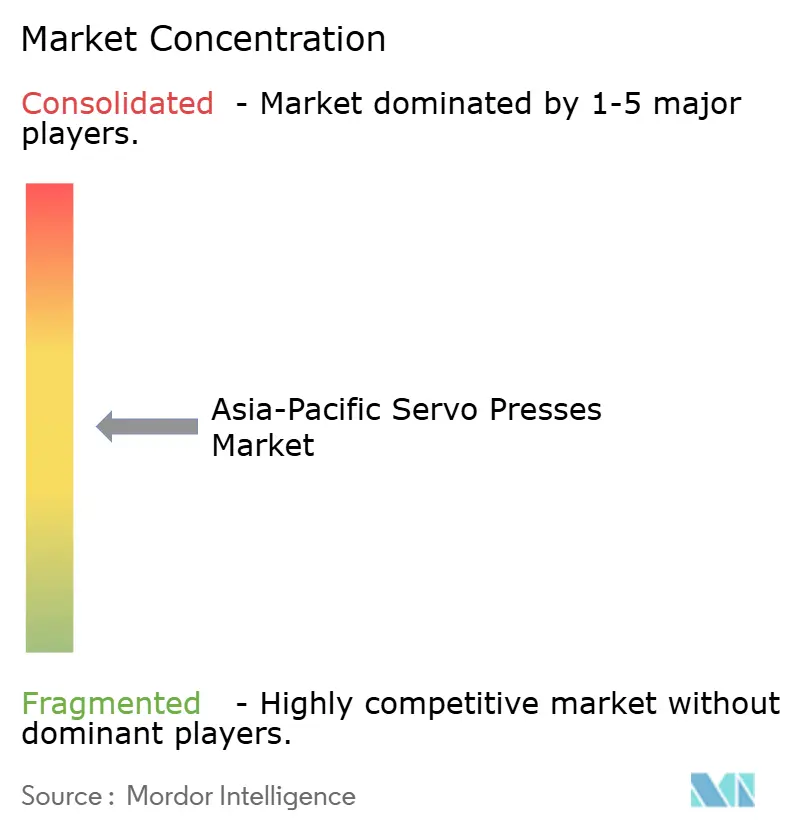
The Asia-Pacific servo presses market is moderately consolidated. AIDA Engineering, Amada, Komatsu Industries, and Hitachi Zosen Fukui hold strong positions in premium applications through proprietary motor designs, direct-drive equipment, and connected control systems. JIER Machine-Tool Group and Yangli Group are narrowing the technology gap in the 100–500-ton category by competing on total cost and domestic execution. SEYI and Chin Fong combine process engineering with pricing suited to ASEAN and Indian customers. Competition is strongest in servo-mechanical machines, where Chinese builders have improved their ability to win domestic automotive contracts. Established suppliers have an advantage when customers need advanced safety engineering, high repeatability, and extensive service support.
Strategic activity is increasingly focused on digital controls and product specialization. AIDA released its DSF-N1-A Series in 2025 with a redesigned high-rigidity straight-side frame and 50% better bolster rigidity than prior-generation models. Amada Press System extended its SWE i3-series with a 600-ton, 6,000 kN variant in 2026, using a triple-servo-motor configuration and twelve programmable motion paths. SEYI completed application development for metallic bipolar-plate stamping with a high-rigidity solid-frame servo press in 2025. These moves show how suppliers are targeting electric vehicles, fuel cells, and other applications that need closely controlled forming. Product development is therefore shifting beyond basic tonnage competition.
Retrofit kits, modular press cells, and force-traceability platforms offer areas of opportunity where full press lines are less practical. Retrofits are relevant to factories with mechanical presses that still have useful structures and tooling. Smaller modular systems can suit job shops and contract manufacturers in India and ASEAN that cannot finance a full new line. Medical-device and electronics customers are also seeking systems that can record force and displacement for quality documentation. Suppliers that combine hardware, software, commissioning, and service can compete more effectively in these areas. The Asia-Pacific servo presses market remains open to both established OEMs and specialized providers because customer needs vary sharply by tonnage, end use, and required process control.
Asia-Pacific Servo Presses Industry Leaders
AIDA Engineering Ltd.
Komatsu Ltd.
ANDRITZ AG and Schuler Group
Yangli Group Corporation
Chin Fong Machine Industrial Co., Ltd.
- *Disclaimer: Major Players sorted in no particular order

Recent Industry Developments
- June 2026: China General Technology Group’s Tianduan subsidiary launched a 20,000 kN hot-forming servo flexible intelligent production line for automotive lightweighting applications.
- May 2026: BYD commissioned its integrated electric vehicle manufacturing complex in Subang, Indonesia. The facility included full stamping operations with 130 stamping dies weighing 2,489 tons shipped from Shenzhen.


Asia-Pacific Servo Presses Market Report Scope
The Asia-Pacific Servo Presses Market Report is Segmented by Frame (C-Frame, H-Frame, and More), by System Type (Servo-Hydraulic Presses, and More), by Press Force (Up To 10 Tons, and More), by Application (Forging and Cold Forming, and More), by End-User Industry (Automotive and Transportation, and More), and by Geography (China, and More). The Report Offers Market Size and Forecasts in Value (USD) for all the Above Segments.
| C-Frame / Gap-Frame Servo Presses |
| Straight-Side / H-Frame Servo Presses |
| Column / Post-Type Servo Presses |
| Other Servo Press Configurations |
| Servo-Mechanical Metal Forming Presses |
| Electromechanical / Electric Servo Assembly Presses |
| Servo-Hydraulic Presses |
| Hybrid Servo Presses |
| Up to 10 Tons |
| Above 10-100 Tons |
| Above 100-500 Tons |
| Above 500-1,000 Tons |
| Above 1,000 Tons |
| Stamping, Blanking, and Punching |
| Deep Drawing and Sheet Forming |
| Forging and Cold Forming |
| Assembly, Press-Fitting and Joining |
| Powder Compaction |
| Other Precision and Specialized Pressing Applications |
| Automotive and Transportation |
| Electrical and Electronics |
| Aerospace and Defense |
| Medical and Precision Devices |
| Industrial Machinery and General Manufacturing |
| Appliances and Consumer Durables |
| Other End-Use Industries |
| China |
| Japan |
| India |
| South Korea |
| Taiwan |
| ASEAN(Singapore, Malaysia, Indonesia, Thailand, Vietnam, Philippines, Myanmar, Cambodia, Laos, Brunei) |
| Rest of Asia-Pacific |
| By Frame / Structural Configuration | C-Frame / Gap-Frame Servo Presses |
| Straight-Side / H-Frame Servo Presses | |
| Column / Post-Type Servo Presses | |
| Other Servo Press Configurations | |
| By Servo Press Technology / System Type | Servo-Mechanical Metal Forming Presses |
| Electromechanical / Electric Servo Assembly Presses | |
| Servo-Hydraulic Presses | |
| Hybrid Servo Presses | |
| By Press Force / Capacity | Up to 10 Tons |
| Above 10-100 Tons | |
| Above 100-500 Tons | |
| Above 500-1,000 Tons | |
| Above 1,000 Tons | |
| By Application | Stamping, Blanking, and Punching |
| Deep Drawing and Sheet Forming | |
| Forging and Cold Forming | |
| Assembly, Press-Fitting and Joining | |
| Powder Compaction | |
| Other Precision and Specialized Pressing Applications | |
| By End User | Automotive and Transportation |
| Electrical and Electronics | |
| Aerospace and Defense | |
| Medical and Precision Devices | |
| Industrial Machinery and General Manufacturing | |
| Appliances and Consumer Durables | |
| Other End-Use Industries | |
| By Geography | China |
| Japan | |
| India | |
| South Korea | |
| Taiwan | |
| ASEAN(Singapore, Malaysia, Indonesia, Thailand, Vietnam, Philippines, Myanmar, Cambodia, Laos, Brunei) | |
| Rest of Asia-Pacific |


Key Questions Answered in the Report
What is the 2026 value of the Asia-Pacific servo presses market?
The Asia-Pacific servo presses market is estimated at USD 2.01 billion in 2026 and is forecast to reach USD 3.01 billion by 2031.
What is driving demand for servo presses in Asia-Pacific?
Electric vehicle components, semiconductor-related production, digital manufacturing, and energy-efficiency needs are supporting demand.
Which frame configuration has the largest share?
Straight-side/H-frame held 42% of the regional value in 2025 and was also identified as the fastest-growing configuration.
Which technology type leads regional demand?
Servo-mechanical metal forming presses led with 49.4% of the 2025 regional value, while electric servo assembly systems were the fastest-growing type.
Which end user buys the most servo presses?
Automotive and transportation held 52% of the 2025 regional value because of demand for vehicle panels, battery enclosures, and motor housings.
Which country has the highest regional share?
China held 53% of the 2025 regional value, supported by its automotive, electric vehicle, and electronics manufacturing base.
Page last updated on:


 Your data is secure and never sold or shared.


