
Servo Presses Market Size and Share
Market Overview
| Study Period | 2020 - 2031 |
|---|---|
| Market Size (2026) | USD 3.80 Billion |
| Market Size (2031) | USD 5.40 Billion |
| Growth Rate (2026 - 2031) | 7.28 % |
| Fastest Growing Market | Middle East and Africa |
| Largest Market | Asia-Pacific |
| Market Concentration | Low |
Major Players *Disclaimer: Major Players sorted in no particular order Image © Mordor Intelligence. Reuse requires attribution under CC BY 4.0. | |
Servo Presses Market Analysis by Mordor Intelligence
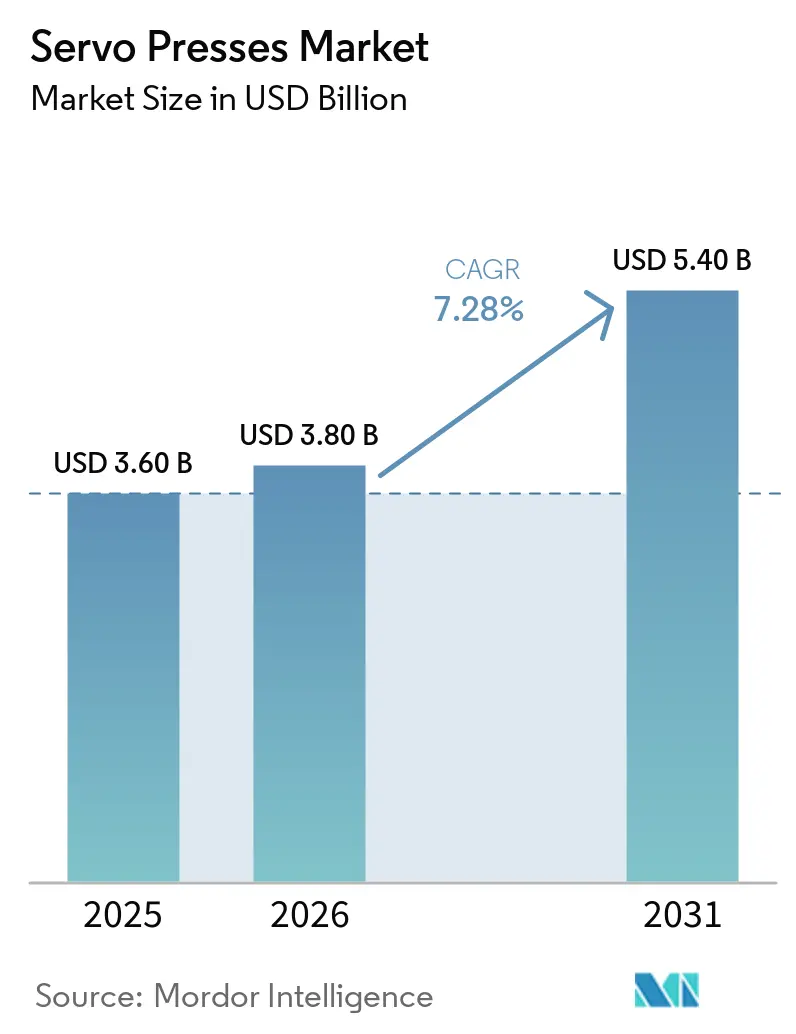
The Servo Presses Market size was valued at USD 3.60 billion in 2025 and is estimated to grow from USD 3.80 billion in 2026 to reach USD 5.40 billion by 2031, at a CAGR of 7.28% during the forecast period (2026-2031).
Demand for servo presses is increasing as manufacturers seek greater control over slide motion, forming speed, force, and dwell time when processing high-strength steels, aluminum, and other difficult-to-form materials. Programmable forming profiles enable the production of complex geometries, improve dimensional consistency, and reduce material and tooling losses. Rising electricity costs are strengthening the value proposition of servo-driven systems, which reduce idle energy consumption by supplying power according to the forming cycle rather than continuously operating a flywheel. The expansion of electric vehicle manufacturing is also creating additional applications for servo presses in battery enclosures, terminals, motor components, and lightweight structural parts, where precision and repeatability are essential. In addition, connected controls, automated die handling, condition monitoring, and production data capture are supporting the integration of servo presses into automated manufacturing cells. However, high upfront equipment costs, the need for specialized programming and maintenance capabilities, and long press replacement cycles continue to constrain adoption, particularly among small and mid-sized manufacturers.
Key Report Takeaways
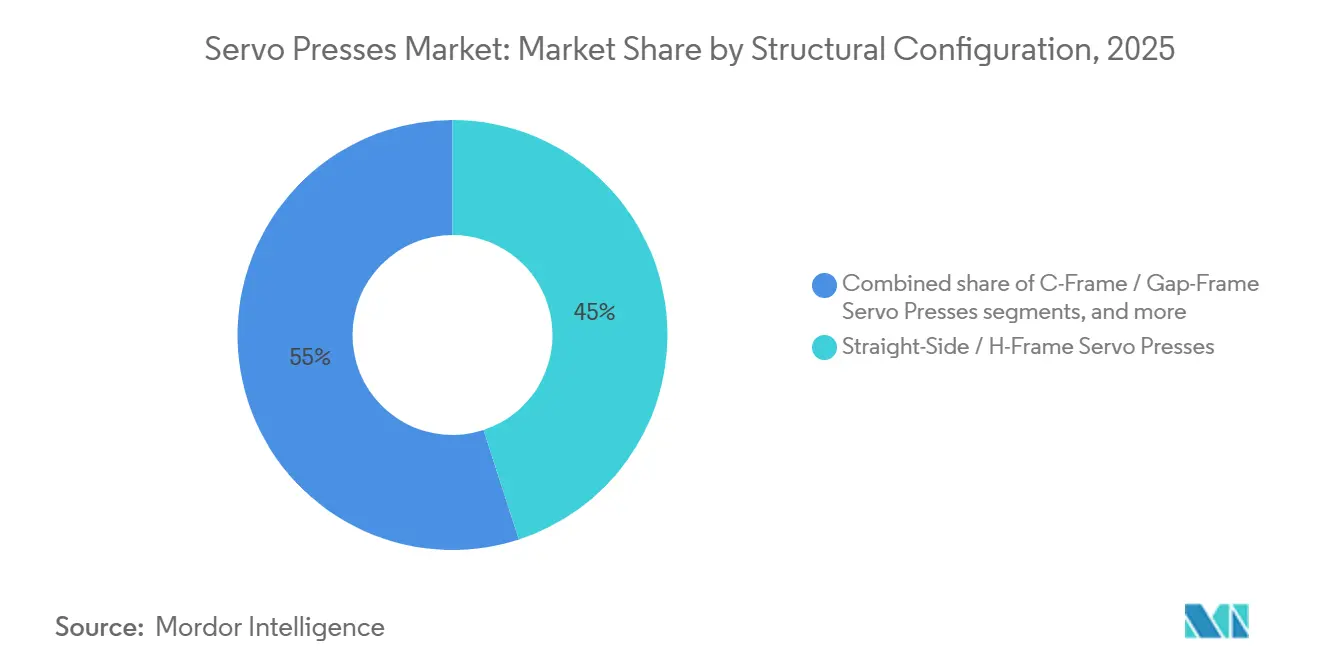
- By frame/structural configuration, straight-side or H-frame servo presses held 45% of the servo presses market share in 2025, and are also forecast to grow at an 8.50% CAGR through 2031.
- By servo press technology/system type, servo-mechanical metal forming presses held 48% of the servo presses market size in 2025, while electromechanical/electric servo assembly presses are forecast to grow at an 11.6% CAGR through 2031.
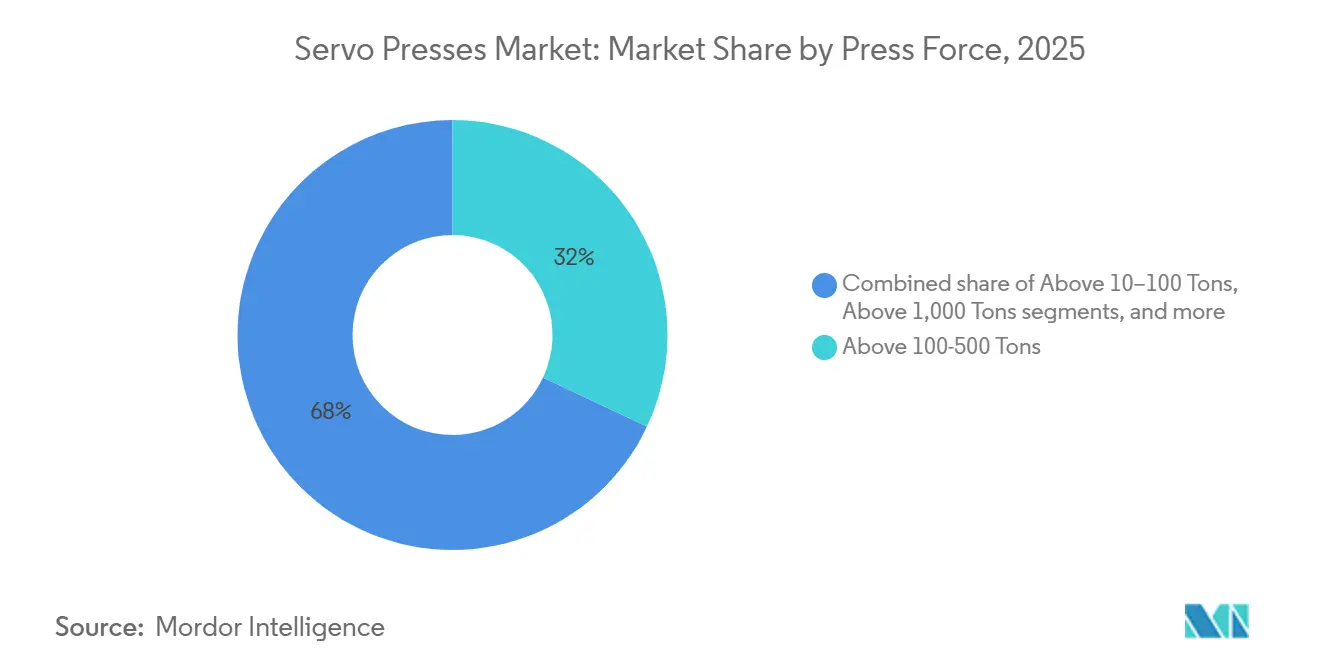
- By press force/capacity, the above 100-500 tons segment held 32% of the servo presses market share in 2025, while the above 1,000 tons segment is forecast to grow at a 10.7% CAGR through 2031.
- By application, stamping, blanking, and punching held 34% of the servo presses market share in 2025, while other precision and specialized pressing applications are forecast to grow at an 11.4% CAGR through 2031.
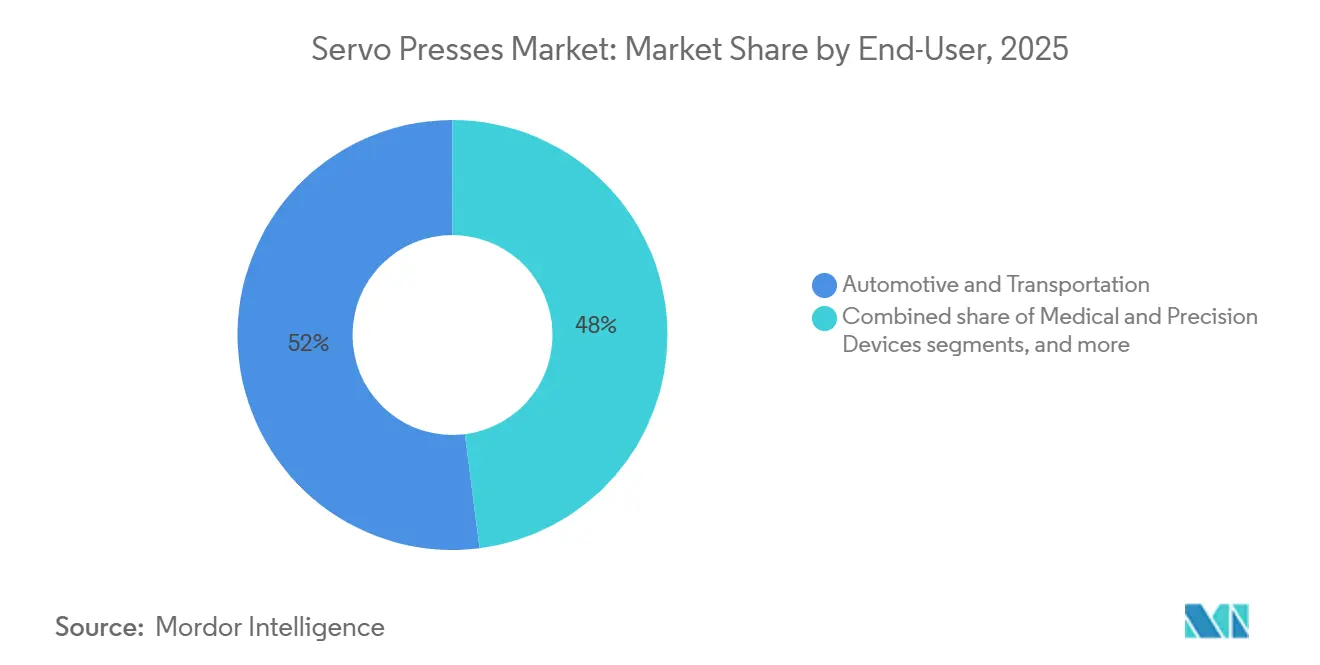
- By end user, automotive and transportation held 52% of the servo presses market share in 2025, while medical and precision devices are forecast to grow at a 14.8% CAGR through 2031.
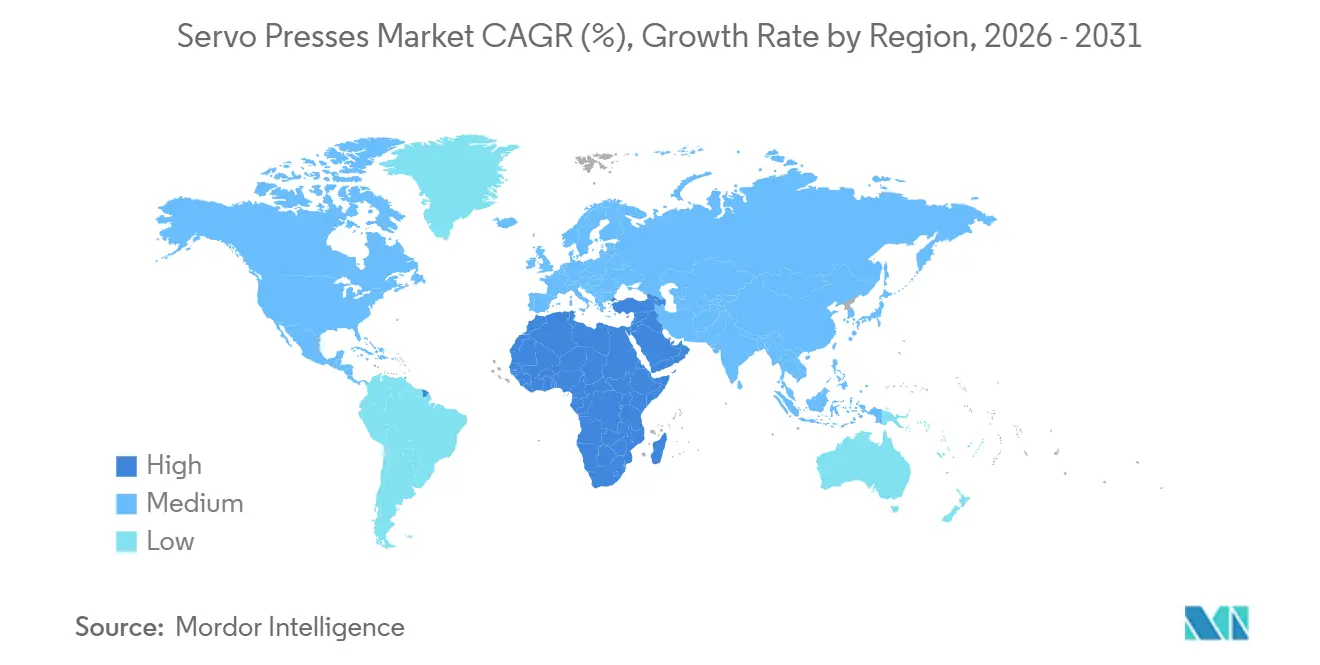
- By geography, Asia-Pacific held 52.48% of the servo presses market share in 2025, while the Middle East and Africa are forecast to grow at a 9% CAGR through 2031.
Note: Market size and forecast figures in this report are generated using Mordor Intelligence’s proprietary estimation framework, updated with the latest available data and insights as of January 2026.
Global Servo Presses Market Trends and Insights
Drivers Impact Analysis*
| Driver | (~) % Impact on CAGR Forecast | Geographic Relevance | Impact Timeline |
|---|---|---|---|
| Energy Efficiency and Lower Total Cost of Ownership | +1.5% | Global, concentrated in the EU, Japan, and energy-intensive Asia-Pacific manufacturing hubs | Short term (≤ 2 years) |
| Automotive Electrification and Lightweight Component Manufacturing | +1.3% | Global, strongest in China, Germany, and the North American EV production corridors | Medium term (2-4 years) |
| Rising Demand for High-Precision Metal Forming | +1.1% | Global, with Asia-Pacific and North America leading in electronics and semiconductor supply chains | Medium term (2-4 years) |
| Industry 4.0 Integration and Traceable Quality Control | +0.9% | North America and the EU are primary, while Asia-Pacific adoption is accelerating. | Medium term (2-4 years) |
| Growth in Electronics and Precision Component Manufacturing | +0.7% | Asia-Pacific, especially China, South Korea, and Taiwan, with expansion into Southeast Asia | Long term (≥ 4 years) |
| Replacement and Modernization of Conventional Press Installed Base | +0.5% | Global, with North America and Europe leading in installed-base age | Long term (≥ 4 years) |
| Source: Mordor Intelligence | |||
Energy Efficiency and Lower Total Cost of Ownership
Energy efficiency became a stronger purchase factor in 2025 as industrial electricity costs and carbon reporting requirements increased. Servo systems use power during active forming cycles and can avoid the constant pump losses associated with hydraulic equipment. Tolomatic reported that electromechanical actuators required 4.4 times less energy than hydraulic counterparts in the applications it assessed. In January 2026, ANDRITZ Schuler introduced HFA plus+ fineblanking systems with servo-controlled hydraulic pump drives and double-digit energy efficiency improvements. These operating savings can shorten the payback period for high-use lines and support wider servo presses market adoption.[1]ANDRITZ, “More Energy Efficiency and Output: ANDRITZ Schuler Further Develops HFA Fineblanking Presses Together with Feintool,” ANDRITZ Newsroom, andritz.com.
Automotive Electrification and Lightweight Component Manufacturing
Electric vehicle production requires parts that differ from those used in conventional powertrains. Battery enclosures, aluminum closures, and ultra-high-strength steel structures need motion profiles that can manage spring back and formability. A 25,000 kN heavy-duty servo press study found that post-calibration torque prediction error fell from 7.6% to 1.4% in automotive door-panel production. Servo press lines also reduce power use by 30-45% compared with conventional hydraulic stamping. AIDA Engineering installed a 300 metric ton direct-drive servo press at Wiegel’s Silao, Mexico, facility in January 2026 for EV busbars, terminals, lead frames, and connectors. These requirements extend the servo presses market beyond replacement demand.
Rising Demand for High-Precision Metal Forming
Manufacturers in medical devices, aerospace, electronics, and semiconductors need tighter control of part geometry. Servo presses use closed-loop force and position control, and the supplied research identifies stroke accuracy of ±0.01 mm for micro-stamping work. This capability supports components such as SAW filters, MEMS actuator caps, and crystal-device lids produced in very high volumes. Aerospace suppliers need part-level production records to meet AS9100 traceability requirements. The servo presses market benefits where conventional mechanical presses cannot consistently deliver the accuracy and documentation needed.
Industry 4.0 Integration and Traceable Quality Control
Connected production cells need presses that can capture and share data from every stroke. This capability supports quality review, maintenance planning, and proof of process control. An IEEE study published in 2025 found that an IoT-enabled digital-twin framework reduced traceability time by 85.6% and inspection-related carbon emissions by 23.4%. Automotive suppliers face similar pressure because IATF 16949 places importance on process traceability. Digital records can also raise switching costs once a press is integrated with quality and production systems.
Restraints Impact Analysis*
| Restraint | (~) % Impact on CAGR Forecast | Geographic Relevance | Impact Timeline |
|---|---|---|---|
| Higher Upfront Capital Cost | -0.9% | Global, most acute in SME-heavy Southeast Asia, South America, and Eastern Europe | Short term (≤ 2 years) |
| Programming, Commissioning, and Skilled-Labor Requirements | -0.7% | Global, with severity in North America and Western Europe | Medium term (2-4 years) |
| Long Replacement Cycles for Existing Mechanical and Hydraulic Presses | -0.5% | North America and the EU, where mid-market installed equipment is often more than 20 years old | Long term (≥ 4 years) |
| Limitations in Ultra-High-Tonnage Applications | -0.3% | Heavy-industry segments globally, especially forging, structural steel, and heavy-gauge deep drawing | Long term (≥ 4 years) |
| Source: Mordor Intelligence | |||
Higher Upfront Capital Cost
Servo presses cost more than comparable conventional systems because they use precision motors, encoders, regenerative drives, and multi-axis controllers. This difference is a material obstacle for small and medium-sized manufacturers with limited capital budgets. Safety hardware, certification, and integration work add to the purchase cost for some installations. ISO 16092-2:2025 sets safety requirements for mechanical presses, including servo-drive systems. The servo presses market will depend on suppliers proving that lower lifetime operating costs justify the initial premium.
Programming, Commissioning, and Skilled-Labor Requirements
Servo equipment requires staff who can program motion profiles and maintain electronic control systems. These needs are more complex than the routine operation of flywheel-based mechanical presses. The United States Bureau of Labor Statistics projected a 7% decline in employment of metal and plastic machine workers from 2024 to 2034, despite 87,900 annual openings, mainly from replacement needs. The agency recorded 56,060 cutting, punching, and press machine operators in fabricated metal product manufacturing in 2025. Training and commissioning support will remain important to the pace of servo presses market deployment.[2]“Metal and Plastic Machine Workers,” Occupational Outlook Handbook, bls.gov.
*Our forecasts treat driver/restraint impacts as directional, not additive. The impact forecasts reflect baseline growth, mix effects, and variable interactions.
Segment Analysis
By Frame / Structural Configuration: Straight-Side Frames Lead High-Force Precision Work
Straight-side or H-frame presses held 45% of the servo presses market share in 2025 and are also forecast to grow at an 8.50% CAGR through 2031. Their rigid construction limits angular deflection under eccentric loading. This is important for automotive body panels and heavy-gauge stampings that use multi-point tooling. The segment also recorded the highest projected growth among frame types through 2031. Larger bed sizes and synchronized tandem lines reinforce demand for this configuration in vehicle production.
C-frame or gap-frame presses continue to serve electronics assembly, appliance forming, and medium-tonnage precision work. Column and post-type systems support narrower uses in aerospace, powder compaction, and industrial machinery. Smaller equipment providers can use this demand to address medical and electronics customers. Straight-side systems nevertheless remain the core of the servo presses market size for high-force, high-accuracy applications. Frame selection is closely linked to the loading pattern and the tooling used on a production line. Straight-side systems are suited to work where a long bed, a large die, and stable guidance are needed. This makes them relevant to larger single-piece automotive stampings and tandem-line upgrades. C-frame equipment offers easier access for operators and automation in smaller precision applications. Column and post designs remain suitable where specialized forming conditions take priority over broad production volume.



By Servo Press Technology / System Type: Servo-Mechanical Systems Lead, Electric Assembly Systems Expand Fastest
Servo-mechanical metal forming presses held 48% of the servo presses market in 2025. They are established in high-speed automotive and appliance stamping. Their installed position reflects the need for reliable output in high-volume operations. Servo-hydraulic presses remain relevant for deep drawing and other high-force work. ANDRITZ Schuler’s HFA plus+ systems show how servo-controlled hydraulic pump drives can improve efficiency in this category. Hybrid servo presses combine a servo primary drive with hydraulic die cushions for difficult automotive steel grades. The servo presses market industry is separating into high-force production systems and precision assembly systems. Assembly equipment is expanding more quickly as manufacturers add controlled joining and traceable production steps.
Electromechanical or electric servo assembly presses are forecast to grow at 11.6% CAGR through 2031. Battery-module joining, lead-frame forming, medical-device assembly, and connector insertion support this faster growth. Technology also reflects the production environment rather than tonnage alone. High-speed stamping lines require consistent cycle performance and integration with progressive dies. Assembly lines need precise force control so that sensitive components are not damaged during joining. Servo-hydraulic equipment remains valuable where deep drawing and demanding materials require hydraulic force characteristics. Hybrid equipment provides flexibility where a controlled primary stroke and die-cushion support are both needed. This range of choices lets suppliers serve both established stamping plants and newer precision assembly cells. The choice is particularly important when customers want to combine a new press with existing material handling and tooling.
By Press Force / Capacity: The 100-500 Ton Range Anchors Demand
The above 100-500 tons segment held 32% of the servo presses market in 2025. This range is widely used for automotive body-panel stamping. It provides sufficient force for structural and exterior parts while supporting progressive dies used by Tier 1 suppliers. The up to 10 tons and above 10-100 tons ranges serve electronics, medical, and precision assembly work. Their revenue contribution is lower, but they support applications with strict force and positioning requirements. The 100-500 tons range remains the practical center of gravity for automotive stamping investment. Above 5,000 kN, conventional hydraulic presses retain a role in heavy forging and deep drawing. This division keeps capacity selection closely tied to the part, material, and production process.
Above 1,000 tons is forecast to grow at a 10.7% CAGR through 2031. EV structures, large battery enclosures, and defense components support the increase. Capacity decisions reflect more than the size of the finished component. Buyers also consider material thickness, die design, the required draw depth, and the number of parts produced per stroke. Automotive suppliers use the 100-500 tons range because it fits a wide range of panel and structural work. Smaller force ranges remain important where controlled joining or micro-forming creates value. The largest systems serve specialized projects that need high force and stable motion over a large working area. Suppliers must therefore offer a broad capacity range while maintaining the accuracy expected from servo controls. The use of progressive dies makes repeatable motion important in the core automotive range. Battery enclosure work also requires sufficient force while maintaining control over complex shapes.
By Application: Stamping Leads Revenue, Specialized Pressing Grows Fastest
Stamping, blanking, and punching captured 34% of the servo presses market in 2025. Automotive, appliance, and electronics producers depend on these processes for high-speed sheet-metal work. Deep drawing and sheet forming remain important for closures and EV battery housings. Assembly, press-fitting, and joining are expanding as producers connect presses with robotic cells. Forging and cold forming also benefit from servo-hydraulic hybrid configurations for near-net-shape EV powertrain parts. A 2025 study on robotic press integration supported the value of connected process traceability in stamping lines. These uses broaden the servo presses market beyond conventional sheet-metal stamping.[3]Chien-Yi Yu et al., “Integrating a Fast and Reliable Robotic Hooking System for Enhanced Stamping Press Processes in Smart Manufacturing,” Automation, mdpi.com.
Other precision and specialized pressing applications are forecast to grow at an 11.4% CAGR through 2031. This category includes micro-stamped connectors, powder-metallurgy compaction, and medical-device forming. Traceability requirements strengthen the use of programmable servo equipment in these applications. Application requirements shape the value placed on servo capability. High-volume stamping benefits from programmable motion that can be matched to the material and die. Precision applications benefit from controlled force, repeatable positioning, and production records. Robotic cells can use those records to support a more connected assembly sequence. Deep drawing and forging require equipment that can manage demanding material behavior without losing process control. The range of applications gives press builders several paths to expand with customers. A manufacturer may begin with conventional stamping and later add joining or precision forming capacity. This can create demand for different press types within the same plant. The move toward robotic cells also makes control-system compatibility an important purchasing issue. Equipment that can provide production data at the stroke level has value where quality records are required. Suppliers that combine forming expertise with automation support are better placed to address these application needs.
By End User: Automotive Leads, Medical and Precision Devices Grow Fastest
Automotive and transportation held 52% of the servo presses market in 2025. Vehicle producers use these presses for conventional powertrain parts and EV structures. The segment benefits from ongoing demand for body panels, battery enclosures, busbars, and structural components. Electrical and electronics demand is supported by 5G infrastructure, AI data-center hardware, and consumer devices. Aerospace and defense customers require traceable forming for fasteners, titanium brackets, and structural parts. Industrial machinery and general manufacturing provide a wider base of demand across capital cycles. Appliances and consumer durables are replacing older mechanical lines to improve productivity and energy use. The servo presses market industry is therefore becoming less dependent on automotive demand alone.
Medical and precision devices are forecast to grow at a 14.8% CAGR through 2031. Miniaturization, biocompatibility, and process-control requirements support this growth. End-user requirements differ in the level of force, speed, traceability, and cleanliness they demand. Automotive plants prioritize output, die compatibility, and reliable handling of structural materials. Medical-device producers place greater emphasis on repeatable force and recorded process data. Electronics makers need precision in small parts that may be produced at high volumes. Aerospace and defense suppliers need traceability for specialized components and materials. This variety helps broaden the customer base for servo press suppliers. It also reduces the effect of a slowdown in any single end-user group. Automotive remains the largest source of revenue, but the faster growth in medical and precision devices changes the mix of demand. Suppliers need to adapt their sales and service approach to customers who use different production volumes and quality standards. Applications in electronics and medical devices can require smaller systems with advanced control capabilities. The end-user base will therefore favor suppliers that can serve both high-volume lines and specialized production environments.
Geography Analysis
Asia-Pacific held 52.48% of the servo presses market in 2025. China supports demand through automotive production, electronics manufacturing, and investment in semiconductor capacity. Japan remains important because several servo press OEMs are headquartered there. South Korea and Taiwan add demand from semiconductor, display, and precision-electronics supply chains. Nidec Drive Technology opened a new press-machine assembly factory in Ritto, Shiga Prefecture, on April 15, 2026, doubling domestic capacity from 60 to 120 presses annually and extending maximum machine size from 150 to 330 tons. India, Thailand, Vietnam, and Indonesia also support regional demand as automotive and electronics supply chains expand.
Europe held a significant revenue position in 2025, led by Germany’s automotive and Tier 1 supplier base. Italy’s precision-mechanics sector and France’s aerospace manufacturing base add to regional demand. The EU Machinery Regulation becomes mandatory on January 20, 2027, and supports equipment modernization decisions. ANDRITZ Schuler advanced its HFA plus+ fineblanking offering in January 2026. Fagor Arrasate and Funditec formed Primus Robotics in March 2026 to develop industrial humanoid robots for precision manufacturing. Poland, the Czech Republic, and Hungary add demand as automotive suppliers localize production.
North America recorded consistent demand in 2025, with the United States supported by Midwest automotive stamping, reshoring activity, and electronics assembly. Mexico gained importance in EV and e-mobility supply chains through new component production. The Middle East and Africa are forecast to grow at a 9% CAGR through 2031, the highest regional rate in the supplied research. Saudi industrial diversification, UAE advanced-manufacturing programs, and South African automotive assembly support this outlook. South America maintains demand through Brazil’s automotive base, although high interest rates constrained capital spending in 2025. Regional strategies in the servo presses market must match equipment capacity, service coverage, and automation needs to local conditions.

Competitive Landscape
The servo presses market is fragmented around Japanese, European, and Taiwanese OEMs, with Chinese producers adding price pressure in mid-market capacity ranges. AIDA Engineering, ANDRITZ Schuler, and Komatsu Industries compete through direct-drive technology, automotive customer relationships, and global service networks. Their position is strongest where buyers need high precision, complex automation, or established technical support. Chinese suppliers compete more directly in standard capacity ranges where purchase price has greater weight. The competition depends on engineering capability, service response, and the ability to provide reliable production systems.
Leading suppliers increasingly offer complete press-room packages that combine the press, servo feed, automated die change, and data-management controls. This approach can support premium pricing and deepen relationships with automotive capital-program customers. In January 2025, AMADA agreed to acquire 100% of H&F Corporation for USD 116 million, expanding into large-format presses, transfer equipment, and laser blanking. In January 2026, ANDRITZ Schuler and Feintool expanded their cooperation on HFA plus+ fineblanking systems. These moves show that companies are broadening their system offerings rather than relying on standalone press sales.
Digital retrofits are a relevant opportunity for older servo-capable presses that lack IIoT connectivity. Higher-force servo-hydraulic hybrids also offer an opportunity in applications where conventional hydraulics still dominate. Component suppliers may seek to capture more value through electronics, controls, and software, while press builders protect their role through integrated systems.
Servo Presses Industry Leaders
AIDA Engineering, Ltd.
ANDRITZ Metals Forming / ANDRITZ Schuler
Komatsu Industries Corp.
Nidec Press & Automation (including Minster and ARISA)
AMADA Group – AMADA PRESS SYSTEM / H&F Corporation
- *Disclaimer: Major Players sorted in no particular order


Recent Industry Developments
- April 2026: AIDA-America supported Graham Stamping Company’s installation of a 400 metric ton unitized-frame direct-drive servo press at its Hermitage, Pennsylvania, facility. The installation supports high-volume automotive and mining contracts, operates in pendulum motion at up to 50 strokes per minute, and enables multi-out die production.
- April 2026: Nidec Drive Technology Corporation opened its new press-machine assembly factory in Ritto, Shiga Prefecture, Japan. The factory doubled domestic production capacity from 60 to 120 presses annually and extended the maximum machine size from 150 to 330 tons.
- January 2026: ANDRITZ Schuler and Feintool expanded their cooperation on HFA plus+ fineblanking press systems. The systems use servo-controlled hydraulic pump drives, deliver double-digit energy efficiency improvements, and offer force options from 3,200 to 15,500 kN.


Global Servo Presses Market Report Scope
The Servo Presses Market Report is Segmented by Frame (C-Frame, H-Frame, and More), by System Type (Servo-Hydraulic Presses, and More), by Press Force (Up To 10 Tons, and More), by Application (Forging and Cold Forming, and More), by End-User Industry (Automotive and Transportation, and More), and by Geography (Asia-Pacific, Europe, and More). The Report Offers Market Size and Forecasts in Value (USD) for all the Above Segments.
| C-Frame / Gap-Frame Servo Presses |
| Straight-Side / H-Frame Servo Presses |
| Column / Post-Type Servo Presses |
| Other Servo Press Configurations |
| Servo-Mechanical Metal Forming Presses |
| Electromechanical / Electric Servo Assembly Presses |
| Servo-Hydraulic Presses |
| Hybrid Servo Presses |
| Up to 10 Tons |
| Above 10-100 Tons |
| Above 100-500 Tons |
| Above 500-1,000 Tons |
| Above 1,000 Tons |
| Stamping, Blanking and Punching |
| Deep Drawing and Sheet Forming |
| Forging and Cold Forming |
| Assembly, Press-Fitting and Joining |
| Powder Compaction |
| Other Precision and Specialized Pressing Applications |
| Automotive and Transportation |
| Electrical and Electronics |
| Aerospace and Defense |
| Medical and Precision Devices |
| Industrial Machinery and General Manufacturing |
| Appliances and Consumer Durables |
| Other End-Use Industries |
| North America | United States |
| Canada | |
| Mexico | |
| South America | Brazil |
| Argentina | |
| Rest of South America | |
| Europe | Germany |
| Italy | |
| France | |
| United Kingdom | |
| Russia | |
| Spain | |
| Rest of Europe | |
| Asia-Pacific | China |
| Japan | |
| India | |
| South Korea | |
| Taiwan | |
| ASEAN (Singapore, Malaysia, Indonesia, Thailand, Vietnam, Philippines, Myanmar, Cambodia, Laos, and Brunei) | |
| Rest of Asia-Pacific | |
| Middle East and Africa | Saudi Arabia |
| United Arab Emirates | |
| Turkiye | |
| South Africa | |
| Egypt | |
| Nigeria | |
| Rest of Middle East and Africa |
| By Frame / Structural Configuration | C-Frame / Gap-Frame Servo Presses | |
| Straight-Side / H-Frame Servo Presses | ||
| Column / Post-Type Servo Presses | ||
| Other Servo Press Configurations | ||
| By Servo Press Technology / System Type | Servo-Mechanical Metal Forming Presses | |
| Electromechanical / Electric Servo Assembly Presses | ||
| Servo-Hydraulic Presses | ||
| Hybrid Servo Presses | ||
| By Press Force / Capacity | Up to 10 Tons | |
| Above 10-100 Tons | ||
| Above 100-500 Tons | ||
| Above 500-1,000 Tons | ||
| Above 1,000 Tons | ||
| By Application | Stamping, Blanking and Punching | |
| Deep Drawing and Sheet Forming | ||
| Forging and Cold Forming | ||
| Assembly, Press-Fitting and Joining | ||
| Powder Compaction | ||
| Other Precision and Specialized Pressing Applications | ||
| By End User | Automotive and Transportation | |
| Electrical and Electronics | ||
| Aerospace and Defense | ||
| Medical and Precision Devices | ||
| Industrial Machinery and General Manufacturing | ||
| Appliances and Consumer Durables | ||
| Other End-Use Industries | ||
| By Geography | North America | United States |
| Canada | ||
| Mexico | ||
| South America | Brazil | |
| Argentina | ||
| Rest of South America | ||
| Europe | Germany | |
| Italy | ||
| France | ||
| United Kingdom | ||
| Russia | ||
| Spain | ||
| Rest of Europe | ||
| Asia-Pacific | China | |
| Japan | ||
| India | ||
| South Korea | ||
| Taiwan | ||
| ASEAN (Singapore, Malaysia, Indonesia, Thailand, Vietnam, Philippines, Myanmar, Cambodia, Laos, and Brunei) | ||
| Rest of Asia-Pacific | ||
| Middle East and Africa | Saudi Arabia | |
| United Arab Emirates | ||
| Turkiye | ||
| South Africa | ||
| Egypt | ||
| Nigeria | ||
| Rest of Middle East and Africa | ||


Key Questions Answered in the Report
What is the projected growth rate for servo presses through 2031?
The servo presses market is forecast to grow at a 7.3% CAGR from 2026 to 2031 and reach USD 5.4 billion by 2031. Growth is supported by energy efficiency, EV component production, precision forming, and connected quality systems across manufacturing locations worldwide.
Which servo press technology is growing the fastest?
Electromechanical or electric servo assembly presses are forecast to grow at 11.6% CAGR through 2031. The growth is supported by battery-module joining, lead-frame forming, medical-device assembly, and precision connector insertion.
Which end user buys the most servo presses?
Automotive and transportation held 52% of the market size in 2025. The sector uses servo presses for body panels, structural parts, battery enclosures, busbars, terminals, and other EV-related components.
Why are manufacturers adopting servo presses?
Buyers seek lower energy use, programmable forming control, precision, and data capture for quality and traceability. Servo systems can also help manage difficult materials and complex geometries in demanding forming operations.
Which region leads to demand for servo presses?
Asia-Pacific held 52.48% of global revenue in 2025. China, Japan, South Korea, and Taiwan support demand through automotive, electronics, semiconductors, precision manufacturing, and the presence of major press OEMs.
What limits the adoption of servo press equipment?
Higher initial cost, skilled labor needs, long replacement cycles, and limits in the highest-force applications can slow adoption. Small manufacturers may find capital commitment and programming requirements particularly difficult to manage.
Page last updated on:


 Your data is secure and never sold or shared.


