
Europe Professional Audio Video (ProAV) Market Size and Share
Market Overview
| Study Period | 2020 - 2031 |
|---|---|
| Forecast Data Period | 2026 - 2031 |
| Base Year Market Size (2025) | USD 31.64 Billion |
| Market Size (2026) | USD 34.53 Billion |
| Market Size (2031) | USD 50.48 Billion |
| Growth Rate (2026 - 2031) | 7.89 % |
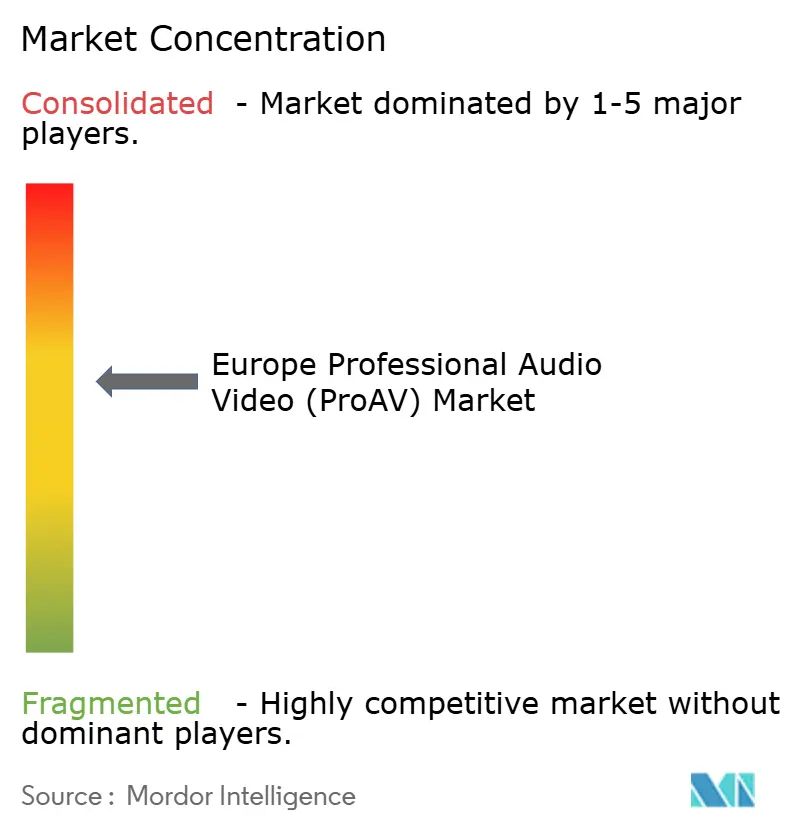
| Market Concentration | Medium |
Major Players *Disclaimer: Major Players sorted in no particular order Image © Mordor Intelligence. Reuse requires attribution under CC BY 4.0. | |
Europe Professional Audio Video (ProAV) Market Analysis by Mordor Intelligence
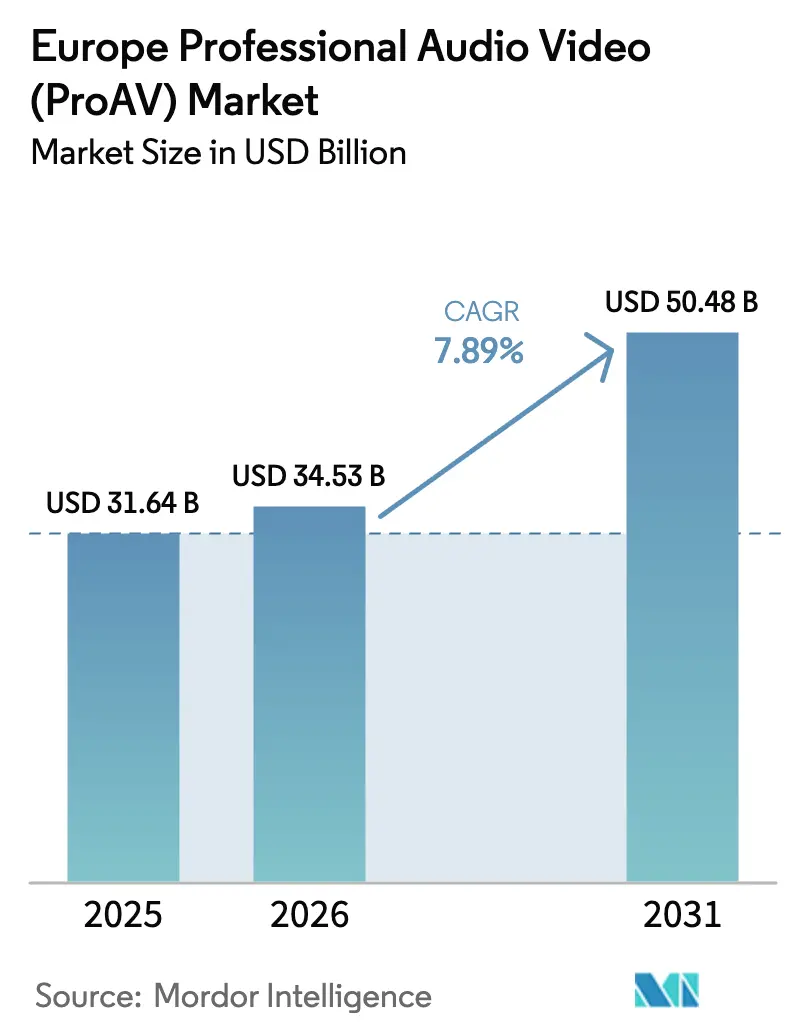
The Europe Professional Audio Video Market size is projected to expand from USD 31.64 billion in 2025 and USD 34.53 billion in 2026 to USD 50.48 billion by 2031, registering a CAGR of 7.89% between 2026 to 2031. The expansion is underpinned by hybrid-work mandates that concentrate technology budgets on fewer yet higher-specification collaboration rooms, an accelerated rollout of networked digital signage across retail and transit hubs, and the transition from analog or proprietary signal chains to IP-based architectures that lower vendor lock-in while enabling remote device management. Enterprises are retiring power-intensive legacy gear ahead of the usual replacement cycle because EU ecodesign regulations favor low-consumption displays and amplifiers, while integrated AI functions, such as real-time transcription, speaker tracking, and spatial audio, are shifting value from standalone processors to smart endpoints. At the same time, channel dynamics are evolving: systems integrators remain influential in complex, multi-site deployments, yet e-commerce portals are gaining traction for commoditized cameras, video bars, and AV-over-IP switches as buyers prioritize transparent pricing and rapid delivery. Heightened cybersecurity scrutiny under the NIS2 Directive is prompting integrators to bundle managed security services with firmware updates and vulnerability audits, supporting the premium that services command over hardware in new contracts.
Key Report Takeaways
- By component, hardware commanded 62% of revenue in 2025, and services are accelerating at a 10.40% CAGR through 2031.
- By solution category, video displays and projection held 28.50% of the Europe professional audio-video market share in 2025, and unified communication and collaboration solutions are advancing at a 12.90% CAGR to 2031.
- By Distribution Channel, Direct Sales held 41.04% of the Europe ProAV market share in 2025, and Online and E-Commerce is advancing at an 11.5% CAGR to 2031.
- By end-user industry, corporate buyers accounted for 30.40% of demand in 2025 in the Europe ProAV market, and education is expanding at an 11.70% CAGR through 2031.
- By geography, Germany led with 25.10% revenue share in 2025, and Italy is forecast to achieve an 8.60% CAGR between 2026 and 2031.
Note: Market size and forecast figures in this report are generated using Mordor Intelligence’s proprietary estimation framework, updated with the latest available data and insights as of January 2026.
Europe Professional Audio Video (ProAV) Market Trends and Insights
Drivers Impact Analysis*
| Driver | (~) % Impact on CAGR Forecast | Geographic Relevance | Impact Timeline |
|---|---|---|---|
| Growing Demand for Hybrid Work and Collaboration Ecosystems Across Enterprises | +2.10% | Germany, France, United Kingdom, Benelux, Southern Europe | Medium term (2-4 years) |
| Rapid Proliferation of Digital Signage in Retail and Transportation Hubs | +1.50% | Germany, France, Spain, Italy (metro areas and airports) | Short term (≤ 2 years) |
| UHD Content Consumption Fuelling Upgrade Cycle for Projection and Display Hardware | +1.30% | United Kingdom, Germany, France | Medium term (2-4 years) |
| Transition to Open Standards Like AV-over-IP Reducing Vendor Lock-in | +1.20% | Germany, United Kingdom, Netherlands | Long term (≥ 4 years) |
| Rising Adoption of Immersive Audio for Esports Arenas and Virtual Event Venues | +0.80% | France, Spain, Germany | Medium term (2-4 years) |
| EU Energy-Efficiency Directives Accelerating Replacement of Legacy AV Gear With Low-Power Solutions | +0.90% | EU-wide, strongest in Germany, France, Netherlands | Short term (≤ 2 years) |
| Source: Mordor Intelligence | |||
Growing Demand for Hybrid Work and Collaboration Ecosystems Across Enterprises
More than one-half of EU companies supported remote meeting capabilities in 2024, up from less than one-third before 2020, signaling a structural redesign of real-estate footprints toward technology-rich collaboration rooms. Organizations are reallocating budgets from large office leases to unified communication suites that combine 4K cameras, beamforming microphones, and AI transcription tools, elevating employee experience and productivity. Investment momentum is visible in vendor performance: Logitech’s video collaboration revenue grew 9% year-over-year to USD 614 million during its October-December 2024 quarter, and continued device certification for Microsoft Teams Rooms and Zoom Rooms is lowering integration risk for buyers. Hybrid work thus acts as a flywheel, boosting endpoint refresh cycles, software subscriptions, and remote management services in the Europe professional audio video market.
Rapid Proliferation of Digital Signage in Retail and Transportation Hubs
European retailers and transit authorities are swapping static posters for networked LED walls that deliver targeted promotions, real-time wayfinding, and higher advertising yields. LG demonstrated transparent OLED storefront panels at CES 2024, enabling immersive overlays without blocking sightlines.[1] Samsung’s modular MicroLED Wall All-in-One, launched in January 2024, integrates onboard processing to simplify installation where space or cooling limits conventional video walls.[2] Centralized, cloud-based content management lets operators schedule campaigns across hundreds of locations, cutting labor costs and permitting data-driven A/B tests. Airports, metro systems, and shopping centers use the same infrastructure for safety messaging, generating recurring demand for ruggedized screens, media players, and analytics software across the Europe professional audio video market.
UHD Content Consumption Fueling Upgrade Cycle for Projection and Display Hardware
Streaming platforms, live sports, and enterprise e-learning assets are increasingly produced in 4K or 8K, rendering older HD-only systems obsolete in visually intensive workflows. Sony released its BVM-HX1710 4K OLED monitor for live production in September 2024 to satisfy broadcasters’ color-critical needs. Barco added HDR-capable cinema projectors in April 2024, raising the bar on brightness and dynamic range for premium auditoriums. Corporate meeting rooms and university lecture theaters now specify 4K flat panels to display dense spreadsheets or medical imagery without zooming, accelerating replacement demand for high-resolution displays and compatible distribution hardware in the Europe ProAV market.
Transition to Open Standards Like AV-over-IP Reducing Vendor Lock-in
IPMX, Dante, and SMPTE ST 2110 allow audio, video, and control data to traverse standard Ethernet, eliminating expensive matrix switchers and proprietary cabling. Audinate reports more than 4,000 Dante-enabled product models as of 2024, expanding buyers’ ability to mix and match brands without compromising functionality. Interoperability improves price transparency, and built-in remote management aligns AV assets with IT service practices. As a result, procurement teams increasingly consider total cost of ownership rather than headline hardware price, reinforcing the migration toward IP workflows across the Europe ProAV market.
Restraints Impact Analysis*
| Restraint | (~) % Impact on CAGR Forecast | Geographic Relevance | Impact Timeline |
|---|---|---|---|
| Cybersecurity and Privacy Threats in Networked AV Systems | -1.10% | Germany, France, Netherlands (NIS2 high scrutiny) | Short term (≤ 2 years) |
| High Initial Capital Expenditure Amid Macroeconomic Uncertainty | -0.90% | Southern Europe, United Kingdom | Short term (≤ 2 years) |
| Semiconductor Supply Instability Curbing Hardware Availability | -0.60% | Germany, France (manufacturing hubs) | Medium term (2-4 years) |
| Growing Environmental Scrutiny of E-Waste in AV Hardware Lifecycle | -0.50% | EU-wide | Long term (≥ 4 years) |
| Source: Mordor Intelligence | |||
Cybersecurity and Privacy Threats in Networked AV Systems
Embedding AV devices on corporate LANs exposes cameras, microphones, and control processors to ransomware, eavesdropping, and unauthorized access, risks heightened by the NIS2 Directive’s mandatory cybersecurity controls for large enterprises.[3] ENISA’s 2024 threat-landscape report flagged compromised video-conferencing endpoints as a vector for corporate espionage, prompting IT teams to enforce network segmentation, certificate authentication, and timely patching. System integrators now wrap projects with managed detection and response services, but the added 15%-25% cost strains price-sensitive public-sector and SME budgets, tempering uptake in parts of the Europe professional audio video market.
High Initial Capital Expenditure Amid Macroeconomic Uncertainty
A fully equipped 4K hybrid meeting room can exceed USD 25,000, while large auditoriums require six-figure investments that many organizations defer amid inflation and rising interest rates. Although Italy’s National Recovery and Resilience Plan allocates EUR 191.5 billion (USD 206.8 billion) to digital transformation, competing healthcare and energy priorities dilute immediate AV outlays, especially for municipalities and smaller universities. Subscription-based AV-as-a-service offers smoother cash flow, but adoption is slow because lessors are cautious about technology obsolescence risk, keeping some demand sidelined in the Europe ProAV market.
*Our forecasts treat driver/restraint impacts as directional, not additive. The impact forecasts reflect baseline growth, mix effects, and variable interactions.
Segment Analysis
By Component: Services Outpace Hardware on Managed-Offering Shift
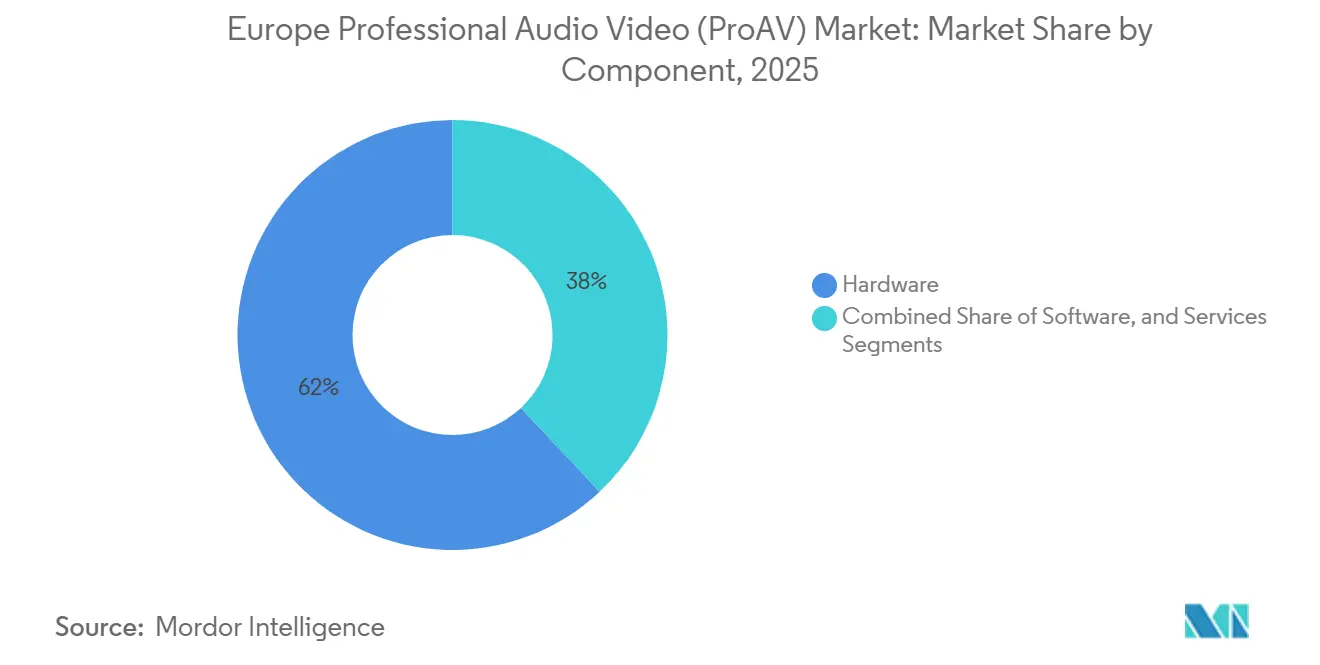
Hardware delivered 62% of 2025 revenue due to the cost of displays, projectors, cameras, microphones, and control processors that form the backbone of ProAV installations. Services revenue is rising at a 10.40% CAGR as enterprises prefer predictable operating expenses and end-to-end accountability for uptime. System integrators bundle remote monitoring, firmware updates, and cybersecurity audits into multi-year contracts, monetizing network operations centers that predict failures before they disrupt meetings. Software platforms, from content management to analytics dashboards, add stickiness by measuring room utilization and device health, supporting incremental upsells. The hardware mix is polarizing: commoditized USB peripherals compete on price, while premium endpoints integrate AI auto-framing or beamforming that justify longer replacement cycles and higher margins. Managed offerings resonate in verticals with scarce in-house expertise such as healthcare, hospitality, and retail, driving sustained growth in the services slice of the Europe ProAV market.
Services also mitigate supply-chain volatility by decoupling customer satisfaction from pure hardware availability. Integrators can swap functionally equivalent devices when chip shortages delay specific models, maintaining SLA compliance. Meanwhile, software subscriptions expand their role in environmental sustainability by triggering automated power-down or lighting adjustments via links to building-management systems. These efficiencies reinforce the business case for services, which are forecast to narrow the revenue gap with hardware beyond 2030 within the Europe professional audio video market.

By Solution Category: Unified Communication Platforms Eclipse Traditional Displays
Video displays and projection accounted for a 28.50% share in 2025, anchored by the omnipresence of large-format screens in meeting rooms, lecture halls, and retail venues. However, unified communication and collaboration kits are advancing at a 12.90% CAGR as pre-certified bundles reduce integration risk and accelerate deployment. Manufacturers ship 4K cameras, microphone arrays, and compute modules as a single SKU that IT teams can deploy in under an hour, shrinking labor costs and downtime. Capture and production equipment is also benefitting from hybrid-event demand; PTZ cameras with NDI or SRT support slot directly into streaming workflows without external encoders, boosting margin-rich sales to venues and broadcasters.
Streaming, storage, and distribution tools enable on-demand access to recorded meetings and training sessions, cultivating secondary revenue through corporate learning platforms. Audio innovations remain central: Dante-enabled ceiling microphones auto-calibrate to room acoustics, while full-range line-array speakers deliver intelligibility in acoustically challenging halls. Software-defined control systems leverage commodity tablets rather than proprietary touch panels, extending flexibility. As buyers gravitate toward integrated user experiences, modular LED walls and immersive audio rigs increasingly anchor flagship deployments, creating a hierarchy of premium showcases that lift the Europe professional audio video market size associated with experiential solutions.
By Distribution Channel: E-Commerce Disrupts Integrator Dominance
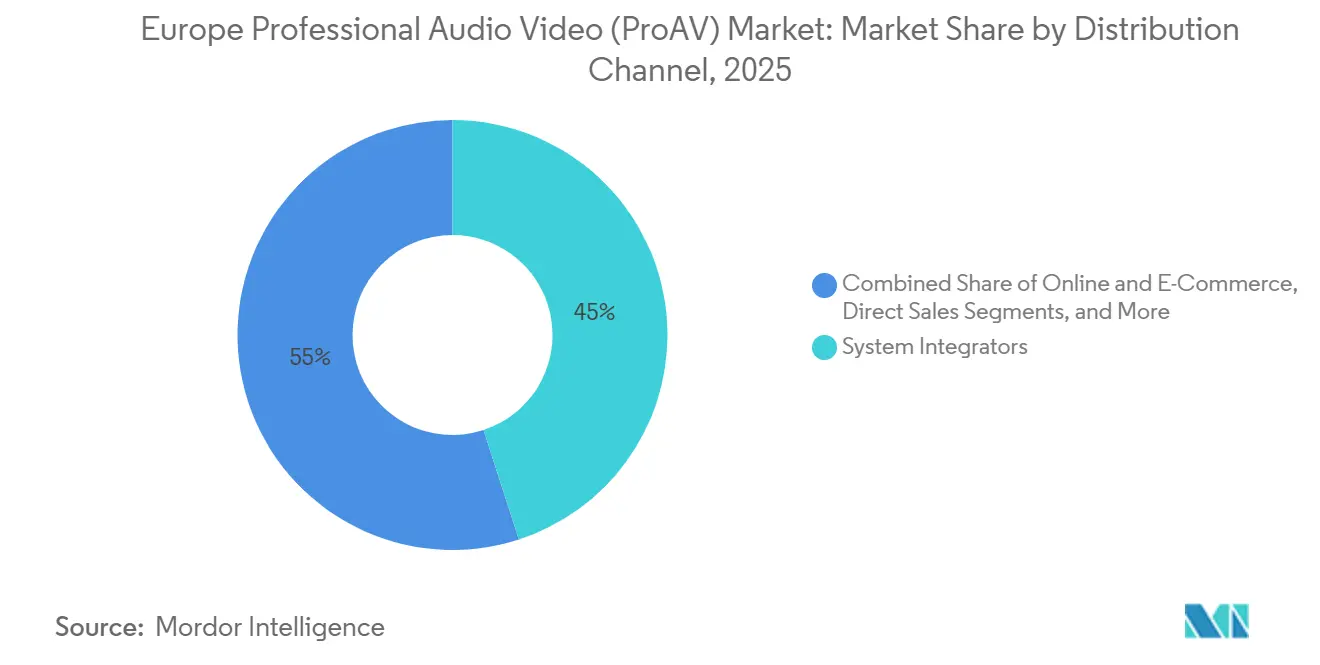
System integrators retained 45% of distribution in 2025, reflecting their value in multi-room design, certification, and commissioning. Yet online marketplaces are expanding at an 11.5% CAGR, particularly among SMEs that purchase video bars, USB DSPs, and HDMI extenders directly after reviewing peer feedback. Amazon Business, CDW, and specialist portals publish spec comparisons and compatibility guides, eroding information asymmetry. Value-added resellers occupy the middle ground, bundling hardware with software keys and light configuration for clients requiring more support than pure e-commerce but less complexity than enterprise-scale integration.
Direct sales remain essential for strategic accounts seeking volume pricing, extended warranties, or co-designed firmware features. Retail outlets serve prosumers equipping home studios and very small businesses. Subscription-based AV-as-a-service blurs channel lines: integrators, resellers, and even manufacturers now offer monthly bundles, aligning incentives around uptime rather than one-off margins. As price transparency rises, integrators differentiate through vertical expertise, managed services, and compliance consulting, preserving their share in highly regulated sectors across the Europe professional audio video market.
By End-User Industry: Education Modernization Outpaces Corporate Refresh
Corporate buyers generated 30.40% of demand in 2025 in the Europe ProAV market as hybrid-work policies embedded collaboration technology into workplace design. Education, however, is the fastest-growing vertical, expanding at an 11.70% CAGR on the back of Italy’s School 4.0 allocation of EUR 2.1 billion (USD 2.27 billion) for approximately 100,000 classrooms and 40,000 buildings. EU connectivity grants totaling EUR 323 million (USD 348.8 million) in 2024 further underpin bandwidth-intensive applications such as live streaming of lectures. Universities install 4K PTZ cameras and interactive flat panels to serve blended cohorts, while K-12 institutions prioritize all-in-one displays that displace projector-plus-whiteboard combos.
Venues and events follow closely, with esports arenas and corporate conventions embracing modular LED walls and immersive sound systems that promise rapid scene changes. Media and entertainment facilities transition to IP production pipelines supporting remote contribution, while retail focuses on experiential signage. Healthcare adopts telemedicine carts and surgical displays, though long procurement cycles temper near-term volumes. Government agencies retrofit council chambers with streaming-ready AV to satisfy transparency mandates. Transportation hubs deploy passenger-information displays integrated with public-address audio. Collectively, these segments illustrate how vertical-specific drivers tilt investment timing and technology mix within the Europe professional audio video market.
Geography Analysis
Germany secured 25.10% of 2025 revenue, leveraging its manufacturing base, dense integrator network, and stringent quality standards. Federal and regional governments fund Industry 4.0 projects and public-sector hybrid-meeting upgrades, sustaining demand even amid macro headwinds. Data privacy and cybersecurity priorities encourage on-premises management and encrypted transport solutions, favoring premium vendors with robust security stacks. France, the United Kingdom, and Spain each contribute sizable volumes. France draws on the EUR 54 billion (USD 58.3 billion) France 2030 investment plan to digitize public services and industry. The United Kingdom navigates post-Brexit customs and standards divergence, stimulating opportunities for domestic integrators and challenges for EU manufacturers crossing new trade barriers. Spain channels Digital Spain 2026 funds toward rural connectivity, unlocking fresh AV demand in schools and municipal buildings.
Italy represents the fastest growth trajectory, catalyzed by School 4.0 and the broader National Recovery and Resilience Plan’s EUR 191.5 billion (USD 206.8 billion) envelope. Classroom modernization involves interactive displays, lecture-capture rigs, and wireless presentation hubs, creating sustained pull through 2031. Universities align with the European Higher Education Area’s interoperability frameworks, further fueling investment. Corporate adoption of hybrid-meeting suites and hotel conference-room upgrades for international events also contribute.
The Rest of Europe displays heterogeneous patterns. Benelux and Nordic countries emphasize sustainability, procuring low-power displays and circular-economy service models. Central and Eastern Europe focus on bridging the digital divide via EU cohesion funds, prioritizing essential functionality over premium features. EU-wide regulations such as the Ecodesign Directive, WEEE, and RoHS harmonize environmental criteria, accelerating retirement of non-compliant analog gear. Collectively, regulatory alignment and stimulus funding shape both baseline demand and technology preferences in the Europe professional audio video market across the region.
Regulatory Landscape
EU-wide sustainability and accessibility requirements are increasingly affecting ProAV product design, procurement, and lifecycle services. The Ecodesign for Sustainable Products Regulation (ESPR) entered into force on 18 July 2024 and sets the direction for Digital Product Passports (DPPs) for electronics, with DPP registries referenced as operational from July 2026 and harmonization work (such as identifiers and interoperability) tracked through European Commission working-plan activity. The report also notes how EU environmental compliance obligations referenced in its scope (Ecodesign, WEEE, RoHS) continue to tighten, accelerating retirement of non-compliant legacy equipment and increasing demand for low-power and more serviceable systems.
Cybersecurity, accessibility, and AI governance are also tightening for networked AV endpoints used in meeting rooms, education, venues, and public spaces. The European Accessibility Act (Directive (EU) 2019/882) applies to products placed on the market from 28 June 2025, and EN 301 549 is commonly used as the harmonized accessibility standard in ICT procurement, shaping user interfaces and control surfaces in collaboration and signage deployments. For AI-enabled functions embedded in cameras, conferencing, and analytics, the EU AI Act has a primary implementation date of 2 August 2026, which increases the emphasis on compliant data handling, documentation, and managed updates, alongside NIS2-driven security controls that make patching and vulnerability management a prerequisite in purchase decisions.
Value Chain Analysis
The Europe ProAV value chain covers component suppliers (semiconductors, memory, optics, microphones, compute modules), OEMs that build endpoints and infrastructure (displays, cameras, audio, AV-over-IP switching), and software providers offering collaboration, content management, device management, and analytics. Distribution involves direct sales for strategic accounts, value-added resellers and online portals for standardized SKUs, and system integrators that design, commission, and secure multi-site installations. Post-install services, including remote monitoring, firmware updates, cybersecurity audits, and SLAs, are taking a larger share of total project value as AV systems increasingly sit on corporate networks and shift toward open standards.
Supply variability is still a constraint for hardware-heavy deployments. Memory shortages reported by the industry, linked to AI data center demand, are extending lead times for embedded boards and controllers from roughly 8-16 weeks to 26-55+ weeks. To keep projects moving, OEMs and integrators qualify alternates, shift configurations, and rely more on software-defined architectures. IT and security involvement has also become a practical gate in the chain, since network security assessment and acceptance testing increasingly run alongside traditional AV commissioning, supporting demand for managed services that include segmentation guidance, credential management, and ongoing patching.
Competitive Landscape
Competition is moderately fragmented, as global display giants, audio specialists, UC-platform vendors, and regional integrators vie for share. Sony, Samsung, LG, and Panasonic defend display and camera franchises through vertical integration and channel breadth. Audio expertise remains the differentiator for Shure, Sennheiser, and Harman, who leverage acoustic research and artist endorsements to justify premium pricing. Control-system incumbents Crestron and Barco face pressure from software-defined alternatives that run on tablets and offer cloud management at lower cost. Open networking standards such as Dante and IPMX erode proprietary ecosystems, allowing smaller players to compete on interoperability.
Integrator consolidation intensifies, targeting geographic coverage and vertical specialization in healthcare, education, or government. Managed services and AV-as-a-service models elevate operational excellence over product margins, tying revenue to uptime and customer satisfaction. White-space growth areas include AI analytics for meeting effectiveness, immersive audio for esports, and modular LED walls for retail storytelling. Cloud-native collaboration suites embedded within productivity platforms pose a disruptive threat by abstracting hardware layers.
Semiconductor supply volatility and cybersecurity compliance create dual stresses. Vendors with resilient supply chains and credible security roadmaps win procurement cycles in finance, healthcare, and public administration. Meanwhile, the embrace of sustainability, from low-power chipsets to recyclable enclosures, differentiates suppliers in environmentally conscious Nordic and Benelux markets. Overall, vendor success hinges on balancing innovation velocity, open-standards adoption, and lifecycle service capabilities in the Europe professional audio video market.
Europe Professional Audio Video (ProAV) Industry Leaders
-
Barco NV
-
Crestron Electronics, Inc.
-
Bosch Security Systems GmbH
-
Harman International Industries, Inc.
-
Sony Corporation
- *Disclaimer: Major Players sorted in no particular order
Market Opportunities and Future Outlook
Regulatory-driven product traceability and sustainability compliance are creating whitespace for vendors and integrators that can turn lifecycle data into usable workflows, including refurbishment and proof-of-compliance. With ESPR in force since 18 July 2024 and Digital Product Passports moving toward operational registry processes referenced for July 2026, asset-management software, serial-level documentation, and service programs that track configuration, energy use, and end-of-life handling across fleets of displays, conferencing endpoints, and signage players gain practical value. Vendors that package hardware with ongoing reporting, remote configuration, and circular-economy services are better placed in public-sector and enterprise tenders that weigh sustainability criteria alongside performance.
A second opportunity cluster centers on secure, software-forward ProAV aligned with enterprise IT governance and accessibility mandates. The European Accessibility Act applying from 28 June 2025 and EN 301 549-based procurement practices add requirements for accessible interfaces in meeting-room controls, digital signage interactions, and conferencing workflows, while NIS2 scrutiny and ENISA concerns on the threat landscape push buyers toward stronger authentication, timely firmware support, and integrator-led vulnerability management. AI-enabled endpoints also shift procurement toward auditable data handling and policy controls ahead of the EU AI Act primary implementation date of 2 August 2026, expanding room for managed services, AV-as-a-service bundles, and pre-certified UC room solutions that reduce integration risk and support standardized deployments.
Recent Industry Developments
- June 2026: Barco HDR by Barco projection technology deployed in 14 sites and 15 EPIC by Vue screens across Europe. The deployment across Europe scales premium visualization capabilities in ProAV and demonstrates Barco's ability to scale high-end projection in multi-site environments. It expands Barco's footprint in integrated projection systems and drives cross-selling with Vue and EPIC platforms.
- May 2026: ClickShare Hub Core bundled with Logitech MeetUp 2 certified for Microsoft Teams Rooms in small meeting rooms. The certification for enterprise and SMB collaboration spaces strengthens Barco's integrated collaboration ecosystem and Teams alignment in SMB and enterprise markets. The alignment with Teams in SMB markets supports broader adoption of Barco's ClickShare in office workflows.
- April 2026: Completed acquisition of VerVent Audio Holding (Focal and Naim) to expand into integrated audiovisual solutions. The acquisition expands Barco's audio portfolio within integrated audiovisual solutions. It broadens addressable ProAV opportunities and enables cross-selling with visualization offerings.
Research Methodology Framework and Report Scope
Market Definition and Coverage
For this report, the Europe professional audio video market covers paid, professional grade audio, video, display, and related control gear that is installed and used in commercial and institutional spaces across Europe.
Scope exclusions: consumer home audio and video devices, personal gaming peripherals, and purely DIY home theater equipment are excluded from the sizing.
Segmentation Overview
- By Component
- Hardware
- Software
- Services
- By Solution Category
- Streaming Media, Storage and Distribution
- Video Displays and Projection
- Audio Equipment
- Unified Communication and Collaboration Solutions
- Others Solution Category (Control Systems, Capture and Production Equipment,and others)
- By Distribution Channel
- Direct Sales
- Online and E-Commerce
- System integrators
- Others Distribution Channel ( Value-Added Resellers, Retail Stores, and Others)
- By End-User Industry
- Corporate
- Venues and Events
- Media and Entertainment
- Education
- Hospitality
- Others End-User Industry
- By Country
- Germany
- France
- United Kingdom
- Italy
- Spain
- Rest of Europe
Data Sources, Market Sizing, and Validation
Desk Research
Desk research was used to set the starting boundaries and to anchor the model to widely visible demand signals in Europe. We relied on public sources such as Eurostat for macro indicators and business activity, UN Comtrade style trade statistics for import and export direction checks, and national statistics offices for construction and services trends that link to commercial AV spending.
To avoid building the market on a single data series, additional reads were taken from sources such as ETSI and IEC standards publications (to understand technology shifts like IP based AV and interoperability), accessibility and public procurement guidance from European Commission portals, and peer reviewed articles on display and audio technology adoption. Company annual reports, investor presentations, and reputable press were used to sanity check product mix shifts, channel motions, and pricing commentary, and then these were supplemented by paid subscriptions for company financials, patent landscapes, and shipment level import and export cuts where available. This list is illustrative and not exhaustive, since many other public documents and data tables were also used for collection, validation, and clarification.
Primary Interviews and Surveys
Primary work focused on validating what gets counted as professional AV spend versus adjacent IT hardware, and on confirming how buying cycles are changing in corporate, education, retail, hospitality, venues, and government spaces. Interviews and surveys covered distributors, integrators, OEM channel teams, consultants, and large end user procurement and facilities roles across major European economies. We then used those inputs to tighten pricing, mix, and replacement assumptions that were unclear in public sources.
Distribution of primary research fieldwork respondents
| Company type | Respondent position |
|---|---|
| Top tier: 35% | CXOs: 16% |
| Mid tier: 49% | Functional/Unit leaders: 35% |
| Smaller Players: 16% | Managers: 49% |
Market-Sizing & Forecasting
Sizing starts with a top-down build where sector spend pools are reconstructed using Europe level activity indicators and trade and production context, and then filtered into a realistic ProAV demand share by space type. Once the demand pool is shaped, it is split into major equipment buckets and priced using average selling price (ASP) bands that reflect the installed use case, not a single blended sticker price.
To keep the model practical and repeatable, inputs used include indicators such as non-residential construction and renovation momentum, the pace of hybrid meeting room upgrades, live events and venue refurbishment cycles, education digitization budgets, and public procurement tender activity for AV enabled spaces. Where desk signals looked noisy, we corroborated totals with selective bottom-up checks, including sampled ASP time unit volumes for common categories, distributor and integrator channel checks, and supplier revenue exposure estimates. Gaps were handled by applying conservative ranges based on adjacent country adoption and replacement timing.
Forecasting uses scenario analysis with a short set of drivers, because these markets track capex cycles and product refresh waves. Assumptions for pricing progression, mix shift toward IP based systems, and replacement cadence were tuned using expert consensus, and then the scenarios were converted into a single base case forecast after review.
Data Validation & Update Cycle
Validation is done through multiple checks so that one data point does not drive the final value. We compare outputs against independent signals like trade movements, public tender intensity, and reported growth cues from channel participants, and then variances are investigated before sign-off.
If an anomaly shows up, such as a sudden pricing swing or a mismatch between demand indicators and modeled revenue, we re-check the input series and re-contact respondents tied to that part of the chain. Reports are refreshed annually, and interim updates are triggered when material events occur, such as major regulation shifts, supply constraints, or sharp currency moves. Before delivery, an analyst runs a final pass to ensure the model reflects the latest available public data and the newest primary feedback.
Mordor Intelligence's Europe Professional Audio Video Market Size Compared With Other Published Estimates
Published values for Europe ProAV often do not line up because the underlying scope and the timing of the data cut are not consistent across sources. Differences show up quickly when one estimate uses a wider regional roll-up, applies older exchange rates, or keeps a single ASP path even when product mix is shifting.
In this study, the refresh cadence and currency timing were treated as first-order inputs, and ASP bands were re-checked with channel feedback before totals were finalized. That approach is a key reason the 2025 view lands where it does for Mordor Intelligence.
Benchmark comparison
| Source | Market Size | Gaps in Research Methodology |
|---|---|---|
| Mordor Intelligence | USD 31.64 B (2025) | |
| Global Consultancy A | USD 18.70 B (2026) | Uses a later base year and a narrower commercial grade definition, and the lower starting value can also reflect different ASP anchoring across installed spaces and a longer forecast window that smooths near term replacement cycles. |
| Industry Association B | USD 86.40 B (2024) | Reported at an EMEA level that blends Europe with Middle East demand, and it is typically presented as total ProAV revenue across broader solution and service spend, which lifts the number versus a Europe-only hardware-led sizing boundary. |
The table shows that the biggest spread is explained by geography roll-ups and what is treated as in-scope revenue, followed by timing choices like the year of currency conversion and how fast ASPs are assumed to move. By keeping the steps traceable to clear demand spaces, price bands, and refresh checks, we can explain what changes the total and what does not, which makes the result easier to use in planning and budgeting conversations.
Key Questions Answered in the Report
How large is the Europe professional audio video market in 2026 and what is its growth forecast?
The market was valued at USD 34.53 billion in 2026 and is expected to reach USD 50.48 billion by 2031, expanding at a 7.89% CAGR.
Which component category is expanding fastest in Europe?
Services are rising at a 10.40% CAGR as enterprises shift from one-time installations to managed offerings covering monitoring, cybersecurity, and firmware updates.
Why is education investment accelerating across the region?
National programs such as Italy’s School 4.0 and EU connectivity grants are funding interactive displays, lecture-capture systems, and broadband infrastructure, driving an 11.70% CAGR in the education segment.
What technology trend is reshaping procurement decisions?
The move to open, IP-based standards like Dante and IPMX is lowering vendor lock-in and enabling central device management, influencing hardware refresh cycles and supplier selection.
How do EU energy-efficiency rules influence AV upgrades?
Ecodesign and WEEE regulations push organizations to retire power-hungry legacy gear in favor of low-consumption equipment.