
Market Overview
| Study Period | 2020 - 2031 |
|---|---|
| Forecast Data Period | 2026 - 2031 |
| Base Year Market Size (2025) | USD 181.34 Billion |
| Market Size (2026) | USD 184.59 Billion |
| Market Size (2031) | USD 201.76 Billion |
| Growth Rate (2026 - 2031) | 1.79 % |
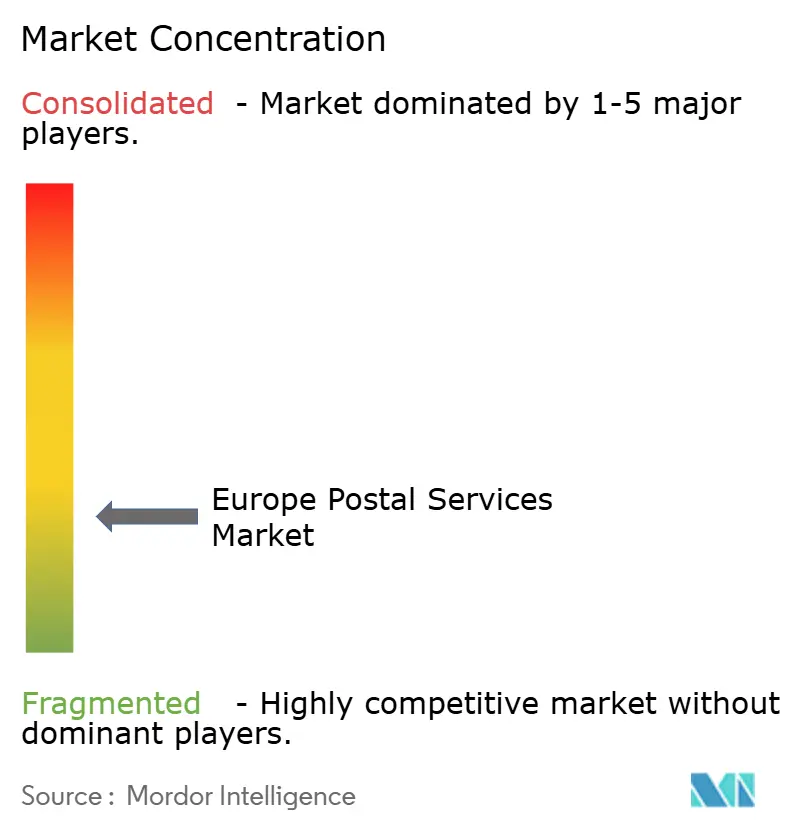
| Market Concentration | Low |
Major Players *Disclaimer: Major Players sorted in no particular order Image © Mordor Intelligence. Reuse requires attribution under CC BY 4.0. | |
Europe Postal Services Market Analysis by Mordor Intelligence
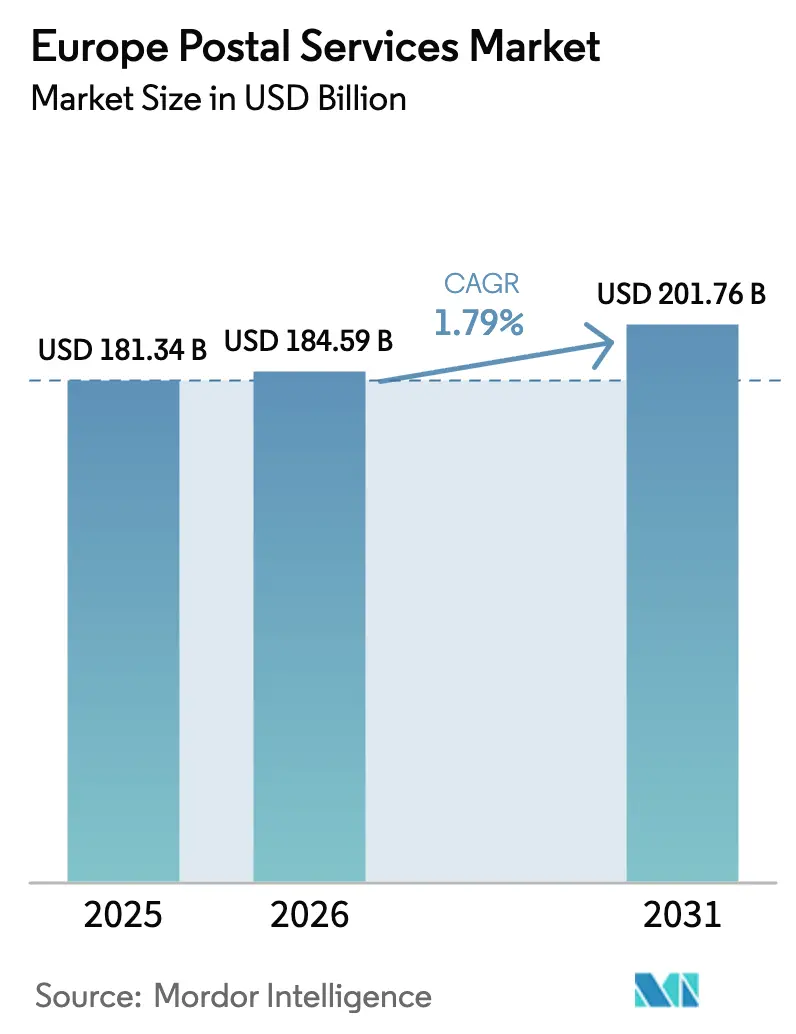
Europe Postal Services Market size in 2026 is estimated at USD 184.59 billion, growing from 2025 value of USD 181.34 billion with 2031 projections showing USD 201.76 billion, growing at 1.79% CAGR over 2026-2031.
Underpinning this expansion is the decisive shift toward parcels, revenue and continue to offset the gradual drop in traditional letters. Express postal services, backed by rising demand for same-day and next-day delivery, are on course for the strongest advance at a 7.1 % CAGR, far outpacing the overall market. Germany retains its leadership position with 24 % share on the strength of a dense logistics backbone, while Spain stands out as the fastest-growing national market, tracking 6.1 % annual expansion as e-commerce partnerships deepen. Operators are responding to tighter competition and digital substitution by accelerating automation, broadening service portfolios, and adapting to new regulatory frameworks such as Germany’s revised Postal Act, which seeks to balance universal service with financial sustainability.
Key Report Takeaways
- By service type, Standard Postal Service held 52.35% of the Europe Postal Services market share in 2025, whereas Express Postal Service is forecast to grow at a 6.96 % CAGR through 2031.
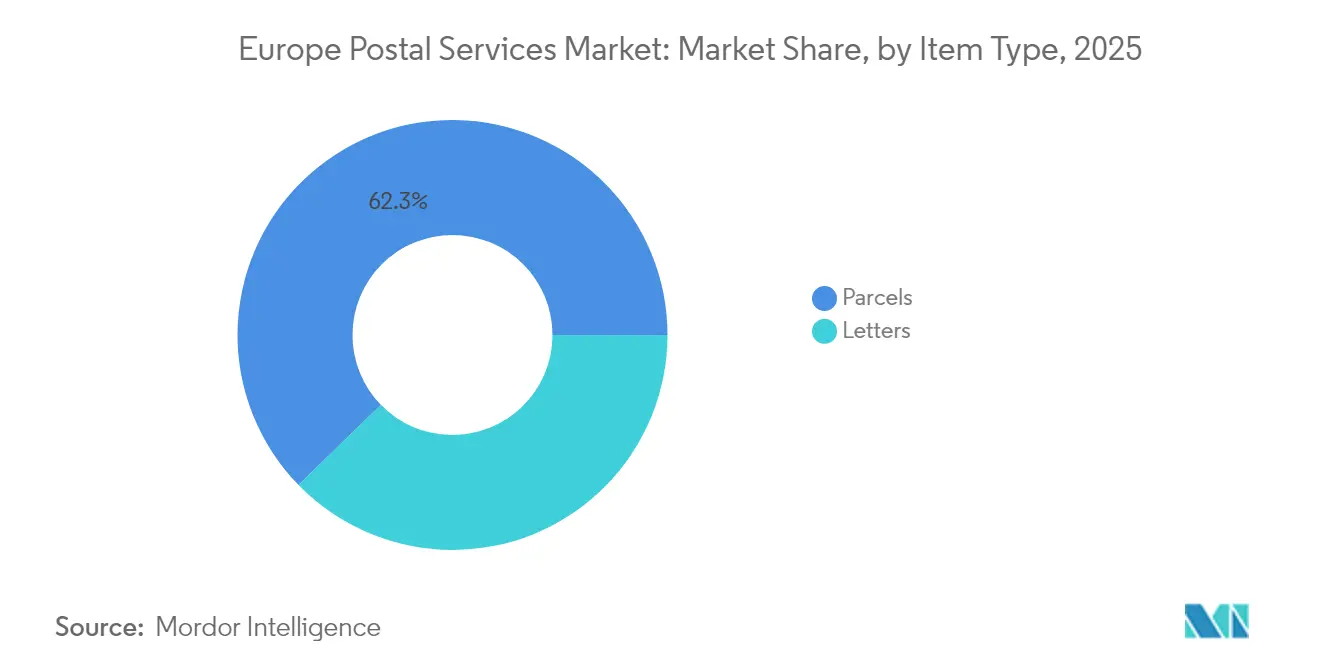
- By item type, Parcels commanded 62.30% of the Europe Postal Services market share in 2025 and are expected to expand at a 6.18% CAGR to 2031.
- By destination, Domestic shipments accounted for 76.45% of the Europe Postal Services market share in 2025, while International shipments are set to register a 6.07% CAGR over 2026-2031.
- By geography, Germany led with a 23.70% of the Europe Postal Services market share in 2025, while Spain is projected to post the fastest growth at a 5.97% CAGR through 2031.
Note: Market size and forecast figures in this report are generated using Mordor Intelligence’s proprietary estimation framework, updated with the latest available data and insights as of 2026.
Market Trends and Insights
Drivers Impact Analysis of Europe Postal Services Market*
| Driver | (~) % Impact on CAGR Forecast | Geographic Relevance | Impact Timeline |
|---|---|---|---|
| E-commerce Boom | +1.8% | Germany, UK, France, Spain | Short term (≤ 2 yrs) |
| EU Carbon Regulations | +0.6% | EU-wide | Medium term (3-4 yrs) |
| Cross-Border Single Market Initiatives | +0.5% | Border regions | Medium term (3-4 yrs) |
| Ageing Population | +0.2% | Germany, Italy | Long term (≥ 5 yrs) |
| Same-Day Delivery Expectations | +1.2% | Urban Europe | Short term (≤ 2 yrs) |
| Logistics Automation | +0.7% | Western Europe | Medium term (3-4 yrs) |
| Source: Mordor Intelligence | |||
E-commerce Boom Driving Parcel Volumes in Germany & the UK
Parcel volumes in Germany rose 9 % year-on-year during Q2 2024 even as consumer spending moderated. The United Kingdom echoes this pattern, with e-commerce holding 26 % of retail in 2024 and set to reach 31 % by 2028. This demand imbalance between parcels and letters is producing asymmetric network utilisation that nudges operators to repurpose letter routes for parcel pickups. A fresh inference is that suburban depots originally designed for mail sorting are quietly morphing into parcel micro-fulfilment hubs, unlocking hidden asset productivity.
EU Carbon Regulations Accelerating Fleet Electrification Investments
Stricter emission caps have accelerated electric-vehicle roll-outs, with UPS deploying more than 100 new EVs in Paris and planning 600 across Europe by end-2024 [1]Carter Chase, “New UPS Electric Vehicles Hit The Streets Of Europe,” UPS, about.ups.com. Bpost doubled its electric van fleet, while PostNL logged 82 % emission-free delivery kilometres in 2023. The underlying inference is that early movers can price carbon-neutral delivery at a modest premium, creating a two-tier service catalogue that hedges against regulatory costs.
Cross-Border Single Market Initiatives Simplifying Customs for SMEs
The Centralised Clearance for Import (CCI) system went live on 1 July 2024, allowing declarations in one EU state and physical presentation in another [2]Directorate-General for Taxation and Customs Union, “Centralised Clearance For Import (CCI) Goes Live,” European Commission, taxation-customs.ec.europa.eu. Together with IPC INTERCONNECT™, these changes compress clearance times and lower paperwork for exporters. One emerging inference is that mid-sized postal operators can now bundle customs brokerage with logistics, generating ancillary revenue streams that did not exist under legacy rules.
Ageing Population Sustaining Letter-Mail Demand for Government Correspondence
Citizens aged 65 + already make up 21.3 % of the EU demographic base. Pension and healthcare agencies still rely on paper notices, so postal operators are seeing a slower erosion of letters in regions with older populations. The fresh takeaway is that demographic pockets create natural hedges against digital substitution, enabling operators to cross-subsidise rural deliveries with stable government mail contracts.
Restraints Impact Analysis of Europe Postal Services Market*
| Restraint | (~) % Impact on CAGR Forecast | Geographic Relevance | Impact Timeline |
|---|---|---|---|
| Declining Letter Volumes | –1.1% | Nordics | Short term (≤ 2 yrs) |
| High Labor Costs & Unionization | –0.7% | Western Europe | Medium term (3-4 yrs) |
| Urban Congestion | –0.5% | Major cities | Medium term (3-4 yrs) |
| Digital Substitutes | –0.9% | EU-wide | Short term (≤ 2 yrs) |
| Source: Mordor Intelligence | |||
Declining Traditional Letter Volumes in Nordic Region
PostNord notes that 76 % of Nordic consumers now purchase cross-border online, diverting attention from domestic mail services. Letter declines accelerate cost-to-serve, forcing operators to trim headcount; Posti’s recent layoffs confirm this restructuring path. The inference is that the Nordic region may pioneer hybrid public-private funding models to keep universal service afloat.
High Labor Costs & Unionization in Western Europe
A one-day strike in Germany during March 2025 illustrates wage tension in heavily unionised markets. Operators respond by accelerating robotics and route optimisation. An immediate inference is that labor volatility indirectly drives technology adoption curves upward, shortening the payback horizon for automation projects.
*Our forecasts treat driver/restraint impacts as directional, not additive. The impact forecasts reflect baseline growth, mix effects, and variable interactions.
Europe Postal Services Market Segment Analysis
Service Type:
Express Services Outpace Standard OfferingsExpress services hold a Europe Postal Services market size that is forecast to expand at 6.96 % CAGR from 2026-2031, significantly faster than standard services, which still command 52.35 % market share in 2025. The widening spread highlights how premium time-definite products monetise consumer willingness to pay for speed. A current inference is that network design is pivoting toward later collection cut-offs and earlier morning delivery waves, squeezing utilisation out of existing fleets.
Standard services, although lower growth, remain indispensable for regulatory service obligations and nationwide coverage. Germany’s revised Postal Act extends permissible delivery time to three business days for 95 % of letters starting 2025, freeing operators to batch deliveries. This regulatory slack implies that standard services will increasingly serve as the cost-optimised backbone, while express layers generate surplus cash.




Item Type:
Parcels Dominate Future Growth LandscapeParcels represent 62.30% Europe Postal Services market share in 2025 and are projected to post 6.18 % CAGR through 2031. DHL’s 9 % year-on-year parcel growth in Germany validates continued outperformance. The inference here is that sustained parcel growth presses operators to standardise packaging and labelling requirements, shaving micro-delays in sortation.
Letters continue a structural downtrend with a 6 % decline logged in Q2 2024. Yet critical government communication and legal correspondence keep this segment relevant. A fresh inference is that digital identity services embedded within registered letters could reposition the category as a trust-anchored channel rather than a volume play.
Destination:
International Shipments AccelerateInternational services are forecast to grow at 6.07 % CAGR versus domestic’s larger but slower 76.45 % share base. The CCI clearance model materially trims cross-border friction. The emergent inference is that SMEs now perceive postal operators as integrated trade facilitators, not merely carriers, boosting loyalty in a previously price-sensitive cohort.
Domestic networks remain crucial for last-mile density, with 94 % of online sellers in Spain offering out-of-home options through parcel lockers. InPost’s November 2024 expansion into eight EU markets demonstrates convergence of domestic locker infrastructure with international flows. The fresh implication is that the boundary between domestic and international sortation nodes will blur as consolidated facilities handle both streams seamlessly.
Geography Analysis
Germany Postal Services Market
Germany retains 23.70 % Europe Postal Services market share in 2025, supported by robust logistics infrastructure and central geography. Although e-commerce volumes dipped in value terms during early 2024, parcel counts still climbed, reinforcing the principle that unit volume growth can offset softer ticket sizes. The new Postal Act’s requirement for 12,000 outlets also hints that bricks-and-mortar access remains politically non-negotiable, anchoring service ubiquity even as digital substitutes proliferate. A key inference is that Germany’s slower letter speed mandate may let operators redeploy labor from evening sortation to early-morning parcel waves, raising asset turns without raising headcount.
Spain Postal Services Market
Spain posts the region’s fastest forecast CAGR at 5.97 %. Government digital-transformation strategy and a resilient consumer economy feed this trajectory. Correos aims to lift logistics revenue share from 25 % to 40 % by 2024, signalling a decisive parcel pivot. Temu’s partnership with Correos in March 2025 to secure full national coverage illustrates how platform alliances rapidly amplify parcel volume. One inference is that Spain could leapfrog into parcel-first workflow designs, sidestepping legacy letter optimisation stages many peers still manage.
Broader European Markets
The United Kingdom, France, and Italy each hold meaningful slices of the Europe Postal Services market size. British policy debate on trimming Saturday letter deliveries mirrors continental precedents, signalling a gradual convergence of universal service scopes. Meanwhile, a London-Glasgow parcel train operating at 100 mph exemplifies how rail decarbonisation can carve new express corridors. The inference is that carbon-efficient rail freight could emerge as an alternative to intra-national airlift, offering express reliability with lower emissions.
Regulatory Landscape
Europe postal services operate under a dual framework of EU-level rules (notably the Postal Services Directive 97/67/EC and Regulation 2018/644 on cross-border parcel delivery) and national universal service obligation (USO) regimes administered by country regulators. A major near-term policy anchor is the European Commission workstream toward an EU Delivery Act. An Implementation Dialogue is scheduled for 22 June 2026 (led by Executive Vice-President Stephane Sejourne), and the proposal is referenced for Q4 2026, which points to efforts to modernize requirements for parcel-era networks while keeping USO principles intact.
Customs and tax policy is also reshaping operational compliance for cross-border parcels. From 1 July 2026, the EU customs reform removes the EUR 150 de minimis exemption for low-value parcels and introduces a flat-rate EUR 3 customs duty per item, with a further EUR 2 handling fee referenced for 1 November 2026. This raises the importance of data quality, pre-clearance, and in-EU fulfillment models. Germany is also showing movement in domestic policy, where a July 2026 draft law proposes ending Deutsche Post VAT exemption on business-to-business mail services. In other markets, operators are adjusting service standards, including PostNL moving letterbox mail to a two-day standard from 12 July 2026, to balance USO performance with cost-to-serve realities.
Value Chain Analysis
The Europe postal services value chain runs from upstream mail and parcel generation (households, SMEs, marketplaces, and large shippers), through induction and acceptance (post offices, parcel shops, lockers, and business collection), line-haul and cross-border transport (road and rail corridors, plus air networks for time-definite products), and finally downstream processing and last mile (automated hubs, local depots, delivery rounds, and out-of-home networks). With parcels at 62.30% of market revenues in 2025, operators are increasingly optimizing around parcel sortation, labeling compliance, and out-of-home handovers. Express providers add time-definite collection cutoffs and morning delivery waves over standard network structures.
Midstream and cross-border steps are becoming more data- and compliance-intensive because the EU customs reform takes effect on 1 July 2026, elevating the role of electronic documentation, bulk clearance, and in-EU inventory positioning to reduce item-by-item administrative friction. At the same time, operators are rebalancing legacy letter-chain economics through service-standard changes and route redesign, including PostNL adopting a two-day letterbox standard from 12 July 2026, alongside investments in hubs, depots, and automation to protect unit costs amid labor pressure. Partnerships and platform-linked volume flows are also shaping network loading, with marketplace and integrator collaborations influencing parcel injection patterns toward locker and pickup-point ecosystems that support density and first-attempt delivery performance.
Competitive Landscape
Deutsche Post DHL Group leads Europe Postal Services industry revenue at EUR 81.76 billion in 2023, with Europe contributing EUR 45.35 billion and an estimated 40 % German parcel market share [3]Agnes Putri, “PowerPoint Presentation,” DHL Group, group.dhl.com. La Poste Groupe, Royal Mail, and Poste Italiane follow, each pursuing diversification into banking or digital trust services. A salient inference is that postal incumbents increasingly treat data security as a service in its own right, evident in Swiss Post’s purchase of cybersecurity firm Open Systems.
White-space opportunities abound in sustainability-themed delivery; 66 % of consumers are willing to pay more for eco-friendly shipping. PostNL’s 82 % emission-free mileage showcases first-mover leverage, while DPD Portugal’s EUR 30 million hub signals scale bets on e-commerce. The inference here is that carbon reporting transparency becomes a differentiator as corporate shippers embed Scope 3 emissions into procurement scorecards.
Emerging disruptors such as InPost exploit parcel locker density and asset-light cross-border models. Acquiring Mondial Relay for EUR 513 million and full control of Menzies Distribution extends its reach into France, Benelux, and the UK. An inference is that locker ecosystems could disintermediate home delivery in dense urban zones, freeing capacity for rural last-mile routes where lockers are less viable.
Europe Postal Services Industry Leaders
Deutsche Post DHL
La Poste
Royal Mail
PostNL
FedEx/TNT Express
- *Disclaimer: Major Players sorted in no particular order
Europe Postal Services Market Companies Covered in this Report
- Deutsche Post DHL Group
- La Poste SA (DPDgroup/GeoPost)
- Royal Mail Group plc
- United Parcel Service Inc. (UPS)
- FedEx Corp. (incl. TNT Express)
- Poste Italiane SpA
- PostNL NV
- Swiss Post AG
- Bpost SA/NV
- PostNord AB
- GLS Group
- Hermes Europe GmbH (Evri)
- Asendia Management SAS
- DPD HL LLP (Russia)
- CTT Correios de Portugal SA
- Bring (Norwegian Posten)
- Omniva (Eesti Post AS)
- Correos y Telegrafos SA
- InPost SA
- Russian Post*

Market Opportunities and Future Outlook
Customs reform effective 1 July 2026, including the removal of the EUR 150 de minimis exemption and introduction of a flat-rate duty, creates room for postal operators and integrators to sell higher-value cross-border solutions beyond pure transport. This includes data-driven pre-clearance, consolidated import programs, and bundled fulfillment plus delivery for SMEs. The go-live of Centralised Clearance for Import (CCI) on 1 July 2024 already provides an operational route to separate declaration and presentation across EU member states, and the 2026 customs shift increases incentives to position inventory inside the EU and rely on bulk clearance models. That, in turn, supports demand for in-region warehousing, returns handling, and compliant labeling and data services.
Network modernization and out-of-home scale remain active investment themes that also translate into service-product opportunities. Recent evidence includes DHL Group committing around EUR 160 million in 2026-2027 to strengthen logistics infrastructure and support the clean energy transition in France, along with La Poste Groupe setting out Ambitions 2031 with EUR 10 billion of investment to reinforce infrastructure. In Iberia, DHL eCommerce and CTT finalized a joint venture in May 2026 to build a parcel distribution network, supporting denser domestic coverage and smoother cross-border handoffs. Service redesign is also showing up in letters, as operators reset standards to protect USO economics, such as PostNL moving to a two-day letterbox standard from 12 July 2026 following reporting EUR 35 million in USO-related losses in 2025, which reinforces a stronger commercial focus on parcels, hybrid delivery models, and automation-led productivity across the region.
Recent Industry Developments in Europe Postal Services Market
- June 2026: La Poste Groupe launches Ambitions 2031 strategic plan with EUR 10 billion investment in infrastructure including hubs in Madrid, Poland, and the UK. The expansion broadens cross-border hub capacity and reinforces the universal service footprint across Europe. The move strengthens scale and integration of La Poste's European parcel network.
- June 2026: DHL Group to invest around EUR 160 million in 2026-2027 to strengthen logistics infrastructure and support clean energy transition in France. The investment enhances hub capacity, automation, and decarbonization in the French market. These upgrades improve service resilience for European e-commerce flows.
- May 2026: DHL eCommerce enters a multi-year exclusive contract with the United States Postal Service valued at over USD 10 billion for last-mile parcel delivery. The partnership expands DHL's European parcel tonnage via a major US route and affects capacity planning. It also influences regional pricing and service levels for cross-border shipments.


Europe Postal Services Market Report Scope and Research Methodology
Market Definition and Coverage
For this study, the Europe postal services market is defined as the revenue earned from collecting, sorting, transporting, and delivering letters and parcels through postal networks across European countries, including domestic and cross-border flows.
Scope exclusions: We exclude pure digital communication services and the value of goods inside shipped parcels, since those are not postal service revenues.
Segments Covered in This Report
- By Service Type
- Express Postal Service
- Standard Postal Service
- By Item Type
- Letters
- Parcels
- By Destination
- Domestic
- International
- By Country
- Germany
- United Kingdom
- France
- Italy
- Spain
- Netherlands
- Nordics (Sweden, Denmark, Norway, Finland)
- Rest of Europe (incl. Eastern Europe & Balkans)
Data Sources, Market Sizing, and Validation
Desk Research
Desk work starts by building an activity map of postal traffic and pricing, so we can translate volumes into service revenue using a consistent approach across countries. We rely on public statistics and sector reporting such as Universal Postal Union (UPU) postal statistics, European Commission postal and single market publications, national regulators (for example, Bundesnetzagentur), national statistical offices, and customs or trade releases for cross-border movements where relevant.
On top of that, we review operator disclosures and public documents such as annual reports, investor presentations, and audited filings to track service mix changes, tariff moves, and network cost pressure. To avoid missing fast-moving changes, we also use general news and financials services, and we selectively use paid datasets for company financials and for shipment-level trade flows where it helps explain cross-border dynamics. The desk sources listed here are illustrative, and many additional public and paid references were used during data collection, validation, and clarification.
Primary Interviews and Surveys
Primary work is used to pressure-test desk assumptions, especially where public data lags or is reported using different definitions by country. We speak with postal operators and integrators, regulators and sector bodies, and large mailers and e-commerce shippers across major European markets, so pricing logic, mix shifts between letters and parcels, and cross-border handling match what is occurring in practice.
Distribution of primary research fieldwork respondents
| Company type | Respondent position |
|---|---|
| Top tier: 34% | CXOs: 18% |
| Mid tier: 47% | Functional/Unit leaders: 30% |
| Smaller Players: 19% | Managers: 52% |
Market-Sizing & Forecasting
Sizing is built using a top-down and bottom-up cross-check flow, so the total remains consistent with observable postal activity. On the top-down side, country-level postal traffic indicators and operator revenue disclosures are used to reconstruct the demand pool, which is then converted into USD after aligning reporting years and currency timing. Once that backbone is set, selective bottom-up approximations validate the totals, such as sampled price per item by service type multiplied by estimated handled volumes, followed by channel checks on cross-border parcel handling.
Key inputs in the model include letter and parcel volume direction, tariff and surcharge movements, cross-border share of parcels, labor and fuel cost pressure that feeds into pricing, and the pace of e-commerce shipments that shifts mix toward parcels. Forecasts are shaped using scenario analysis, where base assumptions on volume decline in letters, parcel growth rates, and price progression are reviewed with primary experts and then applied country by country. When a country has gaps in public reporting for a year, we interpolate using nearby regulatory time series and operator guidance, and then we normalize once fresher disclosures become available.
Data Validation & Update Cycle
Validation is done through repeated checks rather than a single pass. We compare the model outputs against independent signals such as regulator published revenue totals, operator reported service revenue splits, and parcel market indicators to catch outliers early. If a variance is large, the underlying assumptions are reopened, and targeted follow-ups are triggered with the same types of interviewees to understand whether the change is definitional, timing-related, or a true market move.
Before sign-off, the work goes through multi-step analyst reviews where calculations are rechecked, assumptions are documented, and country totals are reconciled back to the regional number. The report is refreshed on an annual cycle, and interim updates are made when a material event shifts pricing, regulation, or network structure. Right before delivery, a final update sweep is completed so clients receive the latest consistent view.
Mordor Intelligence's Europe Postal Services Market Estimate Compared With Other Published Estimates
Published market sizes for Europe postal services can look far apart, even when the topic sounds similar, because the boundary of what counts as postal service revenue is not applied consistently. Differences usually come from whether express and parcel handling is fully included, how cross-border flows are treated, and whether values are kept in local currency or converted into USD using consistent timing.
By tracking tariff changes, service mix shifts between letters and parcels, and currency conversion timing, Mordor Intelligence keeps the estimate tied to postal operator revenue rather than to shipment value proxies, which is where spreads tend to appear in Europe-wide rollups.
Benchmark comparison
| Source | Market Size | Gaps in Research Methodology |
|---|---|---|
| Mordor Intelligence | USD 181.34 B (2025) | |
| Regional Consultancy A | USD 168.28 B (2025) | Uses a faster-growth scenario that appears to extend CEP-style parcel momentum to the full postal market, which can overstate the revenue uplift from letters-to-parcels mix change in mature countries. |
| Industry Research Outlet B | USD 124.32 B (2026) | Applies a narrower service boundary with limited treatment of cross-border parcels and weaker uplift from surcharge and tariff progression, which pulls down the regional total in USD terms. |
The table shows that the biggest drivers behind the spread are scope and the way pricing and currency timing are handled. Our approach stays repeatable because each country total is built from observable revenue signals and then cross-checked with volume and pricing indicators before it is rolled up to the Europe level.


Key Questions Answered in the Report
What is the current Europe Postal Services market size?
The market is valued at USD 184.59 billion in 2026.
How fast is the Europe Postal Services industry expected to grow?
It is projected to grow at a 1.79 % CAGR between 2026 and 2031.
Which segment is growing the quickest?
Express postal services, with an expected 6.96 % CAGR through 2031, are expanding the fastest.
Why are parcels dominating Europe Postal Services market share?
Structural e-commerce growth and consumer demand for fast deliveries push parcel volumes, already representing 62.30 % of market revenues.
How are postal operators addressing carbon regulations?
Companies are electrifying fleets, investing in emission-free delivery infrastructure, and offering carbon-neutral shipping options to meet EU targets.
What role do cross-border initiatives play in market growth?
Systems like Centralised Clearance for Import simplify customs, lowering barriers for SMEs and accelerating international parcel traffic across the region.
Page last updated on:


 Your data is secure and never sold or shared.


