
Europe Metro Dense Wave Division Multiplexing (DWDM) Market Size and Share
Market Overview
| Study Period | 2020 - 2031 |
|---|---|
| Forecast Data Period | 2026 - 2031 |
| Base Year Market Size (2025) | USD 1.99 Billion |
| Market Size (2026) | USD 2.13 Billion |
| Market Size (2031) | USD 2.88 Billion |
| Growth Rate (2026 - 2031) | 6.22 % |
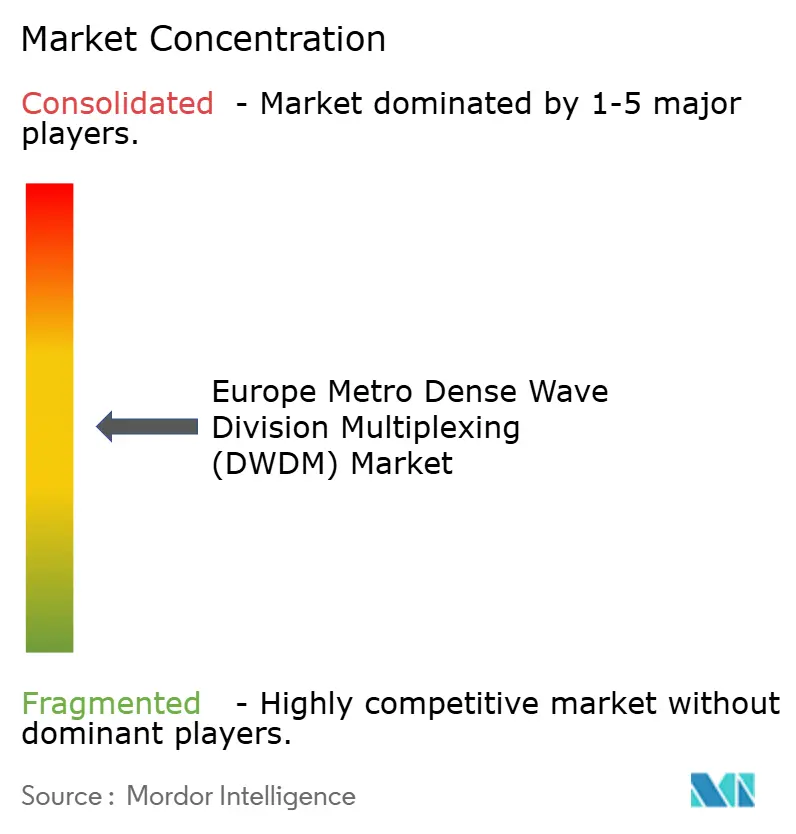
| Market Concentration | Medium |
Major Players *Disclaimer: Major Players sorted in no particular order Image © Mordor Intelligence. Reuse requires attribution under CC BY 4.0. | |
Europe Metro Dense Wave Division Multiplexing (DWDM) Market Analysis by Mordor Intelligence
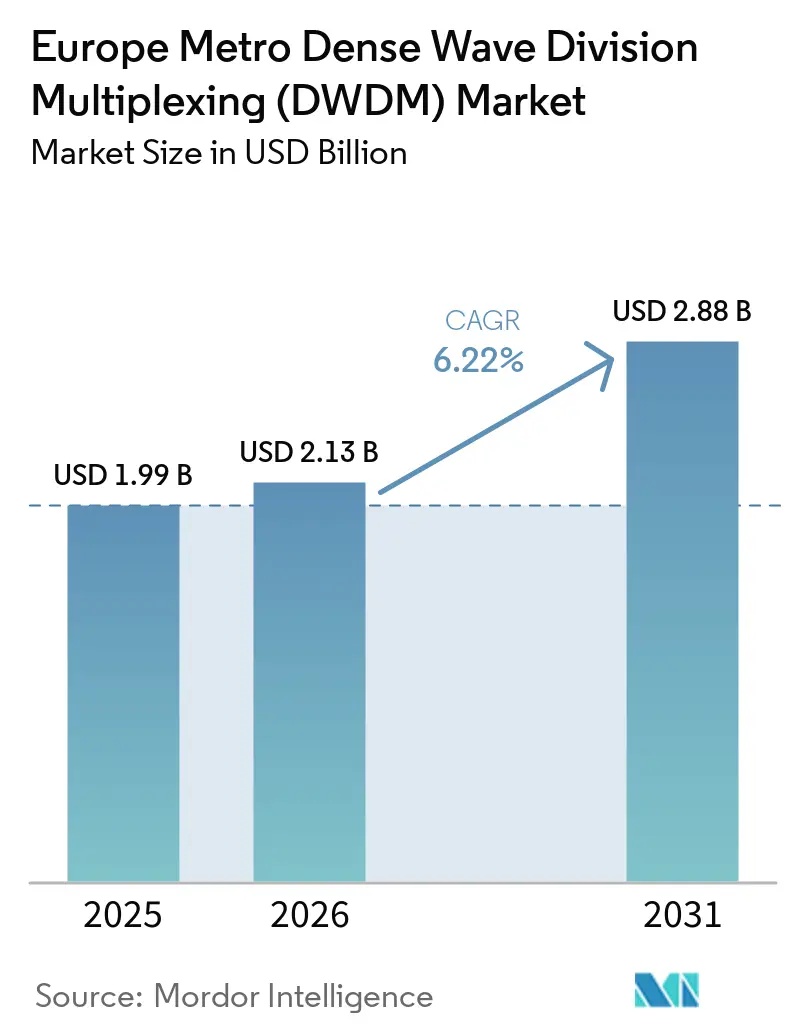
The Europe Metro Dense Wave Division Multiplexing (DWDM) Market size was valued at USD 1.99 billion in 2025 and is estimated to grow from USD 2.13 billion in 2026 to reach USD 2.88 billion by 2031, at a CAGR of 6.22% during the forecast period (2026-2031). Dense wavelength division multiplexing is central to metropolitan fiber transport because it carries cloud traffic, AI inference workloads, and 5G xhaul traffic over short city routes. Demand is increasingly shaped by traffic between data centers rather than by conventional broadband use alone. Hyperscale clusters in Frankfurt, London, Amsterdam, Paris, and Dublin are increasing the need for dedicated, high-capacity interconnection links. Operators are also upgrading existing fiber where new duct construction is difficult or costly. Supply constraints for advanced optical modules may delay some installations, while European digital connectivity and data-residency policies continue to support long-term network investment.
Key Report Takeaways
- By component, hardware accounted for 81.37% of the Europe Metro Dense Wave Division Multiplexing (DWDM) Market in 2025, while software is projected to expand at a 9.27% CAGR through 2031.
- By transmission capacity, 400 Gbps accounted for 31.24% of the European metro DWDM market share in 2025, while above-400 Gbps is projected to expand at an 11.58% CAGR through 2031.
- By application, data center interconnect accounted for 29.83% of the European metro dense wave division multiplexing (DWDM) market in 2025 and is projected to expand at an 8.17% CAGR through 2031.
- By end-user, communication service providers held 57.84% of the European metro dense wave division multiplexing (DWDM) market in 2025, while cloud and data center providers are projected to expand at an 8.94% CAGR through 2031.
- By country, Germany accounted for 25.47% of the European metro-dense wavelength division multiplexing (DWDM) market in 2025, while Spain is projected to expand at a 7.26% CAGR through 2031.
Note: Market size and forecast figures in this report are generated using Mordor Intelligence’s proprietary estimation framework, updated with the latest available data and insights as of January 2026.
Europe Metro Dense Wave Division Multiplexing (DWDM) Market Trends and Insights
Drivers Impact Analysis*
| Driver | (~) % Impact on CAGR Forecast | Geographic Relevance | Impact Timeline |
|---|---|---|---|
| Accelerating Metro Traffic From Cloud, AI, and Video Workloads | +1.8% | Europe, with concentrated demand in Frankfurt, London, Amsterdam, Paris, and Dublin | Short term (≤ 2 years) |
| 5G-Advanced Xhaul and Fiber-Exhaustion Upgrades | +1.3% | Germany, France, and Spain, including European mid-band densification corridors | Medium term (2-4 years) |
| Higher Spectral Efficiency From 400G, 800G, and Coherent Optics | +1.0% | Europe, supported by standards and multi-vendor adoption | Short term (≤ 2 years) |
| Hyperscale and Colocation Expansion Across FLAP-D Hubs | +0.8% | Frankfurt, London, Amsterdam, Paris, and Dublin, extending to Iberia, the Nordics, and secondary cities | Medium term (2-4 years) |
| Open, Disaggregated, and IP-Over-DWDM Architectures | +0.5% | Europe, with early adoption in Austria, Denmark, and Benelux | Medium term (2-4 years) |
| Sovereign Cloud and Intra-European Data Center Interconnection | +0.4% | Germany, France, the Netherlands, and other countries with data-residency requirements | Long term (≥ 4 years) |
| Source: Mordor Intelligence | |||
Accelerating Metro Traffic From Cloud, AI, and Video Workloads
Cloud services, AI inference, and video traffic are raising bandwidth requirements across European metropolitan networks, particularly on routes linking data centers and internet exchange points. Fixed broadband carried 87.5% of total internet traffic in Europe, and fixed broadband investment represented 46% of telecommunications investment, according to Connect Europe.[1] AI traffic exhibits a different network pattern, moving between distributed GPU clusters within metro corridors rather than traveling primarily to consumer endpoints. These connections require dense, short-reach wavelengths with low latency and high capacity, which aligns directly with metropolitan DWDM design. AI adoption among European Union enterprises increased 48% from 2024 to 2025, shortening the time available for operators to add transport capacity. The Europe metro DWDM market, therefore, benefits when traditional network provisioning cycles cannot keep pace with these new, concentrated data flows.
5G-Advanced xHaul and Fiber-Exhaustion Upgrades
5G standalone networks and future 5G-Advanced deployments require operators to upgrade midhaul and fronthaul transport as more radio capacity is placed closer to users. In densely built metropolitan areas, DWDM increases capacity on existing fiber when duct space is constrained, and new construction would take longer. European 5G population coverage reached 94.9% by the end of 2025, although standalone deployment and mid-band density remained behind China and the United States. GSMA estimated that Europe needs EUR 475 billion (USD 553.84 billion) to complete its 5G journey through 2035, with only 57% of that amount expected to materialize.[2] DWDM can support 80 or more wavelengths on a fiber pair, offering an alternative to new civil works at fiber-exhausted sites. This need for greater fiber efficiency supports deployment of European metro DWDM across mobile transport routes and upstream aggregation networks.
Higher Spectral Efficiency From 400G, 800G, and Coherent Optics
Coherent optical technology is moving from 400 Gbps toward 800 Gbps and 1.6 Tbps capacity, allowing operators to carry more traffic over their installed fiber base. Each step can lower transport cost per bit and bring equipment refresh decisions forward, particularly when existing wavelengths are nearing capacity limits. RETN reported in July 2026 that 50% of its IP/MPLS traffic runs over 400G coherent ZR/ZR+ infrastructure following its 2025 deployment across backbone links spanning 300-950 km.[3] The use of pluggable optics in routers also makes IP-over-DWDM architectures more practical for regional operators by reducing the need for separate transport layers. Core-Backbone activated Nokia GX Series 800G technology on its Frankfurt-Amsterdam DWDM route in April 2026, with a total capacity of 2 × 1.2 Tbit/s.[4] Interoperability frameworks such as ITU-T G.698.4 and OIF implementation agreements are becoming more important in public tenders, favoring equipment with completed multi-vendor validation.
Hyperscale and Colocation Expansion Across FLAP-D Hubs
Hyperscale and colocation campuses require dedicated data center interconnect links to add capacity in major European hubs and to move workloads between separate facilities. Each new campus needs physical wavelength termination and optical transport connections before it can begin service, creating procurement ahead of activation. The European Data Centre Association reported that capacity growth is extending into Southern Europe, the Nordics, Central and Eastern Europe, and other Tier-2 metropolitan regions. More than half of AI-related capacity growth is expected in these Tier-2 locations, creating optical requirements in cities that had previously received less investment. The Europe metro DWDM market gains from this broader buildout because each site requires links to campuses, exchanges, cloud availability zones, and local networks. Construction and power constraints can delay facility openings, but they also create a visible pipeline for network provisioning once sites are ready.
Restraints Impact Analysis*
| Restraint | (~) % Impact on CAGR Forecast | Geographic Relevance | Impact Timeline |
|---|---|---|---|
| High Component Lead Times and Photonic Supply Dependence | -1.3% | Europe, with the greatest effect on 800G and higher procurement for data center corridors | Short term (≤ 2 years) |
| Fragmented Cross-Border Equipment Approval and Deployment Rules | -0.7% | Multi-country European operators, particularly on Germany, France, and Benelux corridors | Long term (≥ 4 years) |
| Hyperscaler Purchasing Power and System Price Erosion | -0.5% | Major European hubs and expanding hyperscale campuses in the Nordics and Iberia | Medium term (2-4 years) |
| Multi-Vendor Operational Complexity and Skills Shortage | -0.3% | Europe, especially smaller member states with limited optical engineering capacity | Medium term (2-4 years) |
| Source: Mordor Intelligence | |||
High Component Lead Times and Photonic Supply Dependence
Supply availability for indium phosphide lasers and high-speed optical transceivers can constrain deployment schedules for metropolitan systems, especially where operators need newer coherent modules. The draft identifies a shortfall between demand and supply for advanced modules, with longer lead times for 400G and 800G equipment during 2026. This places greater importance on early procurement for 800G ZR and ZR+ systems that serve the fastest-expanding capacity tier. Operators may need to order components 9-12 months before a planned installation rather than rely on conventional just-in-time purchasing and rapid delivery. Smaller regional carriers have less capacity to hold inventory than larger carriers and hyperscalers, even when they face the same installation requirements. The resulting difference in purchasing flexibility may delay projects in the European metro DWDM market, even where fiber, demand, and deployment plans are already in place.
Fragmented Cross-Border Equipment Approval and Deployment Rules
National approval processes, rights-of-way rules, and vendor security reviews can complicate cross-border optical projects that span multiple European jurisdictions. Operators on routes between Frankfurt, Amsterdam, and Paris may face different certification and vendor requirements in each country before equipment can be installed. The European Union 5G Toolbox has contributed to varying national restrictions that affect supplier choices and procurement planning across borders. These conditions can add 12-24 months to cross-border upgrade schedules because operators must navigate separate planning systems and approval bodies. The Gaia-X Project Tellus prototype showed in January 2025 that sovereign, federated interconnection across distributed cloud environments is technically feasible. Physical deployment rules remain less aligned, which can favor established vendors with dedicated regulatory resources and experience in cross-border contracting.
*Our forecasts treat driver/restraint impacts as directional, not additive. The impact forecasts reflect baseline growth, mix effects, and variable interactions.
Segment Analysis
By Component: Hardware Holds Revenue Leadership While Software Expands
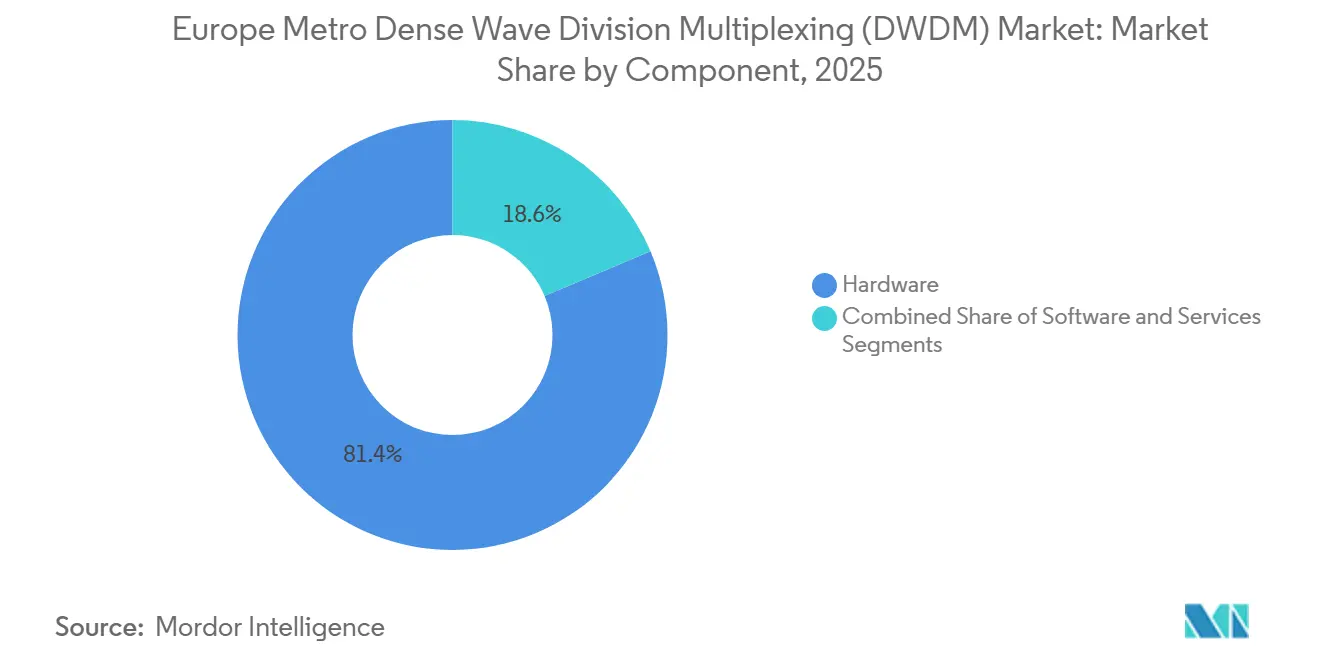
Hardware accounted for 81.37% of the Europe metro DWDM market share in 2025, reflecting the capital intensity of metropolitan optical construction. This position reflected spending on transponder chassis, reconfigurable optical add-drop multiplexers, amplifier nodes, and coherent pluggable modules that create, direct, and strengthen wavelengths. Every new interconnection route requires physical optical equipment before network services can begin, regardless of the software layer selected by the operator. Campus additions and fiber upgrades across high-traffic metropolitan corridors, therefore, sustain demand for these systems, especially where existing capacity is already committed. The European metro DWDM hardware market size is driven by the need to terminate, amplify, protect, and manage wavelengths at each endpoint.
Software is projected to grow at a 9.27% CAGR through 2031, outpacing the overall market as network control becomes more complex. Open control planes and wavelength automation are becoming more relevant as operators manage equipment from several vendors and need clearer network visibility. Disaggregated designs enable software to coordinate ROADMs and amplifiers from different manufacturers, reducing dependence on a single equipment stack. Services provide integration, network design, testing, and managed-wavelength support as network environments become more complex and operational accountability increases. In 2025, eww ITandTEL moved to a disaggregated 400G IP-over-DWDM design using OcNOS-SP-PLUS and white-box hardware, demonstrating this practical shift.

By Transmission Capacity: 400 Gbps Leads, While Above 400 Gbps Advances Quickly
The 400 Gbps tier accounted for 31.24% of the Europe metro DWDM market share in 2025, making it the leading reported transmission capacity. It is the established core speed for data center aggregation and exchange-point connectivity because it combines high capacity with a mature supplier base. Competitive pricing and proven interoperability have made this tier suitable for many open line systems used by carriers and regional operators. The 200 Gbps tier remains relevant for metro-edge and mobile aggregation uses outside the largest hubs, where traffic density and power requirements differ. Legacy systems at up to 100 Gbps still serve long-tail metropolitan circuits and public-sector dark-fiber users, while new installations increasingly move directly to 400 Gbps.
The above 400 Gbps tier is projected to expand at an 11.58% CAGR through 2031, the fastest rate among the reported capacity bands. The Europe metro DWDM market size for this tier is shaped by the movement from 800G trials to commercial deployments on routes with concentrated data center traffic. Core-Backbone's April 2026 deployment on the Frankfurt-Amsterdam route showed that 800G is entering production use on busy European corridors. OIF's 800ZR agreement, finalized in late 2024, created a hardware-neutral pluggable footprint that can reduce switching costs and improve procurement flexibility. It may support adoption by mid-tier operators seeking confidence in multi-source availability before committing to higher-capacity upgrades.
By Application: Data Center Interconnect Leads in Share and Forecast Expansion
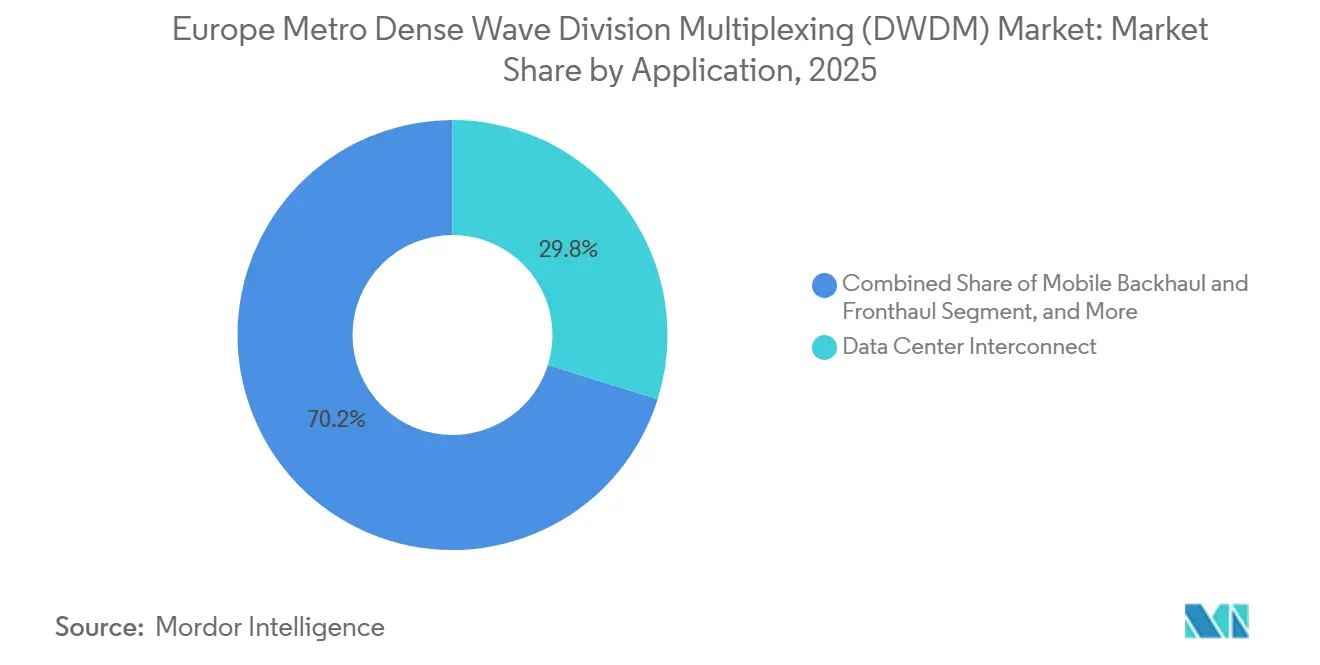
Data center interconnect accounted for 29.83% of the Europe metro DWDM market size in 2025. It is projected to expand at an 8.17% CAGR through 2031, leading the reported applications by share and forecast rate. New campuses require low-latency connections to other facilities, internet exchanges, and cloud environments, often before their own computing capacity is fully active. These workloads favor purpose-built DWDM links because they require high-capacity wavelengths, predictable performance, and efficient power use at dense urban sites. Nokia's May 2025 selection by EXA Infrastructure for a 1.2T-per-channel system demonstrates the performance requirements associated with this connectivity.
Mobile backhaul and fronthaul form the second-largest application area, giving the segment a distinct connection to radio network investment. Their demand is tied to 5G standalone and 5G-Advanced densification, particularly where access-ring fiber capacity is exhausted, and latency requirements are strict. Broadband and access aggregation provide steadier demand as fiber endpoints connect central offices with core points of presence and traffic moves upstream. Fiber-to-the-premises coverage reached 77.2% of European households by the end of 2025, supporting continued upgrades to aggregation networks. Enterprise wavelength services, utility connectivity, and research and education networks provide a baseline less dependent on hyperscale construction and can stabilize procurement patterns.
By End-User: Communication Service Providers Lead as Cloud Buyers Gain Influence
Communication service providers accounted for 57.84% of the European metro DWDM market share in 2025. Their ownership of fiber, duct rights, operations centers, and established transport infrastructure gives them a central role in metropolitan spending decisions. They procure systems for backbone modernization, 5G transport, access aggregation, and the continued maintenance of services already carried on existing routes. Enterprises and public-sector bodies make up a smaller but steady end-user base with requirements that differ from those of large cloud buyers. Enterprise customers often prefer managed wavelength contracts to direct ownership because they can obtain capacity without having to manage complex optical systems.
Cloud and data center providers are projected to expand at an 8.94% CAGR through 2031. They are increasingly installing proprietary metropolitan capacity between colocated campuses in Frankfurt and Amsterdam, rather than relying only on carrier-provisioned wavelengths. European cloud sovereignty work is increasing the importance of data-residency, assurance, and audit requirements in infrastructure decisions. Government demand is also linked to sovereign cloud programs and broader European data center capacity plans that require secure local connectivity. Suppliers are responding with compact platforms and lower minimum order requirements for campus networks, broadening their addressable buyer base.
Geography Analysis
Germany held 25.47% of the Europe metro DWDM market share in 2026, making it the largest reported country position. Frankfurt's role as an interconnection center, the DE-CIX ecosystem, and Deutsche Telekom's 400G and 800G modernization program support recurring optical transport upgrades. In February 2026, TKRZ Stadtwerke GmbH deployed Smartoptics active DWDM to support the Datacenter Munster Osnabrück project. This activity shows that demand extends beyond national carriers to regional network operators and new data center sites.
Spain is projected to expand at a 7.26% CAGR through 2031, the fastest reported country rate. Hyperscale commitments, cross-border fiber development, and edge data center deployments support this position by increasing demand at key national gateway locations. In February 2025, Nokia announced a multi-year agreement to deploy AI-ready networking solutions for Telefonica's 17 edge data centers in Spain. Orange Wholesale opened dark-fiber routes between Spain and Germany via the Somport Pass in 2026, creating a geographically diversified path to Paris and Frankfurt.
The United Kingdom and France are the second and third-largest country markets, respectively. London and Paris remain important locations for colocation, cloud interconnection, carrier-neutral facilities, and the transport networks that connect them. France's power infrastructure is drawing hyperscale attention, which can increase data center interconnect demand through 2028 as new capacity requires dedicated city links. Italy, Benelux, the Nordics, and Central and Eastern Europe are also adding demand through fiber programs and 5G standalone deployments beyond the original FLAP-D core. The European Data Centre Association reported that new capacity is increasingly distributed across Southern Europe, the Nordics, Central and Eastern Europe, and Tier-2 metropolitan regions.
Competitive Landscape
The Europe metro DWDM market is moderately consolidated at the system level, while component supply and network software remain more fragmented. Nokia, Ciena, and Ekinops hold leading positions in full-system offerings that serve carrier and data center transport requirements. Nokia completed its USD 2.3 billion acquisition of Infinera in February 2025, combining photonic integrated circuit capabilities across metro, long-haul, and subsea optical segments. The combined business expects more than EUR 200 million (USD 226 million) in net comparable operating-profit synergies by 2027, supporting its scale in data center interconnect competition.
The main competitive issue is the divide between integrated platform offerings and open-line system offerings. Vendors that can offer both are better positioned for tenders where operators want complete systems as well as the flexibility of disaggregated designs. Ribbon Communications, Fujitsu, and NEC compete for mid-tier provider projects where interoperability, established engineering support, and long equipment lifecycles are important. IP Infusion supports disaggregation through its OcNOS-SP platform, which it states has been deployed across more than 600 operator networks in 60 countries.
Formal interoperability is becoming a qualification factor in European procurement. ITU-T G.698.4, OpenROADM, and OIF 400ZR and 800ZR agreements enable equipment from multiple suppliers to operate on shared systems. Early validation of 800G and emerging 1.6T capabilities may provide access to projects that require documented interoperability, not just product performance claims. Nokia's 2025 EXA Infrastructure contract supplied a 1.2T-per-channel system for a multinational network, showing the focus on high-capacity optical connectivity. Nokia's Telefonica agreement in Spain also aligned its optical and AI-ready networking offerings with edge data center deployment.
Europe Metro Dense Wave Division Multiplexing (DWDM) Industry Leaders
-
Nokia Corporation
-
Ciena Corporation
-
Ekinops S.A.
-
Ribbon Communications Inc.
-
Smartoptics AS
- *Disclaimer: Major Players sorted in no particular order
Recent Industry Developments
- April 2026: Core-Backbone activated the Nokia GX Series 800G on the Frankfurt-Amsterdam DWDM route, with CHM7 line cards supporting 800G wavelengths, delivering 2 × 1.2 Tbit/s total capacity. Additional European routes are planned for the same upgrade.
- February 2026: TKRZ Stadtwerke GmbH in Germany upgraded its backbone to Smartoptics active DWDM, using compact 1U open line systems and 100G and 400G transponders for the Datacenter Munster Osnabruck campus and two existing data centers.
- December 2025: eww ITandTEL in Austria transitioned from a 100G MPLS architecture to a fully disaggregated 400G IP-over-DWDM design using IP Infusion OcNOS-SP-PLUS, UfiSpace, and Edgecore white-box hardware, and 400G ZR+ pluggables supplied by EPS Global. The operator cited data sovereignty and lower total cost of ownership as primary drivers.
- May 2025: EXA Infrastructure selected Nokia's 1.2T-per-channel ICE7 optical transport solution to upgrade its 155,000 km network across 37 countries, prioritizing high-capacity, low-latency data center connectivity.
Europe Metro Dense Wave Division Multiplexing (DWDM) Market Report Scope
The Europe metro dense wave division multiplexing (DWDM) market revenue is generated through the sale of DWDM hardware, software licenses and subscriptions, and associated deployment, integration, network management, maintenance, and support services provided to communication service providers, cloud and data center providers, enterprises, government organizations, and other end-users.
The Europe metro dense wave division multiplexing (DWDM) market report is segmented by component (hardware, software, and services), transmission capacity (up to 100 Gbps, 200 Gbps, 400 Gbps, and above 400 Gbps), application (data center interconnect, mobile backhaul and fronthaul, broadband and access network aggregation, and other applications), end-user (communication service providers, cloud and data center providers, enterprises, and government and public sector), and country (Germany, United Kingdom, France, Italy, Spain, and rest of Europe). The market forecasts are provided in terms of value (USD).
| Hardware |
| Software |
| Services |
| Up to 100 Gbps |
| 200 Gbps |
| 400 Gbps |
| Above 400 Gbps |
| Data Center Interconnect |
| Mobile Backhaul and Fronthaul |
| Broadband and Access Network Aggregation |
| Other Applications |
| Communication Service Providers |
| Cloud and Data Center Providers |
| Enterprises |
| Government and Public Sector |
| Germany |
| United Kingdom |
| France |
| Italy |
| Spain |
| Rest of Europe |
| By Component | Hardware |
| Software | |
| Services | |
| By Transmission Capacity | Up to 100 Gbps |
| 200 Gbps | |
| 400 Gbps | |
| Above 400 Gbps | |
| By Application | Data Center Interconnect |
| Mobile Backhaul and Fronthaul | |
| Broadband and Access Network Aggregation | |
| Other Applications | |
| By End-User | Communication Service Providers |
| Cloud and Data Center Providers | |
| Enterprises | |
| Government and Public Sector | |
| By Country | Germany |
| United Kingdom | |
| France | |
| Italy | |
| Spain | |
| Rest of Europe |
Key Questions Answered in the Report
What is the size of the Europe metro DWDM market?
The Europe metro DWDM market size is projected to be USD 2.13 billion in 2026 and USD 2.88 billion by 2031, at a 6.22% CAGR, driven by higher metropolitan transport requirements across cloud, AI, video, and mobile networks. The forecast reflects demand for denser wavelength capacity on established fiber routes.
What is driving demand for metro DWDM in Europe?
Data center interconnect, AI traffic between distributed computing sites, cloud deployment, video traffic, and 5G transport upgrades are key demand factors across dense metropolitan routes and expanding regional network hubs.
Which component has the largest share in Europe?
Hardware held 81.37% share in 2025 because networks require transponders, ROADMs, amplifiers, and coherent optical modules before services can activate on new or upgraded metropolitan links.
Which transmission capacity is expanding the fastest?
Above 400 Gbps is projected to expand at an 11.58% CAGR through 2031 as 800G shifts from field trials into commercial use on priority European data center routes.
Which country is the largest European metro DWDM market?
Germany held 25.47% share in 2026, supported by Frankfurt's interconnection ecosystem, network modernization, regional data center connectivity projects, and established fiber infrastructure.
Which end-user group is expanding the fastest?
Cloud and data center providers are projected to expand at an 8.94% CAGR through 2031 as they add proprietary metropolitan optical links between colocated campuses, cloud facilities, and regional gateways.